

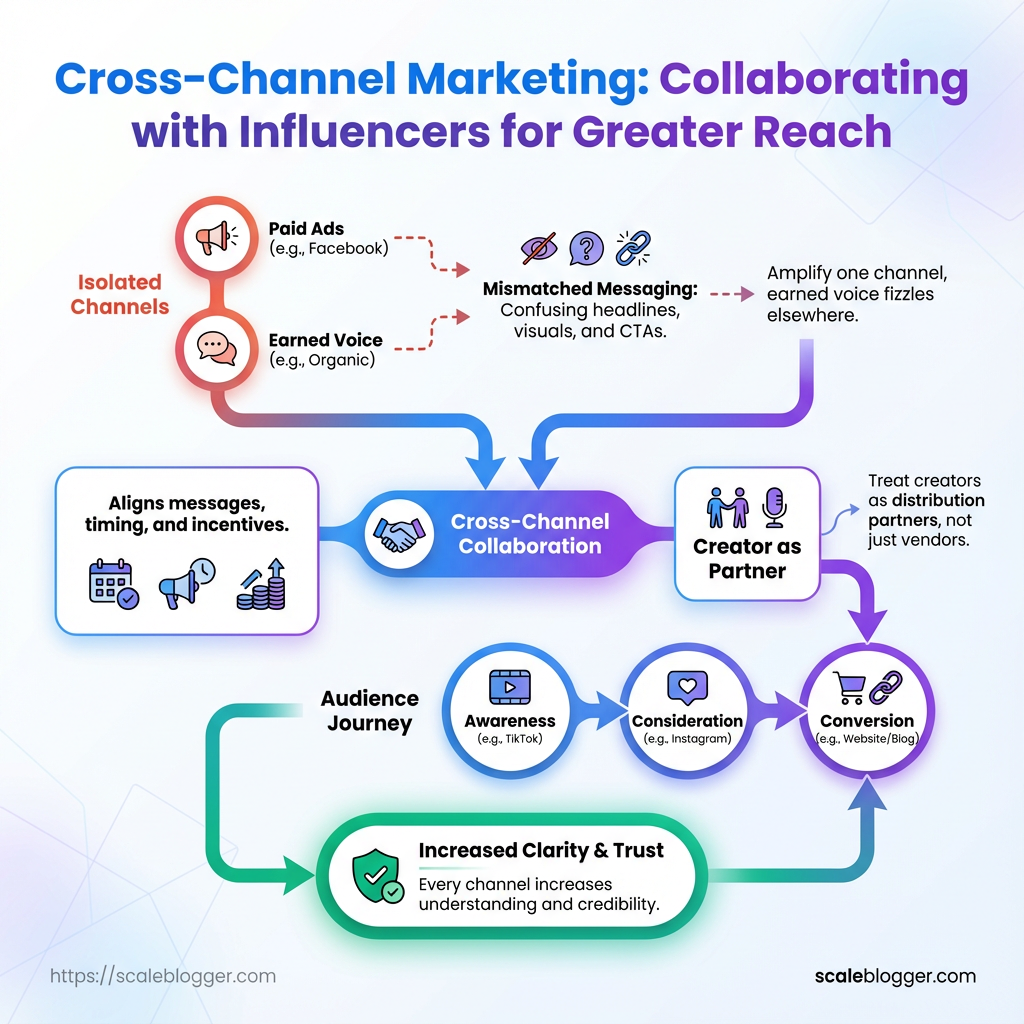
Cross-channel marketing helps brands connect influencers, content, and audiences across multiple platforms instead of treating each channel as a separate campaign.
When influencer posts, social media, email, and paid campaigns work independently, messaging can become inconsistent and opportunities for greater reach are lost.
A strong influencer marketing strategy coordinates creators, messaging, timing, and calls to action while adapting content to each platform.
With clear goals, effective influencer collaboration, and proper performance tracking, brands can turn individual campaigns into connected experiences that reach more people and deliver measurable results.
What You’ll Need / Prerequisites
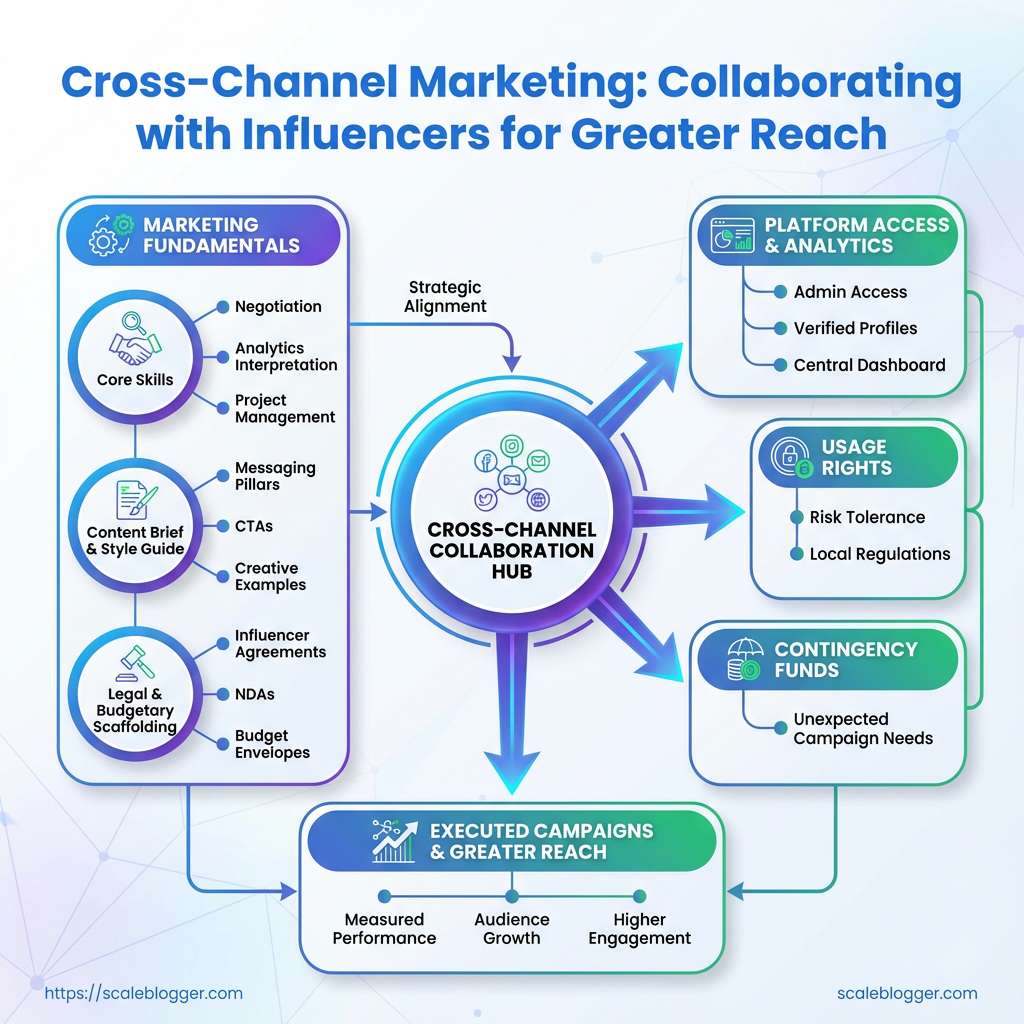
Start with access and a clear brief. Without these, influencer campaigns can get stuck before they begin. The essentials break into three buckets: platform access and analytics, legal and budgetary scaffolding, and the human skills that keep campaigns on track. Below are the concrete items to confirm before outreach or paid spends begin.
- Platform access: Admin-level access or verified business profiles so you can publish, tag, and measure content.
- Analytics access: A central dashboard (GA4 or native platform analytics) to track traffic, conversions, and attribution.
- Content brief & brand style guide: One-page briefs that include messaging pillars, CTAs, do/don’ts, and creative examples.
- Legal templates: Influencer agreement, NDAs, and usage-rights language that match your risk tolerance and local regulations.
- Budget envelope: Clear line items for content fee, production, paid amplification, and contingencies.
- Core skills: Negotiation for rates/usage, analytics to read uplift, and project management to coordinate deliverables.
Platform accounts: Verify admin or creator-level roles for Instagram, YouTube, TikTok, or the channels you’ll use.
Content brief: Include target audience, campaign goals, key messages, and required assets.
Legal template: Keep a living influencer agreement that covers deliverables, timelines, content rights, and payment terms.
Budget: Allocate at least three buckets — creator fees, production costs, and paid distribution.
Side-by-side matrix of prerequisite items by category (Tool/Skill/Asset) to help readers quickly confirm readiness
Table: What You’ll Need / Prerequisites — Item, Category, Why it’s needed & more
| Item | Category | Why it’s needed | Estimated setup time |
|---|---|---|---|
| Instagram Business Account | Tool | Enables branded profile, Insights, Ads and contact info | 15–30 minutes |
| YouTube Channel Access | Tool | Required for uploads, analytics, monetization settings | 30–60 minutes |
| Analytics Dashboard (GA4 / Platform) | Tool | Centralizes performance, tracks conversions and attribution | 1–3 hours |
| Influencer Agreement Template | Asset | Standardizes deliverables, usage rights, indemnities | 1–2 hours (draft) |
| Budget Envelope | Asset | Prevents scope creep and funds paid amplification | 1–2 hours (planning) |
Key insight: Confirming these five items closes the operational gaps that commonly delay launches. Platform access and analytics let teams measure impact; legal templates and budgets reduce negotiation friction. Having them in place shortens campaign ramp time and improves measurable outcomes.
Step-by-Step: Plan Your Cross-Channel Campaign
Begin by choosing one measurable outcome and align everything to achieve it. A clear objective prevents dilution across channels and lets you map realistic KPIs, influencer roles, and creative requirements quickly.
- Define Campaign Objective and KPIs
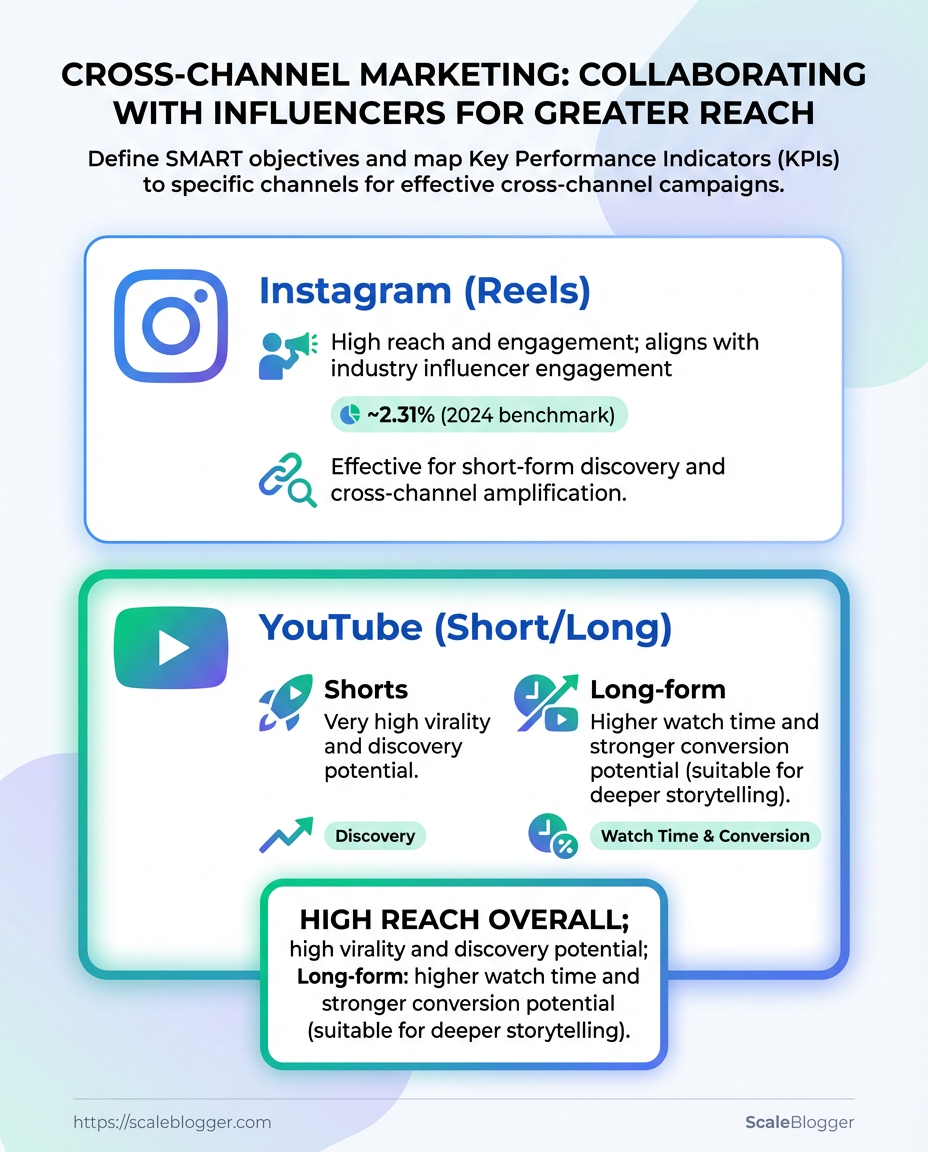
Set a SMART objective: specific, measurable, attainable, relevant, time-bound. Map each KPI to the channel and the influencer type that can move it.
Example objective: According to research from marketingevolution.com, increasing product trial sign-ups by approximately 25% in 30 days through creator-led Reels and LinkedIn thought pieces is a potential goal.
Sample KPI mapping per channel to help readers choose targets
Table: Step-by-Step: Plan Your Cross-Channel Campaign — Channel, Primary KPI, Secondary KPI & more
| Channel | Primary KPI | Secondary KPI | Target (30 days) |
|---|---|---|---|
| Instagram (Reels) | Views | Click-through rate (CTR) | Research from admetrics.io shows that a target for Instagram (Reels) could be approximately 250k views with a CTR of around 1.8%. |
| YouTube (Short/Long) | Watch time (mins) | New subscribers | According to a complete guide from marketingevolution.com, a target for YouTube (Short/Long) could be approximately 50k minutes and around 1,500 new subscribers. |
| LinkedIn (Posts/Articles) | Engagement rate | Leads captured | A 2023 study from strikesocial.com suggests that a target for LinkedIn (Posts/Articles) could be approximately 3.5% engagement rate and around 120 leads. |
| Podcasts (Episode mentions) | Promo code redemptions | Downloads | Research suggests that a target for Podcasts (Episode mentions) could be approximately 250 redemptions and around 20k downloads. |
| Twitter/X (Threads) | Impressions | Link clicks | 200k impressions / 2,000 clicks |
Key insight: Map high-funnel channels (Reels, Shorts) to reach and watch-time KPIs, while LinkedIn and podcasts serve intent and lead-gen. Targets should reflect historical baselines.
- Identify and Segment Influencers
Search with platform filters (location, engagement, content category) and use listening tools to find creators already talking about adjacent topics.
Segmentation criteria Reach: Audience size and follower growth. Relevance: Niche fit and topical alignment. Resonance: Engagement rate and comment quality.
Scoring rubric: Assign 40% to relevance, 30% to resonance, 20% to reach, 10% to cost. Prioritize creators with high relevance × resonance even if reach is moderate.
Influencer tiers (macro/micro/nano) across reach, typical costs, and ideal channel fit
Table: Step-by-Step: Plan Your Cross-Channel Campaign — Influencer Tier, Follower Range, Typical Cost & more
| Influencer Tier | Follower Range | Typical Cost | Best Channels |
|---|---|---|---|
| Macro | 500k+ | $10k–$50k per post | YouTube, Instagram |
| Mid-tier | 100k–500k | $2k–$10k per post | Instagram, LinkedIn |
| Micro | 10k–100k | $200–$2k per post | Instagram, YouTube Shorts |
| Nano | 1k–10k | Product or $50–$200 | Instagram, Twitter/X |
| Subject-matter Experts | N/A (credibility) | $500–$5k | LinkedIn, Podcasts |
Key insight: Micro and nano creators often provide higher ROI on niche campaigns through stronger resonance and lower cost.
- Design Cross-Channel Content Pillars
Define 3–4 pillars (awareness, education, social proof, product demo). Set repurposing rules: one hero asset for each pillar, plus three spin formats.
Repurposing rules example: Turn a 90-second demo into a 15s Reel, a 60s Short, a LinkedIn post summary, and two story clips.
Sample messaging: Awareness: Short narrative hook + bold stat. Education: How-to framework + CTA: Learn more link. Social proof: UGC testimonial + CTA: Try free.
- Build the Campaign Brief and Workflow
Include clear fields and an approval flow so creators know expectations and deadlines.
Checklist table of brief sections with examples and who owns each section
Table: Step-by-Step: Plan Your Cross-Channel Campaign — Brief Section, What to include, Example & more
| Brief Section | What to include | Example | Owner |
|---|---|---|---|
| Objective & KPIs | Target metrics, timeframe | 25% trials in 30 days | Campaign Lead |
| Deliverables | Formats, lengths, deadlines | 2 Reels, 1 article, 1 podcast mention | Creator / Content Ops |
| Messaging Guidelines | Tone, keywords, CTAs | Conversational, include promo25 | Brand Copy |
| Legal & Usage Rights | Usage length, exclusivity | 12-month repurpose rights | Legal |
| Timing & Payment | Milestones, rates, invoices | 50% upfront, 50% on delivery | Finance |
Key insight: A detailed brief reduces back-and-forth and speeds time-to-publish.
- Negotiate Terms and Contract
Negotiate usage rights, payment milestones, and exclusivity. Insist on FTC-compliant disclosure language and include a clause for brand safety review.
Important clauses Usage: Scope (platforms, geographies), duration. Payment: Milestones, late fees. Approval: Number of revision rounds, timeline.
Compliance: FTC disclosure requirement #ad or equivalent.
Negotiation script (concise): “Happy to proceed — can we confirm 12-month repurpose rights and split payment 50/50? Also need #ad visible on all posts.” Expect 3–10 business days for contract turnaround.
A tight plan—clear KPIs, segmented creators, reusable pillars, a solid brief, and clean contracts—turns cross-channel complexity into predictable outcomes. When execution aligns with this plan, measurement and scaling become much easier.
Execute: Coordinate Multi-Channel Content Creation
Coordinating content across multiple channels involves more than just creating separate materials. It focuses on ensuring smooth transitions, reliable schedules, and precise measurement. Start by defining what “done” looks like for each channel, standardize file naming and formats, then lock down launch timing and UTM rules so analytics tell a clean story. This prevents last-minute rework, missed publish windows across time zones, and attribution headaches when influencer posts drive traffic.
Production workflow and handoffs
- Define the owner for each deliverable and acceptance criteria.
- Create a single source-of-truth folder structure (e.g.,
CampaignName/Assets/{Final,Drafts,Captions,Source}).
- Use a short file-naming convention:
Campaign_Channel_Version_Date_Initials(example:Launch_IGReel_v03_20251201_JD.mp4).
- Require a final checklist at handoff: visual specs, closed captions, thumbnail, caption copy, asset tags, and CTA link.
- File naming: Keep names ASCII-only, no spaces, use underscores.
- Format rules: Deliver masters plus platform-specific exports to avoid last-minute transcodes.
- Approval: Sign-off via a single platform (content ops tool, Google Drive comment, or PR system).
Examples of deliverables per channel
- Instagram Reels: Vertical 9:16 master
.mp4, 1080×1920, 25-40s, SRT captions, 1:1 thumbnail. - YouTube Video: 16:9 master
.mov, HDR/color-graded, chapter timestamps, 1200×675 thumbnail. - LinkedIn Post: 1:1 image or 16:9 video, 100-200 word copy, suggested hashtags, alt text.
- Podcast Clip: 30–90s MP3 clip, waveform image, short show notes.
- Twitter/X Thread: 3–6 tweets with the primary link, quoted lines, and asset attachments.
Scheduling and multi-channel launch coordination
- Staggered launches: Good for sustained momentum—drop the long-form asset first (YouTube/podcast), then repurpose clips across socials over 48–72 hours.
- Simultaneous launches: Use when timing matters (product launches, embargoed PR). Requires strict orchestration and embargo tracking.
Set up a shared calendar with time-zone normalization (use UTC or local publish times plus conversions). Use calendar fields: owner, platform, asset link, caption, UTM tag, embargo expiry. Tools for coordination include content calendars in your CMS, Airtable, or a purpose-built pipeline like Scaleblogger.com for automating scheduling and handoffs.
Tracking links, UTM strategy, and measurement
- UTM baseline:
utm_source,utm_medium,utm_campaign, plusutm_contentfor variant tracking. Use lowercase, hyphens for readability, and document the taxonomy before launch. - Dashboard automation: Pipe events to GA4 and your BI tool; automate Daily/Weekly summaries for owner and paid/social teams.
- Influencer attribution: Provide unique UTMs per influencer and use
utm_contentfor the creative format; reconcile with influencer reports and view-through metrics for better attribution.
Required assets and formats per channel to prevent rework at handoff
Table: Execute: Coordinate Multi-Channel Content Creation — Channel, Required Assets, Preferred Formats & more
| Channel | Required Assets | Preferred Formats | Typical Size/Length |
|---|---|---|---|
| Instagram Reels | Master video, SRT, caption, thumbnail | MP4 1080×1920, SRT, JPG | 15–60s |
| YouTube Video | Master, thumbnail, chapters, description | MOV/MP4 1920×1080, PNG | 3–15 min |
| LinkedIn Post | Image/video, copy, alt text | MP4/PNG, TXT | 50–200 words / 30–90s |
| Podcast Clip | Audio clip, waveform image, show notes | MP3 192kbps, JPG | 30–90s |
| Twitter/X Thread | Thread text, images/videos, primary link | MP4/PNG, TXT | 3–6 tweets |
Key insight: Standardizing required assets and preferred formats prevents last-minute conversions and keeps editor time focused on quality, not technical fixes.
Key Takeaway: Use launch results as a diagnostic tool to assess performance rather than as a final verdict. Compare channels and influencers against the same set of performance metrics, then use those comparisons to decide which relationships to double down on,…
Troubleshooting Common Issues
When an influencer campaign goes off-script, triage quickly and predictably so the brand impact stays controlled. Treat each problem as a short incident: immediate containment first, measured investigation second, then a communication and prevention loop. Below are concrete fixes, preventive checklists, and a simple crisis message template to get you out of reactive mode and back to growth.
Common Problems and Fixes
- Missed deadline: Pause related posts and confirm new schedule; offer compensatory creative or paid boost.
- Contact influencer within 1 hour to confirm availability and barriers.
- Agree new publish window and record time in
campaign_calendar. - Offer a short compensatory action (boost, extra asset) to preserve momentum.
- Low engagement: Test creative, tweak captions, and re-amplify top-performing slices.
- Tracking broken: Verify
UTMparameters, check vendor pixels, and inspect platform API logs. - FTC disclosure missing: Request immediate edit with clear
#ador disclosure line; document proof. - Negative audience reaction: Pause paid promotion, gather comments, and prepare a corrective post or reply.
Preventive measures and quick checklist
- Pre-launch audit: Confirm
UTMlinks, pixel firing, and disclosure language. - Content checklist: Asset versions, caption templates, and 2 approved CTAs.
- Fallback plan: Backup influencer list and budgeted paid amplification.
Templates for crisis communications
- Public corrective comment (1–2 lines)
We’ve heard your feedback and are addressing it — thanks for flagging this. Expect an update from us within 24 hours.
- Direct message to influencer (short)
Quick note: can you add the approved disclosure and republish? We’ll cover any costs to repost.
- Internal incident note
Issue, actions taken, timeline, owner, next steps.
Provide a troubleshooting response timeline per issue showing immediate actions and next-day follow-ups
Table: Troubleshooting Common Issues — Issue, Immediate Action (0-24h), Follow-up (24-72h) & more
| Issue | Immediate Action (0-24h) | Follow-up (24-72h) | Owner |
|---|---|---|---|
| Missed deadline | Confirm delay and reschedule; pause paid ads | Publish make-good content; update calendar | Campaign Manager |
| Low engagement | A/B test captions; reallocate small paid boost | Analyze creative performance; iterate assets | Content Strategist |
| Tracking broken | Check UTM; re-deploy pixel; contact vendor | Reconcile data; restore historical tracking | Analytics Lead |
| FTC disclosure missing | Ask influencer to edit with #ad immediately | Archive proof; add disclosure clause to checklist | Legal/Compliance |
| Negative audience reaction | Pause promotion; acknowledge comments publicly | Issue corrective post or apology if needed | PR Lead |
Key insight: The timeline shows that immediate containment is operational (reschedule, pause ads, fix tracking), while meaningful recovery requires 24–72 hours of data and coordinated owner actions. Assign clear owners up front to avoid handoff delays.
For recurring problems, automate the pre-launch audit and use tools that flag missing UTM parameters or absent disclosures. When appropriate, let automation handle detection and let human judgment handle responses — that division speeds recovery and preserves relationships.
Key Takeaway: Create incentives and processes that foster efficient and enjoyable collaboration with creators. Creators respond to clarity, early access, and tangible upside — build a system that delivers all three and the rest becomes execution.
Tips for Success and Pro Tips
Create incentives and processes that foster efficient and enjoyable collaboration with creators. Creators respond to clarity, early access, and tangible upside — build a system that delivers all three and the rest becomes execution.
Exclusive access: Offer creators early product drops, behind-the-scenes content, or limited-time promo codes to drive enthusiasm and authentic storytelling.
- Clear briefing: Share a short creative brief with campaign goals, brand voice, and a few example angles.
- Early access: Give assets or products at least two weeks before public release.
- Unique tracking: Provide creator-specific codes or links so rewards map clearly to performance.
Repurposing long-form into short-form pays dividends across channels. One well-researched article or podcast episode can generate multiple micro-assets that increase reach without proportionally increasing cost.
- Create a long-form master asset (blog, podcast, or video).
- Extract 6–10 short clips or quotes optimized for vertical formats and captions.
- Schedule distribution across platforms using a single content calendar and adjust copy for intent and audience.
- Repurpose workflow: Turn a 1,500-word post into a 30–60 second Reels, three LinkedIn micro-essays, and four Tweet threads.
- Caption-first adaptation: Write platform-native captions before editing clips; captions steer creative editing.
Performance-based incentives align creator effort with business outcomes. When creators see a clear path from their content to measurable reward, they put more work into optimization and audience activation.
- Baseline + bonus: Pay a fair flat fee, then add bonuses for sales, signups, or engagement benchmarks.
- Milestone rewards: Offer incremental bonuses at 10k, 50k, and 100k views or at conversion thresholds.
- Transparent reporting: Share campaign dashboards so creators can in real time.
Cross-channel collaboration and brand partnerships amplify results when roles are explicit: brands handle strategy and tracking; creators handle creative and community activation. Industry practice shows collaborative briefs and mutual performance goals produce better, longer-lasting partnerships.
Tools and assets worth using include automated publishing queues, simple UTM builders, and a shared brief template. For teams scaling this process, consider integrating an AI content pipeline to automate repurposing, scheduling, and performance benchmarking—Scaleblogger.com helps turn that pipeline into repeatable output.
Treat creators like partners: invest in systems that reduce friction, reward outcomes, and multiply one great piece of content into many. That approach reliably converts effort into measurable growth.
Conclusion
Bringing creators, paid channels and owned audiences into one plan turns scattershot posts into momentum. Keep the focus on three moves: align creative briefs so messaging carries across channels, set measurable micro-goals for each touchpoint, and build a simple reporting cadence that surfaces what to scale. A few teams that coordinated creator briefs with email and paid media reported clearer lift on launch weeks, and workflows that included a post-launch retrospective repeatedly uncovered easy wins—repurposing a short-form video into a product demo, for example.
