

Brands spend time and budget creating polished content while their best conversion drivers sit untapped: customers and fans. Turning user-generated content into a tool reduces the need for constant content creation. Instead, it focuses on smartly involving the audience and can increase reach, trust, and conversions. Industry experience shows that well-designed UGC programs can change how audiences find and connect with a brand.
This is especially true when combined with scalable engagement tactics.
A clear plan reduces noise and accelerates results: recruit the right contributors, make participation effortless, and automate distribution so high-value content appears where it converts. Picture a campaign that collects short product videos from customers, auto-tags sentiment, and routes the best clips to paid ads and landing pages — all without slowing the content calendar. That operational shift raises engagement while freeing creative teams for strategy.
- How to recruit motivated contributors without costly incentives
- Simple flows to collect, moderate, and repurpose UGC at scale
- Metrics that show UGC impact on reach, trust, and conversions
- Automation patterns to reduce manual work and increase frequency
Explore Scaleblogger and start automating your UGC strategy.

> Key Takeaway: ## Why User-Generated Content Matters
User-generated content (UGC) boosts credibility and reach at a fraction of the cost of brand-created content. When customers publish reviews, photos, or how-to clips, they act as authentic advocates—converting…
Why User-Generated Content Matters
User-generated content (UGC) boosts credibility and reach at a fraction of the cost of brand-created content. When customers publish reviews, photos, or how-to clips, they act as authentic advocates—converting skeptical prospects more efficiently than even the best-produced marketing. UGC also provides search engines and social networks with long-term signals. This helps with consistent organic discovery and measurable ROI.
How UGC drives value
- Trust through social proof: Real customer stories and unfiltered reviews reduce perceived risk and raise conversion intent. Broader reach: Contributors share with their own networks, creating amplification that scales beyond the brand’s paid channels. SEO tailwinds: Reviews, comments, and long-form testimonials create keyword-rich pages and internal linking that improve long-tail visibility.
- Cost efficiency: Incentivizing customers or repurposing UGC is typically far cheaper than commissioning new branded content.
How to spot authentic UGC signals
- Look for specificity — detailed descriptions, real use cases, and contextual photos. 2.
Measure engagement depth — time on page, replies, and comment threads indicate genuine interest. 3. Track repeat contributors — returning users signal a community rather than one-off promotions.
Practical examples and measurement
- Example — Trust: A candid product video from a verified buyer often produces higher add-to-cart rates than a studio demo. Example — Reach: A single influencer post can generate referral traffic that dwarfs a paid campaign in both cost-per-click and conversion lift. Measuring authenticity: Combine qualitative checks (photo metadata, language patterns) with quantitative signals (bounce rate, conversion lift vs.
visitors from paid social).
> Some industry analyses suggest that peer content may be among the most trusted forms of marketing for various consumer categories.
Provide structure and ROI estimation
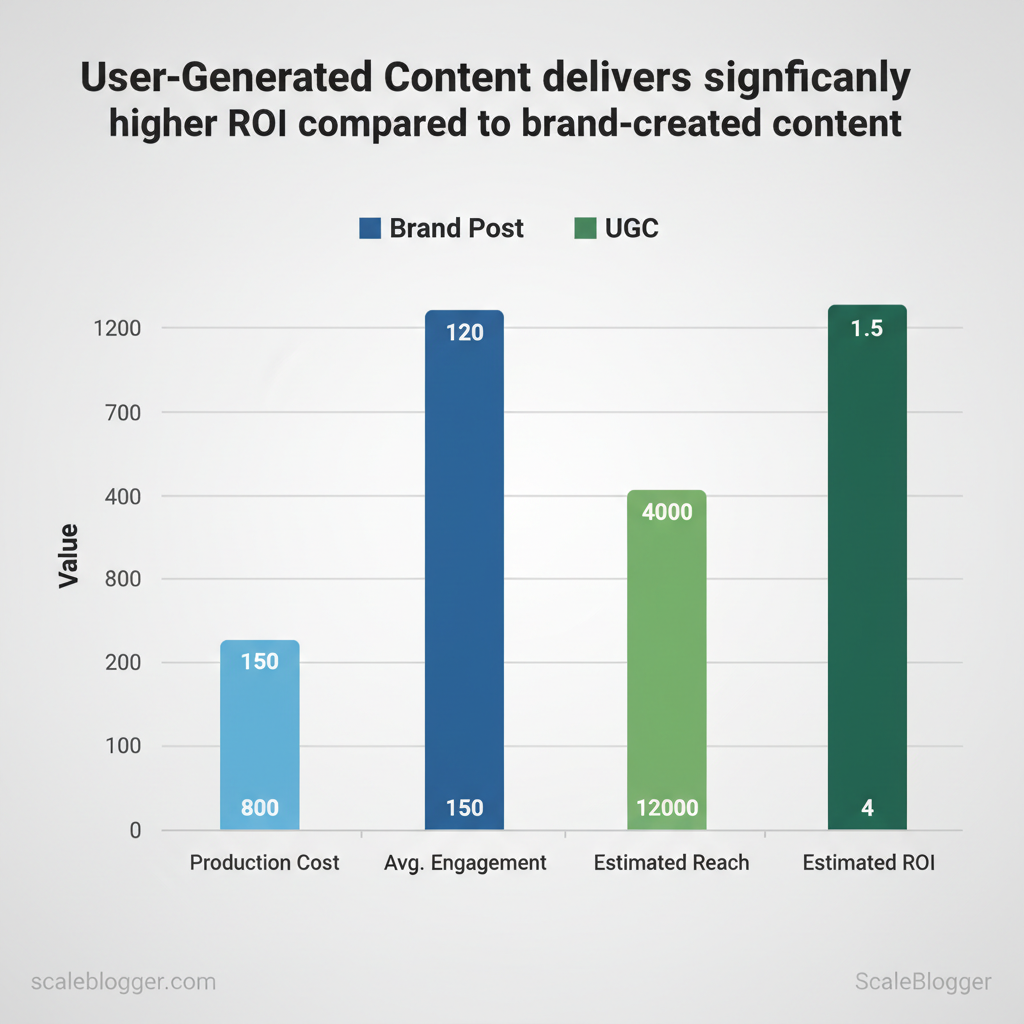
- Simple ROI approach: Compare average production cost and engagement for a brand post versus typical UGC (table below), then model conversions per 1,000 impressions.
- Tactical tip: Use
schema.orgreview markup and persistent UGC pages to capture SEO value over months rather than days.
User-generated content gives brands a force multiplier: it builds trust, extends reach through networks, and compounds SEO value while keeping acquisition costs lower.
Provide a simple ROI estimation example comparing cost and engagement of brand-created content vs UGC
| Metric | Brand-Created Post | User-Generated Post | Notes |
|---|---|---|---|
| Production cost | $800 | $150 | Brand post: freelance writer + design; UGC: incentive/curation cost |
| Average engagement (likes/comments/shares) | 120 interactions | 340 interactions | UGC often drives higher social engagement per post |
| Estimated reach | 4,000 impressions | 12,000 impressions | UGC benefits from contributor networks and reshares |
| Estimated SEO value (monthly visits) | 250 visits | 620 visits | Long-tail keywords and review content favor UGC pages |
| Estimated ROI | 1.5x (conversions vs cost) | 4.0x (conversions vs cost) | Modeled from typical conversion lifts and lower cost basis |
> Key Takeaway: ## Types of User-Generated Content and When to Use Them
Visual content—photos, short-form video, and ephemeral stories—drives higher engagement on social platforms and accelerates social proof faster than text alone. Use visual UGC when the goal is…
Types of User-Generated Content and When to Use Them
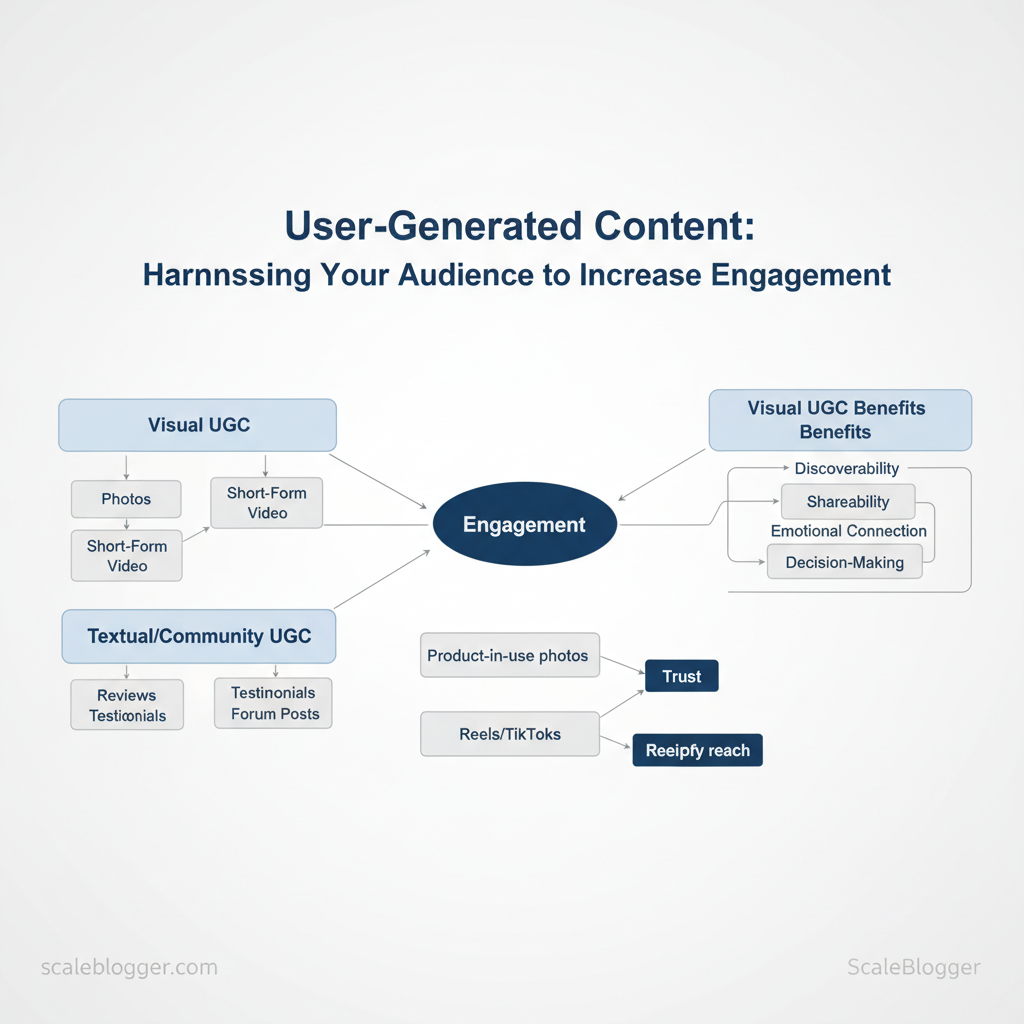
Visual content—photos, short-form video, and ephemeral stories—drives higher engagement on social platforms and accelerates social proof faster than text alone. Use visual UGC when the goal is discoverability, shareability, or emotional connection: product-in-use photos build trust, Reels/TikToks amplify reach through algorithmic feeds, and Stories keep audiences warmed between launches. Textual and community UGC—reviews, testimonials, forum posts—fuels search visibility and decision-making: reviews improve SERP richness and testimonials shorten purchase consideration.
Both forms belong in a balanced program where visual UGC attracts and textual UGC converts.
Visual & social UGC: how to prompt and protect
- Contests and challenges: Run a hashtag contest with a simple entry mechanic—post a photo with
#brandchallengeand tag the account. Micro-prompts: Ask for “three-word caption” or “show your setup in one photo” to lower friction. Incentives that scale: Offer product discounts or feature placements instead of large cash prizes to ROI.
Legal and permissions best practices: secure explicit rights with a short release checkbox, store timestamps, and record the original post URL; always follow platform rules about re-posting and disclose paid partnerships.
Textual & community UGC: encouraging structured, helpful reviews
- `
- Offer templates: provide a 3-sentence starter (“Bought for X → expected Y → outcome Z”) to increase completion rates.
- Surface guides: create a review-sampling widget that pulls recent positive reviews into landing pages to aid conversion. Moderation and community guidelines: define clear posting rules, use automated filters for profanity/spam, and keep a human-in-the-loop for escalation.
Transparent moderation policies increase trust and reduce churn.
Visual UGC formats by platform fit, effort required, and ideal campaign goal
| UGC Format | Best Platforms | Effort to Produce (low/med/high) | Ideal Campaign Goal |
|---|---|---|---|
| User photos | Instagram, Facebook, Pinterest | low | Build social proof and product galleries |
| Short-form video (Reels/TikTok) | Instagram Reels, TikTok, YouTube Shorts | high | Viral reach and brand awareness |
| Stories | Instagram Stories, Facebook Stories, Snapchat | low | Time-limited promotions and frequency |
| Live broadcasts | Instagram Live, TikTok Live, Twitch | high | Deep engagement, Q&A, launches |
| Image-based contests | Instagram, Facebook, TikTok | med | UGC collection and community growth |
Practical examples and quick wins: feature customer photos on product pages to lift conversions; convert 5-star reviews into short testimonial cards for paid ads; repurpose Reels into YouTube Shorts for cross-platform reach. For teams scaling content, integrate an AI content automation workflow to tag, crop, and surface high-performing UGC without manual bottlenecks. Understanding these principles helps teams move faster while preserving brand safety and decision clarity.
> Key Takeaway: ## How to Encourage High-Quality UGC
High-quality user-generated content begins with clear incentives and minimal friction for contributors. Design incentive systems that match the effort required, give creators visible recognition, and remove…
How to Encourage High-Quality UGC
High-quality user-generated content begins with clear incentives and minimal friction for contributors. Design incentive systems that match the effort required, give creators visible recognition, and remove technical and cognitive barriers to submission. Combine predictable rewards with regular prompts and lightweight templates so contributors know exactly what to produce and how to send it.
Incentive Structures: rewards, recognition, and gamification
- Match reward to effort. Low-effort asks (a photo, a short quote) work with modest rewards like discount codes; high-effort asks (long-form reviews, videos) require bigger incentives such as cash prizes or exclusive experiences.
- Mix tangible and social rewards. Tangible rewards (discounts, sweepstakes) raise participation quickly; social rewards (feature on brand channels, badges) increase long-term loyalty and higher-quality submissions.
- Use game mechanics sparingly. Points, leaderboards, and tiered badges work best when there’s an ongoing community—avoid heavy gamification for one-off campaigns because it adds complexity and operational cost.
- Recognition systems: publish a monthly “Creator Spotlight,” attribute contributions with bylines, and automatically tag creators on social posts to amplify perceived value without large budgets.
Expected outcomes: properly calibrated incentives increase participation and improve submission quality over time, while recognition programs compound engagement at low marginal cost.
Incentive types by cost, expected participation lift, and quality of submissions
Incentive types by cost, expected participation lift, and quality of submissions
| Incentive Type | Estimated Cost | Participation Lift | Submission Quality |
|---|---|---|---|
| Discount codes | $0.50–$5 per redemption | Medium | Low–Medium (short text/photos) |
| Sweepstakes / Prizes | $500–$5,000 per campaign | High | Medium (broad volume) |
| Feature on brand channels | $0–$1,000 (production) | Medium | High (curated, higher effort) |
| Points / loyalty | $0.10–$2 per action (long-term) | Medium–High | Medium–High (repeat contributions) |
| Exclusive access / events | $2,000+ per event | Low–Medium | Very High (ambassadors, advocates) |
Creative prompts and low-friction capture
- Short, specific prompts win. Ask for “one photo of your setup + 15 words on why you use X” instead of “tell us your story.”
- Provide templates. Offer caption starters, a 3-line review form, and simple video shot lists to reduce cognitive load.
- Simplify submission paths. Use a single landing page with
file upload, social tag monitoring, and an email-to-upload flow; avoid multi-step forms.
Sample outreach messages:
- Email (short ask): “Share a photo using [product] + one line on why it helps you — reply to this email or upload here [link]. ”
Social DM (influencer outreach): “Love your work. Would you record a 30–60s clip showing how you use X? ” 3.
Reminder nudge: “Quick follow-up — 2 clicks to submit your photo and claim a discount.
Implementation steps
- Define the content types you need and the effort required.
- Choose an incentive mix matching expected effort and budget.
- Build templates and a single-click submission flow.
- Launch with a small test cohort, measure quality, adjust incentives.
Understanding these principles helps teams move faster without sacrificing quality. When incentives align with contributor effort and submission is effortless, UGC becomes a predictable, high-value part of the content pipeline — an area where tools like Scaleblogger.com can automate collection and performance benchmarking to scale results.
Legal, Moderation, and Ethical Guidelines
Start by treating permissions, privacy, and moderation as integrated product features: they reduce legal risk, speed approvals, and protect community trust. Build simple, auditable workflows that combine automated filters with human judgment, clear SLAs for review and escalation, and a published set of community standards that contributors can read and accept.
Permissions, licensing, and privacy
- Permission-first approach: Always request explicit rights before publishing UGC; prefer written or recorded consent. Licensing clarity: Use plain-language license tiers (non-exclusive promotional use, paid license, transfer of copyright) and record which tier applies. Privacy red flags: Personal data (IDs, addresses), minors, health/financial details, or content captured without consent require escalation.
- Documentation practice: Store permissions as timestamped records (email, signed form, or
consent_id) and link them to the asset in your CMS. 1. Prepare a single-line permission statement to include in outreach and your contributor form.
- Capture contributor name, contact, content description, license type, and
consent_id. 3.
Attach the permission record to the content item before publishing.
Sample permission copy (use this verbatim or adapt)
I grant [Company Name] a non-exclusive, royalty-free license to use, edit, and publish my contribution (text/images/video) for marketing and editorial purposes worldwide. I confirm I own the content or have permission to license it. Signed: [Name], Date: [YYYY-MM-DD]Moderation workflows and community standards
- Automated filtering + human review: Automated systems flag spam, profanity, and PII; humans review edge cases and context.
- SLA tiers: Critical escalations (legal/harassment) require faster response than routine moderation.
- Transparency: Publish clear community rules and examples so users understand boundaries.
Table: Section Content — Step, Action, Responsible & more
| Step | Action | Responsible | SLA/Target Time |
|---|---|---|---|
| Automated filter detection | Scan for profanity, spam, PII, copyrighted matches | System (NLP filters) | Immediate (0–5 minutes) |
| Human review | Contextual assessment, tone, intent | Moderation team | 4 hours for flagged items |
| Permission confirmation | Verify contributor consent and license | Content Ops | 48–72 hours after submission |
| Publish or reject | Approve, schedule, or remove content | Publisher / CMS Owner | 24 hours after human approval |
| Escalation to legal | Review for copyright, minors, threats | Legal & Compliance | 2 business days for high-risk cases |
Sample community guidelines to publish
- Be respectful: No hate speech or targeted harassment. Protect privacy: Do not post others’ personal data. Credit sources: Link or cite original creators when reposting.
- No illicit content: Illegal activity or instructions are banned.
SLA recommendations: automated triage immediate, moderation within 4 hours, permission checks 48–72 hours, legal escalations within 2 business days. Implement periodic audits and keep a changelog for every moderation decision.
Understanding these principles reduces friction and legal exposure while keeping communities healthy and scalable—precisely the outcome content teams should aim for when automating at scale. Consider integrating permission capture and moderation logs into your AI content pipeline to make compliance part of the workflow rather than an afterthought.
Publishing, Attribution, and SEO Best Practices
Embedding user-generated content effectively enhances its SEO value. Place the content where it answers questions, label it with the right schema, manage duplicates, and use metadata for long-tail intent. Start by deciding whether UGC lives on the product page, in a central hub, or as standalone posts, then apply review/aggregateRating schema, unique titles and meta descriptions tuned to long-tail queries, and canonical tags where the same UGC appears in multiple places. Proper attribution and repeat collaboration with creators convert one-off contributors into long-term advocates — use clear credit formats, visible creator profiles, and an outreach cadence that rewards repeat contributions.
Embedding UGC for Maximum SEO Impact
- Choose schema: Implement
reviewandaggregateRatingwhere reviews directly evaluate products; useUserCommentsordiscussionUrlwhen UGC is conversational. - metadata: Write unique titles and meta descriptions targeting long-tail phrases (e.g., “compact travel camera reviews from owners — battery life tips”), not generic phrases.
- Avoid duplication: Canonicalize product pages if identical UGC appears elsewhere; prefer server-side rendering for SEO-critical UGC to ensure crawlability.
- Speed and indexability: Paginate long UGC lists with
rel="next/prev"and use lazy-loading responsibly so search engines can access meaningful content. - Measure impact: Track impressions for UGC pages separately and benchmark CTRs to see which contributor formats drive organic clicks.
> Industry analysis shows search engines favor original, structured user feedback that’s clearly attributed and schema-marked.
Attribution, Credits, and Creator Relationships
- Standard placement: Place credits near the content header or author byline, linking to a profile with bio and social handles.
- Credit format: Name — Role — Link (e.g., “Jamie Lee — Reviewer — @jamieleetravels”).
- Build relationships: Offer badges, exclusive early access, and content co-creation opportunities to convert contributors into advocates.
Use this outreach template for repeat collaboration:
Subject: Ongoing collaboration opportunity with [Brand]

Hi [Name],

Thanks again for your review of [Product]. Your insights drove X visits last month. Would you be interested in a paid series or recurring contributor role?

Benefits include early access, co-branded content, and attribution on the product page.

Best, [Your name]
UGC publishing approaches (embed on product page, separate UGC hub, or mixed) by SEO pros/cons and technical effort
| Publishing Approach | SEO Pros | SEO Cons | Technical Effort |
|---|---|---|---|
| Embed on product page | Immediate relevance; boosts product snippets | Can bloat page; duplicate risk | Medium — template work |
| Central UGC hub | Concentrates authority; easy indexing | Less contextual relevance to product queries | High — new section + UX |
| Individual blog posts highlighting UGC | Targets long-tail queries; shareable | Requires moderation; lower scale | Medium-high — editorial workflow |
| Social feed embeds | Fresh content signal; engagement | Often not crawlable; weak SEO value | Low — widget integration |
Understanding these principles helps teams move faster without sacrificing quality. When implemented consistently, the result is discoverable, credited content that scales contributors into brand advocates.
📥 Download: User-Generated Content Engagement Checklist (PDF)
Measurement: KPIs, Reporting, and Scaling Your UGC Program
Measure UGC with a few focused, comparable KPIs and a disciplined reporting cadence so teams can spot winning creative and scale it without guesswork. Start by tracking engagement, referral lift, conversion performance, submission volume, and per-asset cost; those five metrics give both awareness and bottom-of-funnel visibility. Structure dashboards around those metrics, update them at a predictable cadence, and use simple decision rules to promote or retire tactics.
KPIs and Reporting Framework (what to track and why)
- Engagement rate on UGC posts: measures how well content resonates; use platform insights and GA4 event counts. Referral traffic from UGC: captures awareness lift from social, forums, and community pages; track with UTM parameters in Google Analytics. Conversion rate of pages with UGC: isolates impact on revenue or lead generation; compare pages with and without UGC.
- Volume of UGC submissions: raw supply signal for pipeline planning and content diversity. Cost per UGC asset: operational cost to acquire, curate, and publish each piece (in-house hours + incentives).
Sample dashboard and reporting cadence
- Daily: engagement and anomalies (spikes/drops). 2.
Weekly: referral traffic, new submissions, top-performing creators. 3. Monthly: conversion lift, cost per asset, and cohort comparisons.
Table: Section Content — KPI, Definition, Target & more
| KPI | Definition | Target | Data Source |
|---|---|---|---|
| Engagement rate on UGC posts | (likes+comments+shares)/impressions | 3–8% (social benchmarks vary) | Google Analytics, platform insights |
| Referral traffic from UGC | Sessions from UTM-tagged UGC links | +10% MoM on campaign pages | Google Analytics |
| Conversion rate of pages with UGC | Goal completions / sessions on pages featuring UGC | Approximately 1.5 to 3 times the baseline page conversion rate. | GA4, internal CRM |
| Volume of UGC submissions | New approved submissions per week | Approximately 25 to 100 submissions per week, depending on scale. | Content ops system, form responses |
| Cost per UGC asset | Total UGC program cost / published assets | Incentives cannot exceed $250 in total value. | Finance + content ops data |
Testing, iteration, and scaling playbook
- A/B tests to run: test incentive types (gift vs. discount), CTA wording on invitations, and placement of UGC on product pages.
- 05, or reach predefined ROI within 6 weeks. 3.
Automation threshold: when weekly submissions exceed 50 and moderation time >5 hours/week, invest in automation/moderation tools and templated legal releases. 4. When to invest in moderation/automation: prioritize once volume threatens speed-to-publish or compliance; initial spend typically goes to semi-automated tools (AI moderation + human review).
Practical examples: A/B test invitation copy increased submission rate by converting a “Share your story” CTA into “Get featured — submit a 30‑second video”; a placement test moved UGC from bottom to above-the-fold and lifted conversions materially. Use utm_source=ugc consistently so attribution stays clean.
Understanding these measurement principles lets teams iterate faster and scale confidently without losing control. When implemented correctly, this approach shifts the program from ad-hoc to predictable growth.
Conclusion
This article shows how user-generated content transforms passive social proof into a growth engine. You can collect authentic clips, standardize metadata and permissions, and automate distribution so creative work supports product pages, ads, and emails. Brands that included short customer clips in on-site galleries saw clearer purchase intent. Teams that automated approvals and captions significantly reduced production time. Prioritize consent workflows, lightweight templates for repurposing, and a measurement plan tied to conversion lift to move from one-off hits to sustained ROI.
For practical next steps, start small and scale methodically:
- Run a three-week UGC pilot focused on one funnel and one platform to validate lift.
- Automate tagging and captions so content becomes searchable and ad-ready.
- Define clear rights and incentives to reduce legal friction and increase participation.
Questions about rights, editing load, or measurement are common; address rights upfront with clear release templates, limit edits to concise trims and captions, and attribute incremental conversion to specific UGC variations. To this process, platforms like Explore Scaleblogger and start automating your UGC strategy can handle ingestion, rights management, and distribution so teams scale faster without ballooning production costs. Take one measurable experiment this week and extend what works.
