

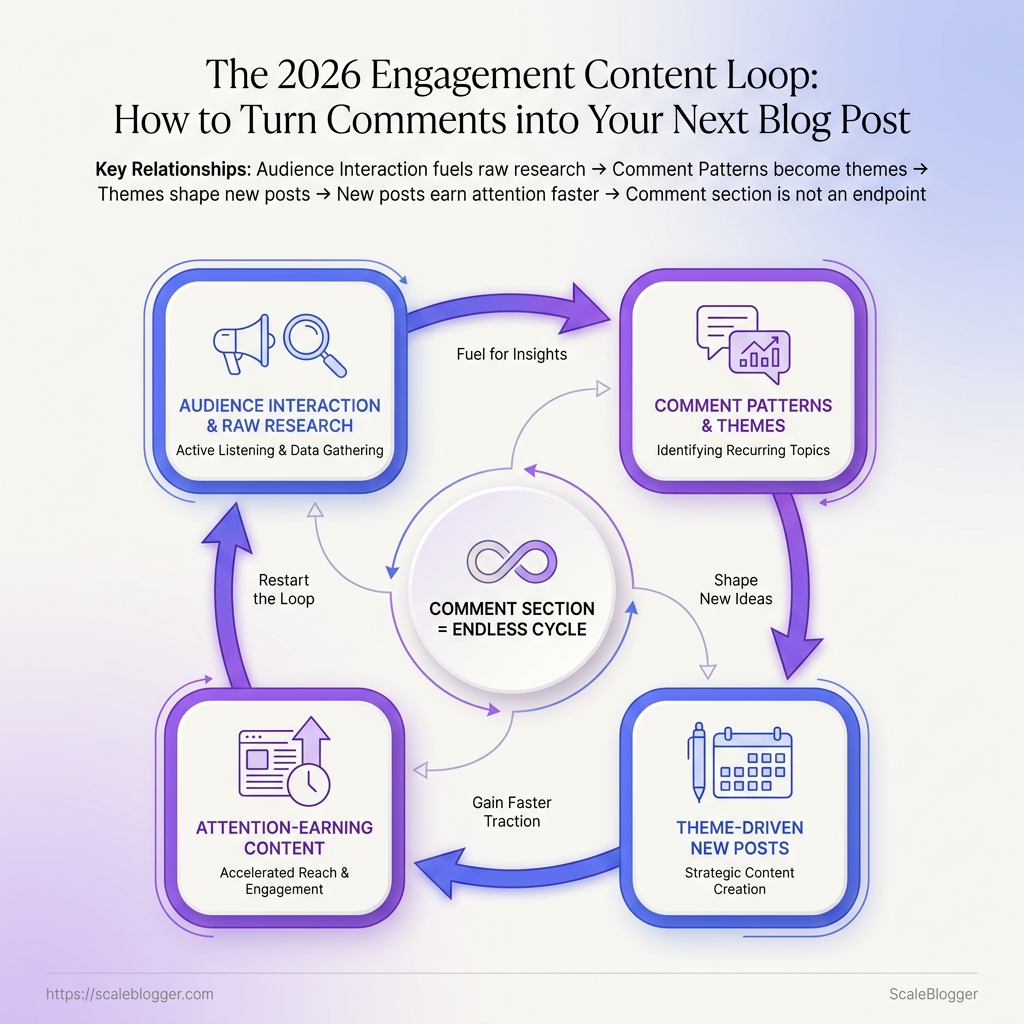
What if your best blog idea is in the comment section? Comments from your audience show their real questions, concerns, and interests.
By engaging with these insights, you can discover key themes that matter to readers.
Their feedback can serve as a valuable source for future posts.
Don’t just see comments as signs of engagement or as cues for questions.
Treat them as real-time insights that can help shape your content.
This practice sharpens your content strategy by grounding it in the authentic language and concerns of your audience, ensuring that your posts remain relevant and engaging.
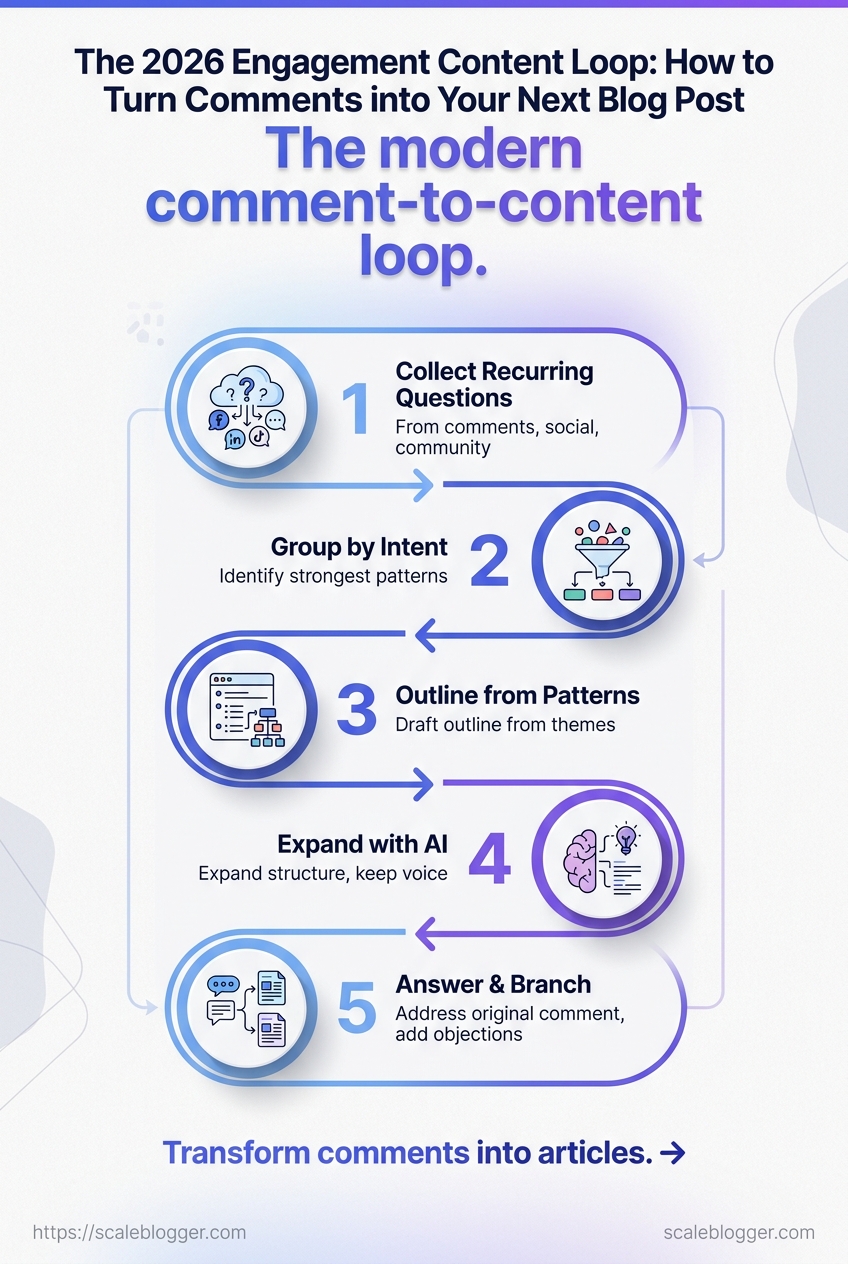
Turn existing comments into new blog posts by extracting the exact questions, objections, and wording readers use.
Cluster these by intent to draft outlines that address those key issues directly.
A reader asking “Does this work for small teams?” already supplies a high-quality headline angle and comparison requirement—so you can write faster and promote earlier because the demand is coming from real audience signals.
Filter out weak or off-topic replies, but build posts from the recurring, high-intent themes commenters repeat.
Key Takeaway:
Uncovering blog ideas from audience comments
A comment thread can serve as a powerful tool compared to generic keyword brainstorming when the audience vocalizes what they…
These comments reveal insights like pain points, fears, and needs that search queries might not show.
This is crucial, as spotting trends and understanding reader language can help create content that resonates better, ensuring relevance and engagement.
Thus, comments become invaluable not just as engagement metrics but as potential blog topics informed by genuine reader concerns.
> Key Takeaway:
> Not every comment deserves a blog post.
A comment thread can be messy but still valuable.
> Not every comment deserves a blog post.
A comment thread can be messy but still valuable.
The mistake is treating every reply as a content brief, when most comments are…
The hard truth: not every comment deserves a blog post
A comment thread can be messy but still valuable.
It’s a mistake to treat every reply as a content brief; most comments signal for conversation, not lengthy articles.
The best blog ideas often come from comments that point out unfinished thoughts.
A reader who says, “This was helpful” is engaging; a reader who says, “How do I do this for a team of 20?” is pointing to a gap worth expanding.
That difference matters in audience interaction and content engagement strategies.
Good blog promotion starts with choosing topics that can pull in search traffic later, not just earn a burst of likes today.
Comment types that are worth expanding into articles
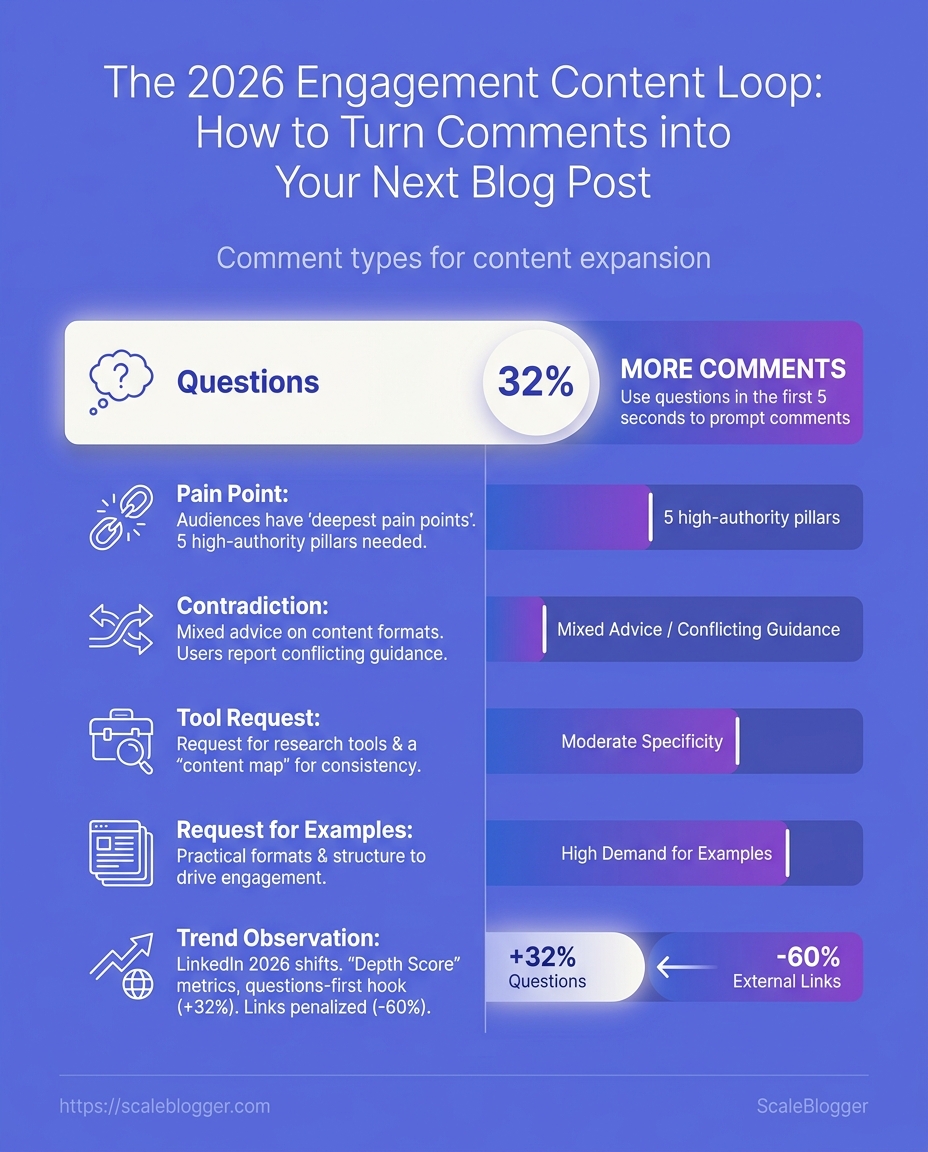
Table: The hard truth: not every comment deserves a blog post — Comment type, Content potential, Best use case & more
| Comment type | Content potential | Best use case | Do or do not |
|---|---|---|---|
| Question | High | A reader asks how, why, or when something works | Do expand when the question is specific and repeatable |
| Pain point | High | The comment describes a blocker, failure, or frustration | Do turn it into a problem-solution article |
| Contradiction | High | Someone challenges the post or presents a different view | Do use it to build a comparison or myth-busting post |
| Tool request | Medium to high | A reader wants software, templates, or workflows | Do expand if the request signals practical search intent |
| Request for examples | Medium | The reader wants proof, use cases, or real scenarios | Do expand when examples would deepen the original idea |
| Trend observation | Medium | A reader notices a pattern in the market or community | Do expand if the observation has broader relevance |
If someone could plausibly type it into Google or an AI answer engine, it has article potential.
A casual reaction, by contrast, usually stays in the replies.
Praise, jokes, and one-line agreement help community health, but they rarely justify a full post unless they reveal a larger pattern.
Signs a comment signals search intent
A search-driven comment often contains specific nouns, not vague enthusiasm.
Look for phrases like “best way to,” “how to fix,” “examples of,” “tool for,” or “difference between.”
Length helps too.
Comments with two or more clauses usually contain a real problem, while short reactions often reflect momentary audience interaction rather than a research need.
One practical test: if the comment would make sense as a subheading, it probably deserves editorial attention.
The comments worth turning into articles are the ones that can survive outside the thread.
Those are the ideas that keep paying off long after the original post fades.
> Key Takeaway:
> Key Takeaway:
A short story: one comment thread becomes one high-intent blog post
A reader repeatedly asks, “Why does my post get likes, but no clicks? ”…
> Key Takeaway:
A short story: one comment thread becomes one high-intent blog post
A reader repeatedly asks, “Why does my post get likes, but no clicks? ” After the third time, this question shifts…
A short story: one comment thread becomes one high-intent blog post
A reader repeatedly asks, “Why does my post get likes, but no clicks?” After the third time, this question shifts from seeming like noise to highlighting a genuine content gap.
That is usually where the best article begins.
The question is narrow, but the problem behind it is wider: weak audience interaction, unclear next steps, and content engagement strategies that stop at the post itself instead of the path after it.
The trick is to move from the exact wording of the comment to the pressure behind it.
In this case, the post is not about “more engagement” in the abstract.
It is about why attention does not turn into action, and how blog promotion can fix that handoff.
A useful outline often looks like this:
- Opening problem: Why a post can attract comments without producing clicks or sign-ups.
- Root cause: The content answers one question, but not the next one readers ask.
- Practical fix: Add one clearer promise, one stronger internal path, and one follow-up asset.
- Headline set: “Why Likes Do Not Become Clicks,” “The Missing Step Between Engagement and Traffic,” and “How to Turn Reader Questions Into Better Blog Posts.”
That structure keeps the article focused on a real user signal instead of a vague topic.
It also gives the writer a clean angle, which makes drafting faster and repurposing easier later.
When the thread is messy, our workflow inside Scaleblogger helps separate the repeat question from the extra chatter, then turns that signal into a draftable outline.
The same workflow can also reframe the idea for social posts, which matters when blog promotion needs more than one channel.
A simple rule helps here: one repeated question should become one promise, one outline, and one headline family.
If those three pieces hold together, the article usually feels inevitable rather than forced.
That is why a comment thread can outperform a brainstorm.
It already contains the reader’s language, and that language tends to travel well from post to post.
> Key Takeaway:
A surprising stat: the fastest content often comes from the closest audience signals
The fastest topic wins are rarely buried in analytics.
These topics usually appear…
A surprising stat: the fastest content often comes from the closest audience signals
The fastest topic wins are rarely buried in analytics.
These topics usually appear clearly in audience interactions that show pain, intent, or unfinished tasks.
A comment, reply, or forum note does not need to be long to matter.
One sharp line can reveal a topic cluster, a search angle, and a strong opening for blog promotion.
The cleanest workflow is simple.
Tag each comment by source, intent, and pain point; cluster near-duplicates under one theme; then score the cluster before it reaches the editorial calendar.
- Tag first: mark the source, the problem type, and whether the comment asks, complains, or compares.
- Cluster second: group comments that mean the same thing, even if the wording differs.
- Score last: rank the cluster for topic fit, urgency, and repeat demand before assigning it to a draft.
The AI part should support that process, not flatten it.
Keep one field for the normalized theme and another for the original reader language, so the phrasing stays usable for headlines, subheads, and content engagement strategies.
A simple scoring model for content engagement strategies
Table: A surprising stat: the fastest content often comes from the closest audience signals — Scoring factor, What to look for, Score range & more
| Scoring factor | What to look for | Score range | Why it matters |
|---|---|---|---|
| Relevance | The comment matches your audience, product, or editorial lane | 0-5 | High-relevance clusters are easier to turn into useful posts |
| Urgency | The reader sounds stuck, time-bound, or ready to act | 0-5 | Urgent topics usually outperform vague curiosity |
| Specificity | The comment names a tool, problem, step, or obstacle | 0-5 | Specific language gives the draft a clearer angle |
| Recurrence | The same issue appears across multiple comments or channels | 0-5 | Repeated signals reduce the risk of building around a one-off remark |
| Search alignment | The wording mirrors how people search or ask the same thing elsewhere | 0-5 | Strong alignment makes the post easier to discover and reuse in blog promotion |
Mid-range clusters often need one more supporting comment before they deserve a full article.
The strongest teams keep the original wording attached to every cluster.
That preserves the audience’s language, which is often sharper than the edited version we would write on our own.
That habit pays off twice: once when selecting topics, and again when shaping headlines that feel native to the reader.
It is a small discipline, but it turns audience interaction into a repeatable editorial system.
A contrarian take: promotion should begin before the post is finished
A post that waits for publication before it gets attention is already behind.
It might sound backward, but this is how effective blog promotion works.
The best signals usually come from audience interaction while the idea is still forming, because people respond to unfinished thinking with sharper questions than they give to polished copy.
A single comment can seed the whole campaign.
Use the original thread as the first distribution asset, not just the research note.
A comment can become the opening line of a social post, the hook in an email teaser, and the first reply that keeps the conversation alive after publication.
That keeps the same idea moving across channels without sounding repetitive, which matters in modern content engagement strategies.
The trick is to promote in layers, not bursts.
One comment should lead to one short social post, one email snippet, and one follow-up reply after the article goes live.
That sequence keeps the loop active because each touchpoint points back to the same reader concern, but from a different angle.
It also gives the post a clearer shape before publishing, since you can see which phrasing earns replies and which version falls flat.
A compact promotion sequence that keeps the audience loop active
Table: A contrarian take: promotion should begin before the post is finished — Channel, Best repurposed asset, Purpose & more
| Channel | Best repurposed asset | Purpose | Timing |
|---|---|---|---|
| Blog intro | The original comment framed as the opening problem | Hooks readers with a real audience question and sets the post’s angle | Before publication, during draft finalization |
| Social post | A compressed quote or question pulled from the comment | Starts conversation and tests which phrasing gets the most response | 24–48 hours before publishing |
| Email teaser | A two-sentence summary built from the same comment | Drives clicks from subscribers who already care about the topic | On publication day, within the first send |
| Community reply | A direct answer that links to the live post | Extends the discussion where the comment first appeared | Same day the post goes live |
| Short-form video script | The comment turned into a 15–30 second hook | Reaches people who respond faster to spoken, visual formats | Within 1–3 days after publishing |
Readers see consistency, not repetition, and that consistency improves recall.
It also reduces wasted effort.
Instead of inventing separate angles for every channel, the comment thread becomes the shared source for the blog intro, social copy, email teaser, and follow-up reply.
That is the kind of promotion rhythm that feels active without becoming noisy.
What is the content strategy trend for 2026?
In 2026, content strategy will focus more on audience interaction—especially comments—rather than on broad brainstorming.
It is anticipated that teams will identify the specific questions and concerns readers express, group them by intent, and create posts that directly address the same challenges for a larger audience.
Promotion will also start earlier, using comment threads as the first distribution asset while the idea is still forming.
What is the 5 3 2 rule on Instagram?
The 5-3-2 rule on Instagram is a posting balance that uses five “value” posts, three “relationship” posts, and two “promotional” posts in each cycle.
Value posts educate or teach; relationship posts build familiarity through community, behind-the-scenes, or engagement-focused content; promotional posts include offers, CTAs, or lead generation.
This keeps your feed from feeling sales-heavy while still driving action.
What are the 5 promotional strategies with examples?
Five effective promotional strategies are: (1) turn the original comment thread into your first campaign asset; (2) use a commenter’s exact wording as the opening hook in a social post; (3) convert the same wording into an email teaser; (4) keep the conversation going after publication by replying and pointing readers to the new post; and (5) cluster recurring high-intent comment themes and promote earlier because the demand is already signaled.
Together, these strategies help content promotion start before the post is fully finished.
What is the 5 5 5 rule for social media?
The 5-5-5 rule for social media typically means dedicating your time to three buckets of engagement: 5 posts, 5 meaningful interactions (like thoughtful comments), and 5 relationship-building actions (such as DMs or replies) within a set period.
The goal is consistent presence without overwhelming your audience.
When you apply it, you generate signals from real conversation and keep content from sitting idle.
What is the 5-3-2 rule on Instagram?
The 5-3-2 rule on Instagram is a simple mix for what to post: 5 value-focused posts, 3 community/relationship posts, and 2 promotional posts.
Value posts teach; relationship posts connect through discussion, behind-the-scenes, or user-focused content; promotional posts drive offers and calls to action.
This structure supports engagement while preventing your feed from becoming repetitive or overly sales-driven.
Turn Comments Into Your Next Publishing Queue
Your best blog ideas often show up as ordinary audience interaction.
A repeated question, strong objection, or a common phrase from readers signals that content strategies should start with real language, not guessed topics.
That is why the comment-thread example matters so much.
One high-intent question can become a post that answers the problem cleanly, then supports blog promotion because the audience already helped shape the angle before publication.
If the same issue appears in several places, that is rarely noise; it is a demand signal.
Review the last ten comments, replies, or direct messages and pull out one repeated question to start.
Turn it into a working headline, a three-point outline, and a promotion note that mirrors the reader’s wording.
When that process needs to happen at scale, our AI-powered content pipeline can help turn those signals into publish-ready drafts without losing the audience’s voice.
