

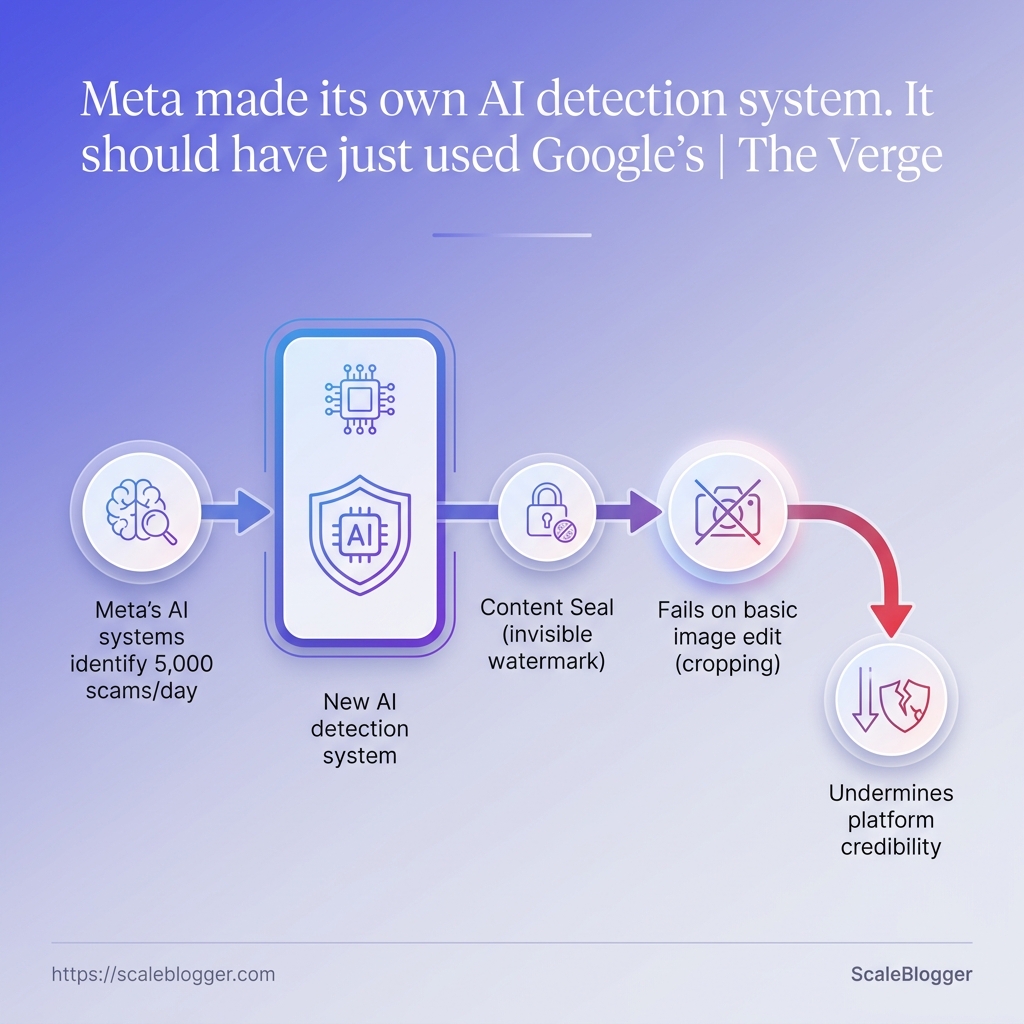
Meta can find and block thousands of scams with its AI systems.
They’ve also added an ‘invisible’ Content Seal watermark to flag AI-generated images.
But Reuters reports that Meta’s AI detection struggles with simple edits.
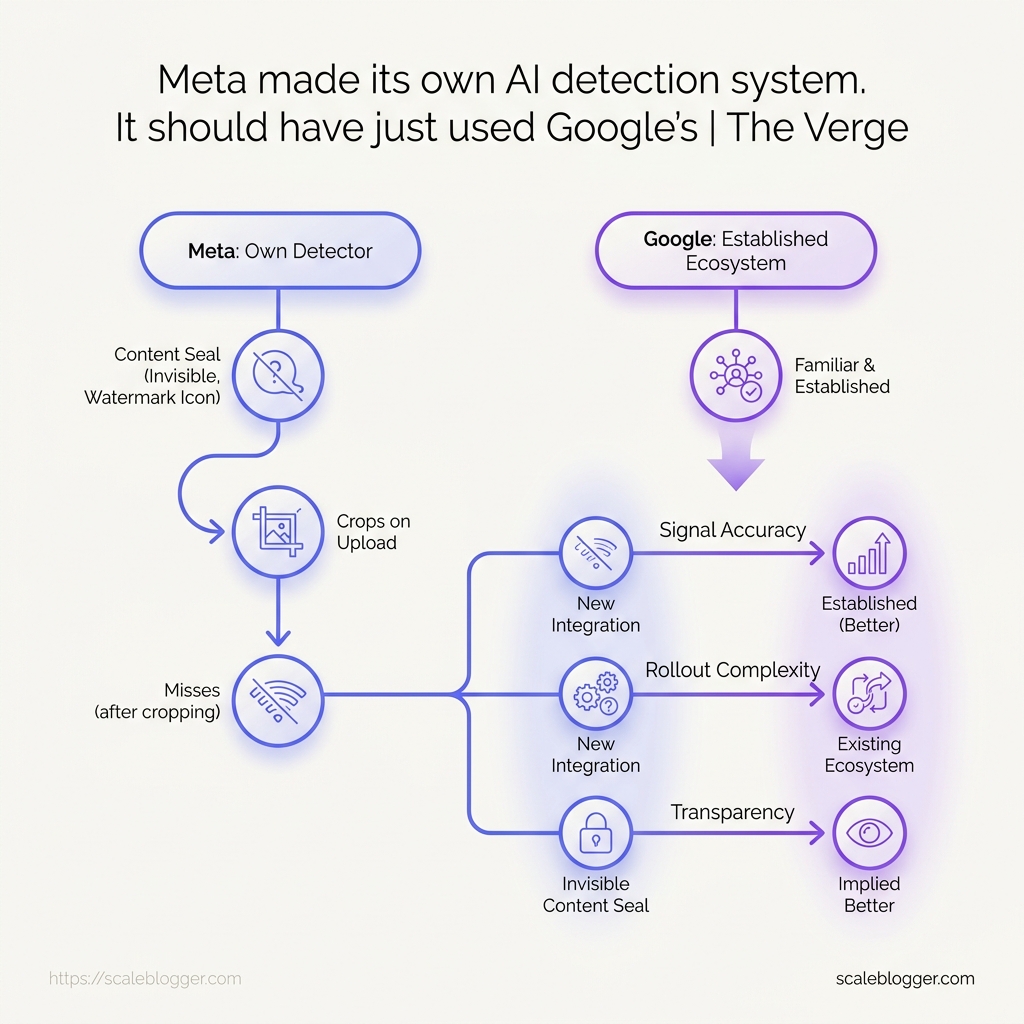
Some AI-generated files can bypass detection even if an image is cropped.
This poses a problem for Facebook, Instagram, and Threads.
Labels on platforms earn trust only when they can handle simple changes.
Cropping isn’t a rare edge case—it’s one of the most common ways content gets reshaped before it ever reaches an audience.
The Verge’s critique lands because the real question isn’t whether Meta can build a detector.
It’s whether a homegrown system stays reliable as content is resized, edited, reposted, and reviewed in real workflows—where labels must hold up consistently to support moderation and reader confidence.
Quick Answer: Meta’s new AI detection system is designed to address the challenge of identifying and classifying AI-generated content effectively.
This initiative seeks to improve real-time classification and reduce the spread of harmful content.
It does this through active moderation and better labeling protocols.
One pivotal issue at hand remains whether this system will maintain its effectiveness across various forms of content editing typical in common use.
Question: What problem is Meta trying to solve with its new AI detection system?
Meta’s new AI detection system aims to swiftly classify AI-generated content and prevent abuse before it spreads.
It claims to identify about 5,000 scam attempts per day in real time.
It also uses an invisible Content Seal watermark to flag these images.
The goal focuses on distinguishing synthetic content efficiently.
However, a detector’s credibility hinges on its performance; if a detection fails to recognize a post after normal edits, this undermines user trust.
In practice, consistent labeling during everyday changes is vital for content that goes through various editing processes.
Therefore, detection systems must do more than just label; they should influence moderation and distribution.
Bold claim: Google’s detection approach may be more practical than Meta’s in real-world publishing workflows
A detector that integrates well with existing workflows is often more pragmatic than one that seems superior on paper.
Publishing teams care about how well detection signals work after editing, not just the initial quality of a post.
Meta’s initiative highlights ambition with features like the Content Seal, yet reports show that performance falters amidst typical content alterations—exactly when consistent labeling is crucial for downstream moderation.
Comparative Analysis of Meta vs. Google
Meta is addressing a platform-native challenge with its bespoke tooling.
In contrast, Google’s more established methodology seems designed for broader application.
Brands usually operate hybrid systems that combine AI drafts with human reviews.
Thus, the relevant question shifts from “Which detector is the smartest?” to “Which system maintains reliability during rapid content edits and repackaging?”
Look for the following signs when any platform launches a new AI detection layer:
- Survivability of common edits: Ensure cropping and other alterations do not disrupt detection.
- Integration with review processes: The alerts should align with editorial workflows and not exist in silos.
- Creation of audit trails: Teams should maintain thorough records of flagged content and the reasons behind each decision.
Without these foundational aspects, new detection systems risk being mere performative tools.
> Key Takeaway:
> Key Takeaway:
Contrarian take: building a new detector is not always the same as solving the problem
A detector can get better while making moderation more…
> Key Takeaway:
Contrarian take: building a new detector is not always the same as solving the problem
A detector can get better while making moderation more complicated.
Rankability’s test of 15 AI detectors…
Contrarian take: building a new detector is not always the same as solving the problem
A detector can get better while making moderation more complicated.
Rankability’s test of 15 AI detectors found that only three got every case right on its dataset.
That is useful context, but it also exposes the trap: a custom system may look strong in testing while still creating confusion once it meets real content, real teams, and real policy pressure.
The hidden cost appears when labeling rules are unclear or keep changing.
One week, a cropped image is treated as synthetic; the next week, the same kind of file gets passed through.
Reviewers do not just see more alerts.
They see less trust in the alerts they already have.
That is why the security-camera analogy fits so well.
An AI detector is like a camera with a moving lens: if the angle shifts, the evidence becomes harder to trust.
The footage may still be real, but the standard for reading it has drifted.
The real issue is not detection alone.
It is the decision chain that follows it.
- Alert noise: Frequent rule changes turn a signal into background noise, especially when teams need fast publishing decisions.
- Policy drift: If the definition of “AI-generated” changes between surfaces or review groups, the same content can produce conflicting outcomes.
- Audit gaps: Inconsistent labels make it harder to explain why content was approved, blocked, or escalated later.
- False confidence: A custom detector can encourage teams to trust the system more than the evidence deserves.
Reuters already showed how fragile this can be when Meta’s detector missed some of its own AI images after cropping.
That kind of miss matters less as a technical blemish than as an operational warning.
The stronger model is narrower and more disciplined.
Detection should flag risk, not replace editorial judgment.
In our workflow guidance, we treat it as triage first and decision support second.
A clean process still wins: create, detect, review, then decide whether content ships, gets revised, or stays parked.
Once those rules stay stable, the detector starts serving the workflow instead of arguing with it.
> Key Takeaway:
> Key Takeaway:
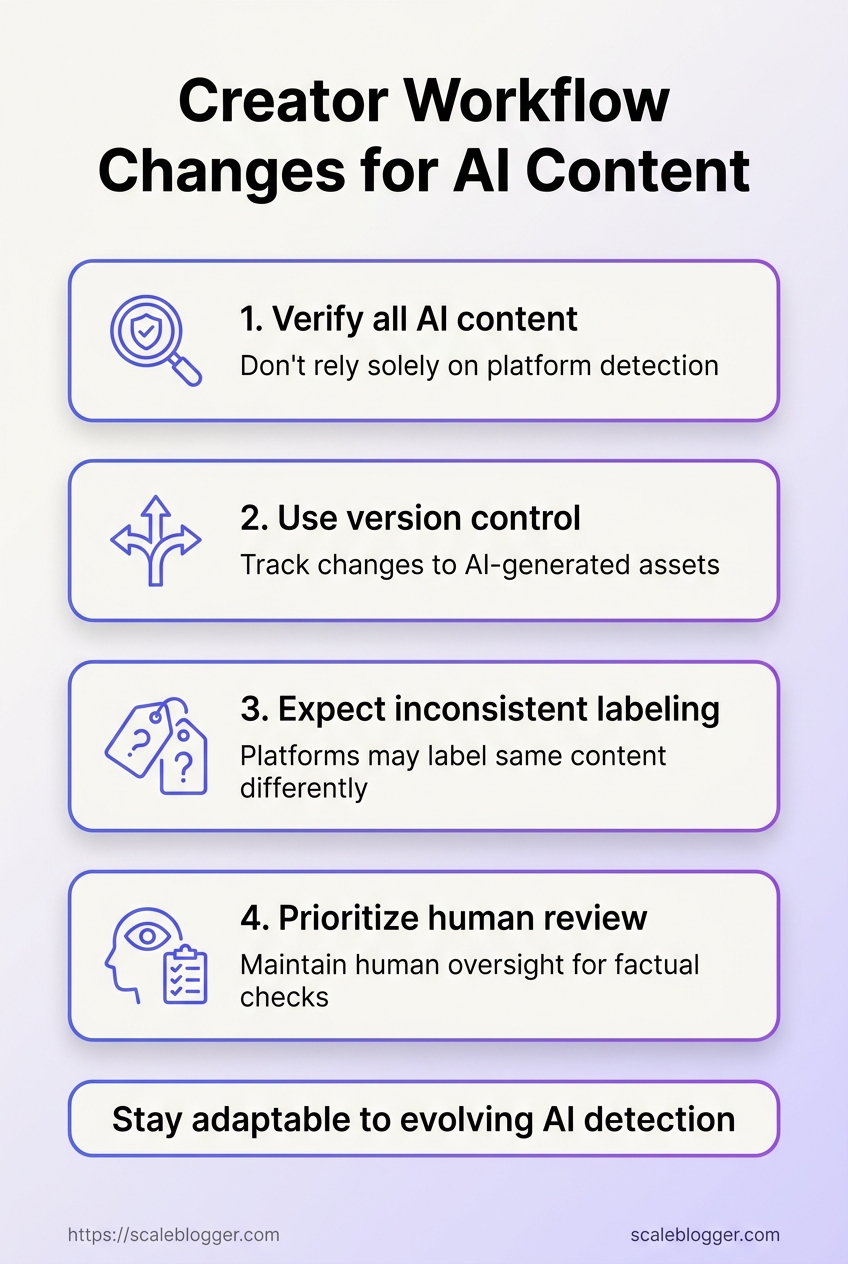
Scenario: what tech-savvy content creators should change in their workflow right now
A creator team shipping five posts a week can no longer…
> Key Takeaway:
Scenario: what tech-savvy content creators should change in their workflow right now
A creator team shipping five posts a week can no longer treat AI as a drafting shortcut and call…
Scenario: what tech-savvy content creators should change in their workflow right now
A creator team shipping five posts a week can no longer treat AI as a drafting shortcut and call it done.
Once platforms begin scanning, labeling, or rejecting content at ingestion, the real risk moves upstream into the workflow itself.
That means the job is not “spot the AI.” It is document every point where AI enters the process and decide who owns the final judgment at each step.
We see the cleanest teams split the pipeline into clear gates: ideation, outline generation, draft creation, editing, metadata, scheduling, and publication.
In practice, that matters because a post can look human at draft stage and still carry detectable patterns after batch rewriting, templating, or automated tagging.
- Ideation: Track whether prompts, topic clusters, or headlines were AI-assisted.
- Drafting: Record which sections were machine-written, rewritten, or expanded.
- Editing: Note who changed facts, tone, and structure before approval.
- Metadata: Check titles, descriptions, tags, and alt text for templated phrasing.
- Scheduling: Review any auto-filled captions or platform-specific variants.
- Publication: Keep a final approval log for anything entering a detection-heavy platform.
- Archive: Save prompt versions and edit histories for audits or disputes.
A simple review template works well here: tag, edit, approve, publish.
Tag the asset as AI-assisted, edit for voice and factual accuracy, approve it with a named human owner, then publish only after the final pass is complete.
> According to a HubSpot report from 2026, approximately 80% of marketers are using AI for content creation, but only about 6% have fully embedded it into workflows.
That gap is where false flags, compliance misses, and voice drift usually creep in.
A small content team gave us the clearest pattern to follow.
They standardized prompts, forced one human edit layer after drafting, and required a final reviewer to sign off on every caption and headline before scheduling.
Their false-flag complaints fell because the content stopped looking like a loose chain of AI outputs and started looking like a controlled editorial process.
That is the real adjustment now.
Build more structure around AI, then let humans own the last mile.
> Key Takeaway:
Surprising-stat: the biggest risk is not detection itself, but inconsistent enforcement across platforms
Meta claims its system spots many scams, but reports show that detection…
Surprising-stat: the biggest risk is not detection itself, but inconsistent enforcement across platforms
Meta claims its system spots many scams, but reports show that detection reliability changes after content is altered.
That gap matters more than the existence of any single detector.
This creates a known moderation issue: the same asset can be handled differently on Facebook, Instagram, and when it’s reshared or edited.
Once enforcement shifts by platform, creators stop trusting the rulebook.
The practical response is measurement, not guesswork.
Track reach, engagement, and every labeling change after an AI policy rolls out, then compare performance before and after the policy takes effect.
A short post can still travel well if the label is consistent.
A cropped image or repurposed clip is where the fracture usually appears—so make sure your benchmarking includes those variants.
- Reach by format: Measure impressions and distribution separately for posts, reels, carousels, and reuploads.
Detection systems often behave differently across media types.
- Engagement shifts: Watch saves, shares, comments, and completion rates after a label appears.
A mild label can reduce clicks without killing interest; heavier review can suppress distribution.
- Labeling drift: Log where the same content gets flagged, labeled, or left untouched.
If one platform is stricter than another, the policy signal becomes unclear.
- Review delay: Record how long content sits in moderation before it is published or downranked.
Delays often matter as much as outright removal.
- Revision impact: Compare original files with cropped, trimmed, or re-encoded versions to see which edits reliably trigger different outcomes.
The best analogy is simple: policy enforcement works best when the rules are as visible as the model itself.
Invisible watermarking can help—but invisible decisions create visible confusion.
That’s why your benchmark should include the policy path (labels → moderation queues → enforcement actions), not just the content path.
How do AI detectors work in 2026?
AI detectors in 2026 typically classify content using machine-learning signals that distinguish AI-generated images from real ones, often combining artifact analysis with learned classifiers.
Some systems also use embedded signals, such as Meta’s “invisible” Content Seal watermark, to identify artificial images.
Their reliability depends on whether those signals survive real-world edits such as resizing and cropping.
Is an AI detector AI itself?
An AI detector is usually an AI or machine-learning model, but it is not generative AI.
It’s designed to assess and label content—classifying it as likely AI-generated or not—often in real time for moderation or enforcement.
Even when it uses AI techniques, it’s fundamentally a detection and classification system.
Can AI detectors detect Meta AI?
AI detectors can detect Meta’s AI-generated images, especially when systems use Meta’s Content Seal watermark signal.
However, detection is not guaranteed across normal user edits: Meta’s own detector has been reported to miss some AI-generated files after basic cropping.
That means whether Meta AI gets detected can change based on how the image is transformed before upload.
What is the 30% rule in AI?
The “30% rule” is not a reliable, official standard used by detectors.
In practice, detectors don’t simply measure a fixed percentage of AI involvement in a piece of content; they analyze signals, artifacts, and sometimes embedded watermarks.
The safer takeaway is that enforcement is inconsistent and content can be labeled differently after edits or reposting.
How to pass AI detection in 2026?
You should not try to “pass” detection by gaming systems, because detectors are imperfect and enforcement can vary after content is edited or reshared.
The best practical approach is to make your workflow compliant: document where AI enters production, ensure any AI-generated content is accurately labeled, and keep post-processing consistent.
Meta’s experience suggests that simple edits like cropping may change how labels apply.
The main issue isn’t whether Meta or Google can perfectly detect AI content.
It’s whether platforms apply the same standard every time—across every file type, edit, and publishing surface.
Creators don’t need a flawless detector to feel the impact.
One inconsistent flag can slow distribution, confuse review teams, and make a clean workflow look suspicious.
The response is operational, not just technical: keep source files, track edits, and treat AI-assisted assets as part of your compliance process—not only your creative process.
Audit one live workflow today.
Pick a recent asset, trace it from draft to publish, and note exactly where a platform could misread it.
For teams publishing at scale, content performance benchmarking (reach/engagement + labeling changes before vs. after policy rollouts) can help surface where platform rules diverge before inconsistency turns into a missed launch or a reputational problem.
At the end of the day: measure enforcement behavior, then build review gates that survive the reality of edits and reposts.
