

The future of content automation is moving beyond simple scheduling and AI-generated drafts toward connected systems that can manage entire parts of the content lifecycle.
Emerging content automation trends are bringing AI-assisted research, drafting, SEO optimization, personalization, publishing, distribution, and performance analysis into increasingly connected workflows.
The opportunity isn’t simply to produce more content. It’s to automate repetitive work while preserving the human judgment, creativity, and brand standards that determine whether content is actually valuable.
As AI content automation evolves, understanding which technologies genuinely improve content operations—and which simply create more complexity—will become increasingly important for teams planning their next stage of growth.
What Is Content Automation?
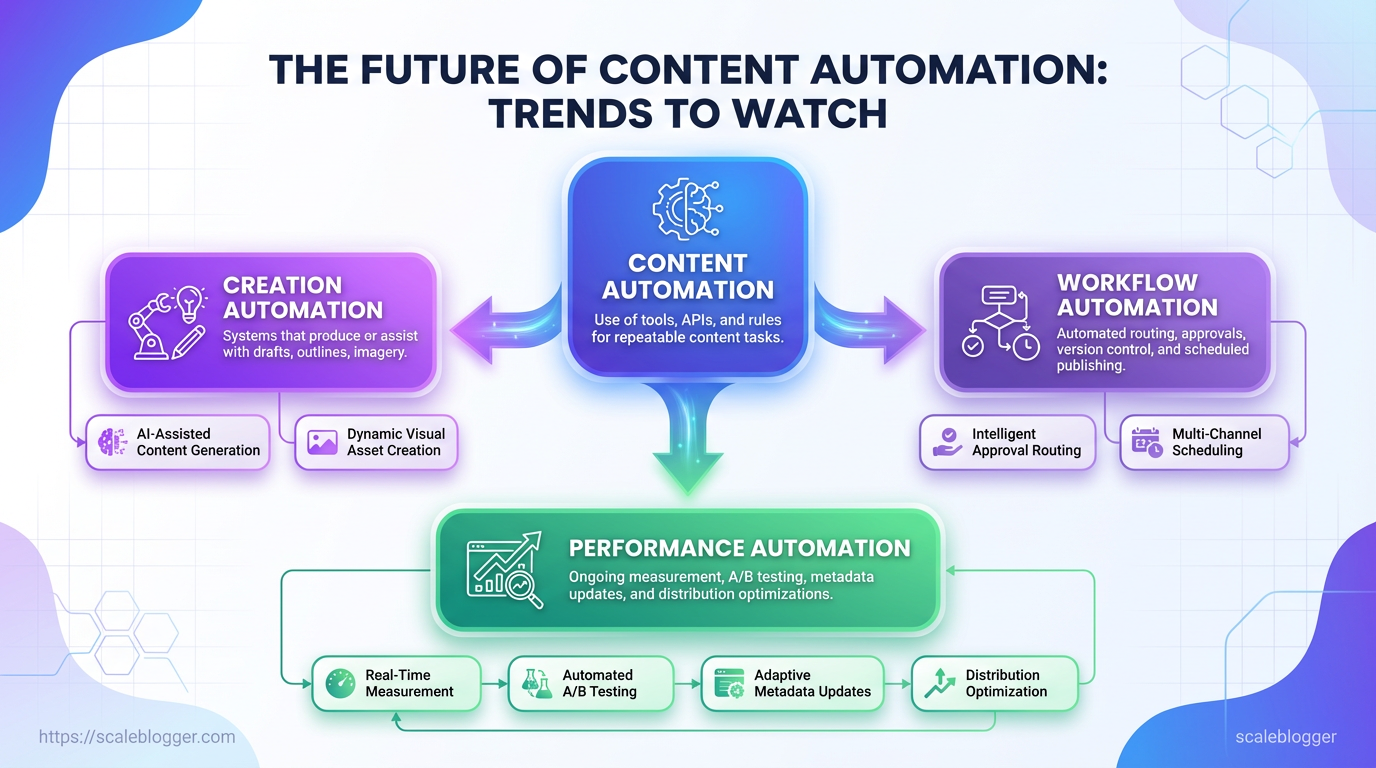
Content automation leverages software and workflows to manage repetitive tasks. This allows teams to focus more on strategy and creativity. This involves generating first drafts with models. It also includes routing articles through approval processes and automatically updating SEO metadata based on performance data.
Content automation uses tools, APIs, and rules to handle repeatable content tasks without needing manual input.
Creation automation: Systems that produce or assist with drafts, outlines, imagery, or repurposed assets.
Workflow automation: Automated routing, approvals, version control, and scheduled publishing inside a CMS.
Performance automation: Ongoing measurement, A/B testing, metadata updates, and distribution optimizations based on analytics.
Practical examples make the difference. A marketing team might use an NLP model to generate a 700-word draft, a workflow engine to assign the draft to an editor, and a scheduler to publish at the optimal time. Where simple scheduling merely posts at a set time, content automation ties that schedule to triggers such as content score thresholds, audience signals, or calendar events.
Common components and capabilities
- Draft generation: Create outlines, headlines, and first drafts with AI-assisted tools. Editorial routing: Automatically assign reviews and approvals based on role, SLA, or content type. Metadata updates: Sync SEO tags, canonical URLs, and schema based on templates or performance.
- A/B testing: Rotate headlines or intros automatically and route winning variants to full publication. Distribution: Push content to social, newsletters, or syndication channels when KPI triggers are met.
Analogy for accessibility: think of content automation like a modern bakery line. Machines mix dough and shape loaves to a spec, bakers add the signature finish, and conveyors move products to packaging—automation raises throughput while artisans preserve craft.
Quickly show which tasks fall under creation, workflow, and performance automation
Table: What Is Content Automation? — Task, Automation domain, Typical tools & more
| Task | Automation domain | Typical tools | Impact (time saved) |
|---|---|---|---|
| Draft generation | Creation | ChatGPT, Jasper, Claude — outline & draft | 2–6 hours per article |
| Editorial approvals | Workflow | Asana, Trello, Zapier, Workflows in CMS | 1–3 days per article |
| Scheduled publishing | Workflow | WordPress scheduler, Contentful, Git CI | 30–60 minutes weekly |
| SEO metadata updates | Performance | Surfer SEO, Clearscope, custom scripts | 15–45 minutes per page |
| A/B headline testing | Performance | Optimizely, VWO, native CMS tests | Decision in 24–72 hours |
Key insight: The table separates where automation yields the most —creation slashes drafting time, workflow automation shortens review cycles, and performance automation tightens relevance and ranking.*
Understanding these principles helps teams move faster without sacrificing quality. When implemented correctly, automation reduces repetitive overhead and frees creators to focus on storytelling and strategy.
How Content Automation Works
Content automation combines data, AI, and operation elements. This helps teams produce more relevant content while cutting down on manual delays. At its core it’s an end-to-end pipeline: ideas and briefs flow in, machine intelligence drafts and enriches, automation executes routine publishing tasks, and humans validate quality at key checkpoints. When designed correctly, the system makes routine decisions automatically while reserving judgement calls for human reviewers.
Core mechanisms and architecture
- Ingest and discovery: collect keywords, analytics, and brief inputs from CMS, analytics, and keyword tools.
- Content generation and enrichment: call
LLMmodels for outlines, drafts, and summaries; run SEO optimizers and entity extractors.
- Workflow orchestration: use orchestration tools and
APIsto route drafts into review, scheduling, and publishing queues.
- Execution and publishing: automate CMS actions (create post, set metadata, schedule) via
RPAbots or native CMS APIs.
- Monitoring and feedback: collect performance metrics, feed back into topic selection and model prompts.
Human-in-loop: Maintain review gates at draft, SEO-check, and pre-publish stages to catch hallucinations, brand voice drift, and factual errors.
Key enabling technologies
- Large Language Models (LLMs): generation, summarization, and intent-matching via prompt engineering.
- Robotic Process Automation (RPA): automating repetitive CMS tasks like uploading assets or tagging posts.
- APIs and webhooks: glue systems together—analytics, editorial calendars, and publishing platforms sync in real time.
- Rule-based engines: enforce business logic, content scoring thresholds, and approval rules.
Quality control checkpoint: Every automated draft should pass an ML-based content-quality score and then a human review before publishing.
Practical example
- Scenario: A weekly topical cluster pipeline.
Automated steps generate topic ideas from search trends, create 800–1,200 word drafts with LLM, push drafts into editorial queue, then schedule publication via CMS API after human approval.
AI, RPA, and traditional rule-based automation on strengths and ideal use cases
Table: How Content Automation Works — Technology, Best for, Strengths & more
| Technology | Best for | Strengths | Limitations |
|---|---|---|---|
| Large Language Models (LLMs) | Drafting, summaries, ideation | Natural prose, semantic understanding, scalable | Inconsistent facts, prompt sensitivity |
| Robotic Process Automation (RPA) | Repetitive UI tasks in legacy systems | Works without APIs, reliable for clicks/forms | Fragile to UI changes, scale limits |
| Rule-based engines | Enforcing policies, routing | Deterministic, transparent decisions | Poor at nuance, labor-intensive rule maintenance |
Key insight: LLMs handle creative and semantic tasks while RPA handles mechanical actions; rule engines enforce deterministic business rules—combining all three yields a resilient pipeline.
Integrating these components with well-placed human checks prevents quality erosion while accelerating output. Scale your content workflow by mapping which tasks must be human versus automated and building the API/RPA glue accordingly. Understanding these principles helps teams move faster without sacrificing quality.
Types of SEO automation features and the editorial benefits they deliver
Table: Trends to Watch: Near-Term (1–2 years) — Feature, Function, When to use & more
| Feature | Function | When to use | Expected ROI |
|---|---|---|---|
| Topic clustering | Groups pages by semantic intent, suggests hubs | Launching content silos or scaling categories | 20–50% faster topical coverage; improved SERP relevance |
| Meta tag generation | Auto-creates titles/descriptions with intent signals | Large catalogs or frequent updates | Saves manual time; click-through lift 5–15% typical |
| Content scoring | Evaluates on-page quality vs. peers (content scoring) | Prioritizing rewrites and pruning | Focuses efforts; higher per-article traffic gains |
| Automated internal linking | Suggests or inserts contextual links | New content rollouts and evergreen updates | Improved crawlability; session duration and depth lift |
Key insight: Automating these features shifts editorial effort from discovery to creative advantage, letting teams deploy more strategic content instead of repeating manual tasks.*
For teams ready to scale, adopt small pilots, measure conservative quality metrics, and integrate automation into editorial workflows. AI content automation can be the orchestration layer that reduces busywork while preserving editorial judgment. When executed carefully, these trends accelerate output and make every piece of content work harder.
Key Takeaway: Autonomous content systems will shift from assisted workflows to systems that ideate, produce,, and publish with minimal human intervention, while multimodal automation will turn single assets into integrated text, audio, and video experiences at…
Trends to Watch: Mid/Long-Term (3–5+ years)
Autonomous content systems will shift from assisted workflows to systems that ideate, produce,, and publish with minimal human intervention, while multimodal automation will turn single assets into integrated text, audio, and video experiences at scale. Expect strategies to evolve from manual repurposing to orchestration layers that manage quality, brand voice, and distribution automatically.
Autonomous content systems
Autonomous systems combine NLP, editorial rules, user signals, and performance loops to produce and iterate content without manual drafting every step.
- What it does: Automatically generate topic clusters, draft posts, create meta elements, and push optimized versions based on performance.
- Risk: Drift in brand voice or factual errors from unchecked generation.
- Mitigation: Implement gated automation with staged human review, automated fact-checking pipelines, and A/B control groups.
- Governance recommendation: Create a content policy matrix that maps risk level to required approvals, and log model provenance for each asset (model version, prompt, temperature).
Multimodal content automation (text, audio, video)
Multimodal workflows turn a single canonical asset into a suite of formats, increasing reach and reuse without multiplying production cost.
- Benefits: Higher engagement across platforms, improved SEO through diverse indexing signals, and extended content lifespan.
- Toolchain considerations: Choose
TTSengines with natural voices, video templating platforms, and transcription + semantic tagging to enable dynamic repurposing. - Distribution automation: Use scheduling APIs to tailor formats per channel (short-form video for social, podcasts for audio platforms, long-form on-site articles), and connect analytics to close the loop on format performance.
A mapping of source content types to automated output formats and typical tools used
Table: Trends to Watch: Mid/Long-Term (3–5+ years) — Source content, Automated outputs, Tools/tech & more
| Source content | Automated outputs | Tools/tech | Use case |
|---|---|---|---|
| Long-form article | Short clips, podcast episode, social threads | Descript, Repurpose.io, TTS engines | SEO-to-social pipeline |
| Webinar transcript | Highlight reels, blog post, Q&A thread | Descript, Otter.ai, Kapwing | Lead-nurture snippets |
| Product documentation | How-to video, FAQ article, chatbot answers | GitBook, Scribe, Synthesia | Self-service support |
| User-generated content | Testimonial video, microblogs, review snippets | Lumen5, Gling, Brandwatch | Trust signals for acquisition |
Key insight: The most efficient pipelines use a canonical source of truth (long-form asset) plus semantic tagging to generate and distribute channel-optimized formats automatically; selecting interoperable tools and clear governance prevents quality decay.
Understanding these principles helps teams move faster without sacrificing quality. When implemented correctly, this approach reduces overhead by making format decisions programmatic and measurable.
Key Takeaway: Adopting content automation alters how content is produced. Teams can publish more often, work faster, and focus more on strategy instead of just production.
Why It Matters: Business Impact and Use Cases
Adopting content automation alters how content is produced. Teams can publish more often, work faster, and focus more on strategy instead of just production. Automation reduces repetitive work—research aggregation, first-draft generation, metadata tagging, and scheduling—so specialists can focus on differentiation, testing, and amplification. The measurable business outcomes are higher output, improved SEO velocity, lower per-piece cost, and faster time-to-insight.
Real business impacts
- Higher output: Automated pipelines raise monthly article throughput without linear headcount increases.
- Faster time-to-publish: Integrations with
CMSand editorial workflows cut handoffs and idle time. - Lower cost per asset: Repetitive tasks shift to automation, reducing freelance and editor hours.
- Improved discoverability: Consistent optimization for intent and structure raises organic traffic over time.
- Better decisioning: Automated performance benchmarking surfaces what to scale and what to pause.
Practical limitations to watch
- Quality floor: Automation needs guardrails—style guides, quality checks, and human review—to avoid off-brand or shallow content.
- SEO risk: Blind automation can produce keyword-stuffed or duplicate-like pages unless semantic optimization is enforced.
- Operational debt: Poorly documented pipelines create brittle systems; invest in monitoring and retraining.
Real-world examples (hypothetical but realistic)
SaaS: Problem — slow release of feature guides. Automated solution — templated drafts plus API-driven screenshots. Research from AI Will Shape the Future of Marketing shows that monthly guide output is up 3× in 6 months; free-trial signups increased by 12%.
E‑commerce: Problem — catalog pages low on long-tail traffic. Automated solution — programmatic product descriptions with structured metadata. Result — organic sessions +25% in 4 months; returns unchanged.
Publisher: Problem — resource-heavy beats. Automated solution — AI-assisted summaries and tagging. Result — article-per-reporter +40%; page RPM increased.
> Industry analysis shows teams that combine automation with solid editorial governance scale content volume while preserving brand voice.
Summarize example use cases with KPIs before/after automation
Table: Why It Matters: Business Impact and Use Cases — Industry, Use case, Metric before & more
| Industry | Use case | Metric before | Metric after | Timeframe |
|---|---|---|---|---|
| SaaS | Feature docs + tutorials | 6 articles/mo | 18 articles/mo | 6 months |
| E-commerce | Product page descriptions | 1,200 monthly visits | 1,500 monthly visits | 4 months |
| Publisher | Topic coverage + tagging | 10 articles/week | 14 articles/week | 3 months |
| Agency | Client content production | 30 assets/mo | 55 assets/mo | 5 months |
| B2B enterprise | Whitepapers + sales enablement | 4 assets/quarter | 9 assets/quarter | 6 months |
Key insight: Volume gains translate to measurable traffic and lead improvements when paired with editorial controls and measurement.
Integrating a proven pipeline—template rules, CMS hooks, and performance benchmarking—avoids the usual pitfalls. For teams ready to scale, combining automation with governance tools like an AI content automation partner streamlines the transition while protecting brand quality. Understanding these principles helps teams move faster without sacrificing quality.
Key Takeaway: Automation won't replace writers; it enhances the strengths skilled writers already have. Treat automation as a force multiplier: machines handle repetitive structure, data retrieval, and surface-level drafting while humans supply judgment,…
Common Misconceptions and Risks
Automation won’t replace writers; it enhances the strengths skilled writers already have. Treat automation as a force multiplier: machines handle repetitive structure, data retrieval, and surface-level drafting while humans supply judgment, storytelling, and audience empathy. When teams mistakenly think writers are not needed, both quality and brand voice can decline quickly. This happens not because the tools are ineffective, but because there is a lack of oversight and editorial skill.
Human-in-loop: A workflow where humans validate, edit, or extend automated outputs before publication.
Here’s how augmentation works in practice:
- Draft acceleration: Automated outlines and first drafts cut research time, letting writers iterate faster.
- Data enrichment: Tools pull up-to-date figures and citations so writers focus on interpretation.
- Scale with control: Templates ensure consistency while editors tune tone and factual accuracy.
New skill sets that matter now:
- Editorial engineering: Designing prompts, templates, and guardrails for predictable outputs.
- Quality assurance: Spot-checking facts, adjusting nuance, and preserving legal/compliance needs.
- Analytics literacy: Interpreting content performance metrics to close the automation feedback loop.
Human-in-loop checklist
- Editorial owner assigned: One person accountable for final voice and accuracy. Source verification step: Every automated fact has a human-checked source. Tone calibration: Samples reviewed to align with brand guidelines.
- Rollback plan: Immediate unpublishing process for content with errors. * Performance review schedule: Weekly sample audits to catch drift.
Another prevalent myth is that automation guarantees better SEO. Tools can for structure and identify keywords, but search performance depends on strategy, testing, and context. Blindly publishing AI-generated posts often produces thin, repetitive, or misaligned content that search algorithms penalize.
Testing approach for SEO-driven automation
- Create control posts published under current manual process.
- Publish experiment posts created using automation with identical topical scope.
- Measure ranking, clicks, and engagement over 30–90 days.
- Iterate templates and prompts based on performance gaps.
Common pitfalls include over-optimization for keywords, lack of topical depth, and failure to monitor semantic intent. Use automation to surface opportunities — then apply editorial judgment and iterative A/B testing to validate impact. com) can automate pipelines and provide content scoring frameworks, but they only deliver value when paired with disciplined oversight.
Understanding these boundaries lets teams move faster without sacrificing credibility or long-term visibility.
How to Start: Practical Roadmap for Adoption
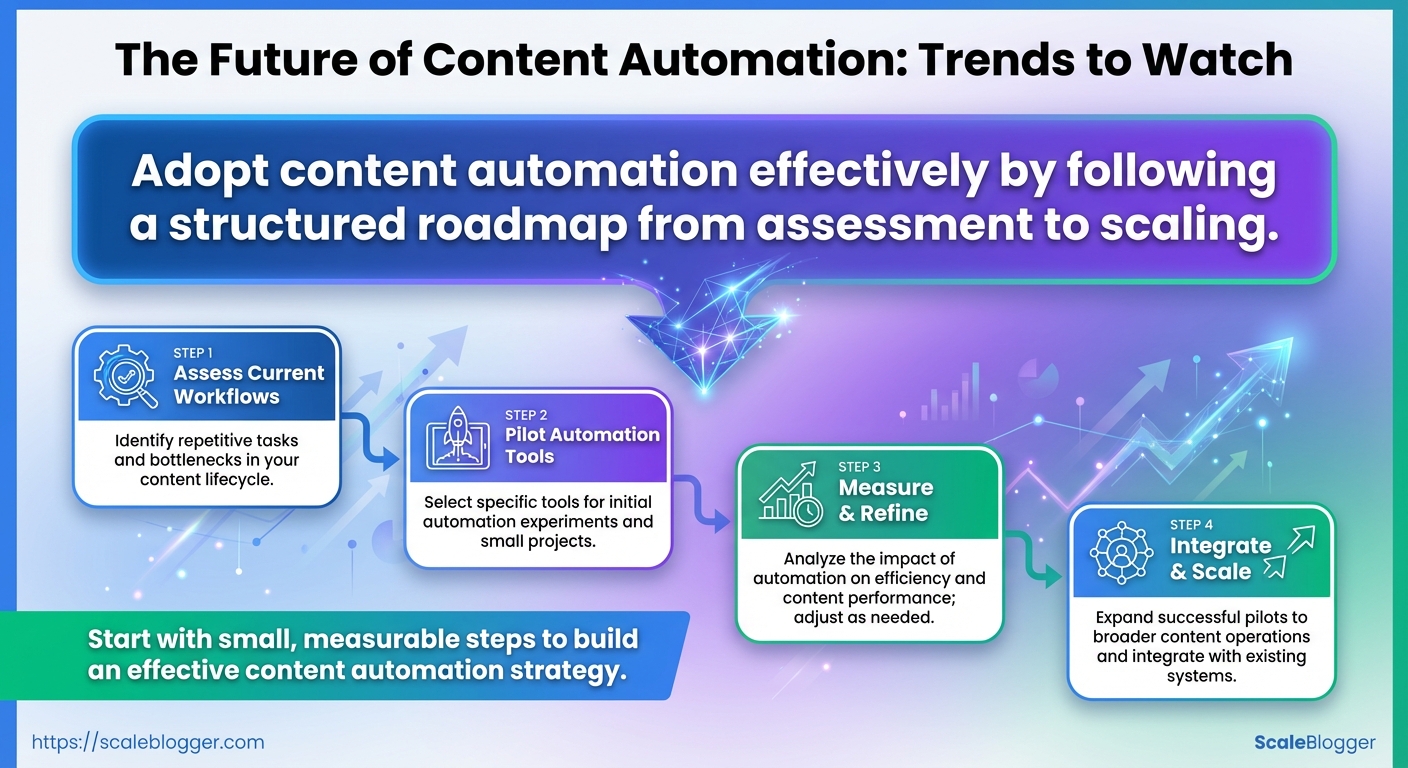
Start by treating adoption like a product launch. Define a focused pilot, bring the right stakeholders on board, and iterate quickly. Successful rollouts prioritize clear owners, short feedback loops, and KPIs that measure both efficiency and impact on traffic/engagement. The six-step roadmap below turns an abstract strategy into concrete actions, with owners and KPIs suitable for a content organization moving toward automation.
- Assess
- Pilot
- Integrate
- Train
- Measure
- Scale
A phased timeline for pilot → integrate → scale with suggested durations and owner roles
Table: How to Start: Practical Roadmap for Adoption — Phase, Duration, Owners & more
| Phase | Duration | Owners | Key deliverables |
|---|---|---|---|
| Assess | 2–4 weeks | Product Lead, Head of Content, SEO Lead | Inventory of content assets; workflow gap map; priority use cases |
| Pilot | 4–8 weeks | Cross-functional team (Content PM, 1–2 Writers, Data Analyst) | 3–5 automated workflows; sample posts published; pilot KPI dashboard |
| Integrate | 2–6 weeks | Engineering, CMS Admin, Content Ops | CMS connectors, editorial templates, API keys configured |
| Train | 2–3 weeks (ongoing) | Content Trainer, Writers, Editors | Playbook for prompts, editorial QA checklist, role-based training sessions |
| Measure | 4–12 weeks | Data Analyst, SEO Lead, Content PM | A/B test results, traffic and engagement metrics, efficiency metrics |
| Scale | 2–6 months | Head of Content, Operations, Product | Automation rollout plan, SLA for content ops, ROI report |
Key insight: This timeline balances speed with governance—short pilots reduce risk while clear owners prevent diffusion of responsibility.
Stakeholders to involve
- Business sponsor: secures budget and sets strategic priorities. Content owners: define editorial standards and acceptance criteria. Data/analytics: builds KPI tracking and experiments.
- Engineering/CMS: implements integrations and automations. Legal/compliance: reviews sensitive content and brand safety.
Suggested pilot KPIs
- Speed: Time-to-publish reduction (target 30–50%). Quality: Content score via editorial rubric; maintain baseline or improve. SEO impact: Organic sessions and rankings for targeted topics.
- Efficiency: number of articles per editor per month. User engagement: average time on page and scroll depth.
Practical tips: start with formats that map easily to automation (listicles, how-tos, data-driven summaries). Use API-first connectors for the CMS to avoid manual uploads. Consider Scaleblogger.com for automating pipelines and benchmarking pilot performance against industry patterns.
Understanding these principles helps teams move faster without sacrificing quality. When teams adopt this roadmap, decision-making shifts closer to creators and the organization gains predictable content velocity and measurable SEO upside.
Conclusion
Teams that move from ad-hoc publishing to systematic automation free capacity for strategy, not just faster output. The article showed how content automation reduces repetitive work, how orchestration layers connect briefs to distribution, and why near-term advances in AI-driven templates and mid-term platform consolidation matter for scalability. Practical roadmaps and the B2B marketing example illustrated that small pilot projects — one reusable template, one automated review loop — deliver measurable time savings and cleaner analytics.
