

Collaborating with creators can look simple on paper, but a perfect brief can quickly become messy when one idea has to work as a video, carousel, caption thread, and static post without losing its voice.
In the creator economy, multi-modal creators must move fast, stay on brand, and adapt content for different platforms. Problems often begin during the handoff—unclear responsibilities, delayed approvals, and inconsistent feedback.
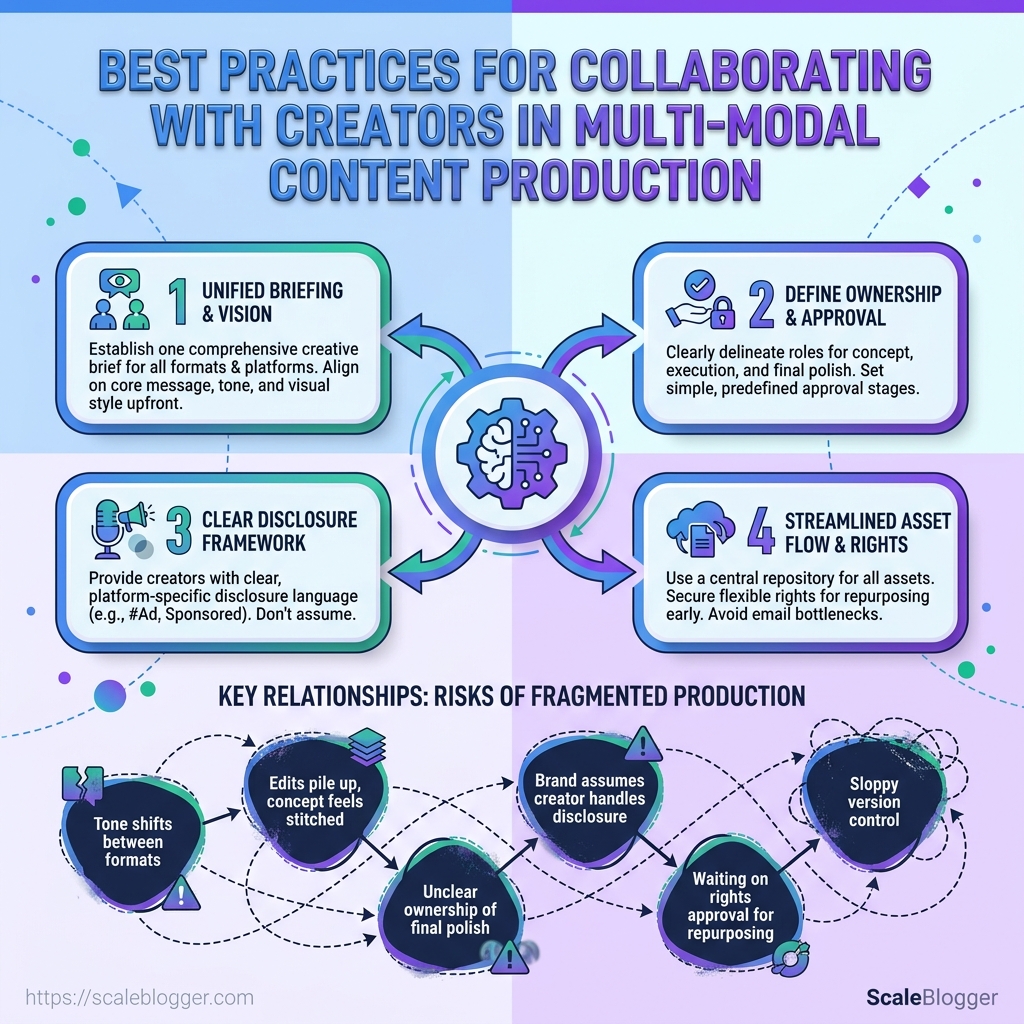
Without a clear content collaboration process, edits pile up, version control gets messy, and strong ideas can turn into disconnected content across formats.
Quick Answer: Multi-modal creator collaboration succeeds when you standardize the handoff: define the deliverables by format, set clear review/approval owners, and bake compliance checks (including disclosure requirements for paid content) into the same workflow gate—so each asset (video, carousel, captions, static post) survives platform constraints without last-minute rewrites. Build that operating model before the first draft, including how revenue splitting and usage terms will be handled.
Why multi-modal creator collaboration fails or succeeds
Why does a brief that looks airtight in a meeting fall apart once video, audio, and written assets enter the same project?
Usually, the problem is not talent.
It is the mismatch between one idea and three different production logics.
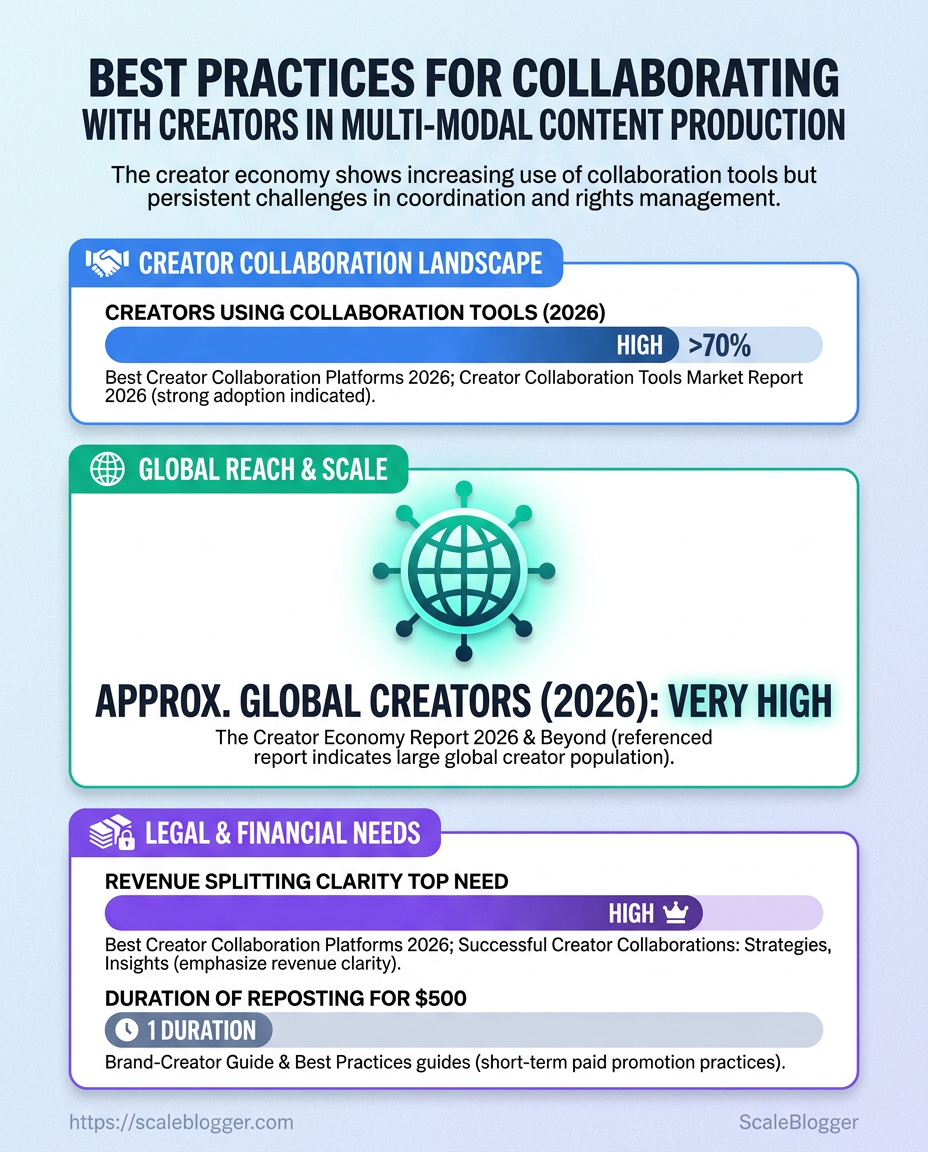
In 2026, the creator economy spans roughly 303 million creators globally, according to InfluenceFlow’s 2026 creator collaboration platforms guide, and that scale makes sloppy coordination expensive fast.
The same guide also cites Statista showing that 67% of creators now use dedicated collaboration tools, up from 45% in 2024, which tells us the work has become more organized but not automatically more aligned.
The breaking point often shows up at the format boundary.
An ACM interview study with 21 cross-platform creators found that they constantly negotiate platform constraints as they move between channels, which explains why a script that works on YouTube can feel dead in a LinkedIn post or too flat as a podcast teaser.
Once one brief has to support multiple outputs, every line needs to survive a different audience, a different length, and a different approval path.
Where the friction shows up
- Rights get fuzzy fast. A 2024 example in InfluenceFlow’s contract guide describes a brand reposting a sponsored TikTok across all channels for 18 months after paying only $500.
- Disclosure rules get missed. The FTC’s Endorsement Guides still require clear
#ador#sponsoredlabeling where viewers see it first.
- Revenue splits stay unclear. InfluenceFlow cites a 2026 HubSpot survey where 71% of creators ranked clear revenue splitting as their top platform need.
- Approvals spread out too far. One brief can support three formats only when the script, caption, edit notes, and publishing owner are all assigned early.
The fix is less glamorous than most teams hope.
It starts with a tighter operating model: format-specific deliverables, a rights window, a disclosure rule, and a clear owner for every handoff.
That matters even more now, because creator collaboration is moving toward mobile-first workflows, faster approvals, and more explicit payment handling.
Teams that get this right stop treating each asset like a one-off and start treating the whole package like a system.
That is where content collaboration becomes repeatable instead of chaotic.
Set the collaboration model before the first draft
A creator who is brilliant on camera can still stall a project if nobody knows who owns the script, the edit, or the approval.
That is why collaboration should be defined by format first, not personality first.
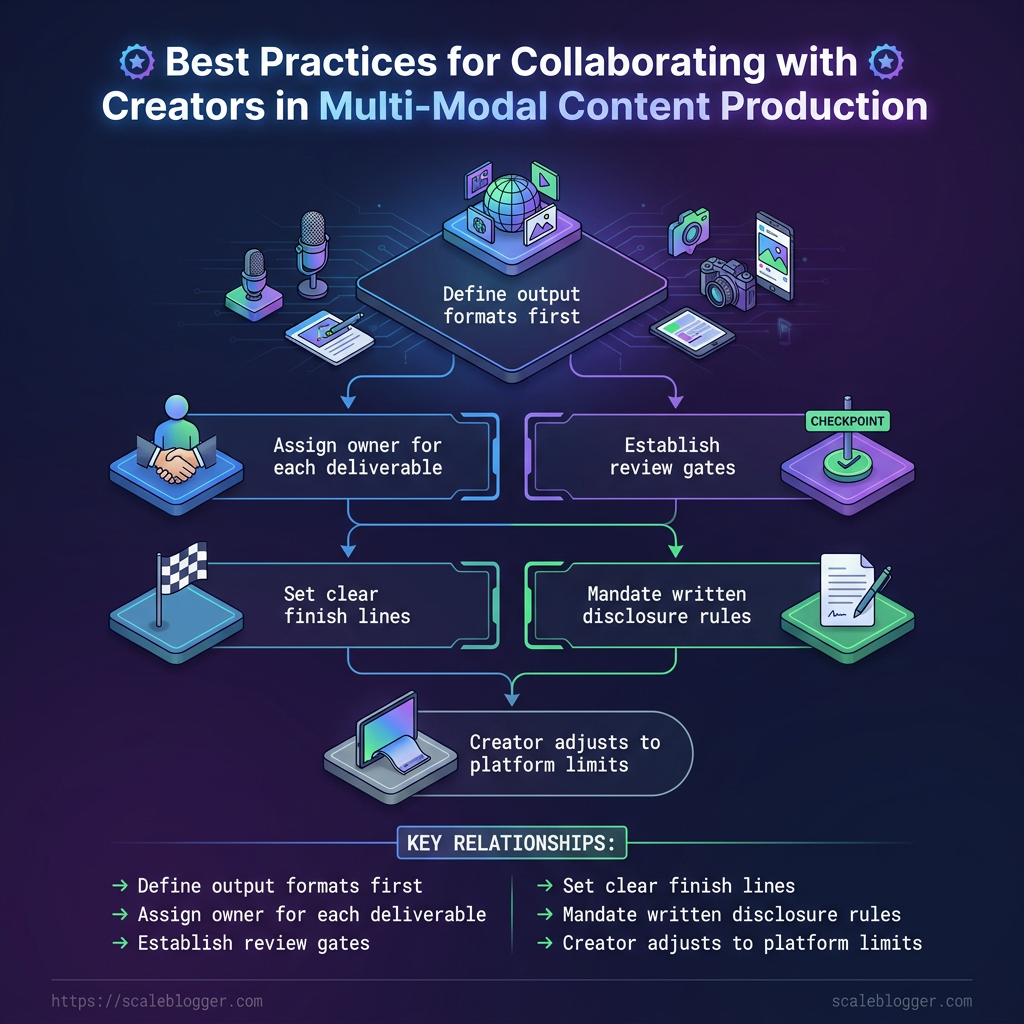
A clean brief starts with the output, then works backward.
If the deliverables include a video, a carousel, and a LinkedIn post, each one needs its own owner, review gate, and finish line.
Sponsored work also needs a disclosure rule in writing, because compliance responsibilities shouldn’t be treated as an after-the-fact “someone will remember” task.
Collaboration matrix for multi-modal production
| Production stage | Primary owner | Creator input | Internal review owner | Output format |
|---|---|---|---|---|
| Topic selection | Strategy lead | Angle ideas, audience insight | Content lead | Approved topic brief |
| Research and scripting | Writer or strategist | Source notes, story beats | Editorial lead | Script, outline, hook set |
| Visual or audio production | Creator or production lead | Performance, footage, voice, raw assets | Brand or creative lead | Video, audio, image set |
| Editing and approval | Editor | Revision notes, timing fixes | Legal, brand, or marketing approver | Final draft with disclosure checks |
| Publishing and distribution | Distribution lead | Caption variants, platform notes | Channel owner | Scheduled posts, CMS entry, social versions |
This matrix works because it removes guesswork before the first asset exists.
It also keeps multi-modal creators from becoming accidental project managers, which is where a lot of content collaboration goes sideways.
The strongest briefs also spell out delivery standards in plain language.
A 60-second Reel is not the same as a 60-word thread, and a YouTube integration should not be judged by the same pacing rules as a static LinkedIn post.
When the model is clear, the draft gets faster, cleaner, and easier to approve.
That is the difference between a campaign that drifts and one that actually ships.
Match creators to the right formats and strengths
Why does a creator with a huge following sometimes underperform on a campaign that looks perfect on paper?
Because reach is only one part of the job.
In a crowded creator ecosystem, format skill matters just as much as audience size. The better question is simple: can this person make the right kind of content, fast, and with enough care to fit the channel?
Video creators usually win on timing, on-camera presence, and visual pacing.
Audio creators tend to be strongest when the message needs warmth, flow, and fewer visual cues.
Carousel specialists are often best at sequencing ideas cleanly across slides.
Long-form writers are the ones who can hold a thesis together, keep the logic tight, and avoid fluff when the brief gets dense.
A scorecard that keeps the match honest
- Creative fit: Does the creator already prove they can work in that format without heavy editing?
- Production speed: Can they turn around usable drafts, cuts, or slide sets without dragging the timeline?
- Audience match: Do their followers look like the people you actually want to reach, not just a large crowd?
- Format fluency: Can they handle the native rhythm of the channel, from hooks in video to structure in writing?
- Compliance awareness: Do they follow disclosure and brand requirements correctly as part of the established review gate?
A practical example helps.
A B2B software brand might pair a sharp writer for a LinkedIn article, a carousel creator for the key ideas, and a video-native creator for a product demo.
Same message, different strengths, far less forcing.
That kind of matching saves edits and avoids awkward repurposing.
It also gives each creator the format they can actually carry.
Design the workflow for fast, consistent production
A draft should not wait three days for a comment.
In multi-modal creator work, speed comes from a workflow that keeps scripts, edits, captions, and approvals moving in one line instead of five messy ones.
That matters even more now: when the same idea must produce several channel outputs, process design becomes basic infrastructure—not an admin nicety.
At Scaleblogger, we use that logic to move one idea into multiple formats without rebuilding the brief every time.
The trick is to separate creation from approval, then keep each stage narrow and predictable.
Turning one idea into multiple drafts
The fastest teams do not ask AI to finish the whole job.
They use it to produce a first pass for each channel, then let humans handle the parts that still need judgment.
A practical comparison helps here.
AI writing and workflow options for multi-format production
| Tool or platform | Best for | Multi-format support | Editing workflow | Collaboration features |
|---|---|---|---|---|
| Scaleblogger | End-to-end blog and social production | Blog drafts, social repurposes, captions, images, and video prompts | Structured draft scoring and review stages | Shared pipeline, scheduling, and auto-publishing |
| General-purpose AI writing platform | Fast ideation and first drafts | Blog copy, captions, summaries, and rewrites | Manual prompt-edit-review loop | Usually light sharing or single-user use |
| Video script generator | Hook-heavy campaigns and short-form scripts | Hooks, scene beats, voiceover lines, and CTAs | Script revision before edit | Comment-based handoff and feedback |
| Outline and brief generator | Planning and angle testing | Outlines, FAQs, and content briefs | Human expansion after approval | Good for shared brief signoff |
| Team editing workspace | Multi-author review | Drafts, comments, and version history | Inline edits and tracked changes | Strong roles, comments, and approvals |
| Social repurposing tool | Turning longform into channel posts | Threads, captions, carousel text, and summaries | Asset-level remix and approval | Shared queues and channel-specific export |
| CMS-connected publishing platform | Final-stage publishing and scheduling | Longform articles, metadata, and excerpts | Pre-publish checks and scheduling | Access control, assignments, and approval gates |
| Brand voice checker | Consistency across creators | Tone notes, rewrites, and style hints | Review against style rules | Feedback loops and shared standards |
The pattern is pretty clear.
General AI tools are flexible, but purpose-built workflows are faster once the same idea needs five output types and one publication path.
Preventing bottlenecks
Approval gates fail when nobody knows how long they last.
InfluenceFlow notes that optimized approval workflows can cut approval time by 30% to 50%, and that kind of speed only shows up when the rules are obvious from the start.
The FTC also keeps tightening disclosure expectations, and InfluenceFlow cites 23% of influencer posts still missing proper disclosure in 2025—so compliance cannot be left for the final glance.
- Version control: Keep one master file and one active draft. Old copies should be archived, not floating around in chat threads.
- Naming rules: Use a fixed pattern like
date_topic_format_version. It sounds boring. It saves hours.
- Approval windows: Set a clear review window, such as 24 hours for factual checks and one final pass for brand voice.
- Rights and disclosure checks: Put usage rights, tagging, and
#adreview in the same gate. That avoids last-minute surprises.
Fast production is not about rushing.
It is about removing the small friction points that waste creator energy and slow publishing to a crawl.
Protect quality, rights, and brand consistency
What happens when a creator nails the content, but the contract is fuzzy? You get avoidable disputes: a usage-rights fight, a disclosure problem, or a brand-voice mismatch that shows up immediately.
Set usage rights and repurposing rules up front
Spell out the basics in plain language:
- Where the asset can run: specific channels (and whether “all channels” is allowed).
- How long it can run: the usage window (and renewal/extension terms).
- Edit permissions: whether the brand can cut, translate, remix, or update claims.
- Repurposing costs: whether cross-posting is included or triggers additional compensation.
When these terms are clear, teams stop guessing—and creators stop treating approvals as a moving target.
Keep the creator voice, not the chaos
The best brand standards act like guardrails, not handcuffs.
Creators should still sound like themselves, but they shouldn’t:
- invent claims or proof points,
- drift into prohibited language,
- ignore platform-specific requirements.
A practical split works well: the brand owns claims, disclosures, and visual/regulated limits; the creator owns phrasing, pacing, and delivery.
Add a QA gate before anything ships
Disclosure and accuracy are not optional “final touches.” They’re part of the publishing standard.
- Rights check: confirm the usage window, platforms, edit rights, and any paid amplification rules.
- Voice check: compare the draft against tone guidance, claims list, and “do not say” items.
- Channel fit check: confirm the format works per network (especially hooks, captions, and disclosure visibility).
- Compliance check: verify
#ador#sponsoredplacement is visible at the point a viewer would first notice the endorsement. - Final owner sign-off: one named reviewer approves the asset to keep accountability unambiguous.
When these gates sit in the workflow—not after the fact—content collaboration gets calmer fast.
Measure collaboration results across every format
A Reels campaign can pull strong views and still be a bad trade.
When multi-modal creators enter the mix, the real question becomes whether each format is doing the job it’s meant to do—without creating hidden cost or approval delays.
Start with one scorecard, not four disconnected reports. The best approach compares engagement, conversion, and production efficiency side by side, because a format that wins attention may still underperform on pipeline impact or turnaround time.
Track the metrics that actually matter
Multi-platform creators do not behave the same way on every channel. A universal KPI usually hides the truth.
Score each format against the job it’s supposed to do:
- Engagement quality: saves, shares, watch time, comments with substance, and swipe-through rate.
- Conversion path: click-through rate, landing-page sessions, assisted conversions, and revenue tied to the asset.
- Production cost: draft-to-publish time, revision count, approval lag, and cost per finished piece.
- Collaboration health: missed handoffs, rework volume, and whether the creator needed a second brief to recover.
Use benchmarks to shape the next brief
Benchmarks should do more than rank last month’s winners. They should tell you what to change next.
- If short video reaches well but converts poorly, update the offer, the CTA, or the landing experience.
- If written posts convert best but take too long to approve, the bottleneck is likely the review workflow—not the creator.
This is the lens that turns measurement into better creator selection, clearer briefs, and faster, more reliable production.
What should be included in a creator contract for multi-modal content (video, images, captions) and repurposing rights?
A creator contract must spell out usage rights and repurposing rules in plain language before any production starts. Specify where the asset can run (including whether “all channels” is allowed), the usage window and renewal terms, what edit permissions the brand has (cut, translate, remix, update claims), and whether cross-posting/repurposing triggers extra compensation. It should also require compliance steps like FTC disclosure so disclosure responsibilities aren’t assumed by the wrong party.
How do you structure an approval workflow when multiple creators and formats must be published across platforms?
You must structure approvals by format first, not by personality, so video, carousels, captions, and static posts move through the same decision path. Build a purpose-built workflow that keeps scripts, edits, captions, and approvals flowing in one line to avoid delays like waiting three days for comments. Include clear review owners and mandatory compliance checks (including FTC disclosure) so rights approval doesn’t block repurposing across platforms.
Making One Idea Work Across Every Format
A strong collaboration model is less about producing more and more about translating one idea cleanly across formats.
That is where most teams stumble in the creator economy: they ask a video-first creator to think like a carousel designer, then wonder why the work feels forced.
The better move is simpler.
Match people to the format they already handle well, set the review rules before the first draft, and treat rights, brand voice, and publishing flow as part of the creative brief, not an afterthought.
That is why the messy brief that looked perfect in the doc often falls apart by publication day.
If one thing should stay with you, it is this: content collaboration works when structure removes friction, not when it adds more meetings. Pick one upcoming campaign, assign each format to the creator best suited for it, and set a single approval path today. If AI writing tools are already part of your process, our platform, Scaleblogger, can help keep drafting, scheduling, and repurposing aligned without turning the workflow into a pile of half-finished tabs.
