

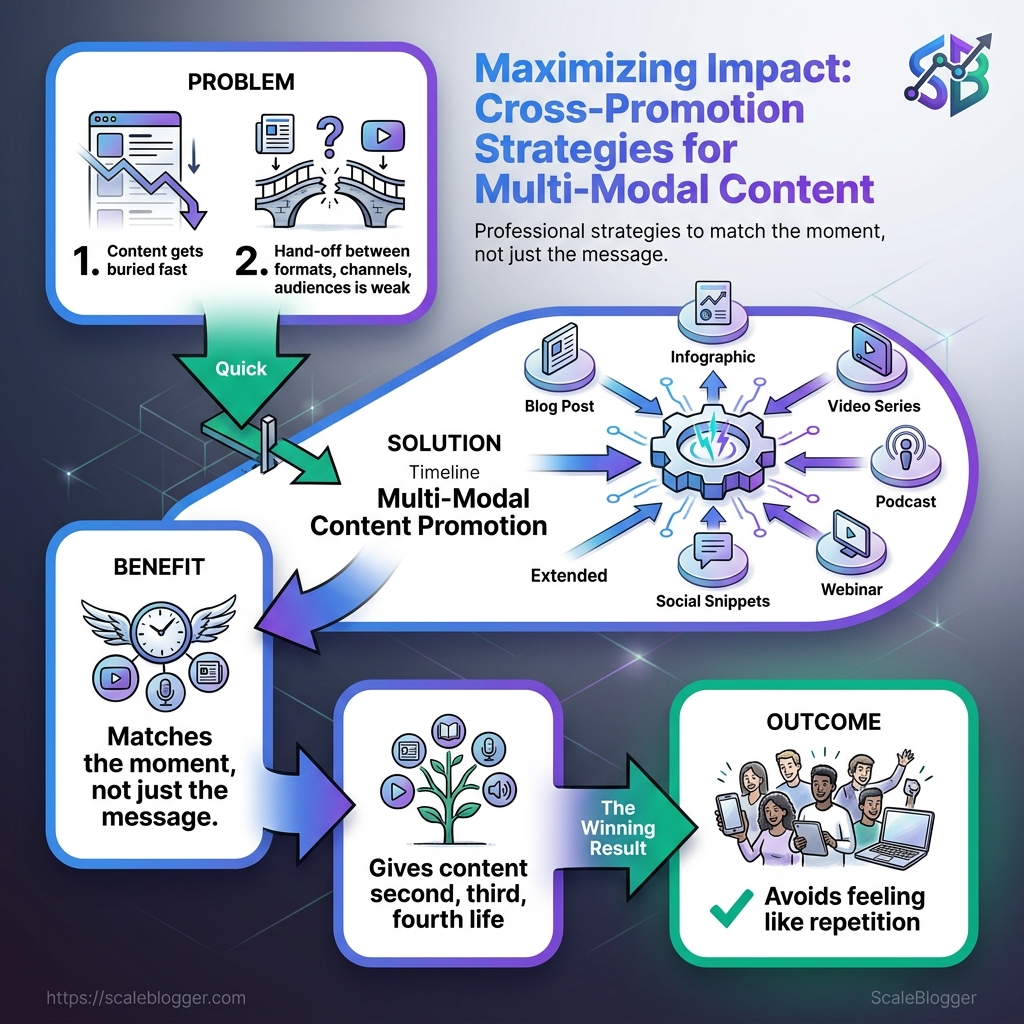
Your strongest piece of content can vanish fast.
One day it looks fresh; two days later, the feed has buried it under louder, faster posts.
That is where cross-promotion strategies start to matter.
The problem is rarely the asset itself; it is the handoff between formats, channels, and audiences.
A webinar clip, a blog post, a carousel, and a short video can all tell the same story without sounding copied.
The trick is multi-modal content promotion that matches the moment, not just the message.
When that part is weak, good work gets stranded.
Strong content distribution techniques give each piece a second, third, and fourth life without making readers feel like they are seeing the same thing on repeat.
Quick Answer: Build a cross-promotion system that adapts one core content asset into native multi-modal formats (e.g., blog post → short highlight clip, skimmable carousel/quote card, email snippet, and search-ready summary) so each audience meets the idea in the context they browse. Instead of repeatedly pushing a single URL, create multiple entry points that all reinforce the same argument and drive back to the original source. Use automation to speed up repurposing mechanics (extracting quotes and drafting platform-length variants) without degrading quality.
Why cross-promotion matters more when content is multi-modal
Why does a strong article stall once it leaves the blog? Usually because the work doesn’t travel—its audience moves to new formats and platforms long before the same idea shows up again.
A single long-form piece can earn deep attention, but it rarely wins on its own anymore. When distribution is fragmented, the content may be excellent and still underperform because it never appears where people actually browse next.
That’s why cross-promotion strategies matter now: the same idea needs to move across search, social, email, video, and partnerships—while still sounding native in each place.
Multi-modal content changes the promotion equation. Instead of one URL getting promoted repeatedly, you get multiple entry points that all lead back to the same core argument. A blog post becomes:
- a short clip that highlights the turning point
- a carousel or quote card that makes the insight skimmable
- a newsletter snippet that frames the takeaway
- a search-friendly summary that matches intent
Each version earns attention in a different context. The “translation” is the key: you’re not copying the post; you’re adapting the idea so each audience can approach it the way they prefer.
So where does automation actually help?
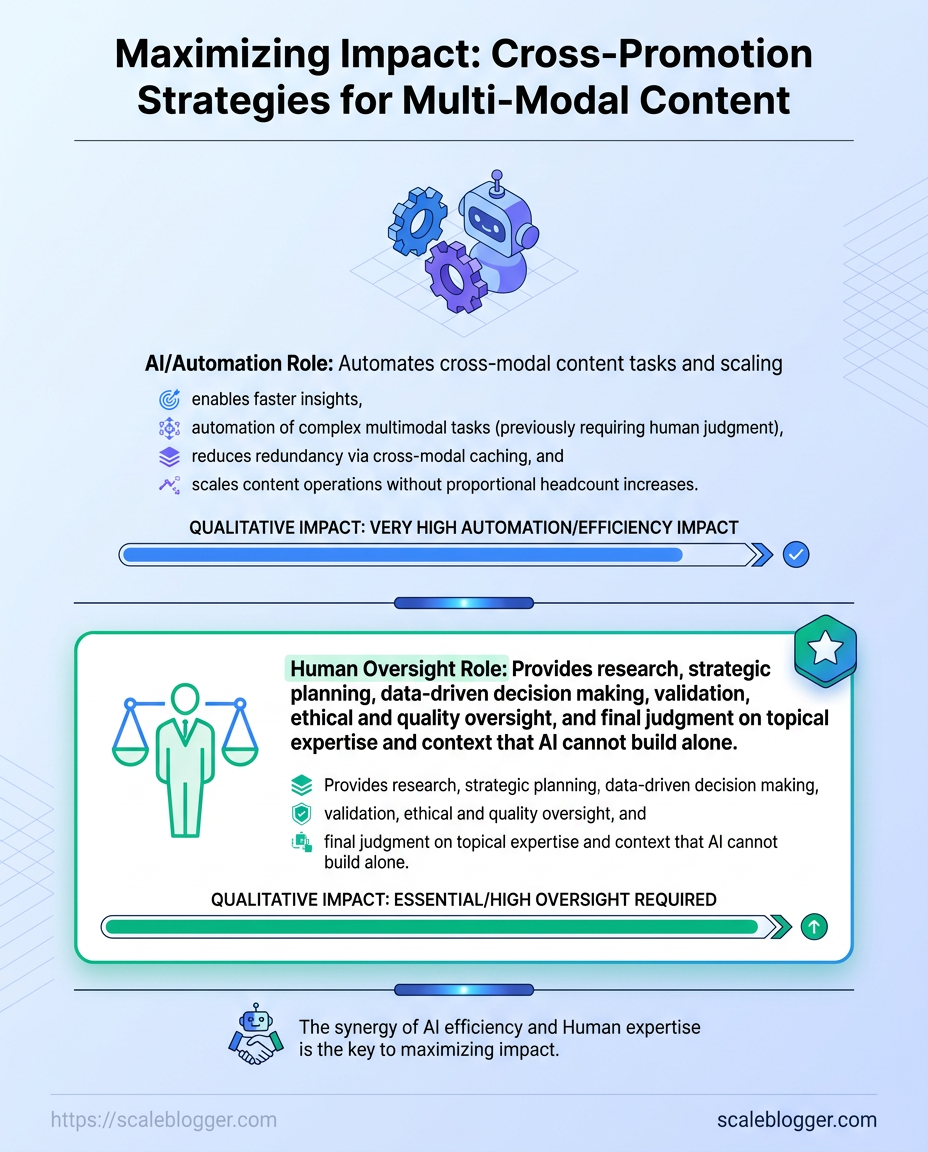
Use it to speed up the mechanics of repurposing—turning one source into usable variants (extracting quotes, drafting platform-length alternatives, generating captions/transcripts, and planning schedules)—so your team can spend time on the decisions that change outcomes: message angle, proof selection, and channel fit.
Then keep editorial control where it matters. Human review should verify:
- voice (does it sound like your brand?)
- accuracy (do claims match the source?)
- relevance (does the asset match the audience’s intent in that channel?)
When you treat automation as production support—not authorship—you scale without flattening your point.
Cross-promotion works best when every format feels native, but unmistakably connected to one core idea.
Build a cross-promotion system around one content source
Momentum usually isn’t lost to weak writing—it’s lost to weak routing.
A great asset can’t compound if your team treats promotion like a one-off task instead of a system that knows what to repurpose first, where it belongs, and how it connects back to the original argument.
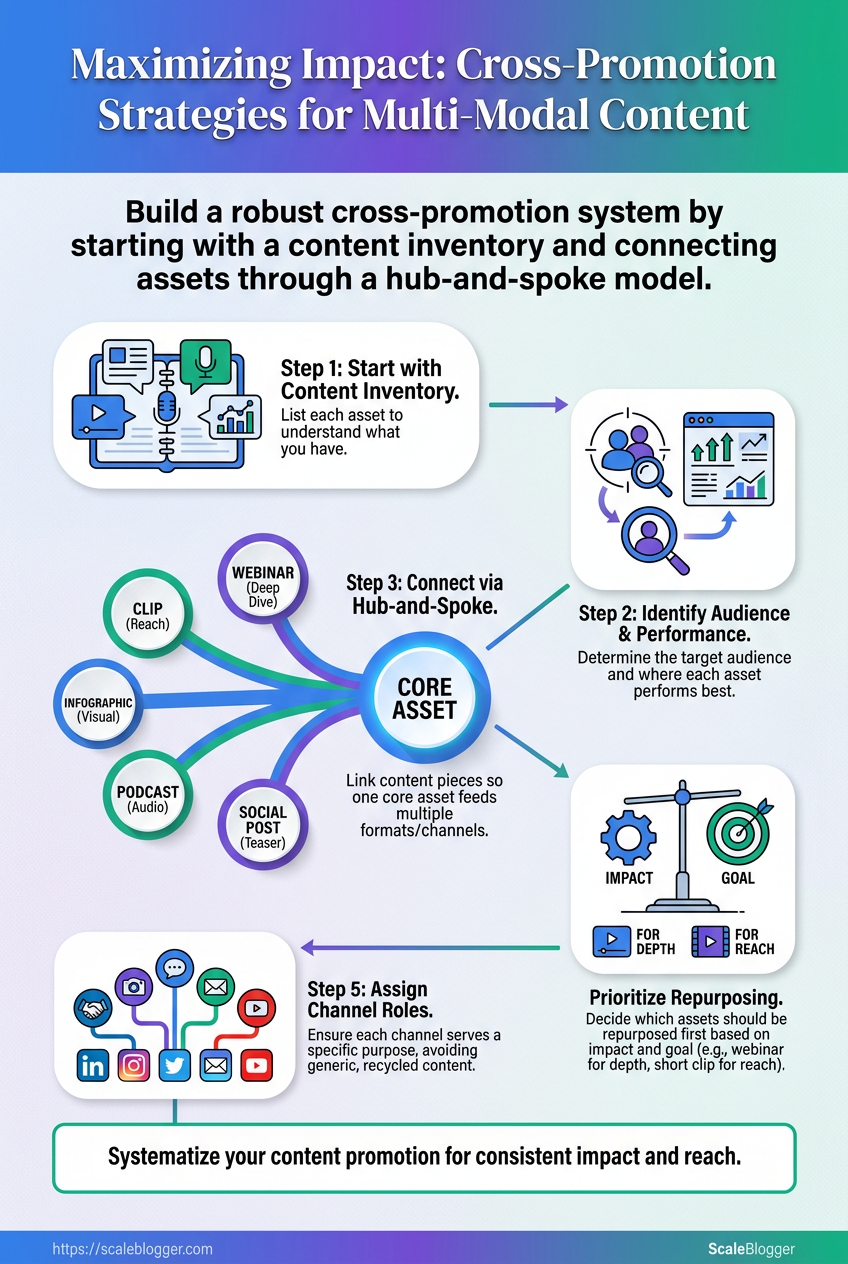
The smartest setup starts with a content inventory. List each asset, the audience it serves, and where it already performs best, then connect the pieces through a hub-and-spoke model.
Semrush describes multimodal content as turning one asset into multiple formats, and Criteo’s 2026 cross-channel guide pushes the same idea: plan once, then show up across the places people actually spend time. Semrush’s guide to building a multimodal content strategy and Criteo’s cross-channel marketing strategies for 2026 both point toward the same practical move.
That inventory should answer one blunt question: what gets repurposed first? A webinar recording usually beats a case study if your audience wants depth. A short-form clip usually beats a newsletter issue if your goal is reach.
Cross-promotion works best when each channel has a job, not when every channel gets the same recycled copy.
The U.S. Chamber’s cross-promotion advice fits here too: clear roles and shared planning make the whole system easier to run. U.S. Chamber cross-promotion strategies for small businesses
Content mapping framework
| Content Asset | Best Channel | Repurpose Effort | Audience Fit | Priority |
|---|---|---|---|---|
| Pillar article | Blog, email, LinkedIn | Medium | High-intent readers | High |
| Webinar recording | YouTube, clips, email | High | Decision-stage audiences | High |
| Short-form video | LinkedIn, Instagram, X | Low | Top-of-funnel viewers | High |
| Newsletter issue | Email, blog recap | Low | Returning readers | Medium |
| Case study | Sales pages, email, social proof posts | Medium | Buyers and skeptics | High |
| Podcast clip | LinkedIn, YouTube Shorts, X | Low | Commute-time listeners | Medium |
High-priority assets usually combine strong proof, broad reuse, and clear channel fit. Low-effort pieces move faster, but the real value comes from pairing them with heavier assets that carry trust, like webinar clips and case studies.
A tidy inventory also makes scheduling easier.
In practice, map one core asset, assign one primary channel, then choose two secondary spokes around it. That keeps work focused instead of chaotic.
That structure is exactly what scales better than one-off posting—especially when your team is building Scaleblogger-style content pipelines across blog, email, and social.
Match promotion tactics to each content format
Different formats reward different packaging.
A long-form post supports nuance and navigation. Video rewards moments. Visual and interactive formats need context people can consume quickly—without hunting for meaning.
That’s how modern cross-channel planning works in practice.
Criteo’s cross-channel marketing guide for 2026 and Semrush’s multi-modal content strategy guide both point to the same idea: one asset should not be promoted the same way everywhere.
Long-form articles
A blog post works best when promotion feels like a trail, not a shout.
Pull one sharp quote, one supporting stat, and one practical section into different distribution angles.
- Internal link paths: Point readers to related guides, case studies, or product pages that extend the same question.
- Quote blocks: Lift a sentence that sounds decisive on its own. That gives social posts a clean hook.
- Social angles: Turn one article into three posts: a contrarian claim, a how-to tip, and a mistake to avoid.
Video and audio
Video and audio need moments people can feel fast.
The strongest promotion tactic is usually to isolate one clear turning point, then reuse it as a clip, transcript snippet, or newsletter insert.
- Clips: Cut around the strongest sentence or example, not the introduction.
- Transcripts: Pull exact wording for captions, summaries, or search-friendly blog support.
- Newsletter inserts: Use a short takeaway plus a link to the full episode or segment.
Improvado’s multi-channel marketing strategy guide makes the same point in a different way: audience preferences change by platform, so the packaging has to change too.
Interactive or visual content
Interactive content works when the promotion explains the usefulness before the novelty.
People rarely click because something is “interactive”; they click because they expect a clearer answer.
- Summary cards: Describe the outcome in plain language, not the mechanism.
- Annotations: Highlight one surprising data point or pattern from the experience.
- Supporting explainers: Publish a short companion post that shows how to read the result.
The U.S. Chamber’s cross-promotion strategies guide reinforces a simple rule: match the message to the moment, not just the channel.
When the format and the tactic fit, distribution stops feeling like repetition and starts feeling like translation.
That’s where cross-promotion strategies pay off—especially across mixed media and multi-modal content promotion.
Apply AI and automation to scale promotion without losing quality
AI helps when it accelerates repeatable work—and leaves judgment to humans.
In multi-modal content promotion, the “repeatable” parts are the channel variants: captions, subject lines, post trims, metadata, and scheduling copy.
The risk is publishing generic output that sounds interchangeable.
So the workflow has to be built around editing discipline, not just generation.
Criteo’s cross-channel marketing strategies for 2026 makes the same practical point: plan once, then show up across formats without treating every channel like a blank page.
Semrush also frames multi-modal content strategy as turning one strong asset into text, video, audio, and visuals without losing the core idea.
At Scaleblogger, our pipeline is built for that middle ground.
We use automation for the heavy lifting, then keep human review focused on voice, factual accuracy, and channel fit.
The safest way to scale content distribution techniques is to treat AI as a first-draft engine, not a final publisher.
That matters even more when cross-promotion strategies span social, blog, video, and email, because each channel rewards a slightly different tone.
VerticalResponse’s marketing plan guidance for 2026 also recommends weekly cross-team syncs—a reminder that speed falls apart when content, paid, and social work in separate rooms.
A clean workflow usually looks like this:
- Draft the core angle: Keep one source message and one audience promise.
- Generate channel variants: Ask AI for platform-specific lengths, hooks, and CTAs.
- Score for fit: Reject lines that feel flat, vague, or overhyped.
- Check facts first: Match every claim to the source article or approved notes.
- Restore brand voice: Swap generic wording for the phrases your audience actually trusts.
The editing rules are simple, but they save everything.
Cut clichés, remove filler, and keep one opinionated sentence that sounds unmistakably like you.
One more guardrail helps a lot: read every AI draft out loud.
If it sounds like it could belong to any company in any industry, it is not ready yet.
That last pass keeps automation useful instead of noisy.
It also makes scale feel intentional—which is the whole game.
Measure performance across channels and refine the distribution plan
Impressions aren’t the outcome.
Two channels can look equally busy on paper, yet produce very different business results.
A post can rack up impressions and still send almost no qualified traffic, while a smaller channel quietly drives clicks, repeat visits, and real downstream action.
The cleaner way to judge cross-promotion strategies is to group metrics into three buckets: reach, engagement, and downstream behavior.
That lines up with how cross-channel planning is handled in current marketing guidance, including Criteo’s 2026 view that teams should verify core events across web, social, video, and retail—not just stare at vanity numbers (Criteo’s cross-channel marketing guide for 2026).
Attribution gets messy fast.
A LinkedIn post, an email, and a YouTube clip can all touch the same reader before a conversion.
That is why the comparison should focus on channel contribution, not a single last click—and why platforms like Semrush and Improvado keep stressing channel-specific behavior and tailored measurement in multi-modal content promotion and broader content distribution techniques (Semrush’s guide to building a multimodal content strategy and Improvado’s multi-channel marketing strategy guide).
Performance dashboard fields that matter most for cross-promotion
A useful dashboard does not need fifty fields.
It needs the right ones, repeated consistently, so patterns become obvious after a few weeks.
Here, we track the same logic across every channel: how many people saw it, how many cared, and how many moved deeper into the funnel.
That makes it much easier to refine the distribution plan without getting fooled by one flashy metric.
| Channel | Primary Metric | Secondary Metric | Benchmark | Action Trigger |
|---|---|---|---|---|
| Organic search | Clicks from search results | Average position | Stable or improving month over month | Refresh titles or internal links if clicks stall |
| Click-through rate | Reply or forward rate | Above prior campaign average | Rework subject line or CTA if clicks sag | |
| Engagement rate | Clicks to site | Consistent audience growth and steady clicks | Test new hook, format, or posting time | |
| YouTube | Watch time | Traffic to linked asset | Retention holds after the opening segment | Tighten intro or improve end-screen CTA |
| Website internal links | Clicks to destination page | Scroll depth on source page | Destination clicks rise without harming source engagement | Move links higher or adjust anchor text |
If one channel shows strong reach but weak downstream behavior, it is probably acting as awareness support, not conversion support.
If internal links keep winning while social clicks fade, the distribution mix needs a sharper bridge between formats and landing pages.
The most useful dashboard fields are the ones you can compare every week without debate.
Keep the table simple, keep the source tags clean with UTMs, and watch which channels consistently move readers from first touch to deeper intent.
That is where distribution starts earning its keep.
How do cross-promotion strategies help multi-modal content travel?
Cross-promotion strategies help multi-modal content travel by routing the same core idea through multiple formats and channels where audiences already browse. Instead of relying on one URL that gets buried, you create native entry points (like clips, carousels, email snippets, and search-ready summaries) that reinforce the same argument and drive back to the original source.
What is a hub-and-spoke model for promoting one content source?
A hub-and-spoke model uses one primary “hub” asset (the original long-form content) and then creates several “spokes” that repurpose it into different formats and placements. Each spoke acts as a separate entry point—video highlight, skimmable carousel/quote card, email snippet, or metadata-enhanced summary—while all spokes connect back to the hub’s core argument.
How do you match promotion tactics to different content formats?
You match promotion tactics to format by packaging the idea for how people consume it. Long-form content supports nuance and navigation, while video focuses on moments and visuals; interactive or visual formats need immediate context so meaning doesn’t require hunting. The goal is to sound native in each channel rather than forcing every audience to click through the same experience.
Which repeatable tasks can AI automate in multi-modal promotion?
AI can automate repeatable variant work such as captions, subject lines, post trims, metadata, and scheduling copy. It can also help extract key quotes and draft platform-length versions so humans can apply editing discipline. This keeps output consistent and scalable while preventing overly generic, interchangeable text from being published.
What metrics should you track for cross-promotion across channels?
Track metrics in three buckets: reach, engagement, and downstream behavior. Impressions alone can mislead, so pair visibility with qualified outcomes like clicks, repeat visits, and other downstream actions. This lets you compare channels fairly and refine the distribution plan based on business impact rather than vanity numbers.
Make One Strong Asset Work Harder
The shift is simple: stop treating content as one-and-done.
A strong article, video, or podcast should become the source for multiple channel-ready messages—each with a clear job for the audience that will see it.
To make this repeatable, combine three steps:
- Map the source to a promotion plan (inventory → hub-and-spokes → priorities).
- Package correctly for the format (hooks, pace, and context that match how people browse).
- Measure contribution (reach → engagement → downstream behavior) and refine your distribution mix.
The article’s core example is straightforward: one blog post can become a short clip, a carousel, a newsletter excerpt, and a social thread—but each version needs a different hook.
That is the heart of multi-modal content promotion, and it’s what keeps good work from disappearing two days after publishing.
Pick one recent piece today and map three offshoots for three different channels. Give each version a specific role, then track which one earns the strongest response—not just the most views.
If the process feels too manual, use an AI-assisted workflow for the repeatable drafts while keeping human editing for voice, accuracy, and channel fit.
