

Marketing teams often waste weeks each quarter on misaligned briefs, duplicated drafts, and slow approvals. These issues only grow as AI tools are introduced without clear ownership.
Build a collaborative, AI-driven content team where strategy, human editorial judgment, and automation work as one operating system—so AI outputs become predictable, measurable, and aligned to your brand.
In this guide, you’ll learn how to define roles and responsibilities, set governance and quality gates, design an end-to-end workflow with SLAs, instrument KPIs and feedback loops, and roll out a 12-month roadmap to scale.
Scaleblogger helps teams map these workflows and skills into practical role templates and automation playbooks.
Discover AI content workflows and automation at Scaleblogger: https://scaleblogger.com
Quick Answer Build a cross-functional AI-driven content team with clear ownership at every stage. The strategist owns briefs and measurable KPI targets, the prompt engineer turns briefs into structured draft variants and maintains a versioned prompt library, the editor/fact-checker validates correctness and brand alignment, the automation engineer manages CMS/integration handoffs, and the data analyst connects results to iterative prompt and workflow improvements. To ensure that publishing stays repeatable at scale, standardize handoffs. Make sure each stage has clear acceptance criteria and set time limits. Capture feedback directly from editor notes and model logs (plus user signals when available) so each cycle tightens output quality and reduces rework—without slowing approvals.Quick Answer: Begin by piloting a workflow you can audit from start to finish: brief, AI-assisted drafting, human QA, publication, and KPI review. Define success thresholds up front (time-to-first-draft, review/rework burden, and early performance signals) and ensure the approval path is explicit. Once the pilot proves repeatability, formalize your operating system by turning what worked into the next layer of structure: role ownership, QA/governance checklists, and stage acceptance criteria—then scale headcount and tooling based on the measured lift.
Section Content
> **Key Takeaway:**Foundation — Why a Collaborative AI-Driven Content Team Matters
A collaborative AI-driven content team accelerates ideation and drafting, maintains a consistent brand…
Foundation — Why a Collaborative AI-Driven Content Team Matters
A collaborative AI-driven content team accelerates ideation and drafting, maintains a consistent brand voice at scale, and enables data-driven personalization without increasing headcount.
When writers, strategists, and automation systems collaborate, AI handles repetitive tasks. This allows humans to focus on judgment, details, and creative direction.
That combination yields faster time-to-publish, predictable quality, and measurable lift from personalized content variants — all essential when competing for attention and search visibility.
Why this matters practically:
Faster ideation: AI surfaces headline variants, topic gaps, and question clusters from keyword and SERP patterns.
Consistent voice: Style guidelines encoded as templates keep output aligned across contributors.
Personalization at scale: Parameterized templates + user signals let teams produce many personalized permutations quickly.
How teams typically organize collaboration
Roles that unite humans and AI
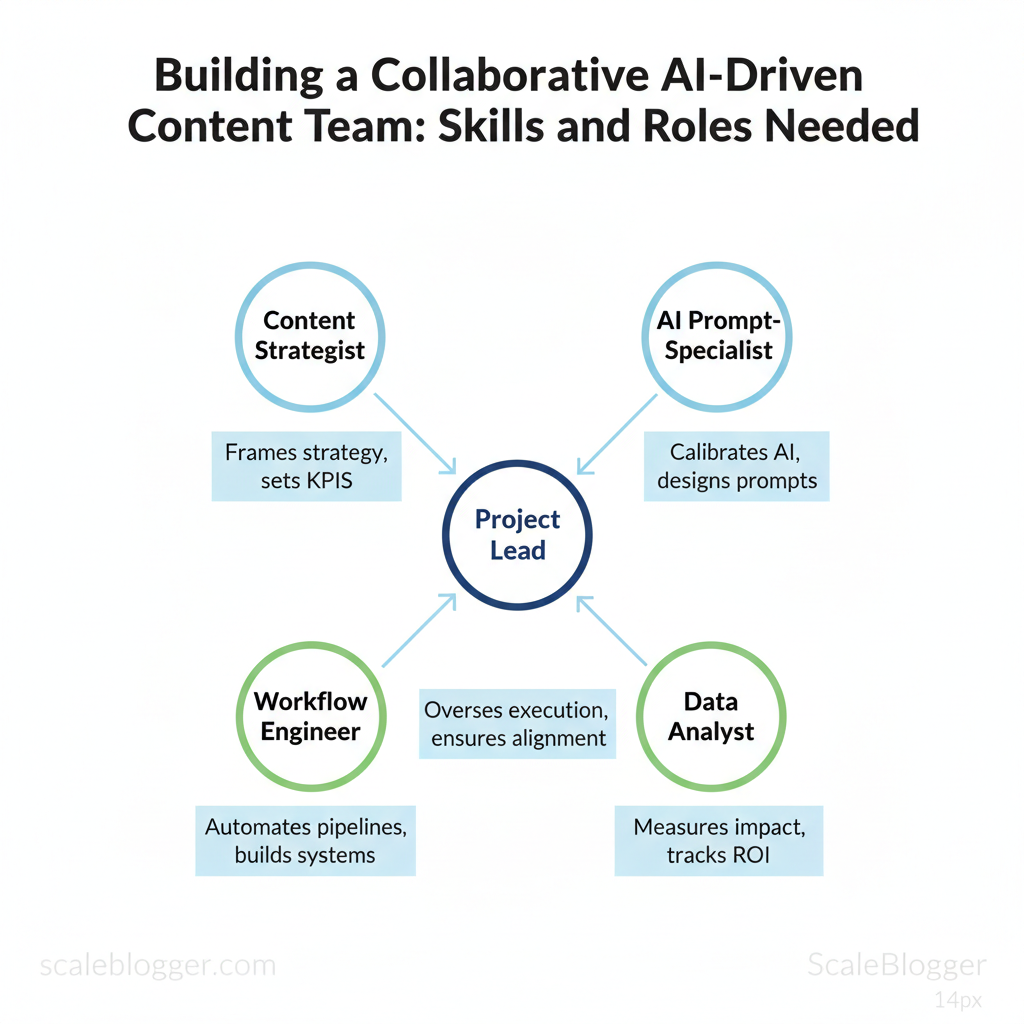
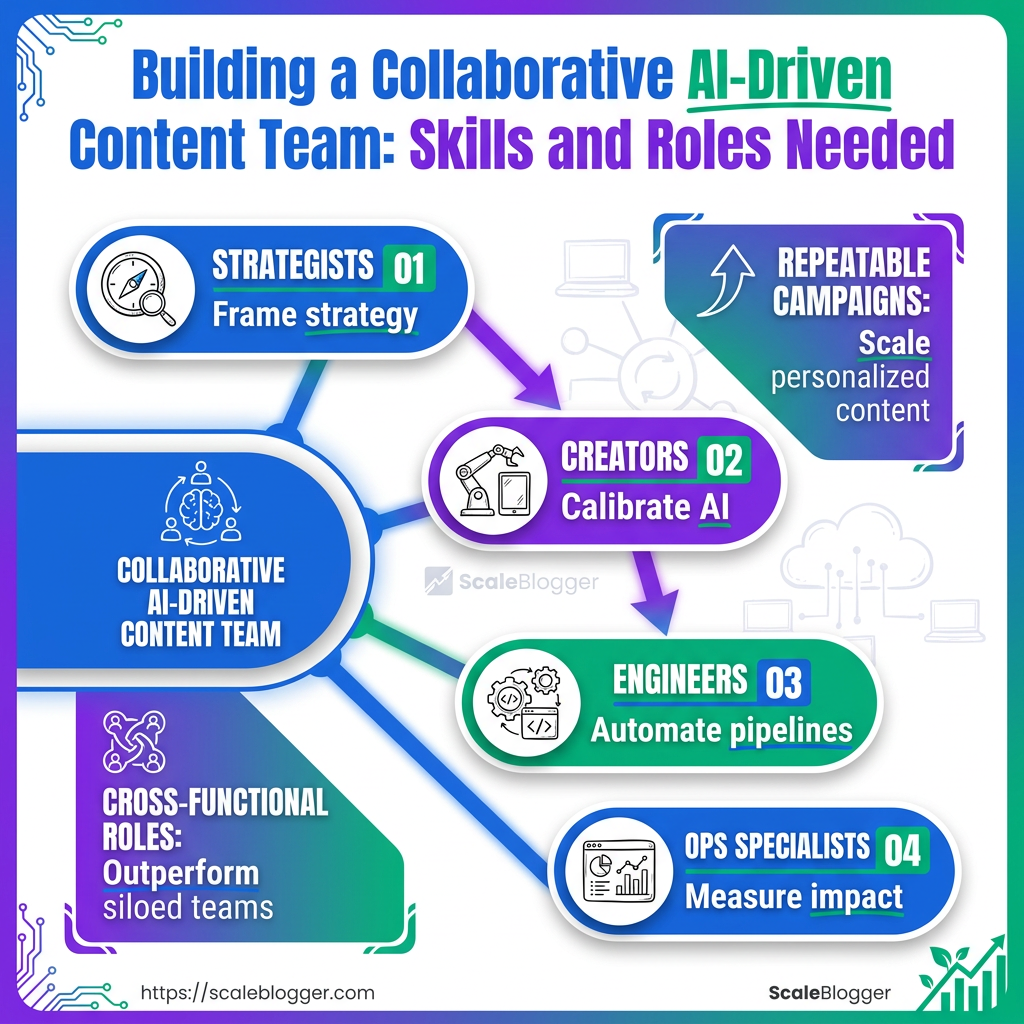
Content strategist: sets KPIs, briefs
prompttemplates, and reviews model outputs.Writer-editor pair: crafts high-value sections and performs editorial QA.
Automation engineer: builds pipelines for scheduling, metadata enrichment, and performance tracking.
Data analyst: ties content variants to engagement signals and adjusts models.
Practical governance and risk controls
Governance checklist
Define allowed AI uses — which tasks are draft-only vs publish-ready.
Set quality gates — editorial review, factual verification, and plagiarism checks.
Maintain model provenance — record prompts, model version, and generation timestamp.
Privacy and compliance — scrub PII and respect copyright in training data.
Performance SLAs — expected iteration cadence and remediation steps for failures.
Accountability cycles
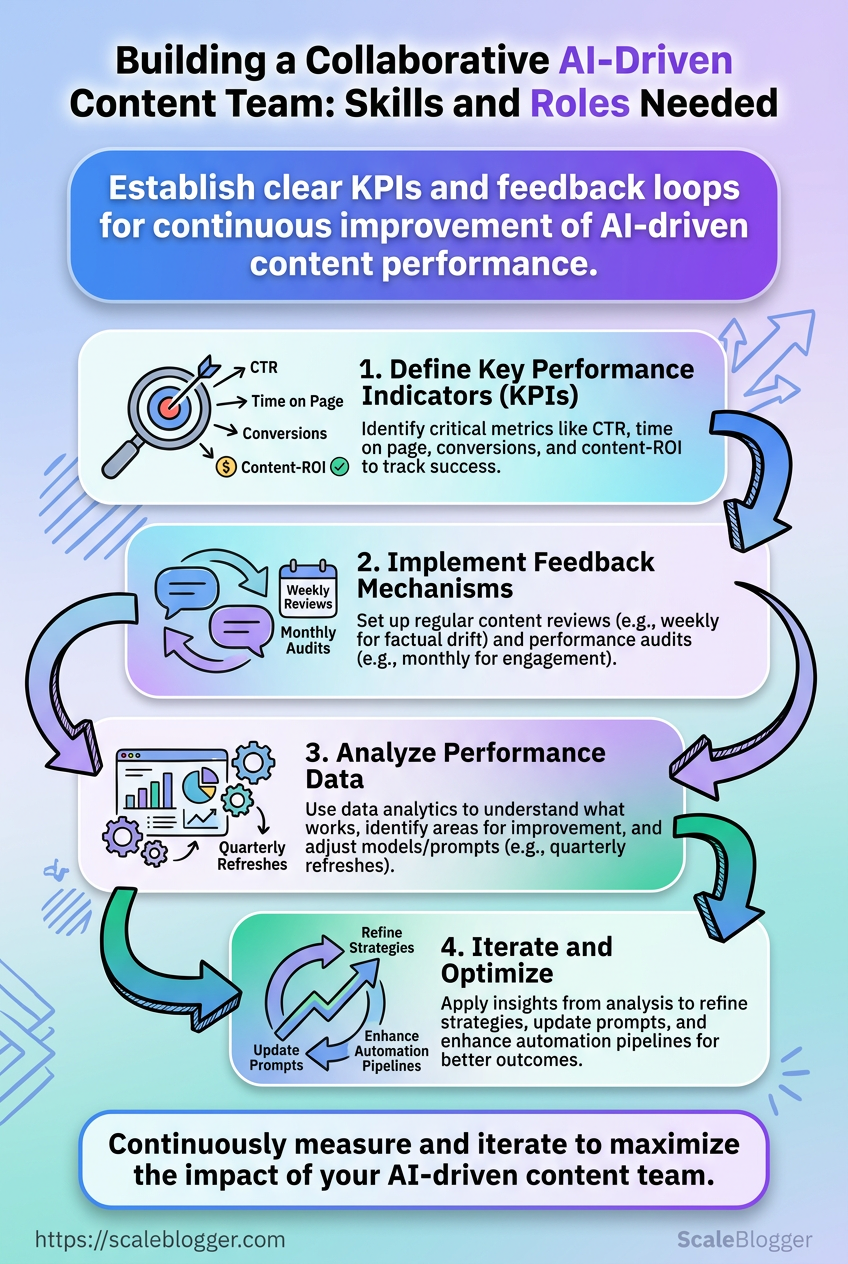
Weekly content reviews for factual drift.
Monthly performance audits (CTR, time on page, conversions).
Quarterly model and prompt refreshes.
Common risks and mitigation
Hallucination risk:* mandate human fact-check for claims and data.
Voice drift:* lock core brand voice elements in templates and linters.
Bias amplification:* diversify prompt inputs and review outputs for representational fairness.
Manual vs AI-augmented vs fully automated content workflows and expected outcomes
| Capability | Manual Team | AI-Augmented Team | Fully Automated |
|---|---|---|---|
| Time to first draft | 3–7 days | hours–24 hours | minutes–hours |
| Quality consistency | Variable by writer | High with human QA | Consistent, needs monitoring |
| Personalization at scale | Limited manual segments | Personalized variants at scale | High personalization via templates |
| Iteration speed | Slow (days–weeks) | Fast (hours–days) | Fastest (minutes–hours) |
| Cost per piece | $500–$2,000 | $50–$300 | <$50 |
For teams ready to operationalize this, tools that automate pipelines and measure performance—paired with a clear governance checklist—make the transition manageable.
If you want a hands-on way to implement these patterns, consider how to scale your content workflow and measure results with an AI-powered content pipeline like those offered by services that automate scheduling, benchmarking, and optimization.
Understanding these principles helps teams move faster without sacrificing quality.
Section Content
> **Key Takeaway:**Roles and Responsibilities — Defining the AI-Driven Content Team
An effective AI-driven content team blends traditional editorial skills with model-first technical roles so…
Roles and Responsibilities — Defining the AI-Driven Content Team
An effective AI-driven content team blends traditional editorial skills with model-first technical roles so outputs map directly to business goals.
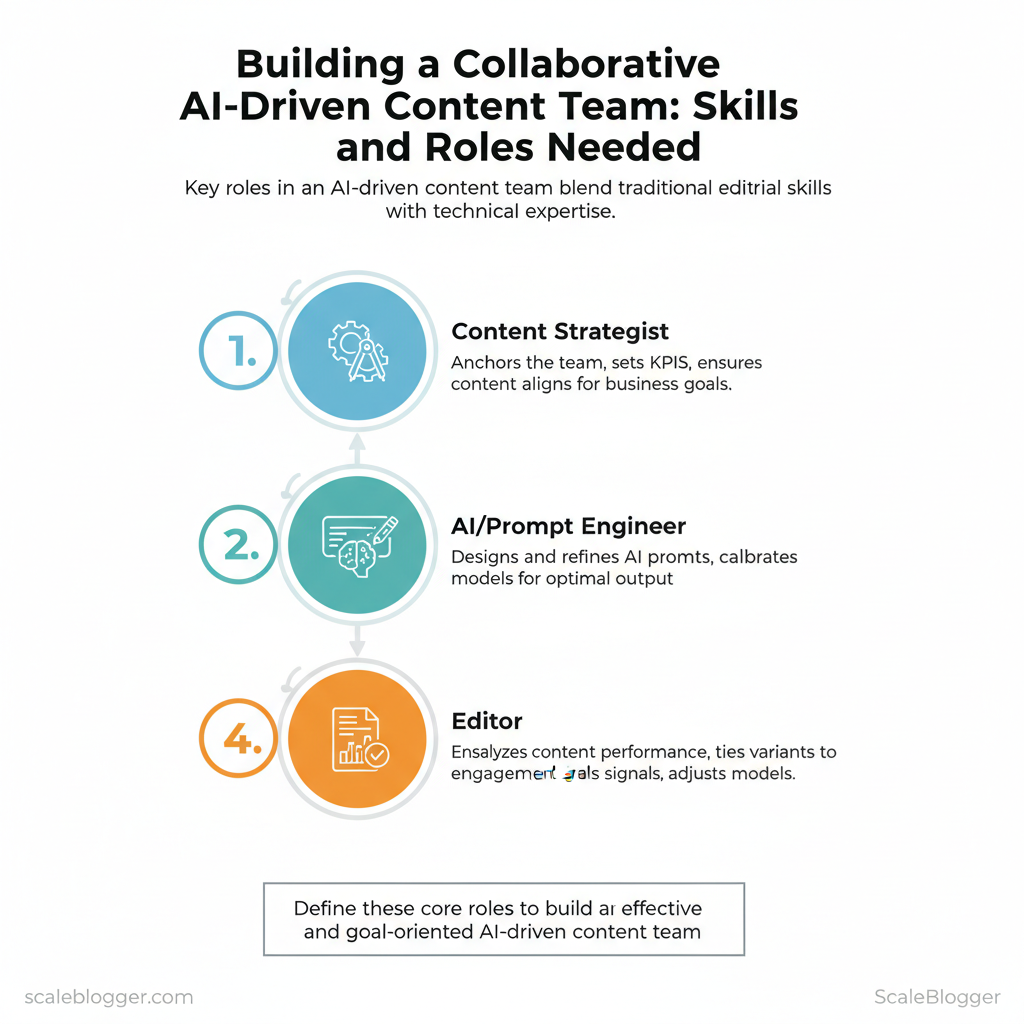
Start by anchoring the team around four core roles — content strategist, AI/prompt engineer, editor, and data analyst — then extend into legal, UX, product, and project management to close governance and delivery gaps.
This structure prevents model drift, protects brand voice, and turns raw AI drafts into measurable traffic and conversion gains.
Core role descriptions and how they interact
Content Strategist: Aligns content topics to business objectives, defines audience segments, and sets KPIs like organic sessions, conversions per article, and topic-cluster growth.
AI/Prompt Engineer: Designs and version-controls prompts, manages model selection and temperature settings, and maintains prompt libraries.
Their output quality is measured by relevance score and reduction in human rewrite time.
Editor / Fact-Checker: Applies brand tone, corrects factual errors, and enforces compliance; essential for reducing risk and maintaining trust.
Data Analyst: Tracks content performance, builds dashboards, and uses model feedback loops to retrain prompts or fine-tune models based on engagement metrics.
Extended stakeholders and collaboration rituals
Legal/Compliance: Reviews riskier content and maintains a checklist for claims and IP.
UX/Product: Ensures content fits user journeys and feeds product roadmaps.
Project Manager: Coordinates sprints, backlog, and SLAs for content delivery.
Recommended collaboration rituals:
Weekly syncs with strategist, editor, and prompt engineer for content backlog triage.
Bi-weekly model review led by the prompt engineer and analyst to adjust prompts and sampling.
Monthly governance meeting including legal and product to review risk issues and roadmap alignment.
Creating a RACI for AI content projects helps avoid handoff confusion:
Responsible: Prompt Engineer, Editor
Accountable: Content Strategist
Consulted: Legal, UX, Product
Informed: Marketing Ops, Stakeholders
Role-feature matrix showing responsibilities, primary KPIs, essential skills, and suggested seniority
| Role | Primary Responsibilities | Essential Skills | Key KPIs |
|---|---|---|---|
| Content Strategist | Topic strategy, editorial calendar, KPI alignment | SEO strategy, audience research, stakeholder management | Organic sessions, CTR, conversions |
| AI / Prompt Engineer | Prompt design, model selection, prompt versioning | NLP concepts, prompt engineering, Git/version control | Draft accuracy, rewrite reduction (%) |
| Editor / Fact-Checker | Tone, accuracy, legal checks | Editing, fact-checking, CMS workflow | Error rate, publish time, brand consistency |
| Content Designer / SEO Specialist | On-page SEO, content structure, internal linking | Technical SEO, UX writing, schema | SERP rankings, time on page |
| Data Analyst | Performance dashboards, feedback loops | SQL, analytics (GA4), A/B testing | Engagement, conversion uplift, model drift metrics |
AI-powered content pipeline for blog creation) can automate many operational tasks while preserving human oversight.
Understanding these responsibilities lets teams move faster while keeping quality and compliance intact.
When implemented properly, these roles reduce bottlenecks and make content decisions measurable at the team level.
Section Content
> **Key Takeaway:**Skills Matrix — What to Hire and Train For
You should hire for a blend of technical AI fluency and classic creative judgment: hire juniors who can execute repeatable tasks and learn…
Skills Matrix — What to Hire and Train For
You should hire for a blend of technical AI fluency and classic creative judgment: hire juniors who can execute repeatable tasks and learn tooling, mids who bridge prompts to strategy, and seniors who set evaluation standards and maintain brand voice.
That means investing in core technical skills—prompt engineering, model evaluation, and platform fluency—while simultaneously training people in editing, narrative craft, and cross-functional collaboration so AI-generated drafts feel authentic and useful.
Practical training pairs short, measurable tasks (prompt A/B tests, labeling exercises) with creative workshops (story arcs, brand voice drills) so teams deliver predictable quality at scale.
Technical and AI-specific skills
Prompt engineering: teach prompt decomposition, context windows, and result conditioning with
system/userrole prompts.Model evaluation: simple metrics (relevance, factuality, hallucination rate) plus human-review workflows.
Tool fluency: hands-on with content platforms, CMS integrations, and basic API use (export/import, scheduling).
Creative and collaboration skills
Editing and voice: exercises where writers rewrite AI drafts to match style guides.
Storytelling: teach structure templates—hook, problem, resonance, CTA—and force-fit AI output into them.
Cross-functional communication: establish clear briefs and feedback loops with PR, product, and SEO teams.
Practical exercises and examples
Prompt A/B workshop: two prompts, measure engagement uplift on headlines.
Labeling sprint: 200 examples labeled for hallucination vs. factual content to train model-evaluation rubrics.
Collaborative edit session: pair a junior prompt-writer with a senior editor to align brand voice.
Code example: simple prompt template
System: You are a concise B2B SaaS copywriter.
User: Write a 60–80 word paragraph for {product} emphasizing {benefit} and include a soft CTA.
Skills-by-role matrix to guide hiring and training priorities (skills for AI marketing)
| Skill | Junior Proficiency | Mid Proficiency | Senior Proficiency |
|---|---|---|---|
| Prompt Engineering | construct basic prompts, use templates | iterate prompts, prompt chaining | design prompt frameworks, cost/latency |
| Content Strategy | follow briefs, topic research | map topic clusters, brief authors | set editorial calendar, ROI modeling |
| SEO & Content Optimization | keyword research basics, on-page SEO | technical SEO flags, schema use | strategy across funnels, performance forecasting |
| Data Analysis & Metrics | read dashboard KPIs, basic A/B tests | cohort analysis, attribution basics | experiment design, LTV/content impact modelling |
| Editorial Judgment | copy editing, grammar | voice consistency, structural edits | brand stewardship, sensitive content review |
If you want, I can adapt this matrix into role-specific job descriptions or a 90-day training plan aligned with your content pipeline and automation goals.
When paired with your workflow and KPIs, it reduces ramp time and keeps quality decisions consistent across the team—so creators can focus on drafting, editing, and narrative direction rather than coordination overhead.
Section Content
Workflows and Processes — Designing AI-Ready Content Operations
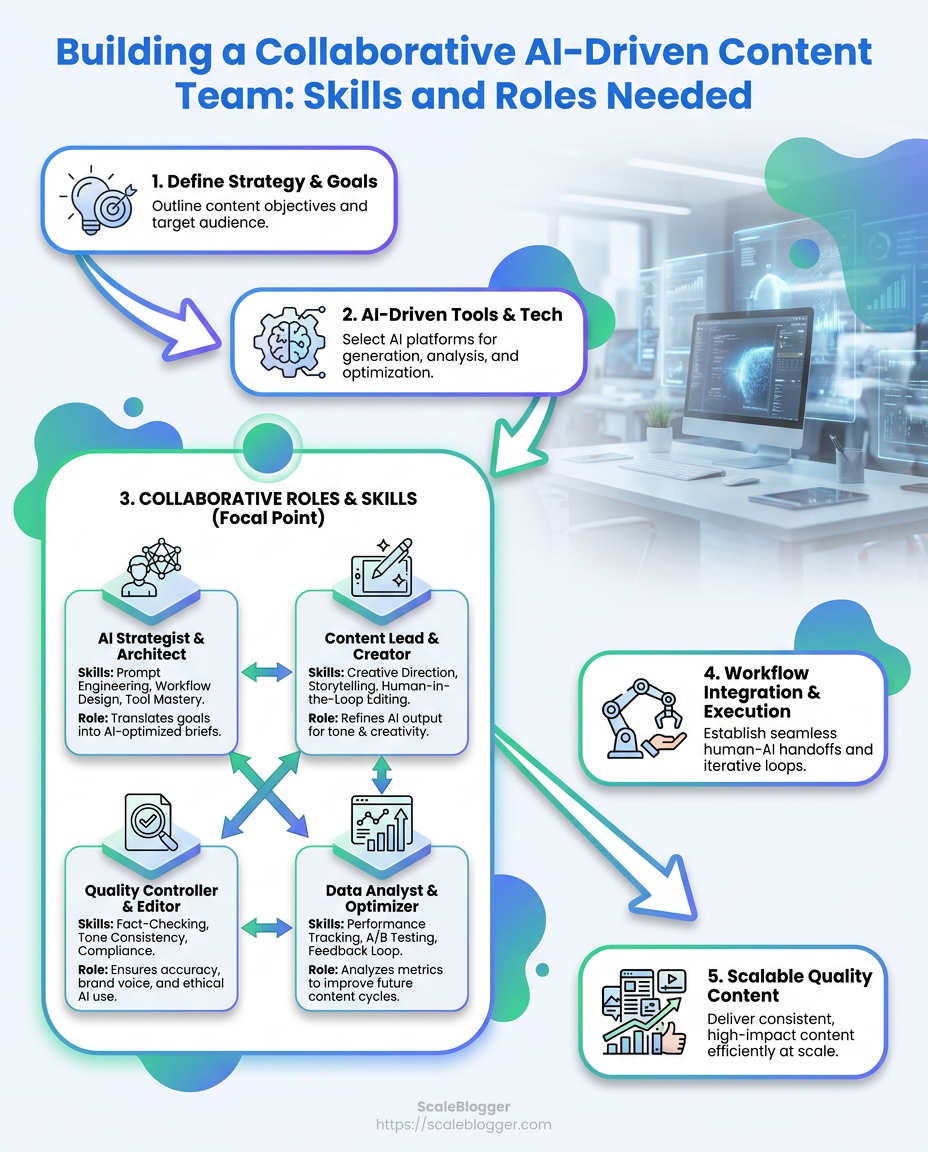
Start by treating content operations as a production line: you need clear stages, owners, measurable SLAs, and automation where it reduces friction.
An AI-ready workflow codifies which tasks AI handles (drafting, metadata, variants) and which require human judgment (fact-checking, brand voice, legal).
This lets teams scale output without multiplying review bottlenecks and makes handoffs predictable—so deadlines, quality gates, and analytics all become reliable inputs to continuous improvement.
Stage-by-stage workflow and checkpoints
Brief & Keyword Research — Owners gather intent signals and priority topics.
AI Draft Generation — AI produces structured drafts and variant headlines.
Human Edit & Fact-Check — Editors refine tone, verify claims, and resolve hallucinations.
SEO Optimization — SEO specialist applies on-page optimization and internal linking.
Publication & Distribution — Publishing manager schedules, tags, and pushes content to channels.
Clear owners: assign one accountable person per stage to avoid review ping-pong.
Defined SLAs: use timeboxes (e.g., 24–72 hours) to keep flow predictable.
Quality gates: acceptance criteria at each stage prevent noisy rework.
Tooling and automation: selecting platforms and building integrations
Platform fit: choose AI tools that export structured content (Markdown, JSON) to preserve metadata.
Integration patterns: use webhooks, middleware (Zapier/Make), or CMS APIs for hands-off handoffs.
Automation opportunities: auto-generate meta descriptions, create GA4 event tags, or spin up A/B headline variants.
Use selection criteria such as model quality on domain text, export formats, enterprise controls (role-based access), and cost per token or seat.
For CMS integration prefer platforms with native plugins or REST/GraphQL APIs to avoid fragile scraping.
SLA and responsibility table showing stage, owner, typical time, and acceptance criteria
AI content workflow: SLA and responsibility table
| Stage | Owner | Typical Time | Acceptance Criteria |
|---|---|---|---|
| Brief & Keyword Research | Content Strategist | 1–3 days | Keyword intent documented; target URL list; editorial brief |
| AI Draft Generation | AI Editor / Content Engineer | 1–2 hours | Structured draft (H2/H3), sources list, suggested CTAs |
| Human Edit & Fact-Check | Senior Editor | 1–2 days | No factual errors; brand voice match; plagiarism check |
| SEO Optimization | SEO Specialist | 4–8 hours | Title + meta complete; internal links added; content score ≥ threshold |
| Publication & Distribution | Publishing Manager | Same day or scheduled | Correct taxonomy, publish date set, analytics tags present |
Practical templates and integrations (CMS API snippets, release checklists, and a content-metadata.json pattern) turn this into an operational system.
If you’d like, I can provide a ready-to-use checklist or a sample webhook mapping for common CMS platforms. When these gates and SLAs are enforced, teams reduce handoff ambiguity and free creators to focus on high-impact work like narrative, research, and editorial judgment.
If helpful, Scale your content workflow with an AI content automation partner like Scaleblogger.com to prototype integrations and SLAs quickly.
Section Content
Measurement and Iteration — KPIs and Feedback Loops
Measure what matters: focus on production throughput, content performance, and model quality together so you can diagnose whether problems are editorial, distributional, or model-driven.
Start by instrumenting a small set of high-signal KPIs (time-to-publish, pieces/month, organic traffic per piece, conversion by content, and model hallucination/error rate).
Those let you separate process bottlenecks from content effectiveness and model drift.
Next, you’ll have a practical method to track those KPIs, gather user feedback on a large scale, and run a quarterly plan that turns insights into prioritized fixes and retraining.
What to track and why
Production KPIs: measure velocity and predictability so resourcing decisions are evidence-based.
Performance KPIs: measure reach and business impact to prioritize topics and formats.
Model KPIs: measure factuality and relevance to know when to retrain or change prompts.
Example: how these KPIs map to action
If time-to-publish rises → audit tooling and handoffs; automate repetitive steps.
If organic traffic per piece falls → re-evaluate intent fit and update semantic targeting.
If hallucination rate increases → add grounding signals and expand curated training data.
Capture feedback and close the loop
Instrumented feedback: embed micro-feedback widgets (thumbs, short reason) and capture session data via analytics.
Qualitative signals: rotate short user interviews and content audits monthly.
Model logs: log prompts, response confidence, and post-edit rates for every generated asset.
Quarterly playbook for continuous improvement
Collect: aggregate analytics, widget feedback, and model logs.
Prioritize: rank issues by impact × effort; treat hallucinations and conversion drops as high priority.
Experiment: A/B prompt variants, editorial templates, and publish cadence changes.
Retrain/Update: add curated examples and counterfactuals to model fine-tuning where justified.
Document: update playbooks and runbooks so fixes scale across the team.
KPI table mapping metric, calculation, owner, and target range to help teams instrument dashboards
| KPI | How to Measure | Owner | Target Range |
|---|---|---|---|
| Time to First Draft | Avg hours from brief to draft (CMS timestamps) | Content Ops | 8–24 hours |
| Pieces Published / Month | Count of published posts (CMS report) | Editorial Lead | 8–20 posts |
| Organic Traffic per Piece | 30-day sessions from GA4 / piece | SEO Owner | 500–5,000 sessions |
| Conversion Rate by Content | Goal completions / sessions (GA4) | Growth/Product | 0.5%–3.0% |
| Model Error/Hallucination Rate | % flagged inaccuracies in model logs / audits | ML Lead | <2–5% flagged answers |
When KPI tracking, widget feedback, and model logs feed into the quarterly playbook, teams can detect drift sooner and prioritize experiments that improve both content quality and ROI.
Understanding these principles helps teams move faster without sacrificing quality.
When implemented consistently, the loop from analytics to playbook to retraining means fewer surprises and steadily improving ROI from your content systems.
📥 Download: Downloadable Template (PDF)
Section Content
Roadmap — Hiring, Upskilling, and Scaling the Team After your pilot workflow demonstrates repeatability, shift your focus to stabilizing it. This means tightening stage SLAs and checking that the quality gates are effective. Also, hire specifically to fill any capacity gaps and necessary skills. Over the next 12 months, your goal is to evolve from experiments into a predictable production machine—using go/no-go criteria at each phase so hiring and tooling spend stay tied to measurable output (traffic, conversions, and throughput). Prioritize a small core team first—editor, SEO specialist, and AI/automation engineer—then layer in creators and analysts as cadence stabilizes. Use automation to reduce headcount pressure and redirect budget toward L&D sprints and tooling that multiplies output. Hiring and training should be playbook-driven: publish concise job ads, evaluate candidates with practical tasks, and run a structured 90-day onboarding that mixes shadowing,tool training, and progressive ownership. For upskilling, run 2–4 week L&D sprints focused on specific capabilities (SEO writing with AI, prompt engineering, analytics dashboards) and measure skill adoption with live content experiments.
Consider integrating an AI content automation partner to accelerate pipeline setup—for example, use an AI content automation service to standardize prompts and publishing workflows before hiring high-volume writers.
Hiring and training playbook — practical snippets and tasks
Job ad (SEO writer): 3–5 years writing experience, proven organic growth case, comfortable using
content briefsand AI-assisted drafting, portfolio link required.Job ad (AI engineer): Experience with API orchestration, workflow automation, and data pipelines; examples of
automationprojects preferred.Job ad (Content analyst): Strong SQL or GA4 skills, experience with content experiments and cohort analysis.
Interview task — SEO writer: Rewrite a 600-word draft to improve clarity and add 2 internal linking opportunities; deliver in 90 minutes.
Interview task — AI engineer: Build a simple workflow diagram or pseudocode to fetch SERP metrics and trigger a content refresh.
Interview task — Analyst: Given a sample dashboard CSV, identify top 3 low-performing topics and propose two experiment ideas.
90-day onboarding sprint
Weeks 1–2: orientation, shadowing, baseline assessments.
Weeks 3–6: L&D sprint on tools and process; paired tasks with senior editor.
Weeks 7–12: Independent ownership of a topic cluster, KPI review, optimization cycle.
12-month roadmap table with phase, months, milestones, hires, and decision criteria for moving to next phase
| Phase | Months | Key Milestones | Hires/Resources | Go/No-Go Criteria |
|---|---|---|---|---|
| Pilot | 0–2 | Build content stack, 10 live posts, baseline analytics | 1 Editor, 1 SEO specialist, automation tooling | Achieve initial CTR uplift or time-to-publish < 30% baseline |
| Stabilize | 3–5 | 30–50 posts, repeatable briefs, publishing SLA | +1 Writer, +1 Analyst, CMS integrations | Consistent weekly cadence and 3x content reuse rate |
| Scale | 6–8 | Topic clusters, A/B testing, 100+ posts | +2 Writers, AI automation engineer, scheduling tool | Cost-per-post drops; organic traffic growth month-over-month |
| Optimization | 9–10 | Content refresh program, personalization tests | +1 Growth PM, tooling for analytics | Positive lift from refreshes; experiments exceed control |
| Expansion | 11–12 | New verticals, partnership content, internationalization | Localization writer(s), CRO specialist | New verticals reach minimum traffic threshold and ROI > target |
Section Content
Conclusion You now have a practical blueprint to turn an AI-driven content experiment into a repeatable operating system. Do one concrete pass this cycle:- Pick your pilot scope + success metrics: Select the next workflow to run end-to-end and define the KPI targets you’ll use to judge quality and ROI.
- Assign RACI and stage gates: Name accountable owners per workflow stage and confirm what qualifies as publish-ready.
- Automate handoff packaging (minimum viable): Standardize the inputs/outputs your team exchanges (brief fields, structured draft format, review checklist, and analytics hooks).
If you want a faster way to prototype drafting, collaboration, and approval automation, explore Scaleblogger for AI content workflow and automation resources.
