

Introduction
Why does one message feel sharp in a blog post, flat in a video, and invisible once it becomes a social clip? That gap is the real challenge behind multi-modal content delivery: ensuring the same idea works across text, audio, images, and video without losing its meaning or impact.
Emerging technologies are rapidly changing how multi-modal content is created and delivered.
According to Storyteq’s 2026 outlook, content marketing platforms are evolving toward AI-powered ecosystems that automate personalization at scale. This is shifting the future of content away from manual repurposing and toward smarter, adaptive systems.
Quick Answer: Use AI-powered adaptive workflows to deliver one coherent message across text, audio, images, and video, because audiences expect to switch formats instantly and won’t tolerate copy-paste inconsistency. A practical standard is to transform each core idea into a 60-second short video plus supporting long-form and audio variants, then measure performance by format (not just total reach) to keep content competitive as platforms personalize at scale.
Why multi-modal content delivery is becoming a competitive requirement
A blog post alone no longer carries the whole conversation.
People want the same idea in text, audio, short video, and something they can tap or explore. Multi-modal content delivery means building one message that moves cleanly across those formats without feeling copied and pasted.
That matters because attention is fragmented, not disappearing.
According to AP workflow coverage of future content creation trends in 2026, YouTube Shorts has reached a scale where audiences move between formats without friction—and brands are expected to keep up with that pace.
Readers, listeners, and viewers now expect brands to meet them where they already spend time.
Emerging technologies are raising the stakes too.
IMD’s 2026 digital transformation report on emerging technologies points to AI, automation, and next-gen cybersecurity as major forces shaping how companies work, while Storyteq’s 2026 look at content marketing platforms describes platforms becoming AI-powered ecosystems that personalize at scale.
Content strategy is moving from “publish once” to “adapt everywhere.”
In practice, the pattern looks like this
One research-backed idea becomes a long-form article, a 60-second clip, a podcast snippet, and a simple interactive asset.
That mix gives the same message more chances to land, especially when different buyers prefer different entry points.
- Text for search and depth: it still does the heavy lifting for intent, nuance, and discoverability.
- Video for speed: it explains faster and fits the way people browse in feeds.
- Audio for commute-time consumption: it keeps the message present when screens are off.
- Interactive elements for engagement: quizzes, calculators, and choose-your-path formats make content feel useful, not passive.
The strategy shift is bigger than format
Teams that still plan content as isolated posts end up doing extra work for weaker results.
Pipefy’s 2026 technology trends analysis also points to automation and workflow improvement as core business priorities, which explains why format adaptation is becoming part of the production system, not a side task.
That is why multi-modal content delivery is turning into a competitive requirement, not a nice extra.
The brands that treat format variety as a normal part of the future of content stay easier to find, easier to remember, and easier to trust.
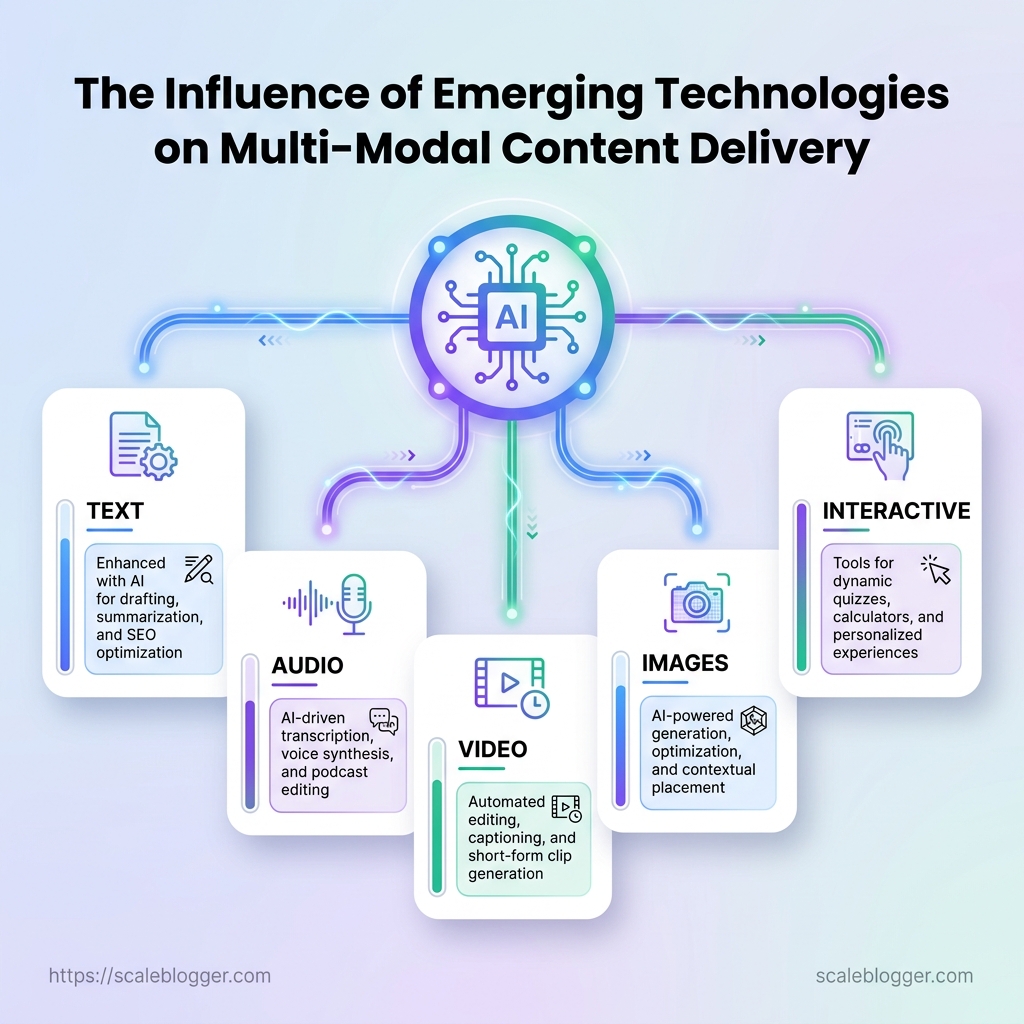
The technologies reshaping the content workflow
Why do some teams ship faster without turning into content factories? The answer is not one magic tool.
It is the way emerging technologies now touch each step, from drafting to publishing to reading audience signals.
AI writing tools handle the first pass.
Image systems fill gaps that used to slow production.
Video assistants cut the friction in clips, captions, and edits, which matters because platforms keep rewarding faster, format-specific output, as noted in AP’s overview of future content creation trends.
The bigger shift is orchestration.
Content platforms are moving toward AI-powered workflows that connect planning, creation, approval, and distribution in one place, a direction Storyteq describes in its 2026 look at content marketing platforms.
That is where workflow automation stops being a nice extra and starts acting like plumbing.
Analytics now feeds the creative choice itself.
Instead of asking, “What should we make?”, stronger teams ask, “What format did this audience already reward?” That kind of feedback loop is exactly what makes the future of content feel less random and more responsive.
How the main technologies affect the content lifecycle
| Technology category | Primary use case | Content formats impacted | Strengths | Common limitations |
|---|---|---|---|---|
| Generative AI writing tools | Drafting outlines, articles, ads, and rewrites | Blog posts, landing pages, social copy, email | Fast first drafts, consistent tone, easy variation | Can sound generic, needs fact checking, weak on original judgment |
| Text-to-image systems | Creating custom visuals from prompts | Blog graphics, social visuals, thumbnails, ads | Quick visual production, strong concept testing | Inconsistent brand style, prompt sensitivity, licensing questions |
| AI video generation and editing | Turning scripts into short clips or edits | Shorts, reels, explainers, product clips | Faster motion content, easier repurposing, caption support | Quality varies, motion artifacts, brand control still matters |
| Speech-to-text and text-to-speech tools | Transcribing and voice conversion | Podcasts, interviews, narrated clips, subtitles | Speeds captioning, improves accessibility, supports reuse | Accent errors, noisy audio problems, synthetic voice can feel flat |
| Content planning and scheduling automation | Planning, queuing, and publishing at scale | Blogs, newsletters, social posts, campaign calendars | Reduces manual work, keeps cadence steady, improves timing | Poor setup creates repetition, weak judgment on nuance |
| Performance analytics platforms | Reading engagement and behavior patterns | All tracked formats | Reveals what audiences actually do, supports smarter format choice | Data can be noisy, attribution is imperfect, dashboards can distract |
The practical shift is simple.
AI handles production chores, automation keeps the machine moving, and analytics decides what deserves more effort next.
Teams that connect those three layers usually waste less time guessing.
For a brand running this end to end, that loop is where our AI-powered content pipeline fits naturally into the picture.
It is less about replacing people and more about removing the dullest bottlenecks so judgment gets spent where it counts.
The technology stack matters most when the pieces talk to each other.
Once drafting, scheduling, and measurement feed one another, content stops feeling like a pile of tasks and starts behaving like a system.
How emerging technologies change each content format
Why does one idea now need four different lives? Because emerging technologies do not just make production faster.
They change what each format is good at, and that changes how teams package the same message.
Text gets sharper first.
AI drafting tools can surface angle gaps, tighten outlines, and spot topic clusters a human editor might miss after the third coffee.
That matters because content marketing platforms are moving toward AI-driven systems that automate personalization and content assembly at scale, not just basic drafting, as noted in Storyteq’s 2026 view of content marketing platforms and IMD’s 2026 emerging technology roundup.
Video changes even more dramatically.
A single script can become a long explainer, a 30-second cut, a captioned social clip, and a vertical teaser without starting from scratch.
That matters in a market where short-form attention is already huge; AP’s workflow coverage highlights how aggressively audiences move between fast, format-specific experiences.
Audio is getting a second life too.
Voice models, clean transcripts, and speech-to-text tools turn one article into a podcast segment, a narrated summary, or a searchable transcript that improves discovery.
The strongest move here is not novelty.
It is reach, because spoken formats pull in people who would never sit through a long read.
Visual content is becoming less static and more modular.
AI can generate supporting graphics, thumbnail options, simple diagrams, and platform-specific crops that match each channel’s size and pace.
That fits the broader shift toward AI-powered content ecosystems described in Storyteq’s 2026 analysis and the broader automation trends highlighted by Pipefy’s 2026 technology trends overview.
- Text: Faster drafts, cleaner edits, and broader topic coverage.
- Video: Script-to-clip repurposing, caption variants, and short-form spin-offs.
- Audio: Narration, transcripts, and searchable spoken content.
- Visuals: Thumbnails, diagrams, and lightweight graphics built for each platform.
The formats are no longer separate jobs.
They are different expressions of the same source idea, and the best teams treat them that way.
That is where the future of content starts to feel practical instead of futuristic.
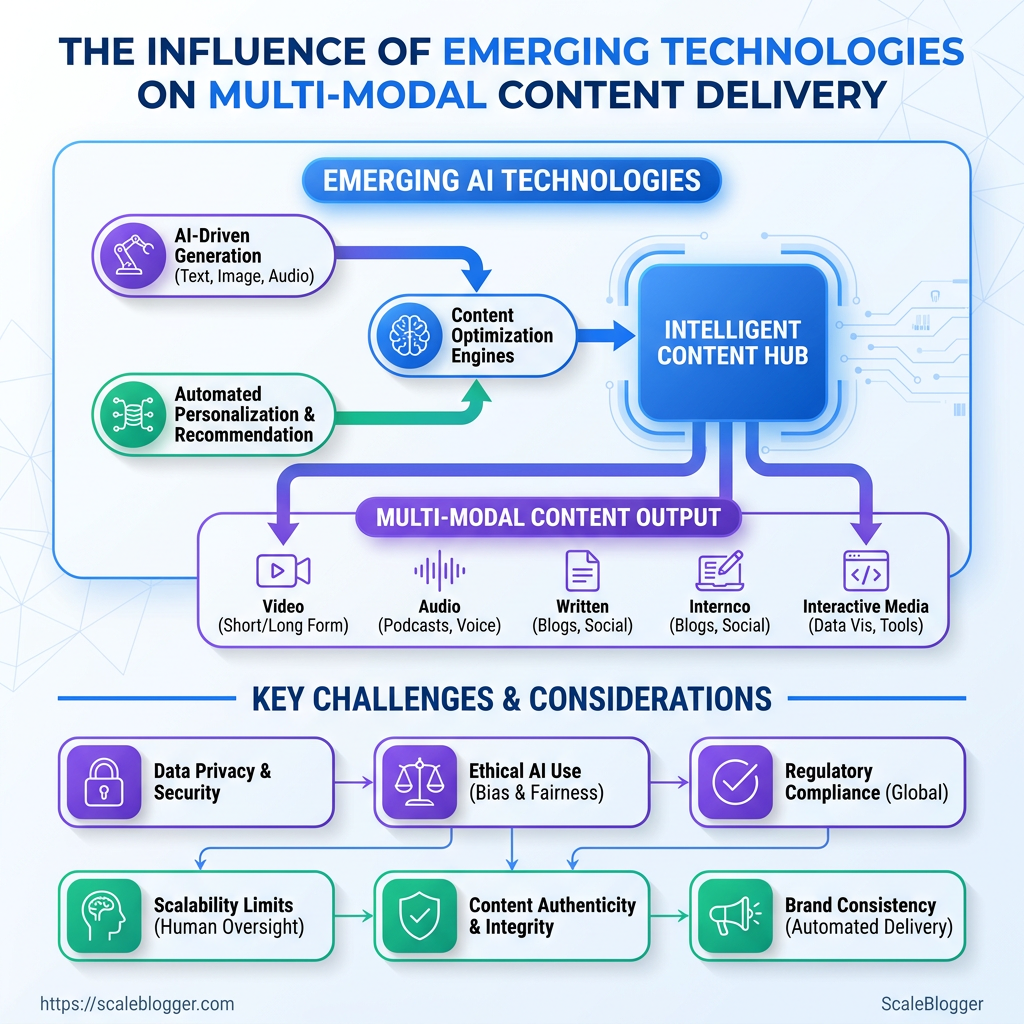
Where AI content tools fit in the modern workflow
Have you ever seen a team burn half a day on headlines before the draft even exists? That usually means the process is stuck, not the writers.
AI content tools fit best at the front of the workflow, where speed matters and judgment is still cheap.
That early stage is where AI can pull real weight.
It can cluster topics, generate angles, draft briefs, and turn a rough idea into a usable outline without draining the team’s energy.
Research on emerging technologies in 2026 from IMD points to AI moving deeper into operational work, while Storyteq’s 2026 look at content marketing platforms describes AI-powered systems becoming part of the day-to-day content engine.
That is the lane we designed for our own workflow.
The machine handles the first pass, and people handle the parts that still need taste, context, and restraint.
Where AI saves the most time
- Ideation: It can turn one audience insight into many workable angles fast.
- Briefs: It can shape scattered notes into a clean, usable content brief.
- Outlines: It can map structure before a writer spends time polishing language.
- Draft generation: It can produce a rough first pass that a human can actually improve.
What still needs a human
AI is fast, but it is not accountable.
A draft can sound polished and still miss a fact, stray from the brand, or repeat itself like it is trying too hard.
- Check facts and dates: Confirm names, claims, and references before anything ships.
- Read for tone: Make sure the piece sounds like the brand, not like generic marketing copy.
- Test brand fit: Cut anything that feels off-message, too stiff, or too salesy.
- Remove repetition: AI often says the same thing in three different ways.
That is why review is not an afterthought.
It is the part that turns machine output into something publishable.
The future of content belongs to teams that divide the work well.
AI handles the early lift, and humans keep the standard high.
What content teams need to measure as formats multiply
When one idea turns into a blog post, a short video, a carousel, and a newsletter blurb, the old vanity metrics start to wobble.
A high view count on one channel can hide weak reading depth, weak search demand, or a format that simply does not hold attention.
That pressure is getting louder in 2026. Storyteq’s look at content marketing platforms in 2026 points to AI-driven personalization at scale, while AP’s 2026 content creation trends roundup notes how quickly audiences are consuming and switching across short-form formats.
Different formats now compete in different ways, so the measurement layer has to keep up.
The trick is to stop judging everything by one score.
Blog posts need search demand and reading depth.
Short-form video needs retention and replay behavior.
Repurposed assets need a clean path back to the original idea, or attribution gets muddy fast.
Key performance signals for multi-modal delivery
| Format | Primary metric | Secondary metric | What it reveals | Typical decision it informs |
|---|---|---|---|---|
| Blog posts | Organic clicks | Average time on page | Search demand and reading engagement | Topic expansion or refresh decisions |
| Short-form video | Watch-through rate | Replays | Hook strength and pacing | Cut length or re-edit opening seconds |
| Social carousels | Saves | Slide completion rate | Utility and message clarity | Turn into a template or retire the angle |
| Newsletter excerpts | Click-through rate | Scroll depth on landing page | Interest transfer from inbox to site | Adjust subject lines or body copy |
| Podcast clips | Completion rate | Follows after play | Listening quality and audience pull | Promote full episodes or change clip selection |
| Landing pages | Conversion rate | Exit rate | Offer clarity and friction points | Rewrite CTA, layout, or proof points |
| Repurposed social posts | Engagement rate | Profile visits | Whether the repackaged idea still lands | Keep, rework, or stop syndication |
| Webinar summaries | Registrations or replay starts | Average engagement time | Whether the summary promises enough value | Build a deeper event or shorten the recap |
One useful rule: pair a reach metric with a depth metric.
Reach tells you whether people showed up.
Depth tells you whether they stayed long enough to matter.
Attribution gets messier once the same idea appears everywhere.
A reader may discover a concept on LinkedIn, search it later, then convert from an email link a week after that.
In practice, that means teams should track assisted paths, not just last-click wins, and compare channel-level lift against the original asset.
That approach fits the broader shift toward AI-heavy, connected systems described in IMD’s 2026 emerging technologies overview and the automation trends covered in Pipefy’s 2026 technology trends report.
Speed matters too, but only beside quality.
The best benchmark is not “how fast did we publish?” It is “how fast did we publish something that earned real engagement, search traction, or downstream action?”
That balance keeps teams honest.
And it keeps the future of content from turning into a pile of fast, forgettable posts.
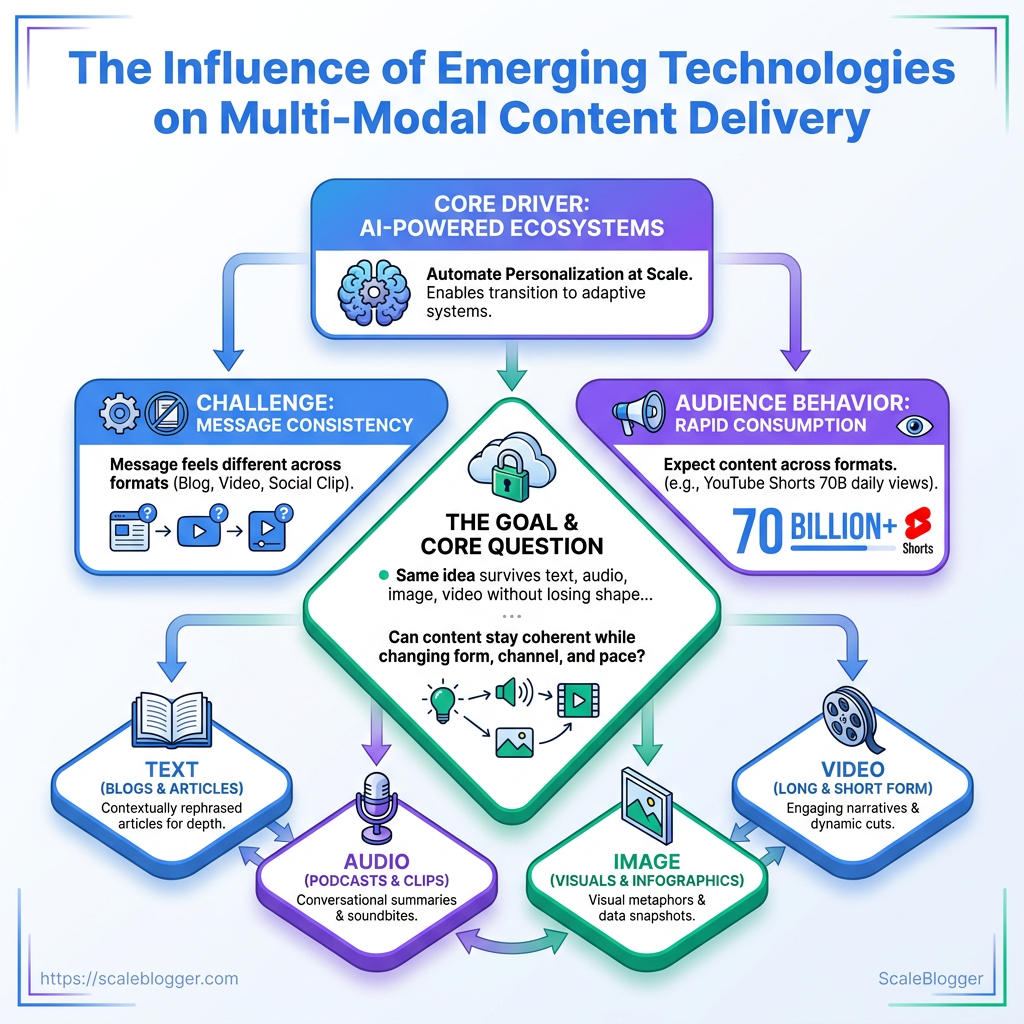
Risks, limits, and governance in technology-led content delivery
What happens when content production gets faster than the fact-checking? That is where trouble starts.
As emerging technologies push more of the workflow into AI and automation, mistakes spread faster too.
IMD’s 2026 look at digital transformation puts AI, automation, and next-gen cybersecurity right at the center of business change, which means content teams are now dealing with speed, scale, and risk at the same time.
The first failure mode is generic output.
AI can draft something that sounds polished while saying very little, and that kind of blandness is deadly in multi-modal content delivery because every format starts to blur into the same voice.
Where things usually go wrong
- Generic output: The copy sounds clean, but it lacks point of view, specific examples, or a real editorial edge.
- Factual errors: AI can miss updated product details, dates, names, or policy language, especially when it is repurposing across formats.
- Inconsistent voice: A blog draft may sound measured, while a social clip caption feels hype-heavy and off-brand.
- Format drift: A long-form article can turn into a loose carousel or video script that no longer matches the original claim.
- Unowned approvals: If nobody owns the final check, small errors slip through and become public truth.
That is why governance matters more as automation increases.
Storyteq’s 2026 view of content marketing platforms describes AI-powered systems that can automate personalization at scale, but scale without rules just multiplies mistakes.
A good governance model keeps every claim, asset, and tone decision traceable.
Rules that keep AI-assisted content sane
- Source every factual claim. If a statistic, product detail, or policy statement appears, it needs a traceable source or internal approval.
- Lock the brand voice. Use a shared tone guide with approved phrases, banned words, and examples for each format.
- Set format-specific limits. A blog, short video, and social post should share the same message, not the same wording.
- Require human signoff. Sensitive topics, regulated industries, and first-time claims should never ship on autopilot.
- Version the prompts and outputs. When something changes, you need to know whether the prompt, the source, or the editor caused it.
Editorial oversight protects credibility because it catches what automation misses.
AP’s 2026 coverage of future content trends shows how quickly platform-specific formats keep multiplying, which makes one clean approval path far more valuable than one more draft generator.
The future of content delivery will reward speed, but only the teams that treat governance as part of production, not an afterthought.
Without that layer, the shiny new pipeline turns into a very efficient way to publish avoidable mistakes.
How to build a future-ready multi-modal content system
What makes a content system still feel sane six months from now? The teams that survive the next wave of emerging technologies do not build around one format at a time.
They build around a shared content core, then fan that core out into text, video, audio, and social-native assets.
That approach fits where the future of content is headed.
By 2026, content marketing platforms are moving toward AI-powered ecosystems that automate personalization at scale, according to Storyteq’s 2026 view of content marketing platforms.
At the same time, IMD’s 2026 emerging technologies roundup points to AI, automation, and next-gen security as practical business shifts, not distant trends.
The practical operating model is simple enough to run on a busy team.
Keep one canonical brief, one source asset library, and one editorial owner per content cluster.
That keeps the work moving without turning every new format into a fresh project.
Build around a content core
A future-ready system starts with a single topic spine, not scattered posts.
One strong cluster can support a long article, a short clip, a newsletter excerpt, and a carousel without reinventing the argument each time.
Choose tools by fit, not feature count. A creator with limited time should care more about handoff speed than shiny dashboards.
- One content source: Look for a system that stores the master draft, assets, and metadata in one place.
- Fast repurposing: Prioritize tools that can turn one draft into multiple format-ready outputs.
- Clear approvals: Pick software with simple review steps, not endless comment threads.
- Publishing reach: Make sure it connects to the channels you actually use.
- Searchable structure: Tags, clusters, and content IDs matter more than another generic “AI” button.
Plan clusters like a map
A cluster plan works best when each piece earns its place.
AP’s 2026 coverage highlights how quickly distribution habits are shifting across short-form platforms—so your cluster should be designed for reuse, not one-off production.
- Start with one audience job. Pick the question the audience is actually trying to solve.
- Build one pillar, then branches. The pillar explains the idea; the branches handle format-specific angles.
- Assign reuse rules. Decide which parts become clips, quotes, visuals, or email copy before production starts.
- Review cluster gaps monthly. Look for missing formats, outdated angles, and topics that deserve a second life.
That is the shape of a durable system: one idea, many uses, very little friction.
We build for that kind of reuse because it keeps publishing fast without making the team chase its own tail.
The Message Matters, Not Just the Format
The real shift in multi-modal content delivery isn’t making more assets—it’s keeping one idea sharp while it moves from blog to video, clips, and social without losing meaning.
That requires treating repurposing as translation, not copy-paste. Format changes the delivery mechanism (pace, emphasis, structure), but the core message and proof points should stay consistent across channels.
A practical way to make that work: start with one canonical content core (a single brief and source asset library), fan it out into the formats your audience actually consumes, and assign format-specific success metrics so you know whether each translation landed.
If your process still feels messy, focus on the system—not the tools: a shared core, clear review ownership, and connected measurement loops. That’s how emerging technologies become a pipeline for coherent delivery instead of a factory for fast, forgettable output.
