

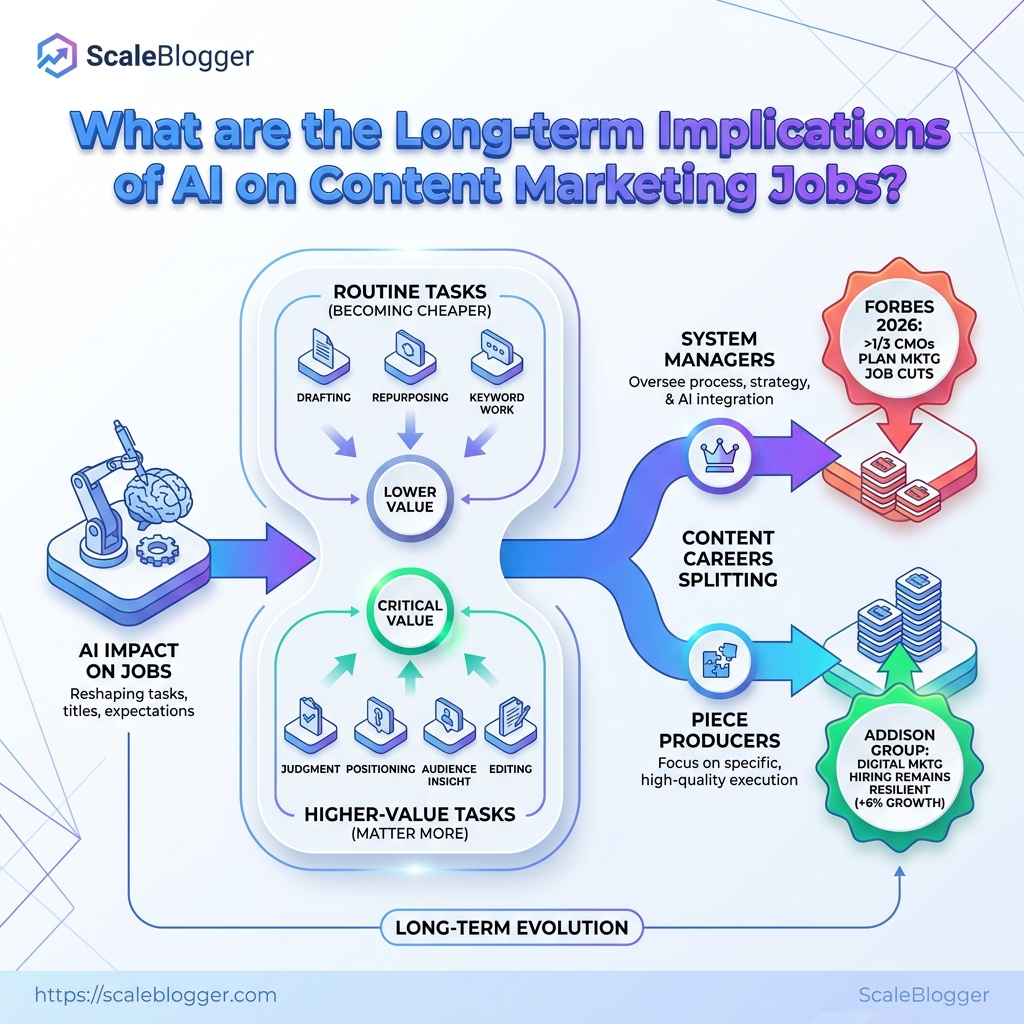
The long-term implications of AI on content marketing jobs are becoming clearer as automation takes over more routine tasks such as drafting, repurposing, keyword research, and reporting.
According to Forbes, more than a third of CMOs surveyed planned to reduce marketing roles as AI adoption accelerates, while other hiring data suggests demand remains for marketers with more adaptable and strategic skills.
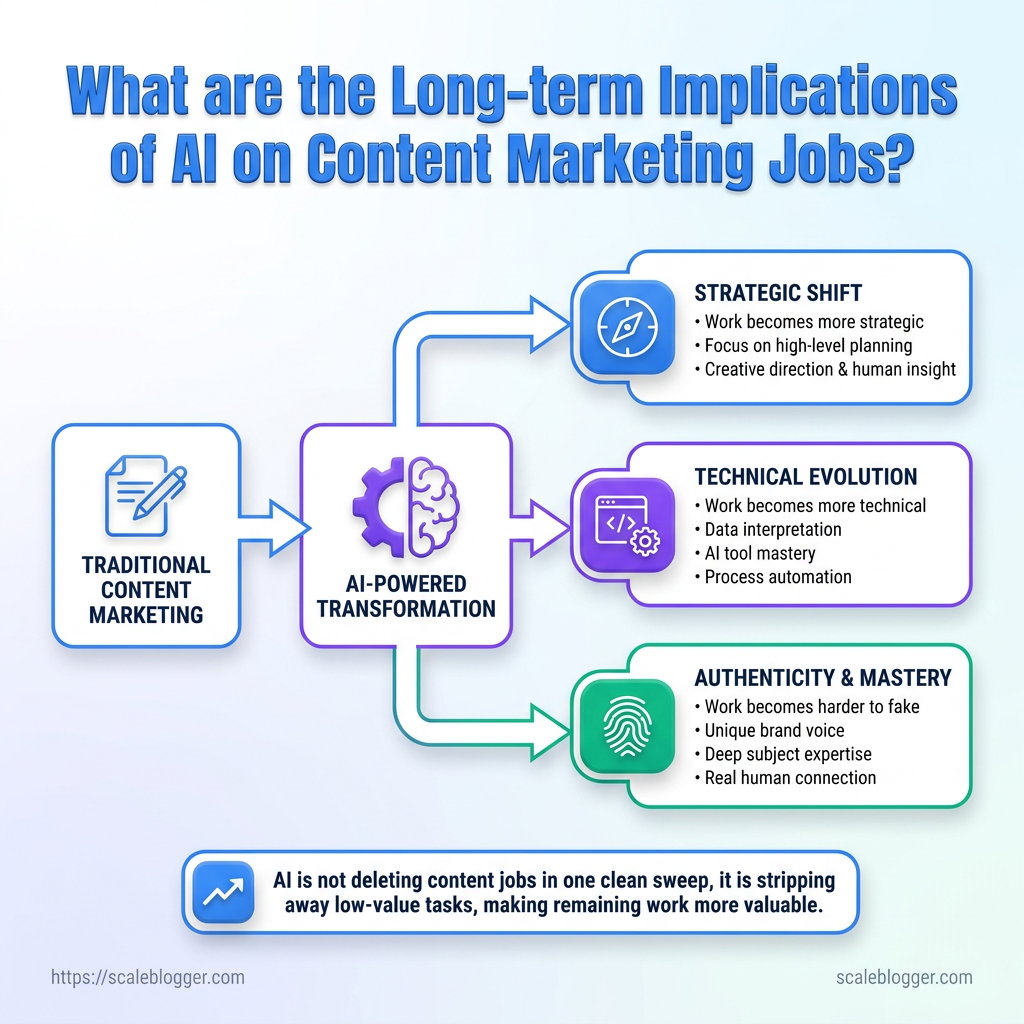
This doesn’t necessarily mean content marketing careers are disappearing. Instead, value is shifting toward strategy, editorial judgment, audience understanding, AI oversight, and quality control.
At ScaleBlogger, this human-AI balance is particularly relevant: automation can handle repetitive production, while people remain responsible for the decisions that determine whether content is accurate, useful, and worth publishing.
Quick Answer:
AI is not eliminating content marketing jobs so much as reshaping them: routine drafting, repurposing, and basic keyword work get automated, while tasks that require judgment—positioning, audience insight, voice editing, and distribution—become more valuable.
In 2026, Forbes reports that more than a third of CMOs plan to cut marketing jobs over the next two years, yet digital marketing hiring is still projected to grow about 6%, reflecting a shift toward fewer, more adaptable roles.
Table of Contents
The real question: is AI replacing content marketing jobs, or changing what those jobs are worth?
Which content marketing tasks are most exposed to AI automation?
How content marketing careers are likely to change over the next 3 to 5 years
What risks should content marketers watch for as AI becomes normal in the workflow?
How can content professionals stay valuable in an AI-heavy market?
The real question: is AI replacing content marketing jobs, or changing what those jobs are worth?
If AI can draft a decent blog post in minutes, the anxiety shifts from “Who will write?” to “Who is accountable for what gets published?” That tension is why the debate feels so loud right now: companies may not be cutting content marketing as a function, but they are changing where work is created, verified, and owned.
Even when headcount trends vary by survey, the consistent pattern is reweighting.
AI accelerates the steps that are repeatable and easy to score, while raising the stakes for the steps that require judgment—positioning, accuracy, brand fit, and distribution decisions.
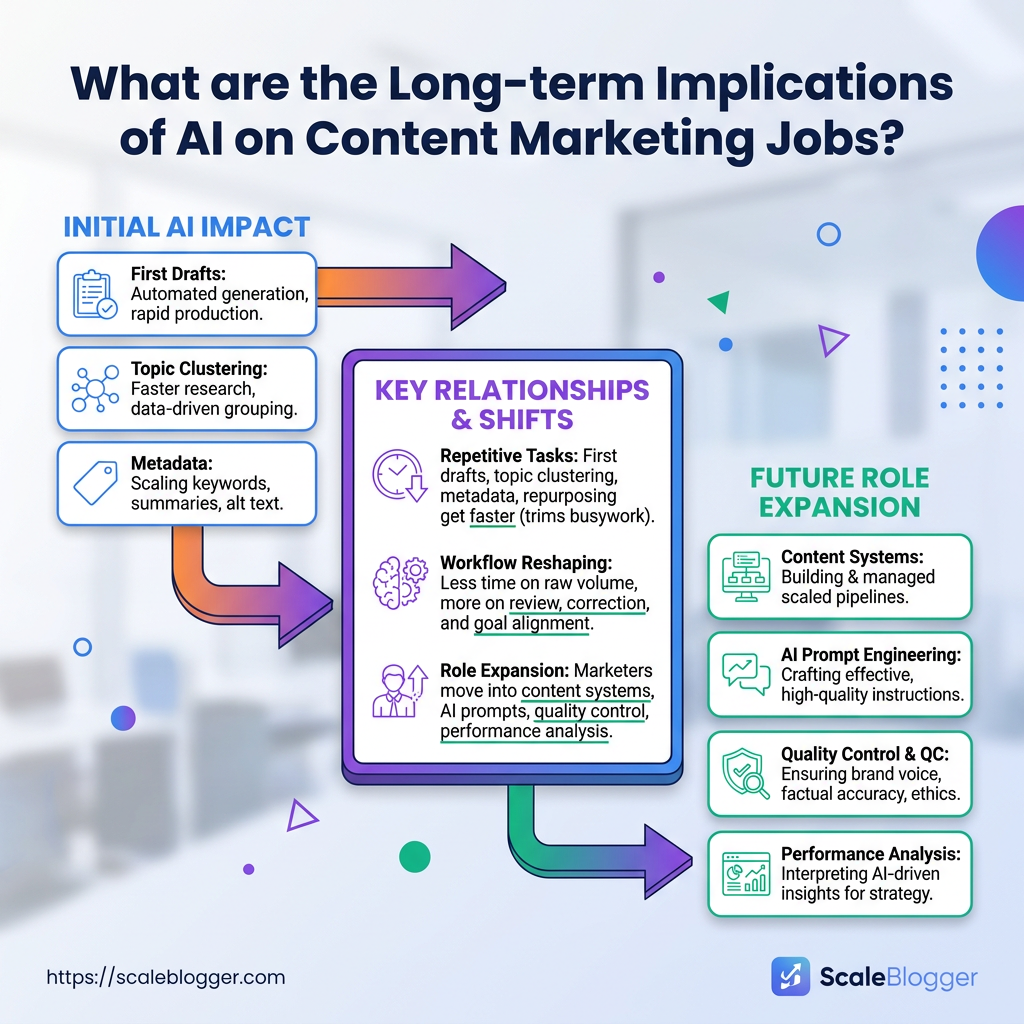
Think of the change in three layers:
Repetitive tasks: First drafts, repurposing, and basic clustering speed up. The work itself gets cheaper.
Workflow reshaping: Teams spend less time generating raw volume and more time aligning outputs to goals, checking quality, and revising for clarity and credibility.
Role expansion: Strong marketers move into content systems—prompting, quality control, governance, and performance analysis—so AI outputs become reliable inputs rather than final answers.
Here’s what that looks like in practice: a writer who used to spend half a day on a blank-page outline may now use AI to generate options, then spend that time picking the best angle, verifying claims, and deciding whether the piece should be repurposed or replaced based on funnel needs.
So the question isn’t “replacement vs survival.” It’s “automation vs accountability.” AI doesn’t remove the need for responsible decision-making—it moves it to the points where the business risk is highest.
Which content marketing tasks are most exposed to AI automation?
The easiest work for AI to touch is the work that already follows a pattern.
First drafts, metadata, calendar updates, and performance reports all have a lot of repeatable structure, so they move fastest.
That is why the AI impact on jobs shows up first in production-heavy content roles, not in strategic ones.
In 2026, Forbes noted that more than a third of CMOs planned to cut marketing jobs over the next two years, while hiring reports still show the field staying resilient overall, which means the pressure is on task mix, not on marketing disappearing altogether.
Repurposing is another soft spot.
A single blog post can now become social copy, email snippets, short summaries, and post variants in minutes, which is exactly why LinkedIn’s 2026 AI marketing trends overview points to generative AI as a core workflow shift.
The human work does not vanish, though.
It just moves up the stack.
Tasks with the highest automation exposure
Content Task | AI Exposure Level | Human Skill Still Required | Likely Long-term Job Impact |
|---|---|---|---|
First-draft blog copy | Very high | Fact-checking, angle choice, source judgment | Less time on drafting, more on editing and approval |
Content calendar scheduling | Very high | Campaign coordination, timing tradeoffs, stakeholder needs | Routine planning work shrinks |
Keyword research | High | Search intent reading, SERP nuance, topic selection | Faster research, stronger strategy input needed |
Performance reporting | Very high | Metric interpretation, cause-and-effect reasoning, executive framing | Reporting shifts toward analysis and decision support |
Editorial strategy | Low to medium | Positioning, business goals, tradeoffs | Still mostly human-led |
Brand voice editing | Medium | Tone judgment, nuance, consistency checks | Humans stay central, AI assists |
Audience insight analysis | Medium to high | Customer empathy, qualitative pattern reading | AI handles summaries; humans synthesize meaning |
Campaign planning | Medium | Cross-channel prioritization, budget calls, risk judgment | Accountability stays human |
The pattern is pretty clear.
AI handles anything that is repeatable, text-heavy, and easy to score.
The jobs most exposed are the ones built around throughput: drafting, scheduling, summarizing, and reporting.
The safer work sits closer to judgment, like campaign calls, editorial taste, and audience understanding.
That split is exactly why Huble’s 2026 overview of AI in marketing and eMarketer’s coverage of the AI-driven workforce shift both point toward new hybrid roles rather than a simple wipeout of content marketing careers.
How content marketing careers are likely to change over the next 3 to 5 years
Will the next wave of AI make content marketing smaller, or just sharper? The honest answer is both.
A lot of entry-level work will get thinner.
Across the evidence cited earlier in this article, many teams are staying selective rather than stopping hiring outright—especially when the work is repeatable and easy to measure. That means fewer jobs built around raw drafting and more roles built around research, content QA, asset preparation, and AI-assisted production with tighter review loops.
Mid-level marketers will feel the biggest shift.
Their value comes less from churning out copy and more from deciding what deserves to exist, what should be cut, and what needs a human edit before it goes live.
That pressure tends to land on the middle of the org: with fewer hands and faster production, you need better prioritization and stronger editorial judgment to keep output relevant and on-brand.
Senior roles will move even further upstream.
Strategy, governance, editorial standards, and cross-channel consistency matter more than writing speed.
The strongest leaders treat AI automation in marketing as infrastructure, not magic. They spend more time deciding how content is approved, measured, and reused across formats—so the workflow creates compounding value instead of just more volume.
A few patterns are already easy to spot:
Entry-level roles shrink in drafting, grow in support. Think briefs, fact checks, CMS updates, and prompt testing.
Mid-level roles become decision-heavy. They’ll choose angles, reject weak ideas, and keep the voice from going bland.
Senior roles become editorial control towers. They’ll set rules, manage risk, and keep automation from flooding the channel.
Specialists gain value fast. People who can combine SEO, analytics, and LLM-aware editing will stand out.
Generalists need stronger judgment. Breadth still matters, but only if it leads to better calls.
That split aligns with the broader market debate: many roles don’t disappear so much as evolve into hybrid work.
They usually evolve first.
The people who do best will be the ones who can tell a useful draft from a publishable one—and can explain the tradeoffs behind that decision. That is a different skill than typing faster.
In our own workflow, Scaleblogger makes that shift pretty obvious: the machine handles more of the assembly line, while people move toward review, direction, and quality control.
That is where content marketing careers are heading, and the work will feel less like typing and more like steering.
What skills will matter most in an AI-shaped content team?
What separates a content team that sounds machine-made from one that still feels sharp and useful? The answer is rarely “better writing” alone.
It is usually better judgment, clearer message thinking, and a cleaner review process.
That matters because the AI impact on jobs is already changing how marketing teams staff and evaluate work: output is faster, but accountability and quality control become the real differentiators.
Editorial judgment is the skill that keeps AI from going off the rails.
A draft can be grammatically perfect and still sound wrong for the brand, the audience, or the moment.
Audience research matters just as much.
AI can generate endless copy, but it cannot decide whether a reader needs reassurance, proof, urgency, or a sharper point of view—so humans still have to translate real customer intent into structure, emphasis, and evidence.
Skills that will matter most
Traditional Skill | AI Era Counterpart | Why It Matters | Example in Practice |
|---|---|---|---|
Manual drafting | Prompt-based drafting and editing | Faster first drafts with human quality control | Using AI for an outline, then refining for brand tone |
Basic keyword placement | Search intent and content mapping | Better alignment with user needs | Choosing topics based on intent clusters |
Publishing volume | Editorial decision-making | Higher-quality content direction | Filtering what should and should not be published |
Static calendars | Adaptive content systems | Faster response to performance data | Reprioritizing content based on results |
Subject-matter familiarity only | Audience research and message architecture | Keeps content tied to real objections and buying stages | Turning customer questions into section structure |
Line editing only | Prompt design and AI review | Cuts wasted drafts and catches tone drift | Asking for three angles, then comparing them for fit |
Template following | Workflow design and handoff management | Makes human review happen at the right moments | Routing drafts through research, draft, fact-check, and approval stages |
One-channel copywriting | Cross-channel consistency | Keeps the same idea coherent everywhere | Rewriting one core message for blog, email, and social |
The people who stand out in content marketing careers now do two things well at once.
They shape the message before AI touches it, then check whether the output still sounds human, accurate, and on brand.
That is why the strongest AI automation in marketing does not remove judgment.
It makes judgment the main event, and the teams that learn that early usually move faster without getting sloppy.
What risks should content marketers watch for as AI becomes normal in the workflow?
When AI writes most first drafts, what exactly gets worse before it gets better? Usually, the first problem is not speed.
It is sameness.
As AI automation in marketing becomes part of everyday work, teams can start accepting safe, polished copy that never says anything sharp enough to matter.
That pressure doesn’t just change output—it changes how teams operate. When drafting is faster, the failure mode shifts toward weaker differentiation, fuzzy accountability, and avoidable trust damage.
Quality drift is the quiet risk
AI output often looks fine on a quick read.
The trouble shows up later, when every article starts sounding like a polished version of the same idea.
That is where content marketing careers get tricky.
People who used to win by drafting fast now need to win by shaping angle, evidence, and opinion.
Generic language: Repeated phrasing makes your brand easy to skim past.
Weak differentiation: If multiple competitors can publish the same article, none of them owns the topic.
Shallow claims: AI is good at pattern completion, not judgment.
Job polarization changes the team shape
The real AI impact on jobs is not simply fewer jobs.
It is fewer roles centered on raw output and more roles centered on oversight, planning, and editorial taste.
That shift shows up in how work is assigned and reviewed:
Production gets compressed: Routine drafting becomes less valuable on its own.
Strategy gets premium value: Topic selection, audience fit, and positioning matter more.
Editorial judgment becomes central: Someone still has to say, “This is bland,” or “This claim isn’t proven.”
Governance is where trust can break fast
Bias, attribution mistakes, and uncited claims are not edge cases.
They happen when teams treat AI output like finished work instead of draft material.
A simple review process helps: verify claims, flag sensitive topics, and define who signs off on what gets published.
Without that, accountability gets fuzzy—and fuzzy accountability turns into public mistakes.
The teams that stay sharp will not just use AI well.
They will know where it tends to fail, and they will build around those weak spots.
How can content professionals stay valuable in an AI-heavy market?
The people who keep their edge in 2026 are not the ones publishing the most.
They are the ones proving they can make sharper calls, faster—without compromising accuracy or brand voice.
The market is still hiring, but it is also getting pickier about how you think, not just what you produce.
Build a portfolio that shows judgment
A pile of published posts is not enough anymore.
Hiring managers want to see why you chose a topic, how you framed it, and what changed after launch. A strong portfolio should include work that shows decision-making under constraints.
That means one piece that rescued weak search demand, one that handled a messy brief, and one that improved after revision based on data.
Before-and-after samples: Show how a rough AI draft became a cleaner, more useful piece.
Decision notes: Explain why you kept one angle and killed another.
Outcome context: Tie the work to traffic, leads, engagement, or a better distribution plan.
Document your AI process
A good process note calms the room.
It tells editors, clients, and managers that AI did not replace your judgment.
Keep a simple record of how you used AI in research, drafting, and editing.
Note what the model handled, what you verified by hand, and where human review changed the final call.
In coverage of marketers and AI automation, the consistent takeaway is that the winners can explain their workflow—not hide it.
Use tools without giving up control
Speed helps only when the editor stays in charge.
The best setup keeps AI in the drafting lane and human judgment on the steering wheel.
Draft faster, edit harder: Use AI to get to a rough shape, then revise for tone, accuracy, and originality.
Keep source trails: Save prompts, references, and revision notes so decisions are traceable.
Protect brand voice: Reject anything that sounds generic, inflated, or too polished to be trusted.
The smartest content professionals will look a lot like editors, strategists, and process designers rolled into one.
That is the standard we build around in our own workflow, because that is what still earns trust.
Where Scaleblogger fits in an AI-assisted content workflow
The best place for AI writing is not at the finish line.
It sits between research and final review, where speed matters but judgment still counts.
That is where we built Scaleblogger to sit: in the handoff from idea to publish-ready draft, then on to scheduling and distribution.
AI is strongest when the job is repeatable.
It can turn a topic cluster into outlines, rough drafts, metadata, and channel-ready repurposing without getting tired or drifting off schedule.
It is weaker when the piece needs taste.
Human editing still matters for claims, examples, brand voice, and anything that could create legal or reputation noise.
That split is showing up in the market too: teams want people who can direct AI outputs and govern quality, not just generate more text.
Where the machine helps
A solid AI-assisted workflow usually starts with structure, not prose.
The machine can cluster topics, draft a first pass, and keep production moving when the calendar gets crowded.
It should also handle the boring middle.
That includes formatting, CMS handoff, and repurposing a finished article into platform-specific snippets for different channels—so teams spend time on editorial decisions instead of repetitive conversions.
First draft generation: good for speed, bad for final judgment.
Topic clustering: useful for planning adjacent articles and internal links.
Distribution prep: captions, summaries, and post variants are easy wins.
Publishing handoff: fewer copy-paste steps means fewer mistakes.
Where people still matter
Editors catch the stuff models miss.
They notice when a claim sounds inflated, a paragraph feels generic, or a headline promises more than the article delivers.
They also bring context.
That matters in AI automation in marketing, because the goal is not just more content.
It is content that fits the brand, the channel, and the reader’s patience.
Why this section belongs in the bigger cluster
This section connects the dots between AI impact on jobs, content marketing careers, and the daily mechanics of production.
The earlier sections explain the pressure and the skill shifts; this one shows the workflow that makes those shifts manageable.
That is the real role of AI here: not replacing the editor, but moving the editor to the point where judgment has the most value.
