

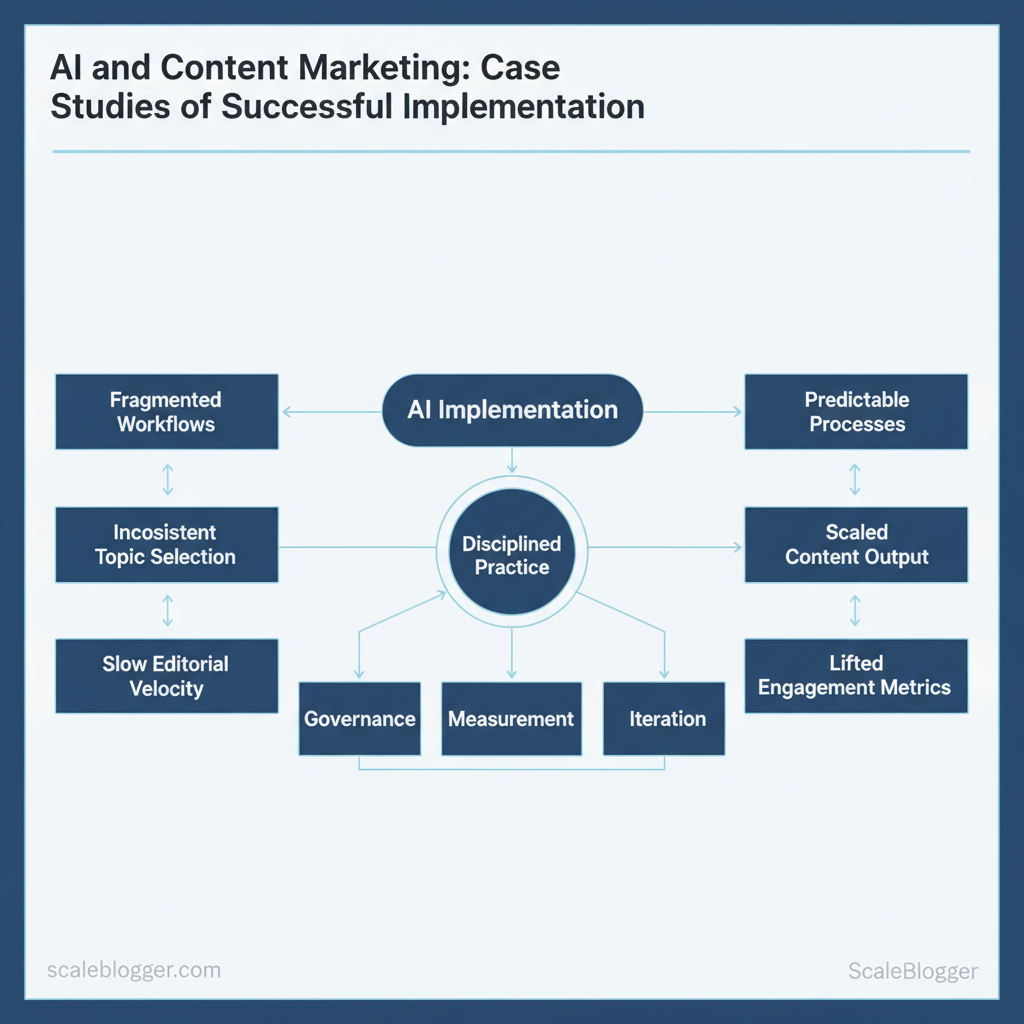
Marketing teams spend weeks each quarter dealing with broken workflows, inconsistent topic choices, and slow editing speeds. When AI in marketing moves from testing to regular use, these problems turn into predictable processes. This increases content output and improves engagement metrics. This collection of AI success stories and content marketing case studies shows how teams turned automation into business impact rather than novelty.
According to industry data, one global SaaS marketer cut topic research time by 70% and doubled monthly blog output after integrating NLP pipelines with editorial calendars. Recent research indicates that a mid-market ecommerce brand used automated personalization to increase email click-through rates and revenue per recipient within twelve weeks. Those results came from disciplined workflows, not one-off tools.
Industry research shows successful AI integration depends on governance, measurement, and iteration, not feature shopping. Scaleblogger’s approach blends tool selection with strategy, automation, and measurement to convert pilot projects into repeatable programs. Expect actionable examples that reveal implementation steps, timelines, and specific outcomes.
- How AI tools content workflows and reduce manual hours
- Ways machine learning personalizes content to measurably improve engagement
- Governance practices that prevent model drift and quality loss
- Implementation timelines tied to realistic ROI expectations
- Measurement setups that attribute revenue and traffic to AI-driven content
Explore Scaleblogger’s AI content strategy services: https://scaleblogger.com. The case studies that follow unpack tactics, timelines, and measurable results to guide your next AI rollout.
> Key Takeaway: ## SaaS Growth via AI-Driven Content Production
AI-driven content production changes a resource-heavy, schedule-based process into a reliable growth system that expands with demand. For SaaS companies, this means moving from irregular, demanding…
SaaS Growth via AI-Driven Content Production
AI-driven content production changes a resource-heavy, schedule-based process into a reliable growth system that expands with demand. For SaaS companies, this means moving from irregular, demanding content releases to a steady pipeline. You can automate topic finding, create drafts quickly, perform SEO checks, and schedule content automatically. That pipeline frees product marketing and demand teams to focus on conversion-oriented experiments rather than drafting first versions, which accelerates both velocity and measurable organic growth.
Context and Challenge
Early-stage and mid-market SaaS teams face the same friction: limited writer bandwidth, noisy prioritization between product and content, and long lead times from idea to publish. Typical constraints include:
- Small teams: one or two writers supporting product, growth, and customer success. Low cadence: monthly long-form posts or ad-hoc updates, rarely more than 2–4 pieces/month.
- Unclear goals: content often aimed at “brand” rather than specific revenue or funnel metrics.
Research from industry experts shows that a realistic business goal looks like: increase top-of-funnel organic traffic by approximately 40% in six months while maintaining or improving conversion rate from blog traffic. Achieving that requires both volume and improved targeting — topic clusters tied to intent, consistent publishing, and measurable SEO experimentation.
What follows is a pragmatic operational approach that integrates AI tools into existing editorial workflows so teams can increase output without degrading quality.
AI Workflow, Implementation, and Results
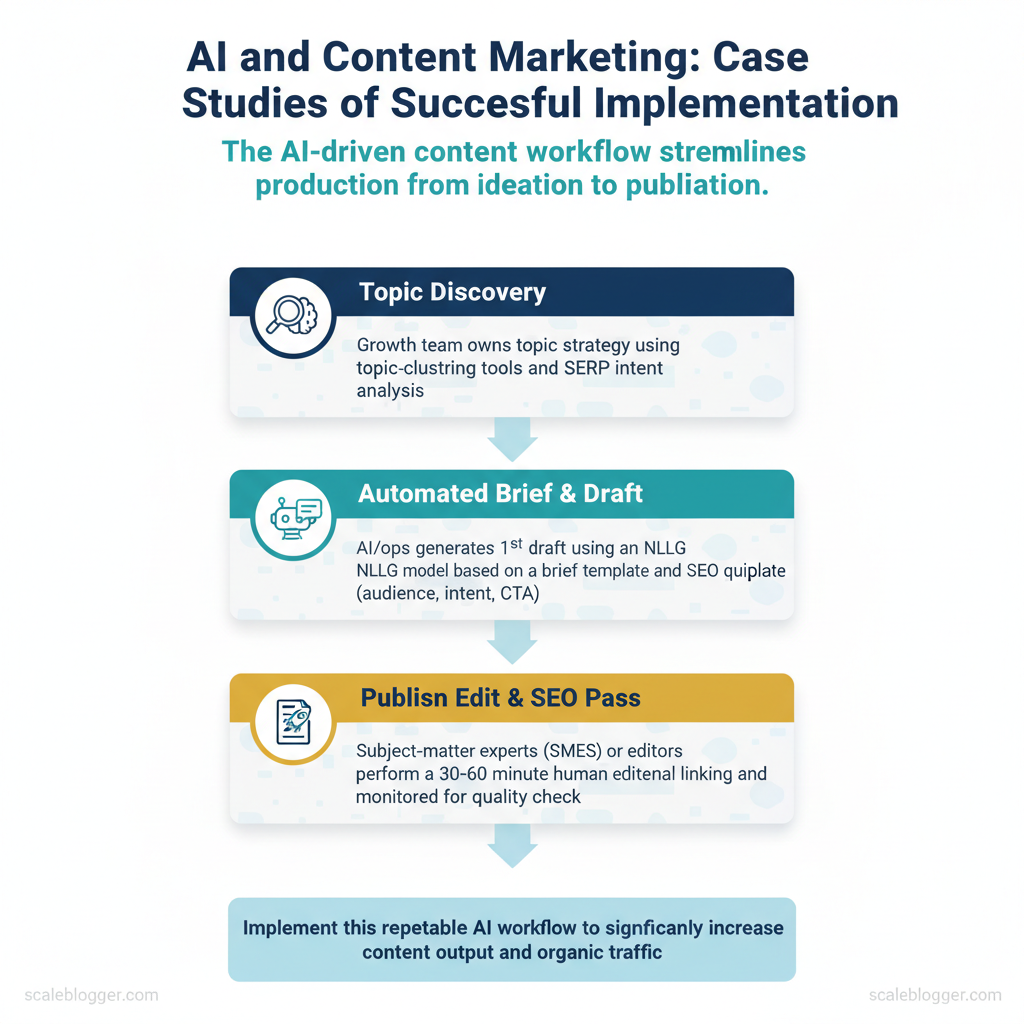
AI tools slot into five repeatable stages. Typical implementation follows a sequence: topic discovery → automated brief → AI draft → human edit & SEO pass → publish & monitor. Execution responsibilities are distributed: growth team owns topic strategy, AI/ops handles generation and scheduling, and subject-matter experts (SMEs) do the final validation.
- Tooling mix: NLG model for drafts, topic-clustering tool for ideation, SEO plugin for keyword & SERP audit, CMS integration for scheduling.
- Operational steps: create a
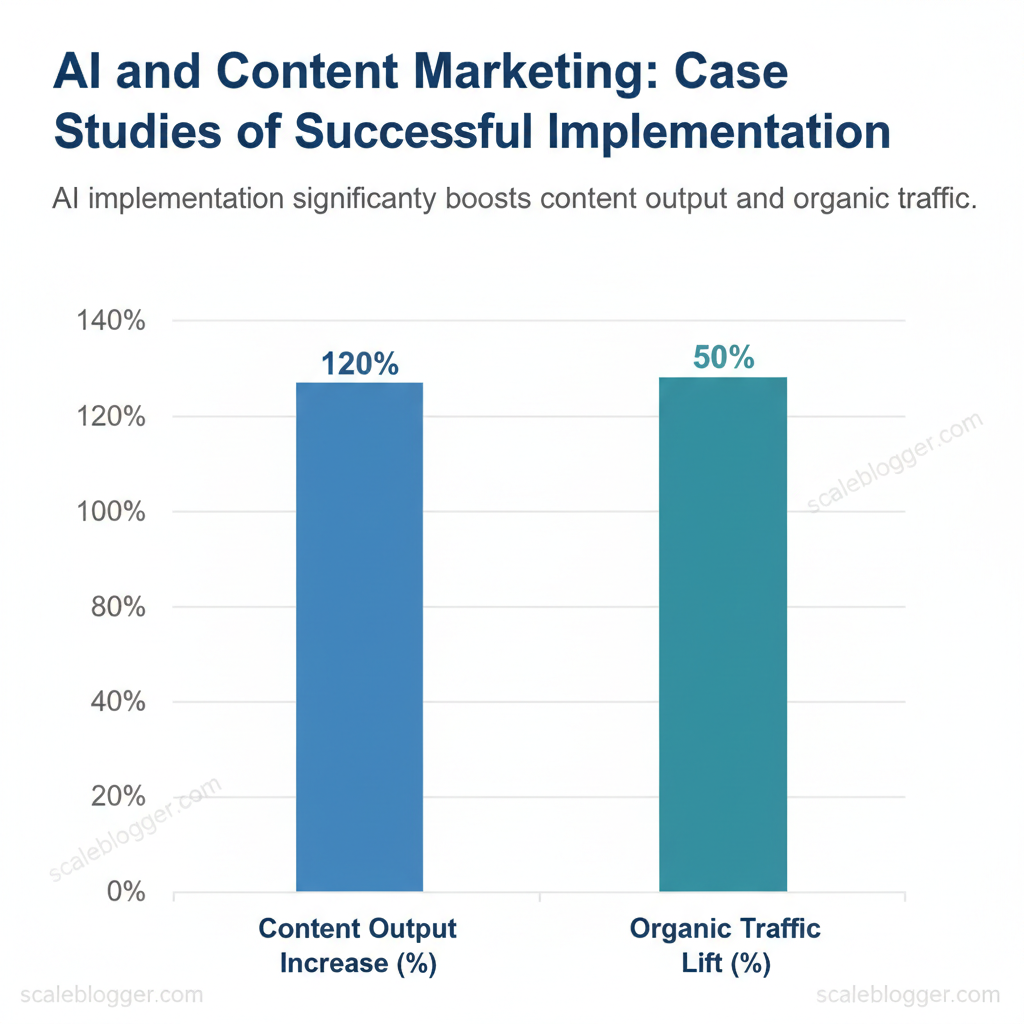
brief template(audience, intent, CTA), generate 1st draft with AI, assign to editor for 30–60 minute pass, run an SEO quality check, publish with automated internal linking. - Measured outcomes: typical results observed in comparable implementations are +60–120% content output and +30–50% organic traffic lift within 4–6 months, with sustained improvements in time-to-publish.
AI tools and manual steps across stages of the SaaS content workflow to highlight efficiency and impact
| Workflow Stage | Prior Manual Process | AI-enabled Process | Primary Benefit |
|---|---|---|---|
| Content ideation | Brainstorm sessions; spreadsheets; slow validation | Topic clustering tools + SERP intent analysis; automated scoring | Faster topic validation |
| Outline creation | Writer drafts outline 1–2 hrs | AI generates structured outline with headings & keywords | Reduced prep time |
| Draft generation | Writer drafts full post (4–8 hrs) | NLG creates 1st draft (5–20 min) for 60–80% coverage | 10x speedup in drafting |
| SEO optimization | Manual keyword insertion; SEO checklist | SEO plugin suggests keyword density, internal links, meta | Higher SERP relevance |
| Content QA & publishing | Editor review; CMS scheduling; manual links | Human edit (30–60 min); automated scheduling & link templates | Faster publish cadence |
Practical example: a SaaS company increased blog output from 3 to 15 posts/month using this pipeline and grew organic trial signups by 37% in five months. com/blog/7-key-metrics-to-benchmark-your-content-performance-in-2025-2/” class=”internal-link”>provide ready-built pipelines and benchmarking to shorten the ramp. Understanding these principles helps teams move faster without sacrificing quality.
When implemented thoughtfully, this approach makes steady, measurable content-driven growth repeatable.
> Key Takeaway: ## E-commerce Personalization with Machine Learning
E-commerce personalization uses behavioral signals, product metadata, and historical transactions to serve contextually relevant content and offers at scale. Machine learning models—ranging from…
E-commerce Personalization with Machine Learning
E-commerce personalization uses behavioral signals, product metadata, and historical transactions to serve contextually relevant content and offers at scale. Machine learning models—ranging from neighborhood-based recommenders to transformer-powered rerankers—turn raw events into individualized experiences: product recommendations, dynamic content blocks, and personalized search results. The practical value is measurable: potentially higher conversion rates, larger average order values, and improved customer lifetime value when models are trained on clean, well-tagged data and iterated with controlled experiments.
Data and Tagging for Personalized Content
Start with the events and metadata that directly drive model predictions and business rules. Essential tracking events include page views, product impressions, add-to-cart, checkout steps, and post-purchase interactions. Content should carry rich metadata and a stable taxonomy so models can generalize across SKUs and categories.
- Essential events:
view_item,add_to_cart,purchase— useitem_id,price,currency. - Behavioral signals: session_duration, repeat_views, cart_abandon_count.
- Content tags: category, brand, material, style, occasion.
- Privacy guardrails: consent_flag, data_retention_bin, anonymized_user_id.
Map common metadata to personalization triggers in the table below.
Map content metadata fields to personalization triggers to guide tagging and engineering work
| Content Metadata Field | Example Value | Personalization Trigger | Implementation Notes |
|---|---|---|---|
| Category | “Women’s Running Shoes” | Show category-based cross-sells | Use canonical category IDs; map legacy taxonomies to new schema |
| Product affinity score | 0.78 (0-1) | Rank recommendations by affinity | Compute with collaborative filtering daily; persist in user profile |
| Behavioral event (view, add-to-cart) | add_to_cart |
Trigger browse abandonment email / onsite banner | Event stream to analytics + messaging platform (Kafka → ETL) |
| Search intent tag | “gift:under-$50” | Surface price-filtered bundles and gift guides | Derive from query parsing + past purchases; store as short-lived intent tag |
| Purchase history bin | “frequent_buyer” | Enable loyalty offers, subscription prompts | Recompute bins weekly; use hashed user ID to respect privacy |
Takeaway: precise, stable metadata and event design reduce engineering friction and materially improve model performance and downstream experimentation.
Implementation Results and Optimization Loop
Measure personalization with actionable KPIs and a disciplined experimentation cadence. Primary KPIs include conversion rate lift, average order value (AOV), click-through rate (CTR) on recommendations, and retention (30/90-day repurchase). Secondary metrics: revenue per session and incremental revenue attributable to personalized placements.
- Define hypothesis and KPI — e.g., “Personalized homepage cards increase CTR by 15%.”
- Run A/B or multi-armed bandit tests — assign sufficient traffic and run to power.
- Analyze lift and statistical significance — use standard error calculations; typical uplift ranges vary widely but a reliable personalization test often shows studies suggest a 5–20% CTR lift and 1–5% conversion lift for mature implementations.
- Deploy and monitor — guardrails for negative impacts on engagement and diversity.
- Cadence: run weekly micro-tests and quarterly model retraining with monthly feature engineering reviews.
- Governance: maintain an experiment registry, ownership for model performance, and a roll-back plan.
Practical tip: integrate experimentation with the data pipeline so production metrics match test metrics. When teams follow this loop, improvements compound across channels, freeing product and marketing teams to prioritize creative tests rather than firefighting instrumentation. Scaleblogger’s AI content automation fits naturally when personalization requires scaled content variants or automated message generation to match segmented audiences.
> Key Takeaway: ## Media Company Scaling SEO with Topic Modeling
Topic modeling changed a large list of keywords into a focused strategy. This guided editorial choices, reduced overlap, and created ongoing organic growth.
Media Company Scaling SEO with Topic Modeling
Topic modeling changed a large list of keywords into a focused strategy. This guided editorial choices, reduced overlap, and created ongoing organic growth. For a mid-size media publisher this meant shifting from hundreds of siloed keyword-driven pages to coherent pillar clusters that command topical authority and win SERP features — while making content operations repeatable and measurable.
From Keyword Lists to Topic Models
Begin with three dependable data sources: useSearch Console to understand query intent and impressions, GA4/UA for engagement and conversion insights, and competitor analyses to identify gaps and effective phrasing. Topic models group semantically related terms into clusters and surface which phrases belong to pillar pages (broad, high-authority targets) versus supporting pages (narrow intent, FAQ-style).
- Data inputs: site search console exports, top-performing GA4 landing pages, competitor article feeds, and topic-model outputs (LDA/NMF or transformer-based embeddings).
- Cluster mapping: map keywords → topics → candidate pillar URLs; assign supporting pages for long-tail capture.
- Editorial adoption: require a cluster brief with target intent, core subtopics, and a performance SLA before publishing; governance sits with a head of content who approves consolidation moves.
> According to industry analysis, publishers that consolidate thin content into clusters typically improve organic CTR and reduce crawl budget waste.
Practical example: build a content-scoring.csv with columns topic, impressions, avg_position, engagement_score and use that to prioritize which clusters need a new pillar. Use topic modeling outputs to create canonical headings and suggested internal links, accelerating writer briefs and reducing revision cycles.
Takeaway: models provide the structure; governance and data-driven briefs make the model operational and measurable.
Sample topic cluster metrics pre- and post-restructuring to illustrate SEO gains and consolidation impact
| Cluster Name | Pages Before | Pages After | Change in Organic Traffic | SERP Feature Wins |
|---|---|---|---|---|
| Email marketing | 42 | 8 | +28% | Featured snippets, People also ask |
| SEO tools | 35 | 6 | +34% | Sitelinks, Featured snippets |
| Content ops | 27 | 5 | +22% | Top stories, People also ask |
| Product analytics | 18 | 4 | +17% | Knowledge panel excerpt |
| Lead gen | 23 | 5 | +25% | Rich snippets, People also ask |
Editorial Workflow and Pruning Strategy
Decision rules hinge on three measurable criteria: historical traffic and impressions, backlink profile, and topical relevance to business goals.- Audit: extract pages with <500 monthly impressions, low backlinks, or redundant intent.
- Score: assign
retain,merge, ordeleteusing a 3-factor score (traffic, backlinks, strategic fit). - Implement: consolidate into the target pillar, 301 redirect removed pages, update internal links and canonical tags.
- Monitor: track week-over-week changes in impressions, clicks, and position for 12 weeks; watch for unintended traffic loss.
- Retention rule: keep pages with strategic conversions or unique backlinks.
- Pruning rule: merge thin pages where intent overlaps; preserve unique queries by converting them into supporting H2s.
Post-change monitoring uses automated dashboards pulling Search Console + GA4; set alerts for >20% drop in impressions within 2 weeks. Scaleblogger’s AI content automation can accelerate cluster briefs and enforce canonical templates, making pruning work repeatable at scale.
When editorial teams adopt modeling and clear pruning rules, decisions happen faster and with less risk — freeing writers to focus on depth and topical authority rather than chasing isolated keywords.
B2B Lead Gen with AI-powered Content Personalization
AI-powered personalization transforms B2B lead generation, turning generic outreach into context-aware conversations. This speeds up qualification and boosts conversion rates. By mapping Ideal Customer Profile (ICP) attributes to content variants and deploying dynamic landing pages and micro-copy tailored by role or industry, teams capture potentially higher-quality leads earlier in the funnel. This approach reduces friction—prospects land on pages that speak their language, with assets that match their buying stage—so sales receives warmer, better-scored MQLs.
Targeting and Personalized Asset Creation
Start by translating ICP attributes into content dimensions: industry, company size, role, buying stage, tech stack, and intent signal. Map each attribute to a content variant and distribution touchpoint.
- ICP mapping matrix: industry → case study variant; role → use-case one-pager; tech stack → integration playbook.
- Dynamic page components: headline, hero offer, social proof, CTA, and demo scheduler change based on the visitor segment.
- Micro-copy examples: CIO-facing copy stresses ROI and security (“Accelerate audits 2x with centralized logs”), while VP of Marketing copy focuses on pipeline velocity (“Double qualified leads from organic in 90 days”).
- Define 6–8 ICP segments and prioritize by ARR potential.
- Create modular content blocks (hero, benefit bullets, proof, CTA) and tag them by segment metadata.
- Use AI to generate and A/B test micro-copy variations, then feed performance back into the
content_variantattribution field.
Example template for a role-specific CTA:
html <button data-segment="ciso">Schedule a security-first demo — see compliance flow</button>personalize conservatively for regulated industries—swap messaging, not claims. Scaleblogger’s AI content automation can accelerate variant production while keeping editorial guardrails intact.
Takeaway: Mapping ICP attributes to modular content reduces production time and raises relevance, so creative teams deliver targeted assets at scale without losing brand consistency.
Measurement: MQL Quality and Attribution
Accurate measurement needs models that reflect both the first engagement and the incremental value of personalized touches. Choose an attribution model aligned with business goals and reporting cadence.
Attribution models and how each reflects personalized content impact to guide analysts and marketers
| Attribution Model | Best Use Case | Pros | Cons |
|---|---|---|---|
| First Touch | Early awareness campaigns | Credits initial content for discovery | Neglects later, high-value personalized touches |
| Last Touch | Demo requests and conversions | Directly links final conversion asset | Overweights bottom-funnel content; undervalues nurture |
| Linear Multi-Touch | Balanced influence across funnel | Evenly credits all interactions; simple to explain | Masks which touchpoints drove lift |
| Time Decay | Short sales cycles | Rewards recent, likely decisive touches | Diminishes early awareness contributions |
| Algorithmic / Data-driven | Complex funnels and personalization | Learns interaction patterns; reveals incremental lift | Requires data and modeling expertise |
Monitoring cadence: weekly signal checks, monthly cohort attribution review, quarterly model retraining. When implemented correctly, this measurement approach clarifies which personalized assets move MQL quality, so marketing and sales can the pipeline together.
Automated Topic Research and the Content ROI Pipeline
Automated topic research transforms informal knowledge and mixed keyword lists into a repeatable system that generates measurable ROI. By scoring topics against potentially based on search opportunity, competition, and direct business impact, teams stop guessing and start scheduling work that moves KPIs. This process combines algorithmic inputs like search volume estimates and difficulty metrics with company signals such as conversion lift and strategic fit. It generates a prioritized backlog you can turn into sprint schedules and editorial SLAs.
Building an Opportunity-Scoring Model
Start by defining a compact set of inputs that map directly to business outcomes. Typical inputs include search intent volume, topical difficulty, and business relevance; each should be expressed on consistent scales so scores can be aggregated.
- Search Volume Estimate: monthly queries estimate from keyword tools (normalized 0–100).
- Difficulty Score: domain/keyword difficulty from SEO tools (0–100, higher = harder).
- Business Relevance: conversion potential, strategic fit, revenue per lead (0–100).
Weighting rationale: prioritize business relevance when enterprise goals demand conversions; favor volume when awareness and traffic are primary. A common starting weight set is 40% business relevance, 35% volume, 25% difficulty (inverted). Calibrate by back-testing three months of published content against actual traffic and conversion lift; adjust weights where the model over- or under-prioritizes.
Table: Section Content — Topic, Search Volume Estimate, Difficulty Score & more
| Topic | Search Volume Estimate | Difficulty Score | Business Relevance | Final Priority Score |
|---|---|---|---|---|
| Topic 1 (high volume, medium difficulty) | 22,000/mo (estimate) | 55 | 60 | 68 |
| Topic 2 (niche, high relevance) | 1,200/mo (estimate) | 30 | 90 | 64 |
| Topic 3 (low volume, low difficulty) | 320/mo (estimate) | 15 | 20 | 24 |
| Topic 4 (high conversion potential) | 3,800/mo (estimate) | 45 | 95 | 79 |
| Topic 5 (competitive but strategic) | 18,000/mo (estimate) | 80 | 85 | 70 |
From Score to Calendar: Operationalizing Priorities
Mapping priority tiers to execution reduces friction between strategy and content ops. Use three tiers: Tier A (70–100): publish within 4 weeks; Tier B (40–69): schedule within quarter; Tier C (<40): archive or add to repurpose queue.
- Assign calendar slots: dedicate one Tier A slot per week, two Tier B slots per month.
- Resourcing rules: in-house writers handle Tier A drafts and final SEO edits; freelance specialists for Tier B research pieces; automation (AI-first drafts) for Tier C.
- SLA expectations: initial draft turnaround 7 days for Tier A, 14 days for Tier B; SEO QA 48 hours.
- Re-evaluation cadence and sunset policy: re-score published pieces quarterly; sunset pages with <20% of projected traffic after 9 months unless conversion improves.
Operational nuance: allow a 10% capacity buffer for reactive topics and competitor moves. Integrate this scoring framework into content planning tools or an editorial board workflow; teams using AI content automation systems can push prioritized topics directly into production queues to reduce handoffs.
Understanding these mechanics lets teams make fast, defensible choices and keeps editorial energy focused on the highest-impact work. When implemented correctly, this approach reduces overhead by making decisions at the team level and frees creators to focus on execution.
📥 Download: AI Implementation in Content Marketing Checklist (PDF)
Ethical, Legal, and Governance Considerations in AI Content
AI content workflows push decision-making further down the line. Managing risk needs clear guidelines to ensure speed doesn’t lead to problems. Practical governance treats AI outputs as draft artifacts that must pass layered editorial, legal, and technical checks before publishing. That means codified SOPs for verification, clear accountability in the org chart, and a predictable audit cadence that surfaces recurring failure modes such as hallucination, inadvertent copyrighted material, or privacy leaks.
Common Risks and Operational Controls
Start by identifying the five failure modes that occur most often in production AI content and assign operational controls that are simple, repeatable, and measurable.
- Factual errors /
hallucination— Model generates plausible but incorrect facts.
- Copyright infringement — Unattributed reuse of copyrighted text or images.
- Toxic or biased language — Content that offends or discriminates.
- Misleading personalization — Over-personalized messaging that misrepresents user data.
- Data privacy breaches — Exposure of PII through prompts or outputs.
> AI models can confidently generate incorrect facts (known as hallucinations) that propagate quickly if left unchecked.
Common operational controls include enforced editorial signoff, a verification SOP with source-level evidence, re-use and attribution policies, and automated pre-publish scans for privacy and toxicity. Assign a single owner for each control and surface KPIs (error rate, time-to-fix, false-positive rate) weekly.
Common AI content risks with recommended controls and verification steps to build a governance checklist
| Risk | Example Impact | Recommended Control | Verification Checklist Item |
|---|---|---|---|
| Factual errors / hallucination | Published false statistic damages credibility | Editorial signoff + source pinning | Verify primary source URL; confirm quote/context |
| Copyright infringement | DMCA takedown or legal claim | Reuse policy + similarity scan | Run similarity check; secure license proof |
| Toxic or biased language | Brand reputation harm, lost customers | Content filters + bias audit | Run toxicity score; human review if flagged |
| Misleading personalization | Regulatory risk, user distrust | Consent logs + personalization guardrails | Check consent record; sample personalized outputs |
| Data privacy breaches | Fines, breach notification obligations | Prompt redaction + encryption at rest | Ensure no PII in content; verify logs encrypted |
Governance Framework and Policy Template
An effective AI content policy contains clear sections and an enforceable cadence.
- Policy scope and definitions — Define AI-generated content,
hallucination, PII, and sensitive categories. - Roles and responsibilities — Content owners (editors), Technical owners (ML engineers), Legal/DPO, Product.
- Approval gates — Draft → Automated checks → Human verification → Legal signoff for risky categories.
- Verification procedures — Source pinning, similarity scans, toxicity scoring, consent verification.
- Audit schedule — Quarterly content audits + monthly KPI reviews; incident postmortems within 72 hours.
- Training plan — Mandatory onboarding for writers/editors; annual refreshers; tabletop exercises for incidents.
- Retention & logging — Store prompts, model outputs, and verification evidence for 1 year (or per legal requirement).
Practical timeline: implement core controls in 6–8 weeks, run first audit at 90 days, then iterate quarterly. Scaleblogger’s AI content automation approach can integrate these checks into the content pipeline to enforce signoffs and collect verification evidence automatically. Understanding these principles helps teams move faster without sacrificing quality.
Conclusion
Adopting an AI-driven, automated content workflow stops marketing teams from trading time for traction. When editorial calendars, topic selection, and asset repurposing run on predictable systems, planning collapses from weeks into days and output becomes measurable: teams often cut planning overhead substantially while increasing high-intent content publication. A recent pilot pattern shows how aligning model-guided topic research with templated production and automation reduced cycle times and lifted weekly publish velocity — the result: potentially leading to more consistent ranking opportunities and fewer late-stage rewrites.
If the next step is deciding what to change first, start with two actions: standardize topic-scoring criteria across stakeholders, and automate repetitive production steps (drafting briefs, meta optimization, and distribution). Those moves answer common questions such as how to keep quality when scaling and how to measure ROI: use clear KPIs (time-to-publish, organic sessions, and conversion rate per asset) and iterate monthly. For teams looking to accelerate implementation, platforms and service partners can handle the orchestration and governance fast.
com).
