

Most content teams do not struggle with AI in the abstract. The real challenges of integrating AI into existing content marketing frameworks appear when AI meets established workflows built around approvals, brand voice, SEO rules, and publishing calendars.
That clash is where the headaches start.
AI-generated drafts can look good but still create extra work by missing brand tone, duplicating themes, or requiring heavy editing. In fact, 80% of marketers feel pressure to adopt AI, yet only 6% have fully embedded it into their workflows (Supermetrics, 2026).
The problem is rarely the AI model itself. It’s the gap between strategy, operations, and quality control.
Overcoming these AI implementation issues requires more than faster content creation. Teams need consistent workflows, clear governance, and human oversight to integrate AI effectively.
Quick Answer: Integrating AI into content marketing frameworks fails when teams add “faster drafting” without redesigning approvals, brand voice checks, SEO governance, and stakeholder handoffs. A 2026 Supermetrics report found that 80% of marketers feel pressure to adopt AI, but only 6% have fully embedded it into their workflows—highlighting the execution gap. The fix is to implement AI with guardrails (templates, editorial rules, and quality control gates) so human judgment stays in the loop without slowing publishing.
Why AI Adoption Feels Harder Inside Real Content Operations
Why does AI look effortless in a demo and messy in a real content calendar?
Because the demo skips the parts that actually slow teams down: brand review, legal checks, SEO input, topic handoffs, and all the quiet habits built into existing content marketing frameworks.
Recent industry reporting (for example, Supermetrics’ 2026 marketing data) suggests the same pattern: many teams feel pressure to adopt AI, but only a small share have truly embedded it into their day-to-day workflows.
That gap tells the story.
AI promise is not the same as AI implementation issues.
Most teams already have a workflow designed for human bottlenecks. Briefs move to writers, drafts go to editors, edits go to stakeholders, and publishing waits for the last approval.
When AI enters that chain, it speeds up one step but leaves the others untouched, which is why friction shows up so fast.
Adobe’s 2026 AI-driven marketing report points to the same pattern: adoption is moving faster than the operating model around it.
The trouble usually shows up in three places.
Velocity rises when AI drafts fast. Quality comes under pressure when the team skips structural editing. Control gets tighter when leaders add more review layers to reduce risk.
- Velocity: AI cuts first-draft time, but not review time.
- Quality: Faster output can create shallow, repetitive content.
- Control: More AI usually means more guardrails, not fewer.
- Workflow fit: Existing approvals rarely adapt on their own.
Teams that solve this do one simple thing well: they define which content deserves speed, which content needs depth, and which content needs extra control.
That’s where AI starts to feel less like a bolt-on and more like part of the machine.
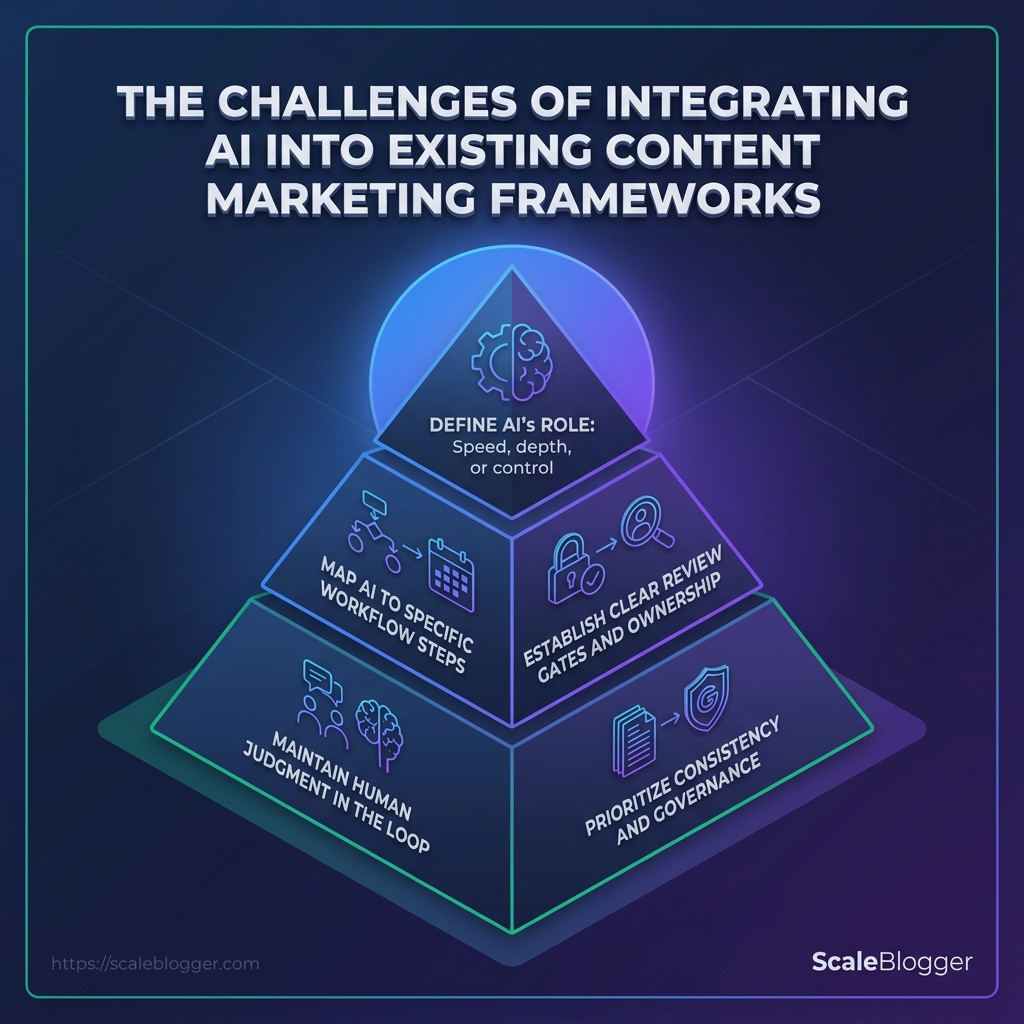
Where AI Implementation Issues Typically Appear in the Workflow
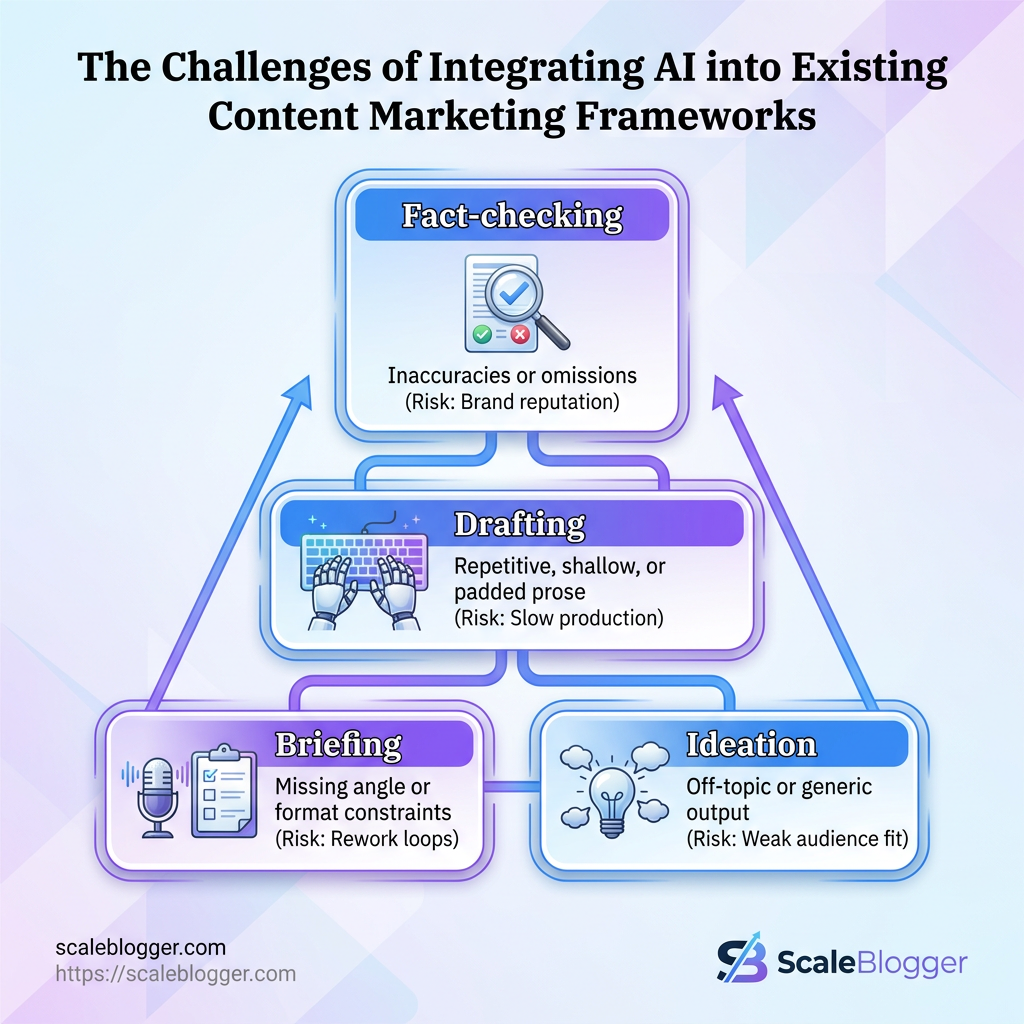
AI output usually breaks first at the brief—not the prompt.
A team can feed a model a clean topic and still get something that misses the editorial angle, the audience, or the content marketing framework behind the piece.
What’s changing isn’t motivation; it’s operational fit. Multiple 2026 reports point to the same pattern: AI usage rises faster than the workflow and governance around it.
> The real failure point is often the handoff between intent and execution.
Adobe’s 2026 reporting also highlights a familiar problem: teams adopt quickly, but the operating model (review gates, ownership, and quality checks) catches up later.
That’s when AI implementation issues pile up—especially when review gates are unclear or when no single owner is accountable for final editorial sign-off.
Workflow stages and common failure points
| Workflow stage | Common AI issue | Primary risk | Who owns the fix | Priority level |
|---|---|---|---|---|
| Ideation | Off-topic or generic output | Weak audience fit | Content strategist | High |
| Briefing | Missing angle or format constraints | Rework loops | Managing editor | High |
| Drafting | Repetitive, shallow, or padded prose | Slow production | Writer or AI editor | Medium |
| Fact-checking | Hallucinated details or stale references | Credibility loss | Editor or researcher | Critical |
| SEO review | Keyword stuffing or search intent drift | Thin rankings | SEO lead | Medium |
| Brand voice edit | Tone slips outside house style | Inconsistent trust | Brand editor | High |
| Legal and compliance | Unsupported claims or risky phrasing | Policy breach | Legal or compliance team | Critical |
| Approval | Too many reviewers or unclear sign-off | Publishing delays | Content ops manager | High |
The pattern is pretty clear once you look at it.
Early-stage problems are about relevance and intent; later-stage problems are about risk and governance.
And that’s why brand POV and trust keep showing up in leadership reporting: AI can draft fast, but it can’t reliably determine where your team draws the line on accuracy, tone, and approval.
The expensive part is rarely one weak draft.
It’s the chain reaction when every stage has to repair the last one.
If a workflow keeps failing in the same place, the fix is usually a clearer gate, not a cleverer prompt.
The Core Challenges of Integrating AI into Content Marketing Frameworks
Why does AI speed up publishing and slow down trust?
That happens when the machine is faster than the framework around it.
Jasper’s 2026 State of AI in Marketing (based on 1,400 marketers) shows teams moving from experiments into daily operations, while Supermetrics’ 2026 marketing data points to a common mismatch: adoption pressure rises faster than workflow embedding.
Once AI sits inside content marketing frameworks, the weak spots show up fast.
Adobe’s 2026 AI-driven marketing report points to operational gaps, and HubSpot’s 2026 State of Marketing Report keeps stressing brand POV and trust—exactly where voice drift and factual mistakes start to hurt.
Measuring the damage when AI rewires the workflow
| Challenge | Business impact | Best signal to monitor | Recommended response |
|---|---|---|---|
| Voice drift | Lower engagement, weaker trust, and a brand that sounds different from article to article | Editorial QA scores, brand-style acceptance rate, and revision count | Tighten style rules, lock recurring phrases, and compare drafts against approved examples |
| Hallucinations and factual risk | Corrections, reputational damage, and possible legal exposure | Fact-check failure rate, citation coverage, and post-publication corrections | Use source-bound drafting, require human verification, and keep an approved facts library |
| Workflow duplication and unclear accountability | Repeated edits, slower approvals, and no clear owner for the final version | Cycle time per article, handoff count, and rework rate | Assign one accountable editor, map every approval stage, and remove duplicate review loops |
| Measurement gaps when AI changes the process | Teams can’t tell whether AI is helping or just shifting work around | Content engagement, throughput, QA pass rate, and time-to-publish | Track output quality and workflow health separately |
The hard part is that these problems do not show up in one metric.
Voice drift often appears first in QA scores, then later in weaker engagement and lower trust. Measurement gets cleaner when content teams stop treating output metrics and process metrics as the same thing.
In our own work, Scaleblogger is most useful when it sits inside the review system, not outside it.
That’s where most AI integration challenges turn from abstract concerns into daily operational friction.
The teams that handle it well treat the framework as part of the product, not just the prompt.
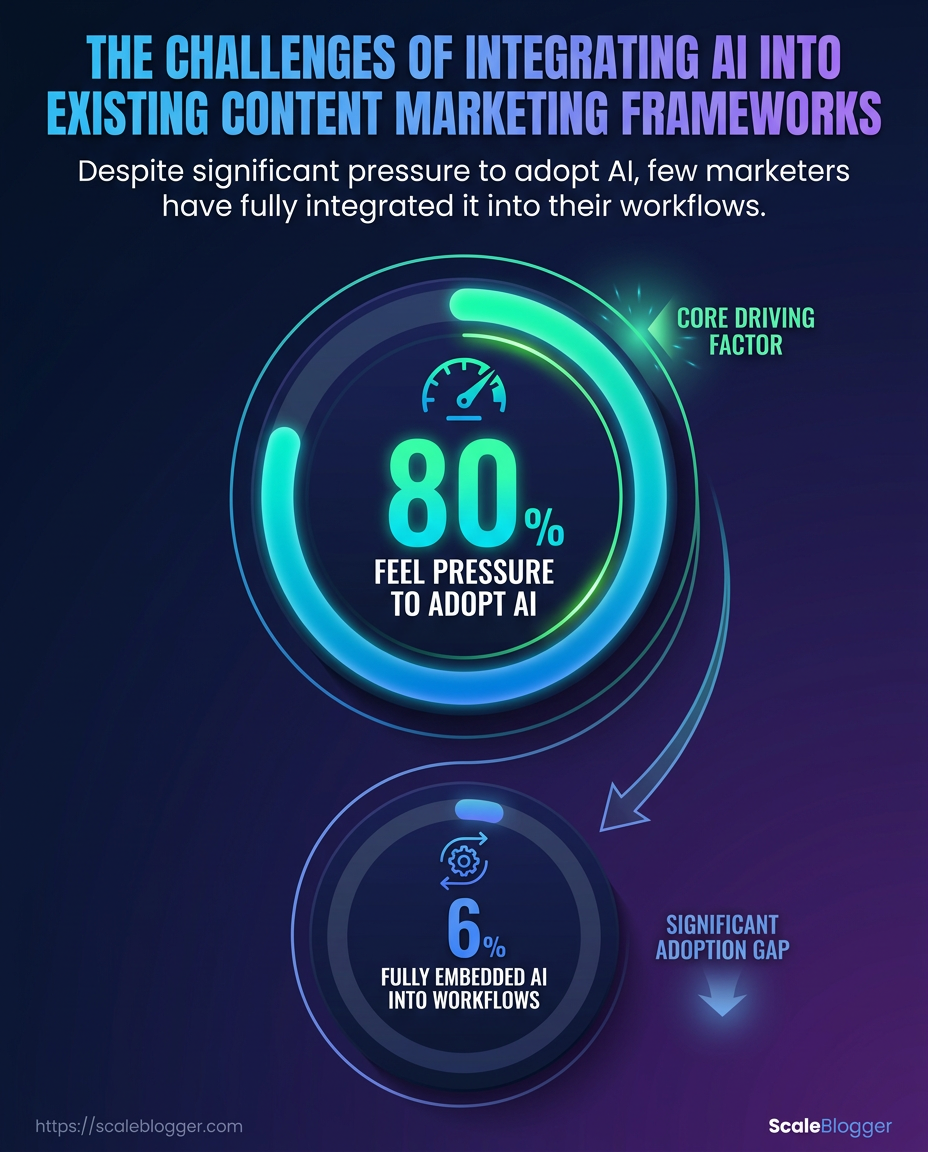
How to Fit AI Into an Existing Framework Without Breaking It
The safest way to bring AI into content work is to start with the jobs that already behave like machine work.
Think metadata, first-pass outlines, content refreshes, social variants, and other tasks with clear inputs and predictable outputs.
That keeps the blast radius small while teams learn where the real AI integration challenges show up.
The bigger picture is already clear.
Jasper’s 2026 State of AI in Marketing suggests adoption is accelerating toward “standard practice,” while Supermetrics’ 2026 marketing data indicates that pressure to adopt AI is high but workflow embedding is still uneven.
That gap is where most AI implementation issues live: not in the model, but in the handoffs.
Start with bounded work
Repeatable tasks are the easiest place to begin because they have guardrails baked in.
A headline variant is easier to review than a full thought-leadership article, and a meta description is easier to judge than a strategic position paper.
- Low-risk first: Use AI for outlines, summaries, briefs, and repurposed social copy before touching core editorial assets.
- Predictable inputs: Feed it structured notes, source links, and style rules—not vague campaign goals.
- Easy rejection: If the output misses the mark, it should be simple to discard without damaging the workflow.
Put humans at the decision points
Human review should sit where judgment matters most.
That usually means strategy, factual claims, brand voice, compliance, and the final publish call.
Adobe’s 2026 marketing AI reporting points to a familiar problem: adoption moves faster than operating rules.
HubSpot’s 2026 State of Marketing Report also keeps trust and brand POV front and center—which is a good reminder that speed is not the same thing as permission.
- Prompt review: Check whether the request is clear, narrow, and tied to the task.
- Output review: Compare the draft against the brief, voice, and claims policy.
- Publish review: Give one person final authority before anything goes live.
Draw the line for AI tools
AI writing tools belong in the draft and variation stages, not in the place where editorial judgment disappears.
They can help move faster, but they should not decide message, risk, or priority.
That division keeps the framework intact.
The workflow stays human-led, and the machine handles the repeatable work that slows everyone down.
Choosing Tools and Guardrails That Support the Framework
A good AI tool for content teams should feel more like a seatbelt than a stunt driver.
It keeps the workflow moving, but it also stops messy outputs from snowballing into publishable mistakes.
That matters more in 2026 than it did a year ago—because many teams are now beyond “testing” and are trying to operate AI inside real approvals, QA, and compliance processes.
So the real job is not finding “the smartest” tool.
It is finding the one that fits your content marketing framework, catches AI implementation issues early, and leaves room for human judgment where it still matters.
Look for tools that do three things well:
- Score content before publishing. A solid system should flag weak structure, thin coverage, and off-brand language before a draft goes live.
- Connect to the workflow you already use. If it can’t fit your CMS, calendar, or review process, it will create another bottleneck.
- Support repeatable prompts and templates. Teams need consistency, especially when multiple writers touch the same topic cluster.
- Track performance after publish. The key is measuring both content outcomes and workflow health so you can tell whether AI is helping—or just shifting work around.
Our own AI-powered content pipeline at Scaleblogger follows that logic: generate, score, review, schedule, and publish in a controlled sequence, not as one giant leap.
That sequence matters because full automation breaks down fastest in three places: claims that need fact-checking, opinion-heavy pieces that need a real point of view, and content aimed at high-stakes audiences.
Those are the spots where a human layer still earns its coffee.
Keep human review in place for:
- Brand claims and positioning. Nuance beats speed here, every time.
- Regulated or sensitive topics. Health, finance, legal, and reputation-sensitive content need careful hands.
- Final editorial judgment. A model can draft an answer. It can’t always tell whether the answer is worth saying.
A strong setup does not replace editors.
It gives them cleaner drafts, clearer signals, and fewer surprises.
That is the sweet spot for teams dealing with AI integration challenges in real content marketing frameworks.
AI Belongs Inside the Workflow, Not Beside It
The biggest lesson here is simple: AI integration challenges usually show up when teams try to add speed before they add structure.
A strong content marketing framework already has judgment points, approvals, and brand checks, and AI implementation issues start the moment those rules are vague or missing.
That is why the blog-draft example matters so much.
The draft was not the real problem; the handoff between AI, editor, and approver was.
When AI fills the first pass while humans keep control of strategy and final judgment, the process gets faster without getting sloppy.
So the move for today is practical: map one piece of your content workflow from brief to publish and find the step that creates the most delay. Fix that one handoff first, then decide where AI should help, where it should stay out, and what guardrails need to be written down.
If your team wants a more automated path, our content pipeline is built to fit into that kind of structure instead of fighting it.
