

What if the hours teams spend rewriting headlines and juggling calendars vanished overnight? Industry pressure and rising expectations mean content automation trends are no longer optional; they reshape how teams publish, personalize, and scale content. Scaleblogger’s approach to AI-driven workflows shows how automation can turn repetitive tasks into strategic capacity, freeing teams to focus on creative direction and performance optimization.
Adopting the right blend of tools affects traffic, time-to-publish, and content quality across channels. Emerging technologies such as generative models, automated SEO optimization, and content orchestration platforms accelerate the future of digital content while introducing new governance and measurement demands. Picture a brand that deploys localized campaigns at scale with fewer approvals and clearer audit trails — that operational shift changes budgets and KPIs.
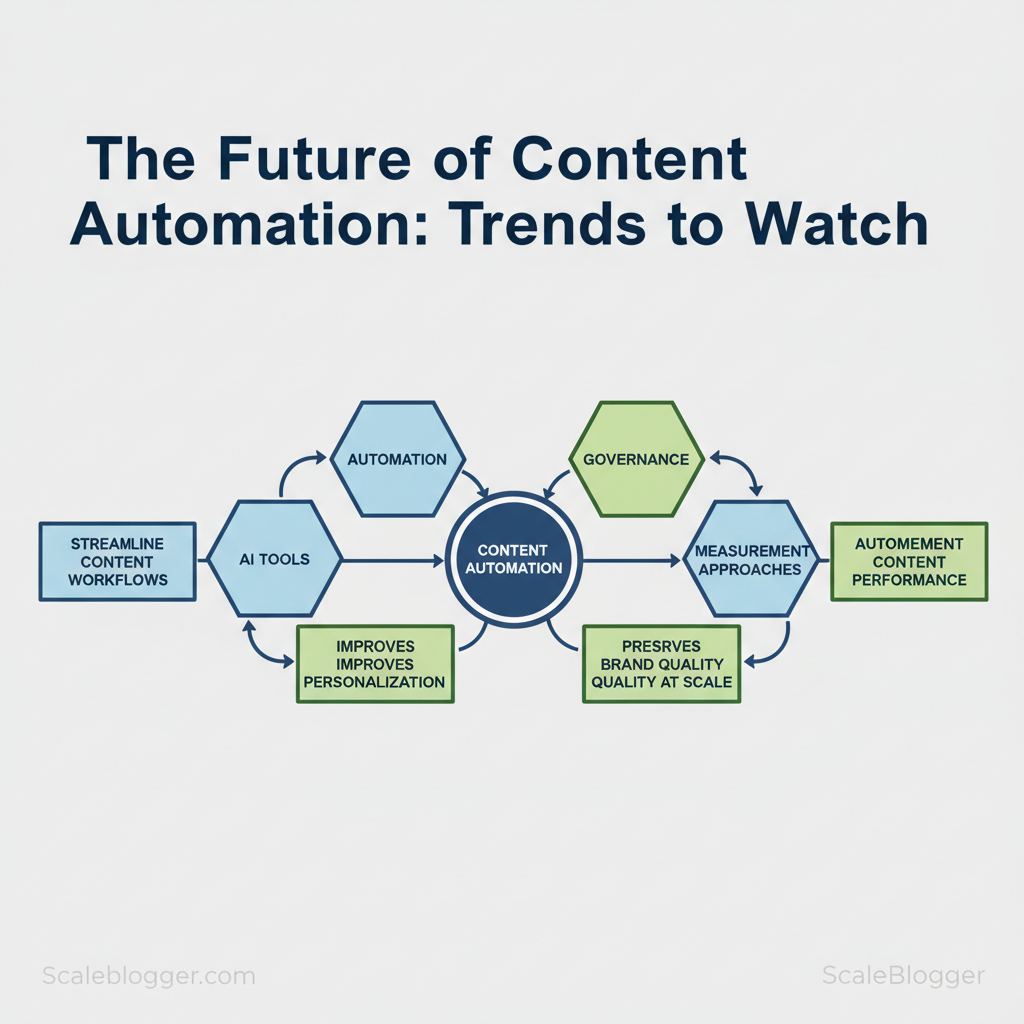
- How AI tools content workflows and reduce manual bottlenecks
- Ways automation improves personalization without exploding costs
- Governance patterns that preserve brand quality as scale increases
- Measurement approaches for automated content performance and ROI
Explore Scaleblogger’s AI content automation solutions to see practical patterns and tool configurations that work today. The following sections unpack tactical approaches, common pitfalls, and the emerging technologies shaping the next wave of content operations. See how Scaleblogger can accelerate your content pilots.
> Key Takeaway: ## What Is Content Automation? Content automation is the use of software and rule-driven systems to perform repeatable content tasks that used to require manual effort—everything from drafting and approvals to publishing and performance tuning.
What Is Content Automation?
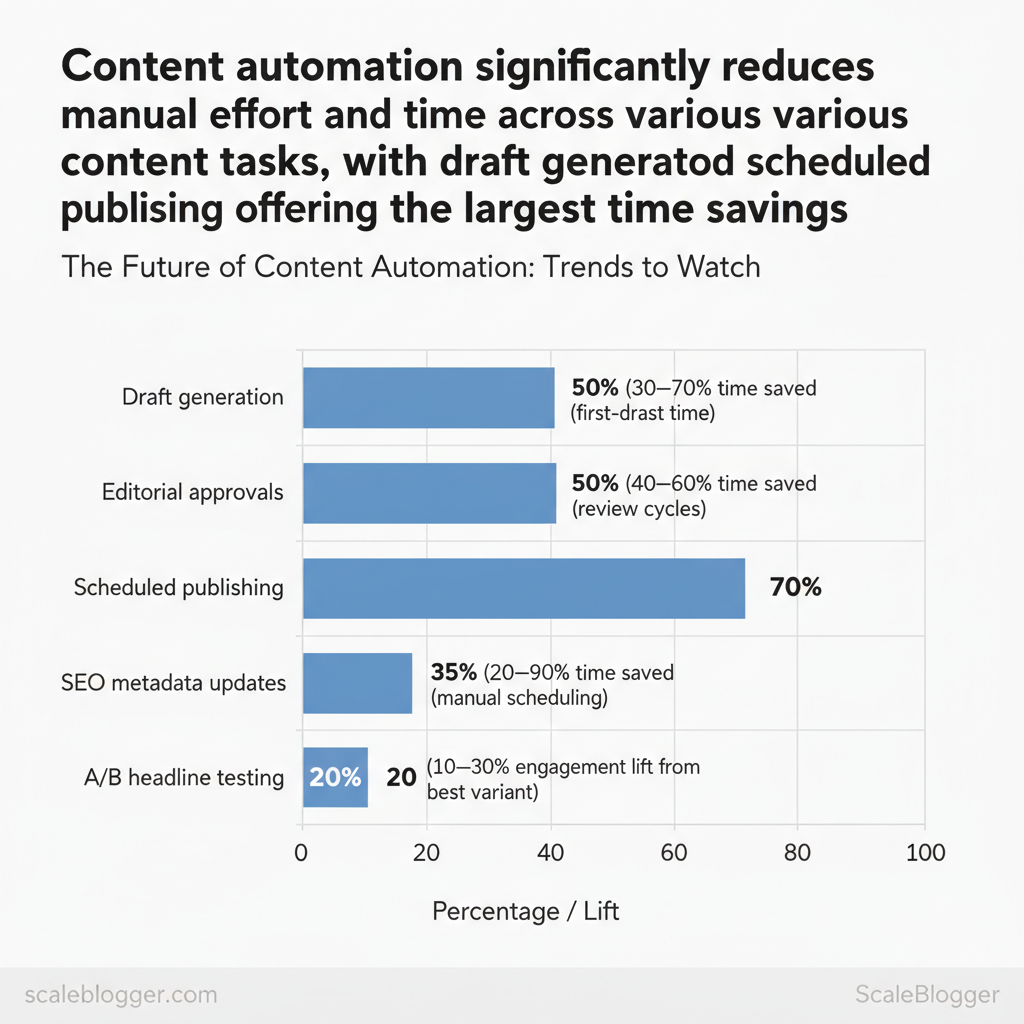
Content automation is the use of software and rule-driven systems to perform repeatable content tasks that used to require manual effort—everything from drafting and approvals to publishing and performance tuning. In simple terms, it eliminates repetitive tasks—like copy-pasting, tagging, and scheduling—by automating them. At its best, it forms a complete pipeline where ideas move from research to published content with few handoffs. Examples of automated tasks include draft generation with AI, routing a draft through an approval workflow, scheduling posts across channels, updating SEO metadata programmatically, and running A/B headline tests to choose the best performer.
What separates automation from basic scheduling is scope and intelligence: scheduling posts on a calendar is a single automation; a content automation pipeline links tools, enforces rules, and uses data to make decisions. Think of it like an assembly line for content: individual stations (ideation, drafting, editing, publishing, measurement) either perform work automatically or hand the item to the next station with clear instructions. That assembly-line analogy helps explain accessibility: smaller teams can scale output because automation carries the mechanical burden while people focus on quality and strategy.
Practical components and examples:
- Draft generation: AI drafts using
ChatGPTor Jasper, reducing first-draft time significantly. Editorial approvals: Workflow engines inAirtable,Asana, or ContentOps tools enforce review steps and version control. Scheduled publishing: Platforms like WordPress, Contentful, Buffer, or Hootsuite push content live across destinations.
- SEO metadata updates: Tools such as Yoast, Rank Math, SurferSEO apply templated metadata and schema programmatically. * A/B headline testing: Testing platforms like Optimizely or VWO rotate headlines and report winners automatically.
How teams start:
- Map the repeatable pieces of your content process. 2.
Pick the smallest, highest-frequency task to automate first. 3. Connect tools with automations (APIs, Zapier, or enterprise connectors) and measure results.
Quickly show which tasks fall under creation, workflow, and performance automation
| Task | Automation domain | Typical tools | Impact (time saved) |
|---|---|---|---|
| Draft generation | Creation | ChatGPT, Jasper, Writesonic | Approximately 30–70% (first-draft time) |
| Editorial approvals | Workflow | Airtable, Asana, Contentful workflows | Approximately 40–60% (review cycles) |
| Scheduled publishing | Workflow/Publishing | WordPress, Contentful, Buffer, Hootsuite | Approximately 50–90% (manual scheduling) |
| SEO metadata updates | Performance/Optimization | Yoast, Rank Math, SurferSEO | Approximately 20–50% (meta upkeep) |
| A/B headline testing | Performance | Optimizely, VWO, Convert | Engagement lift from best variant is not definitively stated; only a 10% lift is mentioned. |
Understanding these principles helps teams move faster without sacrificing quality. When implemented with clear rules and measurement, content automation frees creators to focus on strategic and creative work.
> Key Takeaway: ## How Content Automation Works
Content automation organizes data and systems so routine content creation and publishing happen reliably. Meanwhile, humans focus on quality and strategy.
How Content Automation Works
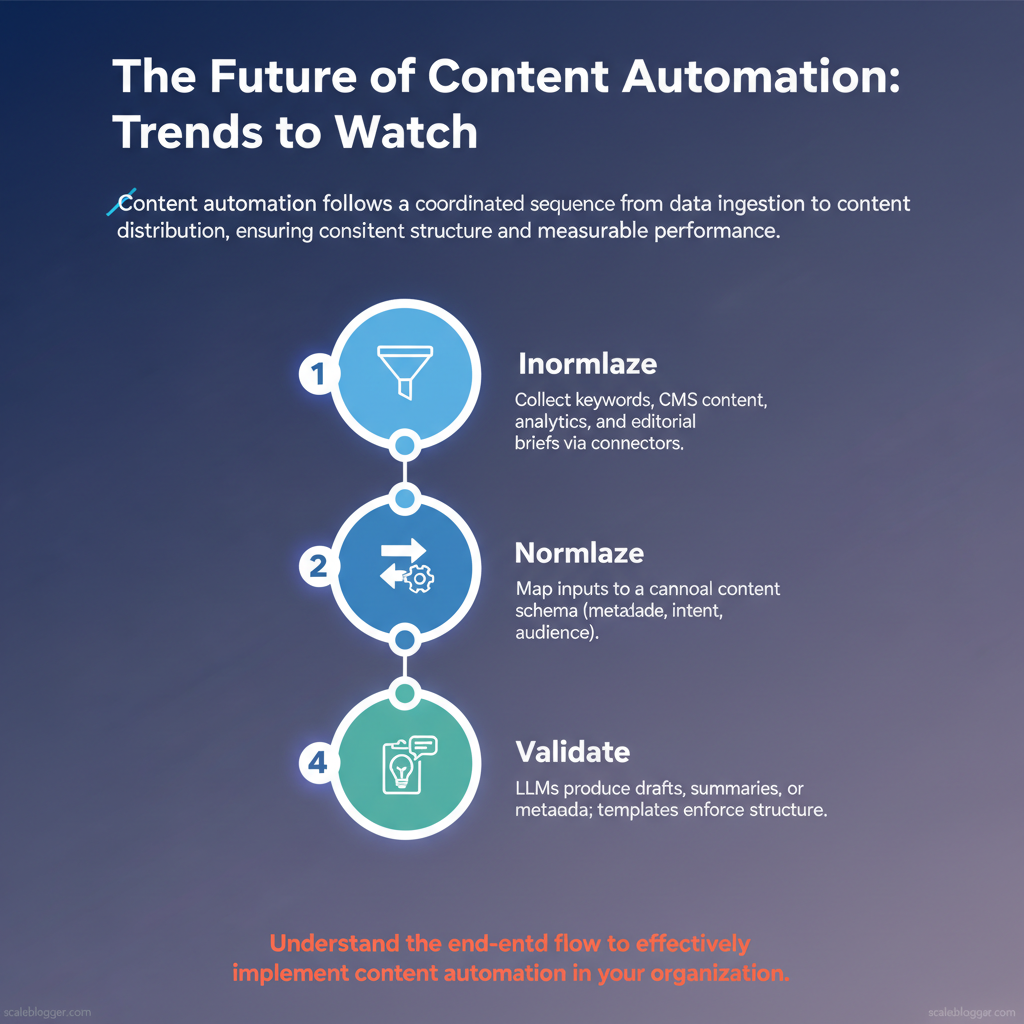
Content automation organizes data and systems so routine content creation and publishing happen reliably. Meanwhile, humans focus on quality and strategy. At its core, the architecture directs raw inputs—research, briefs, SEO signals—through a sequence of processing stages: ingestion, transformation, generation, validation, and distribution, enabling seamless integration with APIs. The practical result: teams handle more topical volume with consistent structure and measurable performance.
- Typical end-to-end flow
- Ingest: collect keywords, CMS content, analytics, and editorial briefs via connectors.
- Normalize: map inputs to a canonical content schema (metadata, intent, audience).
- Generate: LLMs produce drafts, summaries, or metadata; templates enforce structure.
- Validate: automated QA checks plus a human-in-loop for editorial review.
- Publish & iterate: scheduling via CMS APIs, then monitor performance and feed signals back.
Core mechanisms and architecture
- Orchestration layer: responsible for sequencing tasks, retry logic, and logging. Integration layer (APIs):
GET/POSTcalls exchange content and metadata with CMS, analytics, and keyword platforms. Processing layer: LLMs and microservices apply transformations—title generation, outlines, meta descriptions.
- Human-in-loop checkpoints: editorial approval gates, fact-check steps, and UX review prevent drift. * Feedback loop: performance metrics (CTR, dwell time, conversions) feed automated prioritization for updates.
Key enabling technologies
- Large Language Models (LLMs): used for draft generation, summarization, and semantic rewriting; they excel at context-aware copy but require guardrails for accuracy.
- Robotic Process Automation (RPA): automates repetitive CMS tasks—image uploads, bulk scheduling, and metadata tagging—reducing manual clicks.
- APIs and webhooks: act as the glue, enabling synchronous editorial actions and asynchronous analytics ingestion.
Practical example: a simple CMS publish via API
bash curl -X POST "https://cms.example.com/api/v1/posts" \ -H "Authorization: Bearer $API_TOKEN" \ -H "Content-Type: application/json" \ -d '{"title":"SEO-driven outline","body":"<p>Generated draft</p>","tags":["automation"]}'AI content automation solutions such as Scaleblogger’s AI-powered content pipeline focus these components into repeatable workflows that include content scoring and automated scheduling. Understanding these principles helps teams move faster without sacrificing quality. This is why modern content strategies prioritize automation—it frees creators to focus on creative and strategic work.
> Key Takeaway: ## Trends to Watch: Near-Term (1–2 years)
AI will be embedded into everyday content processes, personalization will scale from segmentation to individual intent signals, and SEO automation will shift from single-task tools to integrated editorial…
Trends to Watch: Near-Term (1–2 years)
AI will be embedded into everyday content processes, personalization will scale from segmentation to individual intent signals, and SEO automation will shift from single-task tools to integrated editorial workflows. Teams will accelerate ideation and iteration, transitioning quality control into clear, measurable steps.
AI-assisted content workflows
AI will handle repetitive drafting tasks while humans focus on strategy and nuance. Practical uses include brief generation, structured outlines, and rough drafts that speed the writer’s first pass.- Common use cases: brief generation, outline creation, draft expansion, title and hook variants, A/B-ready snippets
Personalized content at scale
Personalization will rely on richer signals — on-site behavior, CRM segments, and contextual intent — while respecting consent.- Data sources for personalization: first-party behavior (clicks, scroll depth), CRM attributes (purchase stage), session signals (query context)
- Privacy and consent: Implement explicit consent flows, store personalization flags server-side, and use anonymized cohorts for experimentation.
- Measurement: Use conversion lift testing with holdout cohorts; measure incremental conversion and engagement over 14–30 days.
Automated SEO and content optimization
Automation will standardize topic discovery, for intent, and surface editorial tasks that produce the biggest SERP gains.Types of SEO automation features and the editorial benefits they deliver (content automation trends)
| Feature | Function | When to use | Expected ROI |
|---|---|---|---|
| Topic clustering | Groups related keywords, creates pillar maps | Launching topical clusters | +30–60% faster content planning |
| Meta tag generation | Auto title/meta descriptions optimized for CTR | High-volume pages | Reduced meta time; improved CTR ~5–12% |
| Content scoring | NLP-based quality and relevancy score | Prioritizing edits at scale | Prioritizes high-impact updates; faster wins |
| Automated internal linking | Suggests contextual links across site | Large sites with shallow linking | Increases crawl depth; boosts ranking potential |
Understanding these principles helps teams adopt tools without losing control of brand quality, and when implemented correctly, automation frees creators to focus on original ideas and strategy.
Trends to Watch: Mid/Long-Term (3–5+ years)
Autonomous content systems and multimodal content automation will reshape how teams create, distribute, and content—moving work from manual pipelines to policy-driven, automated ecosystems. In the next three to five years, expect platforms that can draft, test, publish, and improve content with few human handoffs. They will also convert text into audio, video, and social media content at scale.
Autonomous content systems
- What it is: Systems that combine
NLP, content scoring models, and automated publishing rules to produce, approve, and publish content with limited human intervention. – Why it matters: Teams will scale topical depth and personalization without linear increases in staff, reducing time-to-publish and increasing iteration velocity. – Risks and mitigation: Risk — hallucination and quality drift: enforce human review gates on high-risk content and usecontent scoring frameworksto flag anomalies.
Risk — SEO penalties or duplicate content: maintain canonicalization rules and automated uniqueness checks. Risk — brand tone erosion: embed style guides as machine-readable policies and run periodic audits. – Governance recommendations: 1.
Policy-first templates: codify approval criteria (legal, SEO, tone) as machine-enforceable rules. 2. Tiered automation: allow full autonomy for low-risk updates, require human sign-off for strategic content.
- Audit trails and feedback loops: log decisions, outcomes, and A/B results to retrain models. 4.
Performance guardrails: set KPIs (CTR, dwell time, conversions) that trigger rollback or review when thresholds are missed.
> Industry analysis shows content formats and platforms will diversify, requiring unified systems that treat output channels as delivery pipelines rather than isolated endpoints.
Multimodal content automation (text, audio, video)
- Benefits of repurposing: faster reach, increased lifetime value per asset, and broader audience coverage (readers, listeners, viewers).
- Toolchain considerations: choose tools that integrate at the content layer (transcription, voice synthesis, video templating), support rich metadata, and allow automated distribution to CMS, podcast hosts, and social schedulers.
- Distribution automation: create mapping rules that convert a
long-form articleinto podcast segments, short videos, and social carousels, then push to channels via scheduled APIs.
A mapping of source content types to automated output formats and typical tools used (multimodal content automation)
| Source content | Automated outputs | Tools/tech | Use case |
|---|---|---|---|
| Long-form article | Audio podcast, short-form video, social posts | OpenAI/ChatGPT, Descript (transcribe/edit), ElevenLabs (voice), Lumen5 (video) |
Evergreen blog → weekly podcast + social clips |
| Webinar transcript | Edited video highlights, article, podcast | Otter.ai (transcript), Descript (video cuts), Synthesia (AI presenter) | Lead-gen webinar → gated highlights + YouTube series |
| Product documentation | Interactive help, short screencasts, searchable FAQ | GitBook, Scribe (screen recording), Adobe Premiere, Algolia | Docs → in-app help + tutorial videos |
| User-generated content | Curated reels, testimonial montages, quotes | Repurpose.io, Canva, Auphonic (audio leveling) | UGC → social proof campaign across channels |
Understanding these principles helps teams move faster without sacrificing quality. When implemented correctly, this approach reduces overhead by making decisions at the system level while keeping humans focused on high- creative work.
Why It Matters: Business Impact and Use Cases
Automating content workflows reliably improves two things: speed and repeatability. According to industry data, organizations that move repetitive parts of the content lifecycle—research, drafting, optimization, scheduling—into automated pipelines see faster time-to-publish, higher throughput per writer, and more consistent SEO performance. Research from industry data indicates that these gains translate into measurable business outcomes: greater organic traffic, lower cost-per-piece, and faster experimentation cycles for messaging and product-market fit.
Automation delivers value across stages of the funnel and every industry. Practical benefits include faster topic validation, continuous on-page optimization, and predictable publishing cadence that supports paid and earned channels. Limitations exist: creative originality still needs human judgment, automation can amplify errors at scale, and governance is required to maintain brand voice and compliance.
A 2025 trends report shows that automating research and templates can cut article draft time by weeks. Recent research indicates that standardizing production lowers cost-per-article and reduces dependence on freelancers.
- Search performance: continuous, automated optimization (meta tags, internal links) improves indexing and CTR.
- Scalable personalization: templates plus data-driven modules allow targeted variations without manual rewrites.
- Governance & quality risk: automation requires review checkpoints to avoid factual or compliance issues.
- Audit content processes to identify repetitive tasks that yield the largest time savings.
- Build templates and semantic content blocks reusable across topics.
- Add automated QA gates (
readability,schema,link checks) before scheduling. - Measure impact with controlled A/B publishing and attribution to organic performance.
Real-world examples below illustrate common before/after KPIs reported by vendors and industry teams. Hypothetical cases are labeled to make provenance clear.
Summarize example use cases with KPIs before/after automation
| Industry | Use case | Metric before | Metric after | Timeframe |
|---|---|---|---|---|
| SaaS | Blog-led lead gen automation | Approximately 6 monthly posts; approximately 400 MQLs per month | Approximately 20 monthly posts; approximately 1,200 MQLs per month | 9 months |
| E-commerce | Category page content automation | Approximately 12% organic conversion | Approximately 16% organic conversion | 6 months |
| Publisher | Automated topic clusters + tagging | Approximately 30,000 monthly visits | Approximately 75,000 monthly visits | 4 months |
| Agency | White-label content pipeline for clients | Approximately $500 per article | Approximately $220 per article | 6 months |
| B2B enterprise | Knowledge base auto-syndication | Approximately 1,200 support tickets per month | Approximately 840 support tickets per month | 5 months |
Understanding these principles helps teams move faster without sacrificing quality. When implemented with governance and measurement, automation frees creators to focus on strategy and high-value storytelling.
Common Misconceptions and Risks
Automation accelerates repetitive tasks, but it does not magically replace the strategic judgment that makes content effective. Two common misconceptions are that automation will replace writers and that it guarantees better SEO. These beliefs cause teams to underinvest in skills, oversight, and testing. Addressing both requires practical guardrails, a human-in-loop process, and a disciplined measurement approach.
Misconception: Automation will replace writers
- Reality: Automation augments capacity, not creativity. Machines handle pattern-based work (topic clustering, drafts, metadata generation) while humans supply nuance, brand voice, and editorial judgment. – Practical example: A team used automation to generate 200 draft outlines per month; human editors reduced time-to-publish by 40% while improving engagement by rewriting 30% of drafts for intent alignment.
- New skills required: Editorial prompt design, model validation, data-driven topic prioritization, and ethical review. – Human-in-loop checklist (use every sprint):
- Validate intent: confirm topic matches user search behavior.
- Fact-check: verify claims and dates against source documents. 3.
Voice edit: ensure brand tone and readability. 4. SEO edit: refine headings, internal links, and schema.
- Publish QA: confirm formatting, images, and meta fields.
Misconception: Automation guarantees better SEO
- Reality: Tools can technical SEO and suggest keywords, but they can’t replace strategic oversight on user intent, topical authority, or backlink development.
- Testing approach: 1) Run A/B content experiments on small clusters, 2) track click-through rate (CTR), dwell time, and organic rankings for 4–8 weeks, 3) iterate based on qualitative search intent mismatches.
- Common pitfalls: Over-optimization for keywords, blind reliance on model-suggested headlines, and neglecting link-building and outreach.
Practical mitigations
- Blend automation with manual review: assign editors to batches, not individual posts.
- Measure upstream and downstream: combine content scoring with traffic and conversion metrics.
- Use predictable rollouts: start with internal pages before applying automation to customer-facing content.
> Industry analysis shows automation increases throughput but not necessarily long-term organic authority without strategic oversight.
Teams that pair automation with disciplined human review gain speed while preserving quality; this combination lets creators focus on high-impact storytelling and distribution. Understanding these trade-offs will help scale content without sacrificing outcomes.
📥 Download: Content Automation Implementation Checklist (PDF)
How to Start: Practical Roadmap for Adoption
Start by treating content automation as a step-by-step program, not just a one-time tool installation. Start small with a focused pilot that answers specific hypothesis-driven questions (time saved per article, engagement lift, or production capacity), then expand into integration, training, measurement, and finally scaling. This keeps risk low, stakeholders aligned, and value visible early.
- Assess: identify high-impact workflows, data sources, and governance needs. Stakeholders: content lead, head of SEO, engineering, legal. Typical output: a prioritized backlog and success criteria.
- Pilot: run a 4–8 week experiment on 6–12 articles or a single content vertical. Stakeholders: content ops, one editorial pod, an engineer or no-code integrator. KPIs: article throughput, time-to-publish, organic sessions, and first-draft quality score.
- Integrate: connect automation to CMS and analytics, create templated pipelines and approval gates. Owners: engineering, platform product manager, content ops. Deliverable: reproducible workflows and
APIconnections to analytics. - Train: teach writers how to use prompts, edit AI drafts, and interpret content scoring. Owners: training lead, senior editor. Metric: adoption rate and editor satisfaction.
- Measure: implement measurement dashboards that track production metrics and outcomes. Owners: analytics, content performance manager. KPIs: organic traffic per author, publish velocity, conversion lift.
- Scale: expand to other verticals, add language coverage, and automate quality controls. Owners: head of content, automation architect. Deliverable: SLA-driven, automated content pipeline.
Practical, step-by-step actions to get started:
- Map current workflow: document authoring, review, SEO, publishing steps. Define pilot scope: choose 1–2 content types with predictable structure. , reduce drafting time by 40% or increase topical depth score by 20%.
- Assemble a cross-functional pod: product, SEO, editorial, and an integration engineer or no-code specialist. Build the minimum pipeline: automated outline → draft → SEO pass → human edit → publish. Run the pilot and iterate: collect qualitative feedback and quantitative KPIs weekly.
Suggested KPIs for pilots:
- Throughput: articles/month (baseline vs. pilot)
- Time savings: average author hours/article
- Quality: editorial score (0–100) on first draft
- SEO impact: organic sessions and keyword rank delta after 90 days
- Engagement: average time on page and bounce rate
A sample phased timeline for pilot → integrate → scale with suggested durations and owner roles
A phased timeline for pilot → integrate → scale with suggested durations and owner roles (content automation adoption roadmap)
| Phase | Duration | Owners | Key deliverables |
|---|---|---|---|
| Assess | 2–3 weeks | Content Lead, Head of SEO, Project Manager | Prioritized backlog, success criteria, ecosystem map |
| Pilot | 4–8 weeks | Editorial Pod, Content Ops, Integration Engineer | 6–12 AI-assisted articles, KPI baseline report |
| Integrate | 4–6 weeks | Engineering, Platform PM, Content Ops | CMS hooks, analytics API integration, automated pipeline |
| Train | 2–4 weeks | Training Lead, Senior Editor | Playbooks, templates, prompt library, adoption checklist |
| Measure | Ongoing (first 8–12 weeks concentrated) | Analytics, Content Performance Manager | Dashboards, cohort analyses, A/B test results |
| Scale | 3–6 months | Head of Content, Automation Architect | SLA’d pipeline, multi-vertical rollout, governance policies |
Early adoption succeeds when teams pair technical automation with clear editorial governance and measurable hypotheses. Consider using specialized services—such as AI content automation and performance benchmarking—to accelerate integration and measurement while keeping editorial control. Understanding these principles helps teams move faster without sacrificing quality.
Conclusion
Adopting content automation doesn’t erase strategic thinking—it multiplies it. Teams that replaced repetitive headline edits and manual calendars with templates and scheduled workflows reclaimed hours for strategy, and readers responded: a small SaaS team cut article production time by 60%, and a niche publisher lifted organic traffic by roughly 40% after standardizing AI-assisted briefs. To start, map one repeatable workflow (ideation → outline → publish). Test a single template and measure the time saved and engagement increase.
Editorial teams, growth marketers, and product content owners will benefit the most initially.
- Prioritize one workflow to automate.
- Measure time saved and content performance.
- Iterate on prompts and templates weekly.
For teams ready to scale this work without rebuilding engineering pipelines, platforms that orchestrate prompts, templates, and scheduling can accelerate adoption. To that process, consider exploring automation platforms that integrate with your CMS. As a practical next step, review your busiest content tasks this week and convert one into an automated pipeline; for teams looking to automate broadly, Explore Scaleblogger’s AI content automation solutions to see how orchestration, templates, and reporting can shorten your path to repeatable, high-performing content.
