

Most blogs stop growing because they rely on one money-making method. This could be one ad network, one affiliate program, or just one sponsored post each month. Build multiple income streams to stabilize cash flow, accelerate growth, and create genuine financial independence for bloggers. Start by treating income channels as products: test, measure, and scale the winners.
Using a varied approach lowers risk and boosts potential earnings. Combining advertising, affiliate funnels, digital products, memberships, and sponsored content turns uneven months into predictable revenue. Industry research shows creators who iterate quickly on monetization outperform peers who rely on one model.
Picture a niche publisher who adds a $29 digital course and a $7/month membership to existing affiliate earnings. Within six months, monthly revenue doubled and churn stabilized because multiple touchpoints increased lifetime value.
Strategies here emphasize practical sequencing, measurable experiments, and automation to free time for content and product development. Scaleblogger is a practical option to automate workflows and scale blog monetization without excessive manual lift.
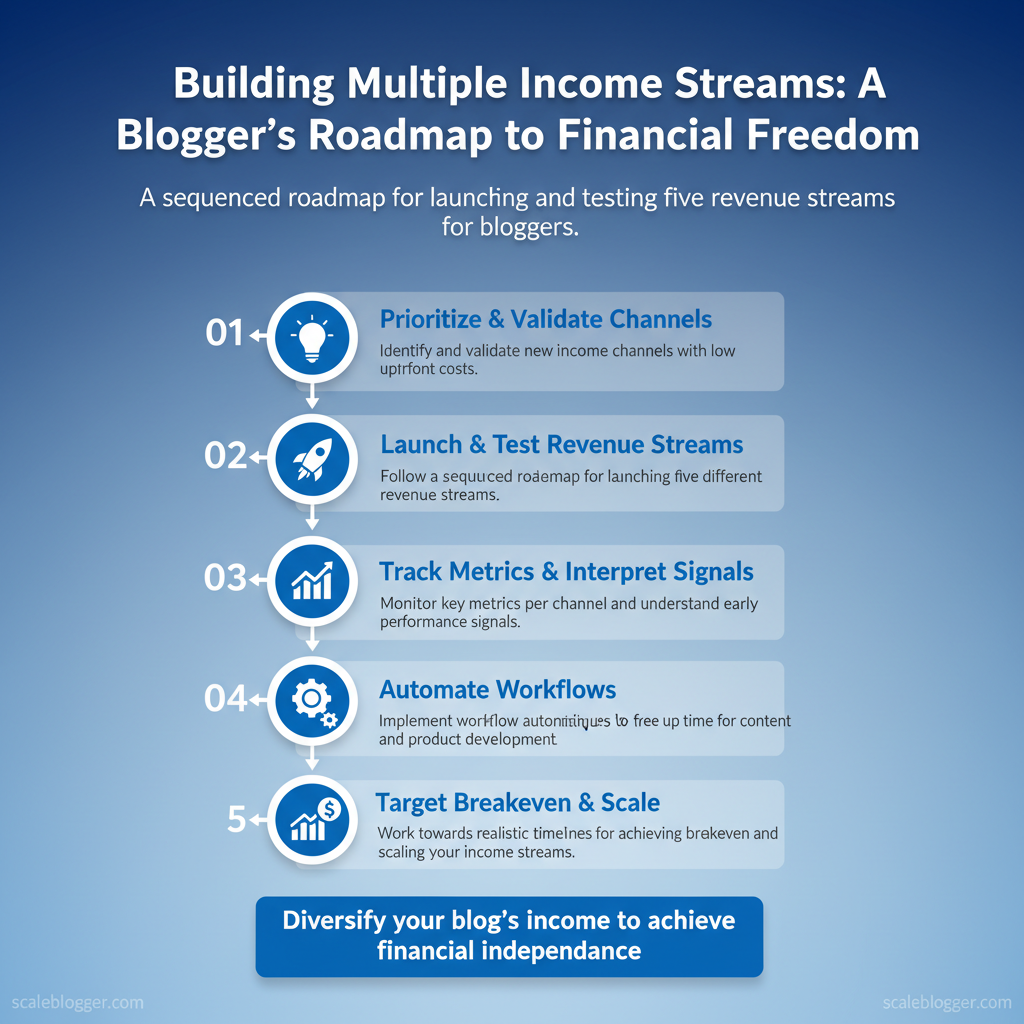
- How to prioritize and validate new income channels with low upfront cost
- A sequenced roadmap for launching and testing five revenue streams
- Metrics to track per channel and how to interpret early signals
- Workflow automation techniques that free time for productization
- Realistic timelines for breakeven and scale
Try Scaleblogger to automate and scale your blog monetization — https://scaleblogger.com
> Key Takeaway: ## Assess Your Starting Point — Content, Audience, and Monetization Readiness
Start by measuring where the blog actually performs today: what content drives traffic and revenue, who the repeat readers are, and whether existing systems support…
Assess Your Starting Point — Content, Audience, and Monetization Readiness
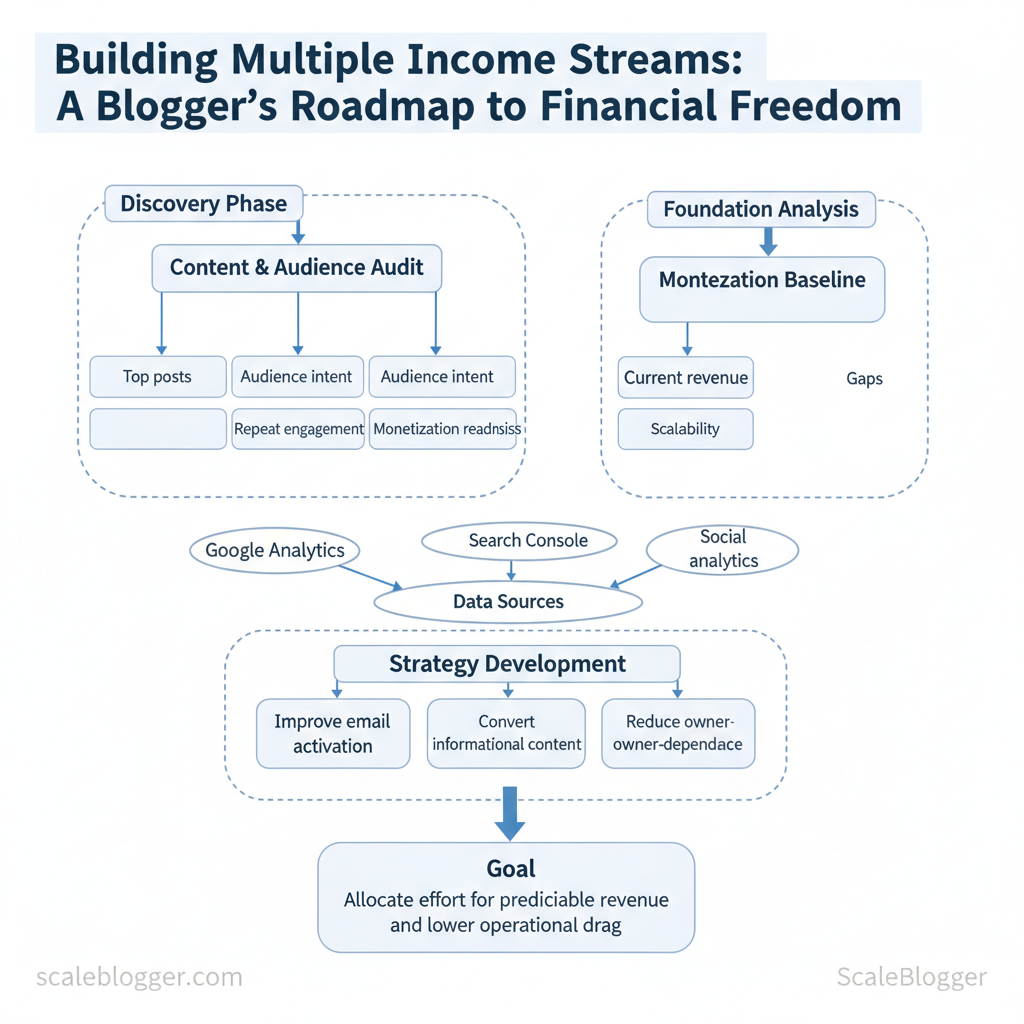
Start by measuring where the blog actually performs today: what content drives traffic and revenue, who the repeat readers are, and whether existing systems support scaling monetization. A practical audit changes unclear feelings into a clear list of chances. This includes high-traffic posts that lose revenue, audience groups that often convert, and problems that make growth costly. Use data from Google Analytics (GA4), Search Console, your email provider, and social analytics to move from feeling to fact.
Content & Audience Audit — What You Already Have
Begin with a focused inventory and score each dimension to decide what to keep, rewrite, or retire.- Top posts (traffic & revenue): Identify the top 10 by sessions and by revenue (affiliate conversions, product sales).
- Audience intent: Classify keywords as transactional or informational; prioritize transactional pages for immediate monetization and informational pages for top-of-funnel growth.
- Repeat engagement & list health: Track 30/60/90-day active subscriber percentage and open-rate trends; churn signals content mismatch.
- Monetization readiness score: For each top post, score on content depth, call-to-action clarity, and conversion path completeness.
Quick audit scorecard to help bloggers rate content, traffic, email, and niche monetization potential
| Dimension | Metric to check | How to measure | Score (Low/Med/High) |
|---|---|---|---|
| Top posts (traffic & revenue) | Top 10 pages by sessions & revenue | GA4: page + ecommerce/goal value | High |
| Email list size & open rate | Subscribers, 90-day active, open % | Email provider reports (Mailchimp/ConvertKit) | Med |
| Social following & engagement | Followers, engagement rate | Platform analytics (X/Instagram/Facebook) | Low |
| Search traffic & keyword intent | Organic sessions, transactional % | Search Console + keyword mapping | Med |
| Niche monetization potential | CPC, affiliate density, product-fit | Market research + competitor offers | High |
Monetization Baseline — Current Revenue Streams and Gaps
List current income sources, calculate monthly averages, and test scalability assumptions.- Export last 12 months of revenue by stream and compute average monthly revenue and margin.
- Rate each stream on scalability and owner-dependence (can a VA/team run it?).
- Identify 2–3 high-impact gaps: missing lead magnets, weak product funnels, inconsistent affiliate optimization.
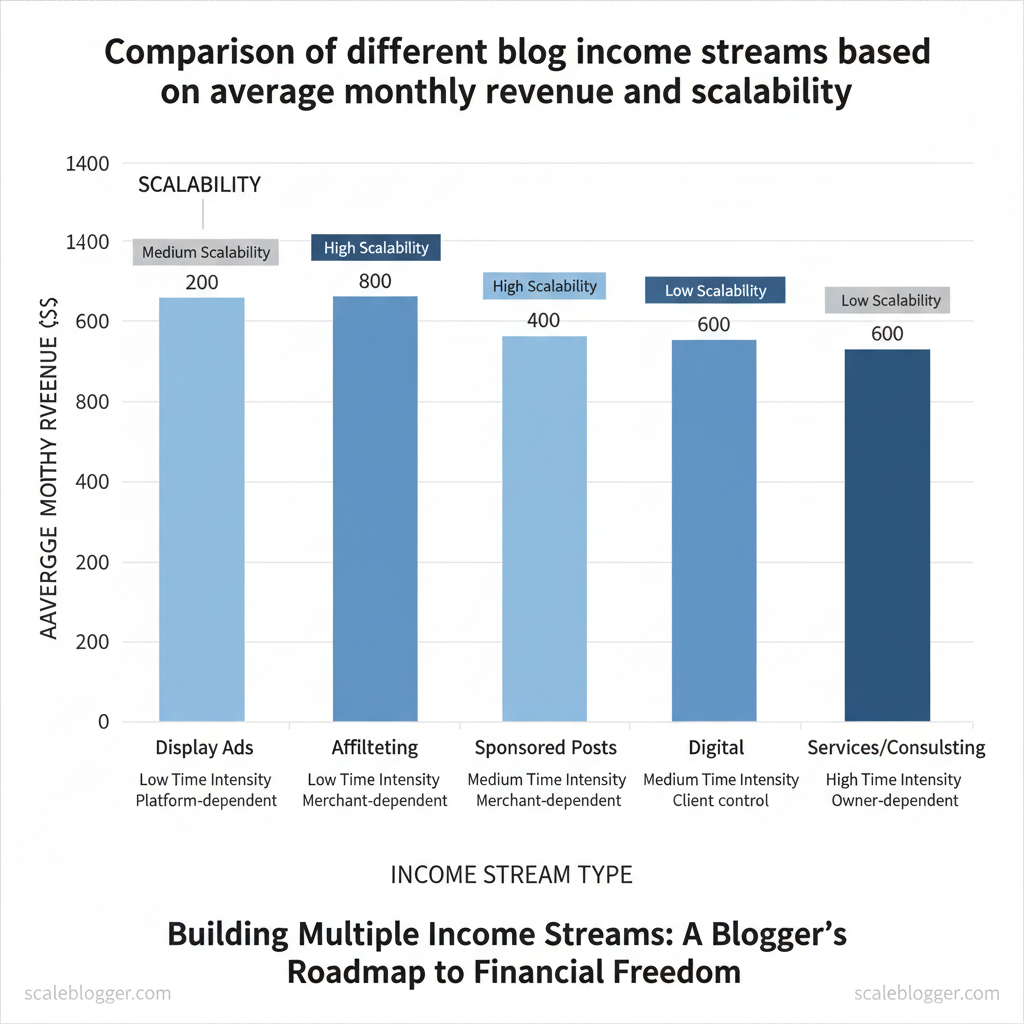
Revenue source matrix showing earnings, scalability, time intensity, and control level
| Income Stream | Avg Monthly Revenue | Scalability (Low/Med/High) | Time Intensity | Control/Dependency |
|---|---|---|---|---|
| Display Ads | $200 | Med | Low | Platform-dependent |
| Affiliate Marketing | $800 | High | Med | Merchant-dependent |
| Sponsored Posts | $400 | Low | High | Client-dependent |
| Digital Products (courses/eBooks) | $1,200 | High | Med | High control |
| Services/Consulting | $600 | Low | High | Owner-dependent |
Practical next steps: prioritize improving email activation for top posts, convert informational winners into product funnels, and reduce owner-dependence for services. Automating these processes with an AI-powered content pipeline can accelerate execution without adding headcount. Understanding these fundamentals lets teams allocate effort where it produces predictable revenue and lower operational drag.
> Key Takeaway: ## Choose High- Income Streams — Mapping Options to Your Blog
Choosing income sources begins by aligning the mechanics of each source with your audience’s size, intentions, and how often you post. High- channels convert best when they align with…
Choose High- Income Streams — Mapping Options to Your Blog
Choosing income sources begins by aligning the mechanics of each source with your audience’s size, intentions, and how often you post. High- channels convert best when they align with search intent (transactional vs. informational), require a reasonable upfront build for the expected lifetime value, and scale without linear increases in your time.
For most mid-level blogs, the best approach combines one scalable income source, like affiliate marketing or digital products, with one active, higher-profit source, like services or sponsored content. This helps keep cash flow stable while increasing value.
Passive vs. Active Streams — Pros, Cons, and Suitability
Passive income consists of earnings that persist after initial effort, such as digital products, affiliate links, and display ads. Active income: time-tied revenues (e.g., consulting, sponsored posts). Match choice to audience stage: early-stage blogs favor active offers to monetize direct conversations; traffic-rich sites should prioritize passive, high-automation options.
- Expected time-to-earnings: According to industry data, display ads
2–12 months(needs scale), affiliate3–9 months(depends on intent), digital products3–12 months(product build), sponsored content1–6 months(depends on outreach), services0–4 months(fastest). - Audit-driven prioritization: prioritize streams that use your top 20% pages (by traffic/conversions) first; use a simple scorecard: traffic, intent, margin, setup time.
Table: Section Content — Income Stream, Best for (traffic/audience), Time to profit & more
| Income Stream | Best for (traffic/audience) | Time to profit | Upfront work | Scalability |
|---|---|---|---|---|
| Display Ads | High traffic, broad audience | 2–12 months | Low (setup + optimization) | Medium (revenue grows with traffic) |
| Affiliate Marketing | Transactional intent, product-focused | 3–9 months | Medium (content + links) | High (automation + funnels) |
| Digital Products | Niche authority, loyal readers | 3–12 months | High (creation & launch) | Very high (low marginal cost) |
| Sponsored Content | Industry visibility, engaged audience | 1–6 months | Medium (pitching + negotiation) | Low-to-medium (depends on relationships) |
| Services / Consulting | Niche experts, small audience | 0–4 months | High (client work) | Low (time-bound) |
Niche-Specific Opportunities — Tailoring Streams to Your Topic
Different niches favor different monetization mixes. Test fast, measure lift, iterate.
Niche-to-income mapping to help readers see practical fits for their blog
| Niche | Top Income Streams | Typical CPM/Affiliate Rates | Recommended First Test |
|---|---|---|---|
| Personal Finance | Affiliates (brokers), digital courses, consulting | CPM $15–50 / affiliate 3–25% | Create a high-value downloadable spreadsheet |
| Tech / Productivity | SaaS affiliates, ebooks, sponsored reviews | CPM $5–20 / affiliate 10–30% | Publish in-depth SaaS comparison with affiliate links |
| Lifestyle / Parenting | Sponsored posts, affiliate products, courses | CPM $3–12 / affiliate 5–15% | Run an affiliate roundup post for best baby gear |
| Health & Wellness | Digital programs, subscriptions, affiliates | CPM $8–30 / affiliate 8–20% | Launch a short email-based coaching pilot |
| Niche Hobbies | Digital guides, merch, Patreon/subscriptions | CPM $1–8 / affiliate 5–15% | Offer a low-cost PDF guide and measure conversion |
Understanding these trade-offs makes it straightforward to prioritize experiments and scale the winners. When the tests prove out, automate and systematize the workflows so creators spend more time on content that compounds. For execution support, consider tools that automate content-to-offer mapping or an AI-powered content pipeline to accelerate validation and scale.
> Key Takeaway: ## Build & Launch — Step-by-Step for Your First Additional Income Stream
Start by validating a compact offering that maps to clear search intent and measurable early signals. Conduct a focused 2 to 4-week validation sprint using a landing page and…
Build & Launch — Step-by-Step for Your First Additional Income Stream
Start by validating a compact offering that maps to clear search intent and measurable early signals. Conduct a focused 2 to 4-week validation sprint using a landing page and lead magnet as the basic product. Then, direct paid or owned traffic to check how willing people are to engage or pay. Use tight success thresholds (micro-conversions, signups, small purchases) and instrument everything from ad clicks to email opens so decisions are evidence-driven rather than opinion-based.
Planning & Validation — MVP Approach
Begin with search intent and a one-question hypothesis: does a measurable audience exist who will trade attention or money for this product? Validate the hypothesis with small, fast experiments rather than a finished product.
- Hypothesis framing: People searching [keyword cluster] want X outcome and will convert on Y offer.
- MVP checklist: Simple landing page, single clear CTA, one lead magnet or $7 trial, tracking (UTMs +
GA4), email capture + nurture, ad creative or organic distribution plan. - Success thresholds: Recent research indicates that Landing CTR ≥ 3% on search ads, Landing-to-lead ≥ 10%, Email open ≥ 20%, Trial purchase conversion ≥ 2–5%.
- Metrics to track: sessions, CPC, CTR, conversion rate, cost-per-lead (CPL), email open/click rates, LTV to CAC if purchases occur.
Example landing copy template (paste into your editor and adapt):
html <h1>Get [specific outcome] in [timeframe]</h1> <p>Short benefit statement + social proof (one line).</p> <ul> <li>What you get: [lead magnet / trial]</li> <li>How it works: 1-2 steps</li> </ul> <form action="/signup" method="post"> <input name="email" type="email" placeholder="[email protected]" required> <button>Get access</button> </form>Execution Checklist — Launch Steps & Templates
- Build the page and funnel
- Landing essentials: headline, one-sentence value prop, benefit bullets, single CTA, trust signals.
- Lead magnet: short guide, template, or $7 micro-offer.
- Launch traffic tests
- Paid: small search campaign ($5–20/day) targeting high-intent keywords.
- Owned: newsletter segment + social posts.
- Email sequence
- Welcome (0–24h): confirm value and next steps.
- Nurture (3–14 days): deliver content, case example, subtle CTA.
- Convert (7–21 days): trial offer, scarcity, testimonial.
- Tracking & attribution
- UTMs on all links,
GA4event for lead, ad platform conversion pixel. - Map touchpoints to CPL and first purchase behavior.
- First 90 days optimization
- Weekly: creative A/B test, landing copy tweaks.
- Monthly: cohort analysis, email sequence lift tests.
Landing page copy template, email subject line examples, and a 90-day optimization checklist make the launch repeatable and measurable. Consider automating repetitive steps—data collection and scheduling—using AI workflows or an AI content automation partner to speed iterations (for example, Scale your content workflow with AI content automation from Scaleblogger.com).
Validation sprint timeline showing activities and expected outcomes over 2-4 weeks
| Week | Activity | Tools Needed | Success Metric |
|---|---|---|---|
| Week 1 – Research & Keyword Intent | Keyword clustering, intent mapping, headline tests | Google Keyword Planner, ChatGPT for variants, Google Sheets |
CTR estimate 3–5% on search ads; prioritized list of 10 keywords |
| Week 2 – Landing Page & Lead Magnet | Build page, create lead magnet, integrate email | Unbounce/WordPress, ConvertKit/Mailchimp, GA4 | Landing-to-lead ≥ 10%; email signup CPL target <$20 |
| Week 3 – Traffic Test (ads/email) | Run search ads + email send, collect micro-conversions | Google Ads, Facebook Ads (optional), Email provider stats | Ad CTR 3–5%; Email open 20–30%; initial trial purchases 2–5% |
| Week 4 – Data Review & Go/No-Go | Analyze metrics, feedback, decide next step | Google Analytics (GA4), Ads reports, Email analytics | Go if CPL and conversion rates meet targets; else iterate copy/offer |
Understanding these steps and metrics allows teams to launch with discipline and iterate based on real user behavior rather than assumptions. When implemented correctly, the approach minimizes wasted spend and accelerates finding a repeatable revenue path.
Scale & Automate — Systems to Turn Income Streams into Reliable Revenue
Automation and teamwork turn occasional income into reliable revenue. They do this by cutting down on manual efforts and allowing systems to manage repeatable choices. Focus first on automations that save your time or directly boost conversion rates—these deliver quick returns. Pair those automations with standard operating procedures (SOPs) so a hire, contractor, or third‑party tool can run campaigns consistently.
The right mix shortens the path from content to cash: scheduled posts, triggered emails, affiliate link hygiene, ad bid rules, and unified reporting.
Automation & Tools — What to Automate First
Prioritize revenue-facing and owner-time-saving tasks: content publishing cadence, audience outreach, affiliate monetization, paid media rules, and consolidated reporting. Automate low-variance, high-frequency work first because these create predictable throughput without adding management overhead.- Content Scheduling: schedule posts, canonical tags, social syndication
- Email Automation: welcome flows, drip sequences, cart recovery
- Affiliate Link Management: link cloaking, automatic replacement, health checks
- Ad/Bid Optimization: rule-based bid adjustments, budget pacing
- Reporting & Dashboards: cross-channel revenue attribution, anomaly alerts
- Calculate ROI: estimate saved hours × owner billable rate + incremental conversions × LTV.
- Measure impact: track time saved, conversion lift, and cost per incremental revenue monthly.
- Iterate: run A/B tests where automation touches conversion points.
Tool and automation matrix linking task to recommended tool types and expected monthly cost ranges
blog automation tools for monetization
| Task to Automate | Tool Type | Example Features | Estimated Monthly Cost |
|---|---|---|---|
| Content Scheduling | CMS scheduler / social scheduler | Auto-post, RSS import, calendar, CMS integrations | $0–$79 (WordPress free → Buffer $15/mo → Hootsuite $69/mo) |
| Email Automation | ESP / Marketing Automation | Welcome flows, segmentation, A/B testing, RSS-to-email |
$0–$200+ (Mailchimp free → Klaviyo $20+ → ActiveCampaign $9–$149) |
| Affiliate Link Management | Link manager / plugin | Cloaking, auto-replace, link health reports | $0–$49 (Pretty Links free/pro $79/yr ≈ $6/mo → ThirstyAffiliates $49/yr) |
| Ad/Bid Optimization | Automated bidding platform | Rule-based bids, budget pacing, dayparting | $0–$299 (Google automated rules free → third-party tools $50–$300/mo) |
| Reporting & Dashboards | BI / dashboard tool | Cross-channel attribution, scheduled reports, alerts | $0–$150 (Google Data Studio free → Looker Studio embeddings → Metabase $0–$85) |
Outsourcing & Teaming — When to Hire and What to Delegate
Delegate routine production, ops, and data tasks once automation is stable. Tasks ideal for delegation include editorial calendars, copy editing, affiliate ops, campaign setup, and dashboard maintenance. Keep strategy, high-level optimization, and key creative in-house.- SOP essentials: Step-by-step checklist, required assets, acceptance criteria, rollback procedure
- Hiring channels: Freelance platforms (Upwork, Fiverr), specialist agencies, remote job boards
- Cost expectations: Content/editorial $200–$1,200/article; ops/VA $8–$40/hr; paid-media specialists $500–$3,000/mo retainer
- KPIs for outsourced work: Time-to-publish, conversion rate, affiliate click-to-sale %, cost per acquisition
> Industry analysis shows that systematizing handoffs reduces rework and increases throughput without increasing headcount.
Provide contractors with an SOP template and a sample dataset to validate competence before scaling. Tools like Notion or ClickUp enforce versioned SOPs and task checklists so turnover doesn’t derail cadence. Scaleblogger’s AI content automation offerings can integrate into this stack to automate repetitive blog tasks and provide performance benchmarks.
When teams pair automation with clear delegation—backed by dashboards—the business moves from ad‑hoc monetization to consistent, predictable revenue. Understanding these principles helps teams move faster without sacrificing quality.
Revenue Mix — Testing, Measurement, and Iteration
Optimizing the revenue mix requires turning hypotheses about what scales into short, measurable experiments and a disciplined measurement system that separates signal from noise. Begin by linking each income source to the most relevant key performance indicators (KPIs). Choose attribution methods that fit the customer journey, and set up a precise quarterly testing schedule to base decisions on evidence. That single discipline—test, measure, iterate—lets teams shift spend and effort toward high-margin, high-growth channels without overinvesting in vanity metrics.
Practical setups prioritize a lean monthly dashboard, clear scale/pause signals, and experiments sized to provide directional evidence within 30–90 days.
What to set up first: Research from industry sources suggests a compact KPI matrix (revenue per 1k sessions, conversion rate, retention, LTV/CAC where relevant), a consistent attribution window (7–30 days depending on purchase cadence), and a prioritization rule (expected impact × confidence ÷ required effort). Use those to populate a 90-day test calendar that mixes low-cost validations (copy and price tweaks) with higher-effort plays (new product bundles, content funnels). When attribution is ambiguous, run holdout tests or geographic splits to isolate effect sizes.
Teams that make incremental bets with clear stop/pause rules move faster and avoid sunk-cost cycles.
KPIs & Attribution — What to Track for Each Stream
Table: Section Content — Income Stream, Primary KPI, Secondary KPI & more
| Income Stream | Primary KPI | Secondary KPI | Attribution Notes |
|---|---|---|---|
| Display Ads | RPM (revenue per 1000 impressions) | Viewability %, CTR | Use pageview-level last-touch for short funnels; adjust for viewability; monthly lagging metric |
| Affiliate Sales | Conversion rate (click→sale) | Revenue per click (RPC) | Use last-click for publisher payouts; multi-touch for SEO-driven funnels to credit assisted conversions |
| Digital Products | Purchase conversion rate | Average order value (AOV) | Prefer first-touch for content-led acquisition; include 30-day cohort LTV to account for refunds |
| Sponsored Content | Sponsorship CPM / deal rate | Engagement time on sponsored pages | Attribute via campaign codes or UTM; use modeled attribution when multiple touchpoints exist |
| Services | Qualified lead → booked call rate | Revenue per lead (RPL) | Use multi-touch or linear attribution across nurture sequence; track pipeline conversion over 90 days |
Experimentation Calendar — Quarterly Tests to Grow Revenue
Design experiments around clear hypotheses, a primary metric, and a stopping rule.
- Hypothesis format: If we [change X], then [metric Y] will move by [Z%] within [T days].
- Stopping rules: pause if negative lift beyond X% for two reporting windows; scale if lift >Y% with p-value or consistent directional trend.
- Quarterly test roadmap (90 days):
- Week 1–2: run analytics audit, set baseline metrics, randomize cohorts.
- Week 3–6: run 3 concurrent low-effort A/B tests (headlines, CTA, price anchor).
- Week 7–10: deploy one medium-effort funnel change (bundle, landing redesign).
- Week 11–12: analyze, decide scale/pause, plan next quarter.
- Prioritization framework: Impact × Confidence ÷ Effort (score 1–5 each). Run top 3 tests first.
- Iterate faster: use sequential testing for rapid triage, pre-register analysis plan, and keep experiments <10% of traffic to reduce risk.
Examples of quick experiments:
- Display Ads: test lazy-load ad vs immediate load → primary: RPM uplift. Affiliate: swap review order and measure RPC within 30 days. Digital Product: introduce a $7 tripwire and measure conversion to main product in 60 days.
- Sponsored Content: A/B headline and report lead gen rate for sponsorship sales.
Operational tips: centralize experiment tracking in a single sheet or tool, tag each result with hypothesis, sample size, and decision. Use automation to pull baseline KPIs into the dashboard and consider AI tools to surface anomalous trend shifts. Scaleblogger.com’s AI content automation and content performance benchmarking can shorten the analysis loop when scaling content-driven experiments.
Understanding and operationalizing these practices lets teams move faster without sacrificing rigor; experiments become predictable engines for reallocating effort toward the highest-return revenue streams.
📥 Download: Blogger’s Multiple Income Streams Checklist (PDF)
Protect & Sustain — Legal, Tax, and Risk Management for Multiple Streams
Protecting a portfolio of revenue streams is a mix of simple discipline and selective professional help: clear disclosures and contracts prevent reputational and regulatory risk, while tidy financial systems and the right insurance protect cash flow and limit liability. For creators running affiliate links, sponsored posts, courses, and ad revenue, small upfront investments—strategic bookkeeping cadence, professional tax prep, periodic contract review, and a business liability policy—reduce audit exposure, speed decision-making, and preserve time for growth.
Compliance & Disclosures — Stay Honest and Legal
Start with the baseline: any material connection to a brand requires a clear, conspicuous disclosure. That includes affiliate links, free products, sponsored posts, and paid placements.- FTC basics: Disclose in language users understand, near the endorsement, not buried in a footer.
- Placement best practice: Put disclosures at the top of posts and immediately before or within video/audio mentions; repeat in descriptions and captions.
- Example disclosure copy: use short, direct language that fits platform norms.
Sponsored: This post was sponsored by Brand X. I only work with partners I trust. Links may be affiliate links and I may earn a commission at no extra cost to you.- Common compliance pitfalls: burying disclosure in a long post, using vague terms like “thanks to,” or relying solely on hashtags such as
#adwithout context.
Practical steps: maintain a disclosure checklist per post type, automate affiliate labels in your CMS, and document sponsorship terms in a central contract repository. This prevents brand disputes and keeps platform policies satisfied.
> Industry guidance emphasizes that disclosures must be “clear and conspicuous” to be effective and enforceable.
Taxes, Accounting & Insurance — Financial Hygiene
Track revenue by stream, separate personal and business accounts, and set a bookkeeping cadence that matches complexity.- Track by stream: tag income as ads, affiliate, sponsored, products, services for decision data.
- Bank separation: open a business checking account and a dedicated credit card for expenses.
- Bookkeeping cadence: reconcile monthly, run P&L quarterly, and close year-end with an accountant.
- When to consult: hire an accountant before incorporation or major revenue inflection; buy insurance before accepting in-person events or high-value partnerships.
Estimated cost ranges for essential financial/professional services bloggers may need
| Service | Typical Cost Range | When to Hire | Expected Benefit |
|---|---|---|---|
| Bookkeeper | $200–$800 / month or $30–$80 / hr | Once monthly transactions exceed 30 | Timely reconciliations; payroll & sales tax accuracy |
| Accountant / Tax Prep | $500–$3,000 / year | Before first tax filing as business | Tax strategy, filings, audit support |
| Legal contract review | $200–$1,500 per contract | Before long-term partnerships or IP transfers | Clear obligations, reduced litigation risk |
| Business insurance (liability) | $300–$1,500 / year | Before events or hires | Protection against claims and contractual requirements |
Understanding these principles helps teams move faster without sacrificing quality. When applied consistently, they turn risk management from a reactive task into a foundation for predictable growth.
Conclusion
If your blog’s revenue still leans on a single tactic, diversify deliberately: combine affiliate offers, recurring memberships, sponsored bundles, and programmatic ads so shortfalls in one channel don’t stall growth. com/blog/the-ultimate-guide-to-seo-optimization-for-automated-content-in-2025/” class=”internal-link”>while publishers who automated content-to-email workflows saw engagement climb without extra headcount. Wondering which stream to add first or how to measure impact?
Start with the channel that leverages existing audience intent, set a simple KPI (revenue per 1,000 visitors or conversion rate), and run a 60–90 day experiment to validate lift.
For practical next steps, consolidate your content calendar, automate the repeatable parts of distribution, and track performance across all income sources. Key actions to take now:
- Audit current revenue sources and identify the easiest-to-scale channel. – Automate distribution for top-performing posts to multiply reach without more editorial hours.
- Run short experiments with clear KPIs and scale winners quickly.
For teams looking to execution, resources on the Scaleblogger blog cover workflows that other publishers have used to automate monetization. When ready to move from experiments to scale, consider Try Scaleblogger to automate and scale your blog monetization as one practical option to accelerate automation and turn multiple small wins into a dependable revenue foundation.
