

The importance of audience personas becomes clear when the same message performs well for one audience but fails to connect with another.
Audience personas help teams understand the goals, behaviors, challenges, and content preferences that influence how different people consume information.
These insights can guide everything from messaging and channel selection to whether an audience prefers articles, videos, carousels, emails, or interactive content.
By combining audience segmentation with a strong multi-modal content strategy, brands can create more relevant experiences instead of delivering the same content to everyone.
Table of Contents
What Audience Personas Change in Multi-Modal Content Planning
A single content version rarely survives contact with real people.
A buyer who wants a fast answer, a viewer who wants proof, and a browser who just needs a nudge all react to the same message in very different ways.
That is where audience personas matter.
They turn a vague target market into specific needs, objections, and habits, which then shape whether the right format is a short video, a landing page, an email, or a deeper FAQ.
The strongest multi-modal content personalization starts before the first draft.
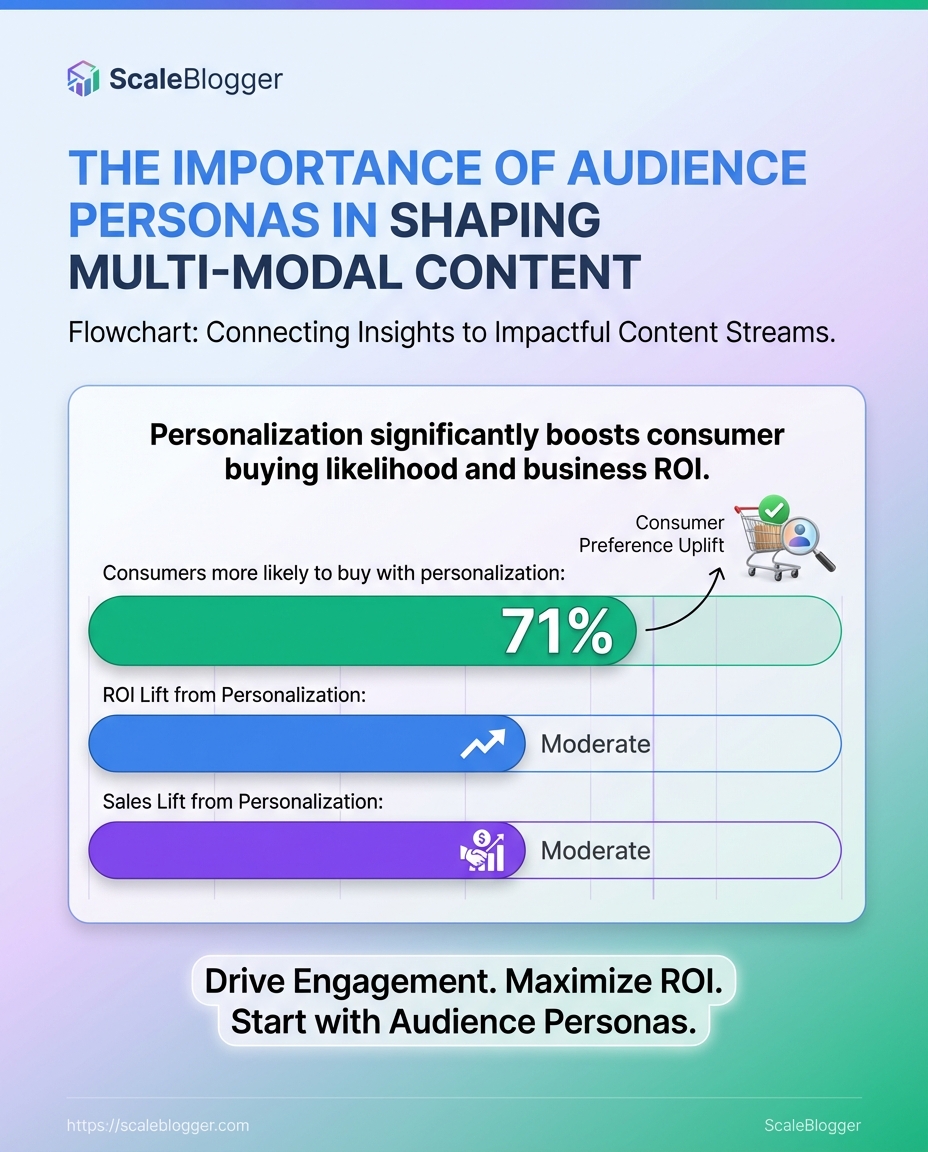
As of 2018, 80% of consumers were more likely to purchase when brands offered personalized experiences, and as of 2016, personalization was often linked with a 5%–8% lift in marketing ROI and a 10%–25% lift in sales.
- One version misses intent. A social clip can spark interest, but it cannot answer detailed objections well.
- Format changes the message. A persona that needs reassurance may want testimonials in an ad, then product specifics on a page.
- Distribution depends on behavior. Netflix and Spotify both show how the same person can need different presentations based on what they watched or listened to before.
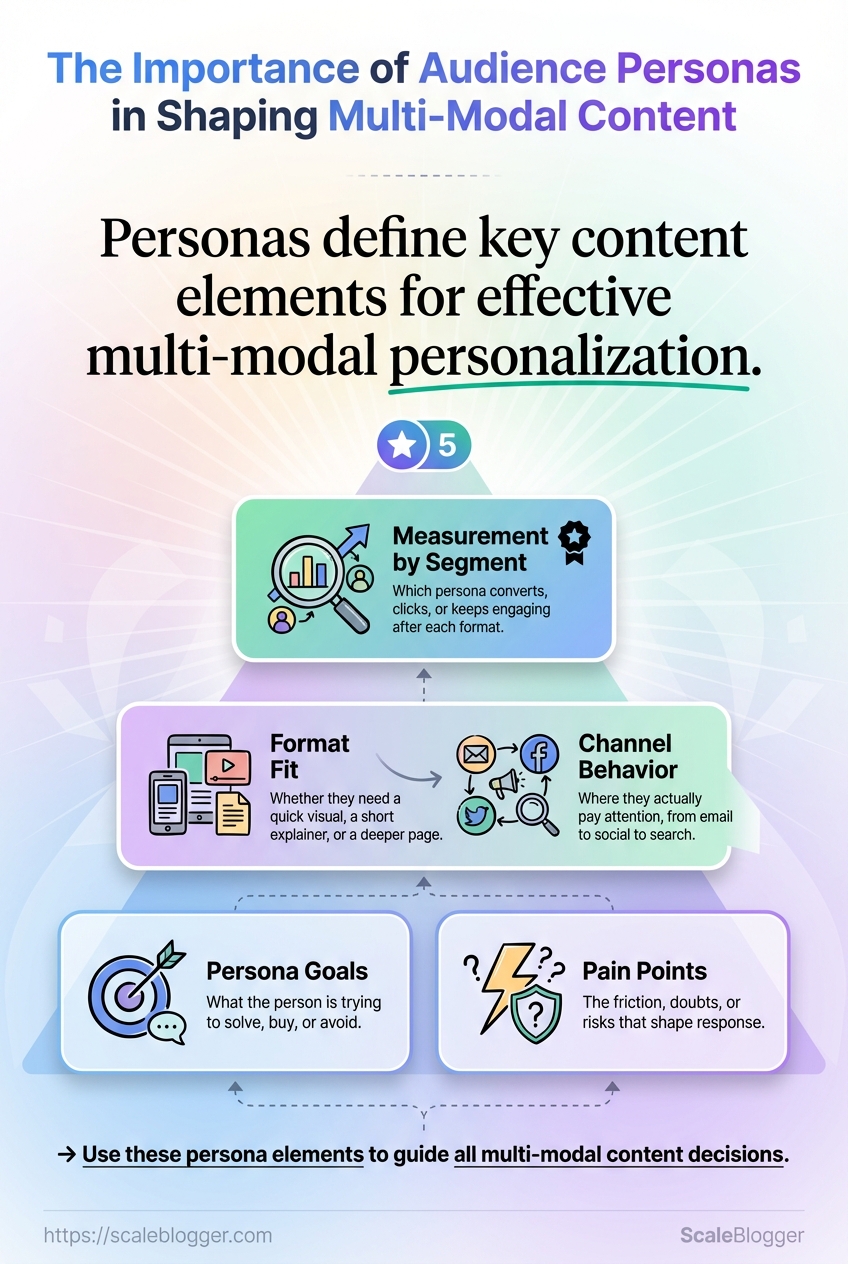
Before content gets built, the team should define the persona’s goal, pain points, preferred depth, and likely action.
HubSpot’s persona guidance works well here because it forces that discipline before anyone starts writing headlines.
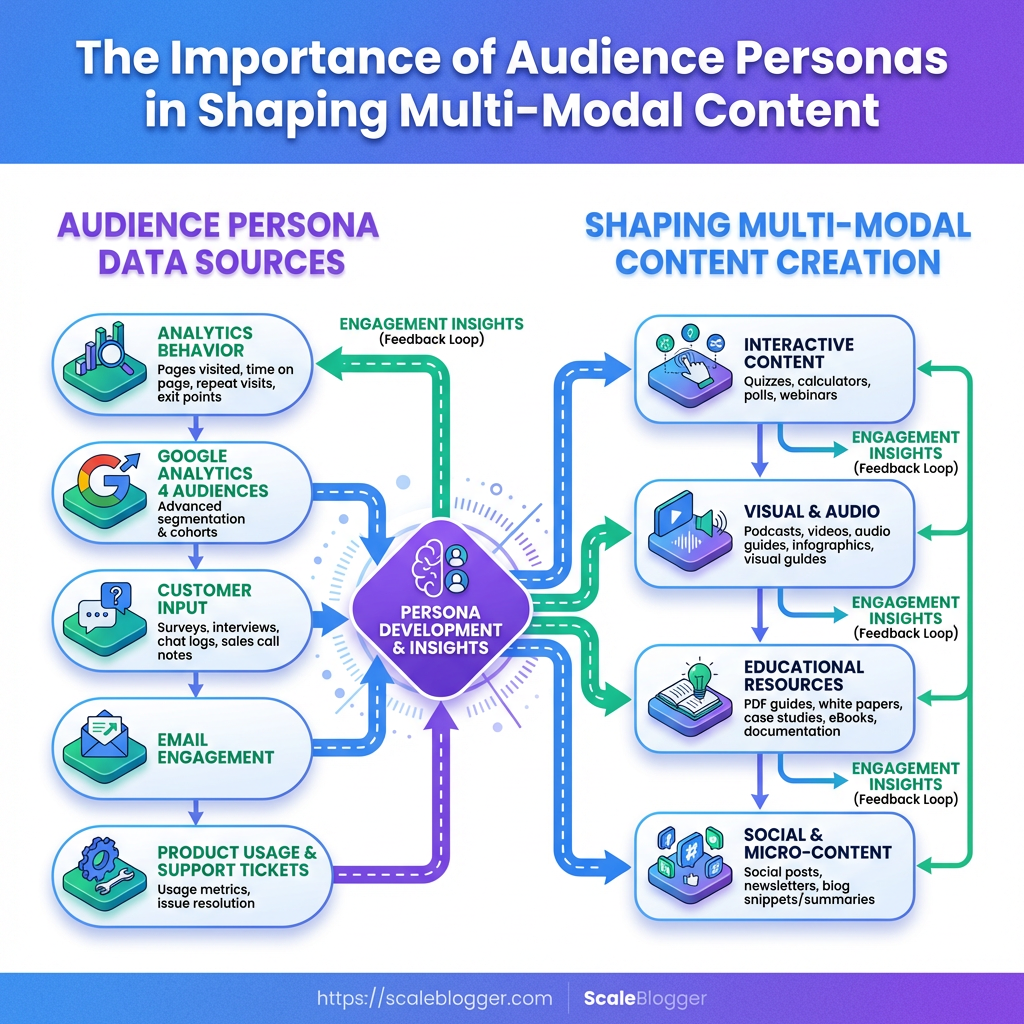
The diagram should show a clean flow: persona inputs on one side, then message architecture, then format choices, then channels, and finally the outcomes we measure.
It helps make one point obvious: the persona does not just change the copy, it changes the whole path from idea to distribution.
- Goal and objection: What the person wants, and what slows them down.
- Format and depth: Video for awareness, text for evaluation, and support content for decision time.
- Channel and timing: Email, social, landing pages, or in-product moments, depending on behavior.
- Measurement by segment: CTR, conversion, retention, and downstream engagement should be read per persona, not just in total.
That is why a persona is not a marketing portrait hanging on a wall.
It is the map that keeps every format, channel, and message headed toward the same person.
Building Audience Personas That Actually Guide Content Decisions
What if your personas are neat little profiles that nobody uses? That happens all the time.
The fix is not more demographic fluff.
It is building personas from signals that change what you publish, how you frame it, and where it appears.
The best persona work starts with behavior, not guesses.
GA4 Audiences can show which users read pricing pages, bounce from long-form guides, or return after watching product demos.
HubSpot’s persona templates can help shape the story, but the real input should come from what people do and say.
That mix matters because personalization has real commercial weight.
As of 2018, 80% of consumers were more likely to buy when brands offered personalized experiences, and older 2016 estimates tied personalization to a 5%–8% ROI lift and a 10%–25% sales lift.
Personas are what make that kind of relevance repeatable instead of accidental.
Start by collecting signals from three places.
Analytics tells you intent, surveys explain the why, and customer behavior shows which formats people actually finish.
- Analytics signals: Track pages viewed, scroll depth, repeat visits, and event paths that reveal intent.
- Survey signals: Ask what nearly stopped the purchase, what proof they wanted, and which format felt easiest to trust.
- Behavior signals: Watch email clicks, demo views, webinar attendance, and content shares to spot content preferences.
Then map each persona around three things: motivations, objections, and preferred content depth.
A cautious evaluator may want comparison charts and FAQ-heavy pages, while a fast-moving browser may prefer short video, bold claims, and one clear next step.
That is the heart of multi-modal content personalization.
The usable persona profile should read like a working brief, not a marketing poster.
Include the trigger that brings the person in, the question they need answered, the objection that slows them down, and the format that earns attention fastest.
A simple structure keeps it actionable:
- Primary goal: What the person is trying to get done.
- Top objection: What could make them hesitate.
- Trusted proof: Case study, benchmark, demo, or explanation.
- Preferred format: Video, article, checklist, email, or comparison page.
- Trigger signal: The behavior or event that puts them into the persona.
Teams that do this well stop writing for “the audience” and start writing for distinct decision patterns.
That is where content strategy tips become useful instead of generic, because every format now has a job.
How to Match Personas to Multi-Modal Content Formats
A finance analyst reading on a lunch break and a hands-on operator comparing tools after work do not want the same content package.
One wants speed and proof.
The other wants depth, structure, and enough detail to act without guessing.
That is why multi-modal content personalization works best when the persona decides the format, not the other way around.
As far back as 2018, 80% of consumers said they were more likely to buy when brands offered personalized experiences, and the older 2016 estimates tied personalization to a 5%–8% ROI lift and a 10%–25% sales lift.
The practical move is simple: match intent to format, then keep the message consistent across each version.
A single idea can become a long-form article for evaluation, a short video for awareness, and an interactive checklist for action without sounding repetitive.
Format fit by persona intent
| Content format | Best persona fit | Primary goal | Production effort | Best channel |
|---|---|---|---|---|
| Long-form article | Deep researchers, evaluators, and comparison shoppers | Explain the problem, build trust, and answer objections | High | Website, blog, search |
| Tutorial video | Visual learners and task-focused users | Show the process and reduce confusion | High | YouTube, landing pages, product pages |
| LinkedIn carousel | Busy professionals and skimmers | Deliver a fast, structured argument | Medium | |
| Podcast clip | Commuters and repeat listeners | Build familiarity and deliver one sharp idea | Low to medium | Podcasts, social feeds |
| Interactive checklist | Implementation-minded personas | Turn interest into action | Medium | Website, email follow-up |
The pattern is easy to miss.
Articles do the heavy lifting when the persona wants confidence, while carousels and clips work better when attention is thin and the message has to land fast.
That also helps with depth.
A persona with high intent can handle technical detail, but a lighter-intent audience usually needs a narrower promise and one clear next step.
A useful content strategy tip is to build one message architecture first, then adapt the wrapper for each format.
That keeps the angle, proof, and CTA aligned, even when the delivery changes.
Tools like Scaleblogger can help keep those versions coordinated without turning every new format into a fresh draft from scratch.
When the same message shows up as a video, a carousel, or a checklist, it should feel familiar, not duplicated.
That balance is what makes persona-based format matching actually pay off.
Designing a Persona-Based Multi-Modal Workflow
What if the real bottleneck is not the idea, but the handoff between formats? A solid persona-based workflow keeps one message intact while reshaping it for email, landing pages, social, and video without starting from scratch every time.
That matters because audience personas only become useful when they drive production rules.
Netflix does this with artwork and ranking, and Spotify does it with personalized playlists, because the same signal needs different packaging in different moments.
The smartest teams treat multi-modal content personalization like a production system.
They define the message once, then let AI handle the fast adaptation while humans guard tone, accuracy, and brand fit.
> As of 2018, 80% of consumers were more likely to buy when brands offered personalized experiences.
- Build the message core first.
Write one persona-specific promise, one proof point, and one objection answer.
AI can then spin that into a short ad, a web intro, or a nurture email without drifting off message.
- Set channel rules before repurposing.
A LinkedIn post may need a sharper hook, while a landing page needs more detail and a clearer CTA.
Decide what changes and what never changes, so the same content does not feel random across channels.
- Use review gates for riskier edits.
Let AI draft the first pass, then review claims, tone, and compliance before publishing.
Teams using GA4 Audiences can tie those reviews back to real behavior, which keeps versions aligned with actual engagement instead of stale assumptions.
- Plan the calendar by persona segment.
Instead of publishing by topic alone, map each week to a segment and its likely buying stage.
That makes the cadence repeatable and stops one persona from dominating the whole calendar.
A simple rhythm works well here: Monday for awareness, midweek for evaluation, end of week for conversion support.
Over a quarter, that pattern creates balance without forcing every persona into the same funnel.
A quick example helps.
One team can turn a single product explainer into a short clip for discovery, a comparison page for evaluators, and a follow-up email for people who clicked but did not convert.
The message stays consistent, but each version fits the channel and the audience’s patience level.
Research from 2016 still gets cited for a reason: personalization can lift ROI by 5%–8% and sales by 10%–25% when the fit is right.
That only happens when the workflow is disciplined enough to keep pace with the audience.
A workflow like this saves time and protects consistency at the same time.
Once the rules are clear, the calendar gets easier to run and the content starts feeling much more deliberate.
Measuring Whether Persona-Driven Content Is Working
A persona can look perfect in a workshop and still fail in the dashboard.
The fastest way to spot the gap is to compare how each audience segment responds across format, channel, and intent.
That means watching more than clicks.
A video can pull strong watch time for evaluators, while a landing page for the same persona may only make sense if scroll depth and conversions move together.
Tools like GA4 Audiences, CRM reports, and campaign dashboards make that comparison practical.
The numbers matter, too.
As of 2018, 80% of consumers were more likely to buy when brands offered personalized experiences, and 2016 industry figures linked personalization to a 5%–8% ROI lift and 10%–25% sales lift.
Those are older figures, but they still explain why persona alignment deserves a real measurement plan.
### Metrics that tell the real story
| Metric | Why it matters | Where to measure | Benchmark signal |
|---|---|---|---|
| Click-through rate | Shows whether the headline and offer match the persona’s intent | GA4, email platform, social analytics | Persona-aligned versions beat the old generic control in the same channel |
| Watch time | Shows whether the opening and pacing hold attention | YouTube, LinkedIn, video analytics | The intended persona stays longer with the version built for their level of detail |
| Scroll depth | Shows whether the page depth matches the reader’s need for detail | GA4 engagement reports, landing page analytics | Comparison-heavy personas go deeper on FAQ or proof-led pages |
| Conversion rate | Shows whether the message moves people to action | CRM reports, campaign dashboards | Persona-specific copy, proof, or CTA changes lift completion rates |
| Return visits | Shows whether the content created enough trust to bring people back | GA4 audiences, CRM, lifecycle dashboards | The same segment comes back more often after aligned content ships |
The cleanest comparison is not channel versus channel.
It is persona-aligned content versus the old baseline for the same audience.
If a format wins attention but loses conversions, the message is off.
If conversions rise but return visits fall, the content may be too narrow or too aggressive.
- Track by segment first. Compare each persona against its own prior baseline, not against the average audience.
- Treat gaps as clues. A weak metric often points to a bad assumption in the persona, not just a bad headline.
- Refresh the persona when behavior changes. If a segment starts acting differently, update the profile before changing the whole content mix.
That loop is where persona work becomes useful instead of decorative.
Measure, compare, revise, and keep the next round of multi-modal content tied to what people actually do.
Common Persona Mistakes That We Should Avoid
What if the persona deck looks polished, but the content still feels off? That usually means the problem is not the format.
It is the way the persona is being used.
The biggest mistake is treating audience personas like frozen portraits.
Real people change with context, channel, and intent, so a persona built once and left alone starts to drift fast.
That matters even more in multi-modal content personalization, where a viewer on YouTube, a reader on a landing page, and a lead in email all need different depth and proof.
Another common trap is using guesses as if they were facts.
HubSpot-style persona templates are useful starting points, but they are not a substitute for behavior signals from tools like Google Analytics 4 audiences or journey data from systems such as Salesforce Marketing Cloud.
The old but still useful personalization stats tell the same story: as of 2016, tailored experiences were often linked with a 5%–8% ROI lift and a 10%–25% sales lift, and in 2018, 80% of consumers were more likely to buy when brands felt personalized.
- Static personas: A persona should change when behavior changes. Netflix and Spotify do this constantly by adjusting recommendations from actual viewing and listening patterns, not from a one-time profile sheet.
- Too many personas: Five crisp segments usually beat twelve fuzzy ones. Once teams create too many, message focus gets muddy and content turns into a pile of near-duplicates.
- Assumption over evidence: “They probably want X” is a weak plan. Verification should come from clicks, watch time, page paths, and conversions, not from the loudest opinion in the room.
- Channel-only thinking: Personas should drive the message first, then the format. If the audience need is unclear, even strong visuals or smart copy will miss.
A cleaner habit is to build one message architecture per persona, then test it against real behavior.
That is where content strategy tips become practical instead of decorative.
Teams using platforms like Adobe Experience Manager or ScaleBlogger tend to get farther when they refresh personas from observed actions, not assumptions.
The work is simpler that way, and the content usually lands harder.
Personas That Change the Shape of the Message
The real shift is simple: audience personas only matter when they change what gets made, where it gets published, and how deep it goes.
A short video can still earn the click, but the follow-through has to feel like it was built for the same person, not a generic crowd.
That is where multi-modal content personalization starts paying off.
The strongest teams do not treat personas as a branding exercise.
They use them to make sharper content strategy tips in practice: which format opens the door, which format builds trust, and which format closes the loop.
That same logic is what keeps a landing page from feeling disconnected after a social post pulls someone in.
The best move today is to pick one persona and one journey stage, then rewrite a single asset for two formats.
Use the persona’s real pain point, not a vague audience label, and measure whether each version earns a better next action.
If the publishing grind is what keeps that from happening consistently, tools like ScaleBlogger can help turn the repeat work into a cleaner workflow.
