

Marketing teams waste too many hours on repetitive tasks. Meanwhile, audience attention is splitting across different channels. The fragmentation increases pressure on content velocity and consistency, and leaders face escalating resource gaps when scaling programs.
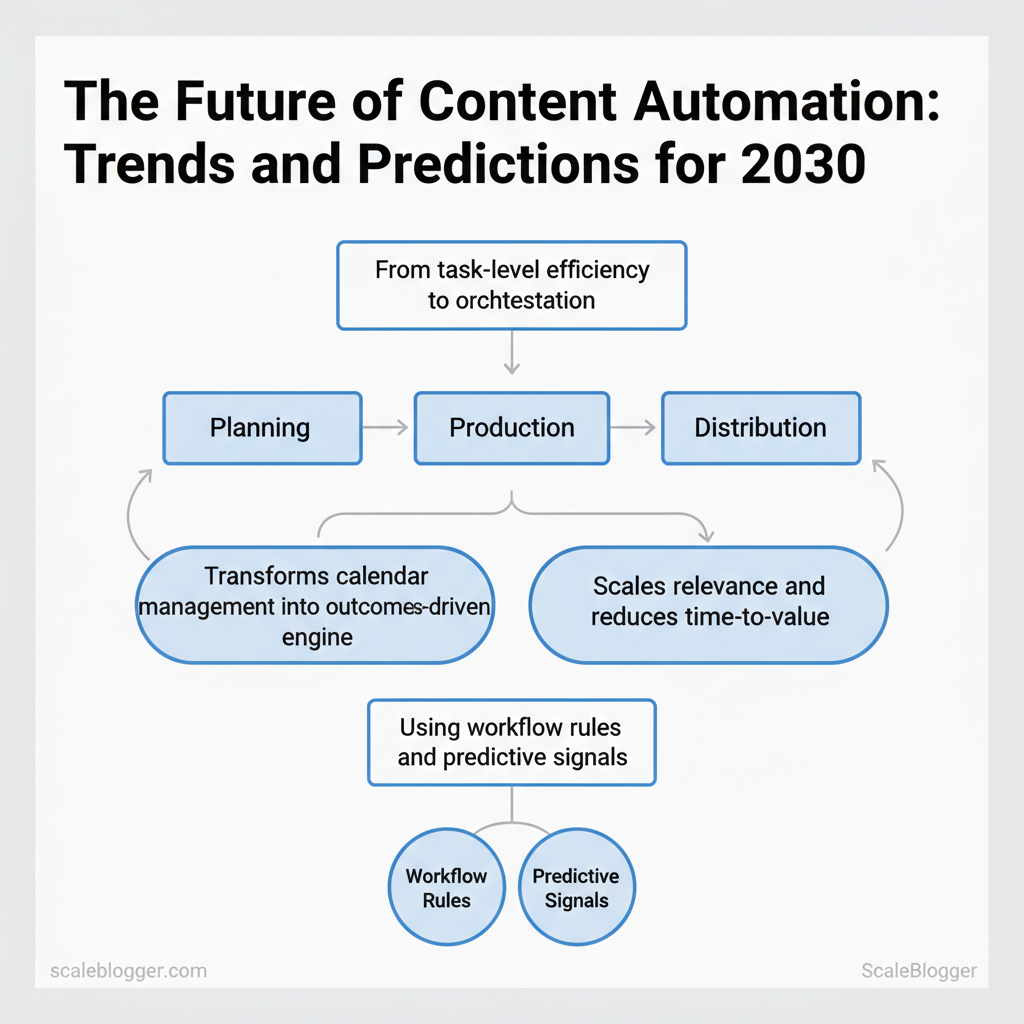
Early signs point to a convergence of automation, creative augmentation, and tighter measurement. Content automation will shift from task-level efficiency to orchestration across planning, production, and distribution, using workflow rules and predictive signals to prioritize what actually moves audiences. Those changes reshape the future of content marketing by turning calendar management into an outcomes-driven engine that scales relevance and reduces time-to-value.
Picture a content operation that uses automated briefs, dynamic templates, and performance-triggered repurposing to halve campaign turnaround. Industry observers note accelerating adoption, and practitioners preparing pilots see clear ROI paths. See how Scaleblogger can pilot content automation (https://scaleblogger.com) to validate assumptions and measure impact.
- What realistic content automation predictions look like for 2030
- How orchestration replaces point solutions in editorial workflows
- Practical ROI levers for scaling content with fewer people
- Emerging roles and skills that matter for automated operations
Explore Scaleblogger’s automation solutions (https://scaleblogger.com) to map a pilot and test the scenarios above as the conversation turns to detailed trend analysis.
> Key Takeaway: ## State of Content Automation in 2025 — Baseline for 2030 Predictions
In 2025, content automation will be mainstream, not just a trial. Large companies will integrate automation in their editorial processes, while many small businesses will use…
State of Content Automation in 2025 — Baseline for 2030 Predictions
In 2025, content automation will be mainstream, not just a trial. Large companies will integrate automation in their editorial processes, while many small businesses will use ready-made tools to boost output. Adoption focuses on repeating, measurable tasks — freeing human writers for strategy and high-stakes creative work. Technical maturity centers on large language models (LLMs) for generative steps, retrieval-augmented generation (RAG) for factual grounding, and modular APIs plus workflow orchestration for reliable, auditable pipelines.
Common patterns today:
- Enterprise adoption: Complex orchestration, governance, and integrations with DAM, CMS, and analytics platforms.
- SMB adoption: Template-driven content generation, SEO automation, and calendar-based publishing.
- Top automation tasks: Ideation, draft generation, SEO metadata, scheduling, and performance reporting dominate investment.
Key technical enablers powering these patterns:
- LLMs as foundation —
transformer-based models provide fluent draft generation and summarization. 2.
RAG workflows — combine vector stores and retrieval to reduce hallucinations and preserve source attribution. 3. APIs + orchestration — REST/GraphQL endpoints and tools like workflow engines enable retries, auditing, and human-in-the-loop handoffs.
- com/blog/the-ultimate-guide-to-seo-optimization-for-automated-content-in-2025/” class=”internal-link”>and analytics — automated content scoring and CTR/engagement pipelines feed continuous improvement loops. 5.
Modular templates & style guides — enforce brand voice programmatically while allowing contextual variation.
Quick reference of common content automation tasks and frequency of adoption
| Task | Typical Tools/Approach | Adoption (High/Medium/Low) | Primary Benefit |
|---|---|---|---|
| Ideation & topic research | LLM prompts + keyword tools | High | Rapid topic lists, cluster suggestions |
| Draft generation | LLMs (fine-tuned) + templates | High | Faster first drafts, consistent tone |
| SEO optimization & metadata | SEO platforms + automated tags | High | Improved discoverability, metadata scale |
| Distribution & scheduling | CMS + publishing APIs | Medium | Consistent posting cadence, multi-channel |
| Performance reporting | Analytics pipelines + dashboards | Medium | Faster insights, iterative testing |
Understanding these principles helps teams move faster without sacrificing quality. When implemented correctly, automation reduces operational friction and lets creators concentrate on strategic narratives and audience connection.
> Key Takeaway: ## Trend 1 — Intelligent Personalization at Scale
AI now enables true one-to-one content experiences rather than broad segments. Rather than “persona A vs.
Trend 1 — Intelligent Personalization at Scale
AI now enables true one-to-one content experiences rather than broad segments. Rather than “persona A vs. persona B,” models infer micro-preferences at the user level through continuous signals — on-site behavior, search intent, content consumption patterns — and assemble content dynamically from modular assets.
This shift reduces wasted impressions and increases engagement. It delivers the right mix of messaging, format, and call-to-action for each user.
Practical mechanisms making this possible:
- User-level modeling — combine
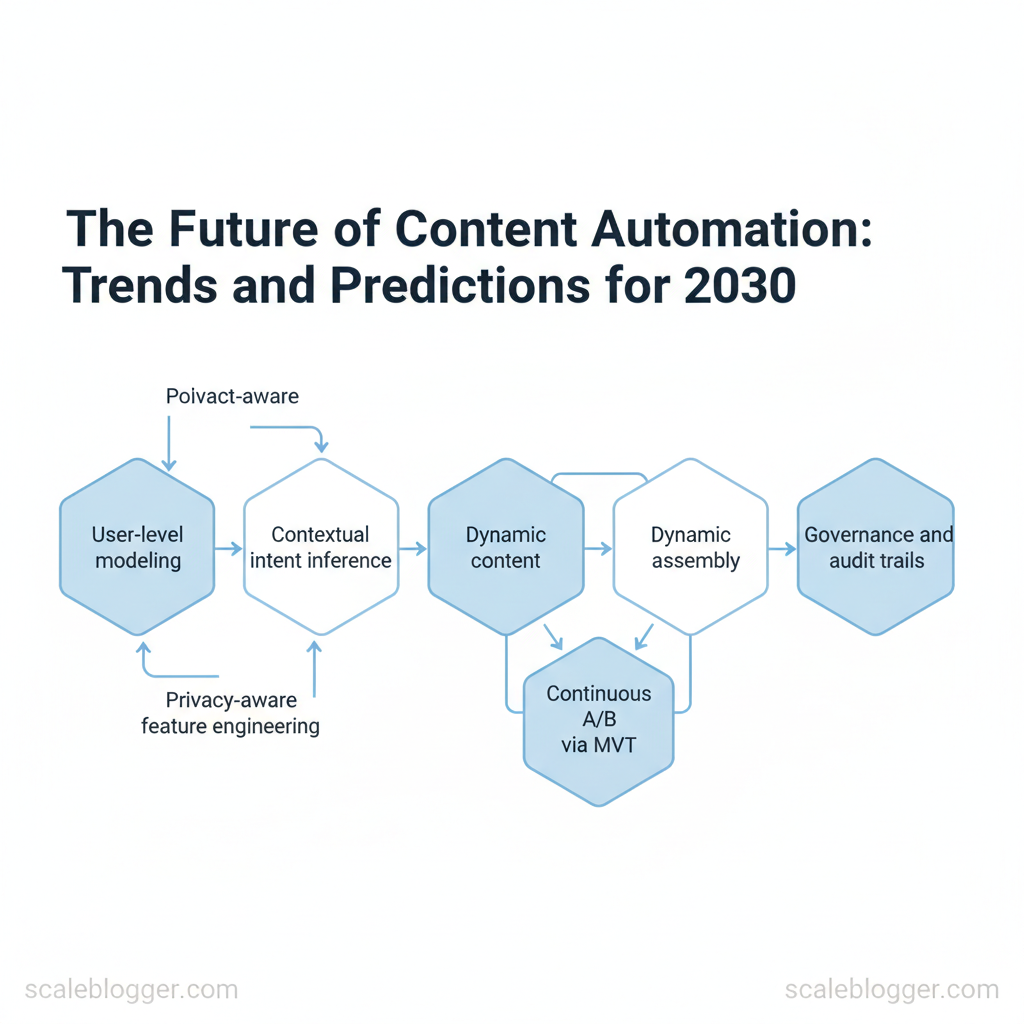
user_idevent histories, recency-weighted interactions, and session embeddings to predict next-best content. Dynamic content assembly — store copy, headlines, images, and micro-components as modular blocks and render personalized combinations in real time. Contextual intent inference — use short-term signals (clicks, scroll depth) plus long-term signals (topic clusters consumed over 90 days).
- Continuous A/B via MVT — move from two-variant tests to multivariate experiments that adjust allocation based on uplift. Privacy-aware feature engineering — rely on aggregated embeddings and hashed identifiers to reduce direct PII exposure. Governance and audit trails — deterministic logging of model inputs and outputs for explainability and compliance.
- Creative orchestration — surface dynamic briefs for writers and creatives so generated content remains on-brand.
- Audit: map datasets, tag content assets, and identify
first-partysignals versus inferred attributes. - Pilot: choose a revenue or engagement use-case, run MVT with clear attribution windows, measure uplift (CTR, time-on-content, conversion lift).
- Scale: automate pipelines, embed governance, and expand to channel-specific variants.
json
{ "personalization_keys": ["user_id","session_vector","topic_score","recency_days"], "assembly_rules": ["lead_variant","hero_image_variant","cta_variant"] }
3-phase roadmap for implementing personalization with milestones and KPIs (content automation predictions)
| Phase | Milestone | Timeframe | Primary KPI |
|---|---|---|---|
| Audit – Data readiness | Inventory content + tag taxonomy, identify first-party signals | 4–6 weeks | Data completeness (%) |
| Pilot – MVT and measurement | Launch multivariate tests on 1 funnel, measure lift | 8–12 weeks | Relative lift in conversion (%) |
| Scale – Automation & governance | CI/CD content pipelines, governance, realtime assembly | 3–6 months | Automation throughput (assets/day) |
Understanding these principles helps teams move faster without sacrificing quality. When implemented correctly, intelligent personalization reduces overhead by making data-driven decisions at the content component level. Consider leveraging AI-powered content automation like Scaleblogger.com to scale the pipeline and build topic clusters aligned with these practices.
> Key Takeaway: ## Trend 2 — From Content Production to Content Orchestration
Content teams are moving from creating one-off pieces to coordinated systems that treat content as a shared product. Instead of producing articles in isolation, modern workflows assemble…
Trend 2 — From Content Production to Content Orchestration
Content teams are moving from creating one-off pieces to coordinated systems that treat content as a shared product. Instead of producing articles in isolation, modern workflows assemble format-agnostic content blocks, automate repurposing, and feed centralized performance signals back into planning. This changes both tooling choices and team design: orchestration requires connectivity, observability, and governance, not just a faster editor.
What changes in practice:
- Format-agnostic content blocks — Break narratives into reusable modules (headlines, intros, data visualizations) that map to multiple channels. Automated repurposing — Publish once, then
transform()into blog, email, social, and short-form video with minimal manual editing. Centralized feedback loops — Connect analytics to planning so organic traffic, dwell time, and conversion metrics inform future blocks.
- Policy-driven governance — Embed brand and legal rules into pipelines so compliance happens before publishing. Runtime orchestration — Schedule and stagger distribution across channels with awareness of audience overlap and frequency caps.
Operational steps to move from production to orchestration:
- Inventory existing assets into
content_blocktypes and tag by intent, persona, and core keyword. 2.
Implement API-first connectors for CMS, analytics, and publishing channels to enable automated flows. 3. Run a 90-day pilot that automates repurposing for a single high-value pillar and measure uplift.
Tooling and organizational design demands change accordingly. Integration-first platforms are prioritized over standalone editors. New roles emerge: automation engineers who build connectors, and content ops who own pipelines and SLAs.
Evaluation criteria should focus on API coverage, observability, and governance capabilities rather than vanity UX alone. For teams evaluating platforms, the matrix below sets practical criteria for orchestration readiness.
Tool evaluation matrix showing criteria for orchestration platforms (future of content marketing)
| Criterion | Why it matters | Red flag | Ideal capability |
|---|---|---|---|
| API / Extensibility | Enables automated connectors and integrations | Closed platform, limited SDKs | REST + GraphQL, webhooks, SDKs |
| Versioning & governance | Traceability and rollback for compliance | No audit logs, manual approvals | Immutable versioning, approval workflows |
| Analytics & attribution | Feeds performance back into planning | Vanity metrics only, siloed data | Raw events, GA4/BI integration, content-level attribution |
| Multichannel publishing | Scale repurposing to all channels | Channel-specific workarounds | Native adapters for blog, email, social, CMS |
| Cost predictability | Avoid surprise expenses as scale grows | Usage-based surprise fees | Clear tiering, rate-limits, cost forecasts |
Adopting orchestration reduces repetitive work and makes content strategy adaptive to real performance signals. When implemented correctly, this approach reduces overhead by making decisions at the team level and frees creators to focus on high-impact storytelling. com/blog/7-key-metrics-to-benchmark-your-content-performance-in-2025-2/” class=”internal-link”>content automation and performance benchmarking model this shift, helping teams convert blocks and signals into predictable traffic.
Understanding these principles helps teams move faster without sacrificing quality.
Trend 3 — Autonomous Content Agents and Workflows
Autonomous content agents are transforming from basic assistants into sophisticated workflows. They plan, create, and test content with little human help. Over the next five to ten years these agents will orchestrate multi-channel campaigns, perform continuous optimization driven by live performance signals, and automate cross-team handoffs so editorial, SEO, and growth teams operate as a single system rather than separate silos.
What these agents enable in practice:
- Campaign orchestration — agents will schedule, publish, and A/B test variations across CMS, social platforms, and email based on performance triggers. Continuous optimization — models will re-run headline, meta, and snippet experiments automatically using real-time engagement and clickthrough data. Cross-team automation — rule-based handoffs and
API-driven tickets will replace manual briefs, pushing editable drafts to product, legal, or localization teams as required.
- Content lifecycle management — from ideation and outline generation through refresh scheduling and archival, agents maintain a living content map with prioritized updates.
Governance, safety, and human oversight must be designed into these systems from day one. Practical controls include:
- Auditability and logging — immutable logs for every action, with timestamps, input prompts, and model versions. , “Selected topic due to 32% QoQ search growth”) and reference the data used.
- Escalation and rollback processes — clear paths to pause agents, revert content to the last approved state, and quarantine outputs flagged by automated checks. Role-based approvals — fine-grained permissions so subject-matter experts only review high-risk changes while agents handle low-risk updates.
Agent capability spectrum from semi-autonomous to fully autonomous with examples
| Autonomy Level | Typical Tasks | Human Oversight Required | Use Case Examples |
|---|---|---|---|
| Assistive (human-in-loop) | Draft outlines, keyword suggestions | Editor approval for publish | Topic ideation + outline generation |
| Semi-autonomous (periodic approval) | Produce content drafts, schedule posts | Weekly review and batch approvals | Weekly blog production pipeline |
| Autonomous (continuous operation) | Publish, A/B test, auto-refresh evergreen posts | Exception-based audits, monthly checks | Evergreen content that self-optimizes |
| Hybrid (rule-based + ML) | Rule triggers + model tuning, compliance checks | Real-time alerts + periodic human tuning | Enterprise multi-region campaigns |
Operationalizing these trends requires clear design of escalation rules, versioned logging, and measurable guardrails. com for orchestrating blog workflows — should prioritize explainability and reversible actions so automation increases output without increasing risk. Understanding these principles helps teams move faster without sacrificing quality.
When implemented correctly, this approach reduces overhead by making decisions at the team level.
Trend 4 — Metrics and ROI: Measuring Automation Impact
Automation only matters when it moves measurable needles. Begin by distinguishing between leading indicators (which predict future performance) and lagging indicators (which demonstrate value). Leading signals include content velocity, time-to-publish, and quality score; lagging signals capture organic traffic lift, conversions, and cost per piece.
For teams using AI-generated drafts, adjust expectations: faster output often requires a stronger quality gate and post-production time baked into KPIs.
Core concepts to apply immediately:
- Track velocity and quality together. High throughput with declining quality is false progress.
- Use attribution windows aligned to content lifecycles. Research from industry data suggests that evergreen articles can take 60–180 days to show full organic lift.
- Automate anomaly alerts so drops in engagement or spikes in bounce rate trigger reviews, not panic.
Designing dashboards and attribution for automated workflows
- Production pane:
content_created,edits_per_piece,time_to_publish— visualize throughput and bottlenecks. 2.
Performance pane: sessions, organic traffic lift, engagement rate, conversions — rolling 7/30/90 day views. 3. Quality pane: human review score, factual-error rate, readability index — trend lines by author/AI model.
- Attribution pane: multi-touch models, first-touch for topic discovery, last-touch for conversion, and fractional credit for long-tail channels. 5.
, 3σ) on weekly organic traffic and review when anomalies persist beyond two weeks.
> Recent research indicates that automated programs can improve efficiency and reduce costs in SEO, but specific claims about doubling output and reworking content are not substantiated.
Practical dashboard template
yaml production: - content_created_weekly
- avg_time_to_publish_days
performance: - organic_sessions_30d
- engagement_rate
quality: - review_score_avg
- factual_error_rate
alerts: - organic_drop_pct_threshold: 15
KPI definitions, formulas, and benchmark ranges for quick implementation
| KPI | Definition | Formula/Calculation | Benchmark Range |
|---|---|---|---|
| Content velocity | Number of publish-ready pieces/week | pieces_published / week |
Approximately 4–20 pieces per week, depending on team size. |
| Time-to-publish | Median hours from draft to live | median(publish_time - draft_time) |
Approximately 24–168 hours. |
| Engagement rate | % of sessions with active engagement | (engaged_sessions / total_sessions)100 |
Approximately 8–25%. |
| Organic traffic lift | % increase in organic sessions vs baseline | (current_30d - baseline_30d)/baseline_30d100 |
Approximately 10–60% over 90 days. |
| Cost per piece | Total content program cost divided by pieces | total_costs / pieces_published |
Approximately $50–$900 per piece. |
📥 Download: Content Automation Implementation Checklist (PDF)
Trend 5 — The Human+AI Practice: Skills, Roles, and Talent
Teams that win with AI reorganize work around complementary strengths: humans set strategy, define nuance, and enforce quality while machines handle scale, pattern recognition, and repetitive assembly. Expect a hybrid operating model where new specialist roles sit alongside traditional marketing functions and cross-functional teams own outcomes rather than tasks.
Emerging roles and priority skills to hire or develop:
- Prompt Engineer — model inputs; skills: prompt design, model behavior testing, UX for prompts. Content Ops Manager — Orchestrate pipelines; skills: workflow automation, CMS integrations, editorial systems. js`).
- Data Analyst — Measure performance signals; skills: analytics (GA4), SQL, attribution modeling. Quality & Compliance Editor — Guard accuracy and policy; skills: editorial judgment, legal/regulatory awareness, brand voice control.
Table: Section Content — Role, Primary Responsibility, Core Skills & more
| Role | Primary Responsibility | Core Skills | Hiring Priority |
|---|---|---|---|
| Prompt Engineer | Design and iterate prompts for consistent outputs | Prompt design, model testing, UX | High |
| Content Ops Manager | Manage content pipeline from brief to publish | Workflow automation, CMS, project mgmt | High |
| Automation Engineer | Implement APIs and integrate tools | API dev, scripting (Python), orchestration |
Medium |
| Data Analyst | Define KPIs, run experiments, report ROI | SQL, GA4, attribution, dashboards | High |
| Quality & Compliance Editor | Review content for accuracy and risks | Editorial review, legal awareness, style | Medium |
Operationalizing change requires purposeful change management. Map stakeholders to responsibilities and incentives, then run small pilots that prove ROI and surface adoption friction. Execute pilots using a clear sequence:
- Define narrow use-case (e.g., blog outlines automated at scale).
- Select cross-functional pilot team (ops, writer, analyst).
- Measure baseline, run experiment, capture time savings and quality metrics.
- Share concrete wins and iterate governance.
A practical prompt template speeds onboarding for writers:
Goal: Draft a 900-word blog post on {topic} Tone: {brand voice} Must include: {keywords}, {data points} Structure: Intro, 3 headers, conclusion Quality checks: factual accuracy, citation placeholdersIndustry analysis shows adoption accelerates when employees see direct benefits and clear guardrails. Integrating this model with services like AI content automation and a content scoring framework helps scale while preserving editorial control. Understanding these principles helps teams move faster without sacrificing quality.
Conclusion
After discussing how fragmented attention and repetitive tasks slow down content production, the solution is clear. Teams should focus on workflows that cut manual steps, centralize the process, and highlight performance signals. This allows them to spend more time on creative strategy. Teams that automated distribution and versioning reclaimed hours per week and kept tone consistent across channels; editorial calendars tied to simple triggers reduced wasted iterations.
Ask which workflow will free the most time, how quickly governance can be implemented, and what minimal tooling is required—start with one high-volume flow and measure lift before scaling.
For teams ready to move from experiment to repeatable systems, identify one process to automate this quarter, assign a single owner, and define the success metric. To that transition and see demos of common implementations, Explore Scaleblogger’s automation solutions — it’s a practical next step for teams looking to automate content workflows without adding overhead.
