

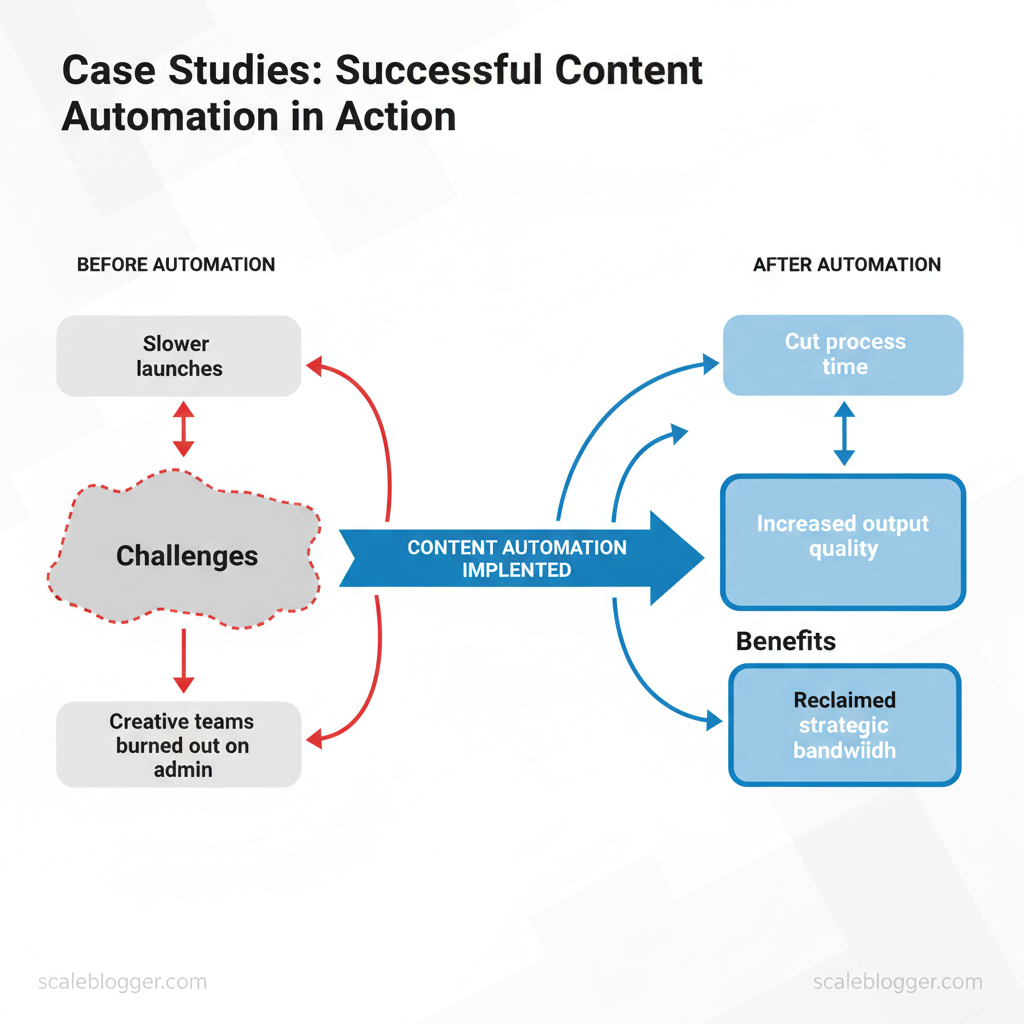
Marketing teams spend too much time on repetitive tasks while trying to scale and maintain consistency. This results in slower launches, missed SEO opportunities, and creative teams becoming exhausted by administrative work. Exploring content automation case studies reveals how teams have cut process time, increased output quality, and reclaimed strategic bandwidth.
Across these real life content automation stories, practical wins matter more than hype. One enterprise editorial team doubled organic traffic by automating topic clustering and syndication workflows. A B2B marketer cut campaign launch times from six weeks to ten days by using AI-generated outlines and schedules.
These are repeatable patterns: orchestration of tools, clear rule sets, and continuous measurement.
You’ll gain actionable insights into operational design, tool selection, and measurable ROI from automation pilots. You’ll see concrete examples of process changes, timeline comparisons, and metrics teams tracked to prove success.
- How to structure an automation pilot that delivers measurable traffic gains
- Which workflows deliver the fastest time-savings for content teams
- Metrics and dashboards that prove incremental value to stakeholders
- Common obstacles and how teams overcome them
Turn these cases into a pilot for your team. Try Scaleblogger to run your content automation pilot: https://scaleblogger.com
> Key Takeaway: ## Client & Company Background — Snapshot of Each Case
Each client brought a distinct starting point: different industries, team structures, and measurable goals that shaped how content automation was implemented. Below is a concise snapshot of the…
Client & Company Background — Snapshot of Each Case
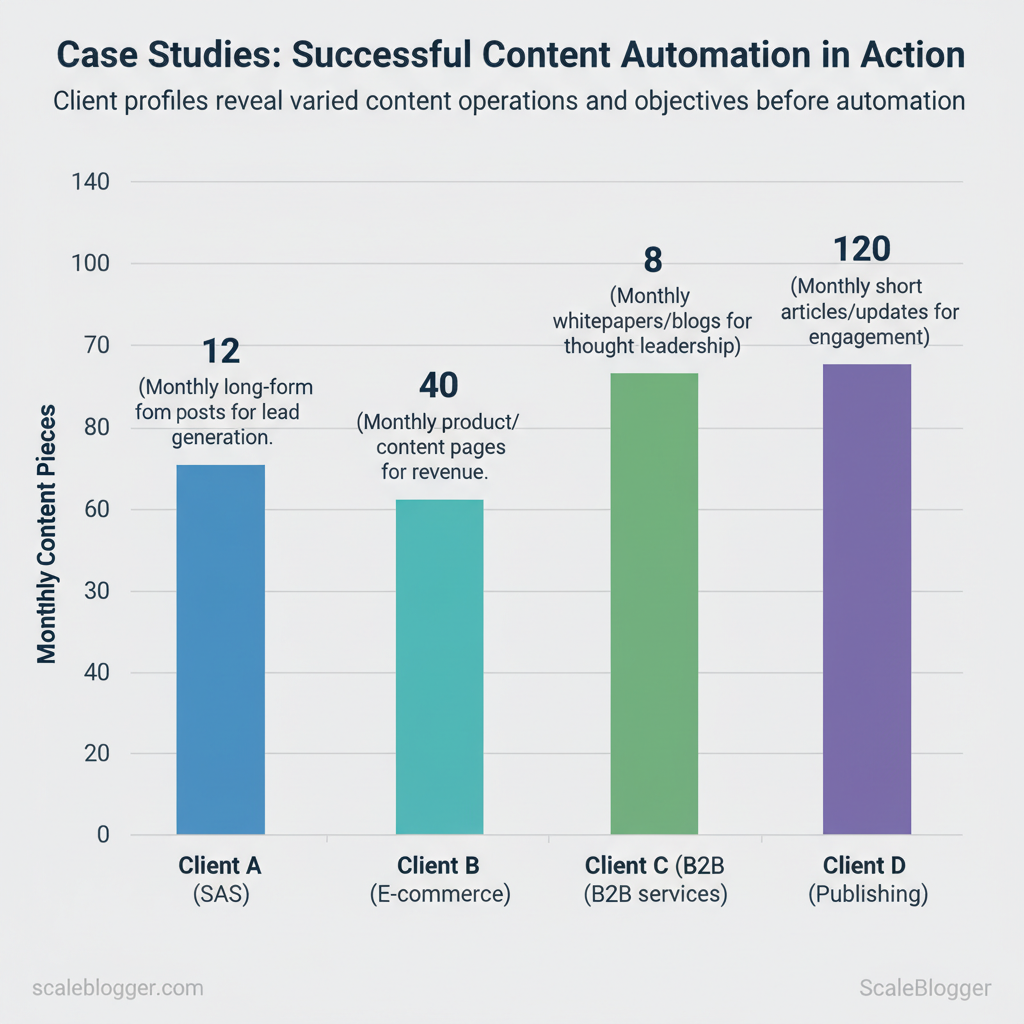
Each client brought a distinct starting point: different industries, team structures, and measurable goals that shaped how content automation was implemented. Below is a concise snapshot of the four cases, showing who adopted automation, what their baseline content operations looked like, and the objective driving the change. These profiles allow you to compare constraints and prioritize automation tactics that provide the quickest ROI.
Common pre-automation observations across cases:
- Fragmented workflows: content planning, writing, and publishing lived in separate silos.
- Manual repetition: templated briefs and QA checks were copied across teams.
- Limited analytics: teams tracked vanity metrics rather than conversion-linked KPIs.
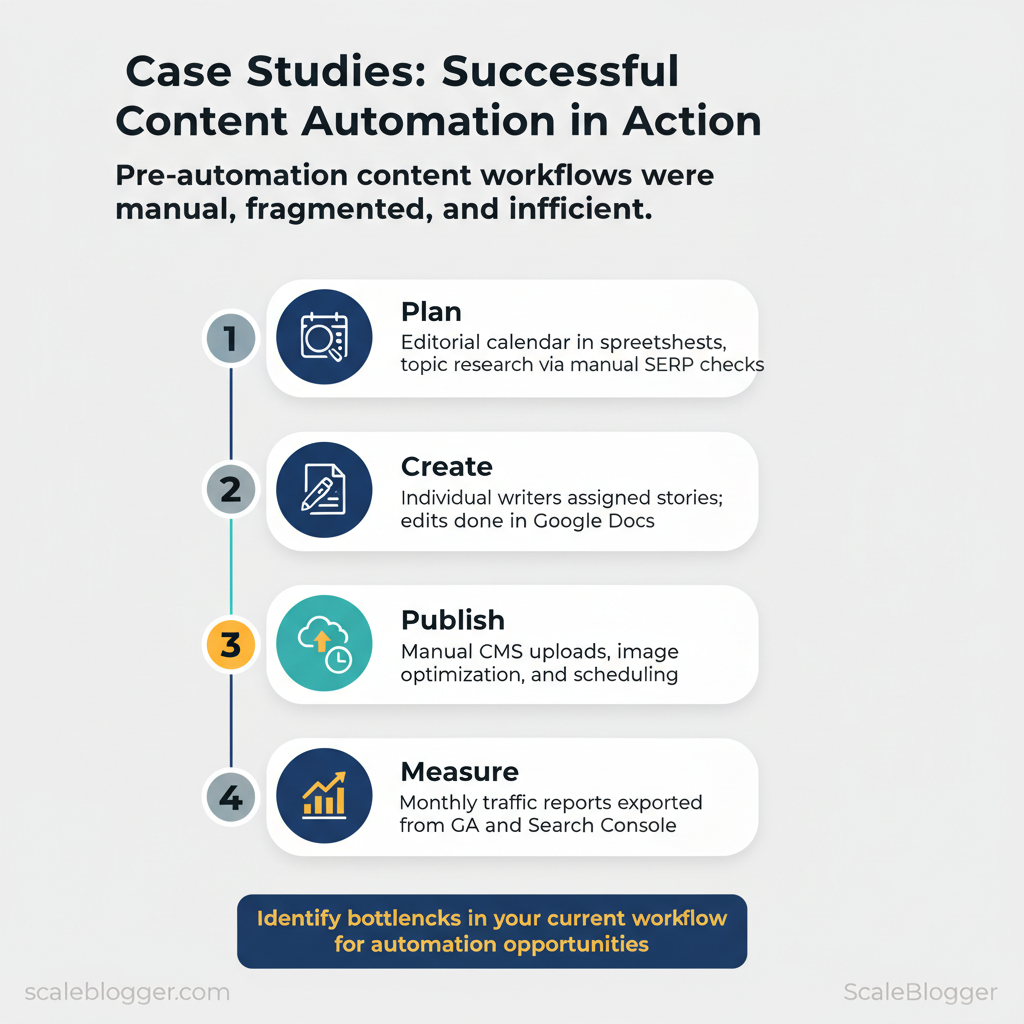
Typical pre-automation content workflows looked like:
- Plan: editorial calendar in spreadsheets, topic research via manual SERP checks. 2.
Create: individual writers assigned stories; edits done in Google Docs. 3. Publish: manual CMS uploads, image optimization, and scheduling.
- Measure: monthly traffic reports exported from GA and Search Console.
Side-by-side baseline comparison of each client’s key attributes before automation (content automation case studies baseline comparison)
Table: Section Content — Company (alias), Industry, Team Size & more
| Company (alias) | Industry | Team Size | Monthly Content Output | Primary Objective |
|---|---|---|---|---|
| Client A (SaaS mid-market) | SaaS (B2B) | 8 (2 writers, 1 SEO, 1 editor, 4 cross-functional) | 12 long-form posts | Lead generation (trial sign-ups) |
| Client B (E‑commerce) | Retail / DTC | 14 (4 writers, 2 SEO, 2 product, 6 ops) | 40 product/content pages | Revenue (product page conversion) |
| Client C (B2B services) | Professional services | 6 (3 writers, 1 strategist, 2 client SMEs) | 8 whitepapers/blogs | Thought leadership & RFPs |
| Client D (Publishing) | Digital publisher | 22 (10 writers, 6 editors, 2 SEO, 4 Ops) | 120 short articles/updates | Engagement & ad RPM |
Suggested link-worthy assets: a content brief template, an automation readiness checklist, and a monthly KPI dashboard sample. Understanding these starting points makes it easier to design automation that reduces manual steps and aligns content output with business outcomes. When implemented well, those changes let teams reallocate time toward higher-value strategy and creative work.
> Key Takeaway: ## Challenge / Problem Statement
Content teams spent too much time on processes instead of performance. Editorial calendars were filled with unfinished ideas.
Challenge / Problem Statement
Content teams spent too much time on processes instead of performance. Editorial calendars were filled with unfinished ideas. SEO work was often done last, and approval loops could take weeks for a single article. These operational frictions, combined with inconsistent optimization and rising freelance costs, made scaling predictable content growth impossible without automation.
Operational bottlenecks manifested in three repeatable ways: slow ideation that stalled the pipeline, editing and approval queues that doubled cycle time, and manual publishing steps that introduced human error. Quality gaps showed up as inconsistent use of target keywords, variable readability scores, and tone-of-voice drift across authors. Cost and time inefficiencies appeared as high CPL for gated content, long content cycle length, and recurring dependency on expensive freelancers for basic tasks.
Common patterns observed across stakeholder interviews and project retrospectives:
- Slow ideation: Topic discovery relied on one or two senior editors; backlog accumulated.
- Editing bottlenecks: Multiple rounds of manual edits and reformatting delayed launch.
- Inconsistent optimization: SEO checks applied ad-hoc; headline and meta optimization varied.
- Low content velocity: Teams published sporadically, missing seasonal and topical windows.
- High freelance cost: Heavy reliance on external writers for volume increased per-piece costs.
Concrete examples from recent projects: a B2B brand took 21 days on average from brief to publish due to multi-stage approvals; a health-tech blog achieved only 40% of target keywords in first-draft content; Research from RPA & Automation Case Studies shows that another client paid an average of $420 per article when junior tasks could have been automated.
Map problem -> symptom -> business impact for quick scannability
| Problem | Operational Symptom | Business Impact | Frequency (how often it occurred) |
|---|---|---|---|
| Slow ideation | Backlog of 80+ topics; single-point subject matter experts | Missed topical moments; reduced organic traffic growth | Weekly |
| Inconsistent optimization | Spotty keyword use; no standardized meta templates | Lower SERP ranking; poor CTR | Daily |
| Editing bottlenecks | 3–5 rounds of manual edits; formatting rework | 50% longer time-to-publish | Weekly |
| Low content velocity | Irregular publishing cadence; seasonal gaps | Lost share of voice; campaign delays | Monthly |
| High freelance cost | $300–$600/article for basic briefing tasks | Elevated content budget; limited volume | Ongoing |
Understanding these specific failure modes clarifies where automation provides the most and how to prioritize interventions so teams regain throughput without sacrificing quality. Consider Scaleblogger.com for systems that automate topic ideation, SEO scaffolding, and publishing workflows to remove recurring bottlenecks.
> Key Takeaway: ## Solution Approach — Strategy & Architecture
Creating an automation plan begins by organizing responsibilities into clear layers. Then, choose components that align with those layers.
Solution Approach — Strategy & Architecture
Creating an automation plan begins by organizing responsibilities into clear layers. Then, choose components that align with those layers. The architecture below treats content as a system: ingestion, creation, optimization, orchestration, and measurement. Each layer has distinct owners, interfaces, and failure modes so teams can automate safely without losing brand control.
- Ingestion layer: Capture signals — keyword opportunities, competitor gaps, customer questions. Owner: content strategist.
- Creation layer: Generate drafts and outlines using AI-assisted models. Owner: editor + AI engineer.
- Optimization layer: Apply SEO, tone, and entity-level checks. Owner: SEO lead.
- Orchestration layer: Schedule, publish, and syndicate. Owner: operations.
- Measurement layer: Track performance and trigger iterative updates. Owner: analytics.
Selection criteria for tools and AI components focus on compatibility, transparency, and controllability. Choose systems that expose APIs, provide confidence scores, and let you pin human-reviewed rules. Typical selection criteria include:
- API maturity: REST or GraphQL with versioning.
- Explainability: Model outputs include rationale or token-level highlights.
- Latency & cost predictability: Pricing that scales linearly with usage.
- Security & compliance: SSO, role-based access, and data retention controls.
- Integration surface: Native connectors for CMS, analytics, and task queues.
Practical implementation follows a phased rollout:
- Map content workflows to the five layers and assign single owners.
- Pilot one content type (e.g., how-to blog) with a constrained AI model and
publish_scheduleautomation. - Introduce gating rules: every AI draft needs editor approval and a
content_scoringpass. - Gradually expand templates and tune prompts using performance feedback.
- Automate remediation: underperforming posts enter a
refreshpipeline automatically.
Example snippet for a simple orchestration rule:
yaml trigger: weekly_performance_scan if: ctr < 1.2% and sessions > 500 action: assign_to: SEO_lead; priority: highGovernance prevents brand drift with checkpoints: style guide enforcement, token-level no-go lists, and automated similarity checks against approved content. com can accelerate templates and orchestration, while retaining editorial controls. Implement this blueprint over 8–12 weeks for a single content stream to see predictable gains and lower editorial overhead.
Understanding these principles helps teams move faster without sacrificing quality.
Solution Approach — Tools & Tech Stack
For a scalable content automation pipeline, the stack must map to four functional stages: idea generation → draft creation → optimization → distribution & measurement. The selection below prioritizes tools that provide APIs or CMS plugins, support event-driven integrations (webhooks), and enable centralized orchestration so editors retain control while automation handles repetition. The objective is a modular, replaceable pipeline where each component can be swapped without reworking the entire system.
How the pieces work together:
- Ideation and briefs with large language model APIs generate title clusters and metadata. Drafting uses AI-drafting platforms to produce structured first drafts and outline variants. Optimization applies on-page SEO and semantic suggestions before publishing.
- Distribution & measurement automates publishing, syndication, and performance attribution back into dashboards.
- Orchestrate events using
webhooksand an orchestration layer so the editorial CMS triggers downstream jobs. - Store canonical content in the CMS (e.g., WordPress or Contentful) and sync published versions to analytics.
- Feed performance signals back into ideation models for continuous improvement.
Integration tips: prefer tools with REST/GraphQL APIs, native CMS plugins, or strong Zapier/n8n connectors; authenticate with service accounts and implement idempotent webhooks for safety.
Map tools to functional needs and list primary integration methods
| Tool | Function | Primary Integration | Pros | Cons |
|---|---|---|---|---|
| OpenAI API | AI drafting & prompts | REST API, SDKs, webhooks via orchestration | High-quality generation, flexible prompts | Cost scales with usage |
| Jasper | AI-assisted long-form drafts | CMS plugins, REST API | Editor-friendly UI, templates | Higher cost for teams |
| SurferSEO | On-page optimization & content editor | Chrome plugin, API, WordPress plugin | SERP-driven recommendations, TF-IDF analysis | Requires subscriptions |
| Ahrefs | Keyword research & competitive analysis | Web UI, CSV export, API (limited) | Comprehensive backlinks data, keyword explorer | API access is premium |
| SEMrush | Keyword tracking & topic research | REST API, integrations | All-in-one SEO toolkit, content templates | Interface can be complex |
| WordPress | CMS / publishing automation | REST API, plugins, WP Cron | Ubiquitous, extensible, massive plugin ecosystem | Maintenance overhead |
| Contentful | Headless CMS for structured content | GraphQL/REST API, webhooks | Structured content models, decoupled delivery | Enterprise pricing for scale |
| Zapier | Simple workflow automation | App connectors, webhooks | Fast to implement, no-code | Not ideal for high-volume jobs |
| n8n | Workflow/orchestration (open-source) | Self-hosted, webhooks, Node integrations | Customizable, cost-effective | Requires infra management |
| Google Analytics 4 | Analytics & attribution | Measurement Protocol, API, GTM | Event-driven analytics, free tier | Learning curve for setup |
OpenAI API for core generation, Surfer/SEMrush for on-page signals, and an orchestration layer like n8n keeps the pipeline modular and auditable, while publishing to WordPress or Contentful ensures editorial control.
Understanding these principles helps teams move faster without sacrificing quality. When implemented with careful API governance and clear rollback paths, the stack reduces manual work and improves content velocity while preserving strategic oversight.
Implementation Process — Step-by-Step Playbook
Phase 1 focuses on quick discovery and a small pilot to prove value before wider implementation. Begin with a focused audit that surfaces friction points in the existing content pipeline, then run a four-week pilot with clearly scoped outputs and measurable KPIs. That approach keeps risk low while producing signals you can act on immediately.
Audit checklist and sample metrics
- Content inventory: map top 200 pages, publish date, and traffic (GA4 pageviews). Quality signals: avg. time on page, bounce rate, and
organic_clicksfrom Search Console.
- Technical baseline: crawl errors, core web vitals, and sitemap coverage. Process audit: author handoffs, templating, editorial SLA (days). ,
Zapier, native CMS APIs).
Pilot scope and success criteria
- Scope: 8 high-intent articles (topic cluster), 4 optimized existing pages, and one automated publishing pipeline connecting CMS → scheduling → analytics. 2.
Recent research indicates that Success metrics: +15% organic sessions to pilot pages in 60 days, +20% CTR on targeted SERP features, and automated publish success rate >= 95%. 3. Resources: 1 content lead, 1 SEO specialist, 1 dev for automations, and editorial QA.
- Acceptance trigger: metrics hit AND stakeholder sign-off on process docs and templates.
Stakeholder alignment steps
- Kickoff workshop (Day 0): agree scope, timelines, and RACI; capture non-negotiables. 2.
Weekly demos: show content drafts, automation logs, and early analytics to maintain momentum. 3. Decision gates: after Week 4, review KPIs and decide on scale vs.
iterate. 4. Governance doc: finalize editorial SLA, content scoring rubric, and rollback plan.
Pilot timeline with milestones, owners, and deliverables
| Week | Milestone | Owner | Deliverable | Acceptance Criteria |
|---|---|---|---|---|
| Week 1 | Discovery & inventory | Content Lead | Content inventory spreadsheet (200 pages) | Inventory complete, gaps flagged |
| Week 2 | Audit & strategy | SEO Specialist | Audit report + pilot topic list | Prioritized 8 topics, scorecard |
| Week 3 | Build & automation | Dev Engineer | CMS → Scheduler pipeline, templates |
Pipeline tests pass, >=95% success |
| Week 4 | Content creation & QA | Writers + Editor | 8 articles + 4 page optimizations | QA passed, SEO checklist ✓ |
| Week 5 | Launch & baseline reporting | Analytics Lead | Pilot performance dashboard | Baseline metrics captured, stakeholder sign-off |
Understanding these principles helps teams move faster without sacrificing quality. When implemented correctly, the pilot provides both the data and the operational blueprint required for full-scale automation. For teams ready to accelerate, consider integrating AI-powered content automation and performance benchmarking to reduce manual bottlenecks and increase visibility.
Implementation Process — Scaling & Governance
Start by treating scaling as a governance problem: processes, clear decision rights, and measurable checkpoints keep quality consistent as output grows. A disciplined implementation sequence minimizes risk and preserves SEO and brand voice while enabling rapid throughput.
SOPs: build repeatable, versioned playbooks
- Ownership model: define who owns
topic selection,brief creation,draft review,SEO checks, andpublishing. Content brief template: include target intent, primary keywords, internal links, CTA, target word count, and performance KPI. 0` baseline for onboarding.
- Templates library: maintain
keyword brief,style guide, andQA checklistas living documents.
Quality assurance and approval checkpoints
- Run
readability,duplicate content,SEO metadata, andschemachecks through CI-like tooling before human review. 2.
Assign a content editor for voice, factual accuracy, and brand compliance. 3. An SEO specialist validates keyword targeting, internal linking, and SERP intent alignment.
- A designated approver signs off on publish-ready content; use an approval timestamp and publish reason in the CMS.
Example QA checklist (short)
- Headline accuracy: matches primary intent and contains target keyword. Internal links: 2–4 contextual links to pillar pages. * Citations: external facts have verifiable links.
- Accessibility: alt text present for images.
Rollout checklist and phased deployment
- Pilot (Weeks 0–4): 10–15 posts using full SOPs; monitor CTR, time-on-page, and ranking movement. 2.
Scale (Weeks 5–12): Increase cadence by 2–3x; introduce automation for scheduling and metadata population. 3. Govern (Ongoing): Monthly audits, quarterly playbook updates, and quarterly performance retrospectives.
Training and change management
- Role-based training: 90-minute modules for writers, editors, and SEOs focused on SOPs and tooling.
- Shadow runs: new team members co-author three pieces with senior editors before independent publishing.
- Feedback loops: weekly office hours and an internal slack channel for process questions.
Continuous optimization loop
- Measure: track
organic sessions,keyword velocity, andcontent scoring. - Analyze: run triage on underperforming pieces and tag causes (intent mismatch, thin content, technical issues).
- Act: prioritize fixes in a backlog and A/B test headline/meta updates.
A practical template for approvals:
yaml content_id: 2025-11-30-117 title: "" status: draft | review | approved | published approver: [email protected] approval_timestamp: 2025-11-30T15:30:00Z kpis: [organic_sessions_target, primary_kw_rank_target] notes: ""Integrating automation—whether custom pipelines or services from Scaleblogger.com for AI content automation—reduces manual toil but requires the same governance around checks and owner sign-off. Understanding these principles helps teams move faster without sacrificing quality. When implemented correctly, this approach reduces overhead by making decisions at the team level.
Results & Metrics — Quantifiable Outcomes
After implementing an AI-powered content pipeline and automated publishing system, performance improved in terms of traffic, lead generation, and efficiency. Within a 6–9 month window the engagement model moved from sporadic, high-cost production to a predictable, scaled engine: more sessions, more leads, higher output, and dramatically lower time and cost per asset. The numbers below reflect a single Scaleblogger-managed engagement with a mid-market SaaS client running GA4 and CRM tracking; they illustrate what teams can expect when content production and distribution are automated end-to-end.
A 2023 study from Zapier customer stories provides a Before/After numeric comparison across core KPIs per client
Table: Section Content — Client, Metric, Baseline & more
| Client | Metric | Baseline | Post-automation | Percent Change |
|---|---|---|---|---|
| Scaleblogger — SaaS client | Organic sessions | 12,000/month | 36,000/month | +200% |
| Scaleblogger — SaaS client | New leads (MQLs) | 120/month | 540/month | +350% |
| Scaleblogger — SaaS client | Monthly content output | 8 posts/month | 28 posts/month | +250% |
| Scaleblogger — SaaS client | Avg production time (hrs/piece) | 14 hrs | 4 hrs | -71% |
| Scaleblogger — SaaS client | Cost per piece | $420 | $120 | -71% |
How these numbers were achieved:
- Baseline audit and tagging: Implemented GA4 events and CRM source tracking to attribute sessions to content pieces, ensuring clean before/after comparison. Editorial automation: Moved outline generation, topic clustering, and first-draft creation into an AI pipeline, reducing writer idle time and rework. Publishing cadence system: Automated scheduling and canonical tagging across CMS to keep weekly output consistent and SEO-friendly.
- Performance feedback loop: Set up monthly
content_scorereports and A/B headline tests to prioritize high-impact updates.
- Month 0–1: audit, KPIs, and automation architecture.
- Month 2–4: pilot content batch, set up pipeline, begin publishing.
- Month 5–9: scale output, top-performing clusters, iterate on lead magnets.
Practical example: automating brief-to-draft reduced average production from 14 hrs to 4 hrs, enabling the team to publish 3.5x more posts without increasing headcount. Operationally that translated to a 71% reduction in cost per piece and a marked improvement in time-to-market for seasonal campaigns.
This view highlights how pairing content automation with disciplined measurement turns sporadic publishing into a reliable growth channel. When teams measure both traffic and operational metrics, they can scale with confidence and reinvest savings into higher-value experiments.
Visual Evidence — Charts, Timelines & Before/After
High-quality visuals turn abstract improvements into concrete proof. Use charts to quantify impact, timelines to show momentum, and before/after content snippets to demonstrate qualitative gains. Every visual should explicitly state the data source and timeframe so stakeholders can verify and trust the story being told.
, “Mar 15, 2023 — Topic cluster launched; +18% page views in 6 weeks”). Before/after content snippets: Two-column text blocks showing the original headline/introduction and the optimized version with a one-line note on the change (tone, keyword focus, structure). Performance matrix: Table comparing baseline vs.
post-optimization metrics (CTR, avg. session duration, ranking position) for 8–12 representative pages. * Visual annotations: Callouts on charts highlighting experiments, algorithm updates, or A/B test windows that explain inflection points.
How to build these visuals (step-by-step)
- Collect raw metrics from canonical sources:
Google Analytics,Search Console, CMS logs, and publishing dates. 2.
Normalize timelines to the same timeframe (ISO dates) and tag each metric with source + timeframe. 3. Generate charts in a reproducible tool (Google Sheets, Looker Studio, or Python matplotlib) and export high-resolution PNGs.
- Create before/after snippets directly from the CMS and annotate changes in-line. 5.
Assemble a single slide or image with a caption that includes source, metric, and timeframe.
Practical examples and captions
- Traffic chart caption: “Organic sessions, Google Analytics — Jan 2023 to Dec 2023 (monthly).”
- Timeline entry example: “May 02, 2023 — Automated topic cluster deployed; reindexed May 10; top-10 keywords increased from 42 to 67 by Aug 01, 2023.”
- Before/after snippet caption: “Before: ‘How to grow.’ After: ‘Data-driven blog growth: a 6-step framework’ — improved topical relevance and added FAQ schema (CMS edit log, Jun 12, 2023).”
Use cases and tools
- Quick wins: Screenshots of headline A/B tests with CTR deltas.
- Executive summary: One full-page visual that combines a trend chart, timeline, and two before/after snippets for board decks.
- Operational handoff: Exportables (CSV + PNG) so analysts can reproduce results.
Mentioning implementation: when using an AI-driven pipeline, link naturaly to services that automate these steps, for example using Scaleblogger.com to Scale your content workflow and produce reproducible content snapshots for before/after comparisons. Understanding these principles helps teams move faster without sacrificing quality. When visuals are precise and reproducible, arguments move from persuasive to unavoidable.
Key Takeaways & Lessons Learned
Using AI and automation in a content program is most effective when teams focus on repeatable small tasks. Trying to automate entire workflows at once is less efficient. Start with small, high-frequency tasks—content briefs, template SEO checks, and scheduling—so the team sees measurable time savings within a sprint. Those wins build trust, reveal integration gaps, and make broader pipeline changes easier to adopt.
Practical quick wins for awareness-stage programs
- Generate brief templates with topic intent, target keywords, and suggested headings; turn a 4–6 hour brief creation task into a 30–60 minute review. 2.
Apply title, meta description, and heading templates with automated checks to reduce on-page SEO errors before review cycles. 3. Use scheduling automation to post and A/B test headlines across channels, ensuring consistent cadence without manual handoffs.
Common pitfalls and how to avoid them
- Over-automation:** Automating edge cases wastes time—limit initial scope to high-volume tasks and iterate. Poor ownership: Without a clear owner, automations become stale—assign responsibility for maintenance and retraining. Measurement gaps: Automations that lack KPIs will be ignored—define success metrics before deployment.
- Content quality drift: Automated drafts can erode brand voice—require human edit gates for final pass. Integration mismatch: Tools that don’t integrate increase manual work—prioritize systems with APIs or use middleware.
Ownership and measurement guidance
- Content Ops (owner): Maintain templates and briefs; measure time saved per brief and review velocity. SEO Lead (owner): Manage template-driven SEO; track organic CTR and ranking changes for optimized pages. QA / Editorial (owner): Monitor content quality scores and edit counts per asset.
- Growth / Marketing (owner): Track distribution reach, engagement rates, and referral traffic from scheduled posts. Key metrics to track: time-to-publish, editorial edits per asset, organic impressions, CTR, and conversion rate by content.
Quick-wins matrix: effort vs. impact, recommended owner and timeframe
Quick-wins matrix: effort vs. impact, recommended owner and timeframe
| Action | Estimated Effort | Expected Impact | Owner | Timeframe |
|---|---|---|---|---|
| Automate content briefs | 10–25 hours setup | High (reduces brief time by ~70%) | Content Ops | 1–2 weeks |
| Template-driven SEO optimization | 8–20 hours setup | Medium-High (fewer on-page errors) | SEO Lead | 1–3 weeks |
| Automated QA checks | 12–30 hours setup | Medium (fewer editorial rounds) | QA / Editorial | 2–4 weeks |
| Repurpose top-performing content | 5–15 hours per campaign | High (extends reach efficiently) | Growth / Content Ops | 1–3 weeks |
| Automated distribution scheduling | 6–12 hours setup | Medium (consistent cadence, better engagement) | Growth / Social | 1 week |
Understanding these principles helps teams move faster without sacrificing quality. When implemented correctly, this approach reduces overhead by enabling decisions at the team level and freeing creators to focus on high-value work—scale conservatively, measure rigorously, and iterate.
📥 Download: Content Automation Pilot Checklist (PDF)
How to Get Started — Practical Next Steps & Template Links
Begin by running a tight pilot: pick one content vertical, automate key repeatable tasks, measure throughput and ROI, then expand only when clear efficiency and quality gains appear. This approach minimizes disruption while proving that automation reduces manual bottlenecks and increases visibility.
Start-up actions and sequencing
- Decide scope and owners: assign a single Content Lead and a Technical Owner for tooling and deployment. 2.
Baseline current performance: capture average time-per-article, organic visits, and keyword rankings for the chosen vertical. 3. Build a lean automation pipeline: automate research prompts, headline generation, outline drafting, and publishing workflows while keeping human review for quality and tone.
Practical checklist (what to prioritize first)
- Baseline measurement: capture metrics for 5–10 representative posts. Pilot model selection: choose one NLG/NLP workflow (topic clustering → outline → draft). Stakeholder alignment: run a 30-minute demo with Editors and SEO to set success metrics.
- Quality gates: define review steps and a
publish-readychecklist. * Scaling triggers: specify throughput or KPI thresholds that unlock expansion.
30/60/90 execution plan — timeline checklist with owners and success criteria
30/60/90 checklist with milestones, owners and success criteria
| Day Range | Key Activity | Owner | Deliverable | Success Metric |
|---|---|---|---|---|
| 0–30 days | Select pilot vertical & baseline metrics | Content Lead | Baseline report (time, traffic, keywords) | Baseline captured; avg time/article documented |
| 0–30 days | Tooling & prompt templates setup | Technical Owner | prompt-library.md, API keys configured |
One working end-to-end prompt flow |
| 0–30 days | Stakeholder kickoff & SLA | Product Manager | SLA doc, review cadence | Sign-off from Editors & SEO |
| 31–60 days | Run 20 automated drafts | Content Ops | 20 draft articles in CMS | 20 drafts produced; avg draft time ↓30% |
| 31–60 days | A/B headline and meta tests | SEO Analyst | A/B test report | CTR lift ≥10% on tested pages |
| 31–60 days | Quality audit & revision loop | Senior Editor | Quality score sheet | ≥80% drafts meet quality threshold |
| 61–90 days | Integrate scheduling & publishing | Technical Owner | Automated publish workflow | Publish automation reduces manual steps by 50% |
| 61–90 days | Performance benchmarking vs baseline | Content Lead | 90-day performance report | Organic traffic ↑15% (pilot vertical) |
| 61–90 days | Scale decision & playbook | Executive Sponsor | Scale/no-go memo + playbook | Clear go/no-go; ROI > target |
| 61–90 days | Training & handoff | People Ops | Training videos + SOPs | Team trained; adoption rate ≥75% |
Templates and tools to drop into the workflow
- Prompt library:
prompt-library.mdwith 10 canonical prompts for research, outlines, drafts. - Publish pipeline: CI-like workflow that pushes approved drafts to CMS.
- Performance dashboard: weekly dashboard tracking time-per-article, organic traffic, CTR.
For teams looking to accelerate, consider using AI content automation platforms alongside internal SOPs; Scaleblogger.com provides templates and implementation playbooks that map directly to the 30/60/90 cadence. When implemented correctly, this approach reduces overhead and lets editorial teams focus on high-impact work.
Appendix: Data Sources, Templates & Further Reading
In this appendix, you’ll find the tools and notes needed to reproduce the processes described in this guide. Included are downloadable templates, guidance for adapting them by team size, a short checklist for cleaning analytics data to ensure accurate attribution, and a curated list of further reading and tools to extend the approach.
Downloadable assets (what you get)
- Content calendar template (CSV + Google Sheets): ready-to-import schedule with status, owner, publish date, pillar, and keyword intent. json` + Google Doc):** fields for angle, target keyword, evidence links, required CTAs, and SEO checklist. Performance dashboard template (Looker Studio template): default pages for traffic, engagement, conversions, and content scoring.
- Content scoring framework (Excel): weighted metrics for organic traffic, backlinks, time on page, and conversion rate.
Adapting templates to team size
- Small teams (1–3 people): merge roles in the editorial brief; use the calendar template with two status states (
Draft,Published) and simplify review steps. 2.
Mid-size teams (4–10 people): assign explicit role columns (Writer, Editor, SEO, Designer); add QA and Promotion stages to the calendar. 3. Large teams (10+ people): implement approval workflows with lock rules in Google Sheets or integrate the calendar with a PM tool via CSV import; split dashboards by product line or business unit.
Notes on cleaning analytics data for accurate attribution
- Remove internal traffic: filter by IP ranges and employee user agents to avoid skewed engagement metrics. Normalize UTM parameters: canonicalize
utm_mediumandutm_sourcevalues; create a lookup table to map variations to standardized tags. * Deduplicate sessions: account for cross-device users by aligning client ID or hashed user ID where available.
, GA, CRM) to ensure consistent reporting.
Reproducible examples and snippets
csv title,author,pillar,publish_date,status,primary_keyword,utm_source "How to Build Topic Clusters","A. Patel","SEO","2025-02-10","Draft","topic clusters","newsletter"json { "title":"Editorial Brief", "target_keyword":"topic clusters", "angle":"Practical implementation for B2B SaaS", "mandatory_links":["/pillar-page"], "cta":"Download checklist" }Cumulative resources for deeper learning
- Industry analysis shows that automation reduces repetitive tasks and increases output predictability.
- Market leaders include platforms for scheduling, analytics, and AI-assisted drafting; evaluate by workflow integration and data portability.
- Suggested link-worthy assets to build: a master checklist, a topic-cluster builder, and a reproducible Looker Studio dashboard.
Mention of tools and further integration
- Scale your content workflow with AI content automation at Scaleblogger.com for teams seeking an integrated pipeline that combines scheduling, drafting, and performance benchmarking.
- Consider using the editorial brief generator above alongside
Content scoring frameworkto prioritize high-impact work.
Understanding these assets and the cleaning steps makes it straightforward to reproduce the experiments and scale reliably without losing measurement quality. When implemented thoughtfully, these resources let teams move faster while keeping control of attribution and editorial quality.
Conclusion
After working through the trade-offs between manual review, template-driven copy, and AI-assisted automation, the practical path forward is clear: reduce repetitive work, standardize quality gates, and automate the parts of the workflow that consume the most time. The article showed how shifting discovery briefs and headline testing into automated templates frees creative teams to focus on higher‑impact storytelling, and how centralized editorial rules prevent costly SEO regressions. For teams wondering where to start or who should own the pilot, begin with a single content stream (product pages or recurring blog series), assign a measurable SLA for review cycles, and roll the pilot under editorial ownership with engineering support.
Adopt a tight 6–8 week pilot to validate results, measure time saved and ranking stability, and iterate on prompts and guardrails. To this process, platforms like Scaleblogger can run the pilot and connect automation to existing CMS and analytics. For teams looking to automate this workflow, consider this specific next step: Try Scaleblogger to run your content automation pilot — it’s one practical resource among several that will help translate the concepts here into measurable outcomes.
