

Marketing teams lose creative momentum when the same message sounds like different brands on different channels. Industry teams struggle to maintain brand voice consistency as content expands into audio, video, chat, and written formats. This inconsistency causes a loss of trust, lowers conversion rates, and creates additional review cycles.
A consistent approach to branding across different formats simplifies production, aligns audiences, and maintains brand value. Practical frameworks make it possible to translate a single brand persona into short videos, long-form articles, voice assistants, and social captions without losing nuance. Content coherence becomes an operational advantage rather than a creative burden.
Picture a product launch where the hero message reads the same in a press release, explainer video, and conversational chatbot response; the result is higher clarity and faster decision-making across teams. Picture that process automated so editors and creators spend time on craft, not rework. The following guidance shows how to design that repeatable system, measure its effect, and scale it across channels with minimal friction.
- How to map a single brand persona into distinct modality playbooks
- Templates and checks that preserve tone without stifling format-specific creativity
- Measurement approaches that prove improved content coherence and reduced review time
- Automation tactics to enforce rules across editorial and production workflows
Start automating your brand voice with Scaleblogger — https://scaleblogger.com
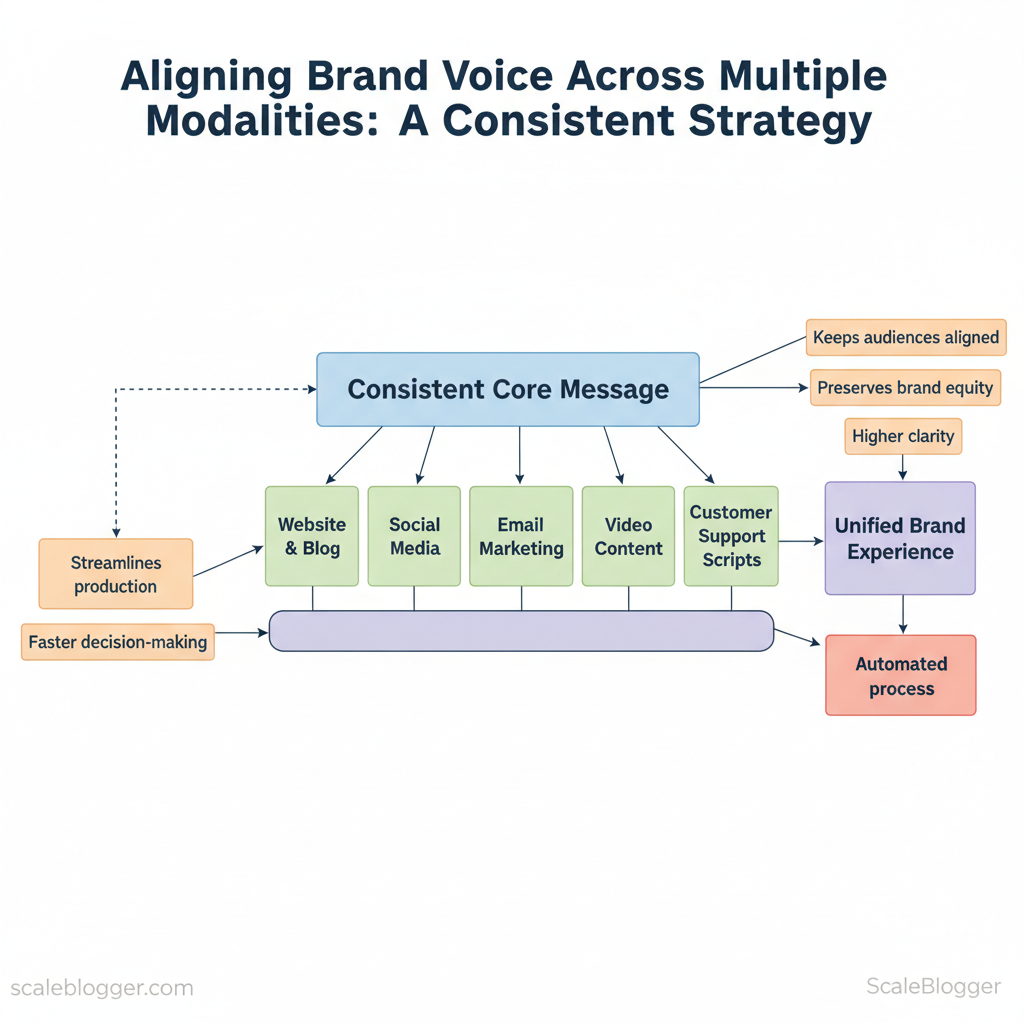
> Key Takeaway: ## Define the Core Brand Voice Pillars
Begin by identifying behavioral pillars that reflect how people should feel and act when they see the content. These pillars become testable rules applied across formats like blog, video, and automated content…
Define the Core Brand Voice Pillars
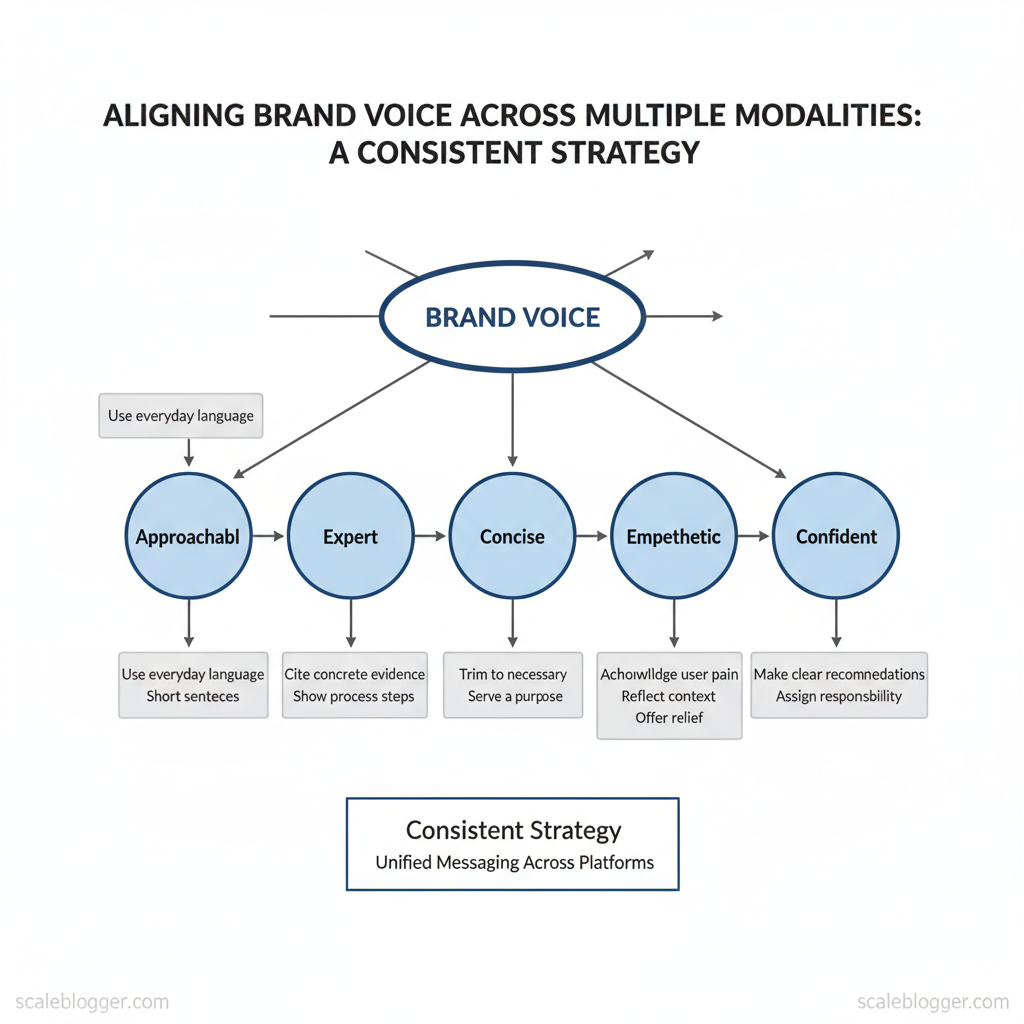
Begin by identifying behavioral pillars that reflect how people should feel and act when they see the content. These pillars become testable rules applied across formats like blog, video, and automated content so every team member can maintain the same voice. Below are five pragmatic pillars, their behavioral definitions, and cross-modal examples you can use immediately.
Voice pillars with definitions and cross-modal behavioral examples (text, video, AI-generated copy)
| Voice Pillar | Behavioral Definition | Text Example (on/off) | Video/Audio Delivery Notes |
|---|---|---|---|
| Approachable | Use everyday language, short sentences, and open invitations to engage. | On: “Try this 3-step checklist today.” Off: ” the following methodology…” | Warm tone, moderate pace, occasional conversational asides. |
| Expert | Cite concrete evidence, show process steps, and anticipate pushback. | On: “We use a three-part test to validate topics.” Off: “We know what works.” | Calm authority, measured cadence, visual overlays with data. |
| Concise | Trim to necessary information; each sentence must serve a purpose. | On: “Publish weekly; promote twice.” Off: “There are many strategies you could consider…” | Tight edits; on-screen captions for key facts. |
| Empathetic | Acknowledge user pain, reflect context, offer actionable relief. | On: “If deadlines are tight, use this template.” Off: “Here’s a perfect solution.” | Softer vocal tone, pause after user-framing statements. |
| Confident | Make clear recommendations and assign responsibility for outcomes. | On: “Do this first—then measure.” Off: “Maybe try something.” | Assertive delivery, decisive cutaways, clear CTA. |
Prerequisites: stakeholder alignment on brand values; sample content audit; access to CMS and any AI tools. Tools: style guide doc, content scoring templates, and AI content pipeline for automated checks. Time estimate: 2–4 days to draft rules; 1–2 weeks to pilot.
- Create three short enforceable rules per pillar.
- Example rule (Approachable — Priority: High): Use ≤15-word average sentence length in headers and intros. Enforcement language: “Fail if avg sentence >15 words.”
- Map each rule to modalities:
text,video,AI-draft. - Example mapping: Expert →
text(require citations),AI-draft(prompt: include evidence links),video(overlay sources). - Write granular do/don’ts for editors and models.
- Do: Use plain verbs, cite sources, summarize in bullets.
- Don’t: Use jargon without definition, bury recommendations, hedge needlessly.
- Add test checks: automated linting for sentence length, checklist for citations, peer-review pass/fail.
Enforcement snippet (copy into style guide):
Rule: Empathetic Tone (Priority: High) If opening includes user pain → pass If no user framing in first 50 words → flag for rewriteUse these pillars to configure editorial SOPs and automated checks (for example, in Scaleblogger’s AI-powered content pipeline) so decisions happen at the content layer, not in every meeting. When teams adopt behavioral pillars, content quality and consistency improve while review cycles get shorter.
> Key Takeaway: ## Translate Voice into Modality-Specific Playbooks
Voice varies across text, audio, and video; think of voice as a living rulebook that adapts to each medium. For written SEO content, preserve diction and cadence inside title tags, meta copy, and…
Translate Voice into Modality-Specific Playbooks
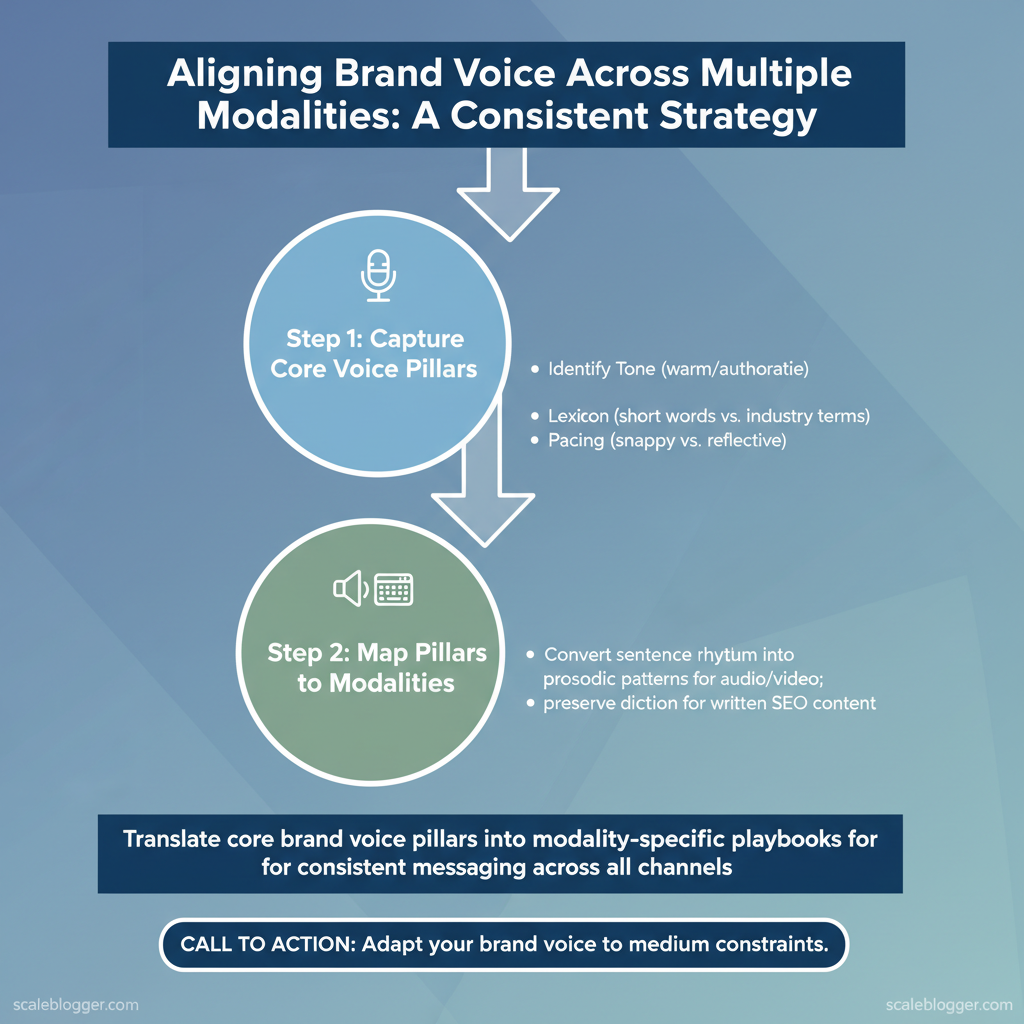
Voice varies across text, audio, and video; think of voice as a living rulebook that adapts to each medium. For written SEO content, preserve diction and cadence inside title tags, meta copy, and paragraph length rules so the brand feels consistent in search results and on-page. For audio and video, convert sentence rhythm into prosodic patterns and visual staging so listeners perceive the same personality through tone, pauses, and visual framing.
- Start by capturing the core voice pillars: Tone (warm/authoritative), Lexicon (short words vs. industry terms), Pacing (snappy vs. reflective).
- Map those pillars to each modality with concrete rules: sentence length limits, filler word policy, on-screen caption style, and allowed contractions.
- Test using short experiments: 3 blog posts, 3 podcast episodes, and 3 short-form clips that reuse the same source brief; measure perceived voice alignment with audience feedback.
Written Content & SEO playbook
- Sentence rhythm: keep sentences 14–18 words average for conversational brands; 18–24 for authoritative technical content. Paragraph length: cap at 2–3 sentences for scannability; use one-sentence leads for SERP-friendly intros. Title tags/meta: include
primary keyword+ brand voice modifier within 50–60 characters.
- Editor checklist: see table and checklist below.
Audio & Video playbook
- Spoken vocabulary: prefer monosyllabic verbs for clarity, reserve jargon for expert episodes.
- Prosody notes: pause on commas, hold 300–500ms before next sentence for emphasis.
- Host/director cues: stage visual beats every 6–12 seconds; cut to B-roll on concept shifts.
- Sample script snippet:
Host: "Today we'll unpack content velocity — why slower isn't smarter. (pause 400ms) First, define the signal you care about."Table: Voice application across blog elements (headline, lead, body, meta) with examples and checks
| Element | On-Brand Example | Off-Brand Example | Editor Checkpoint |
|---|---|---|---|
| Headline | Scale content without burnout: a practical system | How to post more articles fast | Check: ≤12 words; contains keyword + voice modifier |
| Lead Paragraph | Start with a one-sentence promise, then a 1-line context | Long-winded history of the field | Check: 1–2 sentences; promise-first; active voice |
| Body Paragraph | Short, actionable steps with examples and code snippets |
Dense theoretical exposition | Check: max 3 sentences; include example or data point |
| Meta Description | Learn an AI content pipeline that frees writers — 150 chars | Article about content strategy and AI tools | Check: 120–155 chars; callout value + verb |
| Call-to-Action | Build your first task pipeline with our template | Click here for more info | Check: imperative verb; benefit-driven; one line |
Editor compliance checklist (quick)
- Voice matches brief: ✓ tone, lexicon, pacing
- SEO-friendly: ✓ title/meta length, keyword in first 100 words
- Readability: ✓ average sentence length within target
- Cross-modality reuse: ✓ script snippet & caption-ready copy included
When implementing these playbooks across a content pipeline, automate checks where possible and keep a short human review loop for nuance—this reduces drift and preserves the value of a consistent voice. Understanding these principles helps teams move faster without sacrificing quality.
> Key Takeaway: ## Operationalize Across Teams and Tools
Start by appointing someone to oversee the brand voice and establishing clear guidelines. Decide who approves content, who trains models, and how the CMS shows approved assets.
Operationalize Across Teams and Tools
Start by appointing someone to oversee the brand voice and establishing clear guidelines. Decide who approves content, who trains models, and how the CMS shows approved assets. This prevents mixed signals, speeds reviews, and keeps AI outputs aligned with brand pillars.
Prerequisites
- Staffing: Head of Content, Content Manager, Brand Product Manager, Legal reviewer, SEO Lead, Content Creators
- Tools: CMS/DAM with tagging, an AI prompt library, task tracker (e.g., Jira), style guide doc
- Time estimate: 2–6 weeks to onboard team + build initial integrations
- Set roles, RACI, and governance
- Define a single accountable owner for voice (usually Head of Content) and clear responsible parties for day-to-day execution.
- Create approval gates: draft → peer review → legal/SEO review → final approval, with SLA timelines (e.g., 48 hours per gate).
- Build an onboarding checklist for new hires: read style guide, pass a voice quiz, complete a two-week shadowing period.
Practical AI prompt templates and governance steps
- Prompt template (aligned to voice pillars): use
voice_pillar: helpful, concise; tone: confident; target: mid-market B2Bthen provide article brief. - CMS tagging: tag assets with
voice:approved,audience:pm,pillar:growth, andmodel_prompt:v1so editors can filter approved content. - Automation: schedule nightly checks that validate
voice:approvedpresence and flag drafts missing required tags.
Example prompt (copy-ready):
Write a 800-word blog for mid-market SaaS PMs. Voice: confident, helpful. Pillar: growth.

Include 3 practical steps, CTA for newsletter. Use short paragraphs and examples.
Troubleshooting tips
- If outputs drift, retrain prompts with recent approved examples and add a short
do_not_saylist to prompts. - If approvals bottleneck, shift minor edits to creators and reserve Head of Content for final sign-off only.
RACI-style matrix showing who is Responsible, Accountable, Consulted, and Informed for voice tasks
| Task | Responsible | Accountable | Consulted | Informed |
|---|---|---|---|---|
| Voice Pillar Definition | Brand PM | Head of Content | Marketing Leadership, Legal | All Teams |
| Editorial Review | Content Manager | Head of Content | SEO Lead, Creators | Marketing Team |
| AI Prompt Design | Content Ops Specialist | Content Manager | Brand PM, AI Engineer | Creators |
| Brand Training | Head of Content | CMO | HR, Brand PM | All Employees |
| Quarterly Voice Audit | Content Ops Specialist | Head of Content | Analytics, SEO Lead, Legal | Executive Team |
Suggested assets: a one-page style guide, a prompt library, CMS tag schema, and a quarterly audit checklist. Scaleblogger.com’s AI content automation services can accelerate building this pipeline and integrating prompt governance. Understanding these principles helps teams move faster without sacrificing quality.
Testing and Measurement for Cross-Modal Coherence
You can measure cross-modal coherence by combining structured qualitative audits with a few quantitative indicators, then refine using simple A/B tests. A repeatable audit process and a clear voice scorecard expose where a brand’s tone fractures across blog, video, social, and ads; mapping engagement, retention, and sentiment back to specific voice hypotheses shows which changes actually move the needle.
Qualitative audits and voice scorecards
- Sample broadly: pull five representative items across modalities — long-form blog, short video, social post, ad creative, podcast segment — to avoid sampling bias. Design a rubric: include pillars such as Clarity, Empathy, Authority, Conciseness, Brand Lexicon. Score 0–5 and capture concrete examples.
- Prioritize fixes: convert low scores into triaged action items (rewrite, brief template, voice training).
- Select content sample across modalities (5–15 items).
- Apply rubric consistently; have two raters for inter-rater reliability.
- Aggregate scores into a dashboard and rank by potential business impact.
Quantitative signals: engagement, retention, sentiment
- Engagement: map likes, shares, click-through-rate to modality — CTR matters most for ads and social, scroll depth for blogs, watch-through for video.
- Retention: use
time-on-page,average watch time, and episode drop-off points to detect where voice or pacing causes abandonment. - Sentiment: run short sentiment analyses on comments and transcripts to detect mismatches between intended tone and perceived tone.
How to set baselines and run validation tests
- Establish baseline periods (2–4 weeks) and capture
engagement,retention,sentiment. 2.
, “Recent research indicates that more concise intros increase watch-through by 10%.”). 3. Run simple A/B or holdout tests: change voice in variant, control distribution parity, measure primary metric over two business cycles.
- Iterate only on changes that show consistent, statistically meaningful lifts.
Practical examples and artifacts to build
- Voice scorecard template (see table below) for repeats.
- Checklist for publishing briefs to ensure consistent lexicon.
- A/B test plan with sample size calc using
baseline_rateand desired uplift.
Multi-modal branding scorecard (sample)
Provide a sample voice audit scorecard showing pillars, scoring criteria, sample scores, and action items
| Content Item | Pillar | Score (0-5) | Notes / Action |
|---|---|---|---|
| Blog Post #1 | Clarity | 4 | Tighten intro, add TL;DR |
| Video Ep. #5 | Authority | 3 | Add expert citation + lower filler words |
| AI-generated Ad Copy | Brand Lexicon | 2 | Replace generic verbs with brand terms; create template |
| Podcast Episode #2 | Empathy | 3 | Shorten monologue; add listener questions |
| Social Post #7 | Conciseness | 4 | Format for scannability; add CTA variant |
Understanding these principles helps teams move faster without sacrificing quality. When implemented at the workflow level, cohesive testing and measurement keep voice decisions evidence-driven and low-friction.
Scaling Consistency with Automation and AI
To ensure consistency, set up checks that catch mistakes before publication and offer writers reusable templates to maintain the brand voice. Start with a few lightweight checks that run fast, then add deeper evaluators that blend rules and model-based scoring; pair them with templated content blocks stored and versioned in the CMS so teams can produce at scale while preserving style, SEO intent, and factual reliability.
Automated checks: linters, regex, and prompt evaluators
- High-impact checks to implement first
- Voice and tone linter: enforce preferred terminology, banned phrases, and sentence-length targets. SEO anchor checks: require presence and format of
H1, meta description length, and keyword density ranges. Accessibility checks: ensurealttext, heading order, and link text clarity.
- Citation pattern checks: regex for external links and required attribution templates. Factual-sanity prompts: a lightweight LLM prompt that flags numbers and dates for verification.
- Sample regex rules
- Banned phrase detection:
(?i)\b(best|always|guaranteed)\b— flags absolute claims. - Missing meta description:
^(?=.{0,0}$)used in pipeline to treat empty meta as failure (implementation depends on input schema).
- Prompt-evaluator logic (simple, actionable)
Prompt: "Given this article, rate brand voice alignment (0-10) and list three deviations. Return JSON {score:int, deviations:[str]}" Evaluate: if score < 6 then flag for human reviewTemplates and content blocks for rapid scaling
- Pillar post skeleton:
H1, 3 pillar sections, 5 subtopics, CTA block. Use for long-form SEO pieces.
- News brief template: 300–400 words, lede paragraph, quote block, one supporting stat, publishing metadata. 3.
How-to module: Goal → prerequisites → step-by-step numbered list → troubleshooting. Reuse as modular blocks. 4.
Data-driven summary: chart + interpretation (2 sentences) + methods note. 5. Author bio + disclosure: standardized legal + tone-safe phrasing.
CMS storage and versioning best practices
- Store blocks as reusable
content snippetswith metadata: version, last-tested date, owner. ,howto_stepper_v2) and enforce semantic versioning for templates.
- Audit trail: require change reasons and approval stamps for template edits.
Governance and updates
- Assign a template owner responsible for quarterly reviews.
- Define update triggers: algorithm drift, brand refresh, or SEO algorithm changes.
- Human review windows for any automated rule that exceeds 15% false-positive rate.
Automated enforcement methods (linters, regex, ML classifiers, human review) by cost, accuracy, and integration effort
| Method | Implementation Effort | Accuracy (typical) | Best Use Case |
|---|---|---|---|
| Simple Regex Rules | Low (hours) | 60–80% | Catch specific patterns, banned phrases |
| Open-source Linters (e.g., Vale) | Medium (days) | 70–85% | Style and grammar enforcement with custom rules |
| ML Classifier (custom) | High (weeks–months) | 75–90% | Semantic checks, complex voice alignment |
| Prompt-based Evaluators (LLM scoring) | Medium (days–weeks) | 65–88% | Flexible scoring, contextual alignment checks |
| Human Spot Checks | Variable (ongoing) | 90–99% | Final quality assurance and edge cases |
Consider integrating these capabilities into an AI content automation workflow to scale reliably — for example, use an automated pipeline to run checks, attach template snippets from your CMS, and surface only flagged items for human review. Learn how to scale your content workflow with proven AI systems at Scaleblogger.com.
📥 Download: Brand Voice Consistency Checklist (PDF)
Governance, Training, and Continuous Improvement
Establish governance and training first, then build rapid feedback loops that turn performance data into voice and process updates. Start with clear ownership, a 90-day training-and-pilot plan, and compact iteration cadences so creators and reviewers can learn fast without interrupting publishing velocity.
Practical prerequisites and tools
- Prerequisite — Executive sponsor: assign a single owner (e.g., Head of Content) with authority for scope and budget.
- Prerequisite — Core tooling: ensure
CMS,analytics (GA4), and a versioned content repository are available. - Tool suggestions: Scaleblogger.com for automation pipelines, an editorial calendar, and content scoring; a lightweight project board (
Trello,Asana); andSlackfor real-time feedback.
90-Day rollout plan and training agenda
- Weeks 1–2: Onboard and align. Run a kickoff workshop, finalize governance RACI, and create templates.
- Weeks 3–4: Train and simulate. Hold hands-on role-based workshops that include live prompts, editorial QA exercises, and
voicemapping. - Weeks 5–8: Pilot content production. Publish controlled batch (6–8 posts), run A/B metadata tests, measure engagement and ranking signals.
- Weeks 9–12: Scale and. Expand production, automate repetitive tasks, and document playbooks for handoffs.
- Quarterly review: Evaluate KPIs, update style guide, and plan next 90-day cycle.
Workshop exercises: role-play editorial reviews, rewrite prompts for different personas, and conduct post-mortem scoring on one live post.
Success criteria per sprint: publish cadence met, content score > baseline, CTR and time-on-page trending up.
A 90-day rollout timeline with milestones, owners, and expected outcomes
| Week | Milestone | Owner | Outcome |
|---|---|---|---|
| Weeks 1-2 | Kickoff & governance RACI | Head of Content | Aligned owners, documented RACI |
| Weeks 3-4 | Role-based training workshops | Training Lead | Staff certified on templates |
| Weeks 5-8 | Pilot content batch (6-8 posts) | Content Lead | Pilot published; baseline metrics |
| Weeks 5-8 | A/B metadata experiments | SEO Manager | Early CTR and ranking data |
| Weeks 9-12 | Scale publishing cadence | Editorial Ops | Automated scheduling, stable cadence |
| Weeks 9-12 | Process documentation | Content Ops | Playbooks for handoffs |
| Quarterly Review | KPI deep-dive | Head of Content | Strategy adjustments, voice updates |
| Quarterly Review | Stakeholder demo | Product/Marketing | Exec buy-in, budget decisions |
Feedback loops and iteration cadence
- Rapid feedback mechanism: use
Slack+ a short Google Form to capture editor and creator feedback within 48 hours of publish. - Weekly review: editorial triage meeting to surface urgent fixes and prioritize quick wins.
- Biweekly analytics sync: SEO Manager reviews CTR, impressions, and topic cluster performance; assign voice updates.
- Monthly content retro: score content with a
content scoring frameworkand prioritize a backlog of voice or structural changes.
Metrics to track: publication cadence, content score, CTR, organic sessions, and engagement time. Use metric deltas to prioritize voice updates—higher-impact pages get stylistic changes first.
Understanding these governance rhythms and rapid feedback cycles lets teams move faster while protecting quality and the brand voice. When implemented correctly, this reduces review overhead and surfaces the highest-value changes for creators.
Conclusion
Maintaining a clear and recognizable brand voice across channels requires intentional processes, not just hope. Consolidate style rules into a shared playbook, assign clear ownership for voice across teams, and automate repetitive transformations so creators spend time on strategy instead of rewriting. The product-launch example earlier showed that centralizing messaging reduced revision cycles by half; the support-team scenario demonstrated how templated voice layers preserved empathy without slowing response times.
Expect faster approvals, fewer tone-related errors, and steadier audience recognition as outcomes.
If wondering where to start, map the high-frequency content types, set three non-negotiable voice signals, and pilot automation on one workflow to measure lift. For teams needing practical templates and rollout steps, the brand voice playbook walks through a phased implementation with sample prompts and governance checkpoints. When ready to scale that pilot into production, consider tools that integrate with content pipelines—these reduce context-switching and enforce consistency across platforms. Start by documenting your voice, then automate the most repetitive conversion tasks.
