

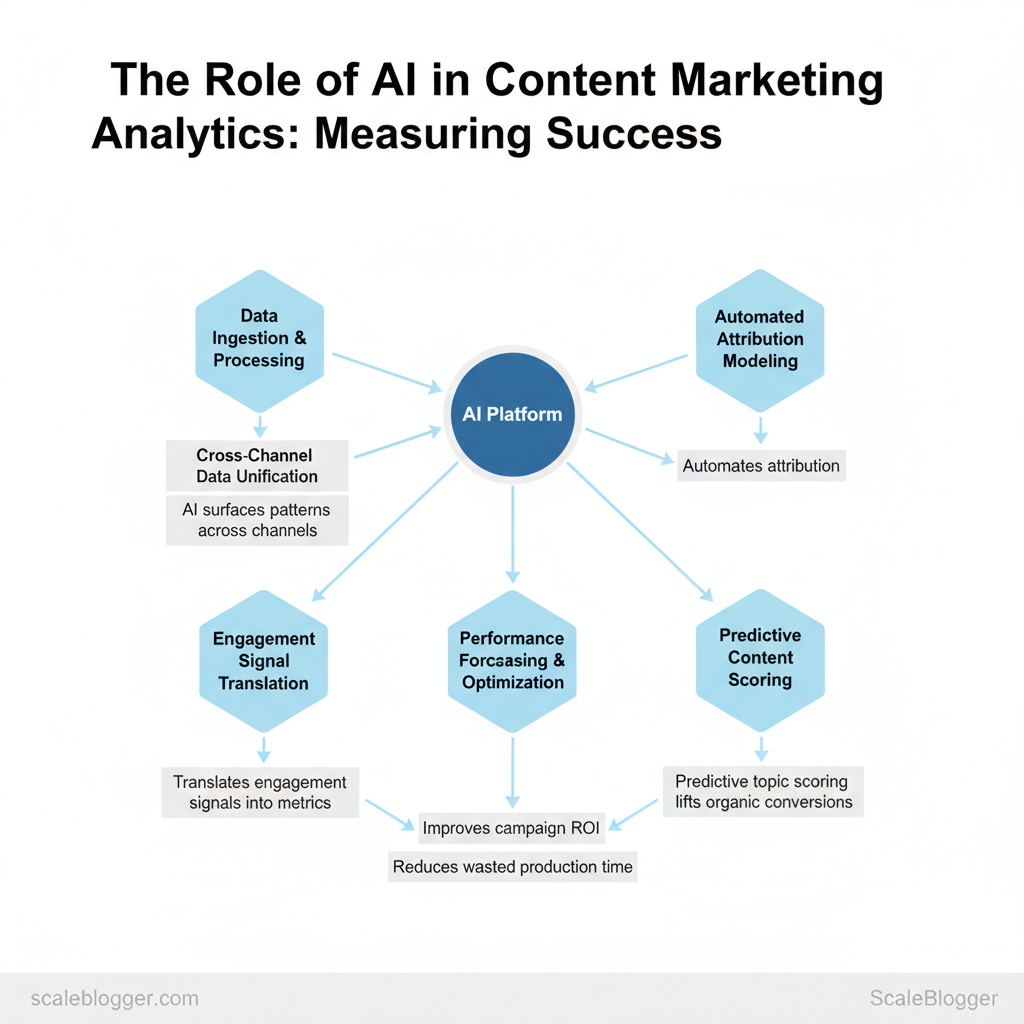
Marketing teams increasingly rely on AI in marketing analytics to attribute value, optimize content, and prove ROI faster than traditional reporting. AI models surface patterns across channels, automate attribution, and translate engagement signals into actionable content marketing metrics that teams can operationalize immediately.
Industry teams using advanced analytics report clearer content-performance lines and faster decision cycles, which improves campaign ROI and reduces wasted production time. Picture a content team that used predictive topic scoring to lift organic conversions by measuring AI-driven engagement signals against baseline KPIs within eight weeks.
- What effective AI models reveal about content performance and attribution
- How to align content marketing metrics with revenue and retention goals
- Practical steps for measuring AI success without overfitting your dashboard
- Pitfalls to avoid when trusting automated recommendations
- How automation scales reporting while preserving strategic judgment
Trusting AI requires clear measurement design, not blind reliance. The next sections explain metric selection, validation techniques, and real-world workflows for measuring AI success.
Foundations — What AI Brings to Content Marketing Analytics
AI converts raw content and performance noise into actionable signals so teams decide faster and with more confidence. Rather than manually stitching together spreadsheets and guesses, modern AI layers — from `NLP` to predictive models and automation pipelines — extract meaning from text, forecast which pieces will drive conversions, and keep dashboards current in near real time. This changes analytics from a rear-view activity into an operational capability that guides ideation, distribution, and optimization.
Key AI Capabilities (NLP, Predictive Modeling, Automation)
AI capabilities break into three practical groups that map directly to analytics outcomes.
- NLP for text understanding: `NLP` handles sentiment, topic clustering, entity extraction, and intent signals so you can measure not just clicks but thematic resonance.
- Predictive modeling for forward-looking insights: Forecast engagement and conversion likelihood at the article or topic level, allowing prioritization of content investments.
- Automation for data reliability: ETL and real-time pipelines feed dashboards and trigger workflows, eliminating lag and manual errors.
| AI Capability | Analytics Use-Case | Business Benefit | Implementation Complexity |
|---|---|---|---|
| NLP | Topic clustering, sentiment, entity extraction | Faster topical discovery; better UX personalization | Medium |
| Predictive Modeling | Engagement & conversion forecasting | Prioritize high-ROI content; reduce wasted spend | High |
| Automation / ETL | Real-time dashboards, data cleaning | Reliable KPIs; faster decision cycles | Medium |
| Anomaly Detection | Traffic/engagement spike alerts | Faster issue detection; fraud/noise filtering | Low |
| Recommendation Engines | Content → content / product recommendations | Increased session depth; higher conversions | High |
What ‘Success’ Means — Metrics vs. Outcomes
Success in content analytics separates vanity metrics from business outcomes and maps leading indicators to final results. Leading indicators (e.g., click-through rate, dwell time, content score) predict future outcomes; lagging indicators (e.g., revenue, conversions, churn reduction) confirm impact. Use a simple 3-step conversion-mapping framework to connect the two:
Practical example: If the outcome is a trial sign-up, map article-level conversion probability, newsletter CTR, and product demo clicks as intermediate signals; prioritize new content with high predicted conversion probability. Tools and frameworks like this are why teams can move from reporting to continuous optimization without adding headcount. Understanding and applying these principles helps teams act faster and focus on content that truly moves the business.
Setting Up an AI-Ready Analytics Stack
An AI-ready analytics stack means collecting the right signals, keeping them clean, and choosing tools that let models and dashboards operate reliably at scale. Start by mapping which content metrics drive decisions — organic traffic, conversion events, engagement depth, and attribution to campaigns — then ensure those signals are captured consistently across CMS, web analytics, CRM, search data, and social APIs. The goal is a single trusted dataset where features (e.g., topical cluster, publish date, impressions) are normalized so downstream models and alerting rules don’t break when a field name changes or a platform drops an API field.
Think practical: prioritize high-impact, low-effort sources first (search queries, page-level traffic, conversions), implement robust ETL with schema checks, and choose a modular tooling approach so you can swap a model or dashboard without reengineering pipelines. If you want a fast win, use an automated content pipeline to normalize titles, canonical URLs, and topic tags before feeding them into analytics and modeling tools — this is where services like Scaleblogger.com can accelerate adoption by automating content ingestion and scoring. The rest of this section covers exactly what to collect, how to keep it clean, and how to choose tooling and dashboards.
Data Collection & Cleanliness — Sources and Best Practices
Collect from these critical sources first and enforce simple quality checks: field presence, canonical URL normalization, consistent timestamp formats, and traffic sanity checks (spikes/zeros).
| Data Source | Typical Fields | Update Frequency | Why It Matters |
|---|---|---|---|
| CMS (page content, metadata) | title, slug, publish_date, author, tags | Real-time via API / nightly export | Source of truth for page-level attributes and content changes |
| Web analytics (sessions, conversions) | sessions, pageviews, bounce_rate, conversion_event | Near real-time / hourly | Measures user behavior and conversion performance |
| CRM (lead source, lifecycle stage) | lead_id, source, campaign, lifecycle_stage | Daily sync / near real-time via webhook | Connects content to revenue and lifecycle outcomes |
| Social platforms (engagement data) | post_id, impressions, likes, shares, comments | Daily / hourly via API | Shows promotional reach and engagement signals |
| Search Console (queries, impressions) | query, clicks, impressions, avg_position | Daily export | Surface search intent and ranking opportunities |
Tooling & Architecture — Choosing AI Tools and Dashboards
When implemented well, teams get reliable signals for AI models and dashboards that make content decisions faster without increasing overhead. This is why modern content strategies invest in both data hygiene and flexible tooling up front.
Designing Actionable Content Metrics with AI
You should design metrics that tell you what to do next, who owns the outcome, and how the measure scales across formats. Start with clear definitions, tie each metric to a decision or trigger, and use AI to enrich attribution and surface patterns you couldn’t see at scale. That combination moves metrics from vanity tracking to a decision system teams can act on daily.
Metric Design Principles — Clarity, Actionability, and Scalability
Clear definitions and ownership prevent arguing over numbers; actionable thresholds make metrics operational; scalability allows the same signal to work for a short social post and a 10,000-word pillar. Below are focused principles and practical ways to implement them.
| Principle | Poor Design Example | Good Design Example | Why it matters |
|---|---|---|---|
| Clarity | “Engagement” tracked vaguely | “Engaged Sessions: sessions with ≥2 pageviews and ≥60s duration” | Reduces interpretation fights and aligns teams |
| Actionability | Weekly raw traffic reports | Threshold: page CTR <1.5% for 10 days → run A/B headline test | Ties metric to an immediate next step |
| Consistency | Different definitions per channel | Standardized `engagement_rate` formula across blog, newsletter, video | Enables apples-to-apples comparisons |
| Measurability | Relies on manual tagging | Auto tag via UTM + CMS event capture | Cuts errors and speeds reporting |
| Scalability | Separate KPIs per asset type | Normalize: `engagement_per_minute` across long/short content | Same signals apply to any content format |
AI-Enhanced Metrics — Examples and Templates
AI turns raw signals into context-rich metrics and automates the “why” behind changes.
“`python
Example template: Headline Alert
if article.ctr_7d < 0.015 and article.impressions_7d > 1000: enqueue_task(‘headline_test’, article.id, owner=article.owner) “`Understanding these design principles and AI-enhanced templates helps teams move from measuring to making decisions fast, and frees creators to focus on craft rather than spreadsheets.
📝 Test Your Knowledge
Take this quick quiz to reinforce what you’ve learned.
From Insight to Action — Automating Decisions and Workflows
Move from passive insight to active automation by turning AI signals into predefined actions that execute without waiting for manual approval. In practice this means configuring alerts that map to clear owners, documented playbooks, and automatic remediation where appropriate — while reserving human review for ambiguous or high-impact decisions. This reduces response latency, keeps content fresh, and lets teams focus on strategy rather than firefighting. Examples include auto-scheduling an updated article when rankings dip slightly, launching A/B tests for underperforming CTAs, or temporarily throttling paid amplification when negative sentiment spikes.
Operationalizing these flows requires three elements: reliable signal detection, unambiguous ownership, and executable playbooks. Choose alerts by business priority (traffic, revenue, brand risk), assign a single owner for first response, and codify the first three actions so they can be automated or executed within minutes. Many teams integrate this with CMS webhooks, marketing automation platforms, or lightweight orchestration tools; for content-heavy organizations, consider pairing these flows with an AI content automation service like Scaleblogger.com to bridge insight and publish actions.
Automated Alerts and Playbooks — Triggering Actions from AI Signals
Automated alerts should be specific, actionable, and tied to an owner who can both decide and execute fast. Below is a practical mapping designed for immediate operationalization.
| Alert Type | Trigger Logic | Owner | First 3 Actions |
|---|---|---|---|
| Traffic Drop | >20% MoM drop in organic sessions (GA4) | SEO Specialist | 1) Verify tracking; 2) Check top landing pages; 3) Re-index affected pages |
| SEO Ranking Decline | Top-10 keyword slip >5 positions (daily rank monitor) | SEO Lead | 1) Review SERP changes; 2) Compare competitors; 3) Push on-page refresh |
| Content Going Viral | >5x baseline traffic + share spike (social analytics) | Content Ops | 1) Pin/share on channels; 2) Add CTAs; 3) Scale paid distribution |
| Negative Sentiment Spike | Sentiment score drop >30% (NLP on mentions) | PR/Brand Manager | 1) Triage comments; 2) Draft response template; 3) Pause promotions |
| Conversion Rate Drop | CR down >15% on key funnel (analytics funnel) | Growth/Product PM | 1) Check funnel errors; 2) Launch quick A/B test; 3) Redirect traffic to fallback page |
Experimentation & Measurement — Running AI-powered Tests
AI accelerates hypothesis generation and variant creation, letting you run more tests with the same headcount. Use AI to propose hypotheses from analytics patterns, generate headline/CTA variants, and simulate probable outcomes before launch.
Practical example: an AI suggests 4 headline variants after detecting declining CTR; a 14-day A/B test (80% power) shows variant B lifts CTR 12% with no CR loss — promote that variant and schedule follow-up tests for supporting content.
Understanding these principles helps teams move faster without sacrificing quality. When implemented correctly, this approach reduces overhead by making decisions at the team level.
Measuring ROI and Demonstrating Value
Start by treating ROI as a decision-making signal, not just a vanity metric: measure the incremental outcomes your AI and automation investments create versus the total cost to operate them. That means tracking both direct outputs (traffic, leads, conversions) and indirect effects (time saved, speed-to-publish, topic coverage) and then attributing a conservative portion of those outcomes to AI-driven changes. Use consistent windows (30/90/365 days), baseline performance periods, and simple attribution rules so results are defensible for stakeholders.
ROI Calculation Frameworks — From Cost to Incremental Revenue
Use a reproducible template that separates costs, outcomes, and attribution. Core template fields:
- Cost inputs: tooling subscription, engineering/integration, content production delta, training & governance.
- Outcome metrics: incremental visits, conversions, average deal value (ADV), lifetime value (LTV).
- Attribution factor: conservative share (%) of incremental performance you assign to AI/automation.
Example with realistic assumptions:
- Monthly cost = $3,200; annualized = $38,400.
- Incremental conversions (90 days) = 120 → monthly ~40.
- ADV = $1,200 → monthly incremental revenue = 40 × $1,200 = $48,000.
- Attribution = 30% → attributed monthly revenue = $14,400 → annualized = $172,800.
- ROI = ($172,800 − $38,400)/$38,400 = 3.5 → 350% annual ROI.
| Cost Component | Monthly Cost | Annualized | Notes |
|---|---|---|---|
| AI tooling subscription | $99 (Jasper Starter) – $399 (ChatGPT Teams equiv.) | $1,188 – $4,788 | Typical mid-tier tooling range; scale based on seats |
| Integration & engineering | $1,200 | $14,400 | Initial automation scripts + monthly maintenance |
| Content production changes | $800 | $9,600 | Faster drafts reduce freelance spend but add editing time |
| Training & governance | $300 | $3,600 | Policy, prompts library, review cycles |
| Estimated incremental revenue | $14,400 (monthly example) | $172,800 | From conversions attributed to AI-assisted content |
Reporting Templates and Stakeholder Narratives
Monthly vs quarterly focus:
- Monthly reports: Performance snapshot: visits, conversions, conversion rate, top-performing topics; Operational metrics: content velocity, time-to-publish, errors prevented.
- Quarterly reports: Strategic impact: cohort lift, channel mix shifts, LTV changes; Financial summary: cumulative attributed revenue, spend vs. forecast, roadmap investment ask.
- Trend lines: traffic, conversions, attribution share over time.
- Cohort charts: retention or conversion lift by content cohort.
- Channel contribution: stacked bars showing AI vs non-AI led channels.
When you combine reproducible ROI calculations with visual, narrative-driven reports, stakeholders move from skepticism to strategic sponsorship faster — and you capture the operational wins that let teams scale content without losing quality. This is why senior teams increasingly require both numbers and a clear story when they fund automation projects.
📥 Download Template: Downloadable Template (PDF)
Ethics, Accuracy, and Continuous Improvement
AI-driven content systems work best when ethics and accuracy are treated as ongoing engineering problems, not one-off checklist items. Start by embedding privacy, bias mitigation, and verifiable accuracy checks into the content pipeline; then measure model health continuously and retrain when signals show degradation. That combination reduces legal risk, improves user trust, and actually raises long-term content performance because editors spend less time fixing repetitive errors.
Bias, Privacy, and Compliance Considerations
Address ethics by designing processes that protect people and surface bias early.
- Privacy-first collection: Collect only necessary PII, store it encrypted, and implement consent records.
- Consent management: Keep `consent_timestamp`, scope, and revocation flags in data records so content personalization respects choices.
- Common bias sources: Training data imbalances, labeling inconsistencies, and proxy variables that correlate with protected attributes.
- Practical mitigation: Use stratified sampling, synthetic augmentation for underrepresented groups, and adversarial tests that probe for biased outputs.
- Compliance checklist: Map data flows to GDPR-type requirements, keep purpose limitation logs, and run periodic DPIA-style reviews.
Market leaders and regulators emphasize explainability and data minimization as central to compliant AI deployment.
Continuous Improvement — Monitoring Accuracy and Retraining
Measure model health with specific, actionable metrics and automated triggers.
Example alert rule in practice: “`yaml alert: hallucination_rate_increase condition: hallucination_rate > baseline*1.10 for 7d action: pause_autopublish -> notify_editorial -> enqueue_retrain “`
Risk Type Potential Impact Mitigation Monitoring Metric Privacy violation Fines, reputational harm Data minimization, encryption, consent logs PII exposure incidents / month Model bias (topic/ demographic) Misrepresentation, user harm Stratified sampling, fairness tests Demographic parity gap Data quality decay Reduced relevance, errors Pipeline validation, deduplication Nulls / anomalies per GB Misattribution of conversions Wrong KPI decisions Attribution tagging, server-side tracking Conversion mismatch rate Over-personalization Filter bubbles, churn Personalization caps, diversity sampling CTR variance by cohort When you combine these controls with regular measurement and a clear HITL workflow, you create a resilient content system that improves over time. Implementing this approach frees teams to scale reliably while keeping editorial quality and compliance intact. This is why teams that automate ethically tend to move faster—and with less downstream rework.
Conclusion
You’ve seen how AI shifts content analytics from slow, manual attribution to fast, pattern-driven decisions that boost ROI and free teams to focus on creative strategy. Teams that adopt automated attribution often surface cross-channel patterns weeks earlier and reallocate spend more confidently; others using model-driven topic clustering increase organic traffic by focusing editorial efforts on high-opportunity themes. Keep in mind the usual questions: will AI replace judgment? No — it augments it by highlighting signals you can validate; is implementation expensive? Costs vary, but many teams recover investment through faster wins and reduced reporting overhead.
– Start with a single use case (attribution, topic discovery, or audience segmentation) and validate results in 4–8 weeks. – Automate scorecards so stakeholders get action-ready insights, not raw data. – Iterate on prompts and models to keep signals aligned with business goals.
If you want to streamline this process, platforms like this can speed setup and surface actionable recommendations for content calendars and spend reallocation. For teams ready to move from pilot to scale, a practical next step is to test an AI content analytics workflow — Explore Scaleblogger’s AI content analytics — and pair it with a focused 30–60 day validation plan to turn insights into measurable growth.
