

You might find yourself juggling many urgent content tasks that provide little return on investment. These tasks include repetitive drafts, inconsistent voice, and slow approvals. Industry discussions focus on balancing speed and quality. There is also a push to turn automation from a way to save costs into a driver of growth.
This tension shapes the AI marketing landscape. There are more tools, more data, and more choices about where to invest.
Scaleblogger helps teams convert those friction points into scalable workflows, connecting creative direction with AI automation to protect brand equity while accelerating output.
- What common AI content challenges derail execution and how to fix them
- Practical ways to capture measurable opportunities in AI marketing
- Workflow changes that reduce manual hours without sacrificing tone or accuracy
- Metrics to track so automation truly drives business outcomes
Expect tactical guidance grounded in real workflows and actionable steps you can test next week. Start a pilot with Scaleblogger to see how these approaches perform in your stack: https://scaleblogger.com
> Key Takeaway: ## Current State of AI in Content Marketing
AI has shifted from being experimental to being operational throughout the content lifecycle. Teams now use AI models to generate drafts, automate repetitive tasks, identify audience signals, and…
Current State of AI in Content Marketing
AI has shifted from being experimental to being operational throughout the content lifecycle. Teams now use AI models to generate drafts, automate repetitive tasks, identify audience signals, and personalize experiences at scale. Today’s focus is less on “can we?” and more on “how do we integrate AI so it speeds delivery without hollowing out quality.” Practical benefits show up as faster production, consistent brand voice, and richer personalization across channels.
Where teams apply AI today:
- Content ideation & drafting: rapid topic expansion and first drafts, freeing senior writers for strategy. SEO optimization: automated keyword research, content briefs, and on-page suggestions. Personalization: dynamic content modules and recomposed copy for segments.
- Distribution & testing: automated scheduling, multivariate copy testing, and optimized send times. Analytics & prediction: forecasting performance and surfacing underused opportunities.
Major tool categories form an ecosystem that maps to those uses:
- Generative writing platforms — produce drafts, headlines, and variations. 2.
SEO intelligence suites — topic modeling, SERP gap analysis, and content briefs. 3. Personalization engines — user profiling, recommendation models, and dynamic rendering.
- Content orchestration platforms — calendars, workflow automation, and publishing connectors. 5.
Analytics & attribution tools — predictive models, uplift measurement, and A/B analysis. 6. API/Developer tools — REST/GraphQL APIs and SDKs for embedding models into CMS.
- Plugins & integrations — direct CMS plugins (WordPress, Contentful) for in-editor assistance. 8.
Compliance & quality tools — brand voice guardrails, fact-checking, and plagiarism detection.
Tools typically integrate via API calls, webhooks, or platform plugins; larger platforms offer native connectors to CMS, analytics, and marketing platforms, while point solutions rely on sandwiching integration with middleware like Zapier or custom scripts. Choosing many point tools yields best-of-breed features but increases integration overhead; integrated platforms reduce orchestration work but can limit flexibility.
Quick snapshot of AI use cases vs. typical benefits and adoption level
| Use Case | Typical Benefit | Example Industry | Adoption Level (Low/Medium/High) |
|---|---|---|---|
| Content generation (blog, product copy) | Faster draft production, consistent tone | Tech SaaS, e-commerce | High |
| Personalization (dynamic content) | Higher engagement, better conversion | Media, retail | Medium-High |
| SEO optimization (topic/research) | Improved discoverability, faster briefs | Agencies, B2B | High |
| Content distribution (scheduling, A/B testing) | Better reach, optimized timing | Publishing, e-commerce | Medium |
| Analytics & insights (performance prediction) | Smarter prioritization, ROI forecasting | Enterprise marketing | Medium |
If you want help wiring these pieces together, consider workflows that start with AI-driven briefs and feed into an orchestration layer—Scaleblogger can help you build that pipeline and measure lift. Implemented well, AI accelerates work and lets creators focus on strategy and quality.
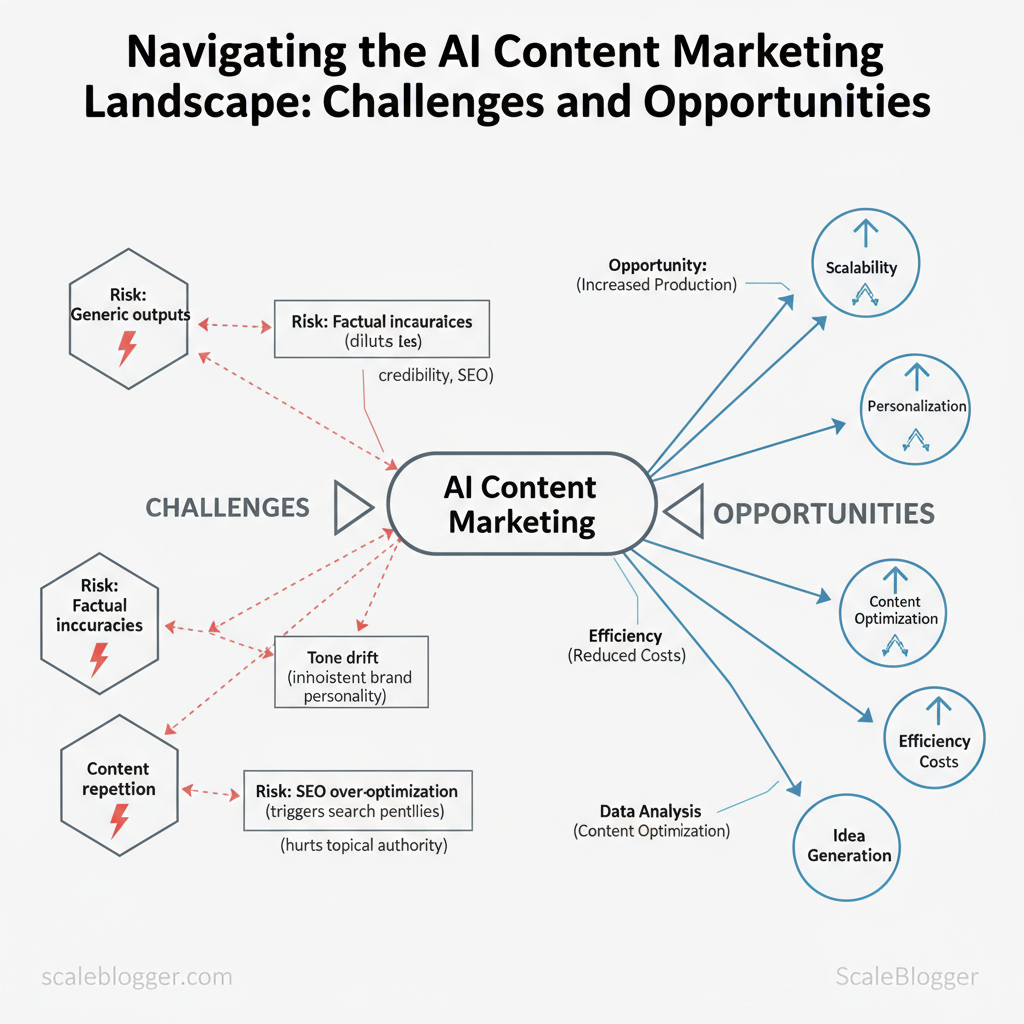
> Key Takeaway: ## Key Challenges in AI-Driven Content
AI can speed up production, but it also brings specific risks that could harm trust if not properly managed. AI models tend to use safe, high-probability phrases.
Key Challenges in AI-Driven Content
AI can speed up production, but it also brings specific risks that could harm trust if not properly managed. AI models tend to use safe, high-probability phrases. This results in generic, bland content that weakens brand differentiation. They also hallucinate facts or misattribute sources, creating factual inaccuracies that damage credibility and SEO performance.
Addressing these problems requires both process controls and editorial discipline.
Quality, Originality, and Brand Voice Risks
- Generic outputs: Models tend to use common patterns, resulting in copy that blends in with every other page. Watch for repeated sentence structures and catchphrases across posts. Factual inaccuracies: LLMs can invent details;
model_name-style outputs aren’t a substitute for primary sourcing.
Verify dates, numbers, and quotes. Tone drift: AI may fail to maintain your brand’s personality across formats; compare against brand voice guidelines for each asset. SEO over-optimization: Prompting for heavy keywords can produce keyword-stuffed content that triggers search penalties.
- Content repetition: When reusing prompts, articles may echo earlier pieces—hurts topical authority and internal linking.
> Industry analysis shows that content quality issues are the most common reason AI-generated pages fail to rank or convert.
Ethical, Legal, and Compliance Concerns
- Copyright risks: Models trained on public text can reproduce copyrighted phrasing; avoid verbatim lifts and run similarity checks. Attribution and IP: When content synthesizes third-party ideas, decide whether citation or permission is required. Regulatory exposure: In regulated verticals (health, finance, legal), unvetted claims can create liability—apply
human_signofffor any compliance-sensitive claim.
- Synthetic-media ethics: Deepfakes, AI images, or fabricated testimonials carry reputational risk; disclose synthetic assets where appropriate. Privacy and data handling: Feeding proprietary or PII into third-party APIs can violate contracts or laws; use on-prem or redaction.
Practical signals and controls to watch
- Run a
similaritycheck against internal corpus to detect repetition. 2.
Flag any numerical claims or named-source quotes for mandatory human review. 3. Use a brand voice checklist (3–5 attributes) during editing.
- Maintain an approvals matrix: content types → required reviewers/legal sign-offs.
Table: Section Content — Failure Mode, Likely Cause, Quick Remediation & more
| Failure Mode | Likely Cause | Quick Remediation | Monitoring Metric |
|---|---|---|---|
| Generic/vanilla content | Prompt/temperature defaults; over-reliance on templates | Add specificity to prompts; inject brand examples | Unique phrasing rate (%) |
| Factual inaccuracy | Model hallucination; no source verification | Fact-check pipeline; mark claims for review | Fact-check fail count |
| Tone mismatch with brand | Missing voice guidelines in prompts | Provide tone examples; enforce style checklist | Brand voice compliance (%) |
| Over-optimization for SEO (keyword stuffing) | Prompted emphasis on keywords | Rebalance prompts; use semantic keywords | Keyword density outliers |
| Repetition across articles | Reuse of prompts; no central content inventory | Centralize topic/asset index; diversify prompts | Duplicate content instances |
Understanding these principles helps teams move faster without sacrificing quality. When you pair automation with clear review gates and measurable metrics, AI becomes a force-multiplier rather than a liability.
> Key Takeaway: ## Opportunities AI Unlocks for Content Marketers
AI shifts the focus from “write more” to “write smarter. ” Teams can automate repetitive tasks in the content lifecycle.
Opportunities AI Unlocks for Content Marketers
AI shifts the focus from “write more” to “write smarter.” Teams can automate repetitive tasks in the content lifecycle. This frees up creators for strategy and impactful storytelling and allows for experiments that clarify what drives metrics. Two areas deliver the clearest, fastest value: efficiency at scale (from briefing to distribution) and deeper personalization that raises engagement.
Efficiency and Scale: From Drafting to Distribution
- Faster topic discovery — AI speeds up
keywordand trend scans so teams can validate ideas in hours instead of days. Draft generation — Models may produce first drafts, outlines, and meta content, potentially cutting initial writer time by approximately 40–70% in typical workflows. SEO automation — Automated headline testing, on-page suggestions, and schema generation improve indexability without manual tagging.
- Localization at scale — Machine translation + cultural tuning lets brands publish region-specific variants quickly. Automated distribution — Scheduling, A/B copy variations, and channel-specific formatting reduce operational overhead and keep cadence steady.
Personalization and Audience Targeting Practical metric improvements are common: Research from HubSpot shows that many teams see CTR lifts in the range of 10–30% after headline + CTA personalization and conversion uplifts of 5–15% when content aligns with CRM segments. ROI signals to watch: output-to-engagement ratios (content published vs. qualified leads), time-to-publish, and cost-per-conversion. Feature-availability matrix showing which workflow stages are typically automated and the typical outcome
CRM-driven content — Merge CRM attributes to tailor content for lifecycle stage, industry, or account value. Segmented recommendations — AI-driven recommendation engines increase time-on-site and downstream conversions.
Key insight: Automation reduces friction at the top and bottom of the funnel—ideas flow faster into drafts, and those drafts reach the right audiences faster. That combination enables safe experimentation and predictable scaling.*
Workflow Stage
Automation Example
Typical Outcome
Expected Impact (Low/Med/High)
Topic research
Trend scraping,
keyword clusteringFaster idea validation, prioritized briefs
High
Draft generation
Long-form draft + outlines
50–70% faster first drafts
High
SEO optimization
Automated meta, schema, internal linking suggestions
Improved indexability, faster QA
Med
Localization
Neural MT + tone adjustments
Multi-market variants with lower cost
Med
Distribution/scheduling
Channel-specific formatting, A/B copy scheduling
Consistent cadence, higher engagement
High
If you want to operationalize these gains, start by mapping time-intensive tasks and piloting small automation wins. When implemented well, AI-driven workflows let teams spend more time creating work that actually grows audiences and revenue.
Practical Governance and Workflow Strategies
When teams introduce AI into content production, governance must be clear. Define who makes decisions, how you’ll check outputs, and where automation stops and human judgment takes over. Define an editorial governance framework that assigns clear roles, enforces labeling and approval gates, and embeds launch and audit checklists so AI becomes a predictable part of the content pipeline rather than a black box.
Editorial Governance Essentials
- Editorial owner: Designate a single accountable person for topic strategy and final sign-off. AI operator: Trains prompts, manages templates, documents model versions. Fact-checker / SME: Verifies claims, sources, and technical accuracy.
- Legal reviewer: Flags IP, regulatory, and brand-risk items. Analytics owner: Tracks performance and feeds learnings back into the model prompts.
- Create approval gates:
draft -> AI-assisted edit -> human revision -> legal/SEO review -> publish. - Label AI-generated content clearly with a short disclosure and metadata tag (
ai_generated: true) to support audits. - Use a launch checklist that includes author, intent, keywords, source citations, image licenses, and publishing window.
> Industry analysis shows teams that define human checkpoints reduce factual errors and brand risk while keeping throughput high.
Quality assurance and measurement must be baked into the workflow. Track both content health and process health so improvements are measurable.
Quality Assurance & Measurement
readability score, factual accuracy rate, editorial error rate, user engagement (time on page, CTR). Performance metrics: organic traffic, ranking velocity, conversions attributed to content. Human-in-the-loop checkpoints: initial prompt review, pre-publish SME check, monthly content audits.
Testing methodologies: A/B test headlines and meta descriptions, experiment with content length/format, use holdout pages to measure lift.
Code snippet for a simple launch checklist template:
markdown - Title:
- Target keyword:
- AI prompt used:
- Sources cited:
- SME sign-off: [name/date]
- Legal clearance: [name/date]
- SEO check: completed (Y/N)
- Publish date:
Table: Section Content — Governance Element, Freelancer/Small Business, Medium Business & more
| Governance Element | Freelancer/Small Business | Medium Business | Enterprise |
|---|---|---|---|
| Editorial owner | Solo founder or editor (single person) | Content manager + rotating owners | Dedicated head of content + editorial councils |
| Fact-checking process | Self-checks, occasional SME hire | Internal reviewer team, freelance SMEs | Centralized QA team, third-party verification |
| Legal compliance review | Ad-hoc, external lawyer when needed ($/hr) | Standard checklist + Legal team liaison | Embedded legal review, compliance workflow, approvals |
| Tooling & automation | Off-the-shelf tools (ChatGPT free/paid) | Mid-tier tools (Jasper, SurferSEO) + automation scripts | Enterprise platforms, CMS integrations, CI/CD for content |
| Audit frequency | Quarterly personal review | Monthly audits + spot checks | Continuous monitoring, quarterly formal audits |
Understanding these principles helps teams move faster without sacrificing quality. When implemented correctly, this approach reduces overhead by making decisions at the team level.
Implementation Roadmap and Best Practices
Start by treating the next 90 days as an experiment: set precise objectives, limit scope, and instrument everything so decisions are data-driven. A focused pilot reduces risk while revealing whether automation and AI genuinely lift traffic, conversion, or efficiency.
90-day pilot timeline showing weeks, objectives, key tasks, and KPIs
| Week Range | Objective | Key Tasks | Success KPI |
|---|---|---|---|
| Weeks 1–2 | Align goals and baseline | Audit top 30 pages, set KPI targets, select tools, train team | Baseline traffic, avg. time on page, content scoring baseline |
| Weeks 3–6 | Create & publish pilot content | Produce 8–12 AI-assisted posts, metadata, schedule publishing | +10% organic sessions on pilot pages, CTR uplift |
| Weeks 7–10 | Measure, iterate, and expand formats | A/B headline tests, repurpose top post into newsletter/short-form, refine prompts | Improved avg. rank for target keywords, lower bounce rate |
| Weeks 11–12 | Consolidate learnings & decision checkpoint | Run ROI model, document workflows, train additional staff | Clear ROI signal (e.g., CAC↘ or LTV↗), decision to scale (Yes/No) |
| Post-pilot review | Plan scale and governance | Roadmap for 6–12 month rollout, governance rules, editorial guardrails | Template-ready processes, projected monthly content throughput |
Follow a practical sequence to execute:
- Define success criteria — set absolute and relative KPIs (traffic, conversions, time saved per article).
- Build small, repeatable workflows — content brief → AI draft → human edit → SEO pass → publish.
- Instrument and monitor — use analytics and
content scoringto compare human vs. AI-assisted outputs. - Decide with data — expand when KPIs show consistent week-over-week improvement.
Operational best practices and scaling signals
- Consistency signals to scale: sustained KPI improvement across 4+ weeks, decreasing edit time per draft, and stable brand voice scores.
- Staffing considerations: hire or reskill for roles in
prompt engineering, SEO editing, and analytics rather than only expanding writer headcount. - Tooling checklist: automation for scheduling, version control, SEO integrations, and a central content dashboard. Consider combining vendor tools with services like Scaleblogger.com to accelerate workflow automation and benchmarking.
- Maintain brand differentiation: lock in a voice guide, require a unique value proposition section in briefs, and keep a human-in-the-loop for all first drafts to preserve nuance.
- Continuous optimization: set weekly retros, rotate experiments (formats, CTAs), and run quarterly content refreshes.
yaml
Simple KPI template
pilot_start: 2025-01-01 target_pages: 12 kpis: organic_sessions: +10% avg_time_on_page: 20s_increase edit_time_per_article: -30% review cadence: weekly
Understanding these principles helps teams move faster without sacrificing quality. When implemented correctly, the roadmap makes it straightforward to decide whether to scale and how to keep your brand distinct as output grows.
Future Outlook and Strategic Recommendations
AI and automation will continue reshaping how teams plan, create, and measure content. Expect tools to move from assistance to orchestration: models will recommend topics, drafts, distribution windows, and even experiment designs. At the same time, regulatory scrutiny and platform policy changes will push teams to add provenance, human review, and stronger ethical guardrails.
Early movers will treat AI as a systems-level capability — not a single tool — and redesign processes around rapid, safe iteration.
Emerging trends to watch
- Orchestrated pipelines: Platforms that connect
topic discovery → draft generation → SEO scoring → schedulingwill reduce manual handoffs. Explainable outputs: Demand for traceability and edit-history will rise as compliance and trust concerns grow. Content personalization at scale: Dynamic templates and modular content blocks let teams serve multiple intents without rewriting.
- Policy-driven publishing: Content governance rules will be enforced programmatically (metadata flags, embargo controls). Human-in-the-loop oversight*: Editors will shift from line-editing to quality assurance, ethical review, and strategy.
Five strategic recommendations
- Run a controlled 90-day pilot — Limit scope to one vertical or campaign, measure lift vs baseline. Next step: define KPIs (organic traffic, time-to-publish, quality score) and select 8–12 test pieces.
- Implement editorial governance — Create
policy + approval matrixfor model use, citation, and revision. Next step: draft a one-page governance playbook and pilot with two editors.
- Invest in training & human oversight — Train editors on prompt design, model limitations, and bias detection. Next step: schedule two half-day workshops with hands-on prompts.
- Measure and iterate with experiments — Treat each change as an A/B test with defined metrics and sample sizes. Next step: run a cohort test comparing human-only vs AI-assisted workflows.
- Monitor legal and ethical developments — Assign a rotating owner to track platform TOS, copyright rulings, and data-privacy updates. Next step: subscribe to two policy update feeds and summarize monthly.
Prioritized recommendations with rationale and sample first steps
| Recommendation | Rationale | First Step | Expected Impact |
|---|---|---|---|
| Run a controlled 90-day pilot | Reduces risk, produces measurable ROI | Define KPIs + select 8–12 pieces | Faster validation; lower cost of failure |
| Implement editorial governance | Ensures compliance and brand safety | Create approval matrix document | Reduced legal risk; consistent quality |
| Invest in training & human oversight | Humans catch nuance and bias | Run prompt-design workshops | Higher content accuracy; trust maintained |
| Measure and iterate with experiments | Data-driven scaling avoids guesswork | Launch A/B tests on headlines/formats | Continuous improvement; lift detection |
| Monitor legal and ethical developments | Regulations evolve quickly | Assign policy owner + monthly digest | Proactive compliance; fewer surprises |
Understanding these principles helps teams move faster without sacrificing quality.
Conclusion
We covered how to stop firefighting content and start running a repeatable, measurable program: briefs, automate drafts, enforce a single brand voice, speed approvals, and measure impact. Teams that used automated templates and lightweight review gates saw faster turnaround and clearer ROI; Some evidence suggests that those changes may reduce revision cycles and boost publish velocity. For clarity, here are three practical takeaways to act on now:
- Standardize briefs: A short, mandatory brief cuts back-and-forth and aligns stakeholders quickly.
- Automate drafts and checks: Use automation for first drafts and editorial checks to free senior writers for strategy. – Measure what matters: Track lead signals tied to content, not just output metrics.
For a low-risk way to test this approach, start small with one channel and workflow to demonstrate its impact; for teams looking to automate these workflows and scale faster, start a pilot with Scaleblogger as a practical next step: Start a pilot with Scaleblogger.
