

Understanding how AI is transforming content distribution starts with a simple problem: great content can still fail if it doesn’t reach the right audience before attention moves elsewhere.
AI can turn one article into channel-ready content for social media, email, and repurposed posts while keeping the message consistent and natural.
The shift goes beyond speed. Strong content marketing strategies depend on delivering the right message through the right channel at the right time—and AI makes that coordination easier.
By improving reach with AI, content becomes more than a one-time publication. It becomes a reusable asset that can continue reaching new audiences long after it goes live.
Table of Contents
Quick Answer: AI content distribution works when you treat distribution like a measurable workflow—not a last-mile afterthought. Use AI to (1) translate each source asset into the formats and channel intent that fit best, (2) prioritize timing and cadence based on segment behavior, and (3) iterate using outcome quality (unique reach, real clicks, and assisted conversions), not raw volume. Keep human editorial judgment in the loop so brand voice and high-stakes claims stay accurate while the system improves your results over time.
What if your best content is already good enough, but it is reaching the wrong audience at the wrong time?
A strong article can still flop if it lands in the wrong feed at the wrong hour.
That’s the uncomfortable truth of modern content marketing: quality decides potential, but distribution decides who actually sees it.
AI content distribution matters here because it makes placement a decision (based on patterns) instead of a guess (based on vibes). It can also help you turn one asset into multiple channel-native versions—without forcing every variant to sound automated.
Most reach gets lost after publication, usually for one of four reasons:
- Weak channel matching: A blog post may be strong, but it underperforms if it never becomes the native format the platform rewards.
- Bad timing: Publishing once and hoping ignores when people scroll, click, and share.
- No repurposing loop: Teams stop at the article instead of feeding social, email, and lightweight follow-ups from the same core idea.
- No feedback loop: Without channel performance feeding back into the next distribution plan, the next post repeats the same mistake.
A practical AI workflow usually starts with the best-performing topics, then maps them to the formats and placements most aligned with audience intent. From there, AI can surface patterns in what earned attention—headline style, post length, hook type, and posting windows—so the next distribution decision is based on evidence, not instinct.
Good content still matters. But good placement, good timing, and repeatable distribution habits are often what separate a quiet post from one that keeps pulling in readers.
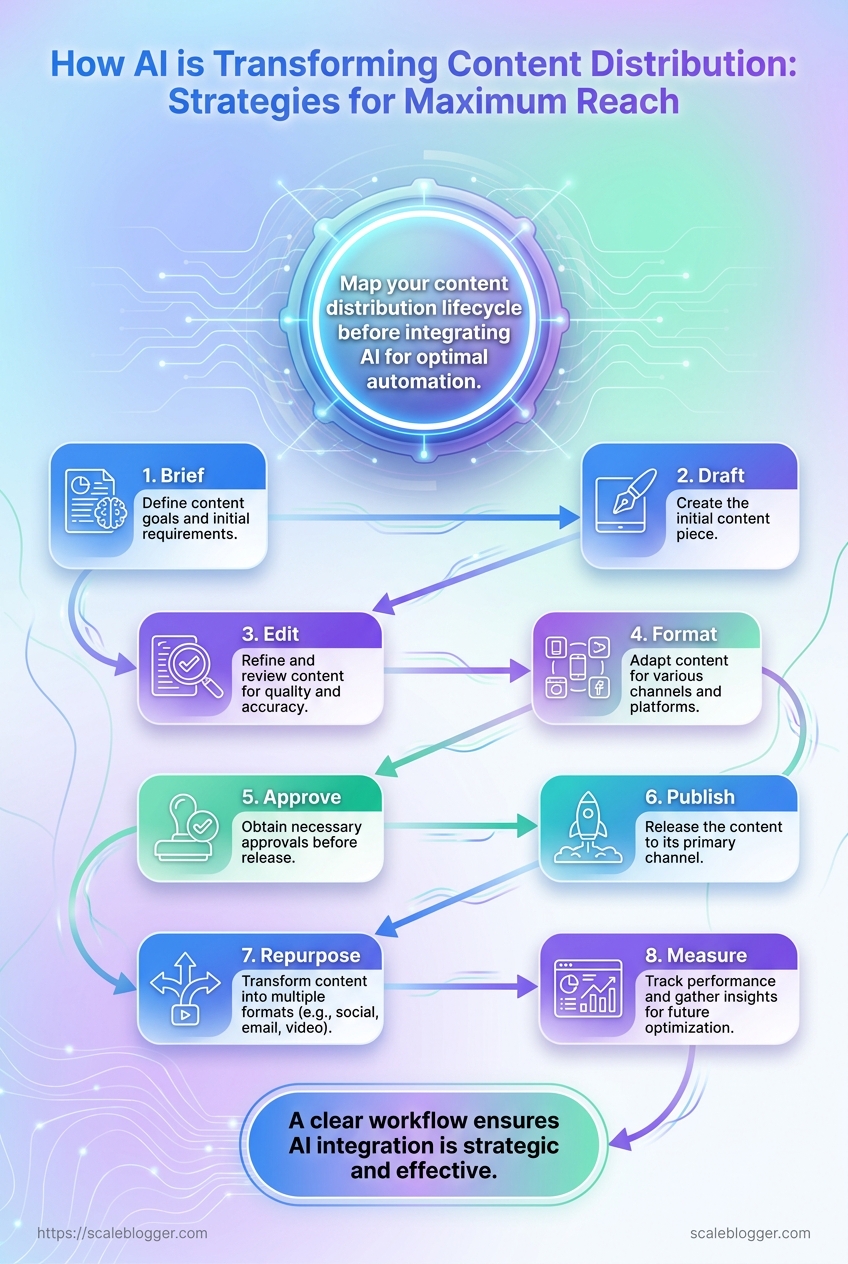
Map the distribution lifecycle before introducing AI
A blog post rarely fails at creation.
It usually breaks somewhere between the draft and the last channel it touches.
That’s why AI content distribution works best after you map the workflow first—before you automate anything.
Start with the path the asset actually follows: brief → draft → edit → format → approve → publish → repurpose → measure.
A single post can become an email snippet, a LinkedIn update, a short video script, or a newsletter block. Treating that repackaging as part of the lifecycle (not an afterthought) is what makes optimization possible.
The key question isn’t “where can AI help?” It’s “which decision happens at each stage, and who owns it?” AI is strongest when handoffs are visible and success metrics are already defined.
- Creation: Use AI to cluster topics, draft outlines, and flag missing angles.
Success looks like faster first drafts, not instant perfection.
- Approval: Use AI to score readability, SEO fit, and brand alignment before a human signs off.
This prevents weak assets from entering the pipeline.
- Channel formatting: Use AI to adapt the same core message for email, social, video captions, and CMS layouts.
- Delivery timing: Use AI to suggest publish windows based on past performance (by segment and channel), not generic charts.
- Measurement: Define baselines for:
- Reach (impressions, unique views)
- Engagement (clicks, saves, comments, dwell time)
- Conversion (sign-ups, demo requests, product clicks)
Without those three layers, optimizing reach with AI turns into busywork.
A clean lifecycle map makes later automation choices easier—and stops teams from asking AI to “fix” a process that was never defined.
Use AI to decide what content should go where
A webinar clip and a blog post should not fight for the same slot.
One needs speed and a strong hook; the other needs depth, search value, and enough context to earn trust.
AI gets useful when it reads the format, the channel, and the audience intent together.
That is where AI content distribution stops feeling random and starts behaving like a smart editor with a very tidy desk.
The cleanest way to think about it is in three buckets: evergreen, timely, and campaign-based assets.
Evergreen pieces belong on channels that keep paying off over time, timely pieces need fast-moving surfaces, and campaign assets work best when they travel as a set.
Research roundups in 2026 point in the same direction.
Guides like Best AI Marketing Tools for 2026 and AI marketing tools in 2026: complete guide for marketers both show AI being used for placement decisions, not just drafting.
A separate 2026 article on AI-powered content marketing strategies makes the same point across blog, email, video, and podcast workflows.
Where each format fits best
| Content format | Best-fit channels | AI recommendation use case | Primary engagement goal | Typical distribution risk |
|---|---|---|---|---|
| Blog post | Search, LinkedIn, email newsletter | Score for evergreen demand, then route into topic clusters and newsletter highlights | Search clicks, saves, and qualified visits | Pushing a thin post into too many channels at once |
| Short-form video | Reels, Shorts, TikTok, LinkedIn | Pull out the strongest hook, caption style, and first three seconds | Reach, recall, and quick follow-on clicks | Losing context when the clip stands alone |
| Email newsletter | Email, subscriber segments, retargeting feeds | Match the piece to lifecycle stage and past click behavior | Repeat visits and conversions | Sending the same message to every segment |
| LinkedIn post | LinkedIn, email teaser, repurposed quote card | Turn one insight into a point of view that invites comments | Conversation and professional visibility | Sounding generic after too much repackaging |
| Podcast clip | YouTube Shorts, LinkedIn, X, newsletter teaser | Detect a quotable moment and pair it with a clear title | Authority and watch-through | Using a clip with no standalone payoff |
| Webinar recap | Blog, email, LinkedIn, gated follow-up page | Decide whether it should become a recap, a campaign asset, or a lead magnet | Mid-funnel trust and registration lift | Publishing the full replay without a sharper cut |
Evergreen assets should usually get first pass to search, newsletters, and profile-led channels like LinkedIn.
Timely pieces need the opposite treatment: quick publication, short captions, and fewer hops between creation and posting.
Campaign assets sit in the middle.
They work better as a set, because AI can cluster them around one shared theme instead of treating each piece as a lonely file with a deadline.
A practical way to cluster is to group assets by problem, not by format.
For example, a “lead generation” theme might include a blog post, a webinar recap, three LinkedIn posts, and two email sends, all pointing at the same offer.
- Evergreen theme: group educational posts, FAQs, and comparison pieces around one lasting search topic.
- Timely theme: group reaction posts, trend commentary, and short clips around a date-sensitive angle.
- Campaign theme: group launch posts, nurture emails, and recap content around one conversion goal.
That same logic is how we handle prioritization inside Scaleblogger: the asset comes first, then the channel mix, then the theme it belongs to.
When those three line up, distribution stops wasting good content on the wrong job.
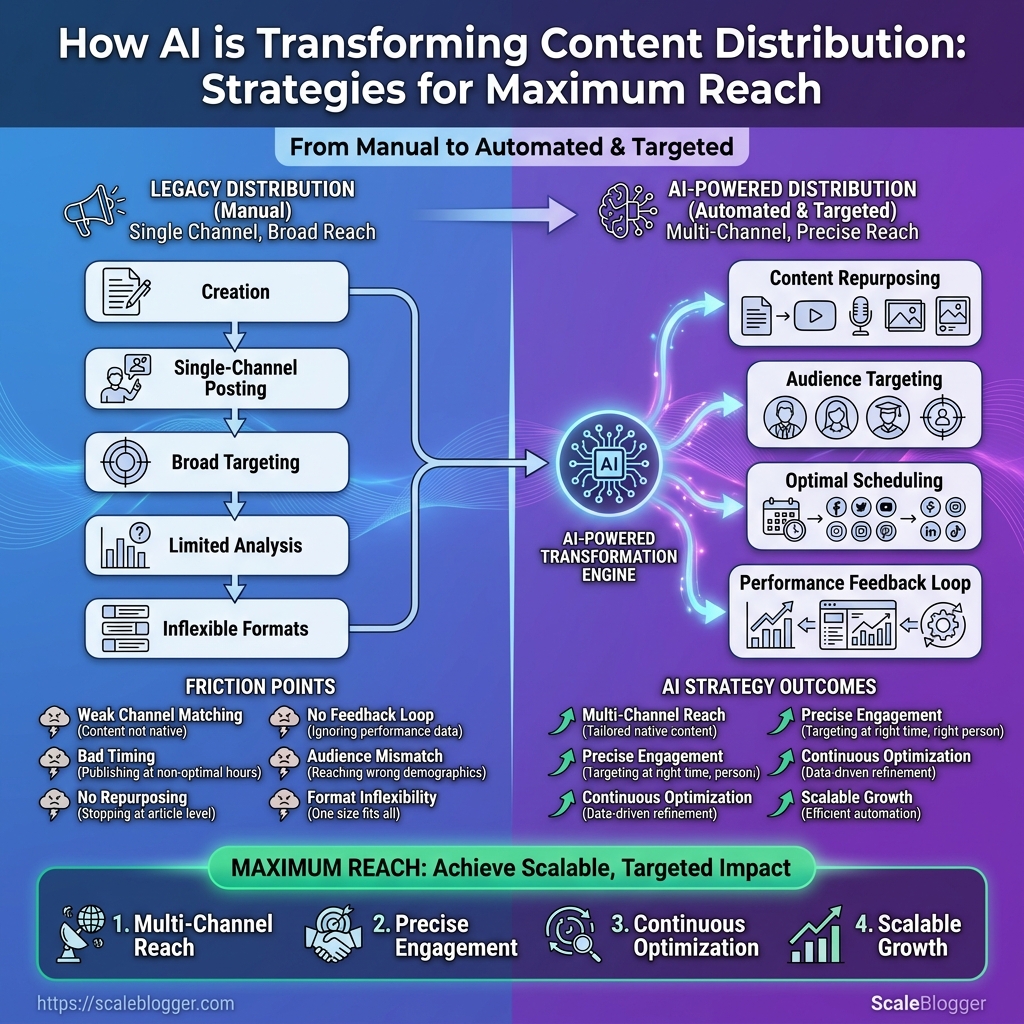
Apply AI to timing, cadence, and audience segmentation
A Tuesday morning send can outperform a Friday afternoon blast—by a mile.
The difference usually isn’t the content itself. It’s the match between audience behavior and the moment someone is actually ready to care.
Modern tools can read engagement history across channels. The practical output should be a cadence plan that differs by segment, not a single schedule applied to everyone.
At Scaleblogger, scheduling logic looks at timing and audience behavior together, not as separate chores. A high-intent reader, a casual browser, and a repeat engager should never receive the same cadence.
Find posting windows from real behavior
Stop guessing and start scoring past engagement.
Look for repeat patterns in opens, clicks, replies, saves, and dwell time—then compare them by channel.
- Start with the last 60–90 days. Enough data to spot patterns without being fooled by one-off spikes.
- Split by channel first. Email, LinkedIn, X, and blog distribution peak at different hours.
- Test one variable at a time. Change send hour before changing headline, topic, or format.
If a segment consistently clicks within the first two hours after posting, that window deserves more weight than generic “best time to post” charts.
Segment by intent, behavior, and content preference
A reader searching for a fix is not the same as someone casually browsing a feed.
Use AI to group people by signals instead of broad demographics.
- Intent: High-intent readers respond best to practical, direct content (tutorials, comparisons, product-aligned pages).
- Behavior: Repeat engagers can handle a faster cadence because they’ve already shown they want more from the same topic area.
- Preference: Some segments click text-heavy posts; others respond to video, carousels, or audio snippets.
Adjust frequency before fatigue shows up
Fatigue usually starts before unsubscribes.
Watch for slower clicks, weaker replies, and fewer repeat visits.
- Increase frequency for active segments—gradually—and note where engagement drops.
- Throttle passive segments—fewer touches, stronger relevance.
- Rotate formats—a burst of similar-looking posts gets ignored fast.
When timing, cadence, and segmentation work together, distribution stops guessing and starts behaving like a system.
Build repeatable repurposing systems for maximum reach
A single strong article should turn into a small content machine.
When one idea becomes a LinkedIn post, an email intro, a short script, and a FAQ snippet, AI content distribution stops feeling improvised and starts compounding.
That shift is showing up everywhere in 2026.
Guides like AI-powered content marketing strategies you must use in 2026 and Best AI Marketing Tools for 2026 both point to the same pattern: one content process can feed multiple formats without rebuilding the whole thing from scratch.
The real move is to make the workflow repeatable, not clever.
Every source asset needs the same path: extract, draft, edit, publish, then file the best-performing version for later.
Inside our workflow at Scaleblogger, the draft is never treated as finished until it has a channel-specific version and a brand pass.
Start with a variant map
A long-form piece works best when the source file is the master and everything else is a derivative.
- Pull the spine: isolate the main argument, a few proof points, and one clear next step.
- Create native formats: turn that spine into platform-fit versions, not copy-pastes.
- Write from the channel outward: LinkedIn wants a sharper opening, email wants one idea, and short video wants spoken rhythm.
- Store the rules: keep tone, length, and formatting notes in a shared template so the next round moves faster.
AI does the heavy lifting at the first draft stage.
Guides like AI marketing tools in 2026: complete guide for marketers and 32 AI Content Marketing Tools In 2026 show how current tools handle repetitive drafting across writing and video, which frees up time for the human edit.
Keep the quality gate ruthless
A repurposed piece still has to sound native.
If a thread reads like chopped blog paragraphs, the system has already slipped.
- Check the hook: the first line should fit the platform.
- Trim the proof: keep only the facts needed there.
- Match the CTA: ask for the next step that makes sense on that channel.
- Save the winner: anything that performs well becomes a reusable pattern.
Repeat that cycle weekly, and the library starts doing real work for you.
That is where optimizing reach with AI starts to feel calm instead of chaotic, because every new asset already knows where it is going.
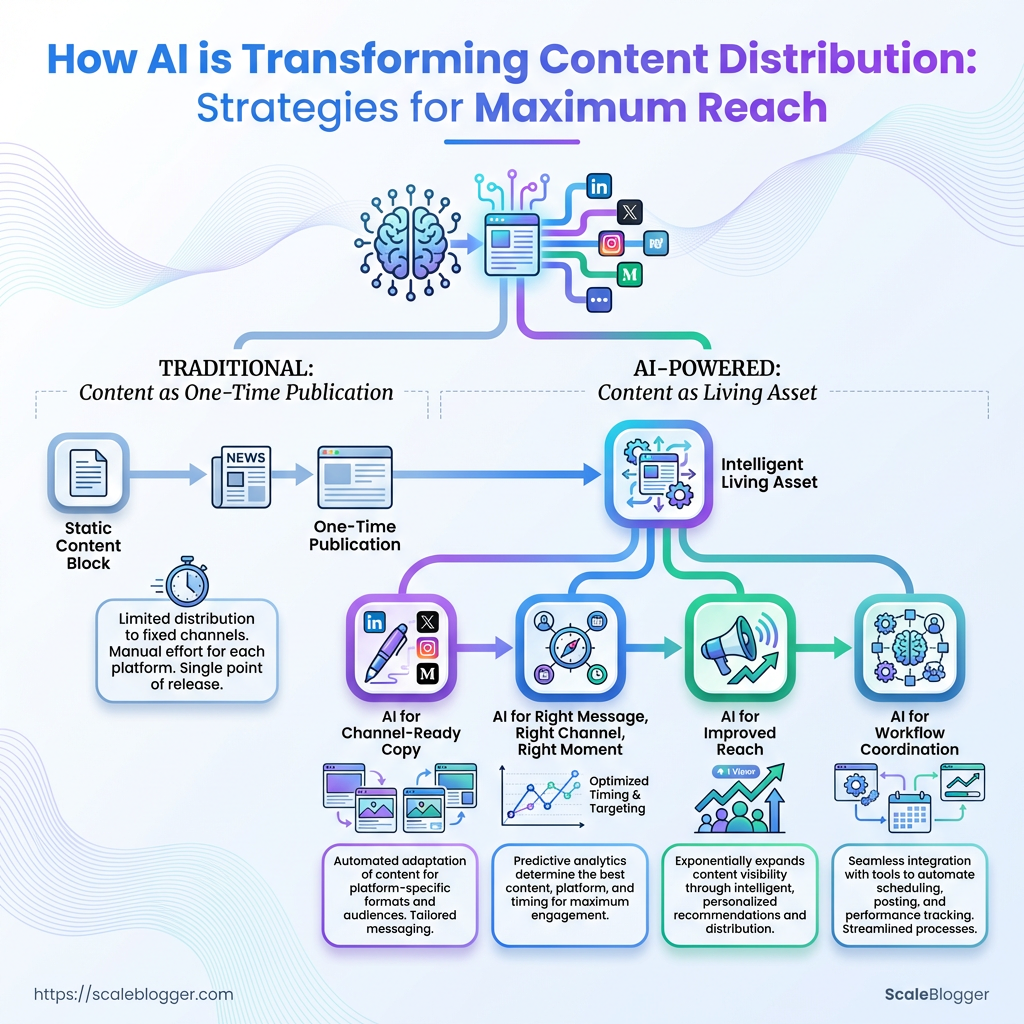
Choose the right AI tools for distribution work
A common mistake is asking one platform to do everything.
It drafts, schedules, analyzes, and repurposes—but usually does each job halfway.
That’s why a cleaner approach is to separate planning, writing, scheduling, and analysis into distinct roles.
Drafting tools are built for speed. Scheduling and analytics tools are built for consistency and feedback. Mixing those jobs tends to create tool sprawl and messy handoffs.
A practical way to compare the stack
| Tool | Primary function | Distribution strengths | Best use case | Notes |
|---|---|---|---|---|
| Scaleblogger | End-to-end content automation | Website analysis, topic clustering, AI drafting, CMS publishing, and social repurposing | Teams publishing SEO content at scale | Built for full pipeline control rather than single-task drafting |
| ChatGPT | General drafting and ideation | Fast outlines, caption variants, channel rewrites | Early-stage copy development | Best paired with a separate scheduler and analytics layer |
| Buffer AI | Social scheduling | Queue management, AI-assisted post creation, cross-platform publishing | Small teams with regular social output | Strong for publishing; lighter on deep reporting |
| Hootsuite | Social management and monitoring | Multi-account scheduling, inbox management, social analytics | Larger teams managing many channels | Better for governance and reporting |
| HubSpot | Marketing automation and CRM | Email workflows, audience segmentation, campaign tracking | Lifecycle distribution tied to leads | Useful when distribution connects directly to revenue |
| Jasper | Marketing copy generation | Brand-voice drafting and campaign variants | Teams producing promo copy fast | Strong creative support; not a native publishing system |
A useful rule: drafting tools should write, scheduling tools should publish, and analytics tools should judge performance.
When one platform tries to own all three jobs, quality usually drops somewhere.
Keep the stack tidy and you keep decisions tidy. That’s when AI content distribution becomes easier to manage over time.
Measure whether AI is increasing reach or just increasing activity
What if the extra output is only making the dashboard look busy? That happens more often than people admit.
A campaign can post faster, publish more variants, and still fail to reach new people or move revenue.
The fix is simple in concept and ruthless in practice: compare AI-assisted campaigns against a non-AI baseline, then score them on reach, engagement quality, and downstream actions.
That means looking past vanity activity and asking whether AI content distribution is actually expanding the audience or just multiplying posts.
The best way to do that is to track a small set of signals that tell one clean story.
- Reach: How many unique people saw the content, and whether that number rose after AI entered the workflow.
- CTR: Whether the headline, thumbnail, or snippet earned a real click, not just an impression.
- Watch time: Whether video or audio kept attention long enough to matter, which is a better test than views alone.
- Saves and shares: Whether people found the content worth keeping or passing along, which usually signals stronger content marketing strategies.
- Assisted conversions: Whether the content helped a later sign-up, demo, or purchase, even if it was not the final touch.
A good comparison needs matching conditions.
Use the same topic, similar audience, and a similar distribution window, then compare AI-assisted campaigns with earlier non-AI campaigns from the same channel set.
That keeps the test honest and gives you a cleaner read on optimizing reach with AI.
Sources that cover the current AI marketing stack, including content and analytics tooling, reinforce how quickly these workflows have become standard in 2026, which makes disciplined measurement even more important (Best AI Marketing Tools for 2026, AI marketing tools in 2026: complete guide for marketers, AI-powered content marketing strategies you must use in 2026).
Once the data is in, use a simple rule: repeat content that lifts reach and assisted conversions, revise content that earns engagement but weak clicks, and retire content that only inflates volume.
That keeps AI tied to outcomes instead of motion.
The strongest teams do not ask whether AI made more content.
They ask whether it made better distribution decisions, and the numbers answer fast.
Reduce common risks when AI enters the distribution process
A polished draft can still go sideways once AI starts pushing it across channels.
The usual failure points are boring but expensive: a brand voice that turns stiff, personalization that feels fake, and a message that looks fine on one platform but lands awkwardly on another.
That risk rises fast when teams chase volume.
The safest teams treat AI content distribution like a quality-control job, not a firehose.
- Protect brand voice: Maintain a channel-by-channel style sheet (tone, forbidden phrases, and formatting rules). Check AI output against it before anything ships.
- Spot weak personalization: Look for duplicate openings, generic pain points, and segment copy that could fit anyone.
- Match the platform: Rewrite for format, length, and context instead of pasting the same message into every channel.
Human review matters most when the stakes are high.
A product launch, a pricing change, a legal update, or a crisis response should never depend on automated publishing alone.
In those moments, one careful reviewer can catch a claim that overreaches, a phrase that sounds wrong, or a timing mistake AI may miss.
We keep the machine busy with repeatable work, then keep people in charge of judgment, nuance, and final approval.
That mix protects content marketing strategies while still enabling optimizing reach with AI.
Make Distribution Work as Hard as the Draft
The real shift is simple: strong content fails when distribution is vague, late, or too manual.
Once AI starts handling content marketing strategies across channels, you stop guessing where each piece belongs and start matching the message to the moment.
That is where AI content distribution earns its keep, especially when the same article can become a LinkedIn post, a short video script, and a newsletter snippet without losing its point.
The example that matters most is the repurposing loop.
A single post should not live and die on one publish date; it should travel through timing, format, and audience segments until the reach starts to compound.
That is the heart of optimizing reach with AI, and it is also where our automated scheduling and repurposing workflow fits naturally when teams want less busywork and more consistent visibility.
Audit one underperforming post today. Pick a piece that had solid substance but weak reach, map where it stalled, and choose two new distribution formats for the next seven days.
If you do that once, the next round of decisions gets much easier, and your content starts acting less like a one-off post and more like a system.
