

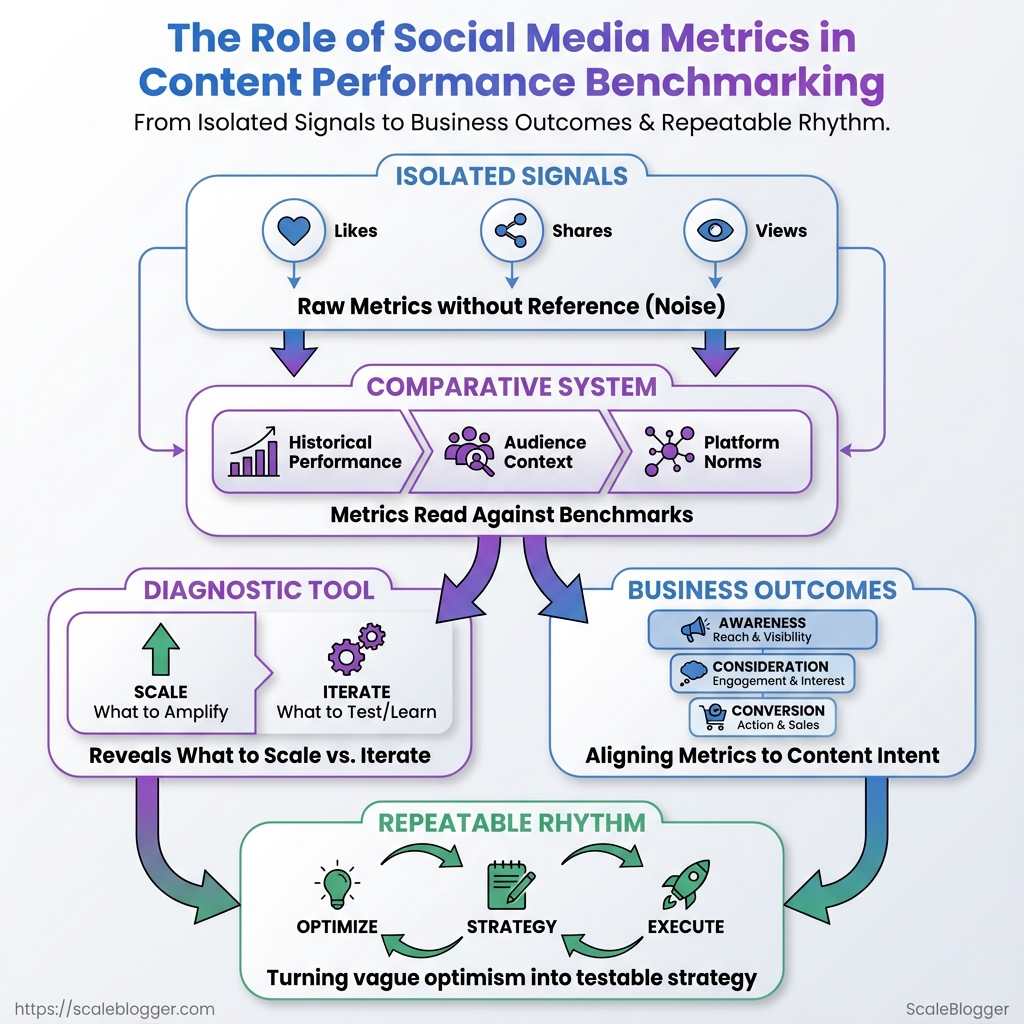
The role of social media metrics in content performance benchmarking is to show whether likes, shares, clicks, reach, and engagement actually translate into meaningful content results.
Looking at these numbers individually can be misleading. Effective content performance benchmarking compares social media results over time and connects them to audience behavior and business goals.
Instead of treating high impressions or likes as automatic success, teams can use social media metrics to identify which content performs best, what needs improvement, and what is worth scaling.
With clear benchmarks, social data becomes more than numbers—it becomes a practical guide for better content decisions.
What Is Social Media Metrics in Benchmarking?
Social media metrics are clear signals that benchmark your content performance against past results, competitors, or industry standards. Think of them as dashboard instruments.
Some metrics show how many people saw a post, others indicate whether those people took action, and a few show how your brand is viewed over time. Benchmarking means placing those signals next to relevant comparators—your previous month, a competitor set, or an industry average—to see where strategy wins or leaks.
Social media metrics: Quantitative measures that track performance across networks, such as impressions, clicks, shares, conversions, and follower growth.
Vanity metrics: Surface-level counts like raw follower totals or total likes that look impressive but often fail to link to business outcomes.
Meaningful metrics: Metrics that tie to objectives—CTR, conversion rate, cost-per-acquisition, and retention rate—which reveal whether content produces value, not just attention.
Useful distinctions and examples:
- When vanity metrics help: Use follower growth or like counts early in awareness campaigns to gauge reach or initial momentum.
- When meaningful metrics matter: Prioritize engagement rate, click-through rate, and conversion metrics for campaigns tied to lead generation, sales, or content performance.
- How benchmarking works: Compare a campaign’s
CTRagainst historical averages or competitorCTRto evaluate creative or targeting effectiveness.
Side-by-side comparison of common metric categories (reach, engagement, conversion, retention) to show what each reveals about content performance
Table: What Is Social Media Metrics in Benchmarking? — Metric Category, Key Metrics, What it indicates & more
| Metric Category | Key Metrics | What it indicates | When to prioritize |
|---|---|---|---|
| Reach | Impressions, unique reach, CPM | How many people saw the content and cost to reach them | Awareness campaigns, new-product launches |
| Engagement | Likes, comments, shares, engagement rate | Content resonance and active interaction level | Community building, content testing |
| Conversion | Click-through rate (CTR), form completions, purchases | Ability to drive actions tied to business goals | Lead gen, ecommerce, campaign ROI |
| Retention | Repeat visits, subscription renewals, churn rate | Long-term value and audience loyalty | Memberships, SaaS, subscription models |
| Sentiment/Brand Lift | Mention sentiment, brand recall lift, NPS | Perception shifts and brand health | Rebranding, crisis management, brand campaigns |
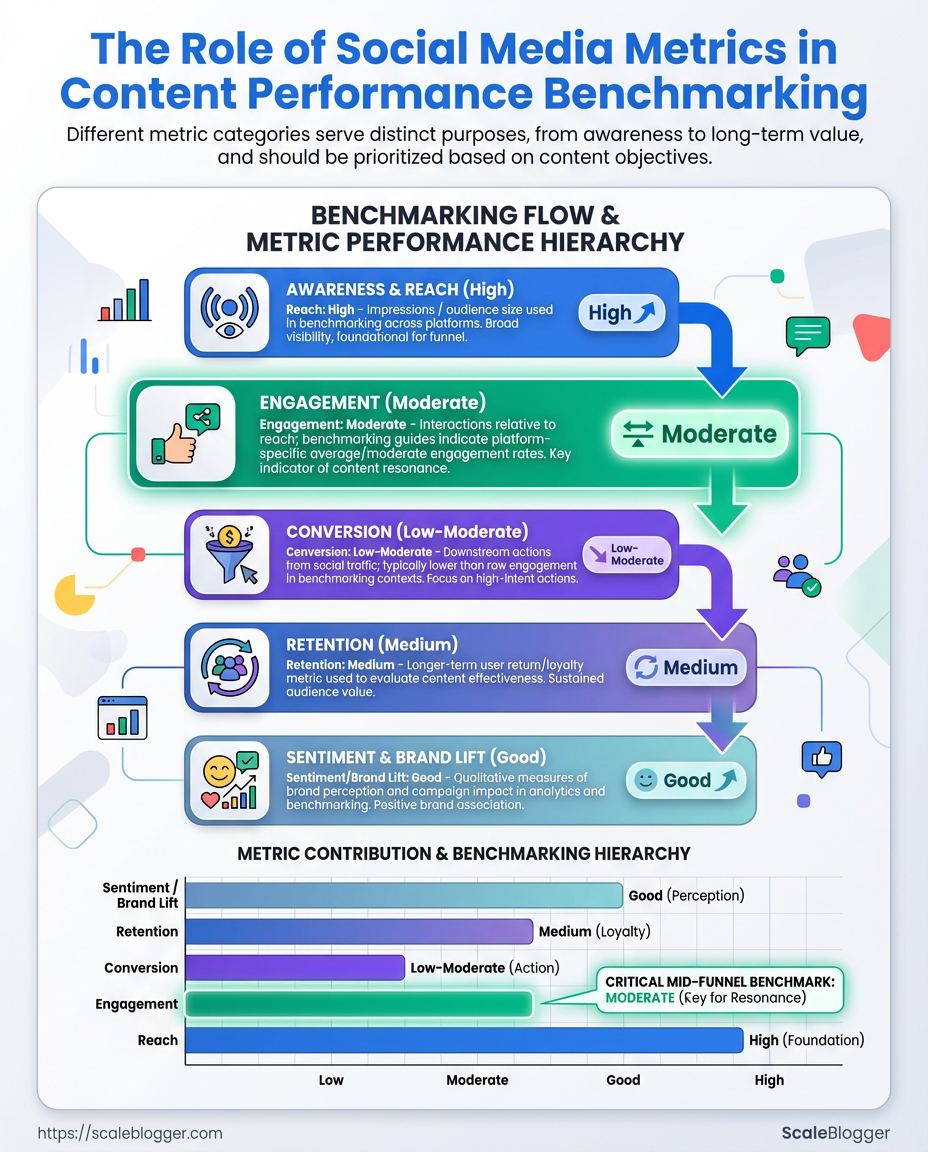
Key insight: This layout shows which metrics reveal short-term visibility versus long-term business impact. Benchmarks should match the metric to the objective—use reach and sentiment for awareness, engagement for resonance, conversions for ROI, and retention for lifetime value.
Tracking the right metrics makes benchmarking a diagnostic tool rather than a scoreboard. When metrics map to goals, benchmarking becomes a fast way to decide what to scale, pause, or.How Does It Work? Mechanisms Behind Metrics and Benchmarks
Metrics come from complicated…
How Does It Work? Mechanisms Behind Metrics and Benchmarks
Metrics come from complex pipelines that must be organized before you can perform effective benchmarking. First, data is collected from platform sources. Then, it is cleaned and organized before being compared with benchmarks to turn numbers into useful decisions.
This pipeline shows whether a report of ‘100 likes’ reflects real growth or is just an artifact of reporting.
Data pipeline: collection, cleaning, and normalization
- Collect raw signals.
- Pull from platform native analytics (e.g.,
Meta Business,X/Twitter Analytics,TikTok Insights). - Ingest third-party dashboards and social listening exports.
- Capture event-level data via UTM-tagged links into
GA4or other web analytics. - Clean the data.
- Remove duplicates, correct timezone offsets, and reconcile user/session definitions.
- Fix common issues like missing UTMs, truncated text fields, or bot traffic spikes.
- Normalize for comparison.
- Map metrics into consistent units (e.g., impressions/day, engagement rate as percent).
- Apply sampling adjustments or weight by audience size when combining platform and server logs.
Common data quality issues and fixes
- Missing UTM tags: Leads to misattributed traffic; enforce template-based link creation.
- Timezone drift: Causes daily aggregates to misalign; normalize everything to UTC.
- Platform sampling: Estimate and backfill using platform-provided sampling ratios.
- Duplicate events: De-dupe on event ID and timestamp windows.
Summarize data sources, pros/cons, and best-use cases for each (native analytics, third-party tools, direct tracking)
Table: How Does It Work? Mechanisms Behind Metrics and Benchmarks — Data Source, Pros, Cons & more
| Data Source | Pros | Cons | Best Use Case |
|---|---|---|---|
| Platform native analytics | Accurate engagement metrics, platform-specific dimensions | Limited export flexibility, metric definitions vary | Quick channel diagnostics |
| Third-party social dashboards | Unified view, cross-channel reporting, scheduled reports | Costly, sometimes delayed data | Executive reporting, trend spotting |
UTM + Google Analytics (GA4) | Session-level attribution, full-funnel view | Requires disciplined tagging, sampling risk | Campaign ROI and conversion tracking |
| Social listening tools | Sentiment, share-of-voice, unstructured mentions | Noise, false positives, API limits | Brand health and crisis detection |
| Platform APIs (raw data) | Full granularity, programmatic access, customizable | Requires engineering, rate limits | Custom pipelines and ML models |
Key insight: Consolidating these sources fixes attribution gaps and reveals which channels truly move conversion metrics, not just vanity counts.
Benchmarking methods: absolute vs. relative benchmarks
Absolute benchmark: A fixed target or KPI (e.g., 2% monthly engagement growth). Relative benchmark: Comparison against peers, percentiles, or historical cohorts (e.g., top 25% in your sector).
Benchmarking methods, listing pros/cons and ideal scenarios
Table: How Does It Work? Mechanisms Behind Metrics and Benchmarks — Method, How it works, Pros & more
| Method | How it works | Pros | Best scenario |
|---|---|---|---|
| Historical baseline | Compare today to past periods | Easy, context-aware | Seasonal businesses |
| Percentile benchmarking | Position metric within peer distribution | Shows competitive standing | Market-positioning analysis |
| Competitive benchmarking | Compare against named competitors | Actionable market gaps | Product feature and creative testing |
| Cohort analysis | Group users/posts by start date or behavior | Reveals retention and lifecycle effects | Content lifecycle and audience segments |
| Rolling average/trendline | Smooths noise with moving windows | Reduces false positives | Short-term campaign monitoring |
Key insight: Use absolute targets for operational goals and relative methods to understand competitive performance; combine percentiles, z-scores, or moving averages to reduce noise and highlight real shifts.
Practical tips on windows and cohorts
- Use 30–90 day windows for general content performance to even out daily volatility.
- Apply weekly windows for high-frequency paid campaigns.
- Define cohorts by publish week, audience source, or campaign UTM to ensure apples-to-apples comparisons.
Putting the pieces together—reliable benchmarks start with clean, normalized data and a deliberate choice between target-driven or peer-driven comparisons. That clarity makes metric-driven decisions repeatable and defensible.
Key Metrics to Track for Content Performance
Begin by separating your goals into awareness, engagement, and conversion. Each group answers a different question about how your content influences the audience. Track the right metric for the job: awareness metrics tell whether content is being seen, engagement metrics reveal if it’s resonating, and conversion metrics prove business impact.
Below are the definitions, how to calculate them, and practical notes on interpretation and benchmarking.
Awareness and distribution metrics
| Metric | How to calculate | What it shows | Sample benchmark range |
|---|---|---|---|
| Impressions | Count of times content was displayed | Reach of content across platforms | 10k–1M+ impressions/month depending on audience size |
| Reach | Unique users who saw the content | Breadth of audience exposure | 5k–500k unique viewers/month |
| Share of voice | brand mentions / total category mentions | Market visibility vs competitors | 5%–40% depending on niche competitiveness |
| Follower growth | (new followers / starting followers) 100 | Momentum of audience growth | According to Hootsuite, 1%–8% monthly for active programs |
| Branded search lift | % increase in branded searches | Awareness converting to intent | Recent research indicates 5%–30% after major campaigns |
Key insight: Awareness metrics set the ceiling for everything downstream — if impressions and reach are low, engagement and conversion will be constrained. Benchmarks vary widely by industry and spend.*
Engagement metrics and formulas
Table: Key Metrics to Track for Content Performance — Formula, Denominator, Best for & more
| Formula | Denominator | Best for | Interpretation notes |
|---|---|---|---|
| Engagements / Impressions | Impressions | Paid and organic where visibility fluctuates | Useful for creative testing when distribution shifts |
| Engagements / Reach | Reach | True interaction rate among people who saw it | More stable than impressions-based rate for organic posts |
| Engagements / Followers | Follower count | Channel health and audience loyalty | Good for long-term account benchmarking |
| Clicks / Impressions (CTR) | Impressions | Measuring content that drives traffic | Best for conversion-focused posts and ads |
| Shares per post | N/A (average per post) | Viral potential and advocacy | High shares indicate content with network effects |
Interpretation tip: denominators change the story — engagements/reach rewards content that resonates deeply with those who see it, while engagements/impressions is sensitive to paid boosts.
Conversion and downstream impact metrics
Table: Key Metrics to Track for Content Performance — Attribution Model, How it allocates credit, Pros & more
| Attribution Model | How it allocates credit | Pros | Best use case |
|---|---|---|---|
| Last-click | 100% to final touch | Simple, stable | Direct-response campaigns |
| First-click | 100% to first touch | Shows top-of-funnel influence | New audience acquisition analysis |
| Linear | Equal credit across touches | Fair distributed view | Multi-touch nurture programs |
| Time-decay | More credit to recent touches | Emphasizes recent influence | Short purchase cycles |
| Position-based | 40/20/40 split (first/ middle/ last) | Balances discovery and conversion | Complex journeys with clear entry/exit points |
Practical setup: use UTMs for every social link, capture utm_source, utm_medium, utm_campaign, and decide whether to rely on last-click or a multi-touch model in your reporting. Typical attribution windows range from 7 to 90 days — shorter windows suit impulse purchases; longer windows are needed for B2B or high-consideration buys. Convert engagement into outcomes by mapping micro-conversions (email signups, content downloads) to macro outcomes (revenue, LTV) and reporting lift by cohort.
Tracking these metrics consistently makes performance predictable and actionable — when numbers are reliable, decisions about content topics, format, and distribution stop being guesses and start becoming repeatable experiments.
Why It Matters: Business Impact & Use Cases
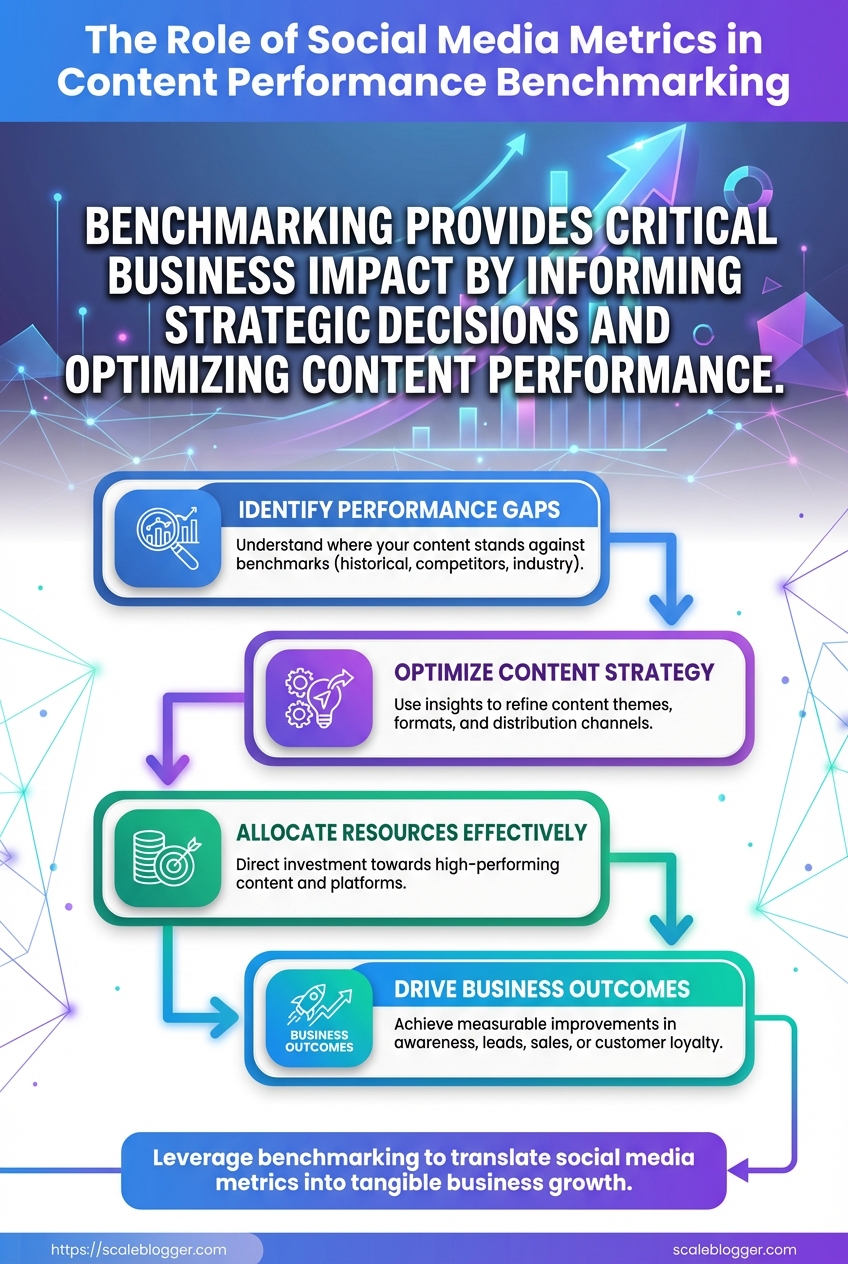
Improving your content strategy is crucial — it directly impacts traffic, conversions, and brand perception. When benchmarks direct which formats and schedules to test, marketing teams waste less budget on guessing and spend more time improving clear winners. Competitive benchmarking exposes where competitors are investing attention and where there’s low-hanging opportunity: a content gap, an under-served audience segment, or a distribution channel your brand can own.
Use case: optimizing content mix and cadence
Benchmarks form the hypotheses you test. Start by measuring current engagement rate, reach, and conversion per post over a representative baseline period (4–6 weeks). Then design experiments that change one variable at a time: format, publish day, or CTA placement.
- Hypothesis framing: State a measurable expectation — e.g., According to Hootsuite, short-form video will increase social engagement by 20% versus image posts.
- Experiment design basics: Randomize audiences where possible, run A/B variants, and keep creative elements consistent across variants.
- Typical test durations: Run social tests at least 2–3 content cycles per variant; for paid amplification, expect 7–14 days to stabilize.
- Sample size guidance: For high-variance social metrics, aim for 500–1,000 impressions per variant before drawing conclusions; for conversion-focused tests, use standard statistical calculators to target power (commonly 80%).
- Evaluation checkpoints: Predefine interim checks (week 2, week 4) and a final analysis endpoint tied to primary KPI.
A sample 8-week experiment timeline with activities, KPIs, and evaluation checkpoints
Table: Why It Matters: Business Impact & Use Cases — Week, Activity, Primary KPI & more
| Week | Activity | Primary KPI | Success criteria |
|---|---|---|---|
| Week 1 | Baseline collection (current mix) | Engagement rate, Reach | Stable baseline over 7 days; no major campaign overlaps |
| Week 2-3 | Test variant A (short videos) | Video view rate, Eng. rate | +15% engagement vs baseline across two cycles |
| Week 4-5 | Test variant B (carousel posts) | Click-through rate | CTR > variant A by 10% with similar reach |
| Week 6 | Consolidation (best creative + timing) | Engagement and CTR combined | Composite score improvement ≥12% |
| Week 7-8 | Scaling/rollout (paid boost + republishing) | Conversions per click | Conversion rate sustains or improves by 5% |
Key insight: Running time-boxed experiments with clear KPIs reduces decision noise. This 8-week timeline balances speed with statistical reliability and ties creative decisions to measurable outcomes.
Use case: competitive benchmarking and market positioning
Competitive benchmarking transforms raw follower counts into strategic actions by normalizing and prioritizing opportunities.
- Identify peer accounts
- Collect public metrics
- Normalize by audience size
- Analyze content themes
- Prioritize opportunities
Identify peer accounts: Choose direct competitors, aspirational brands, and top creators in your niche.
Collect public metrics: Capture follower counts, posting cadence, top-performing posts, and estimated engagement percentages.
Normalize by audience size: Convert raw likes/comments into engagement rate per 1k followers or engagement_per_1k = (likes+comments)/followers1000 to compare apples-to-apples.
Analyze content themes: Tag posts by topic, format, and intent (educational, product, community).
Prioritize opportunities: Rank gaps by impact and effort — e.g., untapped topic with high search intent and low content supply is high priority.
Checklist table for competitive benchmarking with actions and tools
Table: Why It Matters: Business Impact & Use Cases — Step, Action, Recommended tools & more
| Step | Action | Recommended tools | Outcome |
|---|---|---|---|
| Identify peer accounts | Select 8–12 peers across tiers | Brandwatch, native platform search | Balanced peer set for comparison |
| Collect public metrics | Export post-level data for 90 days | Hootsuite, Sprout Social | Dataset for normalization |
| Normalize by audience size | Compute engagement per 1k followers | Excel, Google Sheets, Python | Comparable performance metrics |
| Analyze content themes | Topic modeling and tagging | Airtable, Notion, manual review | Theme frequency and performance |
| Prioritize opportunities | Score gaps by impact/effort | RICE matrix in Google Sheets | Ranked action list for content roadmap |
Key insight: Normalization makes competitor data actionable — it turns raw numbers into prioritized playbooks rather than vanity comparisons.*
Translating gaps into strategy
Start small: pick one high-priority gap, design an 8-week experiment (use the table above), and commit to objective evaluation. Tools like Scaleblogger.com can automate parts of this pipeline — from topic clustering to performance benchmarking — if teams want to accelerate setup without rebuilding dashboards from scratch.
Run the first cycle quickly, learn as you go, and scale what improves business outcomes. That pragmatic loop — benchmark, test, normalize, act — is how content shifts from activities to measurable growth.
Common Misconceptions and Pitfalls
Many teams believe social metrics are either magical or meaningless, but the truth lies somewhere in between. Misunderstanding what metrics actually measure leads to wasted effort, bad content choices, and confusing reports. Below are the top myths, why they stick, what they cost you, and immediate fixes to steer performance back toward business outcomes.
Myth 1: More followers = more success Followers are vanity, not performance. A large audience that doesn’t engage or convert inflates perceived reach but delivers little ROI. This often originates from early social platforms rewarding growth metrics publicly.
Real-world impact: Campaigns aimed at follower growth can cannibalize budget that should target conversion-ready audiences. Corrective actions:
- Define business objectives tied to social (brand awareness, lead gen, revenue).
- Shift targets to engagement and conversion metrics aligned with those objectives.
Myth 2: High impressions mean content is effective Impressions show visibility but not attention or intent. Impressions rise with frequency or paid reach, not quality.
Real-world impact: Teams for frequency and paid placements instead of message testing, producing diminishing returns. Corrective actions:
- Track
engagement_rateand time-on-content alongside impressions. - A/B test headlines and thumbnails to improve attention signals.
Myth 3: All engagements are equal A like isn’t the same as a comment or share. Treating them interchangeably obscures audience sentiment and intent.
Real-world impact: Misguided content that chases likes fails to build community or drive action. Corrective actions:
- Weight interactions: shares > comments > saves > likes for organic reach and intent.
- Use qualitative sampling of comments to surface objections or interest drivers.
Myth 4: Benchmarking only requires industry averages Benchmarks without context (channel, audience, content type) are misleading. Industry averages mask niches and campaign specifics.
Real-world impact: Incorrect targets lead to false positives/negatives in performance reviews. Corrective actions:
- Create segmented benchmarks by channel and content format.
- Use a content performance framework to normalize across formats—consider tools that predict performance and automate comparisons.
Practical next steps: map each social metric to a specific business outcome, give engagement types different values, and build segmented benchmarks. A small shift from vanity to outcome-driven measurement changes strategy and budget decisions quickly, producing clearer wins and smarter content investment.
Metrics before and after attribution changes to highlight the effect on perceived performance
Table: Real-World Examples and Case Studies — Metric, Before (old attribution), After (new attribution) & more
| Metric | Before (old attribution) | After (new attribution) | Interpretation |
|---|---|---|---|
| Attributed conversions | 4,800 | 6,200 | Multi-touch credited more sources, total conversions rose |
| ROAS | 6.2 | 4.8 | Single-channel ROAS drops, overall profitability clearer |
| Assisted conversions | 180 | 1,150 | Upper-funnel channels shown to drive purchases |
| Average order value | $62 | $64 | Minor lift after personalized follow-ups |
| Cost per conversion | $24 | $20 | Smarter allocation reduced acquisition cost |
After switching to multi-touch, the marketing team shifted spend from a few high-ROAS channels to include more upper-funnel programs that were driving assisted conversions. That reallocation reduced short-term ROAS but increased total revenue and lowered cost per conversion.
combining this kind of attribution work with an AI-powered content pipeline — for example, using Scaleblogger.com to automate consistent UTM-tagged content and publish cadence — accelerates insights and reduces manual errors. These two case studies show that measurement choices change not just reports, but real budget decisions and growth outcomes.
Actionable Next Steps and Checklist
Start by committing to a tight learning loop: set measurable early experiments, assign clear owners, and focus on rapid data collection rather than perfection. The next 90 days should deliver a reliable baseline for content performance, a few validated tests that move metrics, and a repeatable publishing pipeline. Below are the concrete tasks, tooling suggestions, and evaluation criteria to get from noise to signal.
- Define measurement baseline: Capture current traffic, engagement, and conversion metrics for priority content.
- Assign ownership: Give each pillar topic a single owner responsible for planning, publishing, and measurement.
- Run targeted experiments: Test headlines, content length, distribution channels, or CTAs in controlled batches.
- Automate repeatable steps: Use automation to schedule, publish, and collect performance data.
- Review and scale: Promote winning variants and bake learnings into templates.
Suggested minimal tooling set:
- Analytics:
GA4for traffic and conversion signals, plus native platform analytics for social metrics. Performance tracker: lightweight dashboard (sheet or BI tool) tracking impressions, sessions, CTR, and conversions. Content ops: editorial calendar with automation (scheduling + publishing). - SEO/IDEA: keyword research and SERP intent tool. Experimentation: simple A/B testing framework or UTM conventions for tracking variants.
Lay out the 30/60/90 day plan as a task timeline with owners and success criteria
Table: Actionable Next Steps and Checklist — Timeframe, Task, Owner & more
| Timeframe | Task | Owner | Success criteria |
|---|---|---|---|
| Days 1-7 | Data audit: traffic, conversions, content inventory | Analytics lead | Baseline dashboard created; missing tracking fixed |
| Weeks 2-4 | Baseline benchmark & prioritization | Content strategist | Top 3 pillar topics prioritized with owners |
| Weeks 5-8 | Run tests: headlines, meta, distribution | Topic owners | 4+ experiments completed; clear winners by uplift |
| Month 3 | Scale winners and automate publishing | Ops lead | 2x weekly publishing automated; 10-20% metric lift on winners |
| Ongoing | Monthly review & optimization | Cross-functional team | Monthly report, updated backlog, repeatable playbook |
Key insight: This timeline forces a rhythm—audit, benchmark, test, then scale—so decisions are data-driven and ownership is clear. Early wins come from small experiments; scaling amplifies impact once success criteria are met.*
How to evaluate early success:
- Short-term: measurable uplift in CTR or sessions for test pages within two weeks.
- Mid-term: improved engagement (time on page, reduced bounce) across prioritized topics.
- Operational: automated publishing and a single source-of-truth dashboard owned by a role.
For teams wanting automation built-in, consider integrating an AI content workflow like AI-powered content automation to speed up the publish-test-scale loop. This approach turns ambiguity into actionable data, so each iteration improves both content and process.
For practical next steps, pick three outcomes to track, set baseline benchmarks, and automate recurring reports so insights land in the hands of decision makers, not spreadsheets. To that process, platforms like See how Scaleblogger automates content performance tracking can handle data pulls, visualizations, and alerts — a useful option for teams looking to scale benchmarking without hiring a data team. If the work feels overwhelming, start by exporting one channel’s monthly report and comparing it to last quarter; that small habit surfaces the patterns that turn metrics into momentum.
