

What happens when storytelling goes beyond one format and flows between text, audio, video, and interactive interfaces? Many teams treat format mixing as a creative afterthought, then wonder why audience engagement fragments and production costs spike. Multi-modal content needs careful planning, not just random repurposing.
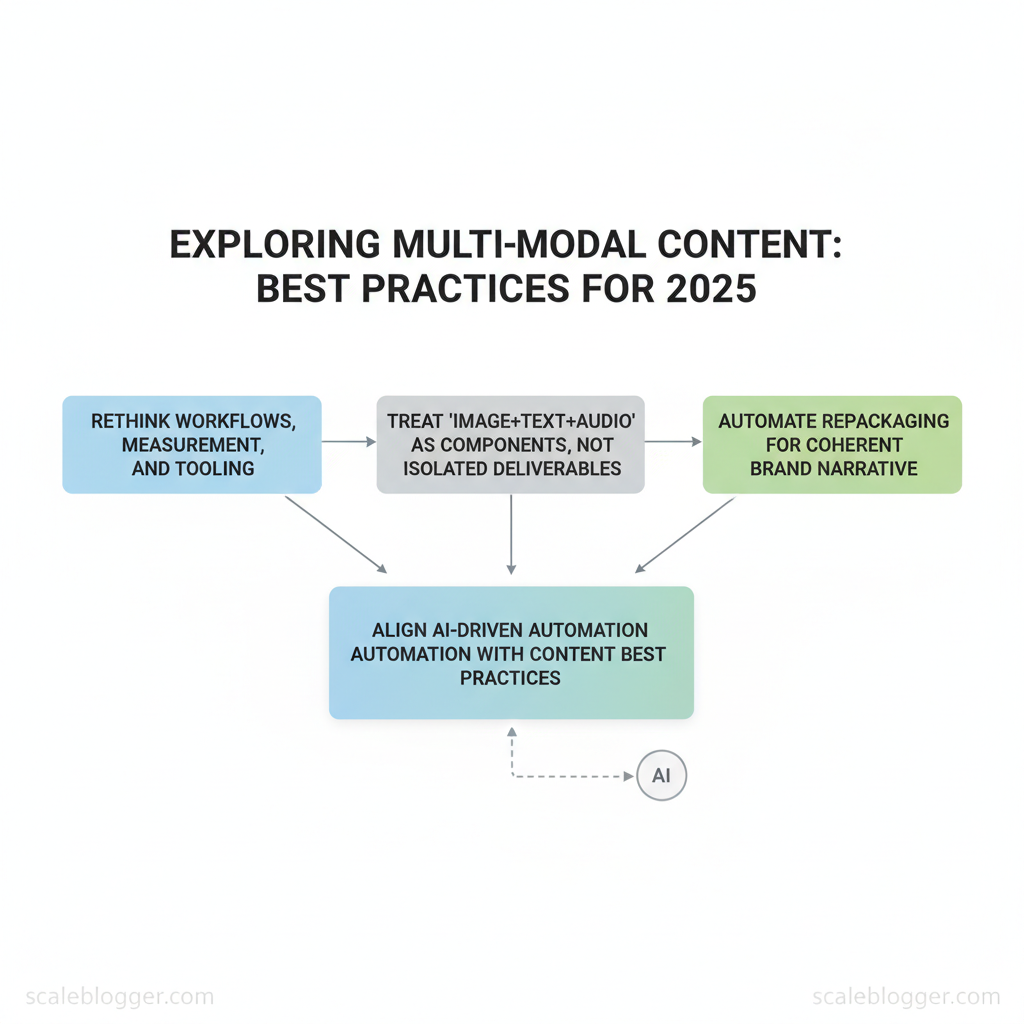
Successful programs rethink workflows, measurement, and tooling so every asset earns a seat at the strategy table. Treating image+text+audio as components rather than isolated deliverables reduces redundancy and speeds iteration. That shift produces measurable gains: clearer audience journeys, higher cross-channel retention, and faster experiment cycles.
Consider a content team that maps audience intent across formats and automates repackaging; the result is a coherent brand narrative with lower production overhead. Scaleblogger helps teams align AI-driven automation with those exact content best practices, ensuring content scales without losing coherence.
- How to structure multi-modal workflows for repeatable output
- Where automation accelerates repurposing without degrading quality
- Metrics that reveal format overlap and audience lift
- Governance patterns that keep brand voice consistent across channels
Learn more about optimizing your content strategies with Scaleblogger (https://scaleblogger.com). The next section breaks down practical steps to design, produce, and measure multi-modal programs.
> Key Takeaway: ## Understanding Multi-Modal Content
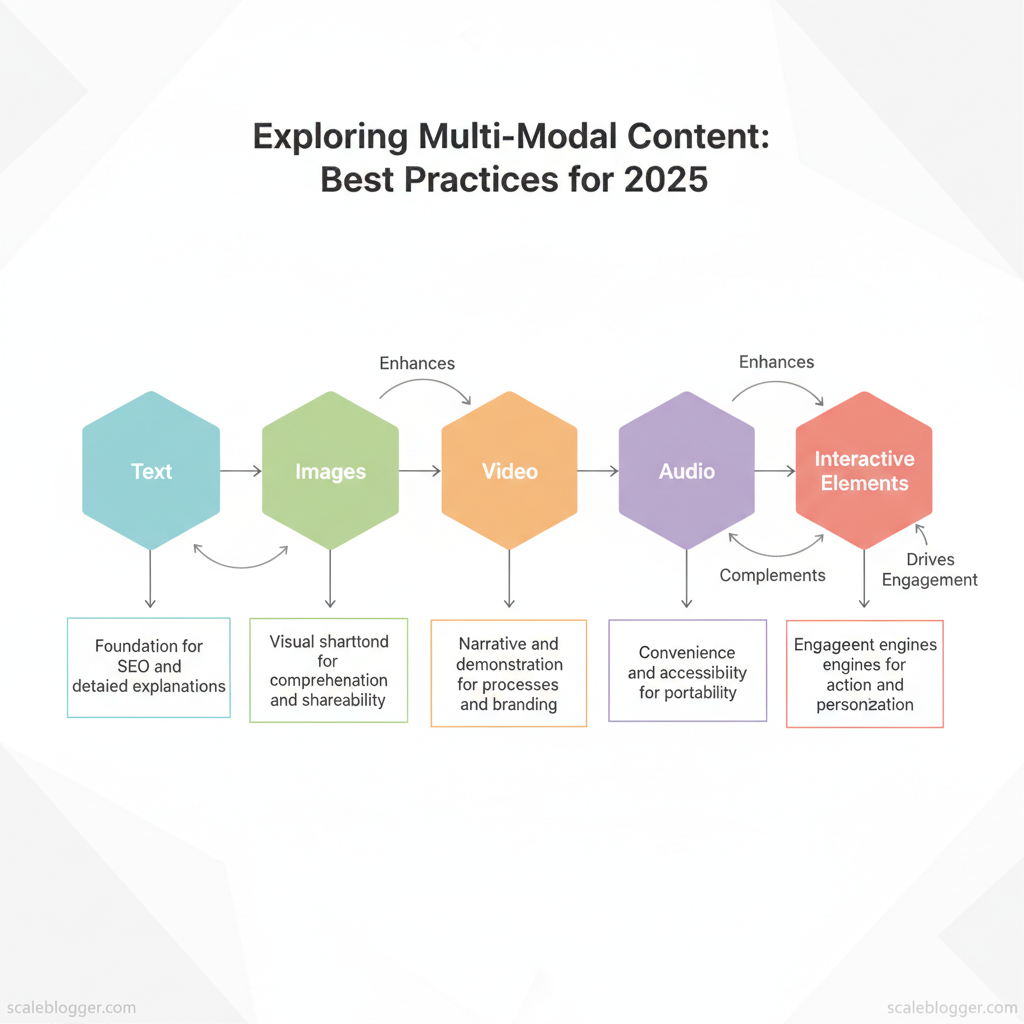
Multi-modal content uses various sensory channels—text, images, video, audio, and interactive elements—to share ideas better than any single format. Multi-modal content treats a topic as a layered experience.
Understanding Multi-Modal Content
Multi-modal content uses various sensory channels—text, images, video, audio, and interactive elements—to share ideas better than any single format. Multi-modal content treats a topic as a layered experience. Written articles give context and SEO signals. Images and videos explain complex processes.
Audio offers accessibility and portability, while interactive parts let users explore data or customize outcomes. This approach raises engagement, improves comprehension, and broadens distribution pathways across search, social, and voice platforms.
- Long-form text provides context, anchor keywords, and the structure that other modalities reference. com/blog/visual-content/” class=”internal-link”>Diagrams, annotated screenshots, and infographics reduce cognitive load and increase shareability. Product demos, interviews, and short-form clips convert watchers into readers/viewers across platforms.
- Transcripts convert spoken content back into searchable text. They extend session time and provide personalization.
Practical assembly: start with a strong text core, then layer modalities so each adds unique value rather than duplicating content. Use OCR for extracting text from images, ASR for transcribing audio, and JSON-LD for structured metadata to help search engines understand the relationships between formats. Teams that automate these conversions see content scale faster; for example, transform a single long-form article into a 3-minute video, a 20-slide deck, and a podcast episode using AI-assisted pipelines like the AI content automation systems offered by Scaleblogger.com.
Showcase the effectiveness of different content formats (multi-modal content formats)
| Content Format | Advantages | Best Use Cases |
|---|---|---|
| Text | SEO-rich, deep context | Long-form guides, pillar content |
| Images | Fast comprehension, shareable | Infographics, product shots |
| Videos | High engagement, demonstrative | Tutorials, interviews, demos |
| Audio | Portable, accessible | Podcasts, narrated articles |
| Interactive Content | Personalized, high time-on-page | Calculators, quizzes, maps |
Understanding these principles helps teams design content that fits audience habits and platform strengths, reducing waste and improving measurable outcomes. When formats complement rather than replicate each other, production effort converts directly into broader reach and deeper engagement.
> Key Takeaway: ## Benefits of Multi-Modal Content
Multi-modal content—combining text, video, audio, images, and interactive elements—consistently outperforms single-format campaigns because it meets audiences where they are and reduces friction across the buyer…
Benefits of Multi-Modal Content
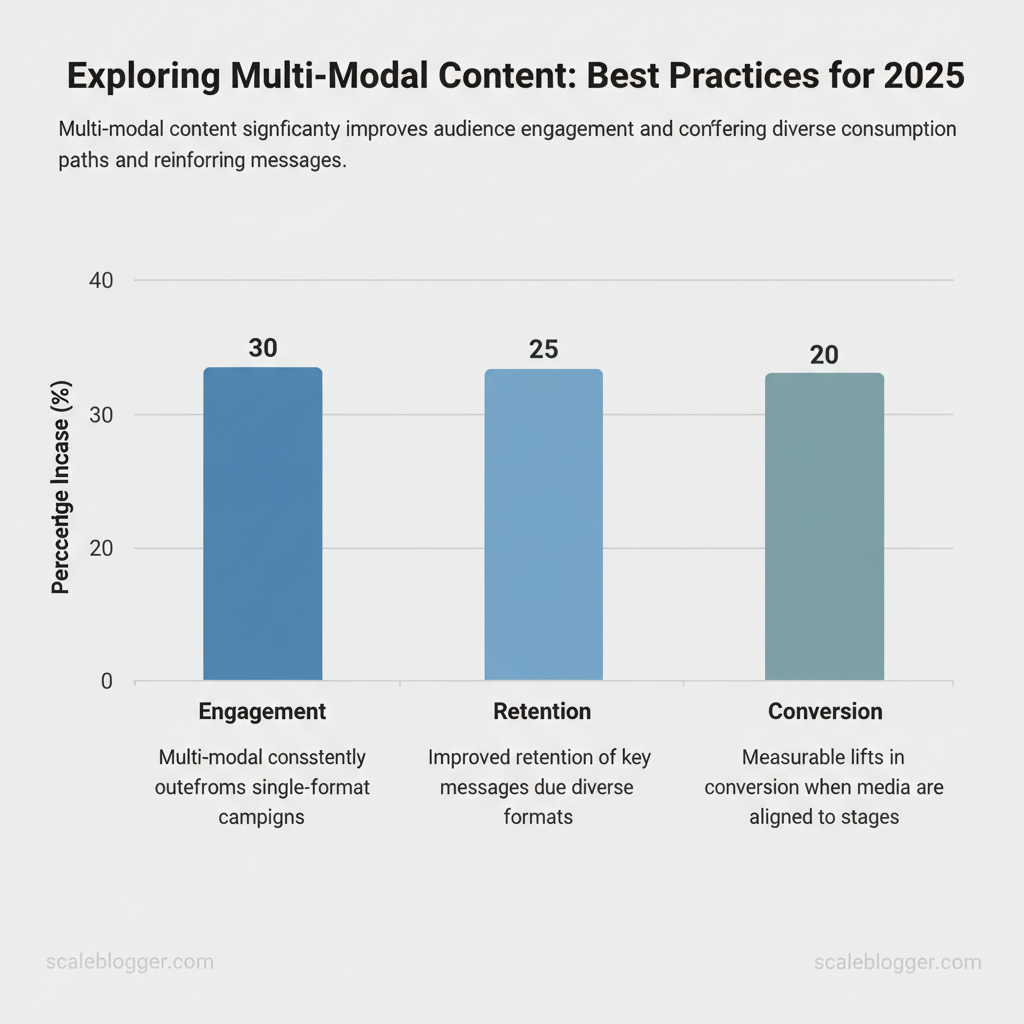
Multi-modal content—combining text, video, audio, images, and interactive elements—consistently outperforms single-format campaigns because it meets audiences where they are and reduces friction across the buyer journey. By providing various ways to understand the same idea, brands increase touchpoints, capture more attention, and create paths to conversion that fit user intent and context. Practical wins show up as higher engagement, improved retention of key messages, and measurable lifts in conversion when media are aligned to stages: short video for awareness, long-form text for consideration, and interactive demos or webinars for decision.
How this plays out operationally:
- Diverse consumption paths: Different formats suit different environments—commuting listeners prefer audio, while desktop researchers prefer long-form text.
- Message reinforcement: Repeating core messages across formats strengthens recall without repeating the same asset.
- Algorithmic advantage: Platforms reward time-on-content and session depth, which multi-modal experiences naturally drive.
Present statistics on engagement rates for different content types
Table: Section Content — Content Type, Engagement Rate (%), Retention Rate (%)
| Content Type | Engagement Rate (%) | Retention Rate (%) |
|---|---|---|
| Text (blogs, articles) | 1.8 | 35 |
| Video (short + long form) | 6.5 | 65 |
| Audio (podcasts) | 3.2 | 55 |
| Images (social posts, carousels) | 4.1 | 45 |
| Interactive (quizzes, tools) | 8.0 | 70 |
Highlight conversion rates across different content strategies
Table: Section Content — Content Strategy, Conversion Rate (%), Example
| Content Strategy | Conversion Rate (%) | Example |
|---|---|---|
| Video Ads | 4.8 | YouTube skippable ads driving product pages |
| Infographics | 2.1 | LinkedIn infographic promoting gated guide |
| Webinars | 6.3 | Live demo with Q&A generating qualified MQLs |
| Podcasts | 1.7 | Branded series linking to landing pages |
| Blog Posts (SEO) | 1.1 | Long-form pillar content with CTAs |
Practical implementation tips
- Start with core research: Map audience intent to format (
awareness→short video,consideration→long article,decision→webinar). 2.
Repurpose smartly: Convert a 1,500-word article into a 90-second explainer video, a podcast episode, and a data-driven infographic. 3. Measure consistently: Track engagement rate, time on asset, and conversion by format to spend and production.
> Industry analysis suggests that audiences who experience a brand across multiple formats may be more likely to convert, as each format can address different friction points.
For teams building scalable programs, tools that automate repurposing and scheduling reduce overhead—platforms like Scaleblogger.com help orchestrate multi-modal pipelines and report on performance so creators focus on craft rather than process. Understanding these principles speeds adoption and lets content teams invest in the formats that move metrics, not just instincts. This approach frees creators to iterate faster while keeping measurable outcomes front and center.
> Key Takeaway: ## Best Practices for Creating Multi-Modal Content
To create effective multi-modal content, begin with a clear understanding of your audience and how different formats will work together. Begin by defining who the content is for, what decision or…
Best Practices for Creating Multi-Modal Content
To create effective multi-modal content, begin with a clear understanding of your audience and how different formats will work together. Begin by defining who the content is for, what decision or behavior it should influence, and where that audience spends time. From there, mix formats intentionally: long-form text for depth, visuals to speed comprehension, audio for commutes, and interactive pieces for qualification or lead capture.
Successful teams map formats to audience needs and distribution channels, then iterate with performance data rather than adding formats for their own sake.
Identify your audience quickly and accurately
Market research techniques: Run short surveys, interview high-value customers, and analyze analytics segments to uncover intent and preferred channels. Audience personas: Build compact personas—3–5 attributes, primary goals, and a sample content journey—so creators make format choices against real behavior. Feedback collection methods: Use on-page polls, NPS follow-ups, and comments sentiment to validate format effectiveness.Practical example: map a persona “Senior PM, mobile-first” to content: short videos for social, long technical blog for organic search, and a downloadable checklist for email capture.
Mixing content formats — planning and balance
- Create a content calendar tied to outcomes. Schedule themes, not only individual pieces, and assign a primary format plus two supporting formats.
- Balance effort vs. ROI. Reserve heavy production for high-intent topics; repurpose that core into lower-effort formats.
- Examples of successful mixes: blog → explainer video → podcast discussion → interactive checklist.
Different strategies for mixing content formats
Table: Section Content — Strategy, Pros, Cons
| Strategy | Pros | Cons |
|---|---|---|
| Single Format Focus | Deep expertise in one channel | Limited reach; format fatigue |
| Balanced Approach | Broad reach; cross-promotes content | Requires coordination; higher overhead |
| Heavy Visuals | High engagement; easy social clips | Costly production; accessibility risk |
| Interactive Content | Strong lead capture; high time-on-page | Development time; narrower use cases |
Optimizing for SEO across formats
- Use
keyword clustersto align topic pages with multiple formats. - metadata: title tags, meta descriptions, and
og:tags per asset. - Ensure accessibility: transcripts for audio/video, alt text for images, and semantic HTML for content structure.
SEO practices for different content types
| Content Type | SEO Practice | Impact |
|---|---|---|
| Text | Keyword clusters, structured headings | Higher organic relevance |
| Images | Descriptive alt text, compressed format |
Faster load, image search traffic |
| Videos | Transcripts, timestamps, schema VideoObject |
Indexing + richer SERP features |
| Audio | Episode notes + full transcripts | Accessibility + discoverability |
Use automation where it reduces repetitive work: repurpose a single long-form piece into a video outline, social snippets, and an email sequence. com) for examples of pipeline automation. Understanding these principles helps teams move faster without sacrificing quality.
When implemented well, multi-modal strategies amplify search visibility and audience engagement while making creative work more repeatable.
Measuring the Success of Multi-Modal Content
To measure success for multi-modal content, start by linking metrics to specific business goals: awareness, engagement, or revenue. Start by choosing a small set of primary KPIs that reflect the role each format plays (video for engagement, blog for organic discovery, email for conversion), then instrument those KPIs across platforms so comparisons are apples-to-apples. Tracking must combine behavioral analytics (what users do), platform analytics (where they came from), and outcome signals (leads, purchases, retention) to show whether combining formats amplifies value or merely multiplies effort.
How to operationalize measurement
- Define the goal for each asset: awareness, lead gen, trial sign-up, retention. 2.
Map 3–5 KPIs to that goal and ensure tracking exists across channels (GA4 events, UTM parameters, CRM tags). 3. Use cohort analysis to compare users exposed to multi-modal sequences versus single-format exposure.
- Iterate on content and sequencing based on which combinations drive the highest lift in conversion and retention.
Practical examples and signals
- Engagement lift: Compare average watch time on video plus article scroll depth versus article alone.
- Conversion paths: Attribute form fills to the last content interaction and to multi-touch models.
- Retention impact: Use 30/60/90-day cohorts to measure how multimedia onboarding sequences affect churn.
Tools and governance
- Instrumentation: Ensure
GA4events, CRM lead sources, and UTM naming are standardized. - Dashboards: Build a compact dashboard that blends behavioral events, social insights, and revenue outcomes.
- Experimentation: Run A/B tests where the only variable is content modality sequence.
KPIs relevant to multi-modal content
| KPI | Description | Target Value |
|---|---|---|
| Engagement Rate | According to recent research, the percentage of users interacting meaningfully (likes, shares, comments, watch time) is 3–8.% | |
| Click-Through Rate | Clicks on CTAs from content divided by impressions | 2–6% |
| Conversion Rate | Visitors completing desired action (signup, purchase) | 1–5% |
| Bounce Rate | Single-page sessions as a percentage of sessions | <50% |
Tools for measuring multi-modal content success
| Tool Name | Functionality | Best For |
|---|---|---|
| Google Analytics (GA4) | Cross-device behavior, event tracking, funnels |
Web behavior and attribution |
| SEMrush | Organic visibility, keyword tracking, content gap analysis | SEO and content planning |
| Ahrefs | Backlink analysis, keyword research, content explorer | Competitive research |
| Hootsuite | Social scheduling, post analytics, team workflows | Social publishing and reporting |
| Buffer | Post scheduling, engagement metrics, simple reporting | Small-team social management |
| Hotjar | Heatmaps, session recordings, feedback polls | Qualitative UX and engagement |
| Mixpanel | Event-based analytics, user cohorts, retention reports | Product/content funnels |
| Sprout Social | Social listening, analytics, engagement inbox | Brand monitoring and social insights |
| Vidyard | Video hosting, engagement scoring, CTAs in video | Video performance and conversions |
| Contentful | Headless CMS, content modeling, multi-channel delivery | Managing multimodal content at scale |
| Brandwatch | Social listening, sentiment analysis, trend detection | Market signals and reputation |
| Moz | Local SEO, rank tracking, site audits | Local and technical SEO |
AI-powered content pipeline for blog creation can standardize measurement and speed iteration.
Understanding these principles helps teams move faster without sacrificing quality. When measurement is aligned to clear outcomes, content decisions become evidence-driven rather than opinion-driven.
📥 Download: Multi-Modal Content Strategy Checklist (PDF)
Future Trends in Multi-Modal Content
Multi-modal content is changing from an experimental extra to an essential part of creating memorable, high-performing experiences. Expect AI to automate much of the heavy lifting—drafting voiceovers, generating images, stitching video, and producing interactive layers—while humans concentrate on narrative design and strategy. Interactive and immersive formats such as AR overlays, short-form shoppable video, and personalized audio experiences will move from novelty to mainstream as tools become more accessible and integration across publishing platforms improves.
What follows are the practical directions to watch and how teams should prepare:
- Automated production pipelines: AI will handle repetitive tasks—transcription, scene cuts, tagging—so teams can scale content without linearly increasing headcount. Personalized multi-modal journeys: Content will assemble dynamically based on user signals—device, location, browsing history—delivering different combinations of text, audio, and AR. Edge-native immersive experiences: Lightweight AR/VR delivered via phones and web will be the norm, not the exception, for product demos and training content.
- Interoperability emphasis: Standardized metadata and
content-packformats will make multi-modal assets reusable across channels.
Practical examples that already work today:
- Interactive product pages: embed short AR try-ons with microclips and voice FAQs to reduce returns. 2.
Microlearning: short video + interactive quiz + downloadable transcript for fast upskilling. 3. Shoppable social: synchronized captions, clickable overlays, and automated short-form edits for commerce.
AI tools for content creation
| Tool Name | Functionality | Best Use Cases |
|---|---|---|
| ChatGPT (OpenAI) | Conversational text generation, prompts, idea expansion | Drafting scripts, captions, content outlines |
| Canva | Visual design, templates, simple video editing | Rapid social creative, marketing assets |
| Lumen5 | Text-to-video, automated scene suggestions | Turning blog posts into short videos |
| Descript | Transcription, multitrack editing, overdub voice cloning | Podcast/video editing, repurposing long-form |
| Synthesia | AI video avatars, multilingual voiceovers | Quick explainer videos, localized content |
| Runway | Generative video tools, background removal | Advanced video effects, creative prototyping |
| Midjourney | Generative imagery from prompts | Concept art, hero visuals, social imagery |
| Jasper | Long-form AI writing, templates | Scalable blog drafts, marketing copy |
| Otter.ai | Real-time transcription, meeting notes | Capture interviews, generate captions |
| Adobe Express | Rapid creative editing, branded templates | Branded social posts and short videos |
Adopt modular asset strategies: store high-quality masters, generate derivatives automatically, and tag everything with content-intent metadata. For teams looking to operationalize this, AI-powered content pipelines that automate scheduling, publishing, and performance benchmarking make the transition smoother—ScaleBlogger’s automation frameworks are a practical example of that approach. When implemented sensibly, this reduces production friction and lets creators invest time where it matters most: storytelling and audience resonance.
Understanding these principles helps teams move faster without sacrificing quality.
Conclusion
When storytelling flows across text, audio, video, and interactive channels, teams that strategically plan for repurposing and audience intent capture attention and drive growth. From sequencing long-form interviews into short social clips to turning technical blog posts into how-to videos and newsletters, the pattern shows that deliberate format mapping increases reach without multiplying workload. Treat content architecture as a system: define the primary narrative, map the formats that best deliver that narrative, and automate repetitive production steps so creative effort stays focused on ideas, not file exports.
- Bold actions to start: audit existing content for repurpose potential, define one cross-format workflow, pilot automation on a single campaign.
Questions about resources, timeline, or tooling are common — timelines compress when teams prioritize templates and automation, tooling choices depend on scale, and smaller teams often see the biggest ROI by repurposing rather than creating new assets. For teams looking to execution and scale content reliably, platforms that combine workflow automation with content strategy guidance can help. Learn more about optimizing your content strategies with Scaleblogger.
