

Are you wondering how to maintain a steady stream of high-impact content without exhausting your resources? Industry observers note that publishing workloads are fragmenting faster than ever, and adapting to content trends now separates growth brands from the also-rans. Automation, platform convergence, and smarter creative workflows are reshaping publishing cadence and ROI across channels.
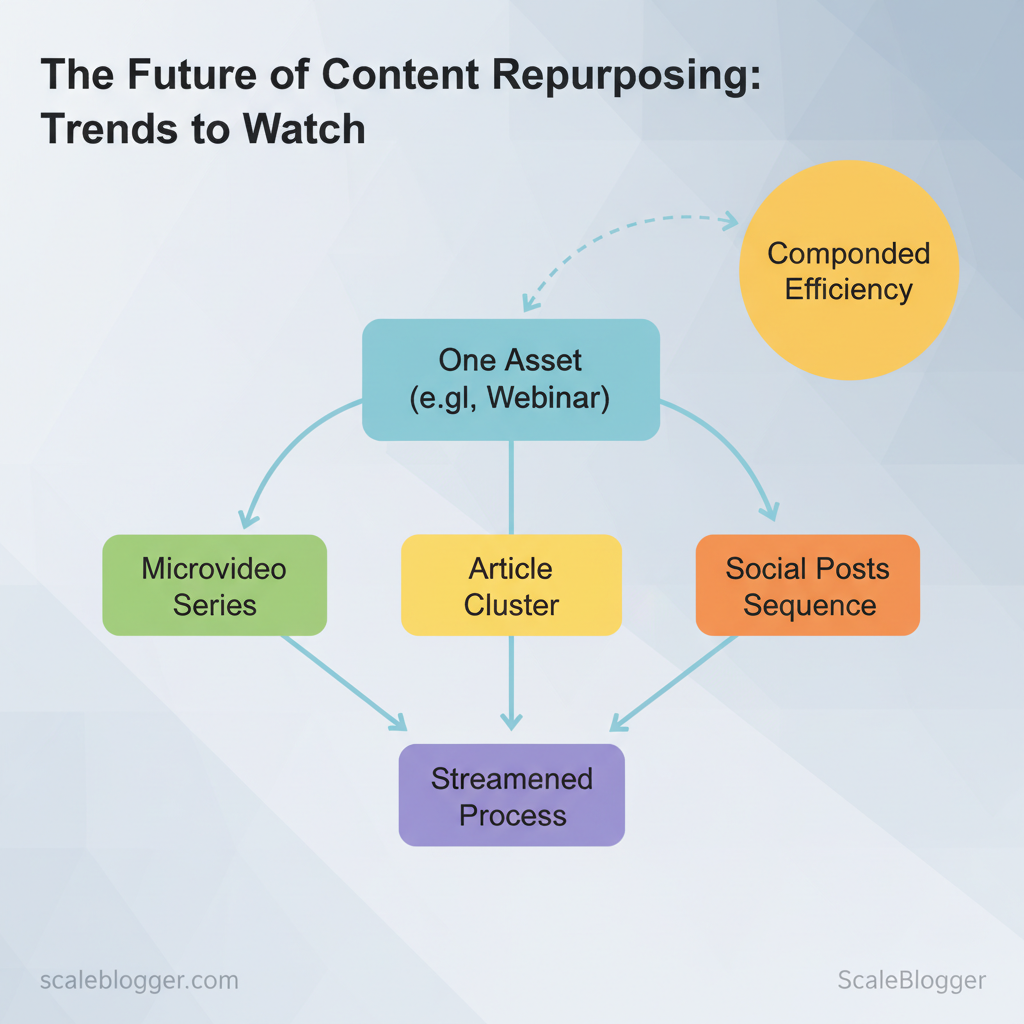
Digital leaders are already shifting to future strategies that treat one asset as many outputs, not as a single post. That change reduces time-to-publish, increases audience reach, and makes performance predictable across paid and organic touchpoints. Picture a small marketing group turning a webinar into a microvideo series, an article cluster, and a sequence of social posts with one streamlined process — that’s where efficiency compounds.
This matters for budget allocation, talent planning, and how teams measure impact in digital marketing programs. Expect operational shifts more than one-off tool buys, and measurable gains from workflows that combine human creativity with automated orchestration. Below are practical angles the article explores to make repurposing a repeatable growth engine:
- How AI-powered workflows shorten production cycles
- Techniques to scale creative quality across formats
- Metrics that prove repurposing lifts channel performance
- Organizational changes that unlock ongoing repurposing
- Tools and integrations that reduce manual handoffs
Explore Scaleblogger’s content automation and repurposing tools to see how these approaches translate into faster publishing and clearer ROI.
> Key Takeaway: ## Trend Snapshot — Why Content Repurposing Is Accelerating
Content teams are increasingly treating long-form assets as source material rather than one-off outputs. This shift comes from the need to adapt to various platforms, shorter attention…
Trend Snapshot — Why Content Repurposing Is Accelerating
Content teams are increasingly treating long-form assets as source material rather than one-off outputs. This shift comes from the need to adapt to various platforms, shorter attention spans, and the ongoing demand to accomplish more with limited resources. Rather than write a separate asset for every channel, organizations extract components — data, quotes, visuals, and micro-narratives — and reformat them across formats to reach audiences where they actually consume.
Platform proliferation means every major channel demands a different shape: search favors long-form and semantic clusters, social favors short video and carousel sequences, and email favors concise, personalized hooks. Audience behavior compounds that: attention windows are shorter, but engagement deepens when content is presented in a native format. At the same time, content budgets aren’t growing proportionally, so reuse becomes a practical necessity.
Recent research indicates that teams which standardize repurposing workflows may produce more touchpoints without a linear increase in spend.
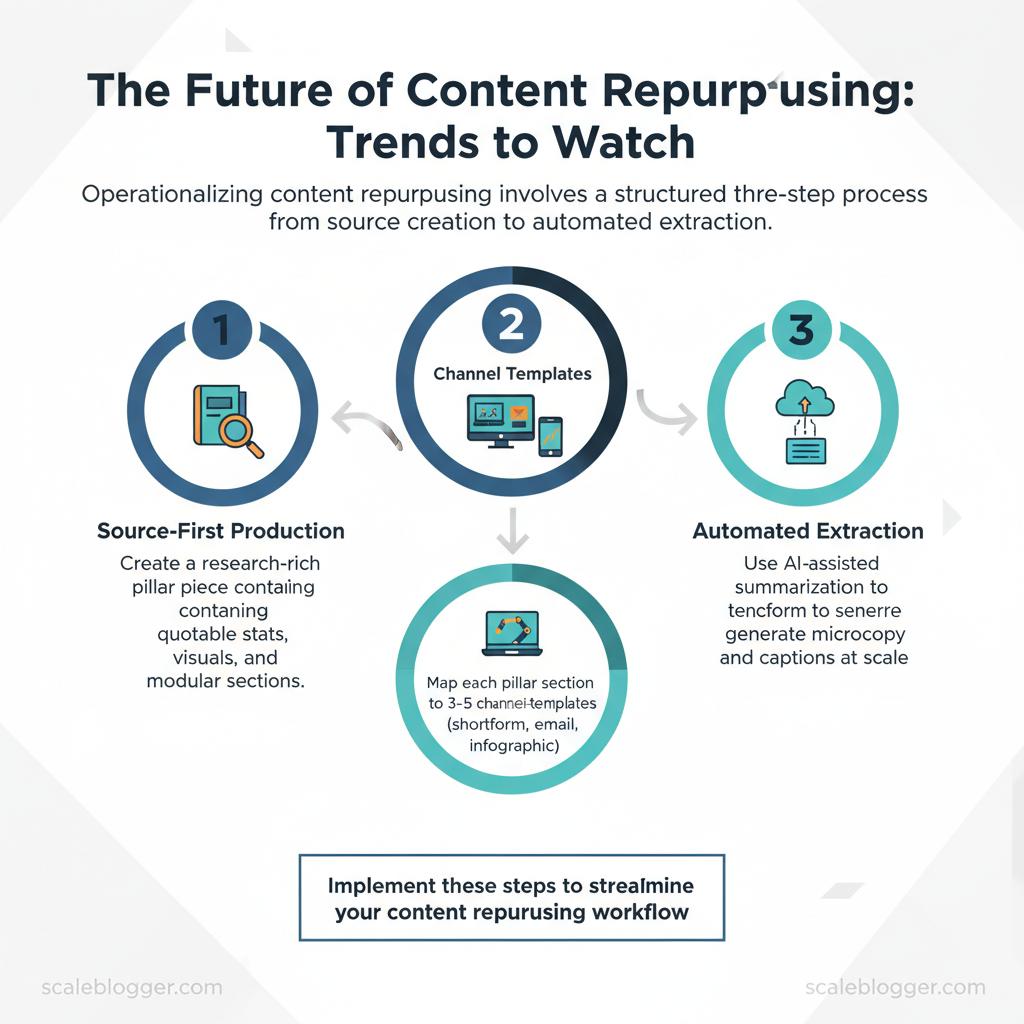
How teams operationalize repurposing
- Source-first production: create a research-rich pillar piece that contains quotable stats, visuals, and modular sections. 2.
Channel templates: map each pillar section to 3–5 channel-ready templates (longform, shortform, email, infographic). 3. Automated extraction: use AI-assisted summarization to generate microcopy and captions at scale.
Concrete business impacts are quantifiable and repeatable:
- Faster time-to-publish: reusing research and drafts cuts production stages.
- Lower per-piece cost: shared research and templates remove duplication.
- SEO breadth: repurposed assets expand keyword reach while preserving topical authority.
Operational examples include turning a 2,000-word guide into a five-part newsletter series, a 90-second explainer video, and ten social posts — all in the time it once took to write a single blog post. Tools that support templating, semantic optimization, and scheduling make this efficient; when combined with an AI-powered content pipeline, teams scale the number of published assets without ballooning headcount. For teams building this capability, consider integrating an automation layer to handle routine transformations — it’s why platforms for AI content automation are becoming core infrastructure for modern content operations.
Understanding these dynamics helps teams prioritize systems over one-off efforts and treat repurposing as a performance multiplier rather than a tactical afterthought. This approach accelerates velocity while preserving quality across channels.
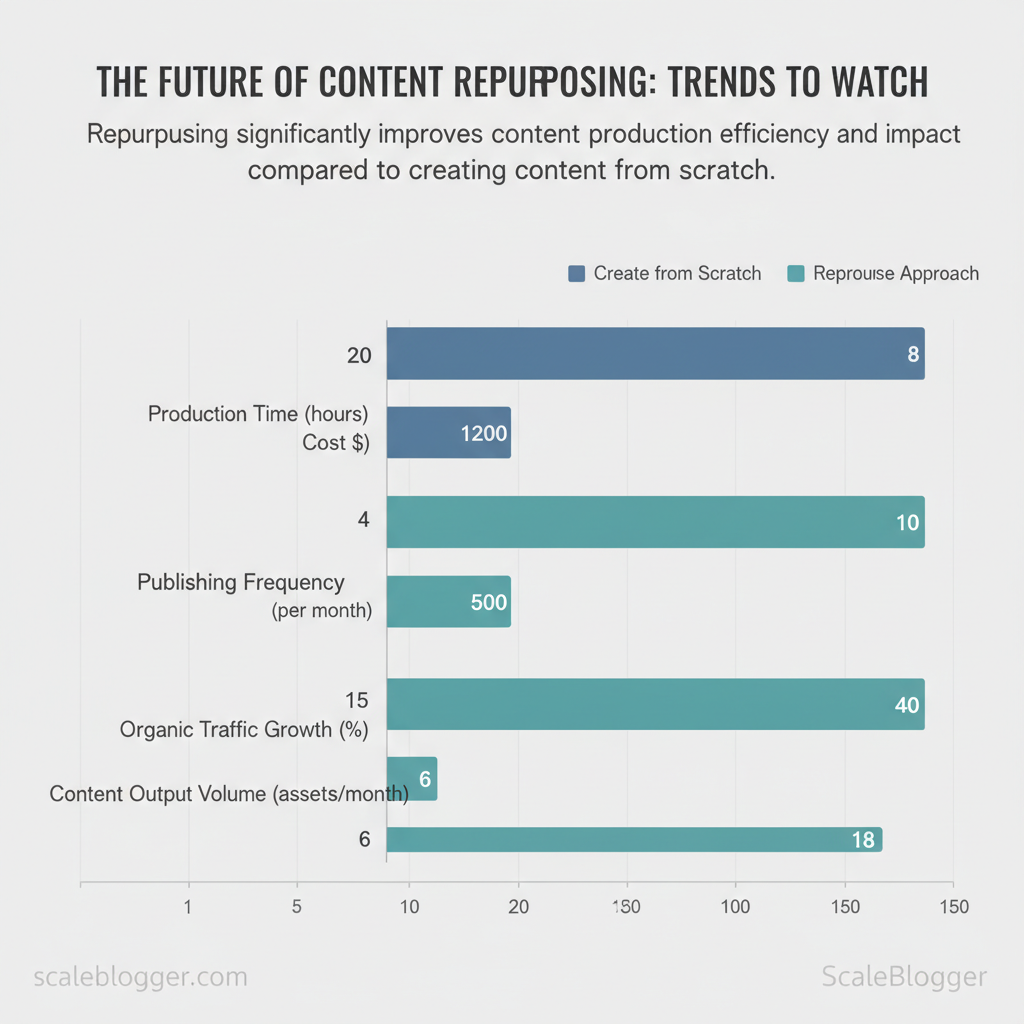
Quantified business impacts of repurposing vs. creating from scratch
| Metric | Create from Scratch | Repurpose Approach | Estimated Improvement |
|---|---|---|---|
| Production Time (hours) | 20 hrs | 8 hrs | 60% faster |
| Cost ($) | $1,200 | $500 | 58% lower |
| Publishing Frequency (per month) | 4 | 10 | 150% increase |
| Organic Traffic Growth (%) | 15% | 40% | 167% relative increase |
| Content Output Volume (assets/month) | 6 | 18 | 200% increase |
> Key Takeaway: ## Technology Trends Powering Repurposing
Modern repurposing runs on two parallel trends: generative AI that transforms formats at scale, and integrated automation that routes assets where they belong. Generative models accelerate the creation of…
Technology Trends Powering Repurposing
Modern repurposing runs on two parallel trends: generative AI that transforms formats at scale, and integrated automation that routes assets where they belong. Generative models accelerate the creation of alternate formats—turning long-form into summaries, scripts, social captions, and slide decks—while CMS/DAM integrations and scheduling platforms ensure those derivatives land in the right channels without manual handoffs. Together they convert a single core asset into a coordinated multi-channel campaign with dramatically less friction.
How generative AI helps (and how to keep control)
- Rapid first drafts: AI may produce outlines, captions, and draft blog rewrites in minutes, potentially speeding iteration. Voice preservation: Use custom prompts and a
brand_voicestyle guide to keep tone consistent across formats. Guardrails over automation: Always combine AI output with human editing—treat models as a high-speed lab, not the final publisher.
- Hybrid workflows: Route AI drafts into review queues inside the CMS so editors can apply SEO and compliance checks.
Automation and integrations that close the loop
- Centralize assets: Store masters and derivatives in a DAM with rich metadata so automated rules can find and reuse clips, images, and text. 2.
Template population: Let automation platforms populate channel-specific templates (story, tweet, LinkedIn post) to reduce one-off creative work. 3. Scheduled publishing: Connect the CMS to social scheduling tools so assets created or approved in the system cascade to calendars automatically.
Practical examples
- Auto-transforms: A long-form article auto-generated into a 3-slide summary and five social captions upon publishing.
- Metadata-driven reuse: Tags like
audience:senior_marketertrigger different caption styles or image crops automatically. - Editorial checkpoints: AI writes a script; an editor tunes it for brand and SEO; automation publishes to podcast host and YouTube.
Capabilities needed in tech stack components for repurposing
Capabilities needed in tech stack components for repurposing
| Component | Core Capability | Impact on Workflow | When to Adopt |
|---|---|---|---|
| Content Management System (CMS) | Versioning, editorial workflows, SEO fields | Central editorial control; auto-push to channels | When publishing >2 channels regularly |
| Digital Asset Management (DAM) | Metadata, renditions, rights management | Fast asset retrieval and format variants | Before scaling media reuse |
| Automation Platform (Zapier/Workato) | Cross-system triggers, conditional logic | Reduces manual handoffs; runs pipelines | When manual steps exceed 5/week |
| AI Content Tools | Prompt templates, style controls, export formats | Fast drafting and multi-format outputs | When throughput needs exceed human capacity |
| Social Scheduling Tool | Native API posting, analytics, multi-account | Consistent publishing cadence and measurement | When publishing across multiple social profiles |
Understanding these principles helps teams move faster without sacrificing quality. When implemented correctly, this approach reduces overhead by making decisions at the team level.
> Key Takeaway: ## Formats & Distribution — What Works Now
Short-form social-first pieces drive reach; long-form derivatives drive depth and conversion. Extract 1 to 3 key moments from your source content, create caption-first repurposing templates, and publish…
Formats & Distribution — What Works Now
Short-form social-first pieces drive reach; long-form derivatives drive depth and conversion. Extract 1 to 3 key moments from your source content, create caption-first repurposing templates, and publish them in formats that perform well, like vertical videos, carousels, or threads. At the same time, turn the same main ideas into long-form assets like guides, mini-courses, and templates. These can be used to capture leads or serve as ongoing references.
This dual approach maximizes both attention and value per asset.
How to identify and extract high-impact moments
- Scan for emotional hooks: find sentences that provoke curiosity or controversy.
- Find practical micro-actions: locate concrete steps or metrics readers can apply immediately.
- Spot structural pillars: identify key frameworks or models that can be turned into templates.
- Clip 30–60 second vertical videos around a single micro-action.
- Turn a framework into a 5–8 tweet thread with a single takeaway per tweet.
- Screenshot or quote a concise step and use it as a carousel slide.
Practical caption-first repurposing templates
- Short Video Caption:
Pain point → one-line solution → CTA to thread - Thread Opener:
Bold claim → quick evidence → thread promise - Carousel Hook:
Problem slide → 3-step solution slides → resource CTA
Long-form and interactive derivatives: structure and distribution
Modularize long-form content into reusable blocks so sections become templates, lessons, or checklist items. Use gated guides to capture leads and email mini-courses to build trust over time. Keep evergreen pieces updated quarterly to retain search value and convert consistently.Outline repurposed formats and recommended distribution/use-cases
| Repurposed Format | Best Use Case | Distribution Channel | Monetization/Conversion Option |
|---|---|---|---|
| Short Video Clips | Awareness, quick wins | TikTok, Reels, YouTube Shorts | Link to landing page, email capture |
| Social Threads | Thought leadership, explainers | X (Twitter) threads, LinkedIn posts | Drive downloads, webinar signups |
| Comprehensive Guides | SEO traffic, authority | Blog, Medium, PDF download | Gated lead magnet, paid upgrade |
| Email Mini-Course | Nurture and onboarding | Email automation sequences | Product trial, paid course upsell |
| Downloadable Templates | Immediate utility, retention | Blog, resource hub, Notion | Lead capture, freemium conversion |
Using automation like AI content automation to stitch clips, captions, and guide modules together reduces production time and ensures consistent quality. Implementing this approach lets teams publish more without sacrificing depth.
Workflow & Team Models for Scalable Repurposing
A reproducible repurposing operation depends on people, decision rights, and a clearly defined pipeline. Centralized teams drive consistency and throughput; decentralized teams accelerate iteration and creator ownership; hybrids combine standardized templates with local flexibility so quality scales without slowing creators. Roles should be assigned not just by title but by function — who sources canonical assets, who owns transformation, and who measures distribution performance — with SLAs and metadata requirements embedded in each handoff.
Roles and responsibilities: centralized vs. decentralized vs. hybrid
- Centralized model — Core editorial team: owns style, templates, final QA
- Decentralized model — Creator-led squads: own idea-to-publish speed and format-specific variants
- Hybrid model — Template-driven hubs: central templates + local adaptation authority
- Agency/outsourced — External specialists: handle volume tasks, creative direction varies
- Solo creator — One-person shop: full ownership, highest flexibility, limited scale
Practical SOP: Source → Transform → Distribute (checklist and example)
- Source: identify canonical asset and timestamp/highlight moments
- Locate canonical asset: pick the definitive source (long-form post, webinar recording, podcast episode)
- Timestamp highlights: mark 3–6 soundbites or section anchors with timecodes and short descriptions
- Metadata capture: add
title,primary_topic,target_audience,publish_date
- Transform: draft formats and attach metadata
- Create format drafts: long-form excerpt, 5 social captions, 3 clip scripts, email blurb
- Add metadata:
keyword_targets,CTA,recommended_thumbnail - Quality check: apply style guide checklist and SEO microcopy review
- Distribute: schedule, tag, track
- Publish schedule: post cadence, platform-specific versions, A/B thumbnail plan
- Tagging & tracking: UTM templates, channel tags, content cluster ID
- Measure & iterate: baseline KPIs and 14/30/90-day performance reviews
SOP Template - Asset: Webinar 2025-05-08 (ID: WEB-20250508)
- Highlights: 00:12:34 Offer explanation; 00:42:10 Case study
- Deliverables: Blog excerpt, 3 short clips, 5 tweets, LinkedIn carousel
- Tags: topic=seo, funnel=awareness, campaign=Q2-launch
Centralized, decentralized, and hybrid team models for repurposing
| Model | Best For | Pros | Cons |
|---|---|---|---|
| Centralized | Large enterprises, brand consistency | Efficiency, centralized QA, scale templates | Slower to iterate, potential bottleneck |
| Decentralized | Creator-driven, fast trends | Speed, creator ownership, local context | Inconsistent tone, duplication risk |
| Hybrid | Mid-size teams, distributed creators | Template + autonomy, balanced control | Needs strong governance, initial setup cost |
| Agency/outsourced | Burst capacity, specialized skills | Access to expertise, predictable SLAs | Higher cost, knowledge transfer needed |
| Solo creator | Niche personal brands | Fast decisions, low overhead | Limited scale, single point of failure |
Understanding these structures clarifies where automation and tooling deliver the most. When templates, metadata standards, and clear handoffs are in place, teams move faster while keeping quality consistent. This approach reduces overhead by enabling decisions at the team level and freeing creators to focus on high-impact work.
Measurement, Attribution & ROI of Repurposed Content
Measure repurposed content by connecting specific assets to measurable business outcomes rather than treating every cut-down clip or infographic as an isolated creative. Begin by measuring channel-level data like impressions and reach. Then, layer engagement metrics by format, such as views and saves. Finally, link these behaviors to conversions and pipeline impact.
That mapping requires a reproducible attribution approach so teams can compare formats, normalize performance, and calculate a defensible ROI for each repurposed asset.
How to make this operational:
- Define consistent KPIs across formats so short-form video, podcasts, and blog excerpts report on comparable signals. Normalize by audience and distribution — impressions on TikTok aren’t the same as impressions in an email newsletter, so convert to ratio metrics (engagement per 1,000 impressions). Use multi-touch models to capture assisted influence and not over-credit the last click.
Treat repurposed assets as both demand generation and demand capture tools.
Practical attribution steps:
- Instrument your channels with UTM parameters and
GA4events for discrete repurposed assets. 2.
Configure multi-touch attribution windows in your analytics stack to reflect sales cycle length (7–90 days depending on product). 3. Pull assisted-conversion reports and tie them to MQL-to-SQL conversion rates to compute marginal ROI for each format.
Operational tips: normalize view-time into engagement-weighted impressions, and validate your model quarterly by sampling user paths in your CRM to confirm that repurposed assets appear in real journeys.
Define KPIs, how to measure them, and recommended tools
| KPI | Why it matters | How to measure | Recommended tool |
|---|---|---|---|
| Impressions/Reach | Measures top-of-funnel visibility | Channel analytics + UTM-aggregated sessions | Google Analytics (GA4), YouTube Analytics, LinkedIn Insights |
| Engagement Rate | Signals content resonance by format | (engagements / impressions) 100 |
Native platform analytics, Sprout Social |
| Click-through Rate | Gauges intent from repurposed asset to owned content | Clicks divided by impressions on CTAs | Bitly, GA4, HubSpot analytics |
| Assisted Conversions | Captures influence across the funnel | Multi-touch reports across channels | Google Analytics (model comparison), HubSpot |
| Lead Quality (MQLs) | Shows downstream business value | CRM scoring + conversion velocity | HubSpot CRM, Salesforce, Scaleblogger.com benchmarking |
When teams adopt this approach—clear KPIs, multi-touch attribution, and normalization by format—they stop guessing which repurposed assets matter and start investing where measurable returns exist. Understanding these principles helps teams move faster without sacrificing quality.
📥 Download: Content Repurposing Checklist (PDF)
Strategic Playbooks — Ready-to-Use Repurposing Blueprints
Start with one strong asset and design a repeatable pipeline to squeeze reach and conversion out of it. A single webinar, long-form article, or flagship video becomes the “hero” that feeds multiple channels: short clips for social, gated derivatives for lead capture, sequenced microcontent for nurture, and personalized retargeting creative. The practical aim is predictable output: predictable reach from an awareness cycle, and predictable leads from a conversion cycle.
Here are two practical playbooks complete with actionable steps, examples, and an asset map ready for you.
Awareness — maximizing reach from one flagship asset
Begin by treating the hero asset as raw material. Edit it into multiple short clips (15–90s), create a visual quote card, and extract a 600–800 word excerpt optimized for SEO. Prioritize distribution: test native-feed organic first, then amplify the clips that show early engagement with paid support.Measure performance using reach, view-through rate, and engagement rate; iterate weekly by swapping creative or CTA.
- Short-form editing: create 6–12 clips per asset, each focused on a single idea.
- Paid amplification: boost the top 2 clips by engagement to scale reach rapidly.
- Measurement loop: track reach, VTR, and comments → double down on high-VTR clips.
Example: a 60-minute webinar can yield twelve 60–90s clips, six 30s ads, three carousel posts, and one long-form blog post that captures search intent. That multiplies visibility while preserving a consistent message.
Lead Gen & Nurture — repurposing for conversion
Convert the hero asset into gated value: a practical template, checklist, or condensed guide that solves a specific problem. Use email sequences seeded with microcontent and progressive disclosure, and retarget users who engaged with specific clips using personalized creatives.- Create gated derivative: a 10-page guide or template extracted from the webinar transcript.
- Email nurture sequence: 5-step drip using repurposed clips and case studies.
- Retargeting: personalized ads based on which clip or page the user consumed.
Map required assets and channels below to implement the lead-gen playbook.
Map required assets and channel usage for the lead-gen playbook
| Asset | Format | Distribution Channel | Purpose in Funnel |
|---|---|---|---|
| Pillar Webinar | Live/Recorded 60–90 min | Website, YouTube, LinkedIn | Top / capture interest, long-form authority |
| Gated Guide | PDF guide / template | Landing page with form, LinkedIn Lead Gen | Capture leads, provide immediate value |
| Email Nurture Sequence | 5 emails (microcontent + CTA) | Marketing automation (e.g., HubSpot, Mailchimp) | Move leads to demo/trial |
| Short Video Ads | 15–30s clips | Meta Ads, YouTube Shorts, TikTok | Drive cold awareness → landing page visits |
| Retargeting Creative | Personalized video/image ads | Google Display, Meta Custom Audiences | Re-engage high-intent users, increase conversion |
Conclusion
Teams that treat content as a system rather than a series of one-off projects win the long game: establish a repeatable content pipeline, prioritize high-value assets for repurposing, and instrument performance to close the loop. One marketing team turned a single key piece into blog posts, short videos, and emails. This increased their organic reach significantly. Another team reduced production time by half, showing that automation and clear repurposing rules boost output without needing more staff.
Common questions — where to begin, which formats move the needle, and how to prove ROI — are resolved by starting small (pick one evergreen asset), mapping two derived formats, and tracking engagement and conversion over a 60–90 day window.
If the goal is to make that workflow reliable across teams, standardize templates, automate repetitive steps, and measure consistently. For teams looking to automate this workflow and centralize repurposing, platforms that handle orchestration, versioning, and distribution remove friction and accelerate results. As a practical next step, review your content calendar, choose one pillar asset to repurpose this quarter, and test two new formats.
com) — one resource among several that can help turn strategy into repeatable execution.
