

Marketing teams often lose search visibility because older pages quietly decay while new content gets all the attention. Freshness matters. Search engines reward timely and relevant content. If updates are neglected, rankings can drop.
Regularly refreshing content boosts relevance signals and user engagement, supporting higher SEO rankings. Targeted content updates that fix accuracy, add depth, and match current intent deliver the fastest impact. Some industry research suggests that search engines may favor pages that reflect recent information and better match query intent.
Updating content reduces bounce rates and increases dwell time, improving organic performance across priority keywords. Consider a SaaS blog that revised ten evergreen posts, added recent stats and internal links, and saw steady traffic growth within weeks. Practical changes include refreshing titles, adding new examples, and republishing with current dates.
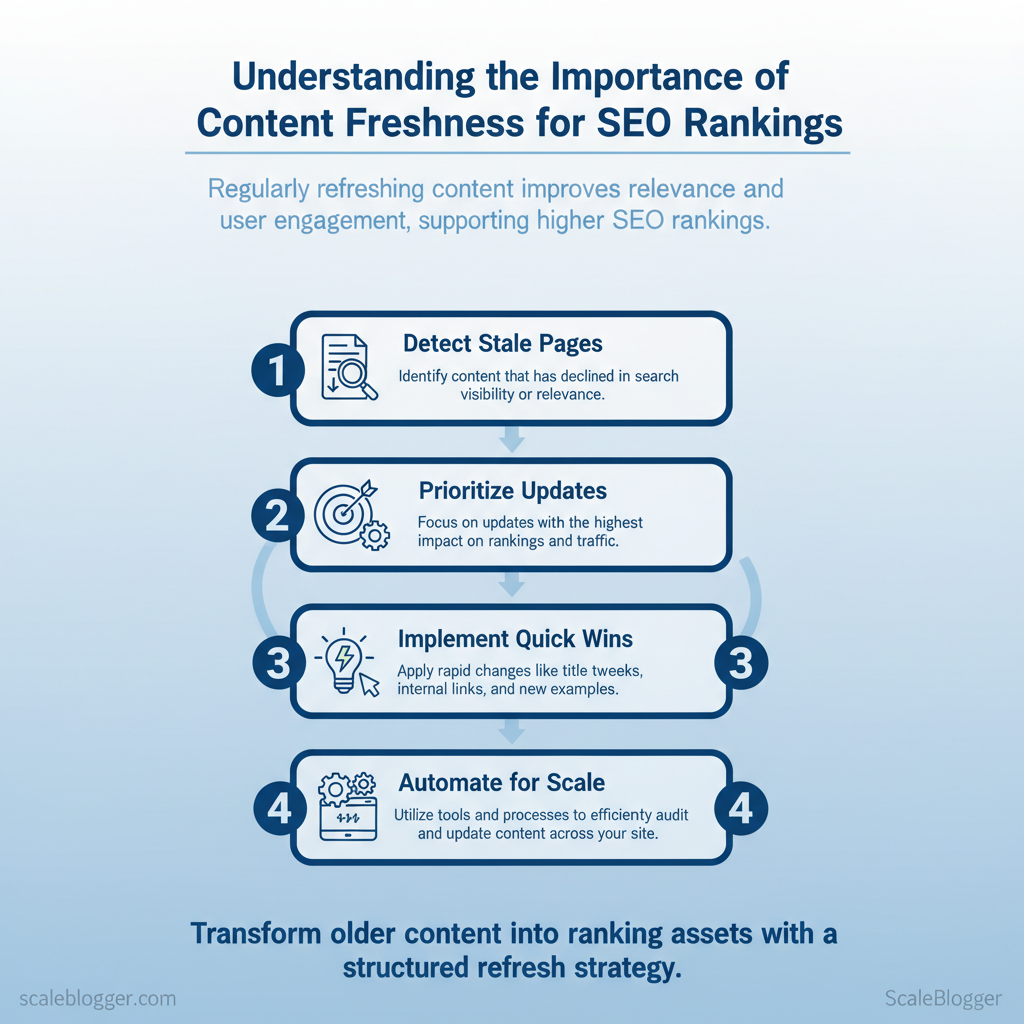
This introduction draws on common SEO principles and publisher experience rather than a single study. It previews how to diagnose stale content, prioritize updates, measure impact, and automate the audit process for scale. Expect one visual illustrating the update workflow after the next section.
- How to detect stale pages that harm rankings
- Prioritization framework for content updates by impact
- Quick wins: title tweaks, internal links, and new sections
- Automation strategies to scale
contentfreshness work
Automate content audits and scale updates with Scaleblogger — https://scaleblogger.com
> Key Takeaway: ## Understanding Content Freshness and Its Impact on Search Engines
Content freshness involves more than just the date in a post header. It includes recency, meaningful updates, and signals that help search engines determine if a page answers…
Understanding Content Freshness and Its Impact on Search Engines
Content freshness involves more than just the date in a post header. It includes recency, meaningful updates, and signals that help search engines determine if a page answers users’ queries. Search engines treat freshness contextually — some queries (news, live events, product releases) demand recent timestamps, while others (evergreen how-tos, reference guides) reward depth and updated accuracy. That means a timestamp change alone rarely moves the needle; meaningful edits that add new sections, current data, or restructured content are what search engines consider when recalculating relevance and ranking.
Defining content freshness — recency vs. relevance
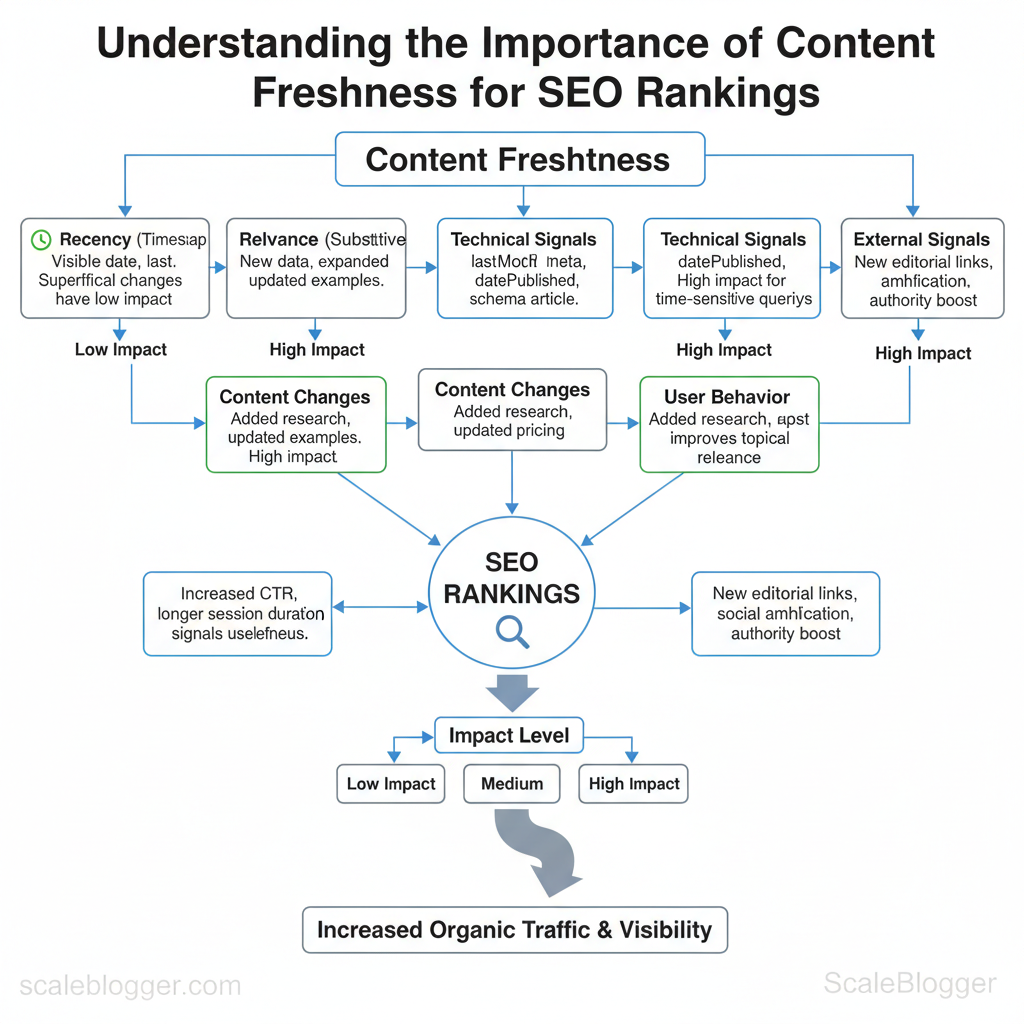
- Recency (timestamp): A visible date or last-updated tag. Useful for time-sensitive queries, but superficial changes (typo fixes, tiny rewording) don’t signal value.
- Relevance (substantive updates): New data, expanded coverage, corrected facts, updated examples. This shifts topical relevance and can improve rankings for queries where freshness matters.
- Why cosmetic updates fall short: Search engines evaluate the extent of changes; swapping a few sentences or changing the date without adding new information typically yields no ranking benefit.
- Examples of meaningful updates:
- Add current stats or studies and summarize their impact.
- Insert a new section covering regulatory, pricing, or tooling changes.
- Re- intent (rewrite intro and headings to match evolving queries).
- Add structured data to expose new facts to crawlers.
Updating with depth also improves user experience — longer dwell times and lower pogo-sticking if the page answers the updated intent.
Signals search engines use to evaluate freshness
Types of freshness signals (technical, content, user-behavior, external) and examples of each with impact level| Signal Type | Example | How to detect/update | Estimated SEO Impact |
|---|---|---|---|
| Technical (timestamps/structured data) | lastModified meta, datePublished, schema article |
Check HTML meta, CMS settings; add/maintain schema.org fields | High for time-sensitive queries |
| Content changes (new sections/data) | Added research, updated pricing table | Use diff tools, CMS revision history; add clear “Updated” sections | High — improves topical relevance |
| User behavior (CTR/dwell time) | Increased clicks, longer session duration | Use GA4/analytics, Search Console CTR reports; A/B test titles/snippets | Medium–High — signals usefulness |
| External signals (new backlinks/shares) | New editorial links, social amplification | Monitor backlinks (Ahrefs, GSC) and referral traffic; outreach for updated page | Medium — authority boost |
| Crawl frequency | More frequent crawls after updates | Check crawl logs, GSC Coverage; submit updated sitemap or URL for indexing | Medium — enables faster re-evaluation |
Many teams automate detection of stale content and schedule meaningful updates; tools and services (including AI content automation like Scaleblogger.com) can help prioritize pages that need substantive revisions. Understanding these layers helps you target updates that search engines will actually notice and reward. When teams focus on adding value rather than cosmetic fixes, updates convert into measurable visibility and engagement gains.
> Key Takeaway: ## Why Content Freshness Matters for SEO Rankings
Search engines reward content that is timely, accurate, and well-maintained. Fresher pages may indicate relevance for queries where recent information is important.
Why Content Freshness Matters for SEO Rankings
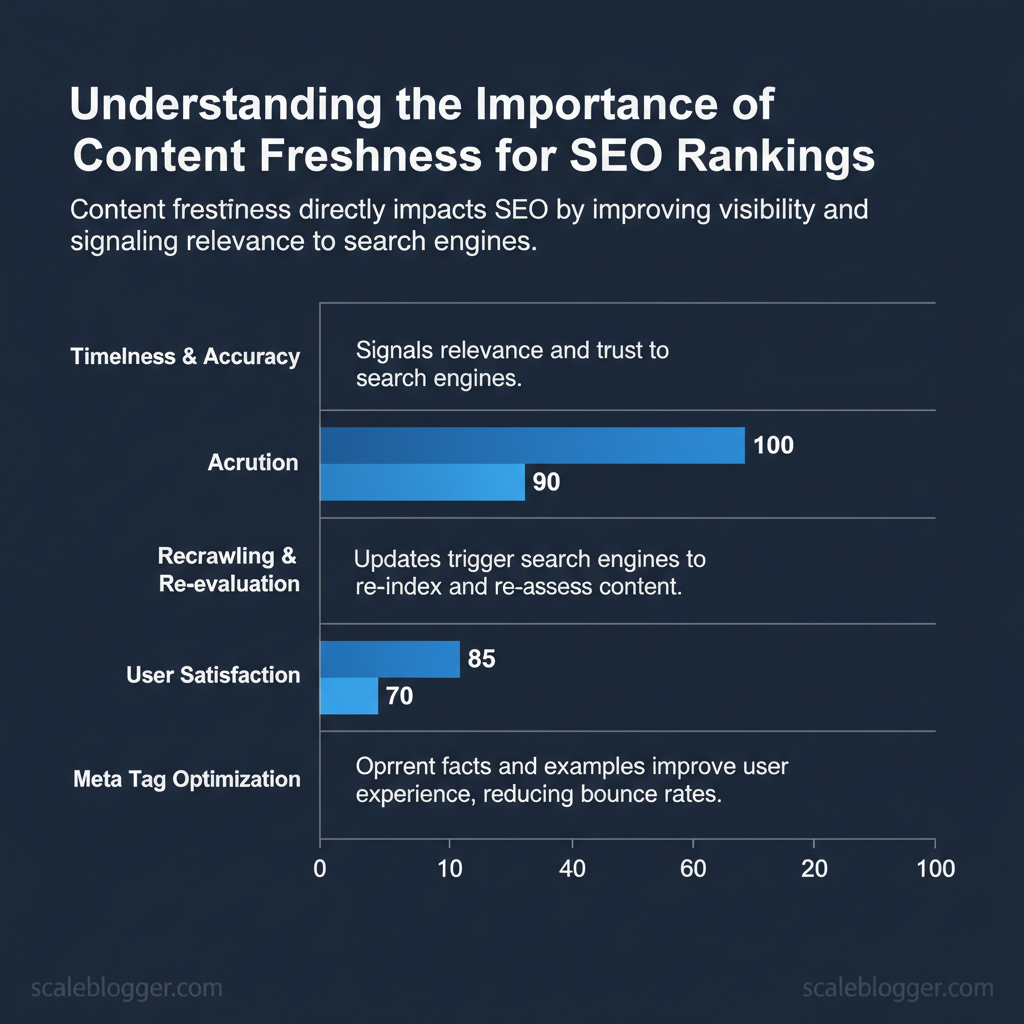
Search engines reward content that is timely, accurate, and well-maintained. Fresher pages may indicate relevance for queries where recent information is important. Updates might also lead to recrawling and re-evaluation, which can boost visibility. For time-sensitive queries—news, product launches, price changes, or rapidly evolving how‑tos—search engines prioritize recent signals.
But freshness also helps evergreen content by keeping facts, examples, and internal links current, which improves user satisfaction and gives you more opportunities to re- meta tags and internal linking for higher click-through rates.
Direct ranking benefits and visibility improvements
Fresh content affects ranking in three concrete ways: it adjusts relevance signals for volatile queries, it increases crawl frequency for updated pages, and it provides new opportunities to title/meta elements for improved SERP CTR. Prioritize updates where the return is highest: pages that already rank on page one for competitive terms, product/pricing pages, and cornerstone how-to guides. Small, meaningful changes—adding new stats, updating dates, refining headings—can push a page from stalling on page two into visible territory.
Feature matrix showing which types of content benefit most from freshness (content update frequency, content types that need freshness)
| Content Type | Benefit from Freshness | Recommended Update Cadence | Quick Update Actions |
|---|---|---|---|
| News / announcements | High — immediate SERP visibility | Daily to weekly | Update headlines, add latest quotes |
| Evergreen how-to guides | Medium — long-term authority boost | Every 3–12 months | Refresh examples, add new screenshots |
| Product / pricing pages | Very high — conversion + rank for transactional queries | Immediately on change; weekly checks | Update prices, specs, structured data |
| Industry trend posts | High — relevance for analyst queries | Quarterly or when new data appears | Insert new charts, cite latest reports |
| Seasonal content | High seasonally — spikes in search demand | Annually, plus pre-season refresh | Update dates, add current promos |
Indirect benefits: user engagement and authority
Freshness boosts click-through rates by enabling updated meta titles and descriptions that reflect current events or offers. Users tend to spend more time on content that references recent developments or data, lowering bounce rates and improving behavioral signals. Over time these engagement improvements strengthen topical authority and increase shareability across social channels, which can generate natural backlinks.
Monitor metrics to prove ROI: 1. Use organic CTR and impressions to measure headline gains. 2.
Track dwell time and scroll depth for engagement. 3. Compare ranking movement before/after updates for attribution.
Understanding these mechanisms helps you prioritize updates where they move the needle most, and tools like AI-assisted auditing can automate spotting high-impact refresh candidates. When implemented well, keeping content fresh reduces wasted effort and steadily improves organic performance.
> Key Takeaway: ## How to Audit Your Content for Freshness Opportunities
Auditing for freshness means identifying pages that need a light update, a complete rewrite, or removal. Start by assembling the right data so decisions are evidence-driven, then score pages…
How to Audit Your Content for Freshness Opportunities
Auditing for freshness means identifying pages that need a light update, a complete rewrite, or removal. Start by assembling the right data so decisions are evidence-driven, then score pages quickly against traffic trends, topical relevance, and estimated effort. This approach turns a noisy spreadsheet into an actionable worklist: low-effort wins, high-impact rewrites, and pruning candidates.
Below you’ll find what to gather, how to export it at scale, and a repeatable prioritization framework with example thresholds you can apply immediately.
Preparing tools and metrics (what to track)
Use a mix of search, analytics, and crawl data to get a 360° view.
- Essential tools to assemble: Google Search Console, Google Analytics / GA4, a site crawler, and an SEO research platform.
- Exact metrics and ranges: Compare recent 90-day vs prior 90-day traffic and impressions, 12-month vs 3-month rankings, CTR, bounce rate, and number of referring internal links.
- Export tips for large sites: Pull GSC in 1-month chunks via CSV export, use GA4’s exploration export for segments, and run crawler exports by subfolder to avoid timeouts.
- Connect GSC for impressions, clicks, CTR, average position over 90/180/365-day ranges.
- Pull GA4
page_pathmetrics for sessions, engagement time, conversions for the same periods. - Run Screaming Frog or Sitebulb to extract meta data, word count, canonical tags, and indexability.
- Use Ahrefs/Semrush for backlink count, organic keywords, and keyword difficulty.
Quick reference: tools, purpose, key metrics to extract, and cost/availability
| Tool | Primary Use | Metrics to Pull | Free / Paid |
|---|---|---|---|
| Google Search Console | Search performance | impressions, clicks, CTR, avg pos | Free |
| Google Analytics / GA4 | Engagement & conversions | sessions, engaged time, conversions | Free |
| Screaming Frog | Technical crawl & meta audit | status codes, meta, word count | Free tier / Paid from £209/yr |
| Ahrefs | Keyword & backlink research | organic keywords, backlinks, traffic est | Paid from $99/mo |
| Semrush | Keyword + competitive insights | keyword positions, gaps, traffic est | Paid from $119.95/mo |
| Moz Pro | Keyword tracking & page optimization | rank tracking, on-page suggestions | Paid from $99/mo |
| Surfer SEO | Content optimization | NLP terms, content score, SERP analysis | Paid from $59/mo |
| ContentKing | Real-time indexing & change tracking | index status, change alerts | Paid from $49/mo |
| Sitebulb | Visual crawl diagnostics | crawl maps, page-level issues | Paid from ~$13/mo |
| Botify | Enterprise crawl & log analysis | log parsing, bot behavior, scale | Enterprise pricing |
Prioritization framework: traffic decline, relevance, and effort
Score each page quickly on three axes: Traffic Trend (T), Relevance (R), and Effort (E). Use simple numeric scores to rank.
- Traffic Trend (T) — 0–3 points: +3 (↑ traffic), +1 (flat), 0 (↓ <30%), -1 (↓ 30–70%), -2 (↓ >70%)
- Relevance (R) — 0–3 points: +3 (core topic), +2 (related), +1 (marginal), 0 (off-topic/outdated)
- Effort (E) — 0–3 points, but invert for ROI: +3 (quick edit <1 hour), +2 (rewrite partial, 2–4 hours), +1 (full rewrite, 1–2 days), 0 (redesign or heavy research)
- Calculate a simple priority score: Priority = ( -T impact if negative ) + R + E — or use Priority = (R + E) – DeclineMultiplier.
- Example thresholds for high priority: pages with traffic decline -30% or more, relevance ≥2, and effort ≥2 → schedule for rewrite within 30 days.
- Low-hanging fruit: pages with modest declines (<30%), high relevance, and effort = 3 → quick updates, metadata refresh, and internal linking.
Practical example: a product guide losing 45% traffic (T = -1), still highly relevant (R = 3), and needs a 2-hour content refresh (E = 3) → priority high; update title, add 2025 stats, refresh CTAs.
Understanding how to score and export these metrics moves teams from guesswork to predictable refresh cycles. When implemented, this approach surfaces fast wins and clarifies where deeper investment will actually improve search performance.
A Practical Workflow to Update Content for Maximum SEO Gain
Treat an update like a mini product launch. Choose the right pages, set measurable goals, and follow a short, repeatable process that combines editorial judgment with SEO signals. Successful updates prioritize intent alignment, on-page relevance, and technical health — not cosmetic edits. This section walks through a hands-on workflow, quick high-impact edits, and practical examples you can replicate in a week-long sprint.
The update workflow (planning, editing, publishing, monitoring)
- Selection & prioritization — 1 day
- Research & outline — 1–2 days
- Content edits & asset creation — 2–4 days
- Technical QA & SEO checks — 1 day
canonical, page speed, mobile layout.
- Publish & monitor — 7–30 days
Workflow timeline showing duration, responsible role, and key deliverables for each update stage
| Stage | Estimated Time | Responsible Role | Deliverable |
|---|---|---|---|
| Selection & prioritization | 1 day | Content Strategist | Prioritized page list (traffic & intent) |
| Research & outline | 1–2 days | SEO Specialist + Writer | Updated content brief, target keywords |
| Content edits & asset creation | 2–4 days | Writer + Designer | New copy, images, CTAs |
| Technical QA & SEO checks | 1 day | SEO Engineer | SEO checklist (schema, speed, mobile) |
| Publish & monitor | 7–30 days | Content Ops + Analyst | Dashboard: rankings, CTR, engagement |
> Tip: Keep a changelog.md for each page so you can audit what changed and when.
markdown changelog for /example-page
- 2025-11-05: Updated H1, added FAQ, optimized meta description (A/B test)
- 2025-11-06: Compressed images, fixed mobile layout shift
- 2025-11-14: Monitored 14-day traffic uplift: +12% clicks
Takeaway: Log changes, assign clear owners, and give the update a monitoring window — that simple discipline separates guesses from measurable improvements. If you want to automate parts of the pipeline (briefs, prioritization, performance alerts), tools for AI content automation like Scaleblogger.com can help scale the process without losing editorial control.
Quick wins and high-impact edits (what matters most)
Start with the edits that move SEO metrics fastest: improve intent match, increase CTR, and eliminate friction.
- Bold headline updates: rewrite H1 to match highest intent query.
- Bold meta description tests: create two variants for A/B CTR testing.
- Bold internal linking fixes: add 2–3 contextual links from high-authority pages.
- Bold content expansion: add 300–600 words where topical gaps exist.
- Bold schema adoption: add
FAQorHowTowhere applicable.
Concrete before/after example: change a generic meta description from “Our product page” to “How to choose X in 2025 — 5 practical tests + free checklist” and run an A/B meta test; a typical result is improved CTR within 2–4 weeks. For A/B testing meta changes, use search console impressions and clicks as your KPI and compare 14–28 day windows; if traffic variance is small, run iterative tweaks rather than large swings.
When teams prioritize these edits and enforce a simple workflow, updates become predictable and measurable. Understanding these principles helps teams move faster without sacrificing quality.
Measuring Impact and Iterating Post-Update
When updating, measure quickly but decide slowly. Monitor early signals to catch issues and allow trends to develop before making big changes. Start with a clear baseline, monitor primary KPIs across short and longer windows, and use explicit action triggers so the next steps — rewrite, expand, merge, or retire — are repeatable and low-friction. Practical thresholds turn opinion into process and protect SEO equity when content changes.
Metrics to monitor and timing for evaluation
Focus on primary search and engagement KPIs first, then layer in backlinks and behavioral signals. Typical monitoring cadence pairs a short-term check (7–14 days) for immediate technical or UX regressions with a long-term window (30–90 days) for ranking and traffic stabilization.- Organic impressions: Baseline: rolling 28–90 day average from
GSC. Short-term: compare 7–14 day % change vs baseline. Long-term: 30–90 day trend for indexation and query spread. - Average position: Baseline: prior 28–90 day average in
GSC. Short-term: watch for sudden drops >5 positions. Long-term: expect slow movement; +2–3 positions in 30–90 days is meaningful. - CTR: Baseline: historical click-through by query. Short-term: immediate UI/title/meta impact in first 7–14 days. Long-term: sustained CTR lift shows relevance improvements.
- Organic sessions: Baseline: prior month(s) average in
GA4. Short-term: early traffic lift or decline — check new vs returning visitors. Long-term: look for steady session growth and lower bounce rates. - Backlinks to page: Baseline: current referring domains from backlink tools. Short-term: look for new links or link removals. Long-term: increased quality links correlate to authority and ranking gains.
Table: Section Content — Metric, Baseline Window, Short-term Window (7–14d) & more
| Metric | Baseline Window | Short-term Window (7–14d) | Long-term Window (30–90d) | Action Trigger |
|---|---|---|---|---|
| Organic impressions | Last 28–90 days average (GSC) |
% change vs baseline in 7–14d | Trendline over 30–90d | Drop >20% or no recovery in 30d → investigate indexing/coverage |
| Average position | 28–90 day avg (GSC) |
Position shifts in 7–14d | Stable trend across 30–90d | Drop >5 positions → rollback title/markup changes |
| CTR | Last 28–90 days by query | Immediate CTR delta after title/meta change | Sustained CTR improvement or decline 30–90d | CTR ↓10%+ after update → test meta/title variants |
| Organic sessions | Monthly avg (GA4) |
7–14d session change, bounce behavior | 30–90d session trend and engagement | Traffic drop >25% or bounce ↑ → audit UX/redirects |
| Backlinks to page | Referring domains (Ahrefs/SEMrush) | New/lost links in 7–14d | Authority growth over 90d | Major link loss or none gained after promotion → outreach SOP |
Iteration loop — when to rework, expand, or retire content
Use clear thresholds and lightweight templates so decisions are fast and defensible.- Evaluate against triggers: if action triggers fire, pick a path: rewrite, expand, merge, or retire.
- Choose the smallest change that addresses the trigger: a title/meta tweak before a full rewrite; expand a section before merging content.
- Run experiments (A/B or staged rollouts) where possible and document results.
- Rewrite brief : use this to scope focused rewrites
Title: [existing title] Problem: [what metric triggered action] Goal: [target KPI and timeframe] Scope: [sections to rewrite, word-count, sources] SEO checks: [target queries, internal links, canonical] QA: [publish checklist, monitor windows]- Merge SOP: map redirects, canonicalize strongest URL, preserve internal links, update site maps, and monitor for traffic consolidation over 30–90 days.
- Archive process: keep a lightweight landing page explaining reason, add 301s to closest topic, retain analytics tag for historical data.
When retiring, preserve SEO equity by redirecting thoughtfully and documenting backlinks to reclaim authority later. If you need a repeatable automation layer for monitoring and rolling updates, tools that provide GSC + GA4 alerts and content scoring can cut decision time — consider integrating an AI content automation partner to surface candidates and predict impact.
> Industry analysis shows refreshed content frequently stabilizes rankings within 30–90 days, while immediate UX fixes appear in engagement metrics within a week.
Understanding these workflows makes iterating less risky and faster, so teams can focus energy on high-impact content instead of firefighting. This approach helps keep content healthy while preserving long-term search value.
📥 Download: Content Freshness SEO Checklist (PDF)
Scaling a Content Freshness Program Across Your Site
Treat freshness as an ongoing program rather than a one-time task. Assign clear roles, set regular schedules by content type, and automate where the benefits are greater than the risks. When teams know who owns category audits, who signs off on factual updates, and what gets auto-refreshed, you scale without drowning in ad-hoc requests. The goal is repeatable handoffs and measurable throughput — pages updated per month, time per update, and quality checks — so you can reallocate effort toward high-impact creative work.
Organizational roles, cadences, and governance
Assign responsibilities and handoffs up front. Use these core roles:- Content Owner: accountable for topical accuracy and performance.
- Editor/Quality Lead: approves tone, SEO, and factual changes.
- SEO Analyst: provides keyword shifts, traffic signals, and priority lists.
- Automation/Dev: implements scheduled exports, CMS scripts, and publish hooks.
- Evergreen/reference — quarterly audits.
- Transactional/product pages — monthly checks for pricing and spec changes.
- News/time-sensitive — daily to weekly monitoring.
- Use version-controlled drafts in your CMS or Git-backed content repo.
- Maintain an update log with reason codes (data update, UX, SEO).
- Escalation path for controversial edits (legal/research sign-off).
Not a cost table per se, but a scalable resourcing matrix showing team size vs recommended monthly update capacity and tool investment level
| Team Size | Monthly Pages Updated | Recommended Tools | Estimated Monthly Effort (hours) |
|---|---|---|---|
| Solo creator | 5–15 | Notion, GSC, ChatGPT |
10–40 |
| Small team (2–5) | 30–120 | Ahrefs, SurferSEO, Zapier |
80–300 |
| Mid-size (6–20) | 200–800 | SEMrush, Contentful, Screaming Frog |
600–2,000 |
| Enterprise (20+) | 1,000+ | BrightEdge, Adobe AEM, BigQuery |
4,000+ |
Automation and tooling to updates
Automation opportunities and trade-offs: Automate detection and draft generation; keep human review for accuracy and brand voice. Common automations: scheduled GSC export → spreadsheet to flag traffic dips, crawl-based page-change detection → CMS draft creation, and templated SERP-driven micro-updates. Sample recipe:bash
Example: scheduled GSC export → Google Sheet → Zapier → CMS draft
0 2 * curl "https://gsc.googleapis.com/..." > gsc.json python map_gsc_to_rows.py gsc.json sheet.csvAI content automation for routing and drafting), but keep approval gates where brand risk exists.
Understanding these principles helps teams move faster without sacrificing quality. When implemented correctly, this approach reduces overhead by making decisions at the team level.
Conclusion
You can stop letting older pages slip away—start by prioritizing regular content audits, measuring impact, and automating routine updates so relevance compounds instead of decays. Across the examples earlier, teams that reworked stale pages into focused guides regained organic traffic within weeks, and editorial teams that automated metadata and internal-link fixes freed hours each month. It is often recommended to focus on mid-performing posts with steady impressions; for revisiting content, a lightweight audit every quarter and a deeper refresh annually may be advisable.
- Audit consistently: schedule recurring checks for traffic, links, and freshness
- Fix high-impact issues quickly: headline, intent, and internal links move the needle fast
- Automate what repeats: template updates, metadata fixes, and content flags
For teams looking to cut the manual drudge and scale updates across hundreds of pages, platforms that automate audits and batch changes can make this process repeatable and measurable. As a practical next step, try one quarterly audit, prioritize ten pages for refresh, and set up automation for recurring fixes. To this work, consider Automate content audits and scale updates with Scaleblogger as one option to accelerate audits and push bulk updates without drowning your team in manual tasks.
