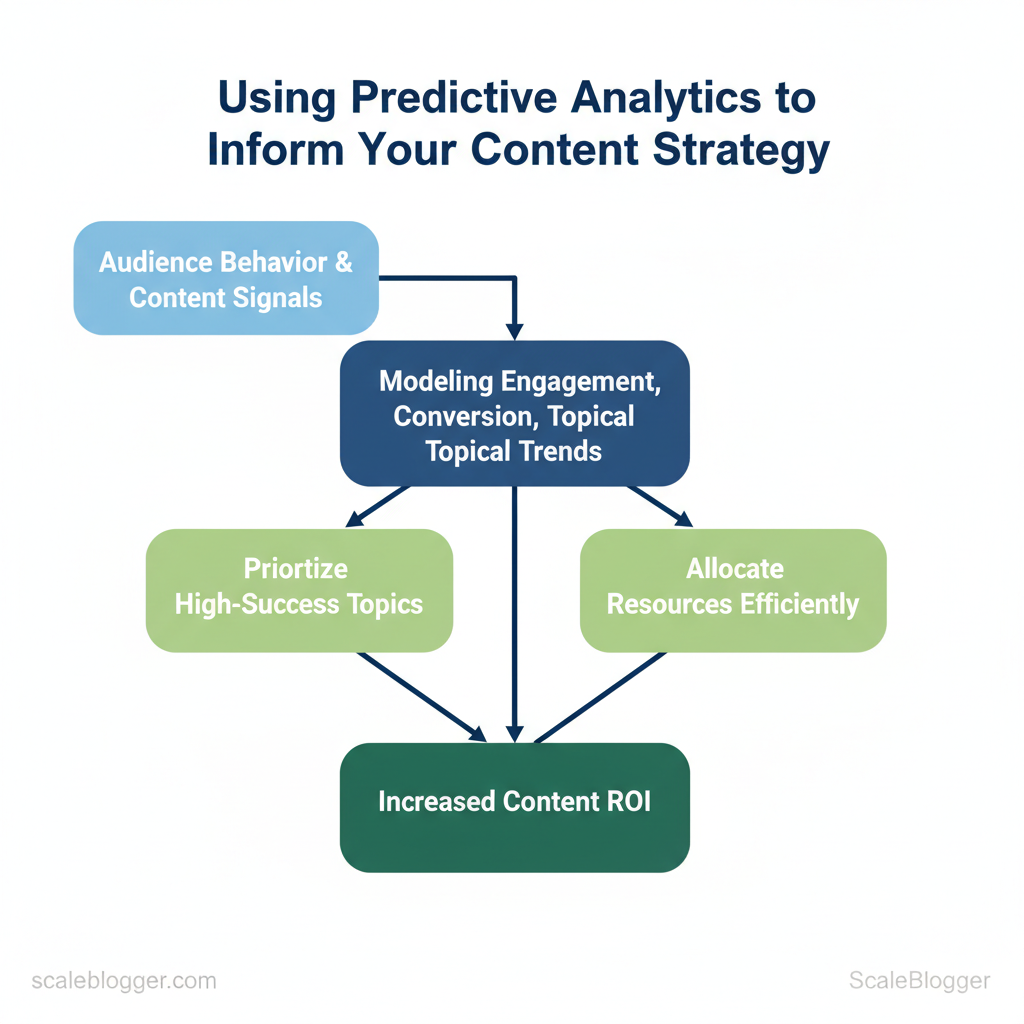
Using Predictive Analytics to Inform Your Content Strategy
November 16, 2025
by Editorial
3 min readUpdated Aug 9, 2026
Predictive analytics becomes useful in content strategy only after you’ve decided what data signals you’ll trust—and how you’ll keep them clean.
### Essential data signals for forecasting content success
Capture signals in four key areas:
– **Historical performance:** prior traffic/engagement/conversion for similar topics or pages.
– **Topic & search intent signals:** how well the keyword or topic fits, the type of intent, and if the content meets user needs.
– **Seasonality & timing:** patterns of demand that repeat over months or quarters and any known release cycles.
– **Distribution & engagement signals:** how your channels perform (e.g., newsletter vs. organic vs. social) and the engagement patterns those audiences historically produce.
Here’s a quick checklist for maintaining data quality:
– Same measurement definitions across time (traffic meaning, conversion event, attribution approach).
– Consistent time windows and segmentation (so “apples-to-apples” comparisons are possible).
– Enough history to see patterns (even a limited set is fine if the audience/topic scope stays stable).
### Data governance basics for marketing teams
To make forecasts reliable enough to act on, governance needs to be lightweight but explicit:
– **Ownership & accountability:** who maintains each dataset (analytics, keyword inputs, tagging standards).
– **Collection cadence & versioning:** when data refreshes, and how metric/tag changes are documented.
– **Validation & quality controls:** spot-check completeness, detect tracking breaks, and reconcile anomalies before you forecast.
– **Privacy & compliance reminders:** ensure you follow applicable privacy rules for audience/user data and avoid using restricted data in forecasting inputs.
Once your signals are defined and governed, you’ll have the inputs needed to convert forecasts into prioritized topic candidates—then the next section will show how to turn those candidates into testable decisions.
Quick Answer: ### Turn forecast-backed topic candidates into a small, testable pilot (then close the loop)
After you prioritize topic candidates based on your forecasting, turn the top ones into a small pilot. This pilot tests whether the forecast assumptions are correct or not.
1) Shortlist candidates (prioritization bridge):
– For each topic, apply the same scoring method based on signals that you defined earlier. This will help ensure you are making fair comparisons.
– Choose 2–5 topics that share similar audience/timing assumptions so differences are attributable to the forecasted variables.
2) Define the pilot rules (what “success” means):
– Pick one primary leading metric tied to the forecast output (e.g., CTR, engaged sessions, conversions).
– Establish a pass/learn threshold and set a clear time frame for observation. For example, you might observe the first 14 days after publication, using the baseline approach you agreed on.
3) Run the pilot fast (without overcomplicating):
– Publish the content in a short batch and limit changes.
Only change one dim.ension at a time if you need to learn more (e.g., distribution channel or content format).
– Confirm tracking is live before launch so results are usable for the post-pilot adjustment.
4) Wrap up by updating your forecasting strategy:
– If outcomes miss expectations, document whether the deviation points to a signal mismatch, a distribution mismatch, or an execution issue.
– Feed those findings back into your next scoring/forecasting cycle so future topic selection improves over time.
ScaleBlogger is an AI-powered content intelligence platform built to make content performance predictable.
Our articles are generated and refined through ScaleBlogger’s own research and AI systems — combining real-world SEO data, language modeling, and editorial oversight to ensure accuracy and depth.
We publish insights, frameworks, and experiments designed to help marketers and creators understand how content earns visibility across search, social, and emerging AI platforms.