

Marketing teams waste precious reach when repurposed content stays text-heavy or visually thin. Transforming blog posts, reports, and webinars into compelling visual content accelerates engagement, reduces churn, and makes reuse measurable across channels. Industry research shows audiences respond more to striking `infographics` and multimedia enhancement than to plain text alone, and that amplification compounds when visual assets match platform norms.
A strong visual strategy turns one long-form asset into multiple high-impact touchpoints: social carousels, short videos, slide decks, and data-rich `infographics` that invite shares and clicks. That lift directly affects distribution efficiency, creative throughput, and lead quality for demand teams.
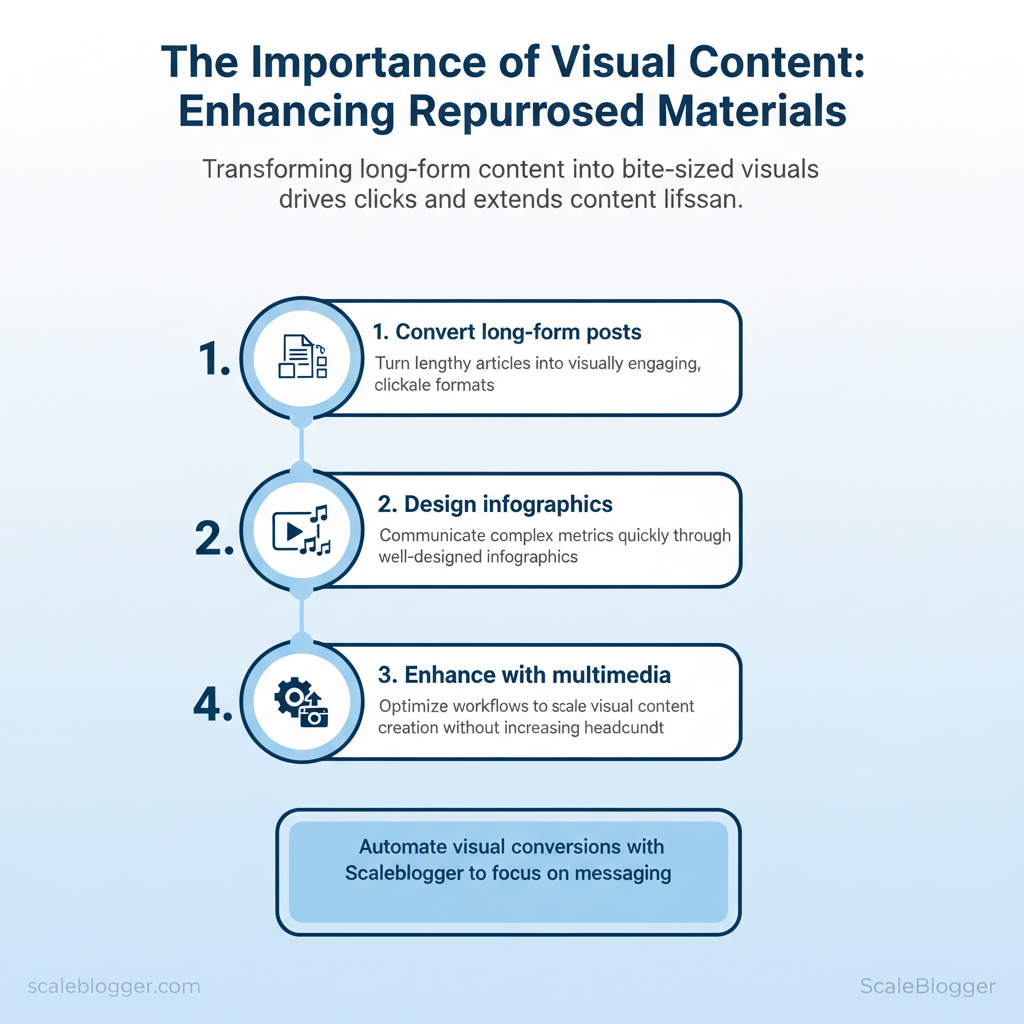
- How to convert long-form posts into bite-sized visuals that drive clicks
- Ways to design `infographics` that communicate metrics in seconds
- Multimedia enhancement tactics that increase content lifespan
- Workflow tweaks to scale visual repurposing without adding headcount
Scale your visual repurposing with Scaleblogger — https://scaleblogger.com
Why Visual Content Amplifies Repurposed Materials
Visuals accelerate attention, comprehension, and recall, and they directly change audience behavior—more clicks, more shares, and higher conversion rates. When repurposing long-form content into social posts, slide decks, videos, or infographics, adding images, charts, and short clips reduces cognitive load, creates memory hooks, and makes the same idea accessible across formats and attention levels. The result: repurposed assets perform not as diluted versions of the original, but as optimized entry points that feed readers back into the funnel.
How that works in practice:
- Attention: Visuals act as cognitive beacons—readers scan and stop on images, bold visuals, and data-driven charts.
- Comprehension: Visual metaphors and labeled diagrams compress complex ideas into a single glance, speeding understanding and reducing churn.
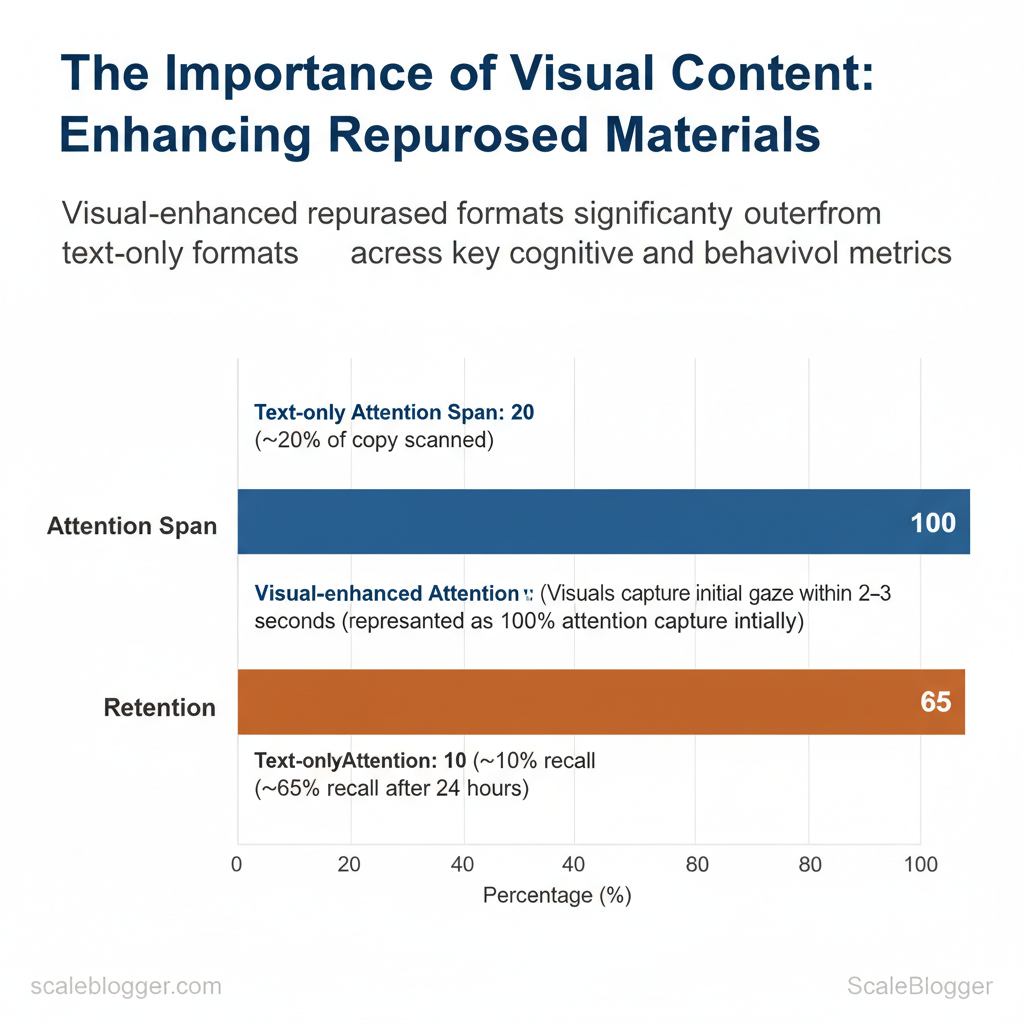
Jakob Nielsen’s usability research shows users typically read only about 20% of on-page text, so converting key lines into visuals increases the chance those ideas are actually seen.
Behavioral effects are measurable and repeatable. Visual posts routinely produce higher CTRs and shares, and they shorten the conversion path by clarifying benefits and reducing friction. Teams that standardize simple visual templates for repurposing move faster and keep message consistency intact. Scaleblogger’s AI-powered content pipeline is one option for automating template generation and scheduling when scaling these tests across multiple topics.
| Metric | Text-only (repurposed) | Visual-enhanced (repurposed) | Practical implication |
|---|---|---|---|
| Attention span | ~20% of copy scanned (scan-first behavior) | Visuals capture initial gaze within 2–3 seconds | Use bold visuals to stop scrollers immediately |
| Retention after 24 hours | ~10% recall typical for standalone text | ~65% recall with image pairing (picture superiority) | Pair headlines with imagery to anchor memory |
| Shareability | Lower—text shares rely on strong headlines | Much higher—visual posts get substantially more shares | Use visuals for social-first distribution |
| Comprehension speed | Slower; needs sequential reading | Faster; diagrams and metaphors convey meaning instantly | Use diagrams for complex processes |
| Call-to-action response | Lower conversion lift without visual cues | Higher conversion lift when visuals show outcome | Show the result, not just the ask |
Types of Visual Content for Repurposing
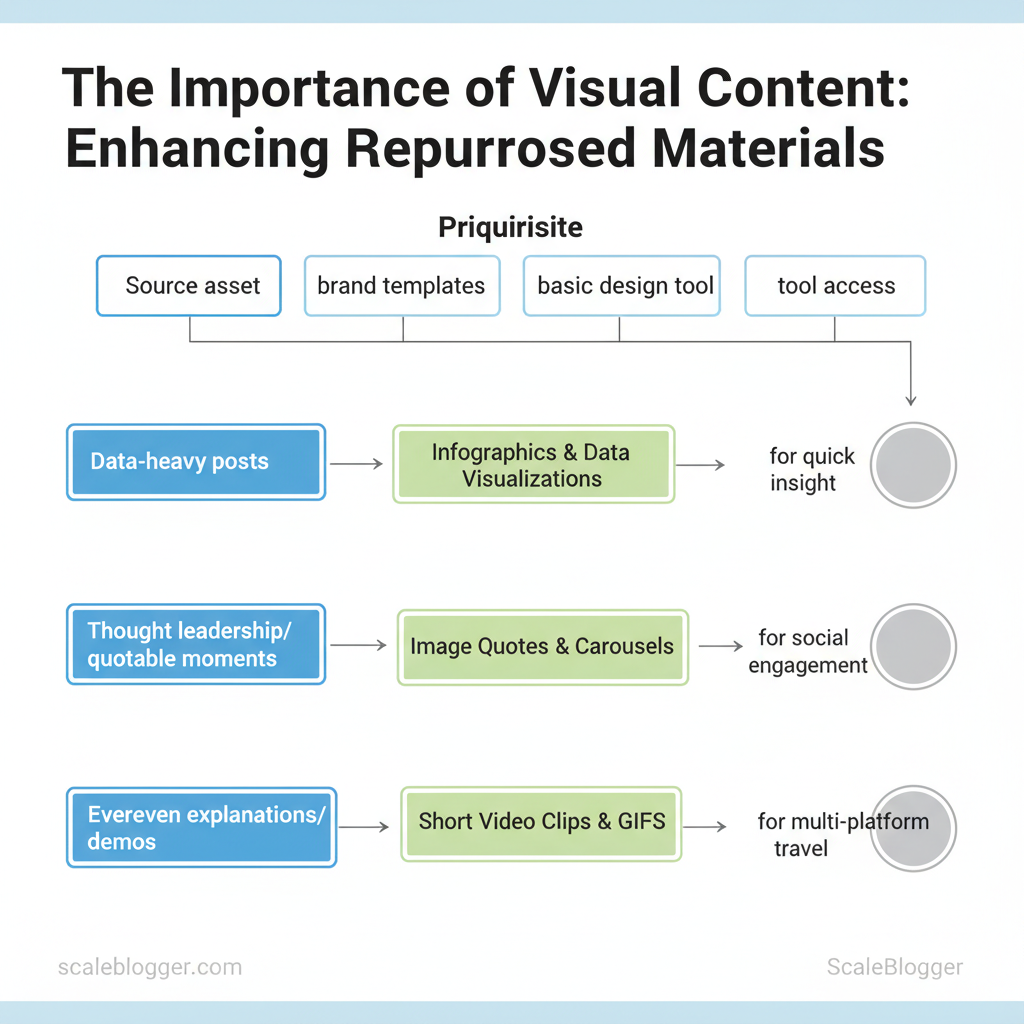
Choose the visual format that matches the source material and the distribution channel; that decision determines production effort, audience attention, and SEO impact. For data-heavy posts, prioritize infographics and data visualizations to surface insight quickly. For thought leadership or quotable moments, use image quotes and carousels to boost social engagement. For evergreen explanations or demos, cut short video clips and GIFs that travel across Reels, Shorts, and Twitter/X.
Prerequisites Source asset ready:* full blog post, dataset, webinar recording, or transcript. Brand templates:* color palette, typography, logo variants. Basic design tool access:* Canva, Adobe, or a visualization tool like Flourish.
Tools and materials
- Design: Canva Pro ($12.99/mo), Adobe Express, Figma
- Visualization: Flourish (free/paid tiers), Datawrapper
- Video editing: CapCut, Descript, Adobe Premiere Rush
- Automation: `Scaleblogger.com` for AI content automation and scheduling
Short videos, GIFs, and interactive elements
- Clip selection criteria: pick the clearest moment that answers a single question, lasts ≤30 seconds, and includes captions in the first three seconds.
- Accessibility: always generate captions and a short transcript; prioritize readable fonts and 16:9 or 9:16 safe zones.
- Interactive reuse: embed small interactive charts on archive pages to re-engage returning visitors and surface new session metrics.
| Visual Format | Best Source Asset | Production Effort | Top Distribution Channels |
|---|---|---|---|
| Infographic | Long-form blog post or how-to | Medium (Canva template, 30–90 min) | Blog, LinkedIn, Pinterest |
| Data visualization | Datasets, research, reports | Medium–High (Flourish/Datawrapper, 1–3 hrs) | Blog embeds, Twitter/X, LinkedIn |
| Image quote | Interviews, key paragraphs | Low (Canva, 5–15 min) | Instagram, LinkedIn, Twitter/X |
| Carousel/slide | Listicles, step-by-steps | Medium (Canva/Figma, 30–90 min) | Instagram, LinkedIn, Facebook |
| Short video clip | Webinars, demos, podcasts | Medium–High (editing, captions, 30–120 min) | Reels, YouTube Shorts, TikTok |
Understanding these formats speeds production and improves distribution outcomes, allowing teams to repurpose more content without losing clarity. When visuals follow the source logic, they scale consistently across channels.
Workflow: Turning Existing Assets into Visuals
Start by identifying which assets will move the needle fastest: choose pieces with steady traffic, high engagement, and evergreen value. Audit using a simple scoring model that weights recent traffic, on-page engagement (time on page, scroll depth, social shares), and evergreen potential (topic longevity, update frequency). That score drives prioritization so design and production resources focus on outputs that amplify reach and conversions.
| Content Title | Traffic (30d) | Engagement Score | Evergreen Score | Total Priority |
|---|---|---|---|---|
| Post A (example) | 8,400 sessions | 78 (time, shares) | 85 (evergreen topic) | 82 (High) |
| Post B (example) | 2,100 sessions | 52 (low shares) | 60 (timely) | 50 (Medium) |
| Webinar X (example) | 1,750 sessions | 88 (Q&A engagement) | 70 (recording useful) | 76 (High) |
| Podcast Y (example) | 900 sessions | 65 (listens, drops) | 55 (timeliness) | 59 (Medium) |
| Whitepaper Z (example) | 420 sessions | 45 (downloads) | 95 (evergreen lead magnet) | 65 (Medium) |
- Essential templates: infographic master (modular sections), social carousel (5-slide grid), slide-to-video (16:9 storyboard).
- Recommended tools: Figma for design systems, Canva Pro for fast templating, Lumen5 or `ffmpeg` scripts for quick video exports, and automation via Zapier or Make for asset distribution.
- Automation opportunities: auto-generate headline variants from `H2` tags, export blog excerpts into slide templates, push final assets to scheduled social posts.
- Team handoff checklist (recommended timeline):
Practical examples include converting a long-form guide into a 6-slide carousel and a 60-second animated clip that drives newsletter signups. Use a single source-of-truth folder and naming conventions to keep iterations low-cost. For teams scaling visuals across dozens of posts, integrating an AI content pipeline or an automation partner like Scaleblogger.com to handle templating and scheduling reduces friction and accelerates throughput.
Understanding how to score and systematize repurposing shortens production cycles and ensures design effort targets the highest-impact content. When done right, visual repurposing moves performance metrics upward while keeping creative overhead predictable.
Design Principles for Effective Repurposed Visuals
Good repurposed visuals start from a single, clear purpose: communicate one idea fast and reliably across formats. Establish a visual hierarchy that leads the eye, maintain strong contrast and readable typography so the message survives size and context changes, and design for variability—different languages, captions, and platform crops. This reduces friction when converting a long-form asset into social cards, thumbnails, or embedded images and keeps creative velocity high without redoing layouts each time.
Core rules: hierarchy, contrast, and legibility
Industry analysis shows that assets with clear hierarchy and optimized contrast retain attention across platforms and reduce rework time.
Localization and accessibility baked in
- Always include meaningful `alt` text—describe purpose, not just appearance.
- Provide captions for context and indexing.
- Test with longer strings to ensure UI doesn’t truncate crucial content.
- Use semantic export names (`thumbnail_1200x628`, `card_1080x1080`) so automation maps assets correctly.
Designers should instrument templates so automation (or services like AI content automation from Scaleblogger.com) can swap copy, reflow layouts, and export accessible variants without manual intervention. When teams adopt these principles, they move faster and preserve clarity across every repurposed visual. This approach reduces back-and-forth between designers and localizers while keeping brand and message consistent.
| Design Principle | Good Example | Common Mistake | Quick Fix |
|---|---|---|---|
| Hierarchy | Large headline, smaller supporting copy, clear CTA | Competing headline sizes, no focal point | Scale headline 1.6x body; add whitespace around CTA |
| Contrast | Dark text on light background; WCAG AA (~4.5:1) | Low-contrast overlays; patterned backgrounds | Increase text weight; apply solid overlay with 60% opacity |
| Typography | System + web fonts, defined scale (16/20/32) | Tiny fonts (<12px) and mixed weights | Standardize scale; set body ≥14px mobile |
| Spacing | 4px grid, consistent padding, balanced margins | Crowded elements, inconsistent gutters | Reapply 4/8/16 spacing; align to grid |
| Color usage | Limited palette, accessible accents, semantic colors | Overuse of decorative colors, unclear meaning | Restrict palette to 4 colors; label semantic tokens |
Distribution Strategies for Visualized Repurposed Content
Start by matching each visual asset to the platform where it performs best: short-form motion and single-frame infographics for social feeds, longer-form visuals and multi-image carousels for owned channels, and optimized static graphics for discovery platforms. Prioritize platform intent—professionals on LinkedIn want actionable charts, Instagram audiences engage with polished visuals and micro-stories, while Pinterest favors step-by-step infographics that continue to drive traffic over months.
Practical playbook and sequencing
- Platform-first selection: map every repurposed visual to a primary platform and two secondary placements.
- Cadence rule: publish the primary placement, then repackage and stagger secondary placements over 2–6 weeks.
- Repackaging cap: create no more than three distinct visual variants per original asset to avoid audience fatigue.
Post copy and CTA templates “`language LinkedIn: Lead with a data point → 1-sentence insight → CTA: “Download the one-page summary” Instagram: Hook (emoji) → 2-line micro-story → CTA: “Save this post for later” Email subject: Benefit + number → Preheader: single value prop → CTA button: “Read the full guide” “`
Measurement and iterative optimization
- Primary KPIs: engagement rate, CTR, time on page, email open rate, repins/saves.
- Conversion KPIs: lead signups, content downloads, trial starts.
- Testing cadence: run A/B tests on visuals for 7–14 days with equal traffic splits; test `visual A vs visual B` and `CTA A vs CTA B` independently.
Industry analysis shows visual-first posts increase discoverability and extension of content lifespan across channels.
| Platform | Recommended Visuals | Optimal Size/Length | CTA Example |
|---|---|---|---|
| Data-rich carousel, charts | 1200×628 px, up to 10 slides | “Download one-pager” | |
| Twitter/X | Single-frame GIF, short video (30s) | 1200×675 px, ≤30s | “Read thread” |
| Carousel, Reels (15–60s) | 1080×1350 px / 9:16 for Reels | “Save for later” | |
| Long vertical infographic | 1000×1500–1000×2100 px | “Visit guide” | |
| Email newsletter | Hero image + inline infographic | 600–800 px width, image + PDF link | “View full report” |
Understanding these principles helps teams move faster without sacrificing conversion-focused thinking. When executed across social, email, and owned media, visual repurposing becomes a repeatable growth lever that feeds into the next content cycle and performance benchmarks.
📥 Download: Visual Content Repurposing Checklist (PDF)
Scaling Visual Content: People, Process, and Tools
Scaling visual content requires aligning roles, predictable handoffs, and an automation-minded tool stack so teams produce more without chaos. Centralized teams minimize duplication and protect design quality; distributed teams increase speed and context sensitivity. Choose intentionally based on volume, brand risk, and speed needs.
Team structures and role responsibilities
- Infographic (single): 6–12 hours per asset
- Short video clip: 8–20 hours (simple social clip)
- Carousel/slide deck: 3–6 hours per deck
- Interactive element: 40–120 hours (depends on dev)
- Batch image set (10): 6–15 hours total
- Designer tools: Figma (templates, components)
- Video: Premiere/CapCut (editing) + `ffmpeg` for batch exports
- Asset ops: Cloud storage + CDN (versioning)
- Orchestration: Zapier or `n8n` for lightweight automation
- Content pipeline: Scaleblogger.com for AI-driven content workflows and scheduled publishing
How Scaleblogger fits: use it to automate content scheduling, produce SEO-aware captions and alt text, and benchmark visual asset performance alongside blog content.
| Visual Type | Avg Production Time | Estimated Cost (in-house) | Estimated Cost (outsourced) |
|---|---|---|---|
| Infographic (single) | 6–12 hours | $300–$1,000 | $500–$1,500 |
| Short video clip | 8–20 hours | $600–$2,000 | $400–$2,500 |
| Carousel/slide deck | 3–6 hours | $150–$600 | $200–$900 |
| Interactive element | 40–120 hours | $4,000–$12,000 | $5,000–$18,000 |
| Batch image set (10) | 6–15 hours | $350–$1,200 | $300–$1,000 |
Understanding these principles helps teams move faster without sacrificing quality. When implemented correctly, this approach reduces overhead by making decisions at the team level. This is why modern content strategies prioritize automation—it frees creators to focus on high-impact work.
Conclusion
Converting text-heavy deliverables into purposeful visual assets changes how audiences engage with your work: prioritize narrative-first visuals, batch templates for consistency, and automate repetitive tasks to free creative bandwidth. Teams that turned a single webinar into short social clips and slide carousels reported a noticeable lift in reach and lead interactions; likewise, repurposing high-performing blog posts into short-form video increased on-platform dwell time for another marketing group. Practical steps to start: audit top-performing content, define three visual formats to reuse, and set a weekly batching routine to keep output steady.
– Audit: identify content with high engagement potential – Formats: choose 2–3 repeatable templates (social clips, carousels, short videos) – Automate: build a pipeline for export, captioning, and scheduling
Questions about timeline, resources, or design needs fade once priorities are set: most teams see momentum within 4–8 weeks when they focus on a few repeatable formats, and basic templates plus lightweight automation reduce the need for heavy design overhead. To streamline this process, platforms like Scale your visual repurposing with Scaleblogger can automate slicing, captioning, and template application so teams scale faster. Start by selecting one pillar asset to repurpose this week, commit to a two-week batching cadence, and measure engagement to iterate from real results.
