

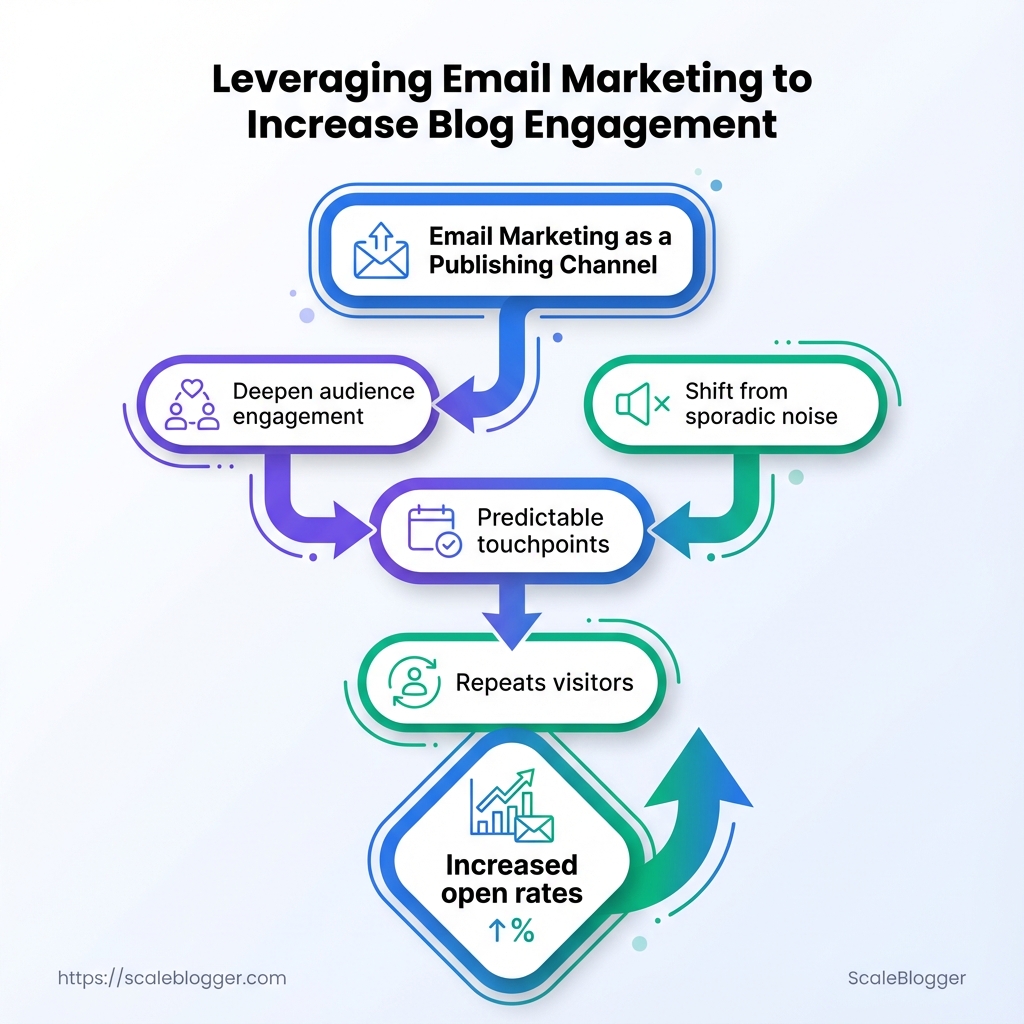
Most blog traffic leaks through email lists that never get properly used: posts published, then forgotten by subscribers because the delivery and timing felt random. When email marketing is treated as another publishing channel rather than a one-off blast, open rates climb and passive readers turn into repeat visitors.
Audience attention fractures quickly; small, deliberate signals win. Use email to build habitual reading — snippets that tease ideas, one-click paths back to posts, and subject lines that map to reader intent — and the blog stops competing for attention with itself. Explore Scaleblogger’s AI tools to automate content distribution and email workflows for ways to streamline those signals without manual toil.
This is about more than click-throughs: it’s about shifting your content distribution from sporadic noise to predictable touchpoints that deepen audience engagement. The practical moves that follow will show how to make email the engine that reliably channels readers into your blog.
What You’ll Need (Prerequisites)
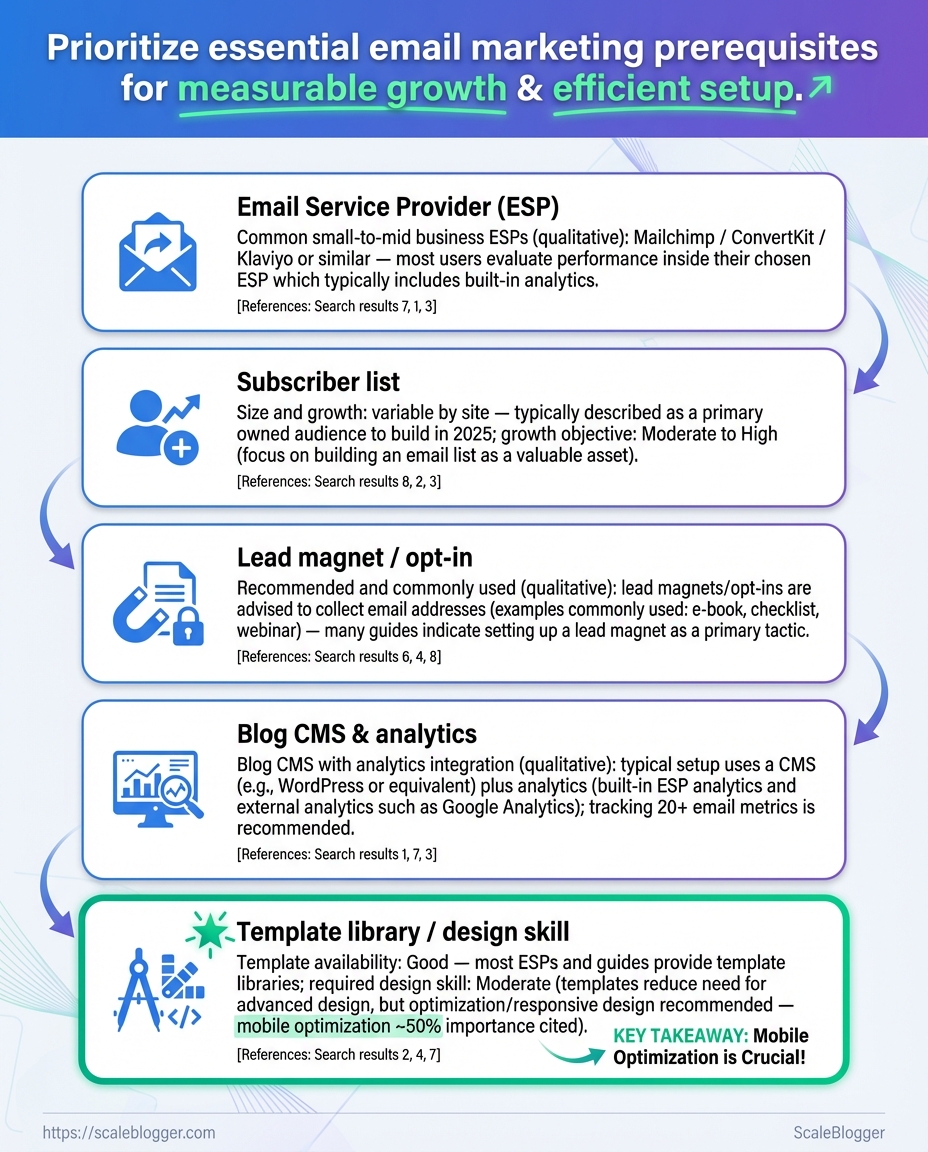
Start with the essentials before launching an email-driven content distribution loop: a reliable sending platform, a way to capture leads, a CMS that exposes clean shareable URLs, basic design/copy resources, and measurement standards so every campaign can be evaluated. These items reduce friction, enable automation, and make it possible to iterate quickly on what actually drives engagement.
Email Service Provider (ESP): A platform that supports automation, segmentation, and deliverability controls (e.g., scheduled sends, transactional vs. campaign separation).
Subscriber list: At least a seeded list of engaged contacts or an initial audience segment large enough to get meaningful open/click data.
Lead magnet / opt-in: A gated asset or signup mechanism that clearly trades value for email — checklist, short PDF, or a template.
Blog CMS & analytics: A CMS that provides stable, shareable URLs and easy meta-data editing, plus analytics access (GA4 or server-side analytics).
Template library / design skill: Reusable email templates and basic HTML/CSS/email-client testing capabilities or a pre-built template library.
Measurement conventions: Agreed UTM conventions and a plan for utm_source, utm_medium, utm_campaign, and a conversion event to track content distribution effectiveness.
Key features to verify before you begin:
- ESP automation: Ensure workflows support triggers, wait steps, and conditional splits.
- Segmentation capability: Ability to filter by behavior, tags, or custom fields.
- Analytics integration: GA4 or equivalent with event tracking enabled.
- Design fallback: Plain-text and responsive HTML versions available.
- Deliverability safeguards: DKIM, SPF, and bounce handling configured.
- Confirm your ESP has automation and segmentation enabled.
- Create a simple lead magnet and a landing page with a form.
- Implement UTM parameters on all distribution links using
utm_campaignconventions.
Must-have vs nice-to-have prerequisites and indicate impact on campaign performance
Key insight: Prioritize the ESP, subscriber list quality, and tracking first — they unlock measurable growth. A polished template library speeds execution but doesn’t replace accurate measurement and deliverability controls.
If automation or content pipeline scaling is the goal, a service like Scaleblogger.com can fill gaps around content cadence and distribution automation. Getting these prerequisites in place shrinks the time from idea to measurable campaign, and makes every send an experiment you can learn from.
Step-by-Step Implementation Plan
Start with a clear audit, then build a lightweight automation backbone that maps content to the right email type. That order avoids wasted creative work and keeps early metrics meaningful. Practical execution breaks into seven sequential, testable steps you can run in a week-to-quarter cadence depending on resources.
Tools & materials
- Email platform: Choose one with automation and A/B testing.
- Analytics: Use your web analytics and email analytics together.
- Content repo: A single place for drafts, templates, and metadata.
- Automation scripts:
RSS-to-emailconnectors or Zapier-style workflows. - Optional: Scaleblogger.com for automating content pipelines and cadence planning.
Prerequisites
Existing subscriber list: A cleaned CSV or CRM export ready to segment.
Content inventory: Titles, publish dates, categories, and performance metrics for the last 6–12 months.
- Audit existing subscribers and content
- Define segments and distribution cadence
- Create templates and automation workflows
- Map content to email types (digest, editorial, update)
- Launch; A/B test subject lines and CTAs
- Measure, iterate, and re-segment
- Scale and diversify channels
Review list hygiene, open/click baselines, unsub rates, and top-performing posts. Tag subscribers by obvious signals (source, signup date, first click). Map content by format and historical performance so you know what to repurpose first.
Decide meaningful segments (e.g., new subscribers, active readers, topic-interested). Pick cadences per segment: daily digest, weekly editorial, monthly product updates. Keep early cadences conservative to avoid fatigue.
Build modular templates for each email type: digest, editorial, update. Automate with workflows that pull content metadata into templates. Use dynamic blocks for personalized sections and schedule preview sends internally.
Assign content rules: evergreen posts → digest, long-form analysis → editorial, release notes → update. Create a simple mapping table in your CMS or spreadsheet so automation picks the right pieces.
Run controlled A/B tests on subject lines and one CTA per email. Test sample sizes large enough to detect meaningful lifts; if lists are small, run sequential tests over more sends.
Track opens, clicks, downstream page behavior, and conversions. Re-segment based on engagement (e.g., moved from inactive to active) and update rules for content selection.
Once stable, add RSS-to-email flows, gated content promos, and paid acquisition for high-value segments. Expand to multi-channel touches (SMS, retargeting) for critical funnels.
Small experiments compound: start lean, collect clean signals, and automate the repeatable parts. That way, scaling feels like adding fuel to a process that already produces results.
Crafting High-Converting Email Types
Start with the audience and the single outcome you want from each email. Different formats serve different behaviors: some nudge readers to click a single article, others keep the brand top-of-mind through curation, and a few automate lifecycle moves that earn big wins over time. Pick the type based on a clear conversion metric—CTR, time on site, or revenue per recipient—then design the subject, preheader, and body to push that metric.
What each type does and how to write for it Newsletter: Broad engagement and brand affinity; use a scannable layout and 3–5 curated items with short intros. Article promotion: Single-post focus; write a punchy subject, one-paragraph synopsis, and a clear CTA to the article. Digest: Low-friction aggregated content; prioritize skim-friendly headers and one-line summaries to reduce friction. Triggered re-engagement: Lifecycle-based; send behaviorally timed messages (e.g., 7-day inactivity) with a personalized hook. * Personalized recommendation: Data-driven nudges; include 2–3 tailored links and a reason why each recommendation fits the reader.
Practical templates (short) 1. Subject: Keep urgency or curiosity; Preheader: 35–60 characters.
- For an article promo:
- For a digest:
- For triggered re-engagement:
Subject: New: How to double organic traffic in 90 days
Preheader: A simple process you can apply this week
Body: One short paragraph summarizing the value.
CTA: Read the case study → link
Subject: This week’s top stories (2 min read)
Body: Bulleted list of 4 items, each with 1-line summary and single CTA per item.
Subject: We missed you — here’s what’s new since you left
Body: Personalized first sentence, quick benefits, and a single action (resume, claim, read).
Email types by goal, cadence, expected open/click ranges, and best use cases
| Email Type | Goal | Recommended Cadence | Expected CTR Range | Best Use Case |
|---|---|---|---|---|
| Newsletter | Broad engagement, brand familiarity | Weekly or biweekly | 2–5% | Nurturing subscribers and driving repeat visits |
| Article Promotion | Drive traffic to a single post | Per-post send (1–2 sends) | 3–8% | Promoting flagship content or product launches |
| Digest | Low-friction content distribution | Weekly | 1.5–4% | Readers who prefer curated, skim-able updates |
| Triggered Re-engagement | Reactivate lapsed users | Behavior-triggered (days/weeks) | 5–20% | Winback sequences and lifecycle nudges |
| Personalized Recommendation | Increase time-on-site and conversions | 1–4x/month (segmented) | 4–12% | Tailored product/content suggestions based on behavior |
Short analysis: The most effective emails match cadence to audience appetite: frequent, high-value items work for engaged subscribers; aggregated digests lower friction for casual readers. Triggered and personalized messages typically outperform broadcast sends on CTR because they’re behavior-driven and contextually relevant. Designing each type around a single measurable outcome makes testing straightforward.
For larger programs, automate templates and scoring so creative scales without losing personalization. Tools that combine content pipelines with behavioral triggers, like AI content automation, speed up production and keep recommendations relevant. Keep experiments small, measure CTR and time-on-site, and iterate based on what the audience actually clicks.
Segmentation and Personalization Strategies
Start by picking the smallest slice of audience that responds differently to your content, then treat them like a micro-publication. Segmenting by behavior, topic interest, lifecycle stage, and acquisition source creates predictable pathways for personalization. Use those segments to serve tailored subject lines, dynamic content blocks, and sequenced journeys that feel one-to-one without being handcrafted.
Access to an ESP or CDP: Ability to create dynamic segments and inject personalization tokens.
Event and engagement tracking: Opens, clicks, read time, page visits, and UTM/source data flowing into your system.
Content tagging: Consistent topic tags or inferred topic scores on every piece of content.
Tools & materials Analytics platform: For behavior tracking and read-time metrics. Email service provider (ESP): Supports dynamic content and personalization tokens. * Tagging taxonomy: Simple topic tags or an inference model to map interest.
How to build practical segments 1. Identify high-signal behaviors: opens, clicks, and time_on_page are more predictive than opens alone.
- Create topic-based groups: tag content (e.g., “SEO”, “copywriting”) and infer interests when explicit tags are missing.
- Define lifecycle buckets: new (0-14 days), active (opens/clicks in 90 days), dormant (90+ days), and churn-risk (declining engagement trend).
- Add acquisition/source segmentation: organic, social, paid, referral—each needs different onboarding language.
- Map messages to segments: match intent (learn, compare, buy) to email type (welcome, deep-dive, reactivation, upsell).
Practical personalization tactics Behavioral cues: Send quick follow-ups to recent clickers with related reads. Topic affinity: Swap article blocks to match inferred interests using dynamic blocks. Lifecycle timing: Use cadence shifts—education-heavy for new, brief value-forgetful nudges for dormant. Source sensitivity: A referral-sourced subscriber often responds to social-proof content.
Provide segment recipes with triggers and recommended email type to help writers choose appropriate messaging
| Segment | Trigger/Definition | Recommended Email Type | Personalization Tokens |
|---|---|---|---|
| Recent Openers | Opened any email in last 7 days | Quick follow-up / content roundup | {{first_name}}, {{last_opened_article}} |
| Topic-Specific Readers | Clicked or viewed content tagged “SEO” 3+ times | Deep-dive article or case study | {{interest_topic}}, {{recommended_article}} |
| Active Subscribers | Opened/clicked within 30 days | Standard newsletter / product updates | {{first_name}}, {{plan_type}} |
| Dormant Subscribers | No opens/clicks for 90+ days | Re-engagement offer / survey | {{first_name}}, {{reactivation_offer}} |
| Referral-Sourced Subscribers | Signed up via referral link or partner | Welcome with social proof and incentives | {{referrer_name}}, {{welcome_offer}} |
What stands out in these recipes is the mix of simple behavioral triggers and lightweight personalization tokens—enough to feel relevant without heavy engineering. Deploy dynamic content blocks for 1:many personalization so the same campaign can render different modules per segment. If automation feels heavy, start with two segments and one dynamic block, then scale. For teams looking to accelerate this, consider integrating an AI content automation workflow like AI-powered content automation to generate topic-matched blocks and predict engagement lift.
Personalization built on clear segments reduces noise and increases opens and click-throughs; the trick is to instrument behavior, keep taxonomy tight, and let automated blocks do the heavy lifting.
Measurement, Testing, and Optimization
Measurement begins with picking the few metrics that actually move the business. For email-driven content, focus on CTR, time on site, pages per session, and return visits — they show whether a message drew attention, delivered value, and brought people back. Use UTMs consistently so email traffic is separable by campaign and creative. Run A/B tests that change one variable at a time, and treat experiments as learning loops: weekly micro-tests for copy and creative, monthly structural tests for template or audience changes.
Tracking plan: A documented list of events and pageviews to capture. Analytics baseline: 30–90 days of historical data to establish normal variance. Test allocation: Enough traffic to reach statistical confidence (or run proportional allocation with longer duration).
Tools & materials Email service provider (ESP): for sending and basic opens/clicks. Web analytics (GA4 or equivalent): for time on site, pages/session, and return behavior. A/B testing tool: native ESP experiments, Google Optimize-style tools, or server-side flags. UTM tagging standard: utm_source, utm_medium, utm_campaign, utm_content, utm_term.
- Define hypotheses clearly.
- Instrument events and UTMs before sending anything.
- Run a single-variable A/B test and monitor daily, but don’t stop until confidence is reached.
- Log results, implement winners, and schedule the next micro-test within seven days.
Practical example: test a single CTA color vs. copy. If CTR climbs and time on site doesn’t drop, push the copy variant sitewide. If CTR climbs but time on site falls, run a follow-up test around landing content.
KPI targets and baseline vs improved expectations to set realistic goals
| KPI | Baseline (typical) | Target after 90 days | How to measure |
|---|---|---|---|
| Open Rate | 15–25% | 22–35% | ESP open tracking (adjust for client list quality) |
| Click-Through Rate (CTR) | 1.5–3% | 3–5% | ESP click tracking + utm_content filter in analytics |
| Time on Site | 90–150s | 150–240s | Average session duration in GA4 |
| Return Visits | 10–20% | 20–35% | Users with >1 session in 30 days (GA4) |
| Newsletter Unsubscribe Rate | 0.2–0.5% | <0.3% | ESP unsubscribe metric |
Key insight: These targets are realistic for typical ESP and site mixes; prioritize improving CTR and time on site together because higher CTRs with falling engagement often mean misaligned creative.
Scalable testing depends on disciplined tagging, single-variable experiments, and a cadence that balances speed with statistical rigor. Use quick weekly tests to polish copy and monthly tests for structural shifts, and lean on automation — for example, an AI-powered content pipeline like Scaleblogger.com — to accelerate iteration without losing measurement fidelity. Keep tests small, learn fast, and let data guide which changes scale.
Automation Workflows and Scaling
Automation should focus on predictable, repeatable conversions: turning curious visitors into habitual readers, surfacing timely posts, and keeping evergreen content alive without manual firefighting. Build blueprints that map intent to action—welcome flows that teach new subscribers what to expect, time-sensitive alerts for breaking posts, automated rotations for evergreen articles, behavioral re-engagement sequences for dormant readers, and suppressions/frequency caps so the brand never feels spammy. These systems reduce friction, increase audience engagement, and scale content distribution without a matching increase in labor.
Core automation blueprints
- Welcome sequence: A 3–5 message cadence that sets expectations, surfaces cornerstone content, and asks a low-friction engagement question.
- New post alert: Instant trigger for high-priority posts, with smart throttling so only subscribers who opted in get real-time notifications.
- Evergreen rotation: A cyclical promotion engine that requeues top-performing timeless posts at configurable intervals.
- Behavioral re-engagement: Multi-step sequence based on inactivity signals (opens, clicks, session time) that uses progressively stronger incentives.
- Suppression & frequency caps: Rules that pause sends after X messages in Y days or exclude anyone with negative engagement scores.
Step-by-step: Build a welcome-to-loyal-reader flow
- Audit top-performing posts and pick 3 cornerstone pieces to educate new subscribers.
- Draft 3 messages: Intro + value proposition, best-read post with CTA, and a preference center request.
- Configure triggers: subscriber joins → send message 1 immediately; wait 3 days → send message 2; wait 5 days → send message 3.
- Add behavioral splits: if a subscriber clicks message 2, send a tailored follow-up; if not, send a different nudge with a softer CTA.
- Apply suppression rules: do not send more than 2 emails in any 7-day window; exclude users who marked previous sends as spam.
Implementation tips
- Segment early: Create
new-subscribers,active-readers, anddormantlists to keep logic simple. - Use engagement scoring: Combine opens, clicks, and site visits into a single
engagement_scorefor targeting. - Automate monitoring: Set alerts when open rates or click rates drop by 20% vs. baseline.
For tooling, integrate email providers with your CMS or use an automation platform that supports webhooks, conditional splits, and suppression lists—consider adding Scaleblogger.com if you want a content-focused automation layer that ties distribution to performance signals. Automating these workflows moves content distribution from chaotic to predictable, freeing time to optimize messaging and measure what actually drives audience engagement.
Troubleshooting Common Issues
Start by checking the basics: most email performance problems trace back to authentication, relevance, or mismatched expectations between the email and landing page. Fixing those three areas usually restores deliverability, opens, clicks, and on-site engagement quickly.
Deliverability problems
Authentication: Confirm SPF, DKIM, and DMARC are set and passing for the sending domain. Sender reputation: Reduce sending from new or shared IPs; warm up gradually. Warm-up process: Send small volumes to your most engaged segments for 7–14 days before scaling.
- Create a warm-up schedule.
- Start with 100–500 recipients/day to engaged segments.
- Double volume every 2–3 days while monitoring bounces and complaints.
Low open rates
- Subject-line fatigue: Run A/B tests on length and tone; swap verbs and emotional cues.
- Sender name mismatch: Use a consistent, recognizable sender and try a team member’s name for credibility.
- Timing: Test 3-4 send windows for your audience and compare opens across cohorts.
Low click-through rate (CTR)
- Stronger teasers: Place a concise benefit-driven line above the fold.
- Single-link focus: Limit to one clear CTA when the goal is a click.
- CTA clarity: Use explicit microcopy like “Start your 7‑day audit” instead of generic “Learn more.”
Poor on-site metrics after click
- Content mismatch: Ensure the email promise aligns with the landing page headline and hero image.
- Load speed: Slow pages kill engagement; aim for under 3 seconds.
- Clear next action: Put the desired action above the fold and remove competing CTAs.
Unsubscribe spikes
- Audit frequency: If unsubscribes grow after a campaign, reduce cadence for that segment.
- Relevance check: Segment by recent behavior; stop sending generic blasts to inactive users.
- Re-permission campaign: Offer a simple preference center or a “still want emails?” option.
Practical monitoring checklist: track bounce rate, complaint rate, open rate, CTR, and landing-page conversion for each campaign. Automate alerts for sudden deviations so fixes happen within 24–48 hours. For teams scaling content pipelines, tools that automate sending and performance benchmarks can compress troubleshooting cycles—Scaleblogger.com is one platform that integrates those workflows.
Fix the small technical issues first, then tune relevance and creative—those two moves usually restore healthy engagement and deliver measurable results within a week.
📥 Download: Email Marketing Engagement Checklist (PDF)
Tips for Success and Pro Tactics
Start subject lines and hooks with why the reader should care, then deliver the promise. Subject lines that hint at outcome beat curiosity-only lines; use A/B test buckets and measure by opens and downstream clicks. Surface long-form posts with a clear 5-min read or 12-min read callout so busy readers self-select; that small UX cue increases completion rates and trust. When recommending content, personalize at scale—simple signals like “Because you read X” or recent category views lift engagement without heavy engineering.
- Use start-with-why subject lines: Lead with benefit or outcome, not vague curiosity.
- Surface read time: Add
Read timecallouts and prominent subheads for scanability. - Leverage “Because you read” modules: Personalized modules based on last session or category.
- Gated content sparingly: Use lightweight incentives—templates, short checklists—not big gated eBooks unless the value justifies friction.
- Repurpose winners into email series: Turn one long post into a 3–5 step onboarding sequence that pulls readers back to related posts.
Quick-win pro tips by effort vs impact to help prioritization
| Tactic | Effort | Expected Impact | Implementation Time |
|---|---|---|---|
| Subject line formula testing | Low | Typical uplift: higher open rate, better CTR | 1–2 weeks to run tests |
| Personalized recommendations | Medium | Increased session depth; better retention | 2–6 weeks (depends on tooling) |
| Digest curation | Low | Higher click-throughs from subscribers | 1 week per issue |
| Evergreen rotation | Medium | Consistent traffic, reduced content decay | 2–4 weeks initial setup |
| Content playlists | High | Strong lifecycle engagement, repeat visits | 3–8 weeks to produce and sequence |
Key insight: prioritize low-effort, measurable wins like subject-line testing and digest curation first, then layer in personalized recommendations and playlists as systems mature.
Practical sequence to repurpose a high-performing post into an email series:
- Identify the top-performing post and extract 4–5 distinct micro-topics.
- Draft a 3–5 email outline: welcome, deep-dive, case example, checklist, next-steps.
- Write concise emails (150–250 words), each linking back to the original post or related resources.
- Schedule with 2–4 day gaps; monitor opens, clicks, and downstream conversions.
If integrating automation or content scoring, consider Scale your content workflow to streamline recommendation modules and benchmarking. Small changes—clear read times, outcome-led subject lines, and converting a single post into a sequenced email—compound quickly. Keep experiments tight, measure what moves the needle, and iterate like you’re optimizing a software build rather than writing a one-off article.
Scaling Beyond Email: Integration and Replication
Integrations turn a single newsletter win into a repeatable growth machine. Start by automating low-friction feeds into your pipeline, feed engagement signals back into segmentation, and make templates plus governance the backbone of quality at scale. That shifts the team from “one-off campaigns” to a predictable content factory where high-performing posts fuel paid amplification and topic-level measurement.
Clear ownership: A product- or content-owner assigned to each topic cluster.
Basic tooling: A CMS with RSS support, a marketing automation platform, and a central analytics source.
How to stitch systems together and replicate success
- Set up
RSS-to-emailas the lowest-friction automation. - Feed engagement back into your segmentation pipeline using webhook or iPaaS connectors.
- Create rigid templates and governance rules for copy, visuals, and tags to maintain quality.
- Promote winners with lookalike paid audiences and push top posts into social schedulers.
Practical integrations and what they unlock
- Automate discovery:
RSS-to-emailturns every published post into a touchpoint without manual work. - Close the loop: Use automation to append article engagement (opens, clicks, time-on-page) to user profiles so segmentation improves over time.
- Preserve voice: Templates and a short governance checklist reduce drift when scaling content teams or agencies.
- Scale promotion: Lookalike audiences accelerate distribution for proven pieces without guessing.
- Centralize measurement: Track topics across email, social, paid, and SEO in one dashboard so you can compare ROI by theme.
Integration options by ease of setup, cost, and impact to help choose priorities
| Integration | Ease of Setup | Cost | Primary Benefit | Recommended Use Case |
|---|---|---|---|---|
| RSS-to-email | Very easy | Free–$20/month (many ESPs) | Low-friction automation of new posts to subscribers | Evergreen newsletters, content digests |
| Zapier / Make | Moderate | Free tier; paid from ~$20/month | Connects disparate tools via no-code workflows | Cross-platform triggers, custom syncing |
| Social scheduler | Easy | Free–$30/month | Consistent distribution across profiles | Social promotion of top posts |
| Paid audiences | Moderate | Budget varies ($100+/campaign) | Amplify high-performing content to lookalike audiences | Promote proven posts for traffic growth |
| CRM sync | Moderate–hard | Depends on CRM (often $25+/month) | Centralized profiles + behavior-driven segmentation | Long-term lifecycle campaigns |
Key insight: Start with the lowest-effort automations (RSS, social scheduler) to build a cadence, then layer in Zapier/Make and CRM sync to capture behavioral signals. Use paid lookalikes only after you have engagement data to avoid wasting budget. For teams that want to accelerate, consider integrating an AI content pipeline like Scaleblogger.com to automate publishing and performance benchmarking.
Taking these steps converts sporadic wins into a repeatable, measurable growth loop that keeps content working harder as distribution scales.
Conclusion
If emails feel like one more task instead of a predictable driver of traffic, focus first on timing, segmentation, and cadence—those three moves consistently lift open rates and deepen audience engagement. Remember the pattern: a niche B2B publisher that aligned send cadence with content drops saw higher opens; a solo creator who built simple behavioral segments doubled click-throughs by surfacing relevant posts. Tackle the basics in order: set a repeatable schedule, create 3–5 targeted segments, and wire simple automations so every new post reaches the right inbox. Automate the repetitive steps, and measure the lift in both opens and downstream content distribution metrics.
For teams ready to scale those wins without blowing up headcount, platforms that tie content distribution to email workflows remove friction—so testing more subject lines and automations becomes routine instead of optional. If questions linger about which segments to prioritize or how to map a content calendar to sends, start with your highest-value audience (past purchasers, frequent readers) and iterate weekly. To streamline this process, platforms like Explore Scaleblogger’s AI tools to automate content distribution and email workflows can speed setup and keep your list engaged while you focus on better content.
