

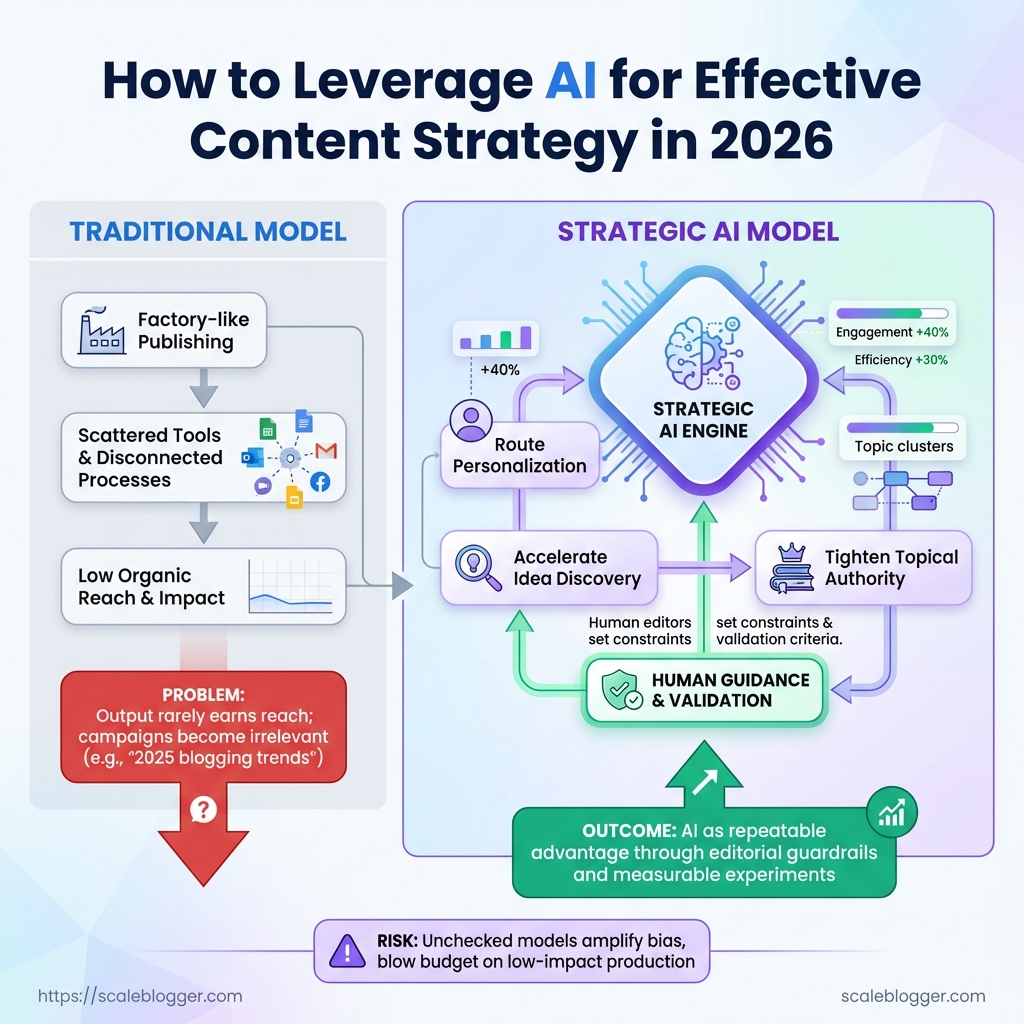
Most content teams still treat publishing like a factory: recipe-driven briefs, scattered tools, and a calendar that swells faster than traffic. The result is lots of output that rarely earns organic reach, and months-long campaigns that change course when search intent shifts. Those who remember the abrupt pivots from 2025 blogging trends know how quickly a headline strategy can become irrelevant.
The practical leverage comes from treating machine intelligence as a strategic layer, not a content press. A well-designed AI content strategy accelerates idea discovery, tightens topical authority, and routes personalization into real distribution channels — when the human editors set the constraints and validation. Left unchecked, models amplify noise, amplify bias, and blow budget on low-impact production.
What matters now is less about chasing every shiny automation and more about wiring AI into decisions that move KPIs: topical coverage, conversion lift, and sustainable organic traffic. Teams that align clear editorial guardrails with measurable experiments turn AI from a flashy capability into a repeatable advantage.
Understanding AI in Content Strategy
AI in content strategy means using machine intelligence to make content planning, creation, distribution, and measurement faster, smarter, and more repeatable. Rather than replacing human judgment, AI automates routine work, surfaces patterns in audience behavior, and suggests what to create next so teams can focus on high-value creative and strategic decisions.
What is AI content strategy: AI content strategy combines algorithmic insight with editorial strategy to optimize the entire content lifecycle — from ideation and drafting to publishing cadence and performance optimization. It pairs models that understand language and metadata with process automation.
Core components and examples
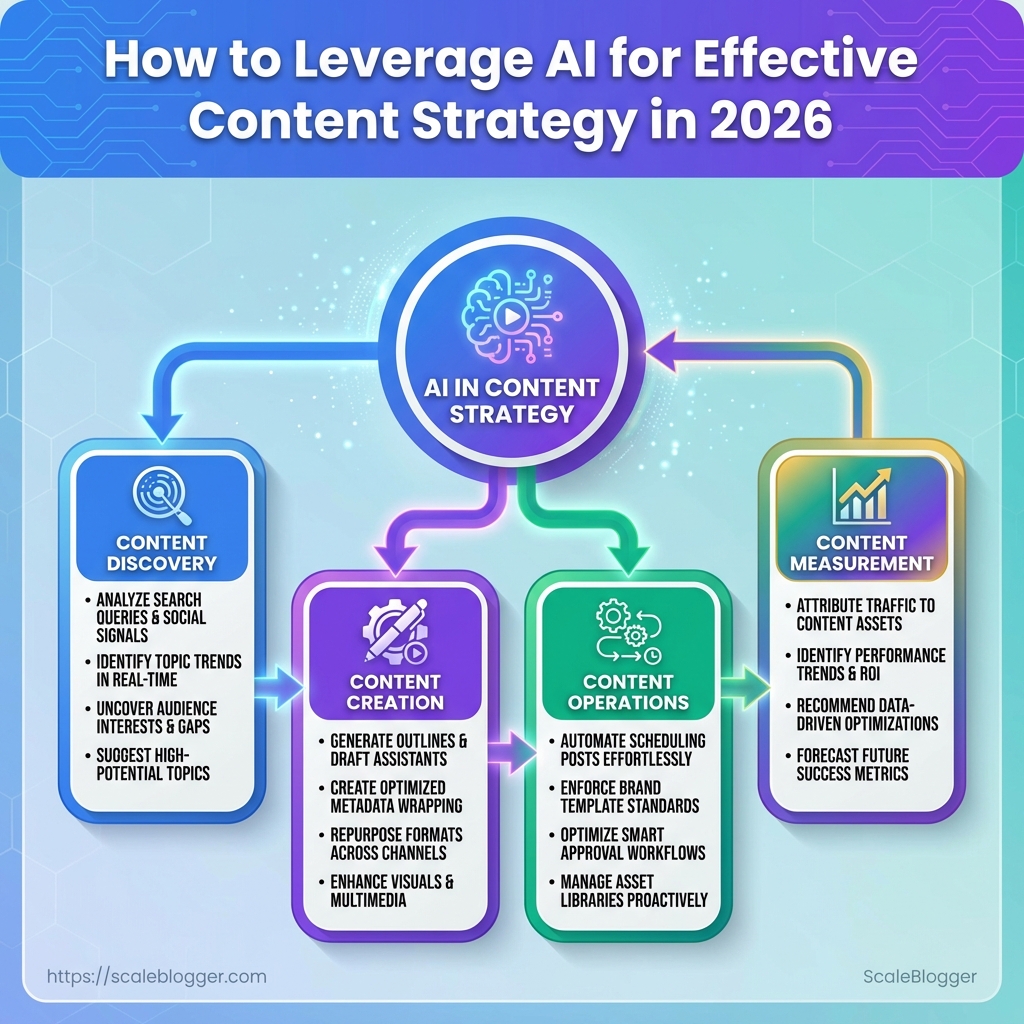
Content discovery: AI analyzes search queries, social signals, and your site analytics to suggest topics that match intent and gaps in coverage.
Content creation: Models generate outlines, drafts, metadata, and repurposed formats (e.g., long-form to social posts) while preserving brand voice.
Content operations: Automation schedules publishing, enforces templates, and routes drafts for review.
Content measurement: AI attributes traffic and conversions to content, identifies trends, and recommends optimization actions.
Examples of AI tools and capabilities:
- Topic research: Tools that cluster keywords and suggest content hubs.
- Draft generation: Large language models that produce first drafts or improved headlines.
- SEO optimization: Systems that score factors like readability, keyword coverage, and internal linking.
- Workflow automation: Pipelines that auto-schedule posts and push metadata into CMSs.
- Performance benchmarking: Platforms that compare content ROI across competitors and industries.
Benefits of applying AI
- Faster ideation: Generate dozens of validated topic angles from a seed idea.
- Consistent output: Maintain tone and template compliance across many posts.
- Smarter prioritization: Allocate effort to high-impact pieces using performance forecasts.
- Lower operational cost: Reduce repetitive tasks like metadata entry and scheduling.
- Better personalization: Tailor content fragments to audience segments automatically.
Quick way to get started
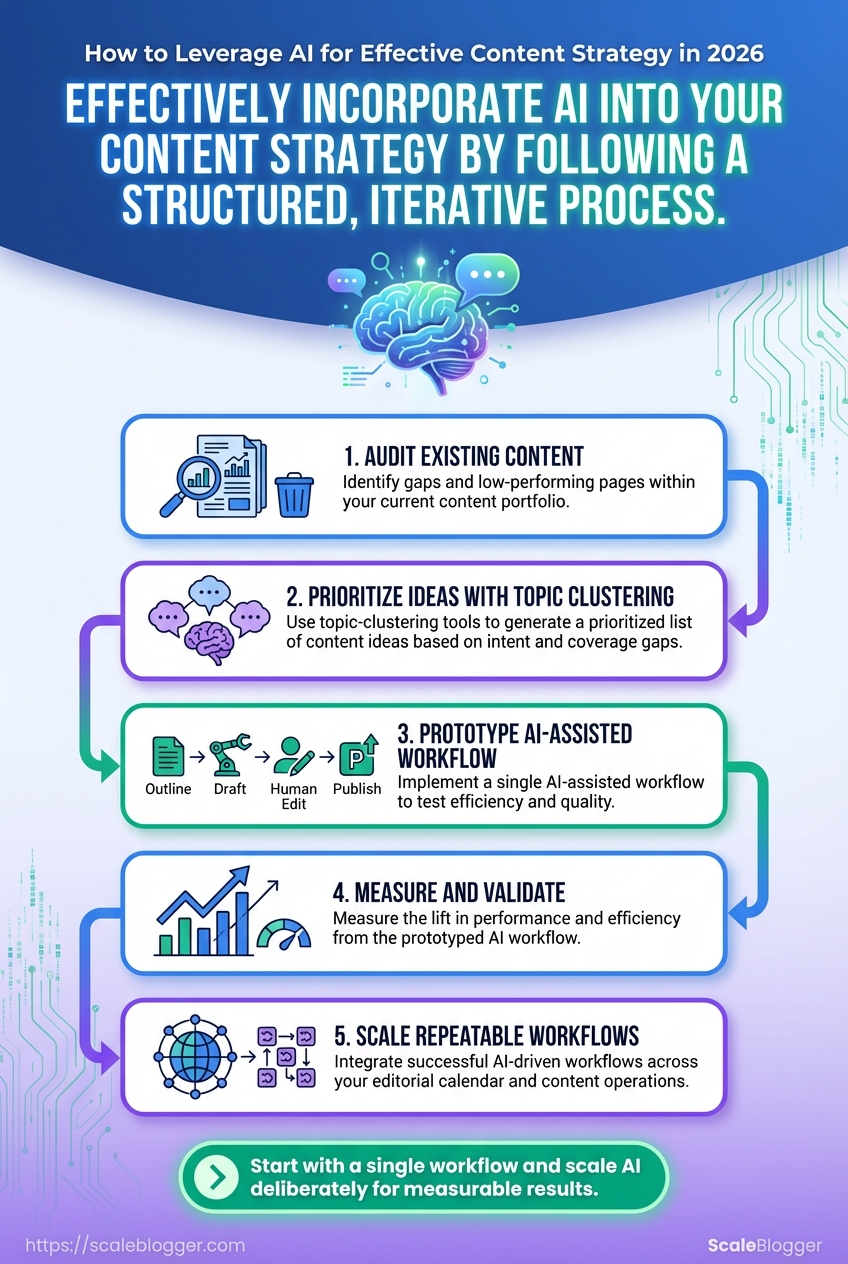
- Audit existing content to identify gaps and low-performing pages.
- Use a topic-clustering tool to produce a prioritized list of ideas.
- Prototype one AI-assisted workflow (outline → draft → human edit → publish) and measure lift.
Scaleblogger’s AI-powered content pipeline is one practical option for automating drafts and scheduling, alongside generic tools for topic research and SEO optimization. Trying a single repeatable workflow first reveals whether AI is lifting quality and efficiency before scaling it across the editorial calendar.
When AI is used deliberately, it reduces busywork and surfaces the creative opportunities that actually move results — which is exactly what modern content teams need to win attention in 2025 blogging trends.
Key AI Tools for Content Creation
Top-tier AI tools now handle idea generation, draft writing, SEO optimization, and editing. Pick tools that match the stage of your content pipeline: brainstorming and outlines, drafting, on-page SEO, or polishing voice and grammar. The right stack mixes a large language model for creativity, an SEO layer for discoverability, and an editing tool for consistency. Below are practical tool picks, what they do best, and where they slot into a modern content workflow.
- Brainstorming & outlines: use models that produce rapid concept variations and content briefs.
- Drafting: favor tools that support
APIaccess and team collaboration to scale production. - SEO & optimization: combine content editors with keyword and SERP analysis capabilities.
- Editing & style: add grammar, tone enforcement, and readability checks as the final gate.
- Pipeline automation: connect tools to publishing and analytics systems to close the loop—this is where automation partners like Scaleblogger add tangible value.
Features and use cases of top AI content tools
| Tool Name | Key Features | Best For |
|---|---|---|
| ChatGPT (OpenAI) | Natural language generation, multi-turn prompts, API for automation |
Rapid drafts, ideation, developer integration |
| Jasper AI | Templates for ads/blogs, tone controls, team workflows | Marketing copy, multi-user content teams |
| Surfer SEO | SERP-based content grading, keyword planner, editor integration | On-page SEO optimization and editorial briefs |
| Grammarly | Advanced grammar, tone detection, plagiarism check | Final editing, brand voice consistency |
| Copysmith | Bulk content generation, e-commerce focused templates, integrations | Product descriptions, scalable marketing content |
Key insight: these five cover the core needs—creative generation, SEO alignment, and final polishing—while offering integration points for automation. Use ChatGPT or Jasper to produce drafts, feed them into Surfer SEO for SERP alignment, and finish with Grammarly for clarity. For scaling across many posts, add an automation layer or partner (for example, Scaleblogger’s AI-powered pipeline) to connect these tools into a repeatable process.
Choosing a combination based on role—creator, optimizer, editor—saves time and raises consistency across content. Pick one tool per stage, automate handoffs, and measure results so the stack improves with real performance data.
Incorporating AI into Your Content Strategy
Start by mapping where AI will remove friction and amplify results rather than replace judgment. Treat AI as a workflow accelerator: it handles repetitive research, draft generation, and optimization signals so humans can focus on strategy, nuance, and brand voice. That approach reduces time-to-publish and raises content velocity without sacrificing quality.
Where to start and what to expect
- Assess current gaps: Inventory content topics, production bottlenecks, and performance shortfalls.
- Prioritize high-leverage tasks: Editorial calendar planning, brief generation, first drafts, headline testing, and SEO optimization are common wins.
- Set quality gates: Define human review steps for factual accuracy, brand tone, and legal checks.
Step-by-step integration process
- Conduct a content audit and map processes to time and value.
- Identify candidate tasks for AI: research briefs, outlines, drafts, metadata, and A/B headline variants.
- Choose tools that fit each task, and run pilot projects on 3–5 pieces of content.
- Define human-in-the-loop checkpoints for editing, verification, and publishing.
- Scale successful pilots into an automated pipeline with monitoring and KPIs.
Implementation tips and practical examples
- Start small: Run a two-week pilot where AI generates outlines for four pillar posts; editors convert them into finished pieces.
- Measure impact: Track time saved per draft, ranking improvements, and engagement lift.
- Avoid verbatim outputs: Always edit AI drafts for voice, accuracy, and original angles.
- Integrate with scheduling: Connect AI outputs to automated publishing queues to cut manual handoffs.
Tools & roles: Productive stacks typically combine an LLM for drafts, an SEO tool for keyword intent, and a CMS integration for scheduling. Scaleblogger’s AI-powered content pipeline fits naturally here if automation of drafting-to-publishing is a priority.
Provide a clear workflow for integrating AI
| Step | Action | Outcome | |—|—|—| | 1 | Audit content, map bottlenecks | Clear list of automation candidates | | 2 | Select AI tasks and tools | Focused pilot scope | | 3 | Run pilots (3–5 posts) | Measured performance signals | | 4 | Add human review gates | Quality and compliance maintained | | 5 | Automate pipeline & monitor KPIs | Faster cadence, measurable ROI |
Key insight: Pilots reveal where AI adds speed without harming quality; human checkpoints preserve brand integrity while automation improves throughput.
This approach keeps control where it matters and automation where it helps, so content teams ship more, learn faster, and keep the brand voice consistent.
2025 Blogging Trends Fueled by AI
AI is no longer an experiment on the side; it’s the engine reshaping how blogs are planned, produced, and measured. Expect content strategies to shift from one-off posts to continuous, data-driven pipelines where models suggest topics, generate first drafts, and optimize distribution. This changes roles — writers will lean into idea curation, voice refining, and strategic editing while automation handles repetitive production tasks. The practical result: more posts, faster iteration, and content tailored to intent signals rather than vanity metrics.
What to watch closely: AI-assisted ideation: systems surface topic clusters and headline variants based on search intent and engagement signals. Personalized content journeys: dynamic content experiences adapt article bodies and CTAs to reader cohorts. Automated SEO optimization: NLP models optimize on-page elements and internal linking at scale. Quality-first automation: human editors certify model outputs to keep brand voice and factual accuracy. * Performance feedback loops: continuous A/B testing feeds model retraining to improve conversions.
Showcase statistics and predictions for blogging trends
Key insight: These trends converge on velocity plus relevance — more posts, but smarter posts. Automation increases output, and human oversight preserves quality.
- Start small: automate topic generation first.
- Add draft automation once editorial guardrails are set.
- Close the loop with performance-based adjustments.
Integrating automation thoughtfully avoids churn and maintains trust. For teams aiming to scale, building an AI-powered content pipeline that includes approval steps and performance benchmarking pays dividends in reach and efficiency.
Measuring the Success of AI-Driven Content
Measuring whether AI-driven content is actually working means tracking a blend of audience signals, SEO outcomes, and business results—then tying those back to the content process itself. Start with a clear set of KPIs, instrument pages and templates consistently, and compare AI-generated pieces against human-written baselines. That way you can judge not just traffic but whether the content improves attention, conversions, and content velocity per dollar spent.
KPIs for measuring AI content success
How to interpret and act on these KPIs
- Instrument pages consistently.
- Add
GA4page-scoped events and UTM parameters to content links. - Baseline performance before scale-up.
- Run A/B tests comparing AI-assisted drafts to human drafts for the same topics.
- Monitor engagement and search signals weekly.
- Set automated reports in Looker Studio and alerts for drop-offs.
- Attribute conversions back to content.
- Use event-based attribution in
GA4and CRM tracking in HubSpot. - Calculate unit economics.
- Track hours saved, editing cost, and revenue per article to get ROI.
Practical tips while measuring
- Segment comparisons: Compare like-for-like (same topic intent and publish date range).
- Blend qualitative with quantitative: Use Hotjar recordings to understand why engagement metrics move.
- Track lifecycle: Measure 30/90/180-day performance to catch slow-burn SEO wins.
The table above helps prioritize which metrics to instrument first; start with organic traffic and a reliable conversion metric, then add engagement and efficiency layers. When those lines move together—traffic up, time on page up, conversions steady or rising—you have practical evidence that AI-driven content is delivering business value.
Challenges and Considerations
AI-driven content systems speed things up, but they also introduce new friction points you can’t ignore. Common barriers fall into three buckets: quality control, workflow integration, and measurement. Left unchecked, each one erodes reader trust, wastes resources, or produces misleading metrics. The first step is recognizing which of those is the real bottleneck for your team—then apply targeted fixes.
- Quality drift: When models generate plausible-sounding but inaccurate content, editorial overhead spikes.
- Tool sprawl: Multiple point solutions create handoffs and duplicate work between
CMS, analytics, and production. - Ownership ambiguity: Nobody owning the prompt-to-publish path causes slow reviews and inconsistent voice.
- Performance measurement gaps: Vanity metrics mask real impact on organic traffic and conversions.
- Compliance and bias risk: Automated generation can unintentionally repeat biased or non-compliant language.
Practical steps to overcome these barriers
- Map the content lifecycle end-to-end.
- Define measurable quality gates.
- Reduce tool friction with a single
content pipeline. - Assign clear roles and SLAs.
- Tie content KPIs to business outcomes.
Identify every handoff from ideation to publish, including who approves prompts, who verifies facts, and who signs off on SEO.
Set pass/fail criteria for drafts (original reporting, fact-check pass, target keyword coverage), and automate automated checks where possible.
Consolidate planning, drafting, and scheduling tools or stitch them with lightweight automation so files, metadata, and timestamps flow without manual re-entry.
Create a Prompt Owner, Editor, and SEO Analyst with response-time SLAs to prevent decision bottlenecks.
Replace surface metrics with a small set of outcome-focused KPIs: organic sessions from targeted clusters, lead-attribution per post, and topical authority growth.
Real examples and trade-offs
- Small team: Use a simple checklist and a single shared
Google Docworkflow to keep quality high without heavy tooling. - Mid-size editorial org: Invest in automation to sync
CMSmetadata and schedule posts; saves hours per week but requires upfront engineering. - Enterprise: Centralize guidelines and run frequent model audits for compliance; costs more but reduces legal and brand risk.
Quality gate: A defined review checklist that every AI draft must pass before publication.
Resolving these challenges takes iteration—start with a high-impact bottleneck, prove the approach, then scale processes and automation. That way, efficiency gains stick and content keeps serving real business goals.
📥 Download: AI-Driven Content Strategy Checklist for 2026 (PDF)
Conclusion and Future Outlook
Adopting AI for content creation no longer feels experimental—it’s the practical route to scale audience reach while keeping quality intact. AI-powered systems handle repetitive tasks, surface topic opportunities, and accelerate iteration cycles, freeing human writers to focus on strategy and storytelling. Expect the next 12–24 months to be about integration: teams that pair editorial judgment with automated pipelines will publish more often, test smarter, and adapt faster to shifting 2025 blogging trends.
What this looks like in practice is a move from one-off content pushes to continuous, data-informed content programs. That means building a steady pipeline that feeds drafts, optimization suggestions, and performance signals into editorial workflows. The payoff is measurable: more keyword coverage, higher content velocity, and faster learning loops for what resonates with readers.
> Industry analysis shows AI-driven content pipelines accelerate production without sacrificing quality.
What to start doing now
- Map your current workflow: Document each step from ideation to publishing so automation targets are obvious.
- Prioritize repetitive bottlenecks: Automate research, metadata, and first-draft generation first.
- Keep humans in editorial control: Use AI for scale, not final judgment—editors should shape voice and nuance.
- Measure lift, not just output: Track engagement, conversions, and time saved to justify investment.
- Experiment with formats: Test short-form, long-form, and repurposed content to match 2025 blogging trends.
Next milestones to aim for
- Audit existing content and identify 20% that can be refreshed with AI-driven optimization.
- Implement an automated scheduling and publishing pipeline that reduces turnaround by 30–50%.
- Set up monthly performance benchmarks to iterate on topics and formats based on reader behavior.
Scaleblogger’s AI-powered content pipeline and automated scheduling tools fit naturally into this approach when teams want a turnkey option to accelerate adoption. They integrate content creation, benchmarking, and publishing so the technical lift is minimized and the focus stays on creative outcomes.
Walk away from this with a practical mindset: adopt small automations first, protect editorial standards, and measure impact. That combination is what turns AI from a novelty into reliable growth.
Conclusion
After shifting publishing from a factory model to an AI-augmented workflow, content teams consistently get more traffic with less wasted effort. Combining AI for research and drafting with human editing, topic clustering, and measurement changed outcomes for several teams: one mid-sized B2B blog doubled organic visits by automating gap analysis and focusing on cluster pages, while another editorial team cut briefing time in half by using AI to generate standardized outlines. If you’re wondering whether AI will replace writers or how to prove ROI—the pattern shows it amplifies skilled writers and gives measurable signals (rank changes, engagement, conversion lift) you can track.
Start by running a small experiment: pick a content cluster, use AI to draft outlines and internal links, then measure results over 90 days. Prioritize human review, set clear KPIs, and iterate based on real performance data. For a practical roadmap and tools that fit each stage of this process, see ScaleBlogger’s playbook and toolset. When ready to scale those experiments into a repeatable system, Explore our AI tools to enhance your content strategy today!
