

You may publish solid posts every week, but if search visibility barely budges, it often indicates a lack of a clear, focused topical authority.
Establishing topical authority—a recognizable command over specific subjects—can significantly enhance your content’s performance.
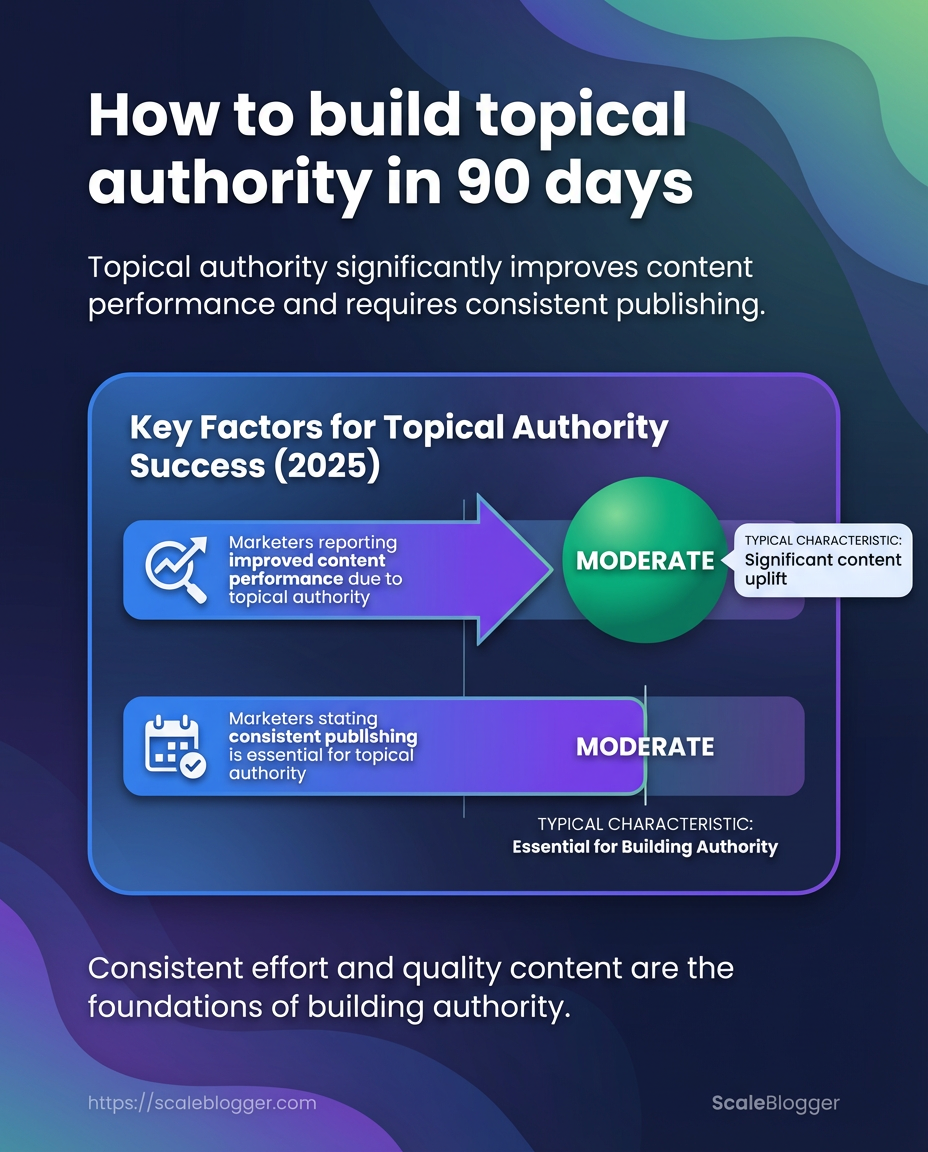
In fact, in 2025, 66% of marketers reported this improvement according to HubSpot.
The mechanics behind it are simple yet crucial: consistency paired with depth is key.
Content Marketing Institute’s findings show that 72% of marketers maintain that a steady publishing schedule (3–5 posts per week) is essential for establishing this authority.
The path to topical authority isn’t merely about filling the calendar; it’s about engagement.
Actively responding to audience feedback and iterating based on comments signals relevance to readers and helps you gain the favor of search engines.
This is where our intensive 90-day plan comes into play: it will outline actionable steps to build your authority in a structured manner.
Defining topical authority and the 90-day challenge
What happens when your site becomes the obvious place people go for one topic? Traffic stabilizes, backlinks arrive naturally, and search engines start treating your pages as reference material.
That shift—when readers and algorithms both recognize expertise—is what people mean by topical authority.
Topical authority is not vague prestige.
It’s a measurable position you earn by covering a subject comprehensively, linking related ideas across pages, and engaging an audience that returns.
In practical terms you see higher organic rankings, longer session times, and more conversion-ready traffic.
A 90-day time-box forces focus.
Instead of thinly spreading effort across dozens of topics, you concentrate research, publishing, and promotion on a single topical cluster.
That compression speeds learning, surfaces the highest-impact content gaps, and creates momentum you can measure every week.
What topical authority looks like in practice
Topical authority: A site-wide perception of expertise on a specific subject, built through depth, structure, and engagement. 90-day challenge: An intensive, time-boxed program to build measurable authority on one topic through focused content and distribution. Measurable outcomes: Rank improvements, organic traffic growth, backlinks earned, engagement metrics (time on page, comments), and conversions tied to topic pages. Concrete outcome example: a marketing blog that publishes an interconnected topic cluster of 12 in-depth posts over 90 days typically sees faster indexing and clearer internal linking signals.
Tools from Moz and Ahrefs help spot content gaps and backlink opportunities during that sprint.
66% of marketers reported in 2025 that building topical authority significantly improved content performance, while 72% in 2025 said consistent publishing (3–5 posts weekly) is essential for establishing authority.
How the 90-day time-box changes priorities
Focus on fewer topics, not more. Depth beats breadth during a sprint.
Prioritize cornerstone pages first, then supporting posts and guides.
Trade short-form pieces for a higher share of long-form, research-backed content.
Editorial cadence: Plan for 3–5 substantial pieces weekly.
Promotion: Spend as much time on distribution as on writing.
Feedback loop: Use audience comments and social signals to refine the next batch of posts.
When the 90 days end, you’ll have a clear baseline: rankings, backlinks, and engagement to measure progress.
That concentrated effort creates a foundation you can scale rather than a scattershot archive of half-finished topics.
Topical authority is built by design, not by chance.
A focused 90-day challenge turns intent into measurable momentum.
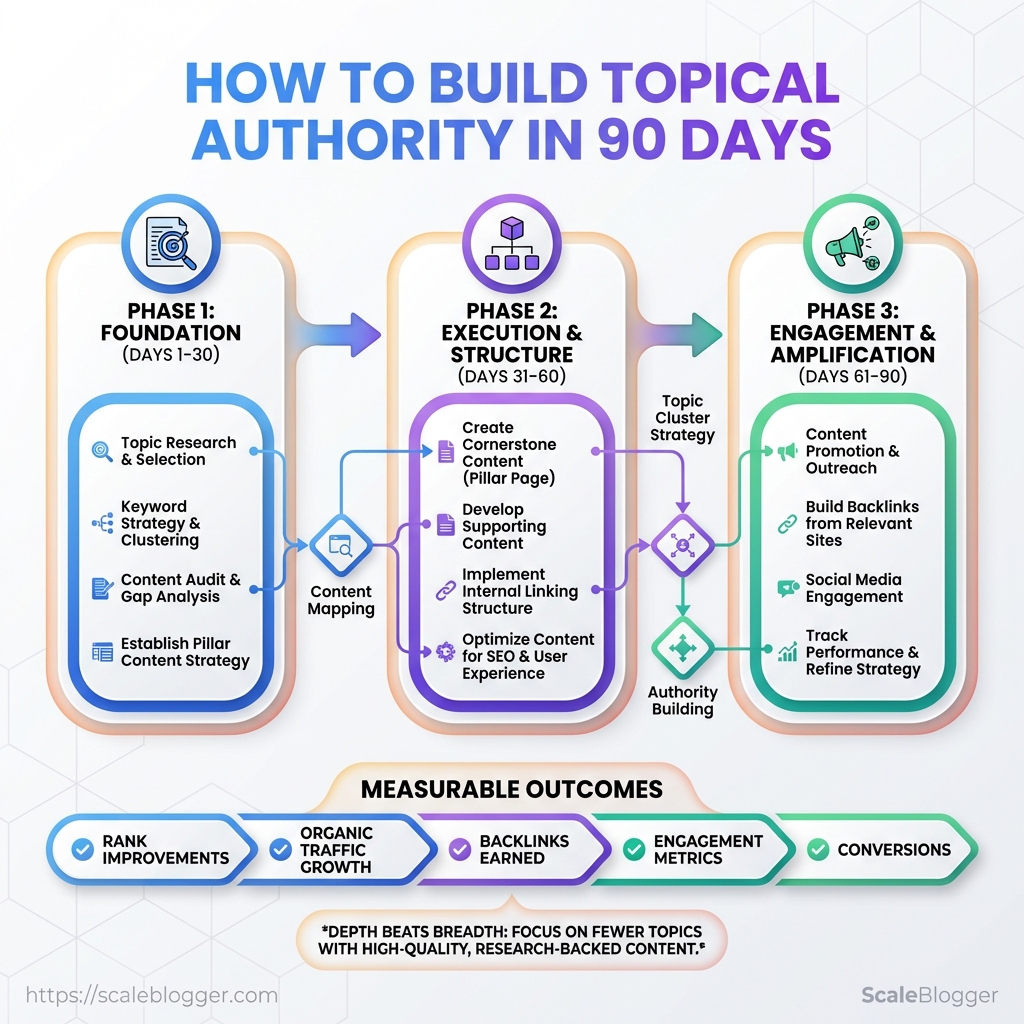
Start: rapid audit and pillar selection (Days 0–7)
Imagine arriving Monday with a messy blog and leaving Sunday with a prioritized roadmap that your editors can actually follow.
This week is about ruthless triage: measure what moves the business, then pick a small set of pillars you can own.
Treat the audit like a lab test.
You want signals that link content performance to revenue, acquisition, or retention—nothing vague.
Conducting a focused content audit: what to measure and why Begin by pulling five high-value metrics that map to real business outcomes.
Each metric answers a direct operational question: is this content bringing people who convert, or just eyeballs that bounce?
Export organic traffic, impressions, and clicks from your search console for the last 90 days.
Look for pages with steady impressions but falling clicks — they’re quick wins for title/meta fixes.
Pull landing-page conversion rates from analytics (sign-ups, trials, MQLs).
Pages with decent traffic and above-average conversion warrant more topical depth.
Inventory backlinks and referring domains with tools like Moz or Ahrefs to find pages already earning links.
Those are priority defenders and expansion candidates.
Estimate production cost: time to research, draft, edit, and design.
Build a
cost-to-publishcolumn so you can compare ROI across topics.Note audience engagement signals — comments, shares, session duration — to understand who finds the content useful.
Each of these maps to a question you can act on in days, not months. Audit metric: Organic clicks — Pages with clicks but low conversions need conversion optimization. Audit metric: Impressions without clicks — Quick title/description wins. Audit metric: Backlinks per page — Signals editorial authority and link-building potential.
Selecting 3–5 pillar topics tied to business signals Pick pillars that align with sales priorities, product-led growth levers, or recurring support queries.
Imagine pillars as business themes that absorb marketing effort and generate measurable outcomes.
Product-led pillar: Topics that map to highest-value product features or buyer-stage queries.
Acquisition pillar: High-intent search clusters that historically convert or are actively targeted by paid channels.
Support-to-content pillar: FAQ clusters that reduce support load and feed product content.
Thought-leadership pillar: Narrow, high-differentiation topics that earn links and partnerships.
The visual maps each pillar to 6–10 subtopics and 1–2 target keywords per subtopic.
Use this when assigning briefs so writers know scope and keyword focus.
Prioritization criteria: traffic potential, intent fit, and production cost Rank each candidate pillar by three scores: Traffic Opportunity (search volume and impressions), Intent Fit (how closely queries match revenue actions), and Production Cost (hours and budget).
Traffic Opportunity: High = large, addressable search demand; Low = niche but valuable.
Intent Fit: High = buyer/convert intent; Medium = research intent; Low = awareness-only.
Production Cost: High = long-form, experiments, multimedia; Low = listicles or editorial updates.
Score pillars 1–5 on each axis, then multiply Intent Fit × (Traffic Opportunity / Production Cost) for a simple priority index.
Tools such as https://scaleblogger.com can help automate scoring and schedule the top pillars for the 90-day plan.
HubSpot research shows this matters: 66% of marketers reported building topical authority improved performance (2025).
And consistent publishing remains critical — 72% of marketers in 2025 said 3–5 posts per week are essential for authority.
Choose pillars that connect cleanly to measurable business signals so editorial work becomes predictable and accountable.
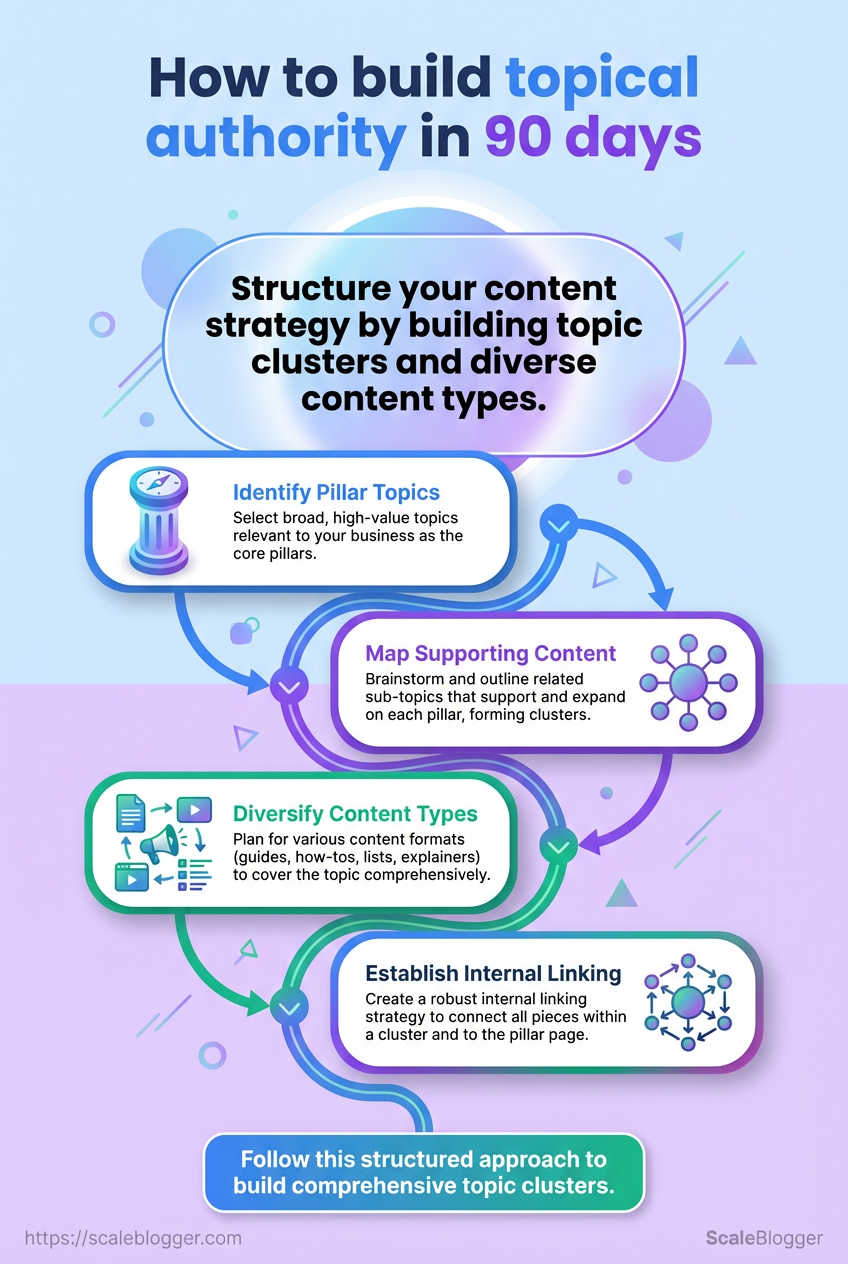
Structure: building topic clusters and content types (Days 8–21)
Imagine turning a scattered set of posts into a navigable ecosystem where every piece serves the pillar and each internal link moves readers deeper.
Days 8–21 are about shaping that ecosystem: define the pillar, then choreograph supporting posts and practical resources so search engines and humans see a cohesive story.
Start by deciding which questions the pillar answers comprehensively and which follow-ups deserve their own posts.
Then pick formats that fit intent—long explainers for learning, FAQs for quick answers, case studies for credibility, and tools or templates for action.
Designing a topic cluster: pillar page, supporting posts, and resources
A pillar page should be the single authoritative guide that organizes the topic into logical sections.
It links out to supporting posts that dig into subtopics, and it aggregates resources like templates, calculators, or downloadable checklists.
Pillar page: authoritative, evergreen guide that maps the topic and hosts the main internal links.
Supporting posts: focused deep-dives that target long-tail queries and answer narrow intents.
Resources: reusable assets (templates, tools, datasets) that earn links and increase time on site.
Matching content format to intent: guides, FAQs, case studies, and tools
Different user intent calls for different formats.
A how-to guide is for users ready to act.
An FAQ captures fragmented queries and ranks in rich snippets.
Case studies convert by showing proof.
Tools and templates create return visits and backlinks.
How-to guides: step-by-step solutions for action-oriented queries; good for conversions.
FAQs: short-answer blocks aimed at informational or navigational intent; optimized for featured snippets.
Case studies: narrative proof showing measured outcomes; use metrics and before/after visuals.
Tool/resource roundups: comparison-style posts that attract links and long-tail traffic.
Content mapping template for consistent coverage
Below is a practical mapping you can copy into your CMS. It ties a content piece to intent, target keywords, production effort, automation role, and cadence.
Content mapping template for consistent coverage
Content Piece | User Intent | Target Keyword(s) | Estimated Effort (hrs) | AI/Automation Role | Publication Cadence |
|---|---|---|---|---|---|
Comprehensive research / education | “complete guide to [topic]” / “[topic] overview” | 40 | Outline, draft generation, internal link suggestions, schema | One-off, update quarterly | |
How-to guide | Task completion / action | “how to [task] [topic]” / “step by step [topic]” | 12 | Drafting, code/example snippets, meta descriptions | Biweekly |
FAQ | Quick answers / voice search | “[topic] FAQs” / “what is [topic]?” | 6 | Generate Q&A pairs, schema markup | Weekly |
Case study | Trust & proof / conversion | “[company] [topic] case study” / “results [topic]” | 16 | Draft interview + metrics extraction, headline A/B | Monthly |
Tool/resource roundup | Comparison / evaluation | “best [topic] tools” / “[topic] tools comparison” | 14 | Compile features table, summarize pros/cons | Quarterly |
Short-form social post | Awareness / distribution | “[topic] tip” / “[topic] insight” | 2 | Create caption variants, schedule posts | 3–5x per week |
This template forces consistent coverage across intent types and makes internal linking predictable.
Use the effort estimates to budget editorial capacity and let automation handle drafting, metadata, and scheduling.
Content frequency matters: in 2025, 72% of marketers said consistent schedules (3–5 posts weekly) are essential for topical authority.
And HubSpot reported in 2025 that 66% of marketers saw significant performance gains after building topical authority.
Those trends argue for steady, mapped publishing rather than random posts.
A tight cluster: pillar plus 6–10 supporting assets and recurring resource updates will accelerate authority.
For end-to-end automation of mapping and scheduling, platforms like https://scaleblogger.com can plug directly into this template and reduce manual overhead.
Production workflows with AI and automation (Days 22–50)
Most teams hit a wall after they map topics: getting predictable output at scale.
The production phase turns strategy into daily work — a repeatable pipeline that moves ideas from intake to published asset without constant firefighting.
Over these four weeks, build a short-cycle pipeline and teach it to your team.
That means clear handoffs, defined quality gates, and AI where it speeds throughput without eroding editorial judgment.
The goal is repeatability: you should be able to onboard a contractor and have them produce publish-ready drafts that need minimal edits.
This period is where cadence becomes culture.
Set templates, assign roles, and measure cycle time so you can improve week-to-week rather than react post-publication.
Designing a repeatable production pipeline: intake → draft → review → publish
Start with a single, shallow funnel that everyone follows.
Capture briefs in a shared form, spin a first-pass draft with an AI assistant, route to an editor for human refinement, then schedule and publish through your CMS.
Intake forms: standard fields (angle, target query, format, CTA) and a content scorecard.
Draft: AI produces outline + first draft; human author rewrites key sections and adds original research.
Review: editor checks facts, tone, and SEO; plus a legal/brand pass if needed.
Publish: staged publish with canonical tags, internal linking, and social snippets created.
Where AI helps — and where humans must lead
AI excels at ideation, outlines, first drafts, metadata generation, and repackaging content into different formats.
It dramatically cuts baseline writer time when prompts are precise.
Humans must own original reporting, strategic framing, interviews, and final judgement on accuracy and brand voice.
Editorial sensitivity, expertise, and controversy handling remain human tasks.
AI wins: rapid drafts, keyword-driven outlines, meta copy, repurposing.
Humans lead: investigative reporting, argument structure, brand voice, legal checks.
Toolset choices and a quick comparison table
Below is a practical comparison of common tools you’ll consider for drafting, research, editing, scheduling, and analytics.
Tool comparison
Tool | Primary Function | Best for | Limitations | Approx. Cost |
|---|---|---|---|---|
OpenAI GPT (API / ChatGPT) | AI drafting & summarization | Generating outlines, drafts, and variants | Hallucination risk; requires strong prompts | $0.01–$0.12 / 1k tokens (varies by model) |
Jasper (Jasper.ai) | Marketing-first AI writing assistant | Short-form marketing and long-form templates | Template-driven style can sound generic | $49–$125+/mo |
SurferSEO | Content optimization and SEO writing | Needs human editing; plan limits | $59–$199+/mo | |
Ahrefs | Research & backlink/keyword insights | Competitive research and content gaps | Costly for small teams | $99–$999+/mo |
Moz Pro | Keyword tracking & page optimization | Local SEO and SERP tracking | Less backlink data than competitors | $99–$249+/mo |
Grammarly Business | Editing & grammar | Tone, clarity, and consistency checks | Not a content strategy tool | $12–$15/user/mo |
Contentful | Headless CMS/editorial workflows | Structured content at scale | Requires engineering to deploy | $99–$400+/mo |
Asana | Editorial project management | Assignments, approvals, and cycles | Heavy setups add overhead | Free–$24.99/user/mo |
Buffer | Scheduling & social publishing | Simple social scheduling and analytics | Lacks advanced automation | $6–$120+/mo |
Google Analytics 4 / Looker Studio | Analytics & dashboards | Traffic, events, and custom dashboards | Steep learning curve for detailed attribution | Free–$200+/mo for connectors |
This blend gives you drafting, research, editorial management, publishing, and analytics covered.
Platforms like https://scaleblogger.com can tie several of these steps into an automated pipeline for teams that want fewer point integrations.
Quick operational checklist for Days 22–50
Standard brief: one-pager with query intent and target metrics. Prompt template: saved prompts for outlines, intros, and meta. Editorial SLA: response times for each stage (e.g., 24h draft, 48h edit). Publish script: checklist for canonical, schema, images, and internal links. Measurement: weekly cycle-time and content scoring. s used in the pipeline: Intake: Form capturing angle, audience, and target keywords. Draft: AI-assisted first pass plus initial human rewrite. Review: Editorial and factual checks before scheduling. Publish: CMS staging, metadata, social snippets, and monitoring.
Following these steps reduces friction and increases output quality.
Over Days 22–50 the priority is shipping predictably so you can focus later on refinement and scale.
Distribution, cadence, and scheduling (Days 51–70)
Ever notice how great content dies quietly when it isn’t pushed into the right channels at the right time? A publish date is only the start.
The distribution plan and cadence you choose make the content visible, testable, and repeatable.
During Days 51–70 the goal is simple: turn production velocity into visible reach. That means locking a repeatable publishing rhythm, assigning owners for each channel, and batching promotion so each pillar piece gets a coordinated push across owned, earned, and partner channels.
Use data from the first 50 days to bias timing and format decisions.
This phase also codifies a feedback loop. Track which days and channels moved traffic, then bake those preferences into the calendar for Weeks 8–12.
Establishing a publishing cadence that reinforces authority
Pick a cadence that matches resources and audience habits.
If the team can sustain it, aim for 3–5 posts per week; consistent output at that frequency is tied to topical authority in recent industry research (Content Marketing Institute, 2025).
Create a predictable pattern: one pillar publish, two supporting posts, one FAQ/update, and one repurpose piece each week.
That rhythm keeps search engines and returning readers expecting fresh, deep material without burning editorial capacity.
Use simple time-to-publish rules: pillar pieces go live Tuesday 09:00 (highest organic engagement), supporting posts Thursday 11:00, and FAQ updates Friday 14:00.
Adjust those windows with real performance signals from your analytics and tools like Moz or Ahrefs.
Editorial windows: Reserve fixed publish days so production teams can batch and review.
Repurpose slot: Always schedule a short-form repurpose (social reel, newsletter snippet) within 48 hours of publish.
Quality gate: No publish without final SEO checklist and internal link review.
Cross-channel distribution: owned, earned, partner
Owned channels are the baseline: blog, newsletter, in-product messages, and social profiles.
Own them well and feed them first.
Owned: Post the full asset on the blog, schedule social snippets, and include a newsletter highlight within 72 hours.
Earned: Plan an outreach sequence for reporters, niche forums, and industry newsletters starting Day +3 after publish.
Use personalized hooks tied to the pillar insight.
Partner: Coordinate co-promotion with partners two weeks before publish and again on Day +7.
Track partner links in attribution tags.
Owned: Primary channels you control — blog, email, social profiles. Earned: Mentions and links from third parties — press, forums, guest posts. Partner: Cross-promotion from collaborators with agreed dates and copy.
Content calendar template for a 90-day sprint
Content calendar template for a 90-day sprint
Date | Content Piece | Channel | Owner | Status | Promotion Notes |
|---|---|---|---|---|---|
2026-03-01 | Pillar: Industry Guide — “X” | Blog | Sr. Editor Alex | Published | Organic SEO + Week 1 newsletter; tag partners Lina & Marco |
2026-03-08 | Supporting post: Tactics roundup | Blog / Social | SEO Lead Priya | Published | Push social reels; amplify with $300 paid boost |
2026-03-15 | FAQ update: Common objections | Blog | Content Ops Jordan | Published | Add to pillar cluster; update schema |
2026-03-22 | Social amplification: Short clips | LinkedIn / Twitter / Reels | Social Lead Marco | Published | 6 posts across platforms; schedule A/B headlines |
2026-03-29 | Newsletter mention: Deep dive | Newsletter Editor Sam | Sent | Segment: product users + top 10% engagers | |
2026-04-05 | Supporting post: Case study | Blog | Partnerships Lina | In Review | Outreach to featured partner for cross-post |
2026-04-12 | FAQ refresh: Data update | Blog | Analytics Jordan | Draft | Run updated charts from last 30 days |
2026-04-19 | Repurpose: Webinar teaser | Social / Email | Events Maya | Scheduled | Webinar landing page + retargeting tag |
2026-04-26 | Partner post: Guest article | Partner blog | Partnerships Lina | Scheduled | Confirm backlink and co-promo copy |
2026-05-03 | Pillar update: New research | Blog | Sr. Editor Alex / Automation | Scheduled | Use platforms like https://scaleblogger.com for automated scheduling |
This template assumes a March 1, 2026 sprint start and reflects team availability and historic posting cadence.
Each row links a publish activity to a promotion action and a single owner to avoid dropped handoffs.
Use this as a living checklist: move items, add promotion notes, and record outcomes for the next 30-day cycle.
The rhythm you pick here should be repeatable and measurable.
Lock ownership, batch distribution actions, and use the calendar to force follow-through so hard work actually reaches readers.
Measurement: KPIs, benchmarks, and early signals (Days 71–90)
This period is about reading momentum, not declaring victory.
Traffic and rankings won’t finish their climb by day 90, but the right signals tell whether the strategy is working and which experiments deserve scale.
Expect noise.
Week-to-week swings are normal, especially for new cluster pages.
The goal is to separate random variation from reproducible gains and to build a short experiment log that ties changes to outcomes. Primary KPIs to track for topical authority Organic traffic: Absolute visits from search engines and percentage change versus the pre-90‑day baseline. Search rankings: Number of keywords moving into top 10 and top 3 positions for pillar and cluster pages. Click‑through rate (CTR): Search impressions vs clicks for targeted queries and pages. Internal link equity: Number and quality of internal links pointing to pillar pages from recent content. Engagement depth: Average session duration, pages per session, and scroll depth on pillar pages. Backlinks and referring domains: New links to pillar pages and their domain authority (quality over count).
The chart above shows expected trajectories for each KPI across 90 days and marks three interpretation bands: caution, promising, and scale.
Use it to map your weekly measurements to an interpretation tier.
Benchmark ranges and how to interpret early signals Organic traffic — Small lift (caution): flat to +5% vs baseline; Promising: +5–20%; Scale:* sustained >20% month-over-month growth. Rankings — Caution: mostly below page 2; Promising: several cluster keywords entering pages 1–2; Scale:* multiple pillar keywords in top 10. CTR — Caution: unchanged or falling; Promising: noticeable CTR improvement for pages with updated titles/meta; Scale:* CTR increases sustained across queries. Internal links — Caution: no new internal links; Promising: deliberate linking from 30–50% of new posts; Scale:* consistent internal funnels strengthening pillar authority.
Use Moz or Ahrefs to quantify ranking and link changes, and compare behavior against the publishing cadence that HubSpot reported as important in 2025 (consistent schedules of 3–5 posts weekly) and Content Marketing Institute benchmarks on cadence importance (2025).
Experiment log: how to test changes and validate impact
Record baseline metrics for the KPIs above and timestamp them.
Write a concise hypothesis (one sentence) tying a specific change to an expected KPI move.
Implement a single change (e.g., rewrite a title, add three internal links, publish a supporting listicle).
Run the test for a fixed window (usually 14–28 days for on‑page, 30–60 days for link-driven changes).
Measure the predefined KPIs and compare to baseline; document qualitative signs like improved SERP snippets.
Accept, iterate, or discard based on prespecified thresholds and statistical confidence.
Keep each experiment small and reproducible.
Early wins are precise tweaks; big overhauls belong after repeated small successes.
Troubleshooting and common pitfalls
Ever hit a week where new posts barely move the needle? That stall feels worse than slow growth because it often hides a handful of fixable problems. Most stalls come from measurement blind spots, editorial drift, or buried technical issues.
Fixing them requires both a quick diagnostic checklist and a small set of containment actions you can run in a single day.
Diagnosis first, then throttle the experiments.
Quick wins usually come from cleaning links, consolidating thin pages, and re-aligning editorial priorities.
Why topic coverage stalls: practical diagnosis steps
Start by scanning the data for three clear signals: falling organic sessions, rising bounce rate, and shrinking pages per session.
Those point to distribution or relevance problems, not a content-quality myth.
Check cluster-level performance.
Compare pillar vs. cluster pages and look for outliers that lost traffic recently.
Run a content-gap and backlink review with tools like Moz or Ahrefs to see if competitors have expanded coverage.
Spot cannibalization by searching the site for overlapping keywords and similar intent pages.
Audit publishing cadence against audience patterns — inconsistent schedules reduce authority signals.
Remember that 72% of marketers in 2025 said publishing 3–5 times weekly mattered for topical authority.
Content cannibalization: When two or more pages compete for the same keyword and split clicks. Coverage gap: A missing subtopic inside a pillar that competitors are filling and ranking for. Technical debt: Redirect loops, broken canonical tags, or slow pages that quietly kill ranking potential.
Handling conflicting editorial signals and changing priorities
Conflicts happen when product launches, PR, or leadership requests push new topics into the calendar.
That’s normal — not fatal.
Establish a decision rule: Prioritize content by business impact score and topical fit.
Score incoming requests: Fast triage keeps pillars protected while allowing experiments.
Maintain an experiment lane: Reserve 10–20% of capacity for urgent topics without derailing the roadmap.
Communicate trade-offs: Share expected risk to pillar metrics before approving pivots.
Imagine a B2B publisher asked to cover a sudden regulatory change; treat that as an experiment, not a permanent pillar shift.
When to pivot and how to preserve authority gains
Pivot only after a short impact assessment (30–60 days) showing sustained opportunity or decline in core metrics.
Freeze critical pillar pages from large edits while testing new angles.
Consolidate or redirect low-value pages with a
301to stronger assets.Update internal links to channel relevance into surviving pillars.
Re-run gap and backlink scans to measure whether the pivot improves coverage.
If you must shift focus, protect earned links and keyword equity first.
Small structural moves—canonical tags, careful redirects, and internal-link updates—save months of regained momentum.
A stalled coverage plan rarely needs a full restart.
Patch the data leaks, make disciplined editorial choices, and preserve the signals that built your authority.
Advanced tactics to extend authority beyond 90 days
Most teams treat day 91 like a victory lap. That’s a mistake.
The first 90 days prove the model; the next 12–24 months turn that model into a dependable destination.
Sustained authority comes from three moves: turning clusters into enduring programs, letting data tell you when to double down or retire content, and expanding your network of contributors.
These are operational shifts, not one-off tasks.
They require cadence, rules, and an editorial feedback loop that survives staff changes.
The approach below shows how to institutionalize those moves so topical authority grows predictably and resists churn.
Scaling clusters into long-term content programs
Start with the pillar but think in seasons.
Treat each cluster as a program with regular deliverables, KPIs, and ownership rather than a pile of posts.
Define program cadence and owners.
Map recurring content types (deep update, case study, quick explainer).
Schedule quarterly “research sprints” to add fresh data and links.
Program cadence: assign a single editor to each cluster and a calendar of recurring posts.
Content templates: create templates for updates, FAQs, and data-driven rundowns to speed production.
Performance gates: require an update every 6–12 months for pages above a traffic threshold.
Example: use Ahrefs to flag pages with declining clicks and schedule them for a research sprint.
Using data to identify expansion opportunities and content retirement
Data should be the referee, not the suggestion box.
Combine traffic, engagement, and commercial intent to decide whether to expand, merge, or retire. Signal: High impressions + low CTR = rewrite headline and meta. Signal: Growing long-tail queries = spawn a sub-cluster or FAQ hub. Retirement rule: pages under X sessions/month and no backlinks for 12 months go to “archive” or merge candidate lists.
Blend metrics: use organic traffic, time on page, backlink count, and conversion signals.
Automated alerts: set thresholds in your analytics tool to flag content for review.
Collaboration models: expert contributions, user-generated resources, and partnerships
Authority scales when you diversify authorship. External voices add credibility and new audiences.
Expert contributions: invite subject-matter specialists for monthly deep dives.
User-generated resources: host community-run FAQs or case logs and curate the best entries.
Partnerships: co-create reports with industry names for linkable assets.
Expert fee model: offer honoraria or revenue-share for repeat contributors. User moderation: assign a community editor to vet submissions and convert strong ones into canonical pages.
Treat collaboration as content infrastructure.
Contracts, submission guidelines, and a pipeline for turning contributions into search-ready pages make partnerships productive rather than chaotic.
Extend authority by making the system part of your operating rhythm, not a campaign.
FAQ section: quick answers to common execution questions
Most teams ask three practical questions once the plan is set: how many assets to publish in 90 days, whether small teams can pull this off, and which metrics will move first.
The honest answer: aim for a focused cadence, plan around capacity, and watch engagement lead the first signals while rankings follow.
Publishing too much shallow content burns editors; publishing too little slows learnings.
A balanced approach—mixing long-form pillars, cluster posts, and 1–2 quick updates each week—lets you test formats and topics fast.
Small teams can hit topical authority if they prioritize high-impact assets and automate repeatable steps.
Expect engagement (clicks, time on page, comments) to rise before rankings move.
Early engagement tells you whether content resonates.
Rankings lag because search engines need time and links to reassess authority.
How many assets should we publish in 90 days?
For most mid-size blogs, a practical target is 20–40 assets in 90 days.
That range balances frequency with depth and creates enough topical footprint to be meaningful.
Start with a few long-form pillars (3–5), then fill clusters with 12–25 supporting posts and 5–10 update/opinion pieces.
Adjust if your team can produce higher-quality long form; quality trumps raw counts.
Pillars first: 3–5 comprehensive guides to anchor the topic.
Cluster posts: 12–25 focused pieces answering specific subquestions.
Fast updates: 5–10 short posts for timeliness and social traction.
Can small teams achieve topical authority in 90 days?
Yes — but only with ruthless prioritization and automation.
Small teams win by picking fewer pillars and making each one exceptional.
Automate routine steps (brief creation, formatting, link checks) and use templates for speed.
Outsource specialized tasks like technical SEO or data visualization when needed.
Automate editorial tasks: frees senior writers for strategy.
Template-driven briefs: reduce review cycles.
Selectivity: one excellent pillar beats five mediocre ones.
Which metrics move first: rankings or engagement?
Engagement almost always moves first.
Pageviews, click-through rate, and time on page react quickly to a publish and distribution push.
Rankings follow after engagement and backlinks accumulate.
Use engagement as a real-time gauge and treat early pieces that get strong engagement as candidates for link outreach and internal linking boosts.
Early signal: CTR and time-on-page.
Mid signal: backlinks and referral traffic.
Late signal: steady ranking improvements.
Definition — Asset: a published piece (guide, post, update) intended to attract and engage a target audience.
The simplest path is to publish deliberately, measure engagement immediately, and convert strong performers into ranking-focused assets.
Small teams can accelerate this with automation and strict prioritization.
Conclusion
Make the 90‑day work actually change search behavior
Topical authority is less about publishing more and more about publishing together.
When your pillar, cluster pieces, distribution cadence, and measurement all point to the same topic, search engines and readers begin to treat your site like the go‑to resource—and that concentrated momentum is the single most powerful lever for visibility.
Remember the rapid audit from Days 0–7: pick a narrow pillar, map three cluster angles, and publish those cluster posts around a single hub.
Pair that with the production workflows from Days 22–50 so briefs, drafts, and publishing are automated, and watch the early signals in Days 71–90 (CTR, impressions, and internal link equity) tell you whether the cluster is working.
Do one practical thing today: block 60 minutes to run a rapid audit and commit to a single pillar, then draft three post titles and schedule them.
If you want help automating briefs and cadence, tools like https://scaleblogger.com can handle that part so you stay focused on the ideas that build real authority.
After that, measure the first 30 days and double down on the signals that move.
