

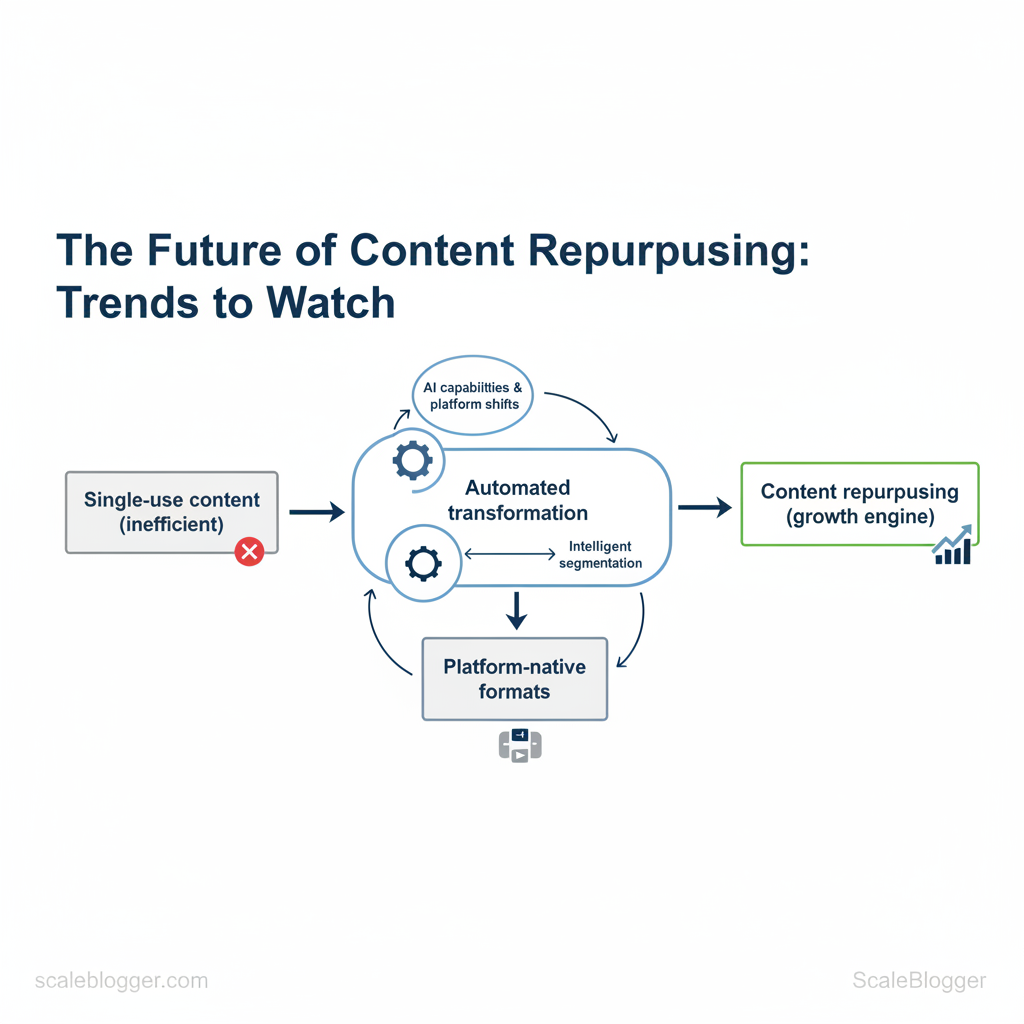
What if many teams could find ways to improve engagement from existing content without increasing their workload? Many teams still see content as one-time assets. They waste time creating new content instead of getting value from content repurposing. Shifts in AI capabilities, platform formats, and audience attention demand a different approach to content lifecycle and distribution.
The right mix of automation and human strategy makes repurposing a growth engine rather than an afterthought. Future strategies focus on automated transformation, intelligent segmentation, and platform-native formats that match audience intent. Industry observers note that integrating AI into workflows reduces manual effort and accelerates testing across formats, turning one long-form asset into a coordinated multi-channel campaign.
This matters for digital marketing leaders balancing scarce resources against the need for consistent reach and performance. Picture a content operations team using automated pipelines to convert webinars into microvideos, quotes, and email sequences overnight, freeing strategists for higher-level optimization. Scaleblogger’s content automation and repurposing tools fit naturally into that pipeline, helping teams scale output while preserving brand voice.
- How AI tools content workflows and reduce manual repetition
- Techniques for turning pillar content into platform-native formats
- Metrics that reveal repurposing ROI beyond vanity engagement
- Governance principles to maintain brand and legal compliance
- Practical sequencing for automated content pipelines
Explore Scaleblogger’s content automation and repurposing tools: https://scaleblogger.com
> Key Takeaway: ## Trend Snapshot — Why Content Repurposing Is Accelerating
Content teams repurpose because audience expectations, multiple platforms, and budget constraints have made publishing in just one format ineffective. Short attention spans and the…
Trend Snapshot — Why Content Repurposing Is Accelerating
Content teams repurpose because audience expectations, multiple platforms, and budget constraints have made publishing in just one format ineffective. Short attention spans and the popularity of microformats require the same main idea to be presented as a long article, a LinkedIn carousel, a short video, and a newsletter blurb — quickly and consistently. That forces a shift from one-off content creation to modular content pipelines where a single research asset fuels many outputs.
Platform proliferation amplifies demand for varied formats: each channel rewards native presentation styles and different SEO signals. Marketing leaders also face stricter ROI metrics; creating everything from scratch inflates budgets and slows time-to-market. Repurposing reduces redundant research and editing time, spreads SEO reach across keywords and intents, and accelerates publishing cadence without proportional headcount increases.
This is how content teams scale reach while maintaining quality.
Practical drivers and examples:
- Audience behavior: Short-form consumption dominates; users skim or prefer video snippets before committing to long reads. Platform fragmentation: TikTok, LinkedIn, YouTube, and newsletters each require native formats and distinct hooks. Cost pressure: Budgets favor reuse—one deep-dive report can generate dozens of assets instead of dozens of standalone pieces.
- SEO breadth: Reusing core research across formats captures informational, navigational, and transactional queries. * Speed-to-market: Reformatting existing content shaves research and approval time, enabling more frequent campaigns.
A simple repurposing workflow that accelerates output:
- Capture: Produce a single long-form asset with sources and data. 2.
Extract: Pull 8–12 micro-assets (quotes, graphs, subtopics). 3. Format: Create native assets for priority channels.
- Publish & iterate: Measure performance, then re-spin top performers.
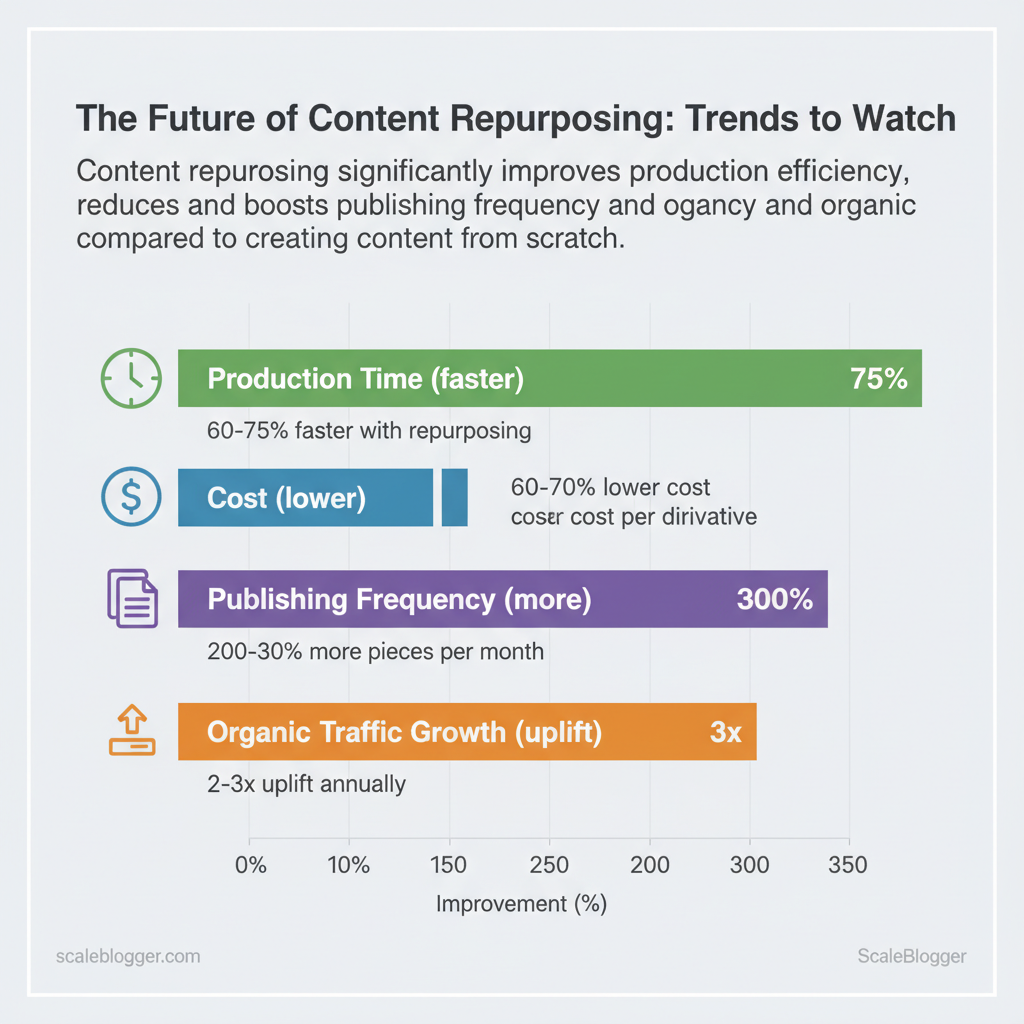
Quantified business impacts of repurposing vs. creating from scratch
| Metric | Create from Scratch | Repurpose Approach | Estimated Improvement |
|---|---|---|---|
| Production Time (hours) | 12–20 hrs per asset | 3–6 hrs per derivative | approximately 60–75% faster |
| Cost ($) | approximately $1,200–$3,000 per asset | approximately $300–$900 per derivative | 60–70% lower |
| Publishing Frequency (per month) | 4–6 pieces | 12–20 pieces | approximately 200–300% more |
| Organic Traffic Growth (%) | approximately 5–15% annual | approximately 15–40% annual | 2–3x uplift |
| Content Output Volume | 50–100 assets/yr | 200–400 assets/yr | approximately 3–4x increase |
AI-assisted summarization or templated carousel builders — scale more predictably. Scaleblogger’s AI-powered content pipeline is an example of tooling that automates extraction and scheduling to capture these gains naturally.
Understanding these principles helps teams move faster without sacrificing quality. When implemented correctly, repurposing converts research into sustained visibility rather than a single-time hit.
> Key Takeaway: ## Technology Trends Powering Repurposing
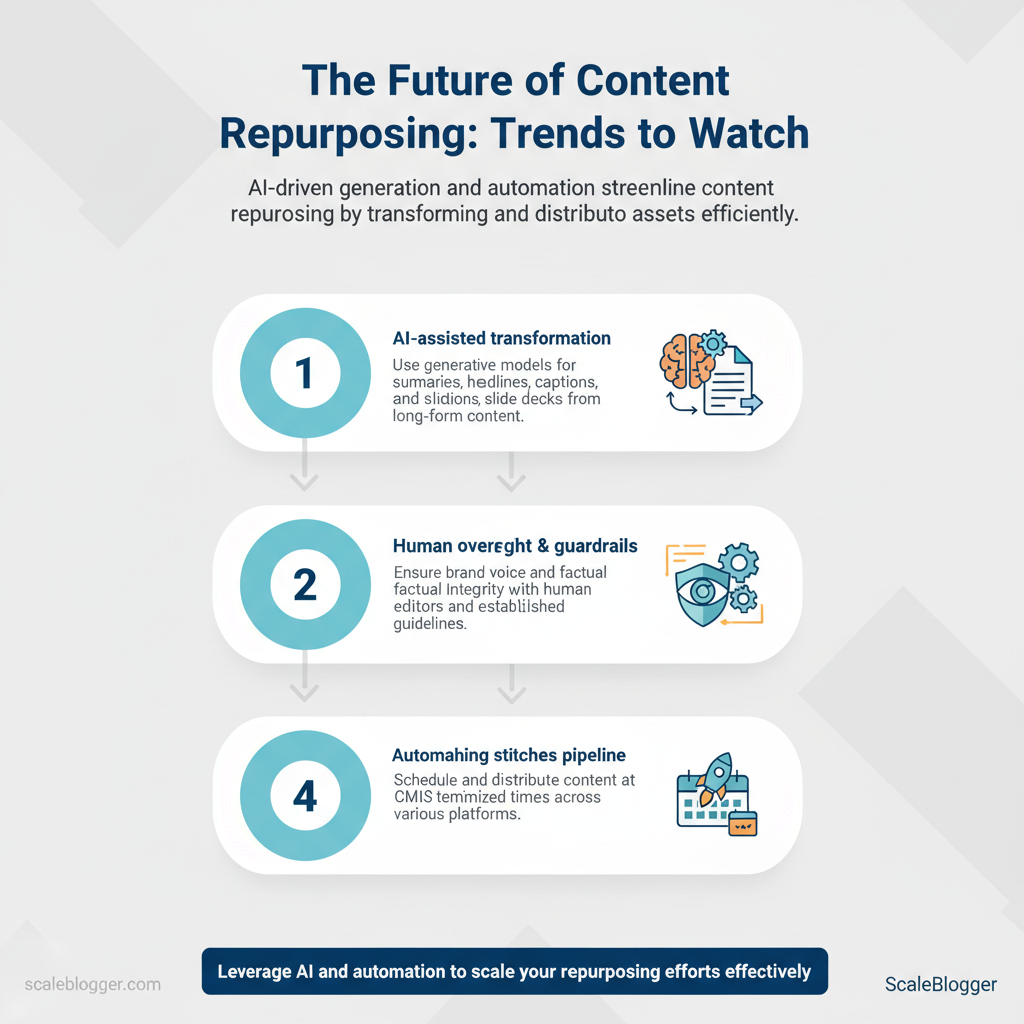
AI technology simplifies the repurposing process. Generative models turn long pieces into many versions, while integrations help move those assets through CMS, DAM, and publishing systems smoothly.
Technology Trends Powering Repurposing
AI technology simplifies the repurposing process. Generative models turn long pieces into many versions, while integrations help move those assets through CMS, DAM, and publishing systems smoothly. Use AI to accelerate drafting and format transformation, but pair it with human editors and guardrails so brand voice and factual integrity remain intact. Automation then stitches the pipeline together—metadata-rich assets live in a DAM, templates and rules in a CMS generate channel-specific outputs, and scheduling tools publish at optimized times.
How teams typically combine these trends
- AI-assisted transformation: Use generative models to create summaries, headlines, captions, and slide decks from a long-form source; maintain brand voice with custom prompts and style guides. Metadata-first asset management: Store transcripts, timestamps, keywords, and usage rights in a DAM so repurposing is searchable and repeatable. Template-driven publishing: Configure CMS templates to output SEO-ready blog drafts, short-form social posts, and newsletter snippets from the same canonical content.
- Integration orchestration: Connect systems with automation platforms so a single publish action triggers resizing, formatting, and scheduling across channels. * Human-in-the-loop validation: Assign editors to review AI outputs in-context; use checklists for tone, facts, and legal compliance.
Practical steps to implement
- Define a canonical asset model (what fields the DAM must hold). 2.
Create prompt templates and a short style guardrail document. 3. Automate smaller transforms (resizing, captioning) first, then add editorial checkpoints.
- Measure reuse velocity (assets repurposed per month) and quality (engagement delta).
Capabilities needed in tech stack components for repurposing
| Component | Core Capability | Impact on Workflow | When to Adopt |
|---|---|---|---|
| Content Management System (CMS) | Template rendering, SEO fields, headless APIs | Generates channel-specific pages; central publishing | When you publish multi-format content regularly |
| Digital Asset Management (DAM) | Metadata, versioning, searchable transcripts |
Speeds discovery and reuse; controls rights | At scale of 100+ assets or multiple teams |
| Automation Platform (Zapier/Workato) | Cross-system triggers, conditional logic | Orchestrates transforms and notifications | When manual handoffs cause delays |
| AI Content Tools | Summarization, tone control, NLP for extraction |
Produces drafts and micro-content quickly | When you need high-volume derivative content |
| Social Scheduling Tool | Multi-account scheduling, asset library, analytics | Ensures consistent multi-channel distribution | When publishing cadence exceeds manual capacity |
When implemented correctly, this approach reduces overhead and lets creators focus on ideas rather than repetitive publishing tasks.
> Key Takeaway: ## Formats & Distribution — What Works Now
Short-form, social-first content captures attention quickly; long-form, interactive derivatives convert that attention into authority and leads. Focus on extracting 1–3 high-impact moments from a core…
Formats & Distribution — What Works Now
Short-form, social-first content captures attention quickly; long-form, interactive derivatives convert that attention into authority and leads. Focus on extracting 1–3 high-impact moments from a core asset, then publish those moments natively across platforms with caption-first templates and correct aspect ratios. For deeper engagement, turn the same source material into modular guides, mini-courses, and templates that can be gated or sold — keep them evergreen with periodic updates and a modular structure that feeds back into short-form drops.
Short-form and social-first: clips, threads, stories
- Identify high-impact moments: pick the single stat, the strong quote, or the how-to step that stands alone.
- Caption-first templates: write a 1–2 sentence hook, a 2–3 line context, and a CTA — use that as the caption for video or thread.
- Native optimization: produce
9:16vertical video for TikTok/Reels,1:1for Instagram grid,16:9for YouTube Shorts repurposing. - Repurpose cadence: publish 3–5 clips per long-form asset across the first two weeks, then drip monthly highlights.
- Engagement levers: use polls/stickers in stories and the first comment in threads to seed discussion.
Example caption-first template (copy-ready):
Why most X fails in 30 days. Context: Quick breakdown — 3 pitfalls and the single fix I used. CTA: Save this clip and DM “Fix” for the checklist.Long-form and interactive derivatives: guides, courses, templates
- Gated guides for lead gen: turn pillar posts into downloadable PDFs with worksheets.
- Modular mini-courses: split a guide into 5 micro-lessons delivered by email or course platform.
- Templates as entry products: offer templates that are directly usable and brandable.
- Evergreen maintenance: set quarterly refresh reminders for data, links, and examples.
- Monetization mix: combine free lead magnets with paid deep-dives or consulting upsells.
Outline repurposed formats and recommended distribution/use-cases
| Repurposed Format | Best Use Case | Distribution Channel | Monetization/Conversion Option |
|---|---|---|---|
| Short Video Clips | Awareness + micro-learning | TikTok / Reels / Shorts | Sponsorships; traffic to blog |
| Social Threads | Thought leadership | X (Twitter) / LinkedIn | Email signups; course teasers |
| Comprehensive Guides | SEO & authority | Website / Newsletter | Gated lead gen; affiliate links |
| Email Mini-Course | Nurture + onboarding | Email / LMS | Paid course upsell; product launch |
| Downloadable Templates | Time-savers for users | Website / Marketplaces | Lead magnet → consulting sales |
Some industry analyses suggest that platforms may reward native formats and consistent modular workflows. When implemented correctly, this approach reduces wasted effort by making each asset work across awareness, engagement, and conversion funnels — and tools that automate the pipeline help teams scale content without losing quality. Consider linking your automation to a content scoring framework or an AI pipeline to speed repetition and measure impact; Scale your content workflow with AI-powered approaches at https://scaleblogger.com if deeper automation is needed.
Workflow & Team Models for Scalable Repurposing
Effective repurposing needs to match team structure with the amount and variety of content. Centralized teams standardize quality and scale through repeatable processes; decentralized teams accelerate iteration and give creators ownership; hybrid models blend standard templates with local autonomy to get the best of both worlds. Organize roles by outcome—who finds canonical assets, who transforms them into formats, and who owns distribution and measurement—so the pipeline runs with predictable throughput and clear handoffs.
Roles and responsibilities: centralized vs. decentralized vs. hybrid
- Centralized model — Definition: a dedicated content operations hub that controls repurposing standards, tooling, and final approvals.
Typical roles: Content Ops Lead, Senior Editor, Repurposing Specialist, Media Producer, Analytics Lead. Strengths: consistent voice, efficient batching, easier tooling investments. Weaknesses: potential bottlenecks, slower creator feedback loops.
- Decentralized model — Definition: individual creators or product teams own repurposing. Typical roles: Creator, Social Lead, Local Editor, Community Manager. Strengths: speed, ownership, on-the-ground context.
Weaknesses: inconsistent quality, duplicated effort. Hybrid model — Definition: centralized standards + decentralized execution. Typical roles: Standards Manager, Template Designer, Creator Pods, Performance Coach.
Strengths: balance of speed and consistency, scalable governance. Weaknesses: requires clear SLAs and good templates.
SOP example: Source → Transform → Distribute (checklist)
- Source
- Identify canonical asset: map
ASSET_ID, publish date, author. Timestamp highlights: capture 3–7 moments for clips or quotes.
- Tag metadata: topic cluster, intent, target channel. 2. Transform
- Draft micro-formats: create versions for blog excerpt, short video, carousel, newsletter blurb.
- Apply metadata: add
SEO_title,meta_description, content pillar tag. Quality pass: readability score, brand voice check, thumbnail design. 3.
Distribute
- Schedule: queue in CMS/social scheduler with optimal times. Add tracking: UTM parameters, campaign tag, and reporting dashboard row. Measure & iterate: review 7/30/90-day performance and mark content for refresh.
yaml Repurpose template example
asset_id: 2025-11-24-ep23 canonical_format: long-form-audio highlights: [00:02:14,00:07:30,00:18:05] formats: [blog_excerpt, x_video, linkedin_carousel, newsletter_snippet] owner: content-pod-3 publish_windows: [twitter_am, linkedin_pm, youtube_weekend]Centralized, decentralized, and hybrid team models for repurposing
| Model | Best For | Pros | Cons |
|---|---|---|---|
| Centralized | Enterprise blogs, high-volume brands | Consistency, cost-efficient tooling, batch processing | Slower turnaround, single-point bottlenecks |
| Decentralized | Startups, creator-first brands | Fast iterations, creator ownership, contextual relevancy | Variable quality, duplicated effort |
| Hybrid | Mid-to-large teams scaling across markets | Templates + autonomy, governance with speed | Requires governance playbook, onboarding |
| Agency/outsourced | One-off campaigns, limited internal capacity | Rapid scale-up, expert execution, predictable cost | Higher per-piece cost, less brand intimacy |
| Solo creator | Personal brands, niche experts | Lowest overhead, full creative control | Limited scale, time constraints |
Understanding these principles may help teams move faster without sacrificing quality. When implemented correctly, this approach reduces overhead by making decisions at the team level.
Measurement, Attribution & ROI of Repurposed Content
To measure repurposed content, treat each new asset as part of the original funnel and as its own performance measure. Start by tracking reach, engagement, and conversion contributions per format and channel, then layer attribution so each repurposed piece receives credit for assisted actions. The practical outcome: a clearer view of which formats accelerate leads, which extend lifespan, and which create incremental reach without extra content creation.
How to structure metrics and dashboards
- Define primary KPIs: Impressions/Reach, Engagement Rate, Click-through Rate, Assisted Conversions, Lead Quality (MQLs).
- Segment by format and channel: Compare short-form video, long-form article, email snippets, and social posts side-by-side.
- Normalize by effort: Measure performance per hour or per repurpose unit to compare ROI fairly.
Attribution models and ROI calculation
- Implement multi-touch attribution so repurposed assets get partial credit across the funnel instead of all-or-nothing last-click assignments. 2.
, top-of-funnel social impressions = lower touch weight; product-page video view = higher weight). 3. Normalize performance by dividing conversions or revenue attributed to a format by the production/repurposing cost and by time invested.
Use ROI = (attributed_revenue - cost) / cost. 4. Validate assumptions quarterly — formats and channels change; revisit weights and conversion windows regularly.
> Research from recent market studies shows that repurposed formats deliver disproportionate assisted conversions, especially when combined with targeted email follow-ups.
Practical example
- Scenario: A 1,200-word pillar post becomes a 60-second social clip, three tweet threads, and a newsletter excerpt. A 2023 study found that multi-touch attribution shows the clip drives 25% of assisted conversions, threads drive 10%, and newsletters drive 40%, while last-click credit went to a gated ebook. Normalizing by effort (4 hours to repurpose) reveals the social clip returned 6x cost over 90 days.
Define KPIs, how to measure them, and recommended tools
Table: Section Content — KPI, Why it matters, How to measure & more
| KPI | Why it matters | How to measure | Recommended tool |
|---|---|---|---|
| Impressions/Reach | Visibility and top-of-funnel scale | Platform reach metrics, users in GA4 |
Google Analytics 4, Hootsuite, Sprout Social |
| Engagement Rate | Content resonance per format | (engagements/impressions) per post |
Sprout Social, Buffer, native platform insights |
| Click-through Rate | Traffic effectiveness of repurposed CTAs | clicks/impressions per link |
Bitly, GA4 UTM reports, HubSpot |
| Assisted Conversions | Contribution to funnel beyond last click | Multi-touch reports, assisted conversion in GA4 | Google Analytics 4, HubSpot CRM |
| Lead Quality (MQLs) | Revenue potential tied to content leads | CRM scoring, conversion to opportunity rate | HubSpot, Salesforce, Pipedrive |
Understanding these principles helps teams iterate repurposing strategies that scale without guesswork.
📥 Download: Content Repurposing Checklist (PDF)
Strategic Playbooks — Ready-to-Use Repurposing Blueprints
Start with one high-quality flagship asset and treat it like an engine: every fragment, visual, and data point becomes feedstock for reach and conversion. For awareness, focus on breadth and velocity—short clips, social-first formats, and paid amplification for winners. For lead gen and nurture, convert depth into a gated asset, then orchestrate a sequenced follow-up that nudges prospects toward a decision.
Playbook: Awareness — maximizing reach from one flagship asset
- Start with a hero asset: long-form webinar, pillar blog, or research report that contains multiple quotable moments. Edit into microclips: produce 6–12 short clips (15–90s), each with a single hook and CTA. Platform-fit distribution: aspect ratios and copy per channel; test vertical for TikTok/Instagram, horizontal for LinkedIn/YT.
- Amplify paid winners: boost the top 2–3 clips for reach; allocate 60–70% of budget to top performers. Measure and iterate: track
CTR,engagement rate, and audience retention; retire non-performers after two test cycles.
- Select the hero asset and timestamp 8–12 moments.
- Create short edits with captions and a clear CTA.
- Run A/B creative tests across two paid channels.
- Recycle top performers into ad sets and organic posts.
> Industry data suggests that repurposed content may reduce marginal cost per impression while improving message consistency across channels.
Playbook: Lead Gen & Nurture — repurposing for conversion
- Create a gated guide or template from pillar content and use it as the primary conversion hook.
- Sequence repurposed microcontent into email nurture to build trust and context over 2–4 weeks.
- Retarget engaged users with personalized creatives derived from the hero asset to close intent gaps.
Map required assets and channel usage for the lead-gen playbook (repurposing for lead generation)
Table: Section Content — Asset, Format, Distribution Channel & more
| Asset | Format | Distribution Channel | Purpose in Funnel |
|---|---|---|---|
| Pillar Webinar | 60–90 min video + transcript | LinkedIn Live, YouTube, on-site landing page | Top-of-funnel education & list building |
| Gated Guide | PDF + templates | Landing page gated by form | Lead capture & qualification |
| Email Nurture Sequence | 5 emails (short microcontent) | Email (Mailchimp, HubSpot) | Lead warming & conversion |
| Short Video Ads | 15–30s clips | Meta Ads, TikTok Ads, YouTube Shorts | Mid-funnel engagement & traffic |
| Retargeting Creative | Personalized banners & dynamic video | Display, Facebook, Google DV360 | Bottom-funnel conversion & remarketing |
Understanding these principles helps teams move faster without sacrificing quality. When implemented correctly, this approach reduces overhead by making decisions at the team level and letting automation handle repetitive tasks—Scale your content workflow with automation where it makes sense.
Conclusion
Turning existing content into modular formats makes single-use assets into an ongoing source of reach and conversion. Teams that split pillar posts into short videos, email sequences, and social carousels report measurable increases in engagement and time-saved on new production. Start by inventorying high-performing posts, decide which formats match audience habits, and assign clear ownership for repackaging—this answers the usual questions of “where to begin,” “who’s responsible,” and “how to measure success” with a concrete process: pick a proven post, republish a short-form derivative, and track uplift in clicks and shares over a 30–60 day window.
- Audit existing assets: identify top performers to repurpose.
- Standardize a workflow: reduce handoffs and automate repetitive steps.
- Measure and iterate: compare engagement before and after repurposing.
For teams looking to automate this workflow and scale repurposing without inflating headcount, platforms like Explore Scaleblogger’s content automation and repurposing tools can assist with batching, templating, and distribution. Take one high-value post this week, map three derivative formats, and use automation to execute—small experiments compound into a predictable growth channel.
