

Marketing teams lose momentum when automation runs without clear measurement. Too often systems publish content at scale while real performance signals — engagement, discoverability, and conversion — go untracked. Without the right content performance metrics, automation becomes busywork rather than a growth engine.
Measuring success means connecting `automation analytics` to business outcomes and proving the ROI of automation through repeatable signals. Trackable metrics like impressions, `CTR`, time on page, and lead conversion reveal where automation amplifies value and where it dilutes it. Industry research shows focusing on discoverability and conversion yields clearer decisions than chasing vanity numbers alone (BrightEdge).
Picture a content program that flags underperforming posts automatically, tests headline variations, and routes promising topics into paid amplification — that pipeline depends on measurable gates, not guesswork. This introduction lays out the practical metrics and dashboards that turn automated content into predictable growth.
- What core metrics correlate with revenue under automation
- How to align `automation analytics` with funnel stages
- Practical thresholds for engagement, discoverability, and conversion
- How to calculate the ROI of automation for reporting and investment decisions
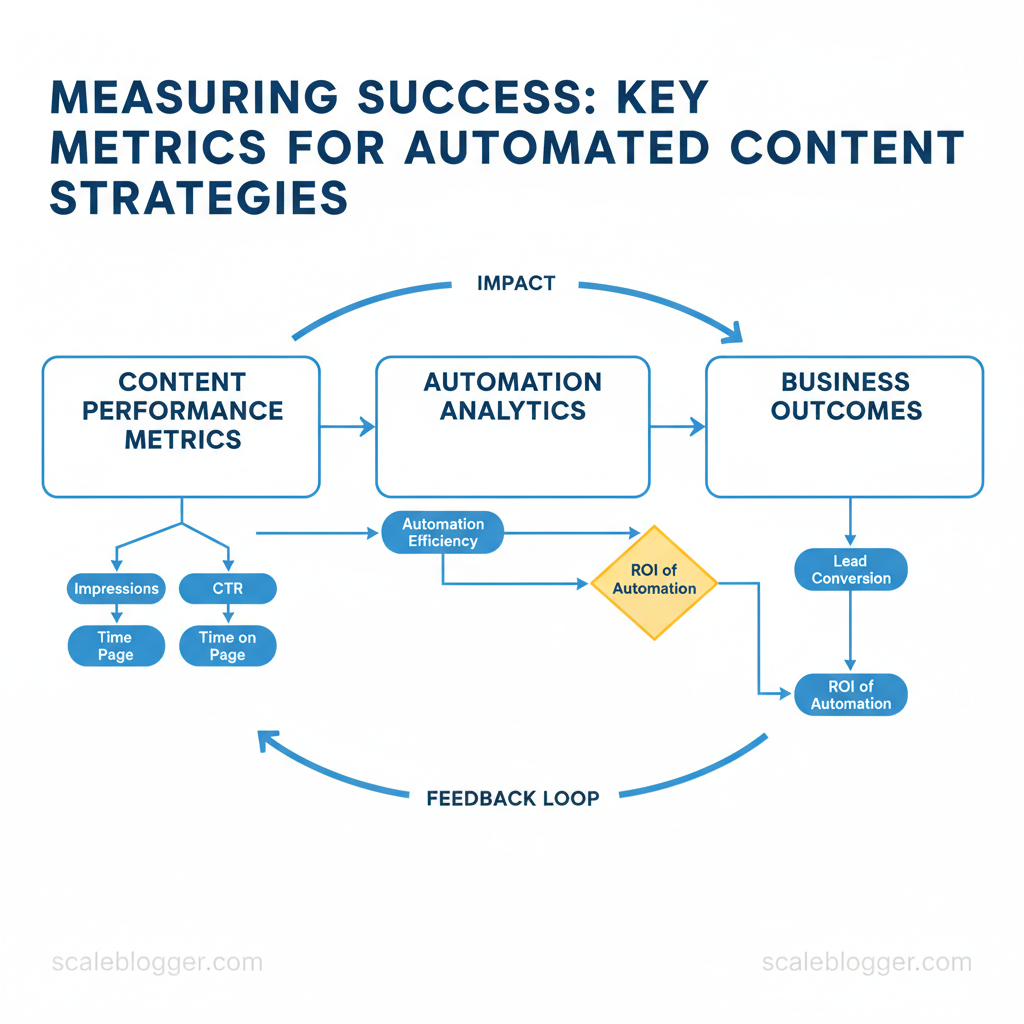
Prerequisites: What You’ll Need Before You Start
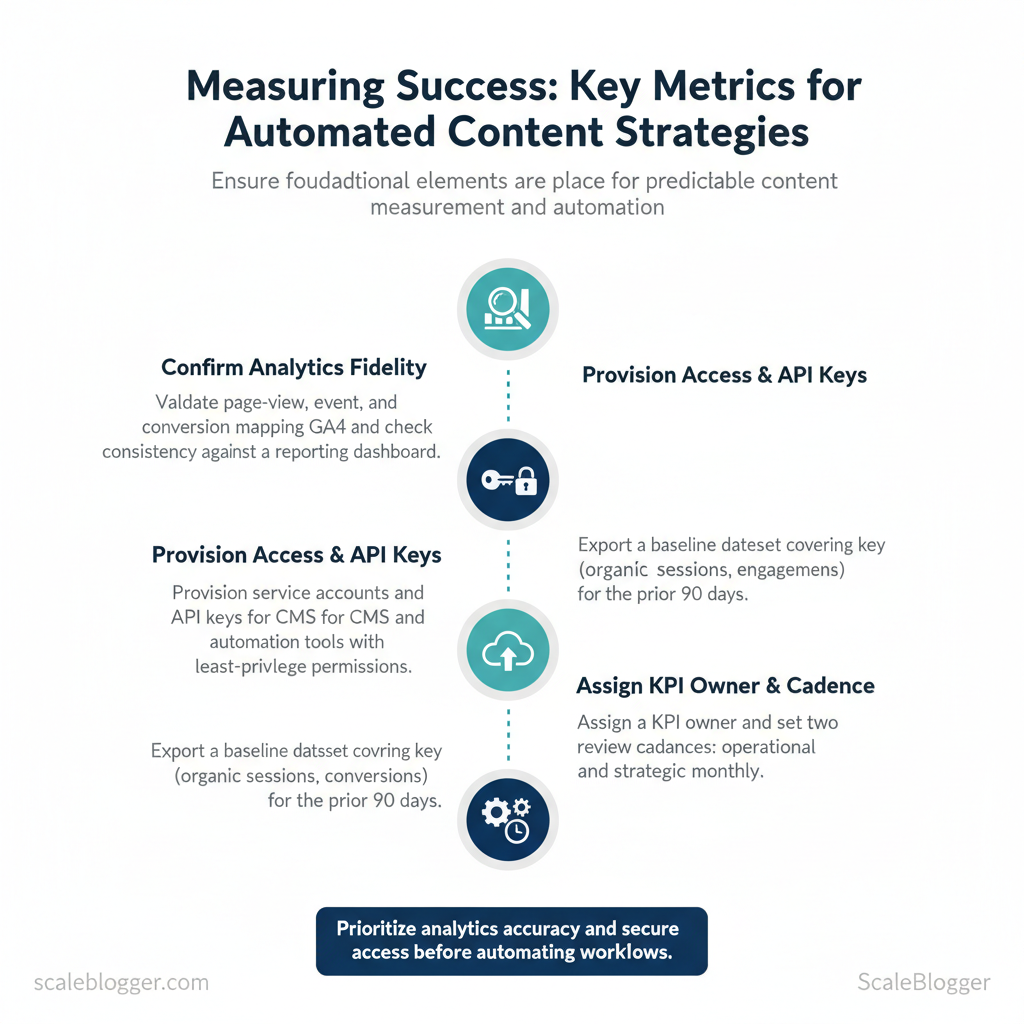
Start with the essentials so measurement and automation work predictably from day one: accurate analytics, programmatic access to your CMS and schedulers, a clean baseline dataset of recent performance, and a named owner who reviews KPIs on a fixed cadence. Without those building blocks, automation amplifies noise instead of signal.
- Analytics platform — ensure `GA4` (or server-side tagging) is collecting page-level events and conversions.
- Content automation access — `CMS` admin/API credentials and any scheduling/orchestration tool API keys.
- KPI owner & cadence — one person accountable and a recurring review rhythm (weekly for operations, monthly for strategy).
Practical examples:
- Example: A team used server-side `GA4` + a dashboard to find a 12% discrepancy in referral traffic vs. GA4; fixing tagging prevented misattributed conversions.
- Example: Provisioning a `read-only` dashboard user for stakeholders prevented accidental publish actions while enabling transparency.
“Impressions, Clicks, Click-Through Rate (CTR), and engagement metrics are core signals for content discoverability and performance.” — BrightEdge 4-step framework to measure content success
| Tool/Resource | Purpose | Required Access/Permission | Minimum Data Window |
|---|---|---|---|
| Web analytics (GA4) | Pageviews, events, conversion attribution | Admin to configure; `Editor` for tagging | 3 months |
| Content management system (CMS) | Publish, edit, schedule content | API key with publish rights; role-based admin | 1 month (content history) |
| Automation/orchestration tool | Scheduling, templates, API-driven publishes | Service account/API token with write | 1 month |
| Attribution platform | Multi-touch attribution, assisted conversions | API read/write for data sync | 3 months |
| Reporting/dashboard tool | Aggregated KPIs, stakeholder dashboards | Viewer for stakeholders; Editor for analysts | 3 months |
Step-by-Step Framework: Define Goals and KPIs
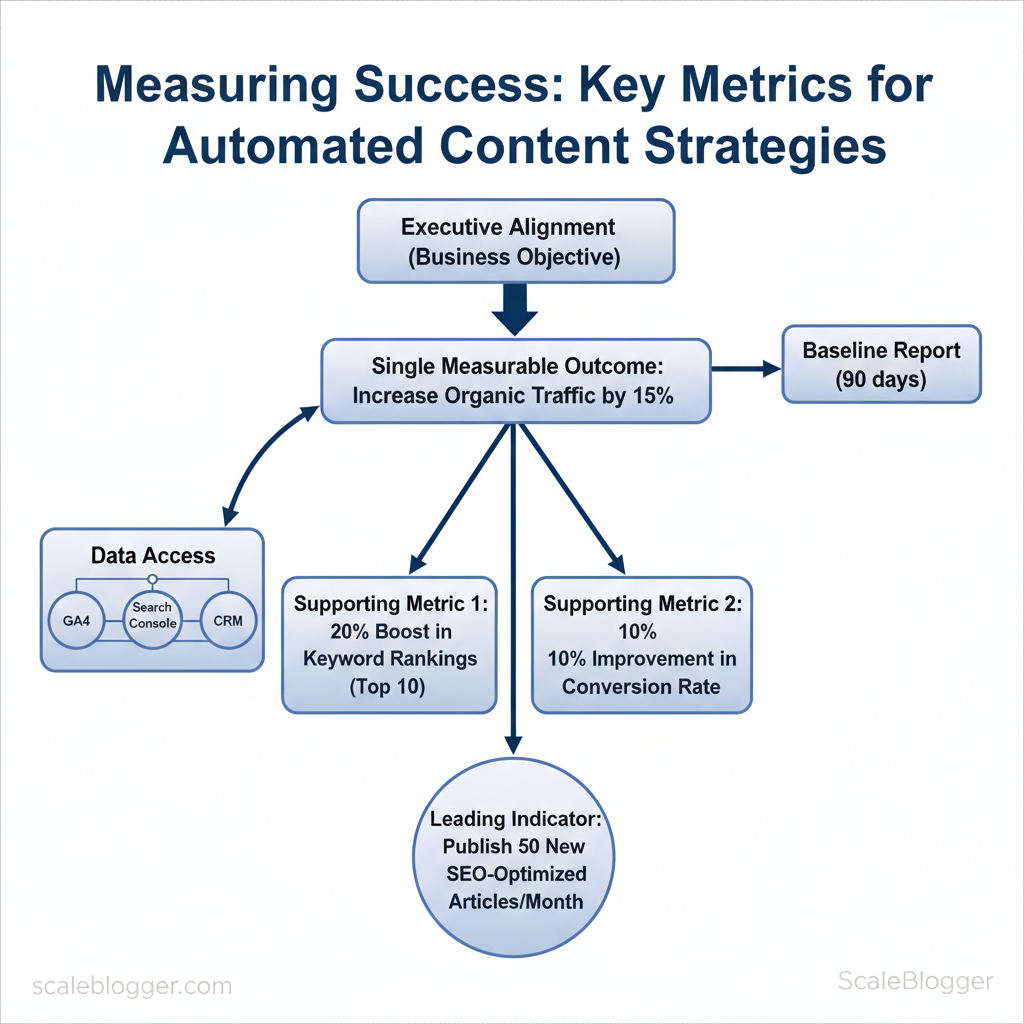
Start by translating the business objective into a single measurable outcome, then backfill two supporting metrics and at least one leading indicator that signals progress fast enough to iterate. This keeps measurement actionable and tied to decisions—rather than swamped by vanity metrics. Below are prerequisites, tools, and the exact steps to execute this translation.
Prerequisites
- Executive alignment: one-line business objective approved by stakeholders (e.g., “Increase MQLs from content by 30% in 12 months”).
- Data access: GA4, Search Console, CRM conversion data, and content repository.
- Baseline report: last 90 days of traffic, conversions, and engagement metrics.
- Analytics: GA4 + Search Console
- Content performance checklist: organic clicks, CTR, time on page (see BrightEdge and DashThis frameworks) A 4-Step Framework to Best Measure Content Success and 10 Must-Track Content Marketing KPIs & Metrics in 2024
- Automation/benchmarking: Scaleblogger.com for pipeline automation and content benchmarking
Real examples Brand awareness: Primary KPI — Impressions; Supporting — Organic clicks, Share of voice; Leading indicator — CTR growth week-over-week* (BrightEdge recommends impressions and CTR as discoverability signals) A 4-Step Framework to Best Measure Content Success. Lead generation: Primary KPI — MQLs from content; Supporting — Content conversion rate, Qualified traffic; Leading indicator — CTA click rate* (DashThis and Tability list conversions and conversion rate as core metrics) 10 Must-Track Content Marketing KPIs & Metrics in 2024 Optimise your content performance: 10 essential content metrics to track.
| Business Objective | Primary KPI | Supporting KPIs | Why it fits automation |
|---|---|---|---|
| Brand awareness | Impressions | Organic clicks; Share of voice | Automation scales content distribution and measures reach quickly |
| Lead generation | MQLs from content | Conversion rate; Qualified traffic | Automated lead scoring ties content actions to CRM outcomes |
| Revenue growth | Revenue attributed to content | Avg. order value; Assisted conversions | Automation links content touches across funnel for attribution |
| Engagement / retention | Returning visitors | Avg. time on page; Pages per session | Automated personalization increases repeat visits and depth |
| Content efficiency | Content production cycle time | Cost per asset; Publish frequency | Automation reduces manual steps and tracks throughput |
When teams follow this pattern, measurement becomes a decision tool rather than a reporting chore, and experimentation velocity increases without losing accountability.
Step-by-Step: Instrumentation and Data Collection
Start by defining a consistent event taxonomy and tagging approach that every engineer and marketer understands. This reduces ambiguity during analysis and enables automation to act on reliable signals. Implement event names, parameter schemas, and UTM rules up front, instrument both client- and server-side, then validate with live debug tools to ensure data quality.
Prerequisites
- Stakeholders aligned: analytics, engineering, content, and growth agree on KPIs.
- Tools in place: tag manager (GTM or equivalent), analytics endpoint (GA4, Snowplow, or similar), server logging pipeline.
- Event catalog template: shared doc accessible to all teams.
- Why server-side: avoids adblocker and client JS failures; preserves data when network drops.
- What to send server-side: conversions, subscription events, publish confirmations, and revenue.
- Keep payload parity: server events must mirror client parameters to deduplicate and join identity.
- Use tag manager preview: check triggers and parameter values before deploy.
- Use analytics debug streams: verify events appear with correct schema.
- Run sampling QA: simulate 50–100 flows (page view → CTA → form_submit) and reconcile counts.
| Event Name | Parameters | Purpose (metric derived) | Validation Method |
|---|---|---|---|
| page_view | `content_id`, `url`, `referrer`, `user_id`, `timestamp` | Pageviews, session starts | Tag Manager preview; GA4 debug stream |
| cta_click | `cta_id`, `content_id`, `position`, `user_id`, `timestamp` | CTR, micro-conversion rate | Click listener test; network inspector |
| form_submit | `form_id`, `lead_type`, `user_id`, `email_hash`, `timestamp` | Leads, conversion rate | End-to-end submit QA; server receipt logs |
| automation_publish | `content_id`, `workflow_id`, `scheduled_at`, `published_at` | Publish throughput, latency | Deployment logs; server event reconciliation |
| social_share | `platform`, `content_id`, `user_id`, `timestamp` | Social referral volume | Social API callbacks; pattern-matching on share endpoints |
Step-by-Step: Build Dashboards and Reports
Create a dashboard that separates automated content from manually produced pieces, tracks both short-term leading indicators and long-term outcomes, and pushes insights to stakeholders automatically. Start by defining which metrics signal health at each stage: attention (traffic), engagement (time on page, scroll), and outcome (leads, conversions). Then design widgets that make those relationships visible and actionable.
Prerequisites
- Data sources: GA4, Search Console, CRM, CMS publish logs, and your automation logs
- Tools: Looker Studio, Tableau, or Google Data Studio; a scheduler (native BI scheduling or email service)
- Time estimate: 4–8 hours to prototype; 1–2 days to validate with real data
- Expected outcome: A dashboard that surfaces pipeline bottlenecks and quantifies automation impact within weeks
Practical examples and templates
- Example: Use a cohort retention chart to compare organic retention at 30/60/90 days between automated vs manual articles; this surfaces quality decay early.
- Template snippet (Looker Studio):
Market guidance suggests combining leading indicators like impressions with outcomes like conversion rate to connect visibility to business impact (see BrightEdge’s measurement framework).
| Dashboard Widget | Visualization Type | Primary KPI | Recommended Filters |
|---|---|---|---|
| Traffic trend | Line chart | Organic sessions | Date range, content_type (`automated`/`manual`) |
| Conversion funnel | Funnel chart | Conversion rate (goal completions / sessions) | Traffic source, landing_page, content_type |
| Content-level performance table | Table with sortable columns | Pageviews, CTR, Avg. time on page | Author, publish_date, topic_cluster |
| Cohort retention chart | Heatmap / line series | % returning users at 30/60/90 days | Cohort by publish_week, content_type |
| Automation efficiency metric | KPI + trend sparkline | Articles per editor-hour; time-to-publish | Workflow_stage, automation_tool |
Troubleshooting tips
- If automated vs manual tags are inconsistent, backfill using URL patterns or content templates.
- If email schedules fail, test with small recipient lists and increase throttling.
- If metrics diverge wildly, validate data joins between GA4 and CMS publish logs.
Step-by-Step: Analyze, Attribute, and Calculate ROI
Start by choosing an attribution model that matches business priorities, then run controlled experiments to validate lift and plug costs into a straightforward payback and annualized ROI calculation. Attribution determines which touchpoints get credit; experiments (A/B tests or holdout groups) measure causal impact; and full ROI must include tooling, engineering, and content operations so the result isn’t misleading.
Prerequisites
- Data access: GA4, CRM revenue events, CMS metrics, and cost/accounting feeds
- Stakeholder alignment: Agreed conversion definitions and horizon (30/90/365 days)
- Baseline metrics: Current conversion rate, average order value (AOV), traffic mix
- Attribution: `GA4` or server-side event store
- Experimentation: A/B platform or traffic holdouts (`VWO`, `Optimizely`, or internal split-tests)
- Cost tracking: Spreadsheet or finance system with monthly run-rates
- Automation costs: vendor invoices (e.g., Jasper starting at $39/month), engineering estimates
“Experimentation is the only reliable way to isolate lift from correlated trends.”
| Line Item | Monthly Cost | Annualized Benefit | Notes |
|---|---|---|---|
| Automation tool subscription (Jasper) | $39 | $1,200 | Jasper starter plan; upgrade costs vary |
| Analytics / attribution tooling | $100 | $2,400 | GA4 free, but paid connectors or BI tools typical |
| Engineering time (20 hrs/mo) | $2,400 | $28,800 | 20 hrs × $120/hr fully loaded rate |
| Content ops time saved (40 hrs/mo) | — | $9,600 | 40 hrs saved × $20/hr cost avoided |
| Revenue uplift (experiment) | — | $45,000 | Measured incremental revenue from lift |
| Net ROI | — | $25,900 | Annualized Benefit − Annual Costs (approx.) |
If attribution matches business priorities and experiments confirm lift, ROI calculations become a decision engine rather than a justification exercise. When implemented cleanly, this process shifts the conversation from “did it work?” to “how fast do we scale it?”
Step-by-Step: Operationalize Measurement (Cadence & Governance)
Assigning clear ownership and a predictable review cadence converts measurement from a guessing game into an operational muscle. Start by naming KPI owners, pairing backups, and mapping weekly, monthly, quarterly, ad-hoc, and annual activities so teams know what to check, when to act, and how to document changes.
Prerequisites
- Data sources: Connected analytics (GA4), CMS, CRM, and campaign platforms
- Tools: Dashboarding (Looker/BQ, Data Studio), alerting (Slack/email), and a change-log repository (Confluence/Git)
- Stakeholders: Content leads, SEO, paid channels, product analytics
- Baseline thresholds: Use historical median ± standard deviation for traffic and conversion metrics.
- Alert channels: Push alerts to Slack + email for P1 incidents; use dashboards for P2.
- Template: store threshold rules as `metric_name: baseline, trigger: -25%, action: pause campaign`.
- Change log: Log every campaign/content release, tag with `release_id`, owner, and expected impact.
- Rollback plan: For automated campaigns, predefine rollback criteria (e.g., >30% CTR drop in 48 hours). Market guides recommend tracking pageviews, CTR, and time on page as core signals How to Measure Content Marketing Performance.
| Cadence | Primary Activities | Deliverables | Owner |
|---|---|---|---|
| Weekly | Quick traffic and health checks; resolve alerts | Weekly dashboard snapshot; alert log | SEO lead (backup: analytics PM) |
| Monthly | Conversion funnels; experiment review | Monthly performance report; action list | Content ops manager |
| Quarterly | KPI reset; strategy alignment | Quarterly roadmap updates; budget reprioritization | Head of Content |
| Ad-hoc incident review | Investigate spikes/drops; execute rollback | Incident report; remediation timeline | Analytics engineer |
| Annual strategy review | Long-term KPI selection; tooling review | Annual measurement plan; SLA agreements | VP Growth |
Troubleshooting Common Issues
Start by checking your telemetry and tag layers before changing automation. When an event or metric looks wrong, most problems trace back to missing tags, misrouted attribution, or a recent automation change. Follow these steps to validate, reconcile, and recover without causing further disruption.
Prerequisites
- Access: Admin access to analytics, tag manager, and the publishing automation
- Tools: Analytics debug logs, `GTM` preview mode, server logs, and a staging environment
- Time estimate: 20–90 minutes per issue, depending on complexity
Concrete troubleshooting steps and checks
- Validate event firing: Use `GTM` preview or `window.dataLayer` to confirm the event name and payload.
- Match IDs: Compare `client_id` or `session_id` across client and server logs to reconcile discrepancies.
- Audit timing: Look for delayed event ingestion (queue backlog) in server logs that creates apparent attribution gaps.
- Rollback safety: If a change caused a drop, revert the specific automation change in staging and re-run tests before production rollback.
- Escalation: If logs are ambiguous, capture HAR files and escalate to backend with exact timestamps and sample IDs.
Practical example: If automated cross-posting reduced organic referrals, reproduce the click path, verify UTM parameters in `dataLayer`, and check whether automation overwritten UTM tags at publish time.
| Symptom | Quick Check | Likely Root Cause | Fix/Remediation |
|---|---|---|---|
| No conversion events recorded | Check analytics debug logs & `GTM` preview | Tag not firing or event name mismatch | Re-deploy corrected tag; test in `GTM` preview |
| Attribution looks wrong | Compare UTM in page source vs server logs | Automation overwrote UTM or redirect stripped params | Preserve UTMs in publish script; patch redirect rules |
| Sudden traffic drop after automation change | Review recent commits and server logs | Automation rollout blocked crawl or removed meta tags | Rollback change; restore meta tags; republish critical pages |
| Discrepancy between server-side and client-side data | Match `session_id` timestamps in both logs | Time skew or lost client-side hits (ad-blockers) | Implement server-side event fallback; normalize timestamps |
| High bounce on automated posts | Inspect page load times and content rendering | Slow render or placeholder content for bots | Optimize render path; ensure server returns full content |
Understanding these troubleshooting patterns prevents knee-jerk rollbacks and helps maintain stable automation while restoring accurate analytics. When implemented consistently, teams recover faster and reduce repeat incidents.
Tips for Success and Pro Tips
Start by making measurement a product: define owners, instrument once, iterate often. Prioritize a small set of actionable metrics tied directly to business outcomes, then use technical controls to keep data trustworthy. This requires upfront alignment (who owns events), simple tooling (feature flags, event validators), and recurring governance (auditable change log and regular audits). Below are concrete pro tips that improve measurement outcomes quickly, with practical steps and examples you can apply this week.
Prerequisites and tools
- Prerequisites: agreed metric definitions, access to analytics and CRM, staging environment for tests.
- Tools: feature-flag system (LaunchDarkly, Split), automated test runner (Cypress, Playwright), analytics platform (GA4, Snowplow), CRM (Salesforce, HubSpot).
- Time estimate: 2–6 weeks to fully instrument and validate a typical mid-size site.
Pro-level practices (detailed)
“Impressions, Clicks, Click-Through Rate (CTR) and conversions are core content success metrics to track.” — A 4-Step Framework to Best Measure Content Success
| Tip | Quick Implementation | Expected Impact | Priority |
|---|---|---|---|
| Feature flags for rollouts | Add flag in LaunchDarkly; release to 10% then expand | Safer deployments; faster rollback | High |
| Automated event tests | Add assertions in Cypress that check event payloads | Fewer silent breaks; higher data integrity | High |
| Holdout groups for experiments | Create randomized 10–20% control cohort | Cleaner causal measurement; reduced bias | Medium |
| CRM enrichment | Stitch analytics user_id to CRM contact record | Measure revenue per content; better ROI | High |
| Regular data audits | Monthly checklist comparing GA & backend logs | Catch drift and mapping errors early | Medium |
📥 Download: Automated Content Success Measurement Checklist (PDF)
Advanced Analysis: Causal Inference and Experimentation
Run a holdout experiment to measure incremental impact by isolating a treatment group from a measured control (holdout) and testing for statistically significant uplift on the metric you care about. Define the experiment population and randomization, choose a practical minimum detectable effect (MDE) with corresponding sample-size calculations, collect baseline and post-intervention windows long enough to absorb seasonality, then analyze uplift with proper significance tests and confidence intervals.
Prerequisites
- Historical performance data: past CTRs, conversion rates, revenue per visitor
- Statistical power tool: web power calculator or `pwr` package
- Instrumentation: analytics that can tag users into treatment/holdout
- Stakeholder alignment: agreed KPI, MDE, and test duration
- Statistical power calculators (online or `R`/`Python` scripts)
- A/B testing platform or experiment tracking in tagging (Google Optimize, internal)
- Data warehouse with user-level timestamps
- Scaleblogger.com for automating content distribution and collecting creative variants
- Baseline window: at least one full traffic cycle (7–14 days) to capture weekday/weekend patterns.
- Post-intervention window: run until precomputed sample sizes are reached; extend for known seasonality.
- Log user-level data: metric value, assignment, timestamps, and covariates for covariate-adjusted analysis.
- Primary analysis: difference-in-proportions or t-test for means with two-sided alpha 0.05.
- Confidence intervals: report 95% CI around the uplift and percent change against baseline.
- Secondary checks: pre-period balance, sequential testing corrections if checking early.
- Report: practical impact (revenue, qualified leads), variability, and recommended action.
Industry guides list the primary metrics teams should track when measuring content impact, including CTR and conversion rate (see 10 Must-Track Content Marketing KPIs & Metrics in 2024: https://dashthis.com/blog/best-kpis-for-content-marketing/).
| Metric | Baseline Rate | Minimum Detectable Effect | Required Sample Size |
|---|---|---|---|
| Click-through rate | 2.5% | +0.5pp (20% relative) | 40,000 per arm |
| Conversion rate | 1.5% | +0.3pp (20% relative) | 50,000 per arm |
| Lead quality metric (qualified lead %) | 20% | +4pp (20% relative) | 10,000 per arm |
| Revenue per visitor (USD mean) | $0.50 | +$0.05 (10% relative) | 60,000 per arm |
| Retention rate (30-day) | 35% | +3.5pp (10% relative) | 8,000 per arm |
Troubleshooting tips
- If sample targets are unreachable, increase MDE (practical tradeoff) or run the test longer.
- If pre-period balance fails, re-randomize or switch to stratified assignment.
- If uplift is small but consistent, consider pooling variants or running a sequential test with alpha adjustments.
Appendix: Templates and Checklists
Start with ready-to-use templates that translate choices into repeatable execution. These artifacts remove ambiguity during handoffs—engineers get a deterministic `event` payload, analysts receive a clear dashboard spec, and content teams can run experiments with statistically defensible sample sizes. Below are practical templates, usage notes, and small examples to drop into your Google Drive or product backlog immediately.
Prerequisites
- Access: Google Drive or company repo where templates live.
- Permissions: Edit rights for product, analytics, and content owners.
- Tools: GA4/BigQuery, Looker/Tableau/Power BI, Google Sheets (or Excel).
Practical examples (short)
- Event schema sample: `page_view` with `user_id`, `session_id`, `content_id`, `channel`.
- ROI calc: revenue lift forecast, LTV assumptions, and traffic conversion delta.
- Experiment plan: A/B hypothesis, metric, sample-size calc using `z=1.96` for 95% confidence.
| Template Name | Format | Primary Use | How to Use |
|---|---|---|---|
| Event Schema | `JSON Schema` / Google Doc | Standardize tracking events | Define events, required fields, types; export as `events.json` for devs |
| ROI Calculator | Google Sheet (`.xlsx`) | Forecast experiment value | Input baseline traffic, conversion, AOV; outputs NPV and payback |
| Experiment Plan | Google Doc + sample-size sheet | Run A/B tests with power calc | List hypothesis, primary metric, sample size via `power` formula |
| Dashboard Spec | Confluence / CSV spec | BI implementation blueprint | Map KPIs to data sources, visuals, refresh cadence for BI team |
| Troubleshooting Checklist | PDF / Google Doc | QA tracking & deployment | Step-by-step validation: schema, dataflow, ingestion, sampling checks |
Example: Event schema snippet “`json { “event”: “content_click”, “user_id”: “string”, “content_id”: “string”, “position”: “integer”, “timestamp”: “ISO8601” } “`
Sample-size formula (two-sided) “`text n = (Z_{1-α/2} + Z_{1-β})^2 * (p1(1-p1)+p2(1-p2)) / (p2-p1)^2 “`
Include these templates in a shared folder (internal product assets or Google Drive) and version them. When teams adopt a single template set, audits and debugging take minutes instead of days. Understanding these principles helps teams move faster without sacrificing quality.
Conclusion
After working through measurement, validation, and iterative optimization, the practical path forward is clear: align publishing with measurable signals, automate the repetitive parts, and keep human judgment where it matters. Teams that added short A/B tests to automated flows quickly identified which headlines and formats actually move discovery and engagement; others who tracked downstream conversions rather than vanity metrics stopped amplifying content that didn’t convert. Expect to spend the first 4–6 weeks instrumenting tracking and running lightweight experiments, then switch to monthly rhythm-based reviews that feed automation rules.
Start with three concrete moves today: instrument engagement and conversion events, run rapid tests on titles and CTAs, and codify winning variants into your automation pipeline. Common questions — “How much tracking is enough?” and “When should automation decide to pause a campaign?” — are answered by setting minimum sample sizes and clear stop-loss rules before full rollout. Research from BrightEdge reinforces that measuring content success requires a repeatable framework and regular checkpoints, not one-off reports. To streamline this process and scale measurement across teams, consider platforms that integrate testing, orchestration, and analytics; for teams looking to automate this workflow, Learn how Scaleblogger can help you measure and scale automated content is a practical next step.
