

Most content teams know the feeling: a backlog of briefs, falling organic traffic, and an inbox full of “can you scale this?” requests that never stop. Choosing between AI content generators now feels less like picking software and more like deciding which part of the editorial engine to replace.
The market in 2026 offers tools that promise speed, creativity, and SEO precision, but each one trades off control, factual accuracy, or integration complexity. A practical comparison shows which trade-offs matter depending on team size, workflow, and the kind of content that actually moves the needle.
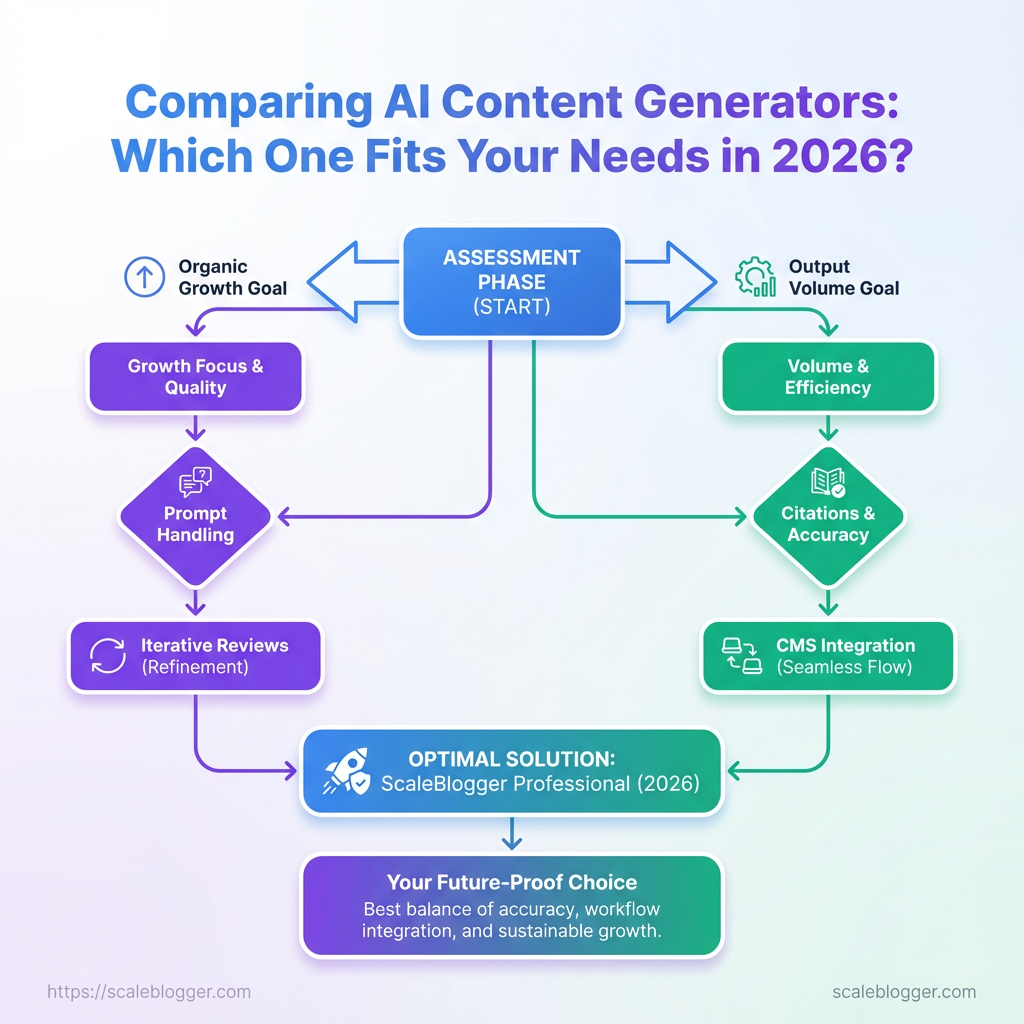
If your metric is organic growth, not just output volume, the right choice hinges on how a generator handles prompts, citations, iterative reviews, and CMS integration. This piece compares real-world capabilities and failure modes so teams can match a generator to the problems they actually need solved.
What is an AI Content Generator?
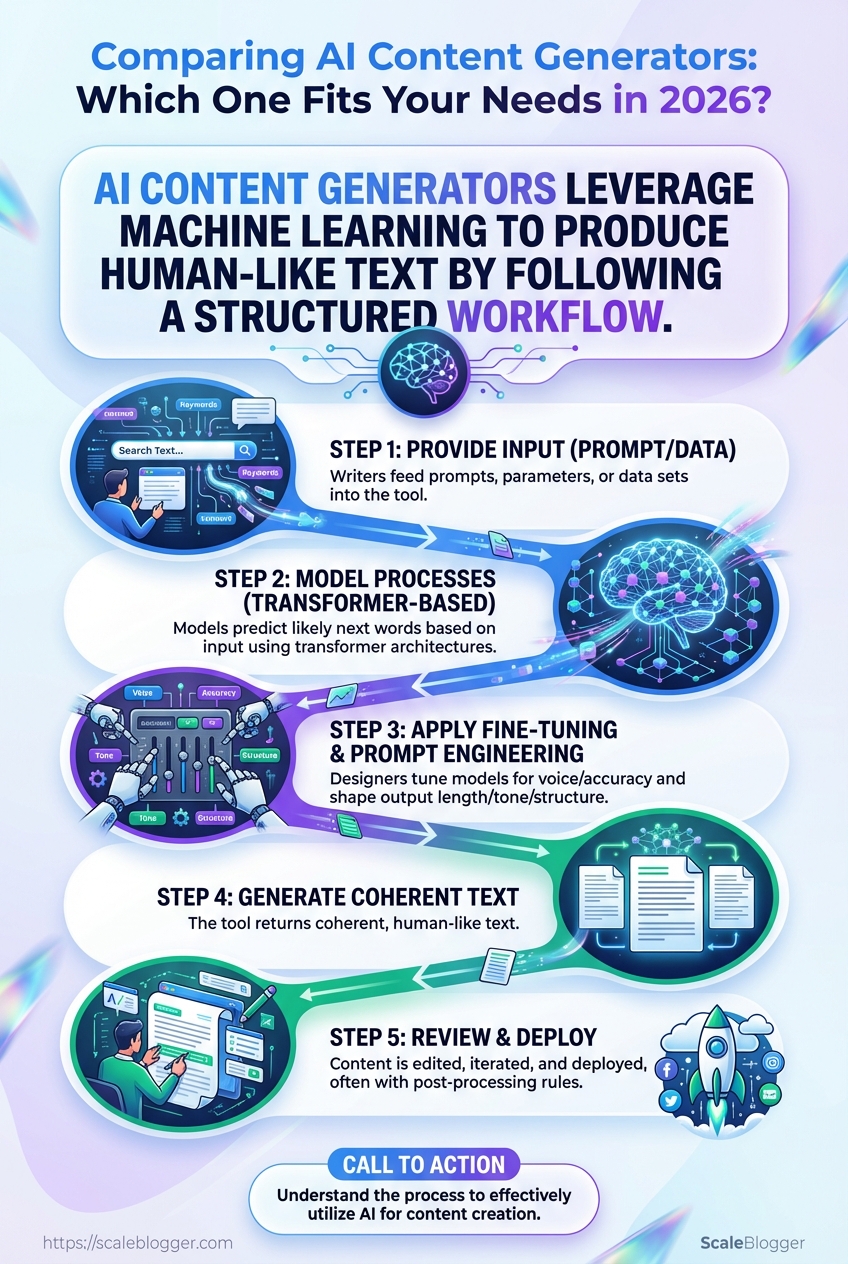
An AI content generator is software that produces written material—articles, headlines, email copy, product descriptions—by using machine learning models trained on large text corpora. Instead of typing every sentence by hand, writers feed prompts, parameters, or data sets into the tool and the model returns coherent, human‑like text that can be edited, iterated, and deployed.
Definition: An AI content generator is a system that translates prompts, templates, or structured inputs into natural-language content using statistical and neural-language models.
How it works: Most modern generators use transformer-based architectures (the transformer family) that predict likely next words conditioned on the input. Designers tune them with: fine-tuning on domain-specific text for voice and accuracy, prompt engineering to shape output length, tone, and structure, * post-processing rules to enforce brand terms or SEO constraints.
Practical examples make the difference. A product team can feed a tool a product_name, features list, and target_audience and receive multiple ready-to-edit product descriptions. A content strategist can use a generator to expand an outline into a full draft, then refine for insight and accuracy.
Common features and capabilities Bulk generation: create dozens of content variants at scale. Style controls: set tone, reading level, and format. Content templates: transform data into copy (e.g., product pages). SEO-aware outputs: include headings, meta descriptions, and keyword suggestions. * Integration hooks: APIs, CMS plugins, or automation pipelines.
Benefits for a content operation Speed: drafts that would take hours appear in minutes. Consistency: unified voice across multiple authors or channels. Scalability: test many headlines, intros, and variations without extra headcount. Efficiency: reduces repetitive writing so humans focus on strategy and editorial value.
A realistic expectation matters: AI generators accelerate ideation and production but don’t replace subject-matter expertise or fact-checking. For teams ready to scale, pairing these tools with processes like editorial review and content scoring—many offered under AI content automation platforms such as Scaleblogger.com—turns rapid drafts into high-performing assets.
This capability changes how content teams allocate time: less on routine drafting, more on insight, verification, and creative strategy.
Key Features to Consider
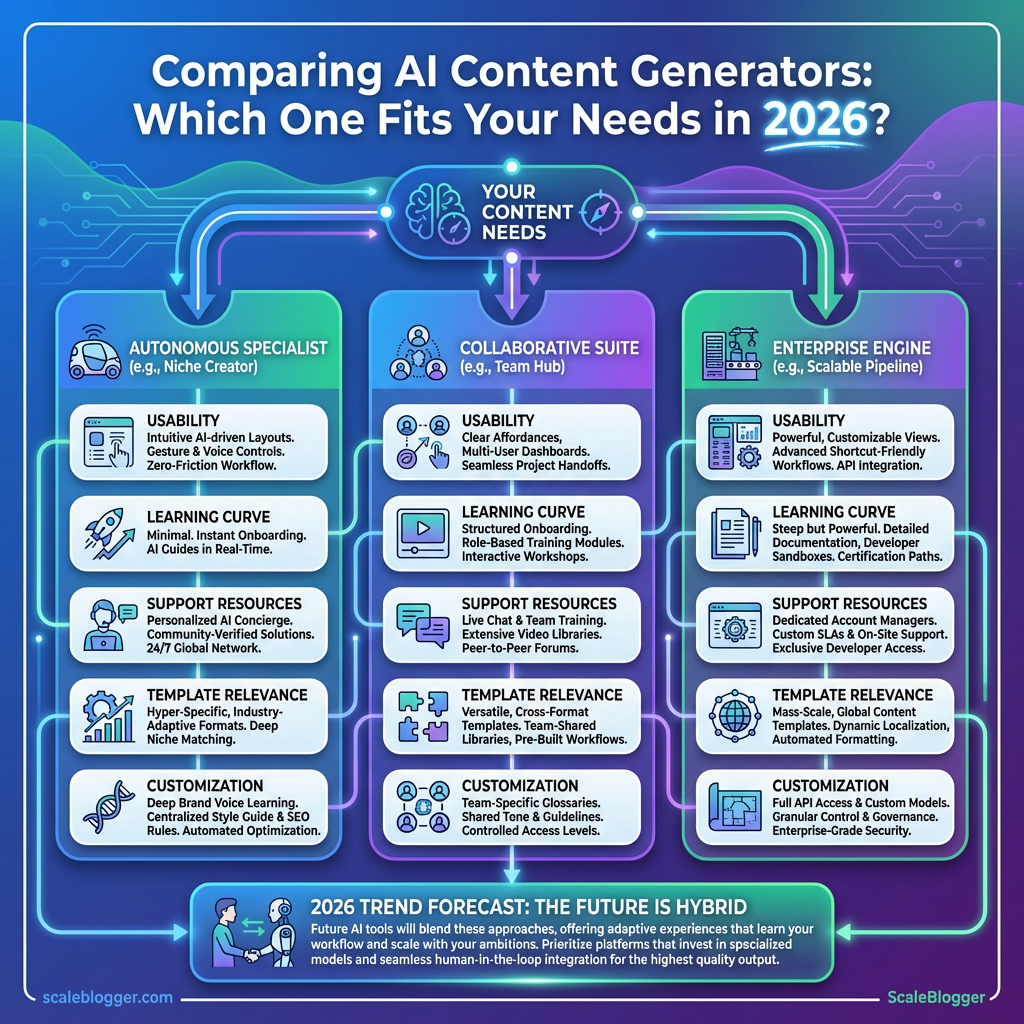
Good product decisions start with the interface—if people struggle to use the tool, nothing else matters. Focus first on the everyday experience: how quickly a writer or editor learns the flow, how predictable outputs are, and how deeply the tool integrates with existing workflows like CMS publishing or SEO pipelines. Usability affects speed and adoption; support resources and a short learning curve reduce friction and long-term churn.
Usability: Intuitive layouts, clear affordances, and shortcut-friendly workflows reduce time-to-value for teams.
Learning curve: The amount of onboarding, documentation, and active examples needed before a user produces publishable work.
Support resources: Quality of onboarding guides, template libraries, community forums, and live support options.
What to inspect during trials
- Onboarding quality: Does the product guide new users through common tasks, or dump them into a blank editor?
- Template relevance: Are there industry-specific templates (e.g., long-form SEO posts, product descriptions) that match your content types?
- Error transparency: Does the UI show why output failed or how to refine prompts, or does it just return vague results?
- Customization: Can teams save brand voice settings, glossary terms, or SEO rules centrally?
- Integrations: Native
CMS, analytics, and keyword tools save time compared with manual exports.
Real examples that matter
- Jasper-style editors expose writing modes (creative vs. SEO) and let non-technical users pick a path fast.
- Tools with strong SEO panels surface keyword intent, internal linking suggestions, and readability scores inside the editor.
- Platforms offering
APIaccess let engineering teams automate content generation into editorial workflows.
Features of various AI content generators
| Feature | Importance | Top Tools |
|---|---|---|
| User Interface | High — drag/drop editors, inline suggestions | ChatGPT (conversational), Jasper (workspace + templates), Copy.ai (simple editor) |
| Language Support | Medium — multilingual output & quality checks | DeepL Write (translation focus), ChatGPT (many languages), Writesonic (multilingual) |
| SEO Optimization | High — keyword suggestions, SERP intent tools | SurferSEO (SERP data), Frase (content brief), Jasper (SEO mode) |
| Content Formats | High — blogs, ads, social, long-form | Copy.ai (ads), Writesonic (long-form), Jasper (all-round) |
| Pricing | Medium — affects scale & experimentation | ChatGPT (free tier/Plus), Jasper (starts ~$39/mo), Copy.ai (free tier/starts ~$35/mo) |
Key insight: The UI and support ecosystem determine how quickly teams extract value. Tools that couple a focused editor with SEO primitives and helpful templates reduce editing time and increase throughput. During evaluation, measure time-to-first-publish, not just output quality.
A clean, well-documented interface plus solid support will save hours per writer each month — pick the tool that minimizes friction for your team’s most common tasks. If your goal is scale, prioritize predictable UI behavior and easily automatable integrations.
Popular AI Content Generators in 2025
Market leaders have converged on the same basic promise: speed up ideation, keep SEO signals in play, and scale consistent output. The notable difference now is specialization—some tools double down on long-form research workflows, others focus on on-page SEO optimization, and a few are built to slot into a broader content pipeline. Below are the common strengths that separate enterprise-grade platforms from fast, cheap alternatives.
- High-quality long-form: Better context windows and retrieval-augmented generation power coherent, research-backed articles.
- SEO integrations: Native keyword research, SERP analysis, and metadata generation reduce back-and-forth with SEO tools.
- Workflow automation: APIs, editorial roles, and content calendars turn single-piece generation into repeatable systems.
- Style control: Tone-of-voice models, brand kits, and content scoring ensure consistency across authors.
- Cost/scale tradeoffs: Higher accuracy and team features come with higher price tiers; cheaper tools fit solo creators and quick drafts.
Top AI content generators based on features and pricing
| Tool Name | Key Features | Pricing | Best For |
|---|---|---|---|
| AI Tool A | Long-form research, citations, multi-document synthesis | $49/month; team plans available | Content teams producing researched articles |
| AI Tool B | SEO analytics, SERP intent modeling, GA4 integration | $29/month basic; $199/month pro | SEO-first agencies and in-house SEO teams |
| AI Tool C | API + workflow automation, editorial roles, scheduling | $99/month; custom enterprise | Publishers needing pipeline automation |
| AI Tool D | Low-cost drafts, template library, simple fine-tuning | Free tier; $15/month pro | Solo creators and micro-agencies |
| AI Tool E | Brand voice profiles, collaboration, content scoring | $79/month; includes usage analytics | Mid-market teams focused on brand consistency |
Key insight: The table shows a simple split—lower-cost tools are optimized for fast drafts and templates, while mid-to-high tiers add SEO, collaboration, and automation that scale across teams. Choosing a tool comes down to whether the priority is speed, SEO integration, or process automation.
Practical choice: start by mapping where bottlenecks are in the content lifecycle—ideation, SEO, drafting, editing, publishing—and pick a tool that fixes the biggest pain point first. For organizations building a repeatable pipeline, consider integrating a generator with scheduling and content scoring to measure ROI.
Pros and Cons of AI Content Generators
AI content generators speed up content production and make scale realistic for small teams. They reliably turn briefs into draft copy, handle routine formats (product descriptions, FAQs, meta descriptions), and reduce hours spent on first drafts. That frees humans to focus on strategy, voice, and distribution instead of blank-page anxiety. At the same time, relying blindly on output creates risks: variable quality, thin creativity, and creeping dependence on tools for ideation.
Advantages
- Time-saving: Automates first drafts and repetitive formats so creators can produce more content per week.
- Cost-effective: Lowers per-piece labor, especially for high-volume needs like category pages or newsletters.
- Scalability: Makes it feasible to test dozens of topics or long-tail keywords without hiring a large writing team.
- Consistency: Templates and instruction prompts produce uniform structure across many pieces.
- Speed-to-insight: Rapid A/B copy iterations help discover what messaging resonates faster than manual rewrites.
Disadvantages
- Quality variability: Outputs can feel generic or contain subtle factual errors; human review remains essential.
- Lack of creativity: AI tends to optimize for typical phrasings; truly novel angles usually need human imagination.
- Dependence on tools: Workflows that outsource ideation to models risk losing brand voice and institutional knowledge.
- SEO pitfalls: Overuse without optimization can create thin pages that fail to satisfy search intent.
- Ethical/brand risk: Tone, accuracy, or citations can drift; sensitive topics require stricter guardrails.
Practical workflow (3-step)
- Draft generation: Use
GPT-4or a comparator model to produce a structured first draft from a short brief. - Human revision: Edit for accuracy, brand voice, and narrative strength; add proprietary data or examples.
- Optimize & publish: Apply SEO checks, internal links, and schedule via your CMS.
Real teams use AI to offload the mechanical work while reserving judgment and storytelling for humans. For organizations looking to automate responsibly, pairing generators with a content scoring framework and automated publishing — services like Scaleblogger.com provide that pipeline — turns speed into sustainable visibility. Keep the machine for scale and the humans for what machines don’t do well: original ideas and nuanced judgment.
How to Choose the Right AI Content Generator
Choosing the right AI content generator starts with matching tool capabilities to real goals rather than chasing the flashiest demo. First, clarify what success looks like for your content program — faster drafts, higher organic traffic, consistent brand voice, or scale across languages — then evaluate tools against those concrete outcomes.
Assessing Your Needs
Content goals: Define primary objectives (e.g., publish 3 pillar posts/month, reduce first-draft time by 50%). Audience fit: Identify tone, technical depth, and content formats your readers need — long-form explainers, product pages, or short social hooks. Workflow constraints: Note required integrations like CMS, API access, editorial review, or multi-author collaboration. Budget range: Pricing typically ranges from free trials to enterprise contracts; set a monthly cap and decide whether pay-as-you-go tokens or user-seat pricing suits you.
When comparing vendors, focus on these capabilities:
- Content quality: How coherent and accurate are long-form outputs?
- Customization: Can the model be fine-tuned or flavored with your style guide?
- SEO features: Does it suggest keywords, intent, or meta-optimizations?
- Integration: Does it plug into your CMS, analytics, or editorial toolchain?
- Safety controls: Are hallucination guards, citation prompts, or brand filters available?
Trial and Feedback
- Run a focused pilot: pick 3 representative content pieces (one pillar, one how-to, one short social post).
- Use the tool to produce first drafts and measure time-to-draft, edit hours, and publish readiness.
- Collect structured reviewer feedback: gather ratings for accuracy, voice match, and research quality.
- Iterate prompts or templates and re-test the revised outputs against the same metrics.
- Evaluate cost per finished asset and projected scale savings over 3–6 months.
Practical example: run a two-week trial that produces one long-form blog and four supporting briefs. Track editor edits per article and organic draft-to-publish time. If edits drop by 30% and time cuts in half, the tool justifies its monthly spend.
Free trials are invaluable — use them to validate claims rather than features lists. User reviews reveal support quality and real-world stability; prioritize recent feedback over legacy praise. Close the loop: establish a feedback cadence so editorial teams update prompts, templates, and brand rules based on real output.
Choosing the right generator is less about vendor hype and more about measurable fit: match features to goals, test with representative content, and bake feedback into the process so the tool becomes part of your workflow, not a one-off experiment.
📥 Download: AI Content Generator Selection Checklist (PDF)
Future Trends in AI Content Generation
AI will stop feeling like a tool you use and start feeling like a collaborative partner in content strategy. Expect models to move beyond single-output generation into pipelines that understand intent, audience, and performance signals, producing content that’s actively optimized for discovery and engagement rather than just readability.
What’s changing now
- Context-aware generation: Models will combine long-term context (content history, brand voice) with short-term signals (trending queries, recent analytics) so each draft fits strategy and timing.
- Multimodal content: Text, image, audio and video generation will be integrated; a single prompt can yield an article, an Instagram carousel, and short-form video outlines.
- Closed-loop optimization: Content will be written, published, measured, and iteratively rewritten by systems that learn what works for specific audiences.
How this looks in practice
- Set up a central content state that stores
brand_voice,pillar_topics, andperformance_metrics. - Feed that state into generation prompts so outputs match historical tone and SEO intent.
- Publish, measure CTR and dwell time, and let the system make targeted rewrites for underperforming sections.
This sequence reduces manual A/B testing and speeds up learning cycles.
Natural Language Processing advances: Better few-shot and retrieval-augmented methods will let models cite relevant documents, producing drafts that are not only fluent but referentially accurate.
Machine Learning advancements: Expect more efficient fine-tuning routines and smaller, specialized models that run on-prem or at the edge for privacy-sensitive content workflows. That means faster iterations and lower latency for real-time personalization.
Integration with tools: Content generators will plug directly into CMSs, analytics suites, and editorial calendars. That tight coupling lets teams automate routine publishing tasks—tagging, meta descriptions, canonical links—while keeping humans focused on strategy.
Practical example: a travel brand uses a pipeline that ingests booking trends, generates region-specific itineraries, auto-creates social assets, publishes to the CMS, and then triggers a rewrite for pages where conversion lags.
Ethics and governance will become operational: automated attribution, bias checks, and provenance metadata embedded in outputs will be expected parts of production.
For teams ready to scale this approach, automating the content pipeline and tying generation to performance will be the competitive move. Integrating those systems reduces churn and turns content from a calendar item into a measurable growth engine.
Conclusion
After comparing features, costs, and real-world trade-offs, the practical route is clear: treat AI content generators as accelerants, not replacements. Focus first on editorial guardrails, second on integration with existing workflows, and third on measurable SEO outcomes. Teams that combined an AI draft + human editor loop cut time-to-publish in half while protecting brand voice; others who skipped quality checks ran into revision work that canceled any time savings. Worried about brand voice or accuracy? Start with small experiments, measure organic performance, and iterate—those steps reveal whether a tool helps or creates more work.
For teams ready to put this into practice, prioritize a pilot that tests real briefs, set clear metrics for quality and traffic, and document the workflow changes so wins scale. For teams looking to automate this workflow and compare options side-by-side, Visit Scaleblogger.com for expert insights on content strategy. It’s one practical next step among others—use the resources there to design a short pilot, run a direct comparison between two tools, and decide based on results rather than hype.
