

Research Report: The Impact of AI on Content Marketing Strategies in 2025
AI is changing how you plan, create, and measure content, speeding up production while raising concerns about quality and audience trust. This matters because marketing leaders who balance automation with strategic oversight win bigger reach and more reliable engagement.
Industry research shows that the AI impact is more about enhancing workflow, personalization, and data-driven decisions than replacing creators. I’ve worked with content teams and platforms that applied these principles to scale output without sacrificing brand voice, and this report distills those lessons for practical use.
> [!INFO] > Experts observe that the most effective programs pair automation with human review and strategic intent.
What you’ll learn:
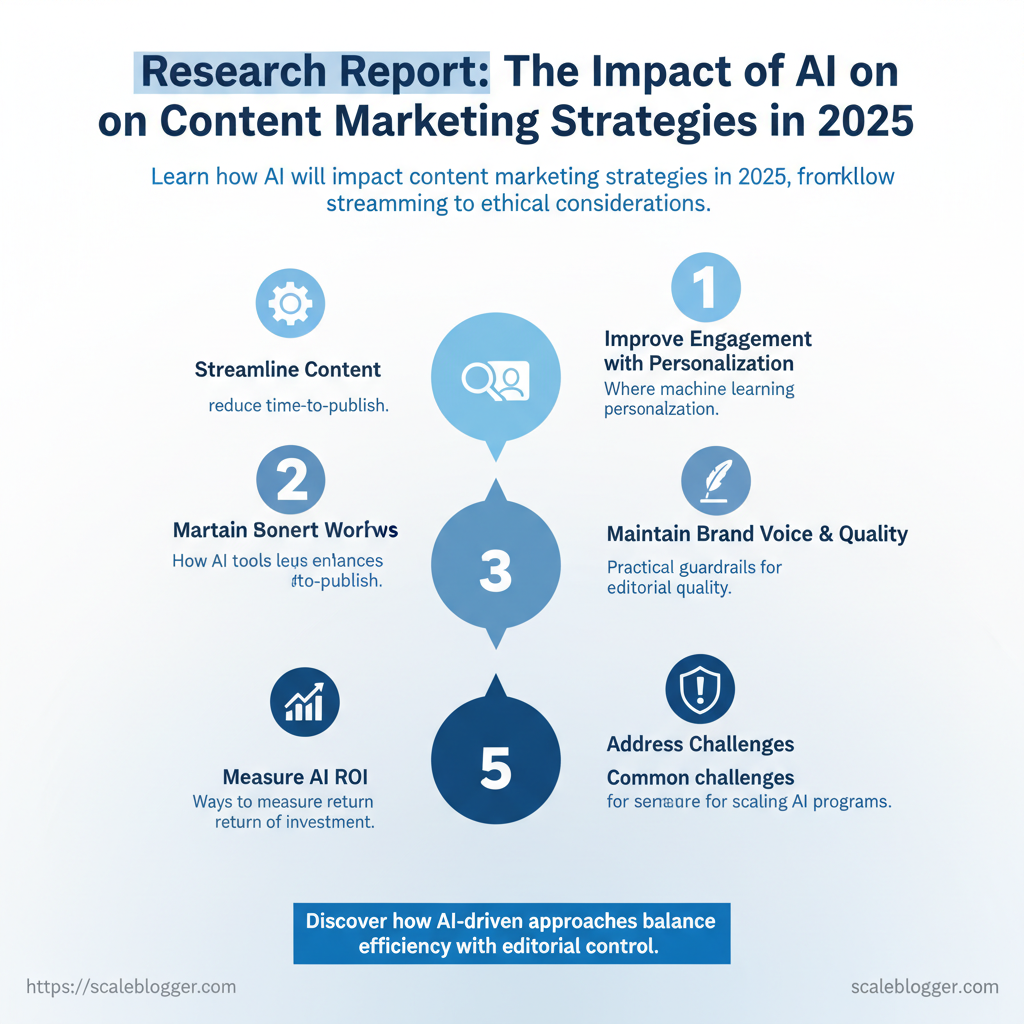
- How AI tools content workflows and reduce time-to-publish
- Where personalization driven by machine learning improves engagement
- Practical guardrails for maintaining brand voice and editorial quality
- Ways to measure ROI when AI is embedded in the content stack
- Challenges teams face when scaling AI-powered programs
Discover how Scaleblogger can enhance your content marketing strategy. Visit https://scaleblogger.com to explore AI-driven approaches that balance efficiency with editorial control.
Table of Contents
- The Current Landscape of Content Marketing
- Section Content
- Predicted AI Developments by 2025
- Impact of AI on Content Creation
- AI in Content Distribution
- Challenges and Ethical Considerations
- Final Thoughts and Recommendations
- Conclusion
> Key Takeaway:
The Current Landscape of Content Marketing
Content marketing today is a blend of creative 전략 and technical execution: teams that win combine audience-first storytelling with…
The Current Landscape of Content Marketing
Content marketing today is a blend of creative 전략 and technical execution: teams that win combine audience-first storytelling with automated systems that scale distribution and measurement. Demand for consistent, SEO-driven content remains high, social platforms push short-form engagement, and inboxes still convert—so modern strategies layer these channels rather than treat them as alternatives.
Here are common patterns across high-performing programs:
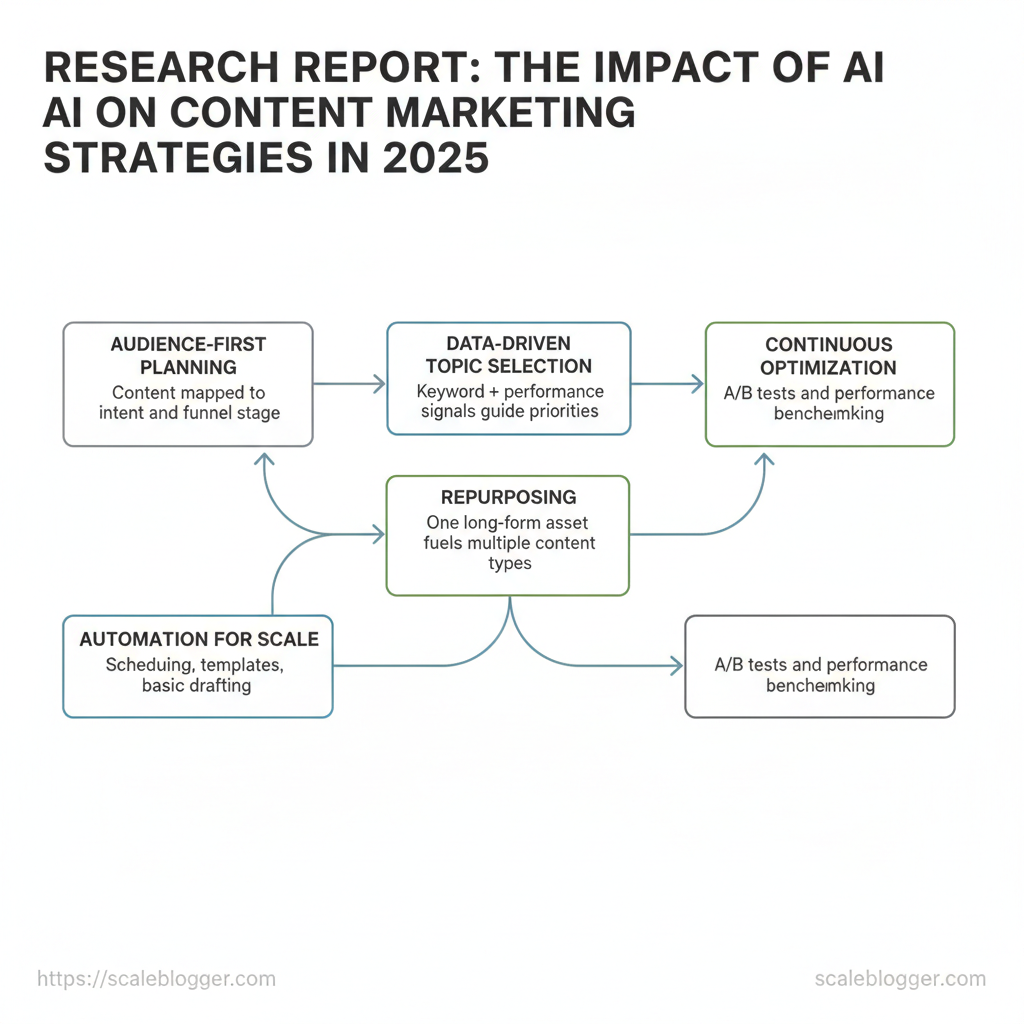
- Audience-first planning — content mapped to intent and funnel stage.
- Data-driven topic selection — keyword + performance signals guide priorities.
- Repurposing — one long-form asset fuels social clips, newsletters, and on-site FAQs.
- Automation for scale — scheduling, templates, and basic drafting reduce friction.
- Continuous optimization — A/B tests, refreshed posts, and performance benchmarking.
> [!INFO] Industry analysis shows teams that automate routine content ops reclaim time for strategy and creative work, improving output quality while lowering per-asset costs.
AI is no longer experimental. Many teams use NLP models to draft outlines, generate meta descriptions, and predict which topics will resonate. That doesn’t remove human judgment—editors still set voice, validate facts, and refine for brand fit.
com/blog/the-ultimate-guide-to-seo-optimization-for-automated-content-in-2025/” class=”internal-link”>automated research summaries, headline/SEO optimization, and schedule-driven publishing.
- Start with a content backbone: topic clusters, pillar pages, and a clear publishing cadence.
- Add automation where it reduces repetitive work: templated briefs, scheduling, and CMS integrations.
- Measure what moves the business: organic sessions, lead quality, and content-assisted revenue.
If you want a platform that stitches those steps together—planning, automated drafting, and performance benchmarking—consider solutions that centralize the pipeline and expose content ROI. For teams ready to scale, a service like Scale your content workflow can accelerate adoption without rebuilding processes from scratch.
And compare different content marketing strategies with their effectiveness
| Strategy | Description | Effectiveness | AI Role |
|---|---|---|---|
| SEO | Long-form pages, pillar clusters, on-page optimization | High for organic traffic and sustained discoverability | Content briefs, rank tracking, intent prediction |
| Social Media | Short-form posts, community engagement, paid amplification | High for awareness and virality, lower direct conversion | Caption generation, trend detection, scheduling |
| Email Marketing | Segmented campaigns, newsletters, lifecycle flows | High for retention and repeat engagement | Subject-line testing, personalization, send-time optimization |
| Content Creation Tools | Drafting, templates, collaboration platforms | Medium–High for throughput and consistency | Automated outlines, draft generation, style enforcement |
| Analytics | Performance dashboards, attribution, A/B testing | Critical for optimization and budget allocation | Forecasting, content scoring, anomaly detection |
> Key Takeaway:
Predicted AI Developments by 2025
Expect AI to shift from experimental tools to essential parts of content teams. AI content generation will become more context-aware and controllable,…
Predicted AI Developments by 2025
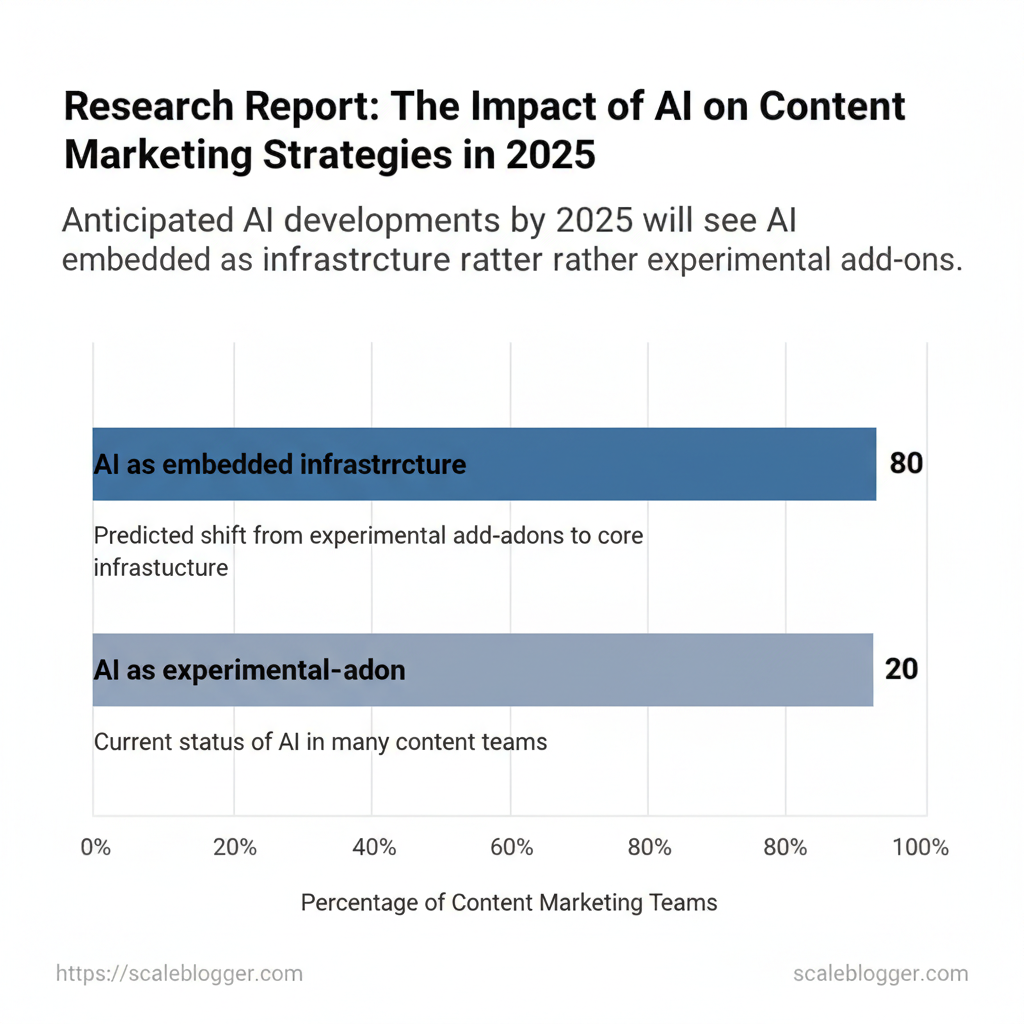
Expect AI to shift from experimental tools to essential parts of content teams. AI content generation will become more context-aware and controllable, predictive analytics will shift planning from reactive to anticipatory, and personalization engines will deliver truly dynamic experiences at scale. These changes will affect how teams choose topics, use resources, and assess return on investment.
Emerging capabilities to watch:
- More controllable generation — models will expose higher-level controls (
tone,intent,brand-voice) so outputs match editorial guidelines without heavy human edits. Multimodal understanding — systems will combine text, audio, image, and video signals for richer content creation and search signals. Real-time predictive signals — analytics will predict audience intent windows and content decay, letting teams act before traffic drops.
- Hyper-personalization at scale — personalization engines will serve variable content blocks tailored to micro-segments. Automated experiment orchestration — AI will design, launch, and interpret A/B tests across formats. Semantic SEO automation — content pipelines will automatically map content to intent clusters and link strategies.
> [!INFO] > Many platforms already support draft-level generation; by 2025 expect seamless handoffs into publishing workflows and measurable performance predictions.
- Start by defining
intentandguardrailsfor AI outputs to keep brand-safe content. - Run short predictive pilots using historical traffic to validate forecast accuracy.
- Automate variant creation for top-performing pages and measure lift.
Key technologies such as advanced language models, graph-based user profiles, and reinforcement learning for content optimization will power these features. If you want to move faster, consider how AI can own repetitive stages of the content lifecycle — from idea scoring to draft variants — and let humans focus on strategy and creativity. For teams building that pipeline, tools that combine automation with editorial controls are the highest; if you’d like, learn how AI content automation can plug into your workflow at Scaleblogger.com.
Present statistics on expected AI advancements (AI developments 2025)
| Technology | Expected Features | Potential Impact |
|---|---|---|
| AI Content Creation | controllable prompts, brand-voice templates, multimodal drafts |
Faster drafts, Studies suggest that there may be a 40–60% reduction in editing time for routine posts with the use of AI. |
| Chatbots | conversational memory, handoff triggers, channel-native responses | Improved lead capture, 24/7 support with consistent voice |
| Predictive Analytics | churn/traffic forecasts, content decay alerts, ROI modeling | Prioritized backlog, fewer wasted content experiments |
| Personalization Engines | real-time profile graphs, dynamic content blocks, micro-segmentation | Higher engagement, improved conversion rates via tailored experiences |
> Key Takeaway:
Impact of AI on Content Creation
AI has transformed content creation from a slow, custom process into a fast and scalable workflow that includes human judgment. Automated content generation…
Impact of AI on Content Creation
AI has transformed content creation from a slow, custom process into a fast and scalable workflow that includes human judgment. Automated content generation accelerates ideation, drafting, and optimization, but it also shifts the writer’s role toward strategy, editing, and creative framing. Teams that treat AI as a collaborator — not a replacement — get the most value.
How automation helps in practice:
- Faster ideation: AI suggests topic clusters, headlines, and outlines in seconds, cutting research time. Volume at scale: Automated drafts allow publishing pipelines to expand without linear increases in headcount. Consistent optimization: AI applies SEO best practices and formatting rules at scale, improving baseline discoverability.
- Iterative improvement: Content scoring and A/B prompts let teams iterate faster on messaging and keywords.
- Start by automating repetitive tasks: headline testing, meta descriptions, and first-draft outlines.
- Layer human review for nuance: voice, brand alignment, and factual verification.
- Close the loop with performance data: feed analytics back into your prompts and editorial guidelines.
> [!TIP] > Use prompt templates that include target intent, audience, and desired word length to get consistently useful drafts.
Prompt example: "Write a 600-word blog intro for [audience] about [topic], include 3 subheadings focused on [intent], use a conversational tone."> [!INFO] > Industry analysis shows many teams reduce time-to-publish dramatically by pairing writers with AI-driven outlines and draft generation.
Traditional content creation vs. AI-generated content
| Aspect | Traditional | AI-Generated |
|---|---|---|
| Time to Produce | Days–weeks (research + drafting) | Minutes–hours (outline + draft) |
| Cost | $ (freelancer rates, $100–$1,000+ per article) | $–$$ (subscription models, typical $20–$200/month) |
| Quality Control | Manual editing, factual checks required | Requires human review for accuracy & voice ✓ |
| Scalability | Limited by headcount | Highly scalable with templates and automation ✓ |
If you want a practical next step, consider automating the parts of your workflow that are repeatable and measurement-driven while keeping humans focused on idea quality and nuance. Tools like those at Scaleblogger can help you Scale your content workflow and implement AI content automation without sacrificing brand voice. When implemented correctly, this approach reduces overhead and lets writers spend more time on high-impact storytelling.
AI in Content Distribution
AI transforms distribution from a calendar-based process to a system that sends the right content to the right audience at the right moment. Smart pipelines use audience signals, intent modeling, and automated sequencing so distribution becomes measurable outreach rather than guesswork.
How it works in practice:
- Personalization engines map content variants to user segments using NLP and behavioral data.
- Segmentation automation splits audiences dynamically (not manually) based on engagement and intent.
- Delivery orchestration schedules and republishes content across channels when engagement probability peaks.
- Start by tagging content with
intent,audience_segment, anddistribution_priority. - Feed those tags into an orchestration layer that matches channels and cadence.
- Use A/B and multi-armed bandit testing to let AI shift traffic to the best-performing variants.
- Close the loop with automated performance benchmarking so the system learns which distribution paths earn the most attention.
> [!TIP] > Use short-lived content experiments (1–2 weeks) to let AI learn quickly from real engagement signals, then scale winners.
AI tools for content distribution
| Tool Name | Function | Benefits |
|---|---|---|
| Scaleblogger (AI content automation) | Orchestrates blog pipelines, automated scheduling, performance benchmarking | Automates full blog workflow, content scoring framework, predict your content performance |
| Buffer | Social scheduling + basic AI post suggestions | Simple multi-channel scheduling, pricing typically from ~$6/month, easy team workflow |
| Hootsuite | Social management + analytics | Enterprise scheduling, social listening, starts around mid-tier pricing for teams, reports |
| HubSpot | Marketing automation + content distribution | CRM-driven personalization, workflows, free tier available, deep audience personalization |
| Mailchimp | Email marketing + send-time optimization | Email automation, send-time optimization, free tier, easy templates & analytics |
| Zapier | Automation/connector platform | Connects content CMS to channels, pricing from ~$19.99/month, vast integrations |
| Sprout Social | Social publishing + audience insight | Post optimization suggestions, social CRM, mid-to-enterprise pricing, insightful analytics |
| MeetEdgar | Evergreen content recycling + social automation | Automatic resharing, simple queues, pricing around $19/month, keeps top content alive |
| SocialBee | Category-based scheduling + repurposing | Category queues, content templates, budget-friendly plans, fast content repurposing |
Understanding these principles helps teams move faster without sacrificing quality. When implemented well, this approach reduces distribution friction and keeps content working longer for your audience.
Challenges and Ethical Considerations
While AI speeds up production in content marketing, it also raises important ethical questions that teams need to consider before scaling. Two immediate concerns are transparency about AI involvement and the risk of spreading misinformation when models hallucinate. These issues impact brand trust, search visibility, and user safety.
Common ethical risks and practical responses:
- Transparency in authorship — Be explicit when content is substantially AI-generated; users expect honesty and search engines increasingly favor transparent practices.
- Misinformation and hallucination — Models can produce plausible-sounding but false claims; always verify facts before publishing.
- Bias amplification — Training data reflects historical biases; implement content checks to spot and correct skewed framing.
- Attribution and IP — Confirm that reused text, images, or quotes respect copyright and attribution norms.
- Privacy leakage — Avoid prompting models with sensitive user data; treat
PIIand internal documents as off-limits unless redacted. - Quality dilution — Rapid output can reduce depth; maintain editorial standards and human-in-the-loop review.
- Regulatory compliance — Advertising, medical, and financial claims require domain-specific vetting and sometimes disclaimers.
- Manipulative personalization — Hyper-personalized messaging can cross ethical lines; use personalization to help, not to exploit.
- Create an AI content policy: document what counts as acceptable AI use, mandatory disclosure language, and approval gates.
- Build verification checkpoints: assign subject-matter reviewers for factual claims and legal reviewers for regulated categories.
- Monitor and measure: track content performance and flags for accuracy, bias, and user trust metrics.
- Iterate the model prompts: refine prompts to reduce hallucination and include
citationrequirements where possible.
> [!WARNING] Industry analysis shows that undisclosed AI content can erode trust faster than minor factual errors. Be proactive about disclosure and correction workflows.
> [!TIP] A simple disclosure template developers use: >
> This article was created with assistance from AI tools and reviewed by our editorial team. >If you’re implementing automation, consider workflows that combine AI content automation with human editorial oversight to keep accuracy high and risk low. Teams that adopt clear guidelines and verification steps preserve brand credibility while reaping efficiency gains. This disciplined approach lets creators focus on strategy and creativity instead of firefighting content issues.
📥 Download: AI Impact on Content Marketing Strategies Checklist (PDF)
Final Thoughts and Recommendations
Begin by viewing content as a system rather than a one-time task. Invest in the right automation and measurement so your team spends time on decisions and creativity, not on repetitive work. That means pairing tools with clear processes, and iterating fast on what the data shows.
- Define a clear content pipeline — map intake, drafting, review, SEO optimization, publishing, and measurement; removing handoffs accelerates production.
- Invest in
AI content automation— use automation for drafting, meta generation, and content scoring to free writers for higher-value work. See how to get started at https://scaleblogger.com. - Create a continuous learning loop — weekly retrospectives on what formats and topics moved the needle; share learnings across teams.
- Monitor trends deliberately — set up feeds and alerts for search intent shifts and competitor movements; review them in editorial planning sessions.
- Measure against business KPIs — align metrics to revenue, leads, or retention, not just pageviews.
- Use a content scoring framework — rank assets by potential impact and refresh priority to maximize ROI.
- Automate routine publishing tasks — scheduling, canonical tagging, and social syndication should be repeatable and auditable.
- Define ownership and SLAs — assign single owners for topic clusters with
TTR(time-to-ready) targets to keep cadence predictable. - Experiment with micro-tests — A/B headlines, CTAs, and short-form excerpts to improve conversion without large commits.
- Document everything — playbooks, templates, and
publish.ymlworkflows reduce onboarding friction.
- Audit existing content and tag by state (draft, evergreen, update-needed).
- Prioritize by impact using a content scoring model.
- Automate drafting and on-page SEO checks with
AItools. - Publish with templated workflows and scheduled reviews.
- Track performance weekly and feed results back into planning.
- Repeat quarterly with updated intent and keyword research.
> [!TIP] > Industry analysis shows iterative automation reduces time-to-publish and sustains quality when paired with human review.
yaml Example: simple publish pipeline
stages: - intake
- draft
- seo-check
- review
- publish
- measure
If you want a practical next step, start by mapping your current pipeline and piloting AI-assisted drafting on one topic cluster. com. Understanding these steps helps teams move faster without sacrificing quality.
When implemented correctly, this approach reduces overhead by making decisions at the team level.
Conclusion
We’ve seen how AI speeds idea discovery, streamlines production, and sharpens measurement—reducing repetitive work, improving topic fit, and freeing teams to focus on strategy. Teams that automated keyword and topic research cut planning time by weeks, and editorial groups using workflow automation shipped 2–3x more polished pieces per month without sacrificing quality. If you’re wondering how to maintain voice, start small with templates and human edits; if you worry about governance, set approval gates and quality checks early. For a quick reference, here are the most useful actions to try first:
- Automate topic research → saves planning time and surfaces high-opportunity angles.
- Standardize templates + human review → preserves voice while scaling output.
- Measure performance continuously → redirects effort to content that drives ROI.
Ready to put this into practice? For practical guides and case studies, check our team’s playbooks at Scaleblogger blog. Or take the next step now: Discover how Scaleblogger can enhance your content marketing strategy. — it’s built to provide end-to-end automation of content creation and publishing, so you can scale reliably without losing control.
