

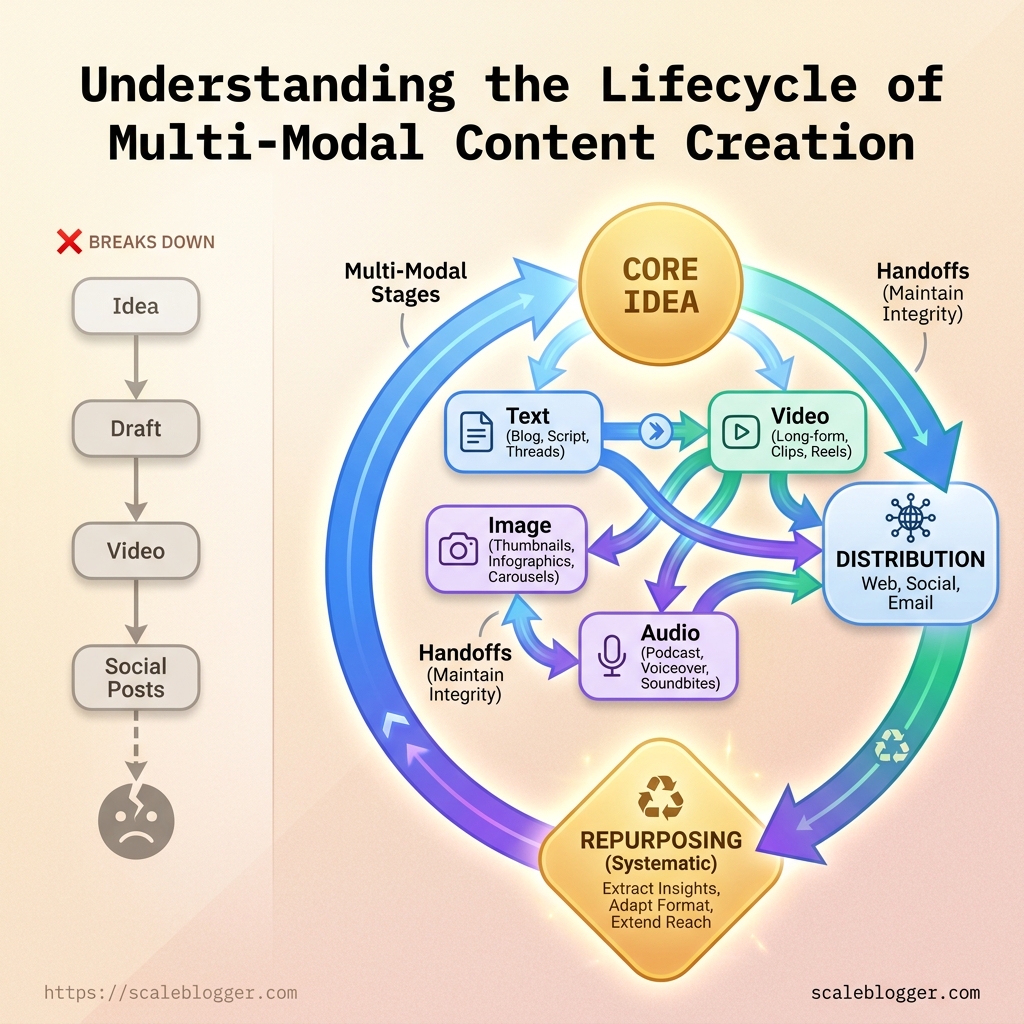
A good idea can fall apart between a draft, a video clip, and three social posts.
That usually happens because the content creation lifecycle is treated like a straight line, when it really behaves like a loop.
Text, images, audio, and video do not move through the same multi-modal content stages at the same pace.
A script needs timing; a thumbnail needs visual tension; a clip needs pacing; a caption needs context.
Miss one handoff, and the whole asset feels oddly flat.
That is why strong content strategy phases start before production and keep going after publishing.
Teams that map ideas, format choices, distribution, and repurposing early tend to waste less effort on content that never travels well across channels.
When the lifecycle is clear, content stops being a pile of assets and starts acting like a system.
The tricky part is knowing where each format should enter, change shape, and carry more weight without losing the original message.
Quick Answer: Use the content creation lifecycle as a looping system that moves a single core idea through gather → combine/align → generate, instead of treating blog, video, carousel, and LinkedIn as separate jobs. Brief once, map where each format enters, changes shape, and carries the same proof, then keep iterating post-publishing using shared context so edits don’t drift and performance insights aren’t trapped in siloed channels.
Why the Content Creation Lifecycle Matters More in Multi-Modal Work
A blog post, a short video, a carousel, and a LinkedIn clip can all start from the same idea, yet they rarely move through the same workflow.
That is where teams lose time.
When every format is handled as a separate job, planning fragments, edits drift, and distribution turns into a messy copy-and-paste exercise.
Multi-modal work changes that math.
Research on multimodal AI describes a three-stage flow of encoding, fusion, and generation, which is a useful model for content teams too: gather inputs, combine them cleanly, then output them in the right form Multimodal AI: Complete Guide to Next-Gen Systems (2026).
In practice, that means the content creation lifecycle is no longer a linear blog process.
It becomes a system for moving one core idea across formats without losing context, tone, or proof.
The hidden cost shows up fast.
Teams often brief once, then rewrite the same message five times, while edits pile up in different places and performance data stays trapped in separate channels.
Studies of multimodal machine learning in the AEC industry note how heterogeneous inputs such as images, BIM models, sensor logs, and text need a lifecycle-aligned approach, because the value comes from connecting the pieces, not treating them in isolation Multimodal machine learning in the AEC industry.
- Planning breaks first: One idea gets split into disconnected briefs, so each format starts from scratch.
- Editing gets inconsistent: Tone, claims, and calls to action drift when each asset is polished in a different tool or by a different person.
- Distribution gets slower: Reformatting for YouTube, LinkedIn, X, or Instagram adds manual steps that eat into publishing speed.
- Performance insight gets blurry: Separate assets make it hard to see which message worked, which format carried it, and where the audience dropped off.
That is why multi-modal content stages matter more than ever.
A stepwise workflow, like the one explored in explainable multimodal systems such as StepMIND, makes it easier to refine one source of truth and push changes across outputs without losing control StepMIND: A Visual Framework for Stepwise, Multimodal Refinement.
The teams that win are the ones that treat planning, editing, and distribution as one connected system.
When the lifecycle is connected, content stops behaving like a pile of assets.
It starts behaving like an engine.
The Core Stages of a Multi-Modal Content Creation Lifecycle
Why does one idea feel sharp in a blog post, then suddenly wobble when it becomes a reel, a carousel, and a podcast clip? Because the content creation lifecycle in multi-modal work is not one task with a few exports at the end.
It is a chain of decisions, and each stage changes the shape of the message.
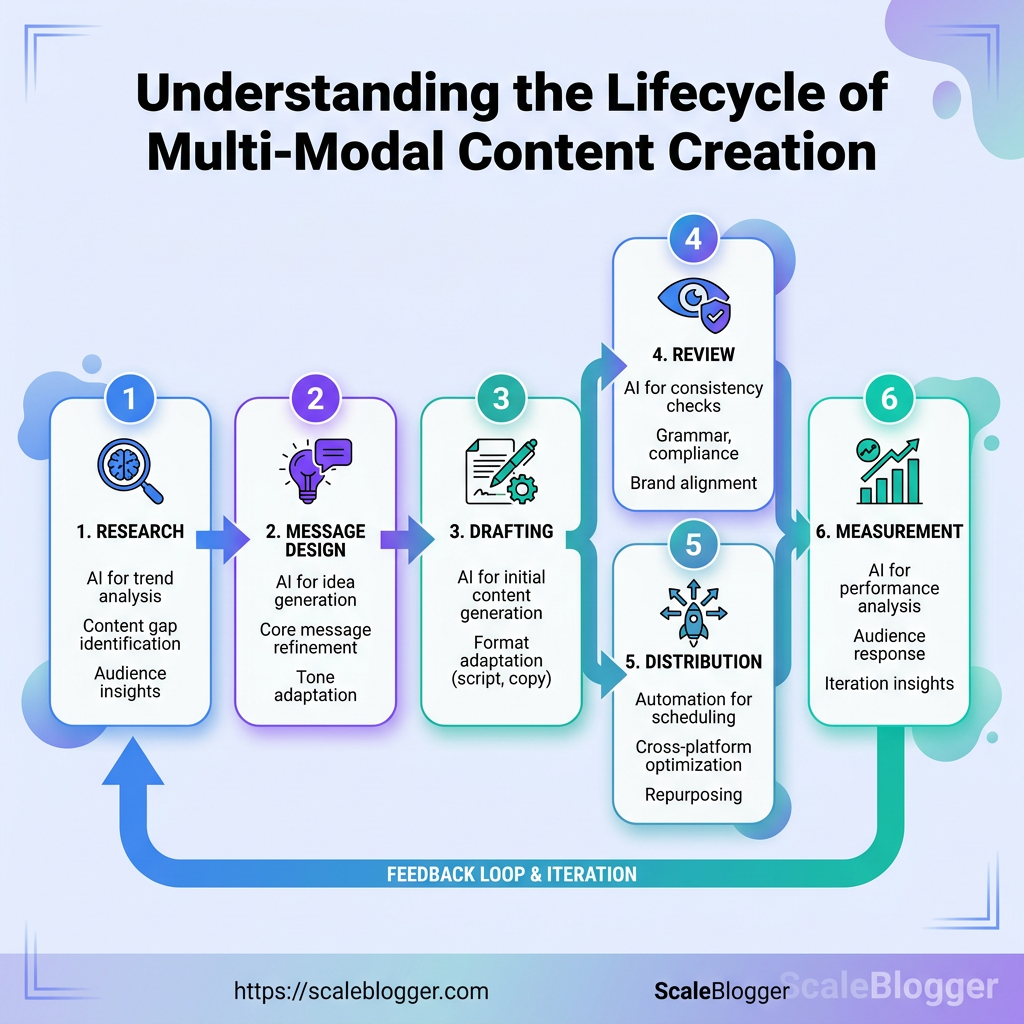
The practical version usually runs through six content strategy phases: research, message design, drafting, review, distribution, and measurement.
That lines up neatly with a 2026 guide on multimodal AI, which describes a flow of encoding, fusion, and generation, and with lifecycle-aligned research on multimodal machine learning in complex workflows Multimodal AI: Complete Guide to Next-Gen Systems (2026) and Multimodal machine learning in the AEC industry.
Multi-Modal Content Stages at a Glance
| Lifecycle stage | Primary task | Key output | Common bottleneck | AI or automation support |
|---|---|---|---|---|
| Research | Find audience pain points, search demand, and content gaps | Validated topic brief | Noisy signals and duplicate topics | Topic clustering, query extraction, audience segmentation |
| Ideation | Turn the brief into one core message and channel angles | Message map and format plan | Too many directions, no clear spine | Outline generation, angle scoring, template suggestions |
| Drafting | Build the master asset and adapt it for each format | First-draft article, script, carousel copy, or voice note | Version sprawl across formats | Draft generation, style adaptation, version control |
| Review | Check facts, tone, compliance, and accessibility | Approved master asset and channel variants | Endless revision loops | Checklist QA, terminology checks, alt-text support |
| Distribution | Publish and coordinate timing across channels | Scheduled and live posts | Mismatched metadata and timing | CMS publishing, scheduling, metadata population |
| Measurement | Compare results by format and channel | Benchmark report and test list | Noisy metrics and weak attribution | Dashboarding, anomaly detection, cross-channel benchmarking |
Research protects against weak topics, ideation prevents fuzzy messaging, and drafting stops the same idea from drifting across channels.
Review is where many teams lose time.
A 2025 ACM framework on stepwise multimodal refinement treats editing as controlled iteration, not a final polish pass, which is exactly how strong multi-modal workflows behave StepMIND: A Visual Framework for Stepwise, Multimodal Explainable AI.
Distribution and measurement matter just as much, because a good asset that lands late or gets tracked badly still underperforms.
A useful way to think about it is simple: one master idea, many controlled versions, and one feedback loop.
That keeps the content strategy phases connected instead of turning them into a pile of disconnected tasks.
Ever watched a strong idea stall because it needs multiple formats, several reviewers, and someone who’s suddenly “out of office”? That friction is usually operational—not creative.
AI and automation help most once you have a clear message structure, a defined source-of-truth, and a predictable set of handoffs. Then they can compress the time between “we have an idea” and “we have publish-ready assets,” without turning editorial standards into guesswork.
Ideation, briefs, and first drafts
AI is strongest when the brief is still forming. It can:- Cluster topics and surface angles the team hasn’t considered
- Turn a rough theme into a message map (core claim → supporting proof → format-specific takeaways)
- Generate first-pass drafts and variants that writers can improve
The key is to treat these outputs as draft material, not authority. Your brief defines what must stay constant (message, audience, claims, proof), and AI fills in the first working version.
Handoffs, scheduling, and asset formatting
Automation earns its keep after the draft is approved. It can reliably handle the repetitive, failure-prone work:- File naming and version tracking
- Resizing/transcoding and exporting assets to channel specs
- Populating CMS fields (title, description, captions, metadata)
- Scheduling across platforms and queuing updates
This matters because multi-modal publishing is coordination-heavy: the “same idea” needs different packaging, and small formatting inconsistencies can break performance tracking and accessibility.
Where human judgment still matters most
Automation can scale production, but it can’t safely replace responsibility. Human review is essential for:- Voice and point of view (brand consistency)
- Accuracy and claims (facts, dates, comparisons, attribution)
- Channel fit (pacing, sensitivity, and contextual appropriateness)
- Final approval and risk control
A practical balance looks like this: AI accelerates the draft and variant-building, automation keeps the pipeline moving with clean handoffs, and people protect the quality that makes the content worth publishing.
Why do some campaigns feel smooth while others turn into half-finished assets? Usually it’s not creativity—it’s the absence of shared rules.
Strong multi-format work starts with one source idea, then branches into different media with clear constraints for what must remain identical (message, proof, audience promise) and what can change (format, pacing, packaging).
Start with a campaign brief that acts like a schema
The first job isn’t producing assets—it’s locking the structure that every format will inherit.Your brief should define:
- The core claim (the one-sentence thesis)
- The audience pain point and context
- The proof points (data, examples, references)
- The tone/voice boundaries
- Channel rules (length, CTA style, rhythm, and what not to say)
Once that’s set, the team can create blog, clip, carousel, email, and social posts without renegotiating strategy every time a new format appears.
A repeatable workflow that scales across formats
- Source once: write the claim, audience pain point, and proof.
- Branch by format: adapt the same idea into blog, script, carousel copy, and audio/podcast notes.
- Apply channel rules: keep the message constant, but match each medium’s behavior (pacing, structure, and packaging).
- Publish in waves: stagger releases so each asset supports the next rather than competing with it.
- Measure together: compare performance across formats and channels using one shared campaign view.
Benchmarks that tell you whether the idea traveled
Benchmarks should answer, “Did the message land, and did the format carry it effectively?” Track metrics like:- Reach (discovery)
- Engagement depth (quality of attention)
- Save/share rate (usefulness)
- Completion rate for video/audio (staying power)
- Assisted conversions (downstream impact)
The smartest teams don’t just optimize per post—they keep one scoreboard for the campaign so they can see which formats actually pull their weight.
Common Failure Points in Multi-Modal Production
Why do strong campaigns start sounding like three different brands once they leave the blog draft?
That usually happens when the content creation lifecycle is stretched across too many formats without a shared standard.
A blog, a short-form video, and a carousel each ask for different pacing, but they still need the same message, tone, and proof points.
Research on multimodal systems keeps showing the same pattern: when heterogeneous inputs are fused without a clear structure, consistency slips fast, whether the system is handling images, text, sensor logs, or other signals, as discussed in the 2026 guide to multimodal AI systems and the lifecycle-aligned review of multimodal machine learning in AEC.
The first failure point is format expansion without message control.
Teams adapt the same idea into five assets, then each version drifts a little more.
By the time the post hits LinkedIn, the hook is sharper than the article, the video overstates the claim, and the carousel leaves out the proof.
Scheduling creates the second trap.
Once approvals stack up, the best ideas sit idle while timestamps and file names become the real workflow.
Stepwise refinement models such as StepMIND are built around controlled iteration for a reason: multimodal work breaks when edits happen in the wrong order, or too late.
- Format drift: One source idea turns into inconsistent messaging across blog, video, and social cuts. Keep a single source-of-truth brief for claims, tone, and audience promise.
- Approval drag: Legal, brand, and stakeholder sign-off can turn into a queue that kills timing. Set approval windows and define which assets need review, and which do not.
- Output vanity: Publishing ten assets means little if none move the needle. Measure saves, clicks, watch time, qualified traffic, and assisted conversions instead of raw volume.
The third failure point is measuring output instead of performance.
A team can publish relentlessly and still miss the real signal if no one checks whether each format actually pulls its weight.
Work on automatic social media content generation and style control via multimodal frameworks points in the same direction: style consistency matters, but only when it serves performance.
A cleaner content strategy phase usually starts with fewer handoffs, tighter message rules, and a harder look at what each format earns.
That is where multi-modal content stages stop feeling chaotic and start behaving like a system.
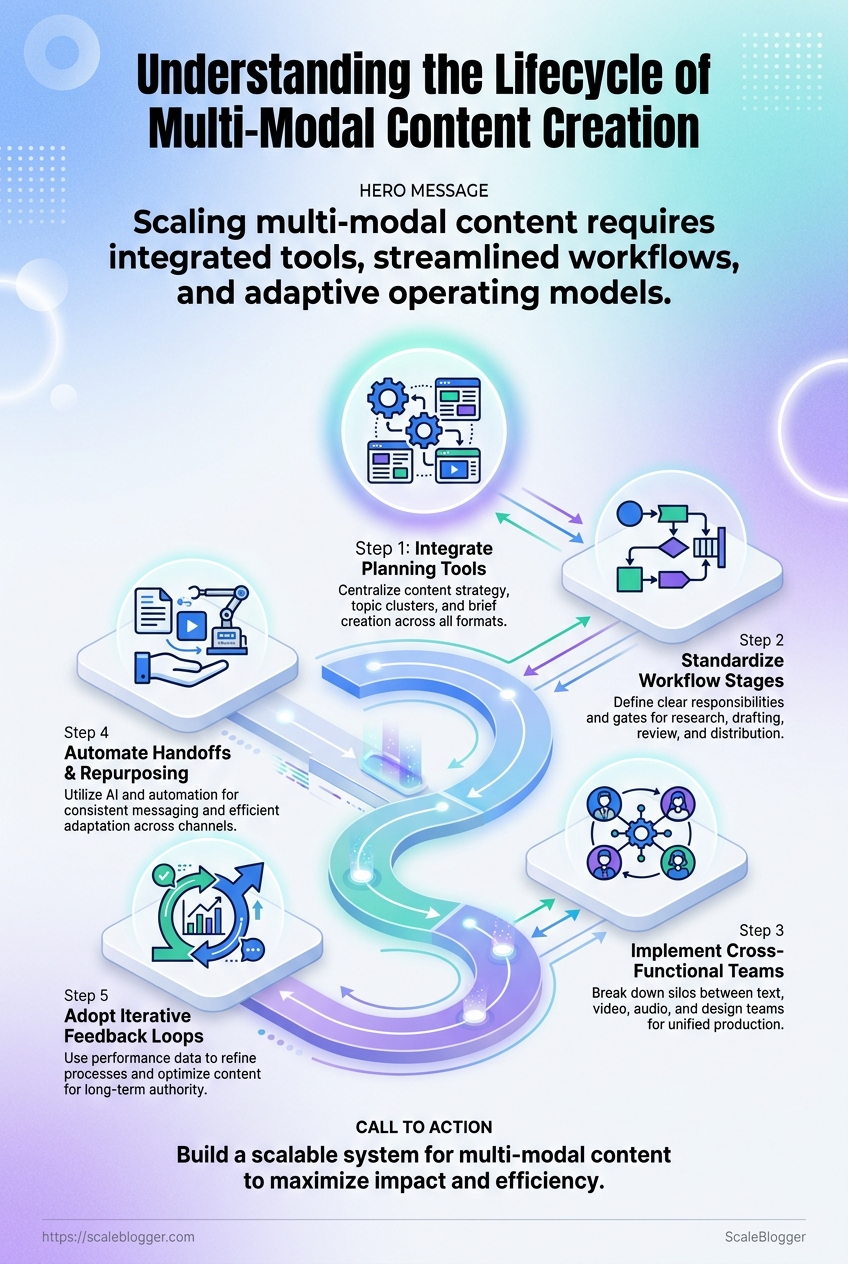
Tools, Workflows, and Operating Models That Scale With the Lifecycle
Why do some content systems stay calm at 50 assets a week while others start wobbling at 10? The difference is usually not talent.
It is whether the stack was built for the whole content creation lifecycle, or just for drafting.
A scalable setup treats content like a repeatable system.
A 2026 overview of multimodal AI describes a clean flow of encoding, fusion, and generation in Multimodal AI: Complete Guide to Next-Gen Systems (2026), and the same logic maps neatly to content work: gather inputs, combine them into a usable brief, then generate and adapt outputs.
That matters because modern content strategy phases pull in messy inputs, not just text.
Research on multimodal machine learning in the AEC industry shows how heterogeneous inputs can live inside one framework, which is exactly how good content ops handles briefs, transcripts, screenshots, performance logs, and channel notes in one place.
That is where we fit in the workflow.
Our role sits between planning and publishing, so the team is not bouncing between a doc, a CMS, a scheduler, and a reporting dashboard all day.
A practical stack usually has four layers:
- Planning layer: topic maps, audience notes, approval rules, and source tracking live here.
- Production layer: drafts, image prompts, short-form variants, and version history stay tied to one source of truth.
- Distribution layer: scheduling, CMS publishing, and channel-specific repurposing happen without manual reformatting.
- Benchmarking layer: performance is compared by format, topic cluster, and industry so teams can see which multi-modal content stages are pulling weight.
The best operating model also keeps human edits in the loop.
Stepwise refinement and bidirectional editing show up in explainable multimodal systems like StepMIND, and that idea translates well to content teams that need review, correction, and version control without slowing everything to a crawl.
For teams chasing style consistency across channels, a multimodal generation framework with style control, like the one described in SPIE’s automatic social media content generation research, is a useful model.
A good rule: pick tools that help one idea move cleanly through planning, production, and benchmarking.
If a tool only helps with one stage, it becomes a handoff tax later.
How the Lifecycle Supports Topic Clusters and Long-Term Authority
Why does one solid article sometimes feel like it disappears after launch, while another keeps pulling traffic for months?
The difference is usually not luck.
It is whether the piece was built as a standalone asset or as part of a content creation lifecycle that connects it to surrounding topics, follow-up pieces, and internal links.
When we treat a post as one node inside a larger system, the multi-modal content stages stop feeling like disconnected production steps.
They become a way to map the next question, the next format, and the next supporting article before the first draft even ships.
That same logic shows up in multimodal research.
According to Ruh.ai’s 2026 guide to multimodal AI, effective systems move through encoding, fusion, and generation.
And ScienceDirect’s 2026 review of multimodal machine learning in the AEC industry describes the value of combining different inputs into one framework, instead of treating each signal in isolation.
The parallel in content is obvious.
A strong article gains authority when it connects to supporting pages that deepen the topic instead of repeating it.
- One asset becomes a hub: A post on topic clustering can point to supporting pieces on search intent, brief creation, and repurposing.
- Internal links get meaning: Links stop being random cross-references and start acting like guided paths through the cluster.
- Depth grows faster: Each new article fills a gap, adds context, or answers a narrower question the core page cannot cover alone.
- Search engines see structure: A clear cluster signals topical coverage, which helps a site look organized rather than scattered.
- Readers move naturally: Someone who starts with one article can keep reading without hitting dead ends.
The best next questions are usually simple ones.
Which related query appears next in the journey? Which supporting page is missing? Which older article deserves a refresh because it still attracts attention but leaves an obvious gap?
A practical cluster review often starts with three checks: what the core page promises, what the subpages explain, and where the links should flow next.
That is where long-term authority starts to compound, one useful connection at a time.
Treat the Workflow Like a System, Not a Stack
The smartest move is to treat the content creation lifecycle as the real unit of work, not the single article, video, or post.
Once a topic moves through the full set of multi-modal content stages, the work stops feeling fragile and starts building on itself.
That is where the strongest content strategy phases begin to pay off: one idea becomes a network of assets instead of a one-off publish.
That matters because the breakdown usually happens at the seams.
A solid draft can still fail when the video cut ignores the angle, or when the social copy drifts away from the original promise.
We see the same pattern when teams create in silos; the content looks busy, but it never compounds into authority.
The practical move today is simple: pick one recent piece and trace it from idea to distribution.
Check where the message changed, where the handoff slowed, and where one asset could have fed the next.
If you want a tighter operating model, our team builds workflows that connect planning, production, publishing, and repurposing so the lifecycle stays intact from start to finish.
