

Understanding how AI will change content consumption is becoming essential as audiences rely more on personalized feeds, AI summaries, recommendations, and flexible content formats to decide what deserves their attention.
Instead of everyone receiving the same article in the same format, AI content consumption is moving toward experiences shaped by individual interests, behavior, context, and preferred ways of consuming information.
That shift changes more than content creation. Brands will need to rethink how they structure, distribute, personalize, and measure content as discovery becomes increasingly influenced by AI systems.
Platforms like ScaleBlogger can help teams adapt by turning content into scalable workflows for creation, optimization, repurposing, and multi-channel distribution while keeping human editorial control
Table of Contents
- What Is AI Content Consumption?
- Section Content
- How Does It Work? Core Mechanisms Driving Change
- Personalization, Formats, and UX: What Users Will Experience
- Creation & Distribution: How AI Changes the Creator Workflow
- Measurement, Attribution & Economics
- Ethics, Privacy & Regulation: Constraints That Shape Adoption
- Real-World Examples & Predictions (2025–2030)
- Conclusion
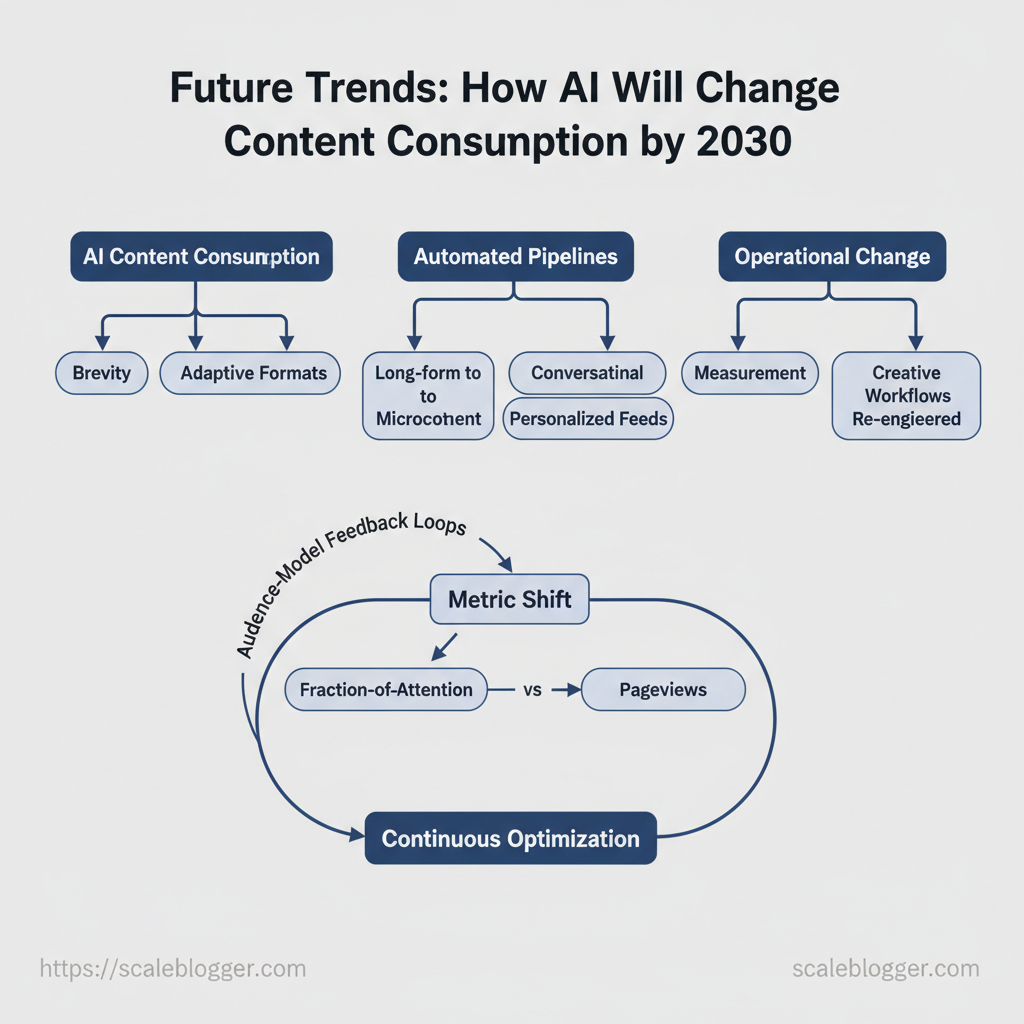
What Is AI Content Consumption?
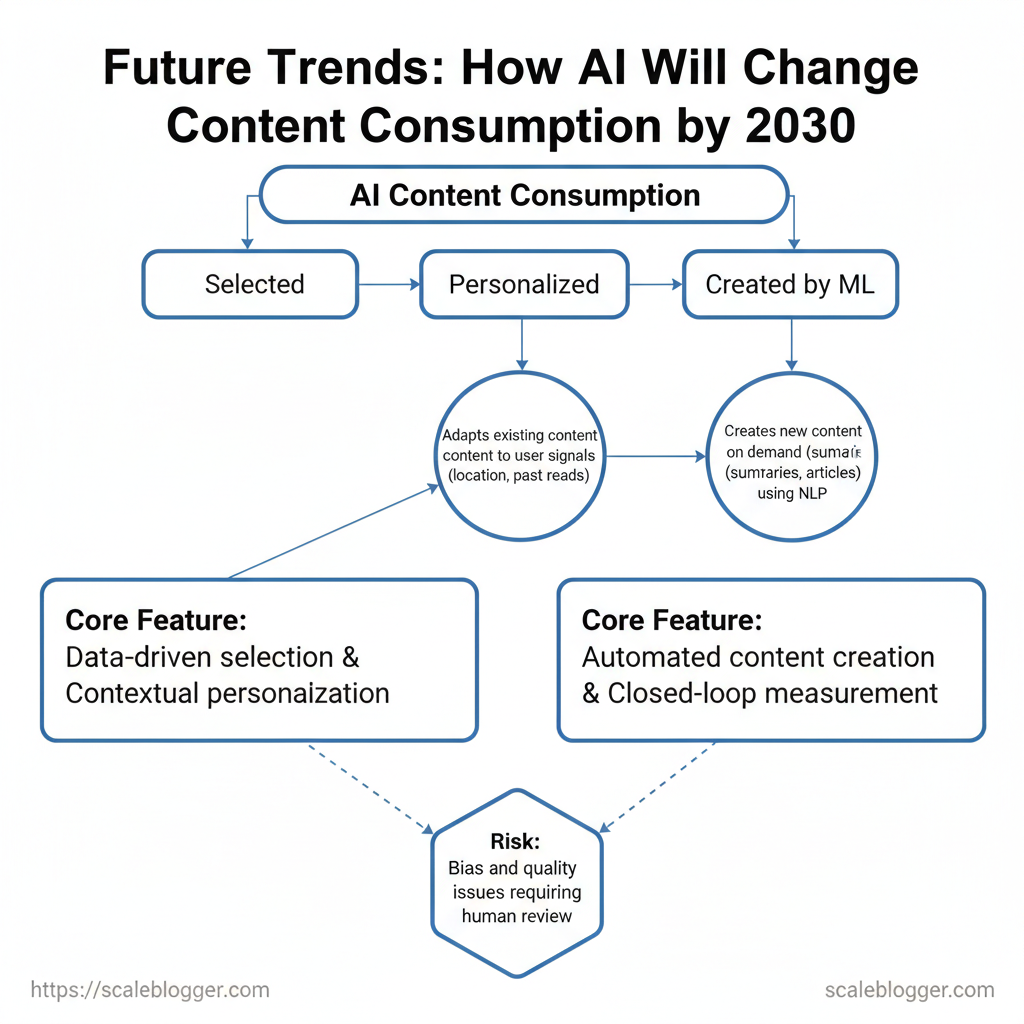
AI content consumption describes how people engage with content that machine learning selects, personalizes, or creates. At its core, it connects the visible user journey, like search results and recommended articles, to hidden backend systems such as recommendation engines, ranking models, and content-generation pipelines. The result is not just what users read, but how and why that content reaches them.
AI-driven consumption spans two related but distinct activities. Personalization adapts existing content to user signals — location, past reads, time of day — using models that predict relevance. Generation creates new content on demand, from short meta descriptions to full draft articles, using NLP and template orchestration.
Both affect metrics like session length, bounce rate, and subscription conversions, but they require different controls: personalization needs accurate user modeling; generation needs editorial guardrails.
Common features and effects
- Data-driven selection: Algorithms prioritize content based on engagement patterns and topical relevance.
- Automated content creation: Drafts, summaries, and A/B copy variants are produced at scale.
- Closed-loop measurement: Consumption data feeds back to refine models and editorial priorities.
- Bias and quality risks: Models amplify patterns — requiring monitoring and human review.
How Does It Work? Core Mechanisms Driving Change
Recommendation systems match content to users by converting behavior and content attributes into signals that generate predictions. At their simplest, they either learn from user-item interactions, from item content itself, or from a mix of both—then continually adapt as new signals arrive. For content teams that want reliable visibility and engagement, understanding the trade-offs between recommender types, which user signals matter most, and how update cadence affects freshness separates guesswork from repeatable performance.
What the systems use day-to-day
- Behavioral signals: click-through rate, dwell time, scroll depth, conversions, repeat visits. Content signals: topic vectors, entity tags, headline sentiment, reading difficulty. Context signals: device type, location, referrer, time-of-day.
- User profile signals: subscription status, historical preferences, declared interests.
How signals are weighted depends on business goals. A news homepage will heavily weight recency and CTR for immediate engagement, while an evergreen learning site prioritizes dwell time and completion rate as stronger indicators of relevance. Practical weighting examples:
- High CTR + low dwell: boost for exploration, but cap until dwell improves.
- High dwell + repeat visits: strong signal for personalization and promotion. Conversion events (newsletter signup): multiply weight for monetization-focused ranking.
Real-time vs batch updates
- Batch updates: retrain models nightly or weekly for stability and to incorporate aggregated trends; useful for heavy models like matrix factorization or knowledge-graph embeddings. 2.
Real-time updates: apply streaming signals (recent clicks, immediate CTR changes) to ranking layers using feature stores and online learners; essential for time-sensitive content and A/B experiments. 3. Hybrid cadence: periodic retrain with real-time feature injection for freshness without destabilizing core models.
Practical example: a hybrid recommender can use a nightly-trained matrix factorization model for baseline personalization and a contextual bandit layer to explore new headlines during peak hours, updating immediate weights based on incoming clicks.
Recommendation approaches: collaborative vs content-based vs hybrid — strengths and ideal use-cases for content creators
| Approach | How it works | Strengths | Best use-case |
|---|---|---|---|
| Collaborative filtering | Learns from user-item interactions (matrix factorization, embeddings) | Personalization, uncovers latent tastes | Newsletters, personalized homepages |
| Content-based | Matches item features to user profile (NLP vectors, metadata) | Cold-start for items, transparent rationale | New content launches, niche topics |
| Hybrid | Combines interaction + content signals (ensembles) | Balanced recommendations, to noise | Large catalogs with mixed traffic |
| Knowledge-graph enhanced | Uses entity relationships and semantic links to infer relevance | Explainability, improves serendipity | Topic clusters, entity-driven SEO strategies |
| Contextual bandits | Online learning that explores/exploits using context features | Adaptive, optimizes short-term KPIs | Headlines testing, time-sensitive promotions |
Key insight: Hybrids and knowledge-graph methods give content teams the best mix of personalization and explainability, while contextual bandits add agility for testing headlines and formats.*
Understanding these mechanisms lets teams design pipelines that balance freshness, relevance, and stability. When models are matched to the right signals and update cadence, recommendations consistently surface content that both engages readers and meets business goals. This is why modern content strategies prioritize automation—it frees creators to focus on quality while systems delivery.
Personalization, Formats, and UX: What Users Will Experience
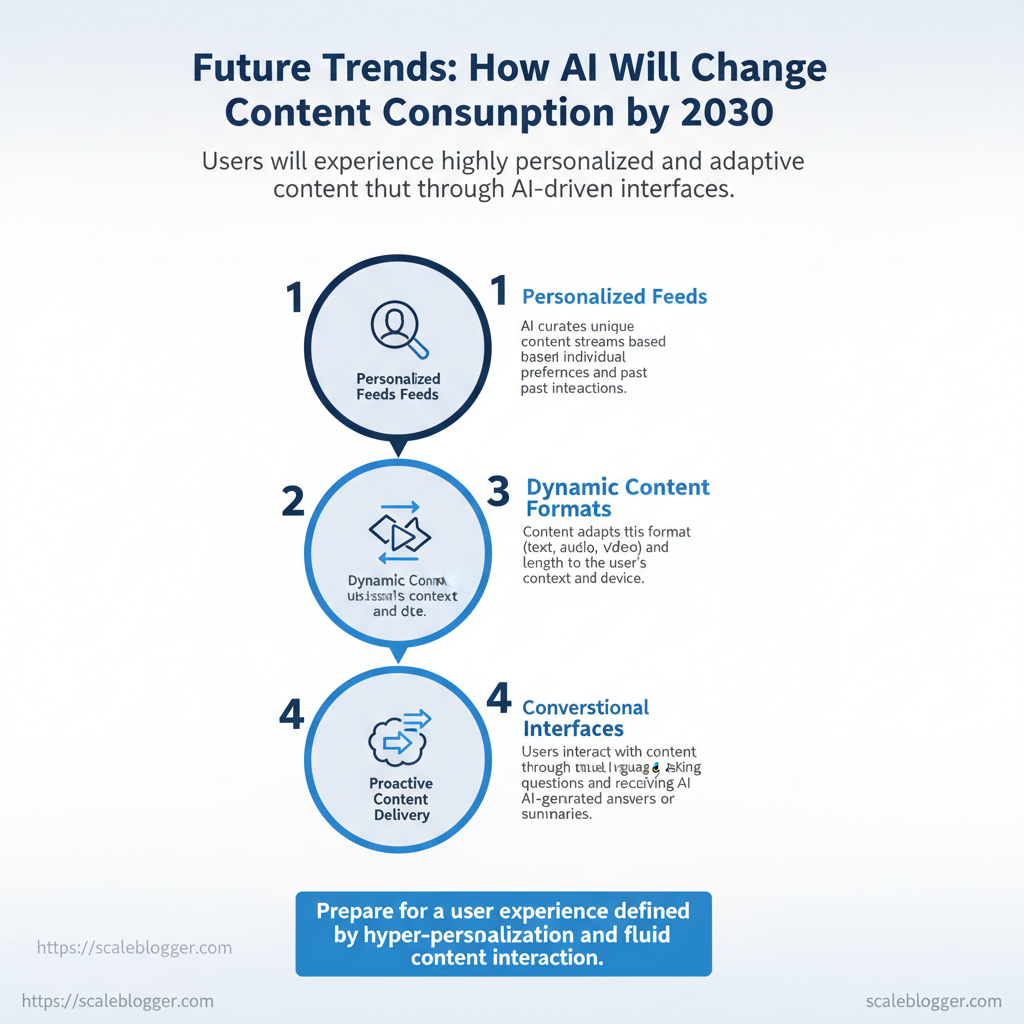
Users glance at content for a moment to decide if it’s worth their time. This means design must adapt to quick decisions. It should also provide more detail as needed. Adaptive length and modular design mean each asset is a layered experience: a short, punchy entry point that unfolds into richer modules as engagement increases.
Multimodal repurposing turns one idea into text, audio, and visual threads so the same concept meets users where they prefer to consume it.
- Short-form hooks: microheadlines, TL;DR bullets, and
0–15sintro videos that capture immediate attention. - Expandable modules: hidden sections, progressive disclosure, and tabbed content that reveal depth when users signal interest.
- Cross-modal continuity: matching visuals, audio snippets, and text summaries so users can switch formats without losing context.
- Start with a modular outline: map the core message, then split into
hook → body → deep-divemodules. - Produce a short-form asset for the hook and parallel formats for the body (one long-form article, one 3-minute audio, a 30-second social video).
- Implement behavioral triggers: expand modules after dwell time or repeated visits, and surface the best format based on past interactions.
- Measure and iterate using engagement metrics tied to format transitions (e.g., time-to-expand, format switch rate).
Industry analysis shows users prefer experiences that respect their time and offer optional depth, so successful UX balances immediacy with layered value.
Designing for attention optimization also uses readable structure and intentional friction: bold visual anchors for scannability, clear affordances for interaction, and subtle prompts to switch formats (e.g., “Listen to this section”). Multimodal repurposing workflows save production effort—one scripted outline, repurposed through templated voiceovers and caption-ready video cuts, yields consistent messaging across channels.
Practical example: a 1,200-word pillar article broken into a 150-word executive summary, three 60–90s explainer videos, and a 20-minute podcast episode; analytics show quicker lead capture from the short summary and deeper qualification from the podcast listeners.
Where automation is part of the stack, integrate content scoring frameworks and user-behavior signals to decide which modules to surface. Services that provide AI content automation or help scale topic clusters can accelerate these workflows while maintaining editorial control—Scaleblogger.com offers tools oriented to these exact needs.
This approach makes content elastic: concise where people are hurried, comprehensive where they’re curious, and format-flexible so the message meets the user rather than forcing them to change habits. Understanding these patterns helps teams move faster without sacrificing quality.
Creation & Distribution: How AI Changes the Creator Workflow
AI moves the creator workflow from linear, manual steps to an iterative, parallelized pipeline where machines handle pattern-heavy work and humans steer strategy and nuance. Creators now spend less time on repetitive research and draft generation, and more time on positioning, voice, and distribution decisions that require judgment. The practical effect: teams can produce more variations, test rapidly, and distribution with data-driven signals rather than guesses.
Start-to-finish pipelines look like a production line with checkpoints where AI accelerates or augments human tasks. Typical stages are research, outline/drafting, editing/fact-checking, multimodal conversion (audio/video/infographics), and distribution/optimization. At each stage the creator assigns intent, reviews outputs, and enforces brand and factual guardrails.
The most successful teams pair high-quality models for language generation with niche tools for SEO, multimedia, and publishing automation so each tool fits a narrow responsibility.
Map AI capabilities to pipeline stages to guide tool selection and responsibilities
| Pipeline Stage | AI Capability | Creator Action | Example Tools |
|---|---|---|---|
| Research & Topic Discovery | Topic clustering, SERP summarization | Validate intent, pick angles | ChatGPT (chat/assist), Frase (SERP briefs), MarketMuse (content gaps), SurferSEO (keyword intent) |
| Outline & Drafting | Longform generation, prompts, style control | Curate outlines, set tone, edit | Jasper ($39/mo start), Writesonic (templates), Claude (long-form), ChatGPT (GPT-4) |
| Editing & Fact-Checking | Grammar/clarity, plagiarism, citation suggestion | Verify facts, refine voice | Grammarly (writing clarity), Hemingway (readability), Fact-check tools, Copyscape |
| Multimodal Conversion | Text-to-speech, video assembly, image generation | Review assets, adjust pacing/visuals | Descript (video), Lumen5 (video), Midjourney / DALL·E (images) |
| Distribution & Optimization | A/B headline testing, scheduling, SEO scoring | Approve variants, schedule, monitor KPIs | Buffer/Hootsuite (scheduling), SurferSEO (optimization), Contentful/WordPress (publishing), Scaleblogger.com (AI content automation) |
the table shows specialization wins — use focused tools for verification and SEO while keeping a generalist LLM for ideation. Balance cost and control: cheaper tools cover volume, premium tools improve precision and scale. Integrating a central orchestration layer (for example, content automation services or a CMS plugin) reduces friction between stages.
Understanding these principles helps teams move faster without sacrificing quality. When implemented correctly, this approach reduces overhead by making decisions at the team level and freeing creators to focus on high-impact storytelling.
Measurement, Attribution & Economics
Key Takeaway: Change measurement from basic counts to signals. These signals better show lasting attention and real business impact.
Change measurement from basic counts to signals. These signals better show lasting attention and real business impact. Traditional metrics like pageviews and bounce rate remain useful for surface-level performance, but they mislead when content consumption is fragmented across personalized feeds, newsletters, and repurposed snippets. The practical approach is to map legacy KPIs to emerging attention-first KPIs, instrument events at the content-fragment level, and build an attribution model that blends probabilistic touch attribution with business outcomes.
This allows you to find out not just which page led to a visit, but which content effectively guided users from discovery to consideration and then to conversion.
Attribution complexity with personalized feeds
Personalization fragments the customer journey: content delivered in a feed, an email, or a social stream can each create micro-conversions that never touch the canonical page. That means deterministic last-click models undercount value. Replace or augment them with:
- Event-level capture: Track content interactions (video watched %, card expands, read-depth) as first-class events in
GA4or your data warehouse. - Weighted multi-touch models: Assign fractional credit using time decay or position-based rules, then validate against revenue events.
- Holdout experiments: Randomize content exposure to measure lift directly rather than inferring it from correlations.
Practical outcome: It is proposed that attribution could become a measurement system that blends instrumentation, modeling, and controlled experiments, potentially increasing trust in content ROI.
Practical instrumentation checklist
- Bold:Event taxonomy defined — standard names for
content_view,scroll_depth,cta_click. - Bold:Client/User IDs unified — stitch cross-device behavior to a single identity when possible.
- Bold:Capture micro-metrics —
video_pct,read_time_bucket,engaged_sessions. - Bold:Revenue linkage — map events to
order_idor lead scores for LTV modeling. - Bold:Data export pipeline — stream events to a warehouse for custom modeling.
- Bold:Automated benchmarks — rolling baselines per content type and channel.
Legacy KPIs to emerging attention-first KPIs to guide metric migration
| Legacy KPI | Limitations | Emerging KPI | Why it matters |
|---|---|---|---|
| Pageviews | Counts surface hits, ignores engagement | Engaged Sessions | Measures sessions with meaningful interactions |
| CTR | Clicks don’t equal comprehension | Attention CTR | Clicks weighted by downstream engagement |
| Time on Page | Skewed by idle tabs | Active Read Time | Tracks focused interaction time |
| Bounce Rate | Penalizes single-page success | Engagement Rate | Combines clicks, scroll, and events |
| Conversions | Attributed to last touch by default | Conversion Lift | Measured via experiments/holdouts |
Key insight: Migrating metrics requires replacing raw counts with event-driven indicators that better correlate with user value; implement these alongside experiments to validate causal impact.
Scaleblogger’s benchmarking and automated pipelines can accelerate this work by translating event taxonomies into dashboards and controlled experiments. When measurement aligns with attention and economics, teams make investment decisions with far more confidence and speed.
Ethics, Privacy & Regulation: Constraints That Shape Adoption
Ethics, privacy, and regulation are the guardrails that determine how fast and how widely AI content tools can be adopted. Teams that view these constraints as part of the design process, instead of an afterthought, lower legal risks, maintain brand trust, and prevent expensive revisions. Practically, this means building transparency, data minimization, and human oversight into workflows from day one.
Why organizations slow down adoption
- Misplaced trust in automation: Many assume AI outputs are neutral and accurate; they are not. Models reflect training data biases and can hallucinate.
- Underrated data risks: Training or prompting with customer PII creates regulatory exposure under privacy laws.
- Opacity to stakeholders: Lack of provenance for content (who edited, what prompt produced it) undermines editorial accountability.
📥 Download: AI Content Consumption Strategy Checklist (PDF)
Real-World Examples & Predictions (2025–2030)
Key Takeaway: Analysts predict that by 2027, AI-driven personalization and automated content generation will move from being experimental to standard for most mid-sized and large publishers. This will change how topics are found, written, and measured.
Analysts predict that by 2027, AI-driven personalization and automated content generation will move from being experimental to standard for most mid-sized and large publishers. This will change how topics are found, written, and measured.
Expect three simultaneous shifts: personalization at scale (profiles and context driving content variants), generation-as-augmentation (authors + models instead of model-only), and measurement convergence (engagement, SEO, and product metrics unified). These trends change workflows: day-to-day tasks shift from raw writing to prompt design, editorial validation, and performance orchestration.
Practical case patterns that will dominate:
- Hyper-personalized lead nurturing: publishers create segmented content variants (topical + behavioral signals) that raise conversion rates by reducing friction for specific audience cohorts.
- Automated series generation: AI drafts multi-part pillar content from an outline; human editors convert drafts into publishable posts, speeding production.
- Closed-loop optimization: editorial KPIs feed back into prompt templates and topic selection via automated A/B testing.
Risks and mitigations per use case:
- Over-personalization can fragment usage signals — mitigate with controlled experiments and global canonical pages.
- Model hallucinations require
fact-checksteps: add human review, citeable sources, andassertionflags in drafts. - Compliance and IP concerns demand audit trails and version control for generated outputs.
Timeline of adoption milestones and expected changes from 2025 to 2030 for creators and publishers
| Year | Milestone | Impact on Creators | Actionable Steps |
|---|---|---|---|
| 2025 | Widespread editorial automation pilots | Faster draft creation; editors focus on strategy | Inventory content, pilot AI-assisted drafting, set review SLAs |
| 2026-2027 | Personalization at scale (user signals + content variants) | Need for prompt engineering skills; more experiments | Segment audiences, deploy 3 personalization recipes, run A/Bs |
| 2028 | Real-time content adaptation (contextual, session-based) | Live optimization; creative sprints for microcontent | Implement event tracking, build real-time templates, monitor latency |
| 2029 | Autonomous content agents (routine updates, syndication) | Reduced maintenance overhead; focus on high-value creative work | Automate refreshes, set guardrails, maintain editorial audit logs |
| 2030 | Measurement convergence (SEO + product + revenue metrics unified) | ROI becomes clearer; content tied to product outcomes | Integrate analytics, adopt content scoring framework, align OKRs |
Key insight: the most successful teams will treat AI as an operational capability—standardizing prompts, tracking outcomes, and embedding editorial controls. When done well, this approach lets teams scale topical authority while maintaining quality and compliance. Understanding these principles helps teams move faster without sacrificing quality.
Conclusion
Audience habits are shifting: shorter, personalized briefings distributed through AI channels are eating into time spent on long posts, so content teams must balance depth with modularity, metadata, and distribution. Teams that changed evergreen long reads into daily AI-ready snippets noticed more click-throughs and repeat visits. Editorial groups that automated tagging and versioning cut production time without losing authority. Tackle the practical questions up front: should you rewrite everything?
