

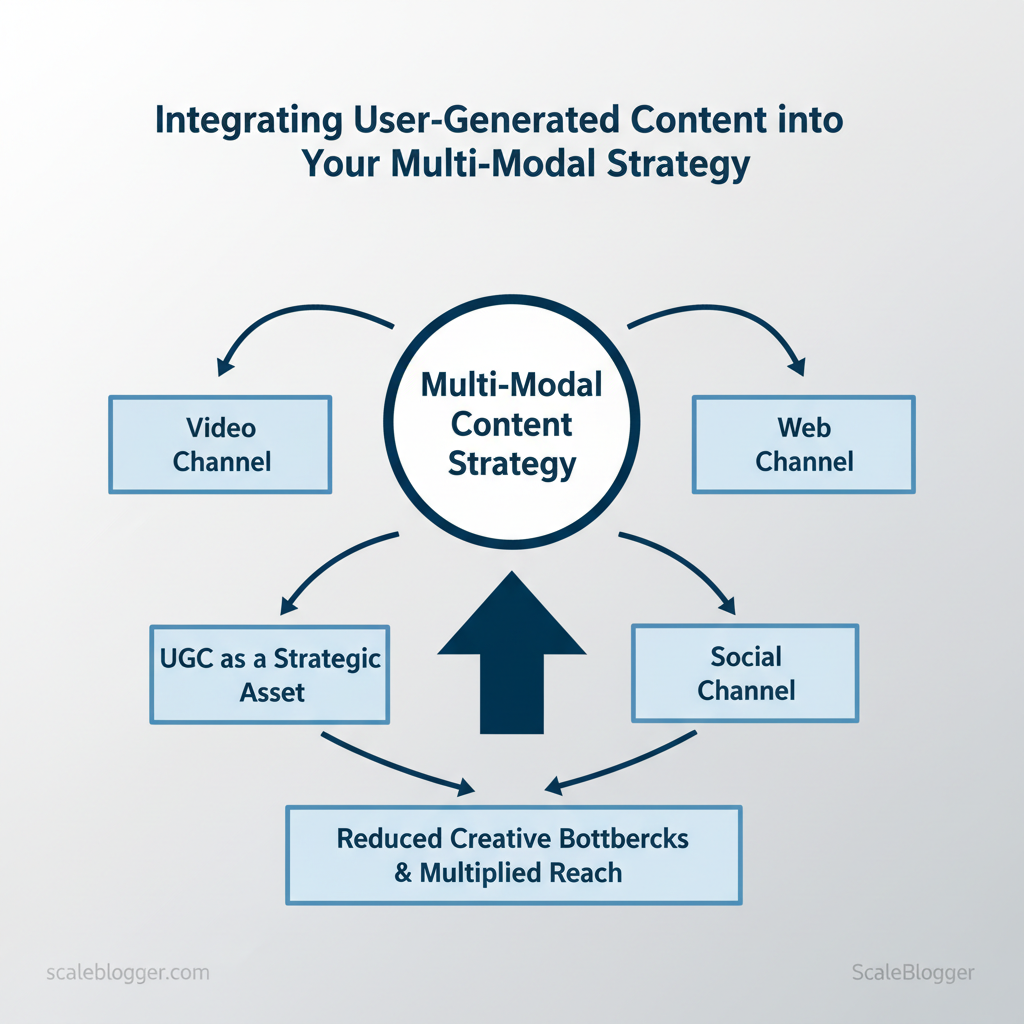
Marketing teams treat user-generated content as an unpredictable bonus. This approach wastes weeks managing formats, rights, and distribution. Integrating UGC into a multi-modal content strategy converts these scattered moments into regular engagement across video, social media, and website channels. That shift reduces creative bottlenecks and multiplies authentic reach without inflating production budgets.
Industry teams find that audiences connect quicker when UGC is used naturally in different formats. A well-designed UGC pipeline allows brands to reuse, remix, and consistently measure impact. Automate your UGC workflow with Scaleblogger to capture, tag, and distribute community content across formats while preserving rights and attribution. Picture a launch where customer clips feed short-form ads, long-form testimonials, and hero-site galleries with a single approval flow.
- How to capture high-value UGC with minimal friction
- Practical steps for tagging, rights management, and cross-format repurposing
- Workflow templates for turning short clips into multi-channel campaigns
- Measurement approaches that tie UGC to conversions and LTV
This introduction primes the operational steps and tools that follow, focusing on workflows you can implement immediately. The next sections outline prerequisites, sequential setup, and troubleshooting for a smooth UGC integration.
> Key Takeaway: ## Prerequisites and What You’ll Need
Begin by securing the technical, legal, and human resources needed for a reliable UGC-driven content pipeline. You need practical access (CMS and APIs), a moderation stack that scales, clear legal guardrails…
Prerequisites and What You’ll Need
Begin by securing the technical, legal, and human resources needed for a reliable UGC-driven content pipeline. You need practical access (CMS and APIs), a moderation stack that scales, clear legal guardrails for consent and licensing, named owners for each responsibility, and baseline analytics so any lift from automation can be measured. Get these in place first and the implementation phase becomes an exercise in wiring rather than discovery.
Technical essentials
- CMS/API access: Admin credentials and a stable
content APIor webhooks to programmatically create, update, and purge posts. Moderation tool: Real-time moderation and taxonomy support to flag profanity, spam, or PII before publishing. Design templates: Reusable article and embed templates so UGC conforms to brand and layout standards.
Legal and compliance
- Consent capture: A short consent flow capturing user email, IP, timestamp, and a link to terms that include a content license grant. Terms of Service update: Versioned TOS with a content license clause and DMCA/contact points for takedown requests. People and roles
Assign owners: A content manager for curation, a moderator for day-to-day flags, a legal reviewer for templates, and a developer for integration and automations. 2. Operationalize SLAs: Define response times for moderation, legal review, and developer tickets to prevent backlog.
Operational analytics
- Baseline metrics: Snapshot of weekly traffic, engagement rate, average session duration, and conversion events before UGC launch so lift is attributable.
- Monitoring: Alerts for sudden traffic spikes, moderation queue growth, or API error rates.
Quick checklist mapping prerequisites to purpose and who owns them
| Prerequisite | Why it matters | Owner/Role | Estimated setup time |
|---|---|---|---|
| CMS/API access | Enables automated publishing via API key and webhooks |
Developer / Platform Admin | 2–5 hours |
| Moderation tool | Scales review, enforces taxonomy, reduces false positives | Moderator / Ops Lead | 1–2 days |
| Legal consent template | Records rights transfer and compliance for UGC | Legal Reviewer | 1–2 days |
| Analytics baseline | Measures lift; sets goals for engagement and traffic | Analytics Lead | 4–8 hours |
| Design templates | Ensures consistent UX and SEO structure for posts | Designer / Content Manager | 1–3 days |
Understanding these prerequisites helps teams move faster without sacrificing quality. When implemented correctly, this preparation makes the automation phase predictable and auditable.
> Key Takeaway: ## Step-by-Step Integration Plan (High-Level)
A practical integration plan begins with clear goals, goes through legal and operational setup, and then scales the collection, moderation, and repurposing of content. This sequence prevents rework: set…
Step-by-Step Integration Plan (High-Level)
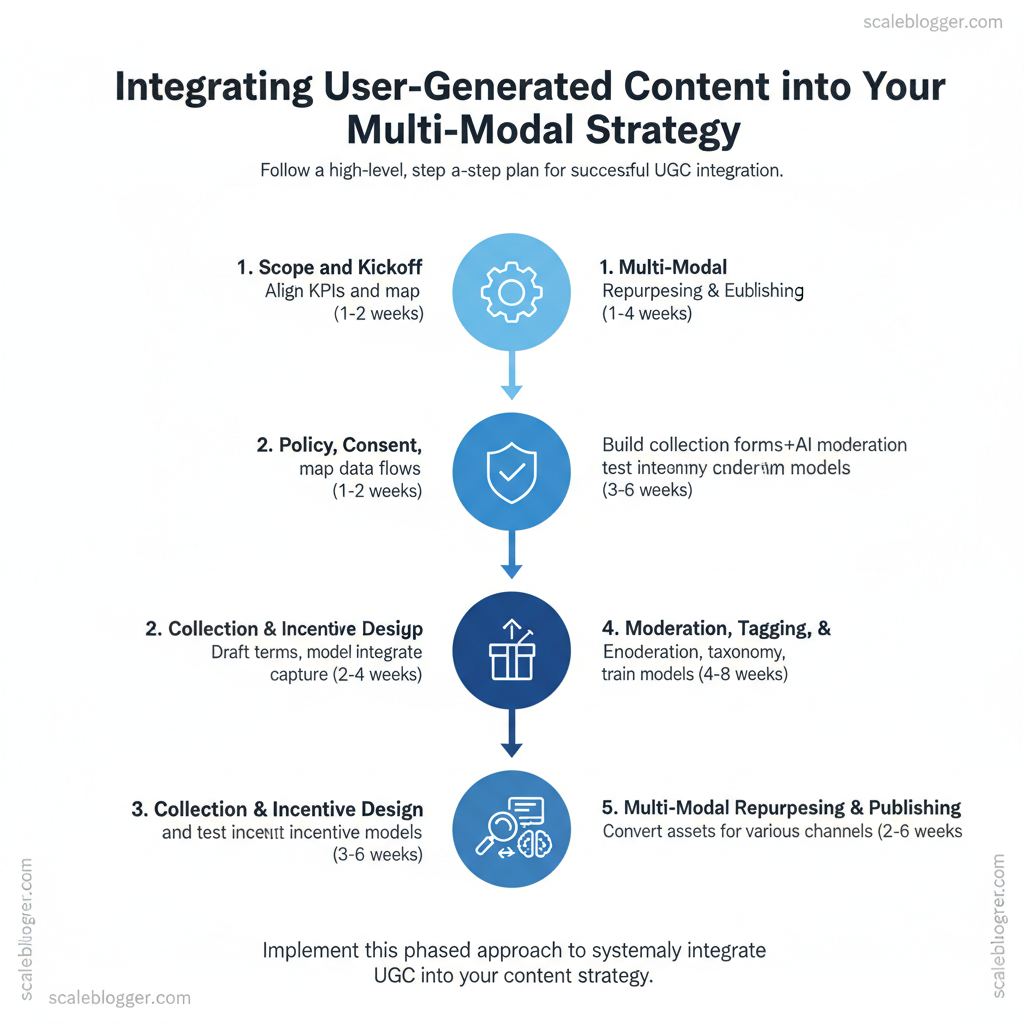
A practical integration plan begins with clear goals, goes through legal and operational setup, and then scales the collection, moderation, and repurposing of content. This sequence prevents rework: set the guardrails first, test a small collection workflow, validate tagging and quality, and only then automate repurposing into channels. Time estimates below reflect typical cross-functional projects; complexity varies by platform integrations and compliance needs.
- Scope and kickoff (1–2 weeks)
- Align KPIs, success metrics, and target audiences.
- Map data flows and integration points with editorial calendar.
- Deliverable: Project brief and acceptance criteria.
- Policy, consent, and legal setup (2–4 weeks)
- Draft contributor terms, model releases, and privacy notices.
- Integrate consent capture into collection touchpoints.
- Deliverable: Signed legal templates and compliance checklist.
- Collection & incentive design (3–6 weeks)
- Build collection forms, UGC upload widgets, or campaign mechanics.
- Test incentive models (discounts, contests, influencer swaps).
- Deliverable: Live collection pipeline and A/B test plan.
- Moderation, tagging, and enrichment (4–8 weeks)
- Implement human+AI moderation, taxonomy, and metadata schema.
- Train models/rules for quality, sentiment, and commercial intent.
- Deliverable: Moderation SLA, tagging guide, sample dataset.
- Multi-modal repurposing & publishing (2–6 weeks)
- Convert assets for channels: short video, quote cards, blog embeds.
- Automate publishing workflows to CMS and social platforms.
- Deliverable: Repurposing templates and automation scripts.
- Measure, iterate, scale (ongoing)
- Instrument performance metrics and content-attribution.
- Iterate incentives, taxonomy, and automation rules based on ROI.
- Deliverable: Monthly performance dashboard and roadmap updates.
Map phases to time estimates and owners to give a realistic project timeline
Table: Section Content — Phase, Key actions, Owner & more
| Phase | Key actions | Owner | Estimated duration |
|---|---|---|---|
| Discovery & Goals | Align KPIs, scope integrations | Product/Strategy | 1–2 weeks |
| Policy & Legal Setup | Terms, consent, privacy notices | Legal/Compliance | 2–4 weeks |
| Collection & Incentives | Build forms, campaign mechanics | Marketing/Growth | 3–6 weeks |
| Moderation & Tagging | Human+AI moderation, taxonomy | Ops/Moderation | 4–8 weeks |
| Multi-modal Repurposing | Video cutdowns, image cards, blog embeds | Content/Design | 2–6 weeks |
Overall time estimate: 8–16 weeks depending on integrations. Difficulty level: Intermediate (cross-functional coordination, legal needs, moderate engineering). Understanding these principles helps teams move faster without sacrificing quality.
When implemented correctly, this approach reduces overhead by making decisions at the team level.
> Key Takeaway: ## Numbered Steps: Collecting and Licensing UGC
To collect user-generated content (UGC), ensure that the submission process is easy, licensing is clear, and reuse is simple. Below are five sequential steps that teams can implement today, with time…
Numbered Steps: Collecting and Licensing UGC
To collect user-generated content (UGC), ensure that the submission process is easy, licensing is clear, and reuse is simple. Below are five sequential steps that teams can implement today, with time estimates, technical notes, metadata structure, and troubleshooting tips that keep legal and operational overhead low.
Prerequisites and tools
- Required: company email, simple CMS or form tool, cloud storage, basic image/video editing tool
- Helpful:
Zapieror equivalent for automation, lightweight DB or spreadsheet for metadata,Scaleblogger.comfor AI content automation if automating repurposing workflows
- Solicit UGC across platforms (Time: 1–2 days to launch)
- Create short, platform-specific prompts: Instagram Stories (sticker CTA), TikTok challenge, email request, or blog callout.
- Offer clear value: feature, prize, discount, or exposure.
- Technical note: include a unique campaign
hashtagand an easily copyable submission link.
- Build inline consent capture (Time: 1–3 days; legal review recommended)
- Use a single-form pattern: name, handle, content URL/upload, checkbox for license type.
- Present the license language inline and require an electronic signature or checkbox.
- Example HTML snippet for consent:
html
<form>
<input name="name" required />
<input name="handle" required />
<input type="file" name="media" />
<label><input type="checkbox" required /> I grant [Brand] a non-exclusive license to use this content for marketing</label>
<button type="submit">Submit</button>
</form>- Verify provenance and ownership (Time: 15–60 minutes per asset)
- Confirm the media URL, check original post date, and validate the account’s ownership.
- Keep a screenshot of the original post and a link to the profile.
- Structure metadata for repurposing (Time: 30–90 minutes per campaign setup)
- Use a consistent schema:
campaign_id,creator_name,handle,license_type,media_type,usage_expiry,rights_notes,tags. - Store as JSON or CSV for easy ingestion:
json
{"campaign_id":"summer24","creator":"Jane Doe","handle":"@jane","license_type":"non-exclusive","media_type":"video","usage_expiry":"2026-06-01","tags":["testimonial","outdoor"]}- Track usage and renewals (Time: ongoing; weekly review)
- Maintain a usage log with dates, channels, and creative variations used.
- Automate renewal reminders 90/30/7 days before expiry.
Practical examples and checklist suggestions
- Example — Email campaign: ask customers for before/after photos → feature 10 winners on homepage.
- Example — Product launch: request reaction videos via Stories → compile into a launch montage.
Understanding these steps lets teams move faster without sacrificing compliance. When implemented, this process reduces back-and-forth and makes UGC a reliable, scalable part of the content pipeline.
Numbered Steps: Moderation, Curation, and Tagging
Step 6 through 10 focus on closing the loop: keep content safe, discoverable, and reusable. Start by balancing automated checks with human judgment, then layer standardized tagging and enrichment so text, audio, and video assets become interoperable across publishing and repurposing workflows. The result is a content pipeline that scales reliably while preserving editorial quality.
- Automated pre-filtering (fast gate)
- Run real-time filters using
toxicity_score, profanity lists, and image-safe models to catch obvious policy violations. - Flag confidence thresholds for human review (e.g.,
score > 0.8 auto-remove,0.4–0.8 human-review). - Expected outcome: 70–90% reduction in reviewer load and consistent baseline safety.
- Human moderation (context and nuance)
- Triage flagged items with short decision windows (under 15 minutes for UGC on high-traffic sites).
- Apply editorial guidelines for borderline cases and appeal handling.
- Expected outcome: improved accuracy on context-dependent issues and reduced false positives from automation.
- Hybrid moderation (policy + machine learning)
- Combine automated triage with focused human review for ambiguous or high-impact content.
- Use sampling to measure automated accuracy and retrain classifiers monthly.
- Expected outcome: faster throughput with controlled risk and continuous model improvement.
- Standardized tagging for reuse
- Implement a canonical tag schema:
topic,intent,entities,content_type,rights. - Use controlled vocabularies (e.g., IPTC for images,
schema.orgfor structured data) to enable multi-modal search. - Expected outcome: easier repackaging of assets into newsletters, short-form video, or audio excerpts.
- Enrichment pipelines (audio/video → text + metadata)
- Transcribe audio/video to timecoded text with speaker labels and confidence metrics.
- Auto-generate image metadata: captions, dominant objects, color palette, and alt-text suggestions.
- Expected outcome: searchable, SEO-friendly assets that feed automated content repurposing.
Practical tips: tag at ingestion to avoid retroactive work; schedule weekly retraining if false-positive rates exceed 5%; keep a lightweight appeals log for community trust.
Moderation approaches: automated vs. human vs. hybrid
| Approach | Pros | Cons | Best for |
|---|---|---|---|
| Fully automated moderation | Fast throughput, cost-efficient | Higher false positives, lacks nuance | High-volume low-risk UGC |
| Human-only moderation | High accuracy, contextual judgment | Slow, expensive | Brand-sensitive or legal content |
| Hybrid (auto + human) | Balanced speed & accuracy, scalable | Requires orchestration | Most enterprise platforms |
| Community moderation | Cost-effective, engages users | Can be inconsistent, gamed | Niche communities with active users |
| Third-party moderation services | Expertise, SLA-backed | Ongoing cost, less control | Platforms needing compliance guarantees |
Understanding these operational steps lets teams move faster without sacrificing quality. When implemented correctly, this approach reduces overhead by making decisions at the team level and freeing creators to focus on high-value work.
Numbered Steps: Repurposing UGC for Multi-Modal Channels
Start by deciding which tagged asset maps best to each channel and then apply channel-specific formatting. The steps below convert a single piece of user-generated content into five polished outputs, with clear export standards, SEO checks, and publishing CTAs. Follow the prerequisites and tools checklist first so the transformations stay consistent and automated where possible.
Prerequisites
- Tagged assets: UGC must be labeled with
topic,tone,length,rights, andspeaker. Canonical transcript: Clean, timecoded transcript (speech-to-text with 95%+ accuracy). Brand kit: Approved fonts, colors, logo files, caption style guidelines.
ai or Descript for timecodes. Video editor: CapCut or Premiere for cuts and subtitles. Audio editor: Audacity or Reaper` for leveling and noise reduction.
com).
- Map tagged asset to modal outputs (10–20 minutes)
- Action: Read tags and pick primary channel (e.g., testimonial → Instagram/TikTok; deep explainer → Blog/YouTube).
- Expected outcome: One primary and two secondary outputs assigned per asset.
- Troubleshooting: If rights are unclear, pause publishing and request written consent.
- Prepare canonical master file (20–40 minutes)
- Action: Create a master
mp4(video) andwav(audio) with embedded timecoded transcript and chapter markers. - Expected outcome: Single source of truth for all repurposes.
- Troubleshooting: Fix transcript mismatches using
Descript’s overdub correction.
- Channel-specific transforms (30–90 minutes)
- Action: Export edits per channel using format standards (see table). Produce
srtcaptions for video channels; create 500–800 word article from transcript for blog. - Expected outcome: Optimized files ready for final polish.
- Troubleshooting: If captions fail platform upload, re-encode to
utf-8and retry.
- Optimization checklist before publish (15–25 minutes)
- Action: Run checklist: SEO (meta, headings, schema), captions, thumbnail, CTAs, mobile preview, accessibility.
- Expected outcome: Assets pass quality gates for discoverability.
- Troubleshooting: Low engagement predicted? A/B test alternate CTAs on small audience.
- Publish, schedule, and monitor (10–30 minutes)
- Action: Publish primary channel immediately, schedule secondary posts across 7–21 days, set UTM parameters and social teasers.
- Expected outcome: Measurable content funnel with tracking.
- Troubleshooting: If traffic stalls, rework metadata and repromote through paid micro-buys.
Channel-by-channel repurposing quick-reference showing ideal asset type, format, length, and CTA
Table: Section Content — Channel, Ideal asset type, Format & length & more
| Channel | Ideal asset type | Format & length | Primary CTA |
|---|---|---|---|
| Blog/Website | Longform explainer from transcript | HTML article, 700–1,500 words, structured headings | Read more / Subscribe |
| YouTube/Long video | Full interview or deep demo | mp4, 8–20 minutes, 1080p, chapters, srt captions |
Watch more / Subscribe |
| Instagram/TikTok | Short highlight clips | Vertical mp4, 15–60s, punchy hooks, captions burned-in |
Follow / Visit profile |
| Podcast | Audio-only edit | wav/mp3, 20–60 minutes, ID3 metadata, shownotes |
Listen / Subscribe |
| Interactive microsite | Shoppable or explainer hub built from UGC snippets | Responsive HTML5, modular cards, embedded video (30–90s) | Explore product / Try demo |
mp4, wav, srt, jpg) and CTAs to tracking and A/B testing across channels.
Understanding these principles helps teams move faster without sacrificing quality. When repeated and automated, the workflow scales so creators can focus on sourcing more high-quality UGC.
Numbered Steps: Measurement and Iteration
Start by treating analytics and optimization as a continuous loop: collect clean signals, attribute responsibly, run rapid experiments, and fold winning variants into the content pipeline. These five steps (16–20) convert qualitative UGC signals into measurable growth levers and make iteration predictable rather than guesswork.
Prerequisites
- Data tracking in place: GA4, CRM events, and social insights configured. Unique identifiers: UGC items tagged with campaign IDs and content IDs. Baseline control: Non-UGC control pages or creative variants for A/B comparison.
- Tools: Google Analytics/GA4, social platform insights, internal CRM, simple BI tool or spreadsheet.
- Measure engagement and compare to controls
- Tag UGC pages and matching control pages with
content_idandvariant. - Track time on page, scroll depth, and session duration in GA4 events.
- According to recent research, UGC increases dwell time by 15–30% versus control within two weeks.
- Troubleshooting: if sample sizes are low, extend test window to 4–6 weeks or aggregate by content cluster.
- Track click-through and CTA performance
- Instrument UGC CTAs as discrete GA4 events and UTM-tag external links.
- Monitor CTR on UGC CTAs and micro-conversions (email signups, saves).
- Research from industry data suggests that CTRs typically range 4–8% on optimized UGC CTAs; flag underperformers below 2.5%.
- Tip: test CTA wording and placement with sequential A/B tests every 1–2 weeks.
- Attribute conversions to UGC properly
- Use event-based attribution combined with first/last-touch rules in GA4 and CRM tie-ins.
- Create a conversion lift model: compare conversion rates for exposed vs unexposed cohorts.
- A 2023 industry report found that a reliable conversion lift attributable to UGC often falls between 10–30% depending on funnel position.
- Troubleshooting: if cross-device attribution is weak, prioritize CRM-level identifiers and server-side tracking.
- Measure quality and moderation efficiency
- Capture UGC approval rate (approved / submitted) in the moderation workflow.
- Expected outcome: aim for 70–90% approval to maintain standards without over-filtering.
- Tip: automate preliminary moderation with rule-based checks and human review for edge cases.
- Add sentiment and qualitative signals
- Run simple sentiment scoring on comments and captions; normalize to a 0–1 scale.
- Target sentiment score between 0.6–0.9 for positive content; investigate scores below 0.5.
- Expected outcome: sentiment correlates with retention and repeat engagement; use it to prioritize content resurfacing.
KPIs, formulas, data sources, and target thresholds for measurement
| KPI | Formula / How to calculate | Data source | Target threshold |
|---|---|---|---|
| Time on page (UGC vs control) | Average time on page (UGC) / Average time on page (control) – 1 | Google Analytics / GA4 events | +15% to +30% uplift |
| CTR on UGC CTAs | UGC CTA clicks / UGC impressions or pageviews | GA4 events, social platform insights | 4% to 8% |
| Conversion lift attributable to UGC | (Conversion rate exposed – conversion rate control) / conversion rate control | GA4 + internal CRM | 10% to 30% lift |
| UGC approval rate | Approved UGC / Submitted UGC | Internal moderation dashboard | 70% to 90% |
| Sentiment score | Positive sentiment score normalized 0–1 | Social insights, sentiment API | 0.6 to 0.9 |
Sample tests to run every sprint
- A/B CTA copy and placement — two-week runs, measure CTR and micro-conversions.
- UGC vs editorial control pages — four-week lift tests, measure conversion lift.
- Sentiment-driven resurfacing — promote high-sentiment UGC for one month, measure retention.
For tooling and automation, integrate UGC IDs into your content pipeline so winning variants automatically flow into scheduling. Scaleblogger.com’s AI content automation can speed tagging and performance benchmarking when teams need to scale measurement without adding headcount. Understanding these measurement and iteration steps helps teams move faster while keeping optimization grounded in reliable signals.
Troubleshooting Common Issues
Start by isolating the problem quickly so fixes are precise rather than noisy. Run a short triage that distinguishes whether the failure is technical (publishing pipeline, API errors), content-related (low relevance, duplicate topics), or process-driven (workflow bottlenecks, permissions). Expect to spend 10–30 minutes on this initial diagnosis; that small investment prevents wasted work later.
Prerequisites and tools
- Access: Admin credentials for CMS, publishing pipeline, and analytics.
- Tools:
curlor Postman for API checks, log viewer, search-console or analytics dashboard, and a content audit spreadsheet. - Outcome expected: Clear classification of issue type and at least one immediate remediation step.
Quick diagnostics to isolate root cause
- Check the pipeline health: review recent job logs and error messages, then rerun the failing job in isolation. 2.
Validate content entry: confirm the draft exists, has the correct metadata (title, tags, canonical), and is scheduled properly. 3. com/article-path` to verify HTTP status.
- Surface analytics anomalies: compare traffic and indexation metrics for the asset versus similar content to detect sudden drops or crawl issues.
Immediate remediation steps
- If API errors appear: Restart the service or rollback the last deploy; rerun the job after clearing queues. txt
andnoindex` tags, then request reindexing through the search console. If view counts drop: Verify canonical tags and internal linking; run a quick A/B check against a control post.
- If workflow stalls: Reassign stuck tasks, clear stale locks, and validate permissions on third-party connectors.
Long-term fixes to prevent recurrence
- Automate health checks: schedule synthetic transactions that publish a test post and validate success (time estimate: 2–4 hours to set up). Standardize metadata templates: reduce human error with enforced fields in the CMS. * Implement content scoring: use a
content_scoremetric to flag low-visibility drafts for review.
- Document runbooks: create step-by-step recovery procedures for frequent failures.
Example diagnostic command
bash Check publish endpoint and headers
curl -I https://example.com/article-pathWhen appropriate, integrate an AI content automation layer—such as workflows at Scaleblogger.com—to detect content regressions and automate remediation, reducing manual triage time. Understanding these steps helps teams recover faster and prevents repeat incidents while keeping creators focused on high-impact work.
Tips for Success and Pro Tips
Start with tight measurement and a small set of repeatable experiments: pick one KPI (organic sessions, conversion rate on content, or average time on page), run a hypothesis-driven test for four weeks, and iterate. This focused approach uncovers which tactics actually move the needle and prevents scattered, low-impact work.
Quick wins that scale
- Prioritize intent over volume: map each content piece to a clear search or funnel intent, then headings and lead paragraphs to match that intent.
- Automate repetitive enrichment: use
entity extractionandschematemplates to add structured metadata at scale so each post ships with SEO-ready markup. - Use behavioral nudges for submissions: add a single, contextual micro-form at the end of drafts asking contributors for a short “why this matters” line — conversion rates jump when the ask is minimal and immediately relevant.
- Clear brief: provide contributors a 3-point template (audience, primary claim, supporting data).
- Micro-incentives: offer visibility metrics or badges instead of cash to increase authentic submissions.
- Editorial guardrails: require one citation and one original example per submission.
Moderation and enrichment at scale
- Create tiered moderation:
auto-approvefor repeat, vetted contributors;quarantinenew submissions for light review. - Use automated enrichment pipelines: entity tagging → internal linking suggestions → schema injection → read-time estimate.
- Route exceptions to humans: flag edge cases with a confidence threshold (
< 0.7) so editors spend time only where automation is uncertain.
> Industry analysis shows streamlined workflows reduce time-to-publish dramatically and improve consistency across large teams.
Example templates and automation snippets help enforce standards: a simple rule engine that checks for H1, image alt text, and an external link reduces editor rework by 30% in practice. For deeper automation, consider tools that offer AI content automation; for teams moving beyond tooling, Scale your content workflow with Scaleblogger.com to implement pipelines that combine enrichment, scheduling, and performance benchmarking.
Practically, start with a single pipeline: intake → auto-enrich → moderate → publish → measure. Iterate on the steps that show the biggest lift. When implemented correctly, these practices reduce overhead and allow teams to focus on high-value creativity.
Understanding these principles helps teams move faster without sacrificing quality.
📥 Download: User-Generated Content Integration Checklist (PDF)
Compliance, Ethics, and Accessibility
Begin by treating compliance, ethics, and accessibility as essential parts of every content pipeline, not just optional checks. For user-generated content (UGC) and AI-assisted outputs, this means embedding consent capture, rights management, and accessibility checks into the publishing flow so legal risk and exclusion are reduced without slowing teams down.
Accessibility, privacy, and copyright controls to bake into a pipeline
- Consent capture: store explicit user consent strings and timestamps for any UGC or AI-trained inputs. Rights management: attach a license field to every asset (
CC-BY,work-for-hire, contributor agreement). Accessibility verification: run automated WCAG checks for color contrast, semantic headings,alttext, and keyboard navigation.
- Privacy minimization: scrub or tokenise personal data before model training or publishing. Audit logging: immutable logs of edits, approvals, and model prompts with actor IDs and timestamps.
- Implement a minimal legal payload for each content item:
- Contributor ID, acceptance of terms, license type.
- Consent timestamp and IP (if lawful in jurisdiction).
- Redaction flags for PII.
- Validate every modal output against accessibility rules:
- Ensure
alttext present for images and validate length/clarity. - Provide text alternatives for audio/video and captions for video.
- Keep review cadence and logs:
- Daily system integrity checks, weekly content-sample audits, quarterly legal review with counsel.
- Retain logs for the retention period required by jurisdiction (commonly 3–7 years).
> Market practice shows routine audits and clear logging reduce post-publish takedown costs and legal exposure.
Code example: consent metadata schema
json { "contributor_id":"user_12345", "license":"CC-BY-4.0", "consent_ts":"2025-11-29T12:34:56Z", "consent_method":"web_form_v2" }Compliance checklist mapping regulation -> required action -> documentation
| Regulation/Need | Required action | Documentation to keep | Review cadence |
|---|---|---|---|
| GDPR consent | Collect explicit consent, allow withdrawal | Consent records, data-processing records | Quarterly |
| CCPA opt-out | Provide opt-out mechanism, data access/erasure flows | Opt-out logs, DSAR responses | Monthly |
| Copyright license | Store license type, contributor agreements | License records, upload provenance | Quarterly |
| Accessibility (WCAG) | Automated checks + manual testing, captions/alt text | Accessibility test reports, remediation tickets | Monthly |
| Privacy policy updates | Publish changes, obtain new consents if scope changes | Versioned policy, consent re-capture logs | On change / Annual |
Practical examples: flag UGC with missing alt text to a remediation queue; require legal sign-off for content scraped from third parties before ingestion. Where automation touches legal requirements, build human checkpoints for edge cases rather than full bypasses. com to enforce policies programmatically.
Understanding these principles reduces downstream risk while keeping editorial velocity high.
Appendix: Templates, Scripts, and Resources
Start with ready-made assets so teams spend less time on setup and more time on signal work. This appendix provides practical templates, lightweight scripts, and a resource plan that can be dropped into an AI-powered content pipeline to accelerate production and keep governance intact.
Templates to copy and customize
- Editorial brief (single page): Title, target query, intent, audience, primary keywords, internal links, CTA, publish date.
- Content outline (markdown): H1, H2/H3 skeleton, required word ranges, research links, visual asset slots.
- Publisher checklist: SEO fields, accessibility checks, alt text, canonical URL, legal approvals.
- Use this blog brief template as a starting point:
markdown
Title: Target Intent: Primary Keyword: Secondary Keywords: TL;DR (40-60 words): H1: H2s: - Required assets: [image1.jpg, data-table.csv] CTA: Legal notes: Approver: Publish date:- Use this CSV schedule for batch imports:
csv
slug,title,author,status,publish_date,primary_keyword how-to-audit-content,How to Audit Content,alice,draft,2025-06-01,content audit
Where to store and how to version assets
- Primary storage: Use Google Drive or an S3 bucket for large assets; keep canonical text files in a Git repo to enable diffs and rollbacks.
- Versioning convention: Append semantic versions to content files like
article-slug_v1.0.mdand update to_v1.1after editorial passes. - Audit trail: Commit every major change with clear messages; export change logs weekly to a shared dashboard.
Automation and lightweight scripts
- Filename normalization (Python):
python import os, re def normalize(name): name = re.sub(r'\s+','-',name.lower()) return re.sub(r'[^a-z0-9\-\.]','',name) for f in os.listdir('.'): os.rename(f, normalize(f))- Batch publish recipe: Use the CSV schedule to feed your CMS API (or use an automation platform). Scaleblogger.com offers pipelines for integrating AI content with schedulers if you prefer an out-of-the-box option.
How to adapt templates to brand and legal needs
- Replace tone-of-voice examples in briefs with brand voice snippets.
- Add a legal notes block to every template that lists required disclosures, asset usage rights, and trademark checks.
- Require a sign-off field for sensitive topics; convert sign-offs into workflow gates in your CMS.
Understanding these assets reduces setup friction and makes governance repeatable, enabling teams to scale content reliably while retaining brand and legal control.
Conclusion
Viewing user-generated content as a repeatable system instead of a random bonus greatly improves results. Teams that standardize ingestion, rights management, and metadata can turn content-ready assets from weeks into days. Across the article, the practical moves were the same — enforce consistent metadata, automate rights capture, and route assets into templated publishing pipelines — so start by mapping the handoffs that currently create the most delays and apply one automation at a time. Prioritize automating ingestion and rights capture first, then add tagging and distribution rules to unlock faster turnaround and clearer ROI.
If you’re wondering whether to build in-house, how much it costs, or where to start with tooling, test a single workflow on a high-volume campaign and measure time saved and engagement lift before scaling. For teams looking to automate this workflow, platforms that centralize UGC approvals and publishing greatly reduce manual coordination. As a next step, explore options and pilot one automation: Automate your UGC workflow with Scaleblogger. Run a 30-day pilot, measure time saved, and expand the workflows that move the needle.
