

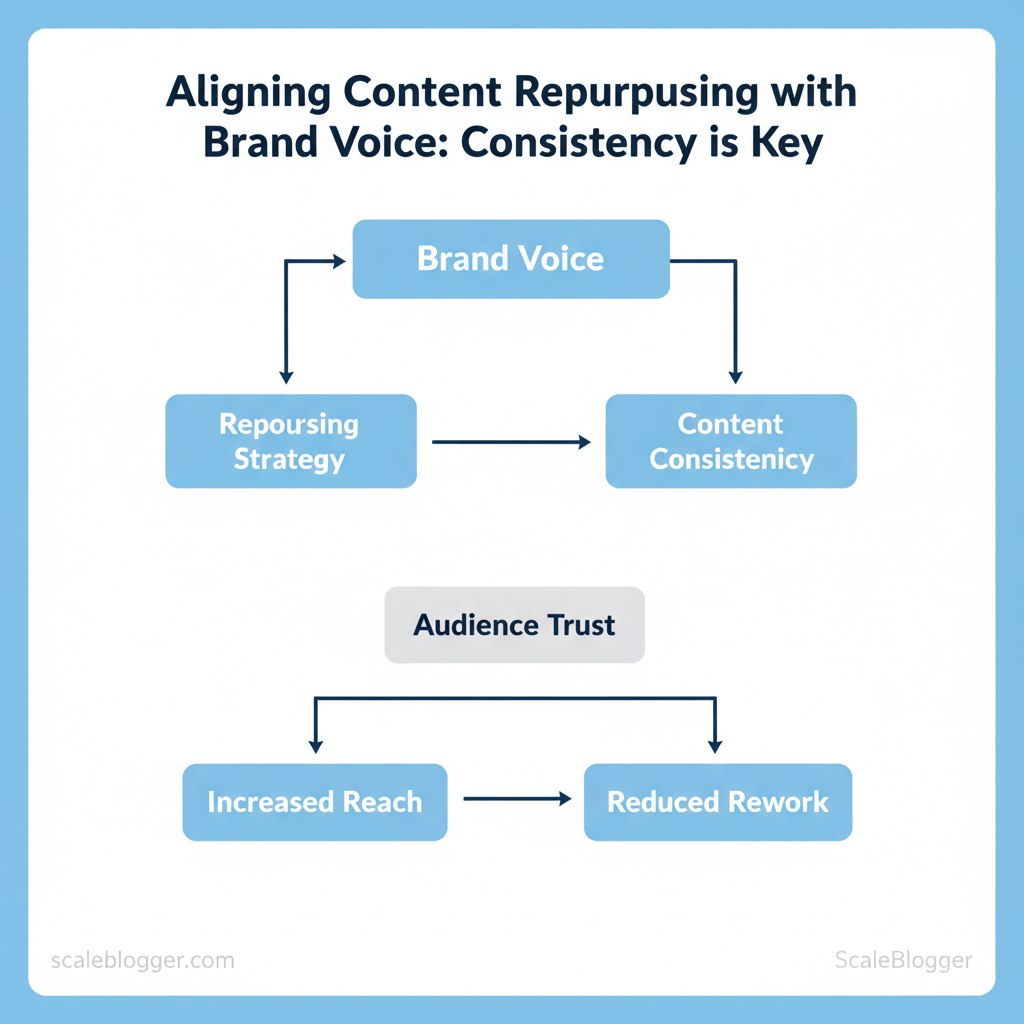
Too many teams see repurposing as just a way to increase content volume. This leads to publishing noisy and inconsistent pieces. When snippets, carousels, and newsletters lose their original tone, audience trust and conversions decline. Aligning your brand voice with a clear repurposing approach builds authority and expands your reach.
A clear voice-informed workflow reduces rework, speeds production, and keeps messaging recognizable across channels. Picture a product marketing team turning a single launch webinar into social clips, a blog series, and email sequences without diluting the narrative — all while keeping content consistency intact. Industry practice suggests that a documented voice framework and automated templates may help cut iteration time and errors.
- How to map voice attributes to formats so tone survives edits
- Practical checks that prevent subtle tone drift during repurposing
- Templates and automation tactics to scale consistent messaging
- Measuring content consistency without subjective reviews
This introduction sets the stage for a hands-on guide that transforms repurposing from a risky scramble into a reliable growth lever. Try Scaleblogger to automate voice-preserving repurposing and scale consistent content across every channel.
> Key Takeaway: ## Foundation — Define Your Brand Voice Before You Repurpose
Begin by crafting a straightforward definition of your brand’s voice. This becomes your go-to guide when turning long content into social posts, emails, or video scripts.
Foundation — Define Your Brand Voice Before You Repurpose
Begin by crafting a straightforward definition of your brand’s voice. This becomes your go-to guide when turning long content into social posts, emails, or video scripts. A three-line brand-voice summary captures the essentials — tone, audience, and signature phrasing — so every repurposed asset stays recognizably yours without extra editing. The point is practical: make reuse predictable, fast, and defensible.
A compact matrix of sample brand-voice components across three example industries
Table: Section Content — Component, B2B Tech Example, Consumer Lifestyle Example & more
| Component | B2B Tech Example | Consumer Lifestyle Example | Coach/Creator Example |
|---|---|---|---|
| Tone Adjectives | Authoritative, Concise, Helpful | Warm, Aspirational, Playful | Direct, Empathetic, Motivational |
| Audience Snapshot | VPs of Product, technical PMs, procurement | Affluent urban millennials, trend-focused shoppers | Ambitious solopreneurs, early-stage course buyers |
| Key Phrases | “enterprise-ready,” “time-to-value,” “scalable” | “everyday luxury,” “curated for you,” “mix-and-match” | “action plan,” “build momentum,” “consistent wins” |
| Language Dos | Use clear metrics, avoid buzzwords, cite outcomes | Use sensory words, show lifestyle context, use emojis sparingly | Use short directives, share micro-stories, call out wins |
| Language Don’ts | Don’t use vague jargon, avoid casual slang | Avoid corporate tone, don’t preach or overpromise | Avoid passive voice, don’t use abstract platitudes |
3-line Brand-Voice Summary (what belongs, examples, validation checklist)
- What belongs: one-line tone, one-line audience, one-line signature phrasing/positioning. B2B example: Authoritative and concise. Product leaders at growth-stage SaaS companies.
”
Warm, aspirational voice. Urban trendsetters aged 25–40. ”
New solopreneurs seeking momentum.
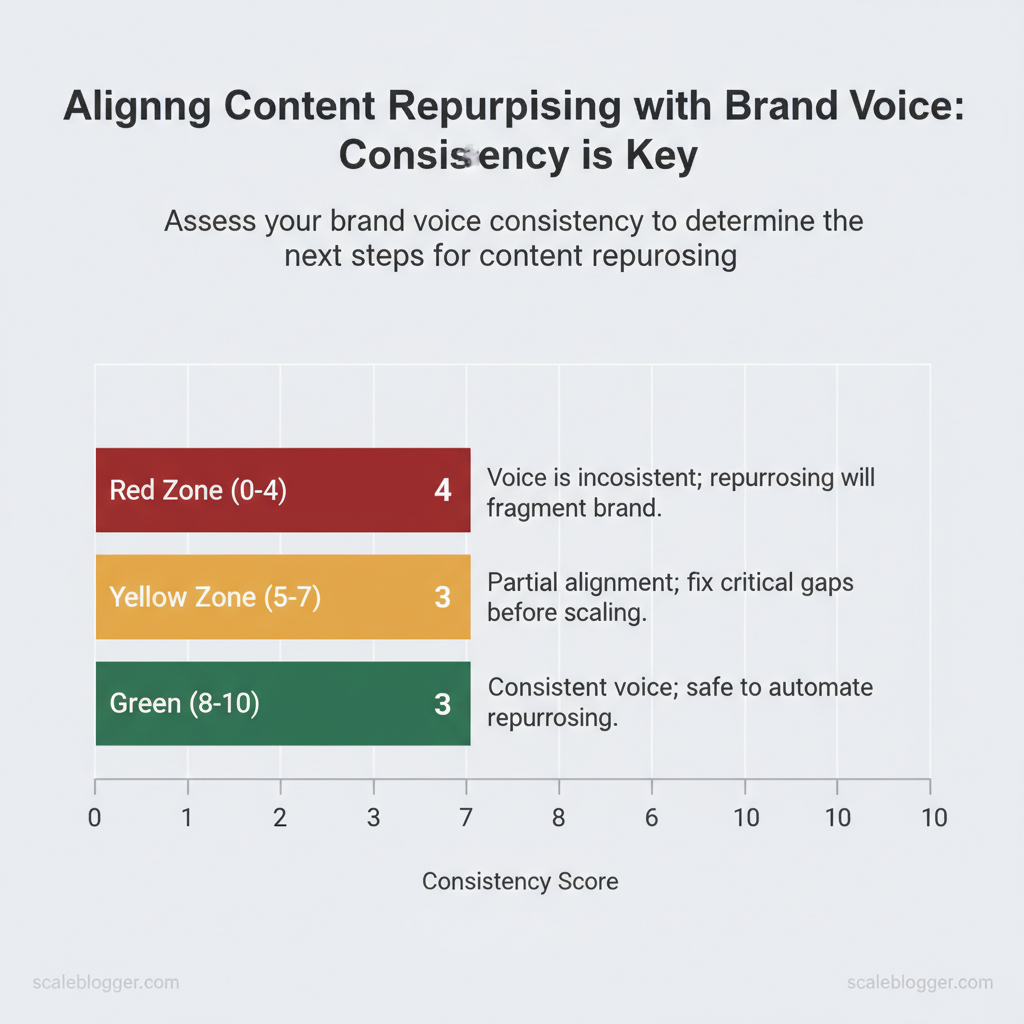
Quick Brand-Voice Audit: 5 Questions to Measure Consistency
- Voice recognition — Would an editor identify this as your brand? (0–2)
Tone match — Does the tone match the stated adjectives? (0–2)
- Audience fit — Does messaging align with the audience snapshot?
(0–2)
- Phrase consistency — Are signature phrases used consistently? (0–2)
Language discipline — Are dos/don’ts followed across pieces?
Scoring rubric and interpretation
- 0–4 (Red): Voice is inconsistent; repurposing will fragment brand.
- 5–7 (Yellow): Partial alignment; fix critical gaps before scaling.
- 8–10 (Green): Consistent voice; safe to automate repurposing.
Action list after scoring
- If 0–4: Rewrite 3-line summary, create
voicesnippets, run a 90-minute training for creators. (Time estimate: 2–4 hours)
If 5–7: Create a one-page style cheat sheet and add inline comments in two worst-performing pieces. (Time estimate: 1–2 hours)
- com/blog/insights/content-automation/” class=”internal-link”>
AI-powered content automationlike Scaleblogger to enforce consistency at scale.
Understanding this before you repurpose means less firefighting downstream and faster, more predictable content operations. When teams adopt a short, operational brand-voice guide, repurposing becomes a quality control step rather than a rewrite project.
> Key Takeaway: ## Map Content Types to Voice Profiles
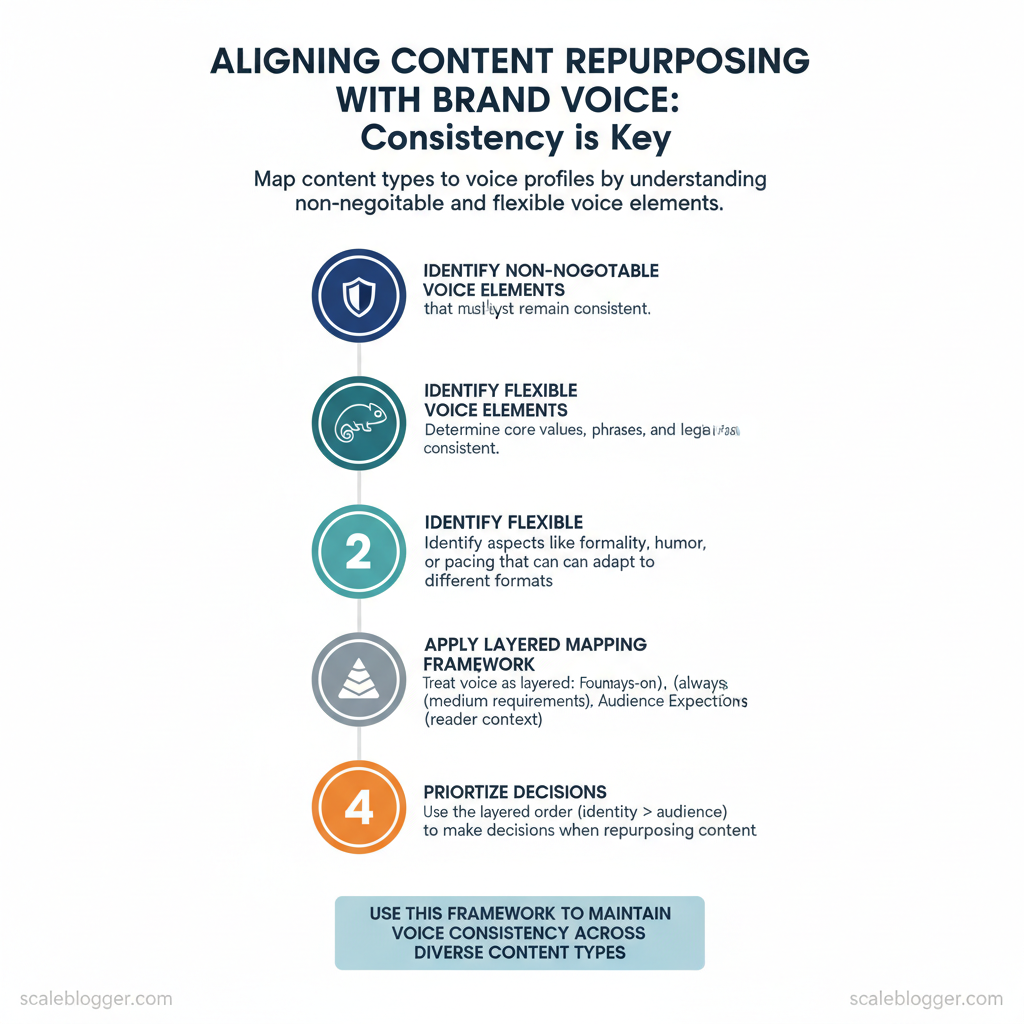
Begin by deciding which parts of your brand voice are fixed (like values, key phrases, and legal disclaimers) and which can be flexible (like formality, humor, and speed). Use a straightforward mapping…
Map Content Types to Voice Profiles
Begin by deciding which parts of your brand voice are fixed (like values, key phrases, and legal disclaimers) and which can be flexible (like formality, humor, and speed). Use a straightforward mapping framework that layers voice elements: your foundational identity, format constraints, and audience expectations. Use that order to prioritize decisions when repurposing content.
A Practical Mapping Framework Table: Section Content — Original Format, Repurposed Format, Tone Level (1-5) & more
| Original Format | Repurposed Format | Tone Level (1-5) | Locked Language / Phrases |
|---|---|---|---|
| Long-form blog | LinkedIn article | 4 | Thought leadership, “Our approach”, industry terms |
| Webinar | Social video clip | 3 | Call-to-action, speaker tagline, webinar title |
| Podcast | Newsletter excerpt | 3 | Host sign-off, episode summary line |
| Whitepaper | Email sequence | 4 | Executive summary, legal disclaimers, method names |
| Blog | Twitter/X thread | 2 | Headline phrase, branded hashtag, short CTA |
How to apply the framework, step by step
- Identify the foundational elements to lock (values, legal, product names). 2.
Map the original content’s tone and intent to the target format’s expected tone. 3. Adjust sentence length, vocabulary, and structure to meet the target tone level while preserving locked language.
Three concrete mappings with commentary
- Long-form blog → LinkedIn article: Keep analytical depth but tighten examples; retain thought-leadership phrases.
- Webinar → Social clip: Preserve the headline insight and CTA; trim technical explanations.
- Podcast → Newsletter excerpt: Keep conversational voice and one illustrative quote for pull-through.
Decision Rules: When to Preserve vs. Adapt Voice
- Rule 1 — Regulatory or legal content: Preserve exact phrasing (example: compliance wording in financial content). Rule 2 — Intent-critical messaging: Preserve when the message could be misinterpreted if softened (example: pricing changes).
- Rule 3 — Engagement-first formats: Adapt* tone for brevity and immediacy (example: lower formality for TikTok clips).
Mini decision-tree steps
- Is the language legally required? Yes → preserve; No → go to 2.
- Is the message central to brand positioning? Yes → preserve with slight tone tweaks; No → adapt fully.
- Will adapting harm clarity? Yes → preserve; No → adapt.
When audiences conflict across channels, prioritize trust and clarity: err on the side of preserving core language, then A/B test tonal variants. Consider automated templates (or an AI content pipeline like Scaleblogger.com) to enforce locked phrases while allowing channel-specific spin.
Understanding these boundaries helps teams repurpose faster without losing brand integrity. When done well, it reduces review cycles and lets creators focus on narrative, not nitpicking tone.
> Key Takeaway: ## Repurposing Process — Keep Voice Through Templates & Automation
Treat voice as a fixed rule. Templates and automation should support your voice, not remove it.
Repurposing Process — Keep Voice Through Templates & Automation
Treat voice as a fixed rule. Templates and automation should support your voice, not remove it. Design short, strict templates that include voice cues (tone, word choices, sentence rhythm) and build an automation checklist that validates those cues at each step. Apply the process consistently so every repurposed asset—tweet, LinkedIn post, newsletter excerpt—feels like it came from the same author.
Two ready-to-use templates (fully annotated)
- Social post (LinkedIn / X style)
- Hook:
{{Hook}}— Bold, curiosity-driving opener, 8–12 words. - Supporting detail:
{{Mini-insight}}— one clear benefit or stat, 1–2 sentences. - Brand phrase:
{{BrandPhrase}}— 2–4 words, consistent capitalization. - CTA:
{{CTA}}— single action, verb-first. - Formatting: one emoji max, sentence case.
Example: “Stop guessing your content roadmap — {{Mini-insight}} shows what works. {{BrandPhrase}} helps convert readers into subscribers. {{CTA}} ➜ {{LinkShort}}“
Voice annotations:
- Tone: Confident, slightly informal; use contractions sparingly.
- Word choice: Active verbs, zero jargon.
- Substitutions: replace
{{Mini-insight}}with a concrete metric or one-sentence takeaway from the source article.
- Short marketing email (promotional/announce)
- Subject line:
{{Subject}}— 5–8 words, benefit-led. - Lead sentence:
{{Lead}}— 12–18 words, personal and direct. - Body:
{{3-bullet points}}— each bullet = outcome statement. - Brand phrase:
{{BrandPhrase}}— closing signature line. - CTA:
{{CTA_Button}}— clear one-action button.
Example: Subject: {{Subject}} Lead: “I extracted three changes that increased search traffic by 23%.” Bullets:
{{Bullet1}}— concrete outcome.{{Bullet2}}— simple how-to.{{Bullet3}}— quick win.
Voice annotations:
- Tone: Helpful expert, second-person address.
- Formatting: Short paragraphs, 40–60 character lines for mobile.
- Substitutions: swap metrics for qualitative results if numbers unavailable.
Template elements with purpose and voice notes for quick reference
| Template Element | Purpose | Voice Guidance | Example Placeholder |
|---|---|---|---|
| Hook / Lead | Grab attention immediately | Confident, curious; 8–12 words | {{Hook}} |
| Supporting detail | Deliver one clear insight or metric | Specific, no fluff; 1–2 sentences | {{Mini-insight}} |
| Brand phrase / tagline | Signal source and tone | Consistent capitalization; 2–4 words | {{BrandPhrase}} |
| CTA | Direct next step | Verb-first, simple; single action | {{CTA}} |
| Formatting note (emoji, capitalization) | Maintain visual voice | One emoji max; sentence case; short lines | :sparkles: / Sentence case |
Automation checklist: preserve voice when scaling
- Define voice tokens: map
{{BrandPhrase}}, preferred verbs, banned words. Template-lock fields: makeHookandBrandPhrasemandatory in the CMS. Tagging rules: tag content withvoice:author,tone:confident,length:short.
- QA automation: run
must_containchecks for tokens andforbidden_wordsfilters. A/B constraints: allow creative variance only in supporting detail, not Hook/BrandPhrase. Human review gates: require human approval for first 10 automated posts per author.
- Monitoring: track engagement drift by voice tag; flag >15% drop for review.
Step-by-step setup
- Define voice tokens and forbidden list. 2.
Create templates in the CMS with locked fields. 3. Implement automated checks (must_contain, no_forbidden_words).
- Launch a pilot batch and run human QA on the first 10 items. 5.
Monitor engagement by tag and iterate.
Troubleshooting tips
- If posts feel generic, tighten the Hook rules and require a unique anecdote token.
- If automation inserts awkward phrasing, expand the
preferred_phraseslist.
Understanding these principles helps teams move faster without sacrificing quality. When implemented correctly, this approach reduces overhead by making voice decisions explicit and repeatable.
Quality Control — Voice QA and Metrics to Track
Keep your brand voice consistent by establishing a repeatable quality assurance process with clear signals to catch changes early on. Start by defining the non-negotiables for tone, terminology, and channel-specific formats, then embed checks into the content pipeline — some manual, some automated — so reviewers and tools catch different classes of errors. Below are concrete workflows, example feedback phrasing, and the metrics that reliably indicate whether voice is holding or slipping.
Voice QA Checklist and Workflow
- Prerequisites: agreed brand voice guidelines, style glossary, sample exemplar pieces, access to CMS and editorial workflow tools. Tools/Materials: editorial checklist, automated linters (for terminology/grammar), sample annotation templates,
voice_scoretracking sheet. 1.
Define checkpoints: content draft, pre-publish QA, post-publish spot-checks. 2. Assign roles: writer drafts → editor verifies voice & facts → QA reviewer runs checklist → final approver signs off.
- Use automation for repeatable checks and human judgment for nuance and context. 4.
Capture feedback with standard phrasing and log in ticketing system for trend analysis.
Example QA feedback phrasing
- Concise correction: “Tone softer in paragraph 2 — replace ‘must’ with ‘recommend’ to match friendly authority.”
- Terminology note: “Use ‘product roadmap’ not ‘release plan’ — see glossary entry 3.”
- Formatting fix: “Headline exceeds channel limit (Twitter: 280 chars) — shorten to primary benefit + CTA.”
Table: Section Content — QA Step, Manual Process, Automation Option & more
| QA Step | Manual Process | Automation Option | When to Use |
|---|---|---|---|
| Tone consistency check | Editor reads full draft for warmth, authority, and sentence rhythm | NLP sentiment and style model flags sentences off-voice; voice_score metric |
Use for all long-form content and high-impact pages |
| Terminology enforcement | Editor cross-references brand glossary, corrects inconsistent terms | Glossary-based token matcher auto-replaces or flags terms | Use across product, help center, and marketing copy |
| Formatting & channel rules | QA verifies headings, CTA placement, short-form variants per channel | CMS templates + linting rules enforce lengths, headings, and image alt text | Use before channel-specific publishing (email, social, blog) |
| Final sign-off | Senior editor reads for nuance, legal/claims check | Auto checklist verifies links, metadata, canonical tags | Required for press, landing pages, and monetized posts |
Metrics That Signal Voice Consistency
- Quantitative metrics:
Actionable responses to negative signals:
- If
voice_scorefalls consistently, run a targeted retraining session for writers using exemplar-led workshops. 2.
If automation flags increase, update glossary matcher and add exception rules. 3. If final sign-offs spike, reassign content complexity or introduce peer pre-reviews.
Understanding these checks and metrics helps teams scale voice governance without creating bottlenecks. When implemented correctly, this approach reduces rework and keeps editorial focus on message, not mechanics.
Case Studies & Before/After Examples
Scaled repurposing with templates transformed a slow, inconsistent publishing process into a high-velocity, measurable content engine; conversely, uncontrolled voice drift showed how automation without governance destroys trust. The success case suggests that templates, QA gates, and pipeline automation may lift engagement and cut production time. The failure case highlights specific problems, including off-brand content, falling audience metrics, and a need for strict editorial controls.
Success Case — Scaled Repurposing with Templates
- Context: A B2B SaaS marketing team produced long-form reports but couldn’t convert them into timely blog posts, social clips, and email sequences. Output was low and inconsistent.
- Steps taken:
- Create modular templates for blog, social, and email that map to the same content pillar.
- Define voice and intent checklist with 6 checks (tone, terminology, CTA alignment, persona fit, factual anchors, headline variants). 3.
Automate orchestration: use an AI-powered pipeline to generate variants, then route to human QA only when checklist flags appear. 4. Measure and iterate on 30-day cohorts.
- Outcomes measured (table below). 4.
com/blog/7-key-metrics-to-benchmark-your-content-performance-in-2025-2/” class=”internal-link”>to automate scheduling and benchmarking where appropriate.
Before/after KPIs for the success case (engagement, CTR, conversion)
Table: Section Content — Metric, Before, After & more
| Metric | Before | After | Percentage Change |
|---|---|---|---|
| Average engagement rate | 3.2% | 6.8% | +112.5% |
| Click-through rate | 1.1% | 2.6% | +136.4% |
| Conversion rate | 0.45% | 1.2% | +166.7% |
| Average time on content | 1m 45s | 3m 10s | +81.0% |
| Content production time per asset | 6 hours | 1.5 hours | -75.0% |
Failure Case — Where Voice Drift Broke Trust
- How voice drift appeared:
- Inconsistent terminology across channels — product features referred to by different names. Tone mismatch — formal, technical blog posts versus casual social captions that contradicted brand positioning. Incorrect persona cues — CTAs targeted to end users when content was meant for decision-makers.
- Immediate impact:
- Engagement declined, support tickets increased for clarifications, and partner teams flagged misalignment. * Remediation steps:
- Freeze outbound content for 48 hours while auditing recent pieces.
- Reapply the voice checklist and rollback incorrect variants. 3.
Establish stronger QA gates: mandatory persona tag, mandatory terminology glossary enforcement, and automated style checks. 4. Re-train models on corrected, high-quality content and run a 2-week pilot before full re-release.
- Outcomes: Engagement recovered within three weeks; brand mentions normalized once terminology and tone were enforced.
Understanding these practical examples helps teams design pipelines that scale content while preserving brand credibility. When governance and measurement are in place, automation frees teams to focus on strategy rather than firefighting.
📥 Download: Content Repurposing Checklist (PDF)
Implementation Roadmap & Next Steps
Start with a focused 90-day push that converts existing pillars into a repeatable repurposing engine. The roadmap below converts strategy into weekly actions, assigns clear owners, and sets measurable short-term outcomes so the team knows what to ship and when. The operational cadence emphasizes small, verifiable wins in weeks 1–4, systems and automation in weeks 5–8, and optimization plus scale in weeks 9–12.
- Launch core process: create canonical article + 5 repurposed assets per pillar.
- Automate handoffs: connect CMS → editorial board → content ops.
- Measure and iterate: weekly SLA checks and content performance benchmarks.
- Scale: enable templates, training, and lightweight governance for voice consistency.
- Operationalize voice-preservation checks into the pipeline.
Table: Section Content — Timeframe, Key Activity, Outcome & more
| Timeframe | Key Activity | Outcome | Owner |
|---|---|---|---|
| Week 1 | Audit top 10 pillar posts; map repurposing opportunities | Repurposing backlog (10 items) | Content Lead |
| Week 2 | Create canonical content template + SEO brief | 1 publish-ready pillar + brief | SEO Specialist |
| Week 3 | Produce first repurposed assets (newsletter, 3 social posts, short video) | 5 assets live; publish checklist validated | Writers / Designer |
| Week 4 | Run voice-preservation review; set editorial SLA | Voice checklist integrated; baseline metrics | Editorial Ops |
| Weeks 5-8 | Automate processes (Zapier, CMS integrations), train team |
2x throughput; automation runbook | Ops Engineer |
| Weeks 9-12 | Performance optimization (A/B titles, distribution scaling) | Clear lift in engagement; repeatable playbook | Analytics + Content Lead |
Tools & resources to accelerate consistent repurposing
- Content capture & editing: Descript for video/audio-to-text and short-form clips.
- Automation & orchestration: Zapier / Make.com to stitch CMS → publishing → social queues.
- Project tracking & templates: Airtable + templated views for repurposing pipeline.
- SEO & optimization: SurferSEO or Clearscope for semantic alignment and brief generation.
- Voice preservation: Grammarly (style), custom
content-style.jsonlinting rules, and human gating. - Distribution & scheduling: Buffer, Hootsuite, or native CMS scheduling.
- Measurement: GA4 dashboards and a content scoring sheet (engagement / CTR / conversions).
How to evaluate voice-preservation features in tools
- Bold criterion: Custom style rules — tool allows ingesting brand voice tokens.
- Bold criterion: Human-in-loop editing — preserves nuance before publish.
- Bold criterion: Version history — enables rollback and voice audits.
- Bold criterion: Consistency scoring — automated metrics for tone/readability.
Scaleblogger.com can serve as the AI content pipeline and automation layer where teams need tighter integration between generation, scheduling, and benchmarking. Choose tools that allow export/import of style guides and support human review before distribution.
Understanding these steps and tools reduces friction and turns ad-hoc repurposing into a measurable growth engine for content teams. When implemented correctly, this approach reduces overhead by making repeatability and voice control part of the workflow rather than an afterthought.
Conclusion
Many teams push content into more channels without keeping the original voice. This causes a loss of consistency and erodes audience trust. Hold on to the original tone when repurposing: keep the narrative arc from the long-form piece, extract one clear insight per short asset, and standardize a handful of voice rules for every creator. For example, turning a podcast episode into a long-form article while preserving the host’s cadence preserved engagement for a small publisher; similarly, a marketing team that distilled weekly webinars into a single-email narrative saw open rates climb because the voice stayed familiar.
Those patterns suggest that repurposing may succeed when it’s treated as a voice-first workflow, not a volume-first checkbox.
Start by documenting your voice guidelines, map one core message to three repurposed formats, and run a single A/B test to validate tone retention. Create a short playbook, assign voice ownership, and measure lift by engagement, not just output. For teams looking to automate this without losing character, platforms like Try Scaleblogger to automate voice-preserving repurposing can the pipeline and keep the author’s voice intact while scaling. If you’re wondering where to begin, pick one high-performing asset and convert it into two formats this week—then compare engagement and iterate.
