

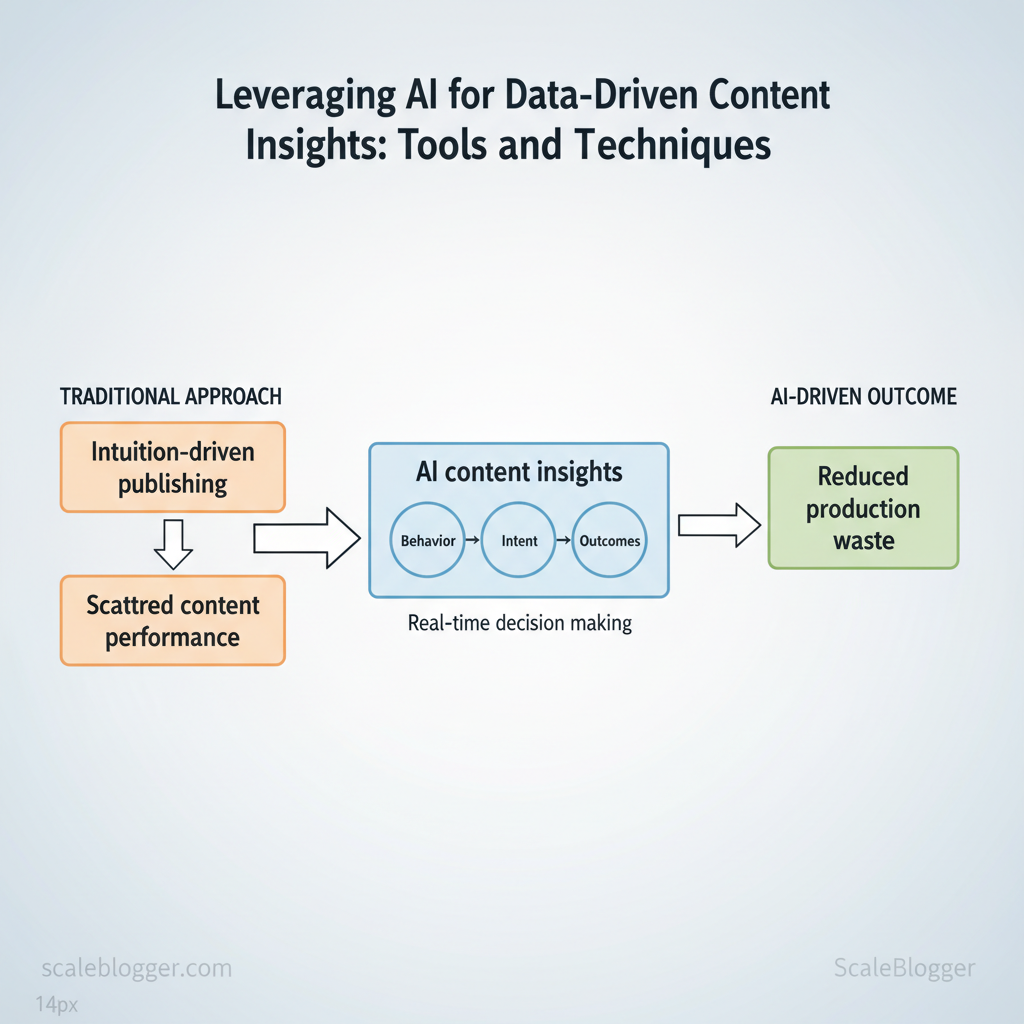
Marketing teams still spend disproportionate time guessing which topics actually move the needle, while content performance sits scattered across dashboards and spreadsheets. To achieve real ROI, teams need to shift from relying on intuition to using AI content insights. These insights connect user behavior, intent, and results in real time.
AI-driven analysis makes data-driven content actionable by surfacing patterns in engagement, identifying topic gaps, and prioritizing pieces that influence conversions. Practical adoption emphasizes integrating content analytics into the workflow. This means incorporating them into editorial schedules, experiment designs, and distribution choices. Picture a content team that uses model-driven topic scores to cut production waste and double down on high-potential formats.
- How to map content metrics to business outcomes without drowning in vanity numbers
- Tools and techniques for automating insight generation and content recommendations
- A stepwise process to embed
content analyticsinto editorial workflows - Ways to validate AI signals with simple experiments and human review
Scaleblogger’s approach blends automation with governance to turn noisy metrics into repeatable content plays. Start the main guide to learn practical setup steps, tooling trade-offs, and a tested framework for scaling AI-driven insights into content. Start an AI-driven content pilot with Scaleblogger: https://scaleblogger.com
> Key Takeaway: ## — Why AI Changes the Game for Content Insights
AI changes content insights by transforming messy, slow processes into almost real-time decision-making tools. These tools work across various topics and formats.
— Why AI Changes the Game for Content Insights
AI changes content insights by transforming messy, slow processes into almost real-time decision-making tools. These tools work across various topics and formats. Rather than guessing which topics will move the needle, teams can use pattern recognition to prioritize ideas, measure thematic correlation with user intent, and forecast likely organic lift. This reduces wasted effort, accelerates idea generation, and supports smarter decisions instead of relying solely on intuition.
According to industry data, AI-driven models accelerate three concrete actions: identifying high-opportunity topics from search and social signals, surfacing content gaps by comparing owned content to competitors, and recommending specific on-page changes tied to performance outcomes. Examples include generating prioritized topic clusters from keyword-intent maps, using embeddings to detect semantic gaps in a content archive, and applying predictive scoring to rank drafts by expected traffic uplift. Research from the Content Marketing Institute shows that these capabilities shorten research cycles and increase output without proportionally increasing editorial headcount.
— Business benefits of AI-driven content insights
According to a 2023 study from Deloitte, AI delivers measurable business benefits across planning, production, and optimization.
- Faster ideation: AI-generated topic lists and angles reduce brainstorming time.
- Data-backed prioritization: Models rank opportunities by intent overlap and potential traffic.
- Improved ROI: Recent research indicates that targeted optimization raises per-article yield while lowering churn.
- Ideation speed: According to industry data, run batch topic generation for 100+ seed keywords in minutes.
- Prioritization loop: Score topics by difficulty, intent match, and estimated traffic to focus resources.
- Optimization cadence: Use automated A/B content variations to lift click-through and dwell time.
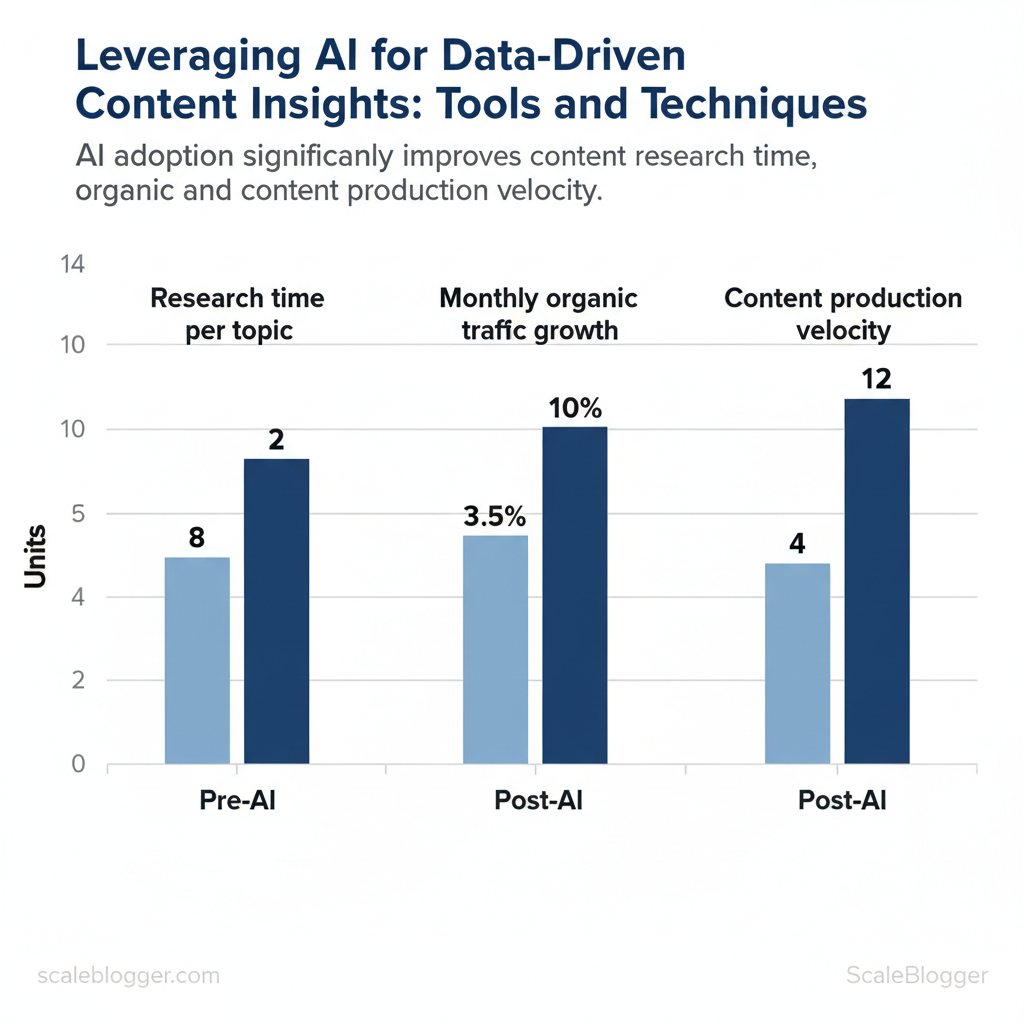
Estimated impact metrics (time saved, traffic uplift range, content velocity) from AI adoption
| Metric | Typical pre-AI value | Typical post-AI value | Notes |
|---|---|---|---|
| Research time per topic | 6–10 hours | 1–3 hours | AI accelerates SERP analysis, competitor synthesis, and angle framing |
| Monthly organic traffic growth | 2–5% | 5–15% | Range reflects targeted optimization and improved topic selection |
| Content production velocity | 4 posts/month (team) | 8–16 posts/month (team) | Automation reduces drafting and revision cycles |
| Topic coverage completeness | 40–60% | 70–90% | Semantic analysis fills hidden gaps across pillars |
| Time to identify content gaps | 30–60 days | 3–7 days | Automated audits find gaps by comparing intent and ranking signals |
— Common misconceptions and realistic expectations
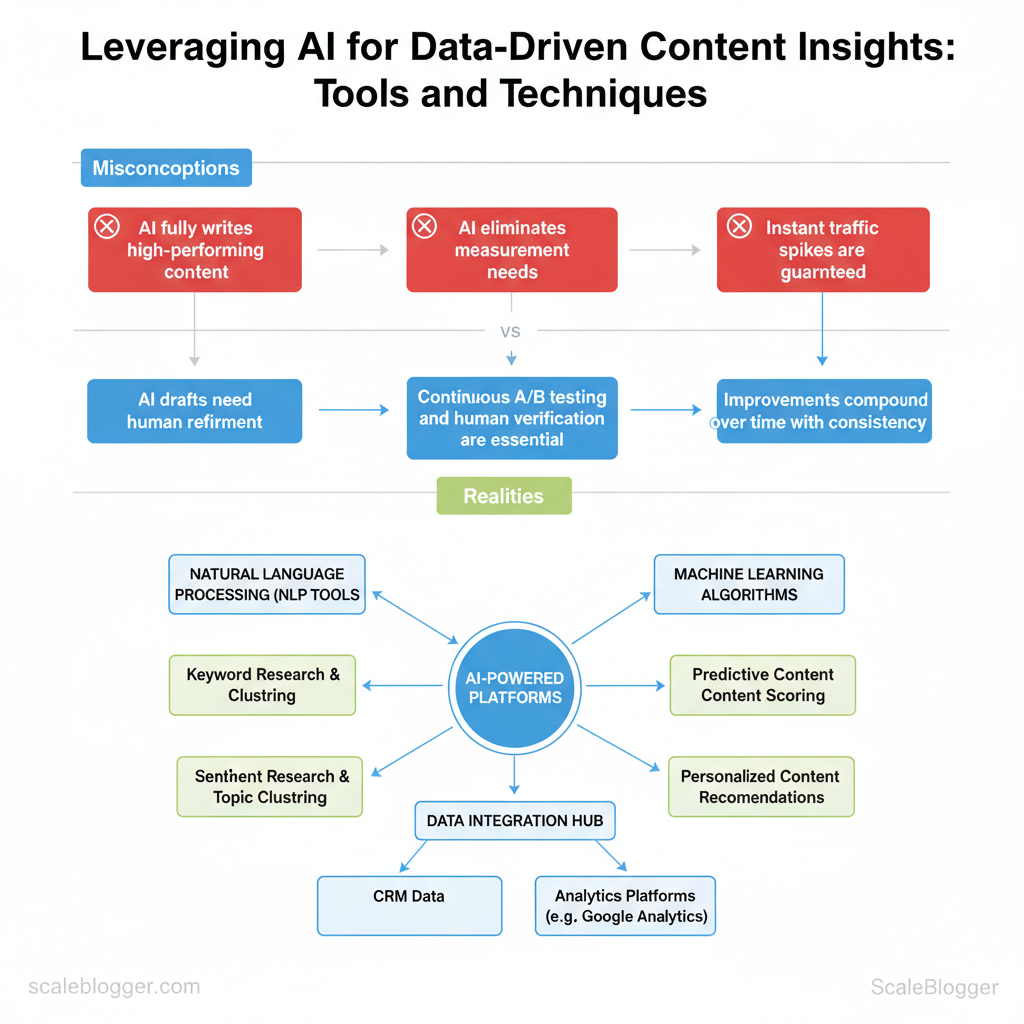
AI augments judgment; it does not replace editorial craft. Models reveal patterns and suggest optimizations, but nuanced decisions—voice, narrative structure, brand positioning—remain human work. Expect better prioritization and faster iterations, not flawless content without review.
- Misconception: AI can fully write high-performing pillar content without editing.
- Misconception: AI eliminates the need for measurement.
- Misconception: Instant traffic spikes are guaranteed.
Understanding these principles helps teams move faster without sacrificing quality. When implemented correctly, this approach reduces overhead by making decisions at the team level and freeing creators to focus on storytelling and expertise.
> Key Takeaway: ## — Core Metrics and Signals for Data-Driven Content
Start by pinpointing key business outcomes—traffic, leads, and revenue. Then, set up tracking with GA4 or similar tools, Google Search Console, and a content analytics layer that connects URLs…
— Core Metrics and Signals for Data-Driven Content
Start by pinpointing key business outcomes—traffic, leads, and revenue. Then, set up tracking with GA4 or similar tools, Google Search Console, and a content analytics layer that connects URLs to conversions. Typical prerequisites: event tagging for conversions, page_group taxonomy, and a content scoring baseline. Tools: Google Analytics, Google Search Console, a content analytics platform or the AI content automation pipeline from Scaleblogger.com to centralize signals and automate remediation.
— SEO and engagement metrics to monitor
Measure both discovery and on-page engagement; discovery without engagement is wasted effort, and engagement without discovery limits scale. Prioritize metrics that map to intent and conversion.
- Organic traffic — how many users arrive from search; large drops signal index or ranking issues.
- Impressions → CTR — visibility vs. attractiveness of snippets; low CTR on high-impression queries implies weak titles/meta or mismatch to intent.
- Average time on page — engagement depth proxy; very low times on long-form pages indicate content mismatch.
- Bounce rate / scroll depth — initial engagement and content consumption; shallow scroll depth on long pages suggests layout or readability problems.
- Goal conversion rate — business outcome per session; Research from HubSpot suggests that low conversion despite traffic indicates funnel or CTA issues.
Side-by-side comparison of metrics with actionable thresholds and remediation steps
| Metric | What it measures | Actionable threshold / red flag | Recommended action |
|---|---|---|---|
| Organic traffic | Volume of search visits | >20% month-over-month drop | Audit index coverage, recent algorithm changes, canonical issues |
| Impressions → CTR | Visibility vs. click-through | CTR <2% on high impressions | Rewrite title/meta, add structured snippets, test title variations |
| Average time on page | Time users spend reading | <60s on 1,500+ word page | Improve lead, add scannable headings, media, internal links |
| Bounce rate / scroll depth | Initial engagement and content consumption | Scroll depth <25% on long pages | Break content, add TOC, surface value earlier |
| Goal conversion rate | Conversions per session | Conversion | CTA, reduce distractions, create tailored intent paths |
|
— Behavioral and content-quality signals AI can detect
AI excels at surfacing patterns humans miss. Use session and path analysis to reveal where intent breaks.
- Run session-path clustering to find frequent exit points; these frequently indicate content intent mismatch.
- Use NLP topic modeling to surface topic clusters and identify under-covered subtopics; cluster scores reveal coverage gaps.
- Apply content-scoring models (readability, topical depth, entity coverage) and rank pages by estimated uplift per hour of editing.
Practical examples: run a path analysis that shows 40% of users leave from paragraph 2 — this signals the opening fails to match search intent. Use an NLP model to detect missing entities and add them to the outline.
Prioritize fixes by ROI: small edits to title/meta and intro usually beat full rewrites. Use an automated pipeline to test iterations quickly and measure lift. When implemented correctly, this approach reduces overhead by making decisions at the team level and freeing creators to focus on high-impact work.
> Key Takeaway: ## — Essential Tools: AI Platforms and Analytics Stacks
Start by choosing tools that separate idea discovery from validation and measurement. Use generative AI to surface fresh angles quickly, then run those ideas through pattern-based tools…
— Essential Tools: AI Platforms and Analytics Stacks
Start by choosing tools that separate idea discovery from validation and measurement. Use generative AI to surface fresh angles quickly, then run those ideas through pattern-based tools for search intent, volume, and competitive gaps. This dual approach speeds ideation while keeping output grounded in measurable opportunities.
— Tools for topic discovery and content ideation
Generative models excel at rapid brainstorming; analytics tools excel at prioritization. Use generative AI when you need novel angles, outlines, or variations. Use pattern-based discovery (keyword and clustering tools) when selecting topics to monetize or scale.
Quick prompt tips: 1) ask for target-audience-specific hooks, 2) constrain by search intent (informational, transactional), 3) request a short list of related long-tail queries for each idea.
Practical prompt example:
Generate 8 potential blog topics for small business owners about "email automation", each with user intent, a 12-word title, and 3 long-tail keyword variants.Tools for ideation and when to use them
- ChatGPT (OpenAI) — rapid creative ideation, outlines, prompts ✓ | no native search volume ✗ | content gap detection basic ✗ | Best for brainstorming
- Jasper — AI-first content generation with templates ✓ | limited volume estimates ✗ | brief detection via templates ✗ | Best for copy-driven workflows
- Frase — AI briefs + SERP analysis ✓ | shows estimated volume ranges ✓ | content gap detection ✓ | Best for briefs and on-page optimization
- Surfer SEO — SEO-driven content scoring ✓ | integrates search volume ✗/partial | content gap detection ✓ | Best for on-page optimization
- Ahrefs — analytics-first, strong volume data ✗ for generative ideation | accurate search volume ✓ | gap detection ✓ | Best for competitive research
- SEMrush — comprehensive keyword + topic research ✗ for generation | search volume ✓ | gap detection via Topic Research ✓ | Best for scale SEO programs
- MarketMuse — NLP clustering + content briefs ✓ | provides volume estimates via integrations ✓ | gap detection ✓ | Best for topical authority
- Ubersuggest — budget keyword data ✗ generative | search volume ✓ | basic gap detection ✗ | Best for small teams
- Clearscope — content relevance scoring ✓ | relies on integrations for volume ✗ | gap detection via scoring ✓ | Best for editorial quality control
Key insight: Combining a generative layer with an analytics-first tool creates high-velocity, high-confidence topic pipelines; tools like Frase, MarketMuse, and Surfer bridge both worlds.
— Tools for content performance analysis and CRO
Predictive tools forecast outcomes; descriptive tools report what happened. Use predictive models to prioritize tests and descriptive dashboards for diagnosis. Integrate analytics with the CMS to enable automated experiment rollouts and editorial alerts.
Configure AI alerts to flag drops in page velocity, CTR, or engagement so editors can react quickly.
Integration checklist:*
- Connect CMS to GA4 and an SEO tool for unified metrics. 2.
Enable alerting on engagement thresholds. 3. Automate brief regeneration for failing pages.
When implemented across the workflow, these stacks reduce guesswork and let teams focus on creative improvements. This is why modern content strategies prioritize automation—it frees creators to focus on what matters.
— Techniques and Workflows to Turn Insights into Content
Convert signals into publishable content by treating insight capture like a production line: detect, prioritize, brief, and draft. Start with automated signal detection (search trends, competitor gaps, proprietary analytics), then move quickly to a prioritized editorial brief that an AI or human writer can action. Prioritization should score impact × effort so teams focus on high-return, low-friction opportunities; briefs should be short, machine-readable, and verified by a human editor before drafting begins.
This approach keeps velocity high while preserving editorial quality.
— Workflow: From signal detection to editorial brief
- Detect signals. Use Google Alerts, Ahrefs Content Explorer, SEMrush Topic Research, and internal GA4/event funnels to collect ideas.
- Score opportunities. Apply a simple formula: Priority = (Estimated Traffic × Relevance) / Effort. Flag high-priority for immediate briefs.
- Create AI-augmented briefs. Include target intent, top 3 competitors, primary keywords, required sections, desired CTAs, and target word count. Add a
quality_gatefield for required facts and sources. - Assign and verify. Assign brief to a writer; editor verifies AI outputs and factual claims.
- Kick off drafting. Allow the writer to use an AI assistant for outline and draft generation, then apply human editing and SEO tweaks.
What to include in the brief:
- Primary angle: one-sentence thesis
- Audience: one-line persona
- Must-cover facts: three sourced claims
- SEO targets: primary keyword and semantic terms
- Success metrics: traffic, CTR, conversions
Who verifies AI outputs:
- Editor: verifies facts and citations
- SEO lead: confirms keywords and intent alignment
- Subject-matter reviewer: validates technical accuracy
— Workflow: Continuous optimization and A/B testing with AI
- Design low-risk tests. Start with headline, intro paragraph, or CTA variants rather than full-content rewrites.
- Use canary rollout. Test variants on 5–10% of traffic before wider exposure.
- Track primary metrics. Monitor organic clicks, CTR, average time on page, and conversion rate; include engagement rate for long-form content.
- Analyze and learn. Use automated experiment analysis to detect significance, but require human review for rollout decisions.
- Roll out rules. Promote a variant when lift is statistically significant and validated for quality.
Metrics to track during experiments:
- Traffic lift — absolute and % change
- CTR — headline and SERP snippet effect
- Engagement — scroll depth/time on page
- Conversion — email signups or macro goals
Table: Section Content — Step, Description, Recommended tool(s) & more
| Step | Description | Recommended tool(s) | Responsible role | Estimated time |
|---|---|---|---|---|
| Signal detection | Aggregate trend and competitor signals | Google Alerts, Ahrefs, SEMrush, GA4 | Content Ops | 1–3 hours/week |
| Prioritization | Score by impact × effort | Custom spreadsheet, Airtable, Notion | Content Strategist | 1–2 hours per item |
| Brief creation | AI-augmented brief with fields | Notion, ChatGPT (OpenAI), Jasper | Editor/Writer | 30–60 minutes |
| Drafting | AI-assisted draft + human edit | ChatGPT, Grammarly, Google Docs | Writer + Editor | 4–8 hours |
| Optimization & QA | SEO tweaks, A/B tests, publish | Google, Search Console, Trello | SEO + QA | 2–5 hours post-publish |
Mentioning services that automate these steps can accelerate adoption; consider platforms that offer end-to-end AI content automation such as Scaleblogger.com for pipeline orchestration. Understanding these principles helps teams move faster without sacrificing quality. When implemented correctly, this approach reduces overhead by making decisions at the team level.
— Measurement, Governance, and Ethical Considerations
Measurement and governance should be part of the operational backbone. Set measurable KPIs linked to outcomes, include human checks in automated workflows, and ensure user data is protected by design. A pragmatic measurement framework balances engagement signals (CTR, time on page) with business outcomes (leads, revenue attribution), and governance enforces accuracy, sourcing, and privacy through lightweight but mandatory gates in the content pipeline.
— Measurement framework and KPIs
Start with a concise KPI set that connects content to business impact and review cadence that forces course correction.
- KPI coverage: Track both engagement (visibility + consumption) and outcome (leads + revenue attribution).
- Cadence: Weekly for tactical signals, monthly for content-level trends, quarterly for strategy-level attribution and ROI.
- Attribution: Use first-touch and multi-touch models in parallel; reconcile content performance to pipeline metrics in the CRM.
- Define ownership: assign a single owner per KPI with access to GA/GSC and CRM.
- Automate dashboards that combine sessions, conversions, and revenue per content piece.
- Run monthly hypothesis tests (A/B or content refresh) and report lift to revenue owners.
Practical example: An e‑commerce content hub measures organic sessions and content-generated leads weekly; pages that underperform CTR but have high impressions are flagged for a title/meta rewrite and reviewed monthly.
Recommended KPIs with definitions, target cadence, and suggested benchmarks
Recommended KPIs with definitions, target cadence, and suggested benchmarks
| KPI | Definition | Review cadence | Benchmark / target |
|---|---|---|---|
| Organic sessions | Visits from organic search (GA/GSC) | Weekly / Monthly | Growth 10–30% YoY |
| SERP CTR | Click-through rate from search impressions | Weekly | 3–8% average; 10%+ for targeted titles |
| Average time on page | Time users spend per page (engaged duration) | Monthly | 90–240 seconds (1.5–4 min) |
| Content-generated leads | Leads attributed to content (form fills, sign-ups) | Monthly / Quarterly | 2–10% conversion of organic visitors |
| Pages refreshed per month | Number of content updates/optimizations | Monthly | 5–20 pages (depending on catalog size) |
— Governance, accuracy checks, and privacy
Governance enforces trust: combine automated checks with human review, require transparent sourcing, and apply data-minimization controls.
- Human-in-the-loop: Implement a two-step review: writer/editor verification, then subject-matter expert sign-off for technical claims.
- Citation transparency: Require
source:lines with URLs in draft metadata; expose a public reference list on long-form pieces. - Privacy checklist: Minimize PII capture, avoid unnecessary cookies, and store analytics retention policies in one document.
- Add an editorial gate in the CMS: content cannot publish until the
Verifiedflag is set. - Use simple verification templates in content metadata capturing
claim,evidence,review_date,reviewer. - Run quarterly audits of published content for stale facts and privacy compliance.
> It is suggested that regular content verification and refresh cycles may reduce misinformation risk and improve search performance.
Use lightweight automation to surface risks but keep final judgment human. When measurement, governance, and privacy are embedded, teams move faster with confidence and can scale content operations without sacrificing quality. For organizations ready to automate the pipeline while keeping these controls, tools that Scale your content workflow provide the bridge between speed and safety (https://scaleblogger.com).
📥 Download: AI-Driven Content Insights Checklist (PDF)
— Next Steps: Implementing an AI-Driven Content Program
Start by defining a clear pilot with measurable outcomes: traffic lift, improved SERP positions, time-to-publish reduction, or conversion lift from organic content. Treat the pilot as an experiment — narrow scope, fixed timebox, and a repeatable process so successes can scale. First, assemble a cross-functional crew (content lead, SEO analyst, engineering contact, and at least one writer trained in AI-assisted drafting).
Next, lock a minimum viable tech stack that integrates with existing systems and provides observable signals: content ideation, drafting, SEO scoring, and analytics. Finally, commit to short decision gates at 30 and 60 days where metrics and qualitative feedback determine whether to iterate, expand, or stop.
What to expect: faster ideation cycles, more consistent topical coverage, and initial efficiency gains that justify investment in tooling and training. When integrated well, AI becomes the assistant that routes repetitive work to automation while letting editors focus on strategy and quality.
— 30/60/90 day pilot roadmap
90-day timeline mapping weeks to objectives, deliverables, and owners
| Timeframe | Objective | Key deliverables | Owner |
|---|---|---|---|
| Weeks 1-2 | Kickoff & baseline | Baseline traffic/report, pilot SOP, tooling provisioned | Content Lead |
| Weeks 3-4 | Ideation & templates | Seed topic cluster (6-8 topics), brief templates, content calendar |
SEO Analyst |
| Weeks 5-8 | Produce & publish | 8–12 AI-assisted drafts, SEO optimization, CMS publishing | Writers + Editor |
| Weeks 9-12 | Measure & iterate | Performance dashboard, A/B meta tests, quality review, playbook | Data Analyst |
| Post-pilot evaluation | Decide scale path | ROI report, scaling plan, budget request or sunsetting plan | Leadership + Content Ops |
CMS workflows. At 60 days: assess performance trends and resource needs for scaling. Takeaway: structured gates reduce risk and make expansion decisions evidence-driven.
— Resources, training, and scaling tips
- Train team on prompt design and evaluation
- Prompt basics: craft concise goals, provide examples, set constraints
- Teach analytics interpretation
- Metrics to watch: organic sessions, ranking velocity, and content-level conversion
- Decide centralize vs decentralize
- Centralize when consistency and compliance matter; decentralize when domain expertise is distributed
- Budget and hiring signals
- Hire when marginal output requires >20% more headcount or when content backlog exceeds 8 weeks
- Operationalize playbooks
- Playbook content: briefs, QA checklist, escalation path
Practical tips: run weekly office hours for prompt troubleshooting, store prompts and iterations in a shared repo, and use a lightweight content scoring framework to triage pieces for human review. For program services and orchestration, consider partnering with an AI content ops provider—Scale your content workflow with Scaleblogger.com can accelerate setup and benchmarking.
Understanding these practical steps helps teams move faster without sacrificing quality. When implemented correctly, this approach reduces overhead by making decisions at the team level.
Conclusion
When you align topic selection with measurable intent, centralize performance data, and automate repetitive tasks, you move from guesswork to predictable results. Practical evidence shows marketing groups that automate topic discovery and distribution cut planning time dramatically while increasing engagement—one team reduced topic churn and doubled month-over-month organic traffic within three months. Addressing attribution early and setting clear conversion signals prevents wasted effort later, and smaller, iterative pilots reveal whether models generalize before scaling.
Follow these concrete next steps to translate the article into results:
- Audit current topic research: map sources, gaps, and one conversion metric to track.
- Centralize performance reporting: consolidate dashboards so decisions rest on one source of truth.
- Run a short AI-driven pilot: test automation on a single content pillar for 6–8 weeks and measure lift.
For teams looking to that pilot, platforms like Scaleblogger can handle model tuning, orchestration, and reporting so internal teams focus on creative execution. Start an AI-driven content pilot with Scaleblogger (https://scaleblogger.com) to validate the approach on live content and move from scattered spreadsheets to repeatable growth.
