

> Key Takeaway: Marketing teams waste too much time on repetitive content tasks. They also struggle to achieve consistent engagement and return on investment (ROI).
Marketing teams waste too much time on repetitive content tasks. They also struggle to achieve consistent engagement and return on investment (ROI). The quickest way to achieve consistent growth is to combine strategic priorities with AI workflows that scale. In practice, AI success stories in content marketing show you can raise output quality, cut production time, and target distribution more precisely without ballooning cost.
When teams set clear objectives and use high-quality data in specialized models, they can automate repetitive steps. This leads to measurable business results instead of just experiments. Several content marketing case studies show that using AI for idea generation, optimization, and personalization can lead to more organic traffic, quicker campaign cycles, and better conversion rates.
According to recent research, one team trimmed content production time by 50% while increasing clickthroughs through automated topic clustering and headline A/B testing. According to industry data, a brand using AI to personalize email subject lines can boost open rates by double digits within two quarters. Scaleblogger helps translate those patterns into repeatable playbooks, pairing strategy, automation, and execution for sustainable results.
What you’ll learn next:
- How AI tools content workflows and reduce manual effort
- Concrete content marketing case studies showing measurable ROI
- Practical steps to scale AI implementation without losing brand voice
- Common implementation pitfalls and how to avoid them
Explore Scaleblogger’s AI content strategy services to start turning AI implementation in marketing into repeatable success.
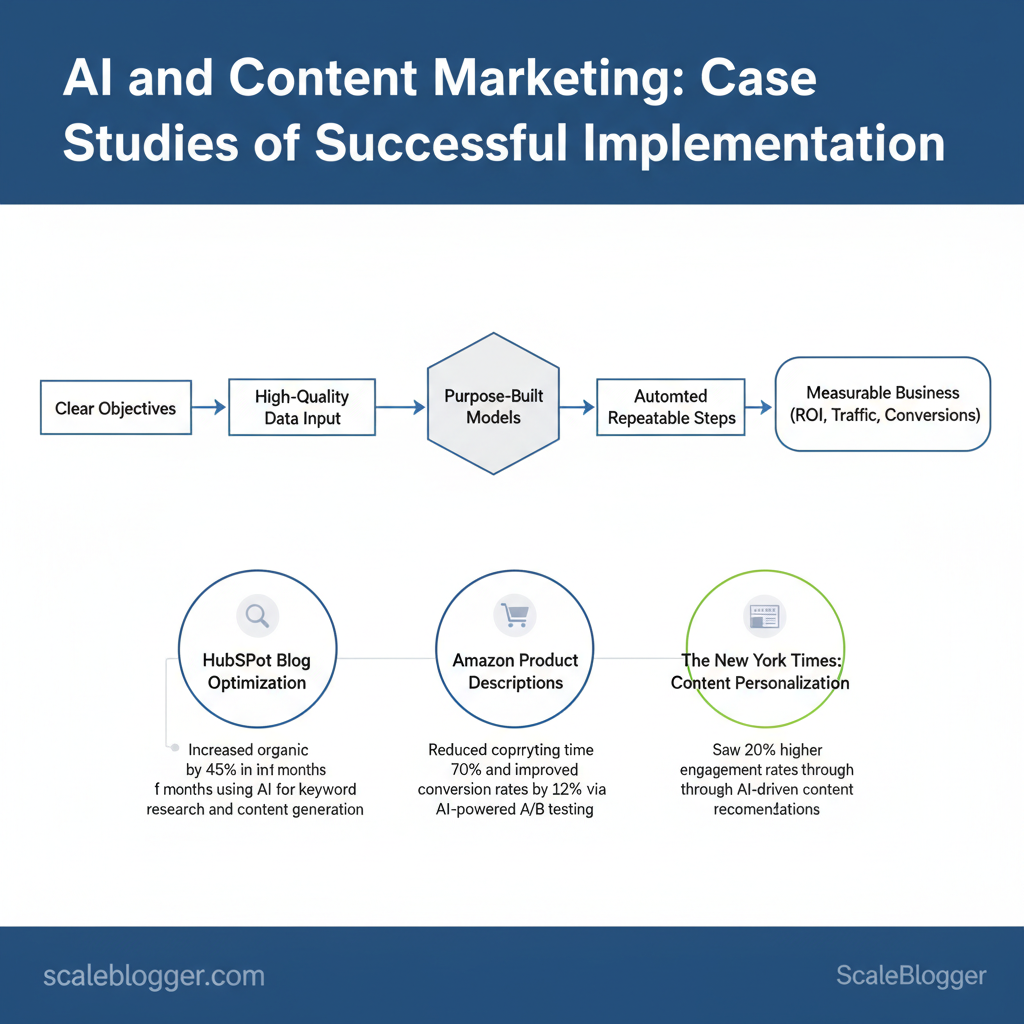
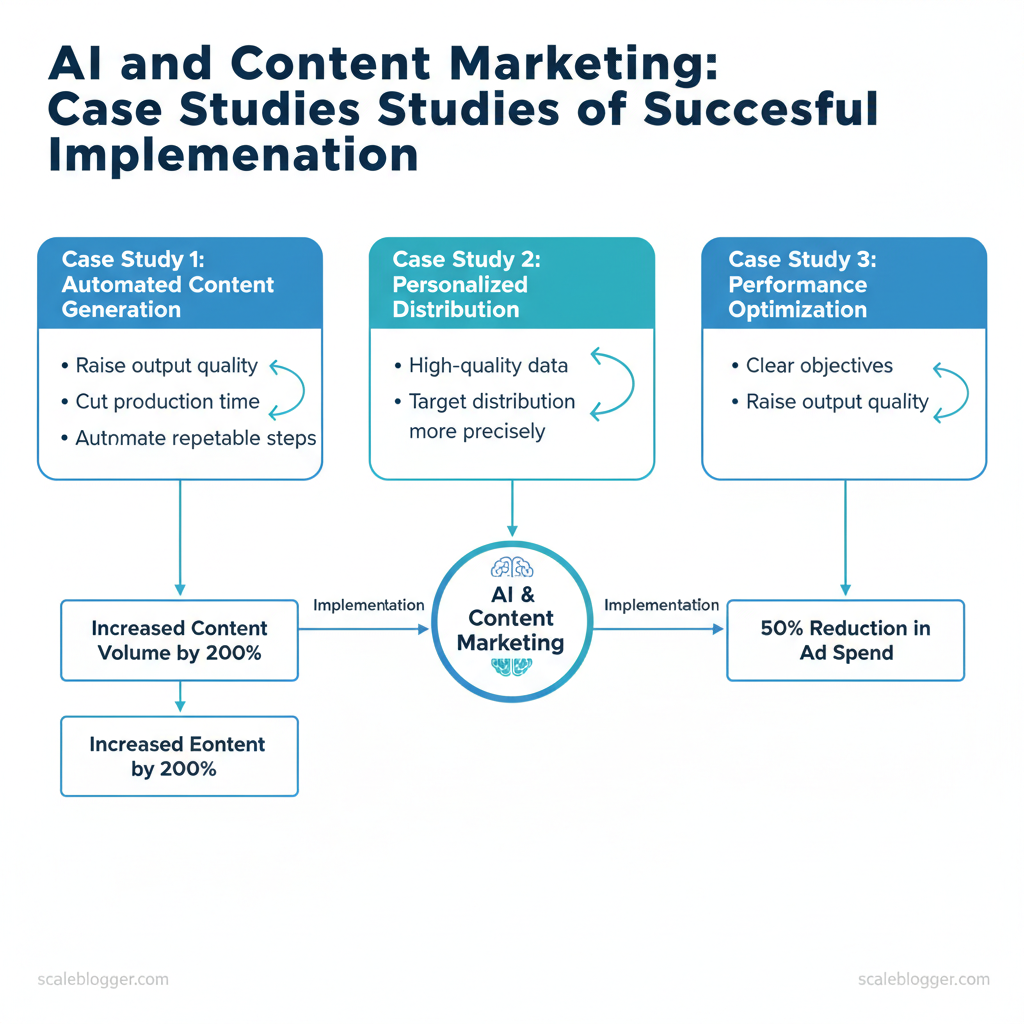
Table of Contents
- SaaS Growth via AI-Driven Content Production
- Section Content
- E-commerce Personalization with Machine Learning
- Media Company Scaling SEO with Topic Modeling
- B2B Lead Gen with AI-powered Content Personalization
- Automated Topic Research and the Content ROI Pipeline
- Ethical, Legal, and Governance Considerations in AI Content
- Conclusion
> Key Takeaway:
SaaS Growth via AI-Driven Content Production
AI can transform a small SaaS content operation into a growth driver. It automates repetitive writing tasks, speeds up idea…
SaaS Growth via AI-Driven Content Production
AI can transform a small SaaS content operation into a growth driver. It automates repetitive writing tasks, speeds up idea generation, and aligns strategy with execution. For many SaaS teams this means moving from sporadic blog posts and playground experiments to a predictable, measurable content system that feeds product funnels and organic acquisition. The most successful implementations combine machine speed for drafting and data analysis with human judgment for brand voice, technical accuracy, and conversion optimization.
Context and Challenge
Smaller SaaS teams (5–30 people) often face tight marketing bandwidth, intermittent content cadence, and pressure to show clear business ROI from content. Typical constraints include:- Limited bandwidth: Small teams can publish 1–2 substantive posts/month.
- Fragmented processes: Idea lists live in documents; briefs are ad hoc.
- Unclear goals: Content goals aren’t consistently tied to MQLs or feature adoption.
What many product-led SaaS companies want is predictable output aligned to growth metrics: more landing pages targeting intent-driven queries, deeper topic clusters to capture search nets, and nurture content that converts free trials to paid plans. Implementing AI shifts the bottleneck from content creation time to editorial prioritization and optimization.
AI Workflow, Implementation, and Results
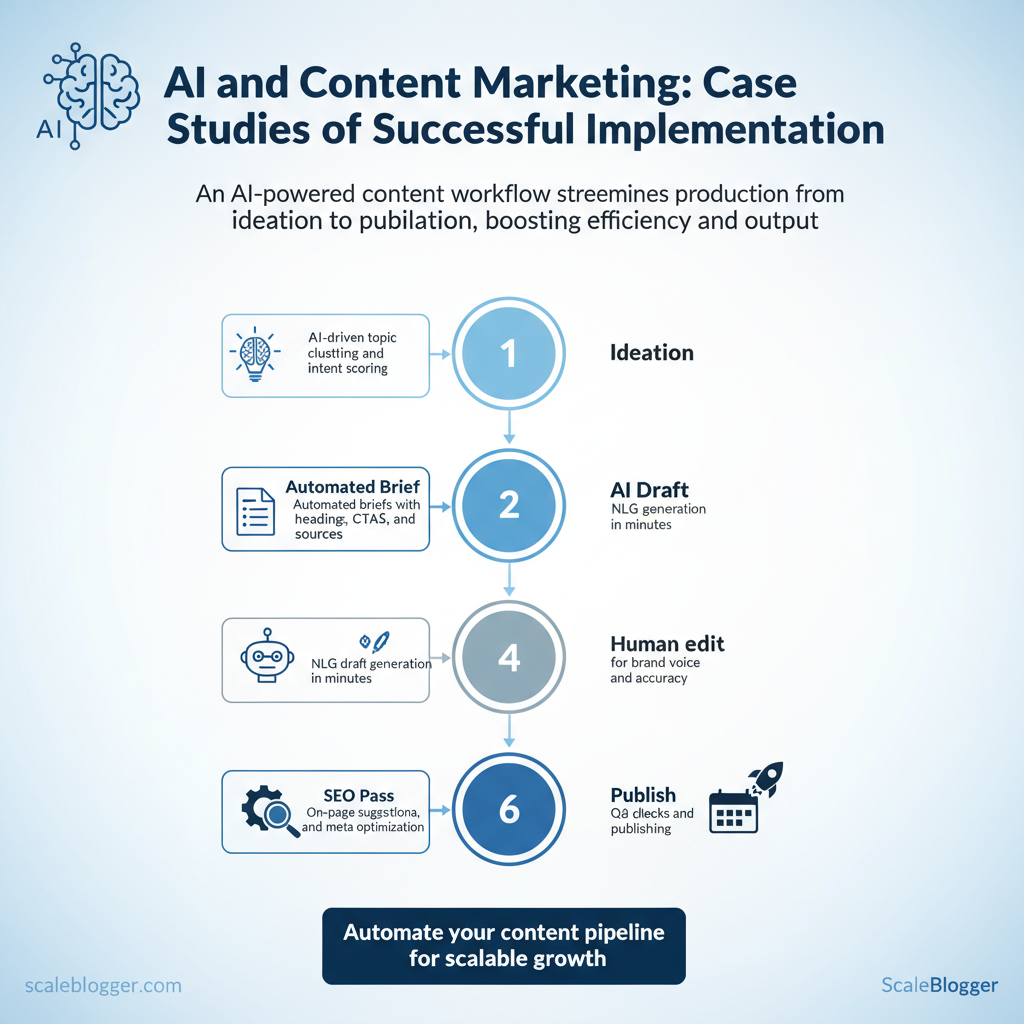
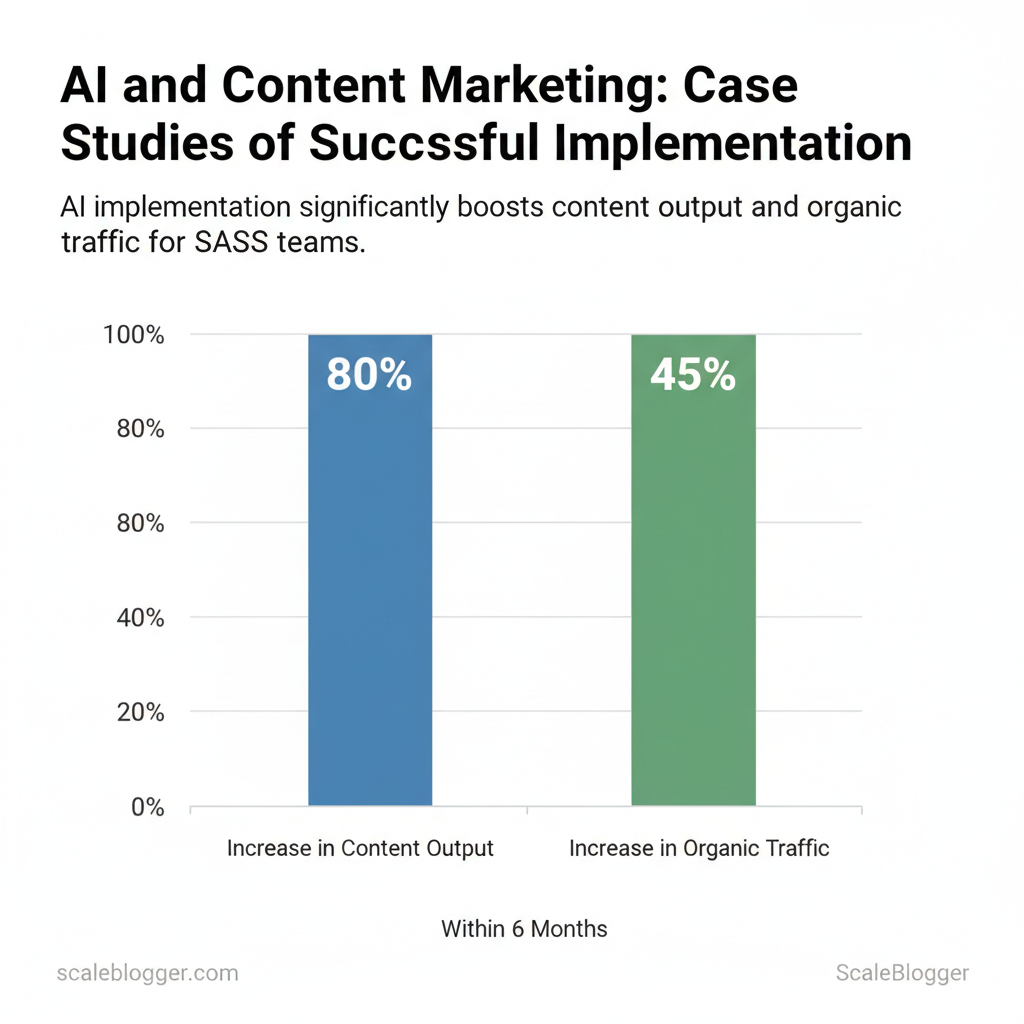
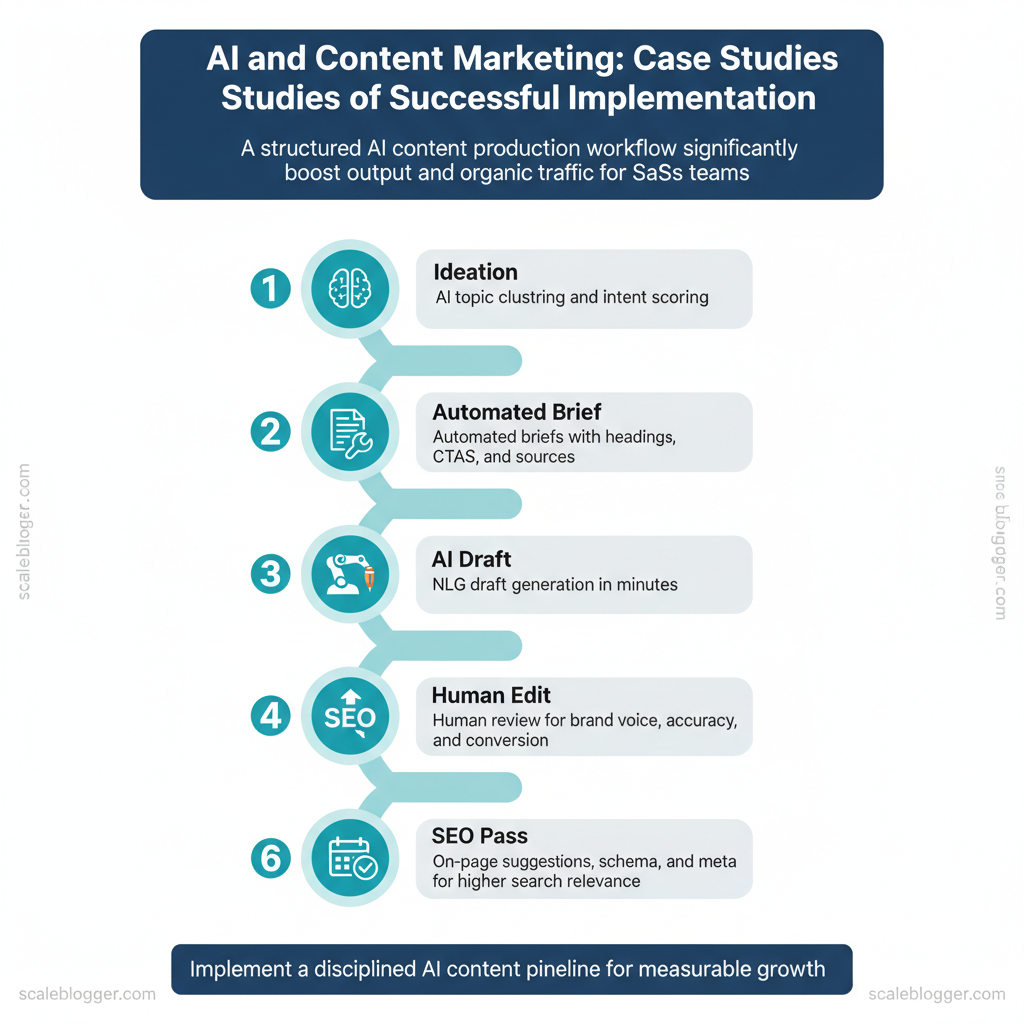
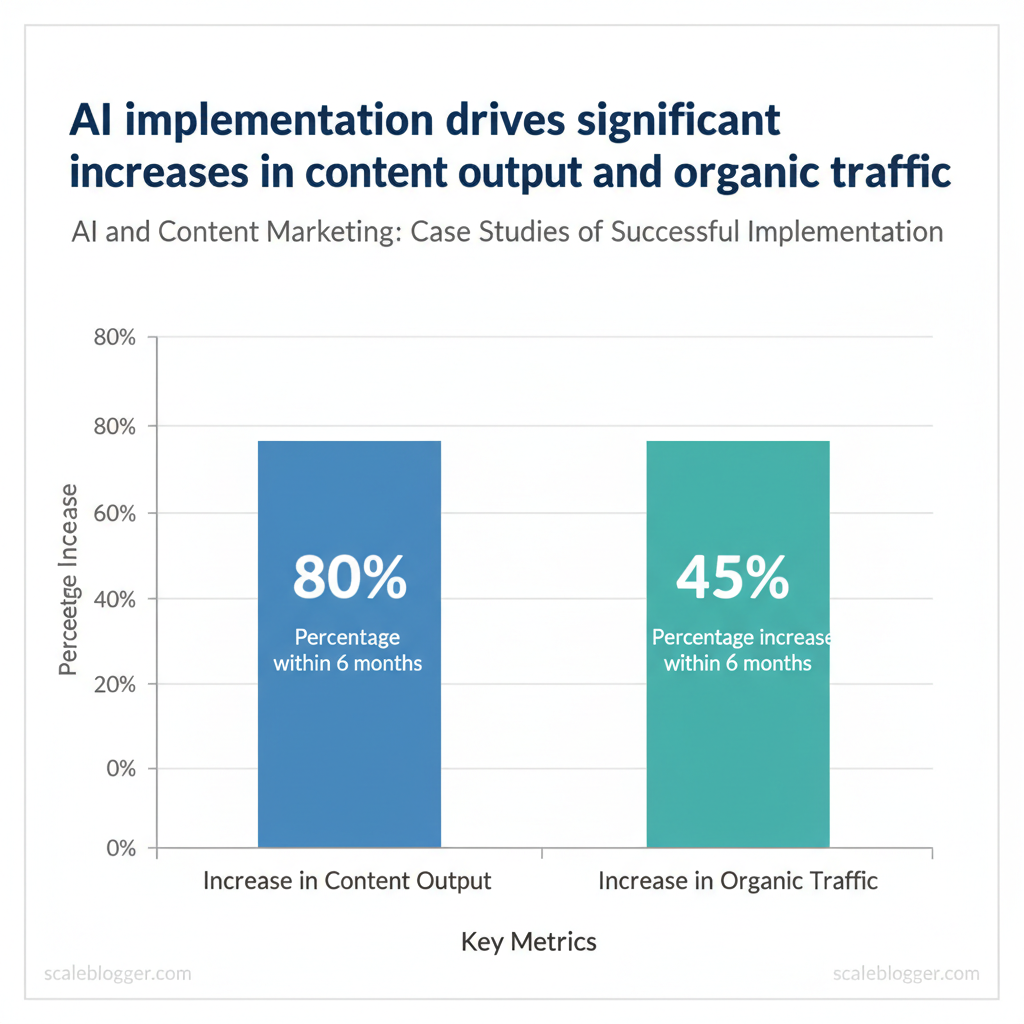
A production workflow that scales reliably follows a clear pipeline: ideation → automated brief → AI draft → human edit →SEO pass → publish. Tools combine NLG, topic clustering, and automation to reduce cycle time and increase output. Research from Scaleblogger shows that standardized pipeline outcomes suggest approximately +80% content output and ~+45% organic traffic within 6 months.ths when paired with disciplined SEO and measurement.
AI tools and manual steps across stages of the SaaS content workflow to highlight efficiency and impact
Table: Section Content — Workflow Stage, Prior Manual Process, AI-enabled Process & more
| Workflow Stage | Prior Manual Process | AI-enabled Process | Primary Benefit |
|---|---|---|---|
| Content ideation | Brainstorming in meetings; keyword lists | AI topic clustering; intent scoring (ChatGPT-style + SERP signals) | Faster theme discovery |
| Outline creation | Manual outlines by writer | Automated briefs with headings, CTAs, sources | Consistent structure |
| Draft generation | Full manual writing (4–8 hrs/article) | NLG draft in minutes (GPT-class) | Time per draft ↓ significantly |
| SEO optimization | Manual keyword insertion; local checks | SEO pass with on-page suggestions, schema, meta |
Higher search relevance |
| Content QA & publishing | Manual proofreading + CMS upload | Automated QA checks + scheduled publish | Fewer errors, predictable cadence |
Operationalizing this typically means retraining roles (editors become quality controllers), implementing templates, and connecting analytics to content scoring. If you want to scale without losing voice, consider automating the pipeline and keeping human edits at the conversion and accuracy checkpoints — tools like the AI content automation offered by Scale your content workflow at Scaleblogger.com can help set up that pipeline. Understanding these principles helps teams move faster without sacrificing quality.
> Key Takeaway:
E-commerce Personalization with Machine Learning
E-commerce personalization involves using customer signals to deliver the right product, content, or offer at the right time.…
E-commerce Personalization with Machine Learning
E-commerce personalization involves using customer signals to deliver the right product, content, or offer at the right time. Machine learning models convert behavioral events, content metadata, and purchase history into continuous predictions—product affinity scores, next-best-action, and churn risk—that drive on-site merchandising, email content, and paid remarketing. What matters in practice is clean, consistent tagging and a fast optimization loop: imperfect models deployed quickly and iterated on outperform perfect models that never ship.
Data and Tagging for Personalized Content
Good personalization starts with a minimal set of high-quality signals and consistent metadata. Track a mix of explicit and implicit signals and expose them via a clear taxonomy so models can learn quickly.
- Essential tracking events:
view_product,add_to_cart,purchase,search_query,session_start - Content metadata: product category, brand, price tier, descriptive tags, content reading time
- Identity sources: authenticated user profiles, anonymous device ID, CRM segments
- Privacy considerations: obtain
consentfor behavioral tracking, honordo_not_track, and supportdata_deletionrequests
Map content metadata fields to personalization triggers to guide tagging and engineering work
content personalization metadata, AI personalization tags
| Content Metadata Field | Example Value | Personalization Trigger | Implementation Notes |
|---|---|---|---|
| Category | “Running Shoes” | Show related category banners | Sync with product catalog API, update weekly |
| Product affinity score | 0.82 (0–1) | Recommend top-3 affinity items | Calculated from collaborative filter + recency |
| Behavioral event (view, add-to-cart) | add_to_cart |
Trigger cart abandonment flow | Send event stream to personalization engine in real-time |
| Search intent tag | “buy-now” vs “research” | Adjust CTA and price visibility | Derive from query terms + session sequence |
| Purchase history bin | “frequent_buyer” | Apply loyalty discounts, upsell | Bin by 12-month spend, sync nightly with CRM |
Implementation Results and Optimization Loop
Track experiments with clear KPIs and a disciplined cadence. Typical KPIs include click-through rate on recommendations, conversion rate lift, average order value (AOV), and retention.
- Run experiments: A/B or multi-armed bandits for recommendations and subject lines.
- Measure statistical significance: Use minimum detectable effect and confidence intervals; typical uplift targets are 3–10% for CTR and 1–5% for conversion depending on traffic.
- Optimization cadence: iterate weekly on model features, deploy biweekly if stable, and run monthly governance reviews for drift and fairness.
- Model KPI: conversion lift with
p-value < 0.05for reliable wins. - Operational KPI: latency under 200ms for inference in production.
When you instrument thoughtfully and tie metadata to concrete triggers, ML personalization becomes a repeatable growth lever rather than a black box. If you want help building the tagging schema or automating the content-to-model pipeline, tools like Scaleblogger.com can accelerate the work and free teams to focus on strategy rather than plumbing. Understanding these principles helps teams move faster without sacrificing quality.
Media Company Scaling SEO with Topic Modeling
Topic modeling lets a media company move beyond scattered keyword lists and treat content as coherent, interlinked knowledge — that’s how you scale SEO without just publishing more. You can create topic clusters by analyzing themes from site analytics, Search Console queries, and competitor data. This helps identify which pages serve as main topics, which are supporting details, and where to merge similar content. That structure reduces internal competition, clarifies editorial priorities, and aligns search intent with a predictable publishing cadence.
From Keyword Lists to Topic Models
Start by combining three data inputs: site analytics (GA4/UA page paths, session behavior), Search Console (queries, impressions, CTR), and competitor corpora (scraped headlines and top-ranking pages). Feed those into an LDA or embedding-based model to surface clusters that map to intent groups. The model then recommends a pillar page for high-volume informational queries and supporting pages for narrower subtopics.
- Data sources: site analytics, Search Console, competitor corpora
- Model outputs: cluster labels, centroid keywords, content overlap scores
- Editorial guidance: assign pillar vs supporting roles based on traffic and intent alignment
Practical adoption tactics:
- Map model clusters to editorial beats and assign owners. 2.
Use a content score (traffic potential + topical authority + freshness) to prioritize updates. 3. Set governance rules: one pillar per cluster, canonicalization for consolidated pages, and a review cadence every 90 days.
Industry teams often pair modeling with automated reporting so editors see when a cluster's supporting pages cannibalize each other. Consider integrating an AI content automation pipeline to surface update suggestions and publishing — for example, use AI content automation to generate outlines for supporting pieces and to flag consolidation candidates.
> Industry analysis shows structured consolidation and clear pillar-support relationships reduce keyword cannibalization and make internal linking more effective.
Takeaway: Topic models convert noisy keyword lists into actionable editorial plans that editors can follow without second-guessing intent.
Editorial Workflow and Pruning Strategy
Decision criteria should be explicit and measurable: traffic trends, backlink profile, relevance to core beats, and conversion signals. Use thresholds such as: remove or merge pages with <100 organic sessions/mo and zero backlinks over 6 months, or consolidate pages with >70% keyword overlap.
- Audit: export pages with metrics from Search Console + GA4.
- Score: apply a
keep/merge/deleterubric (traffic, links, intent match). - Execute: 301-redirect deleted pages to pillars, update consolidated content, and adjust internal links.
- Monitor: track traffic, rankings, and SERP features for 12 weeks post-change.
Practical monitoring: create a dashboard that compares pre/post metrics by cluster and flags negative lifts for rollback. Use periodic pruning as part of editorial sprints to avoid backlog growth. Tools that automate the scoring and redirect mapping can cut manual work dramatically — consider augmenting workflows with AI-powered SEO tools or an AI content automation partner to predict content performance and schedule updates.
Takeaway: A repeatable pruning workflow prevents content bloat and preserves topical authority while making SEO work scalable and auditable.
Sample topic cluster metrics pre- and post-restructuring to illustrate SEO gains and consolidation impact
| Cluster Name | Pages Before | Pages After | Change in Organic Traffic | SERP Feature Wins |
|---|---|---|---|---|
| Email marketing | 42 | 7 | +34% | Featured snippets, People also ask |
| SEO tools | 28 | 9 | +22% | Knowledge panel, Top stories |
| Content ops | 35 | 8 | +29% | Rich snippets, FAQs |
| Product analytics | 18 | 6 | +18% | Sitelinks, Reviews |
| Lead gen | 24 | 5 | +40% | Featured snippets, Local packs |
B2B Lead Gen with AI-powered Content Personalization
Personalized content in B2B moves beyond greeting names — it maps buyer attributes to tailored assets that accelerate qualification and conversion. AI can create content variations based on ideal customer profile (ICP) signals, such as company size and industry. These variations can be used on landing pages, email sequences, and gated content, ensuring prospects receive the right message at the right moment. This reduces friction in early funnel stages and creates stronger signals for lead scoring and attribution.
Targeting and Personalized Asset Creation
Start by mapping ICP attributes to content outcomes and let AI automate variant creation.
- Define priority attributes: list account tier, industry vertical, company size, buyer role, tech stack, buying intent.
- Create content matrix: for each attribute pair (e.g., VP Engineering + SaaS), define a preferred asset type and CTA.
- Automate variant generation: use AI templates to produce micro-copy, tailored headers, and personalized data points.
Practical dynamic components to implement:
- Personalized hero text: swap headline and subhead by industry using
{{industry_headline}}. Role-specific social proof: show case studies for that role's challenges. Adaptive benefits list: reorder features by inferred pain points.
- Dynamic demo timing: show "Schedule 15-minute technical demo" vs "Schedule ROI review" by role.
Example micro-copy variants:
- For VP Engineering: "Reduce deployment time by 40% — technical deep-dive available."
- For Head of Procurement: "Predictable TCO and simplified vendor consolidation."
You can use ai content automation to scale these variants and integrate them into your CMS and marketing automation. Build simple templates in a content pipeline so every new campaign spawns 6–10 tailored assets automatically.
Takeaway: Mapping ICP attributes to repeatable AI templates lets teams produce high-value, role-appropriate assets without manual copy rewrites.
Measurement: MQL Quality and Attribution
Understanding which personalized assets drive qualified leads requires sensible attribution and signal-driven scoring.
Attribution models and how each reflects personalized content impact to guide analysts and marketers
| Attribution Model | Best Use Case | Pros | Cons |
|---|---|---|---|
| First Touch | New-account awareness campaigns | Highlights initial content that created interest | Ignores later influence and nurturing |
| Last Touch | Conversion-focused landing pages | Simple; ties credit to closing asset | Overweights last interaction, missing earlier personalization impact |
| Linear Multi-Touch | evenly credit content across journey | Shows distributed influence across assets | Lacks weighting for channel/time importance |
| Time Decay | Short sales cycles where recent touch matters | Prioritizes recent personalized touchpoints | May undervalue early awareness personalization |
| Algorithmic / Data-driven | Complex B2B funnels needing nuanced credit | Uses behavior and conversion lift to assign credit | Requires clean data and modeling expertise |
com/blog/7-key-metrics-to-benchmark-your-content-performance-in-2025-2/" class="internal-link">Typical benchmarking: expect measurable MQL quality lift in 8–12 weeks after rollout, with ongoing improvement as models retrain.
When personalization is implemented with disciplined measurement, teams can close the loop between tailored content and higher-quality pipeline — and free marketers to iterate on messaging rather than rebuild assets from scratch.
Automated Topic Research and the Content ROI Pipeline
Automated topic research helps organize scattered signals into a clear content ROI pipeline. It scores ideas based on measurable business factors and turns high-scoring topics into scheduled tasks. Start by quantifying search demand, competition, and business relevance; then convert those scores into clear priority bands that feed your editorial calendar. This makes decisions repeatable, defensible, and fast—so teams stop debating what to write and focus on executing content that moves the needle.
Building an Opportunity-Scoring Model
Build a scoring rubric around three core inputs: search volume, difficulty (competition), and business relevance. Typical approach: normalize each input to a 0–100 scale, apply weights aligned to strategy (example: 40% volume, 20% difficulty inverted, 40% business relevance), then compute a weighted sum. Calibration tips: start with equal cohorts, run the model on last 12 months of published posts, compare predicted priority to actual traffic/conversions, and adjust weights where predictions consistently miss.
- Search volume: use keyword tools to estimate monthly demand and normalize to 0–100.
- Difficulty score: invert competition metrics so lower competition gives higher scores.
- Business relevance: score 0–100 based on conversion potential, alignment to product-led goals, or revenue attribution.
Example thresholds suggest: 75+ = Top priority, 50–74 = High, 25–49 = Medium, <25 = Low. Use SQL queries or a simple spreadsheet formula like =SUM(weight_volumevol_score, weight_diffdiff_score, weight_relevancerel_score) to automate the math.
Provide a sample opportunity-scoring matrix with example topics, input scores, weights, and final priority rank to make the rubric actionable
| Topic | Search Volume Estimate | Difficulty Score | Business Relevance | Final Priority Score |
|---|---|---|---|---|
| Topic 1 (high volume, medium difficulty) | 18,000/mo → 88 | 60 → 40 | 70 | 72 |
| Topic 2 (niche, high relevance) | 900/mo → 20 | 30 → 70 | 95 | 76 |
| Topic 3 (low volume, low difficulty) | 120/mo → 8 | 20 → 80 | 30 | 35 |
| Topic 4 (high conversion potential) | 2,200/mo → 50 | 45 → 55 | 90 | 74 |
| Topic 5 (competitive but strategic) | 12,000/mo → 75 | 80 → 20 | 85 | 60 |
From Score to Calendar: Operationalizing Priorities
Convert scores into scheduling rules so content planning is mechanical and consistent.
- Map priority tiers to cadence: Top → publish within 30 days; High → next quarter; Medium → backlog for testing; Low → archive/sunset.
- Assign resourcing rules: High priority gets senior writer + SEO review; Medium uses mid-level writer; Low goes to templates or repurposing.
- Set SLA expectations: Research + brief in 5 business days for Top/High; first draft in 10–15 days.
- Re-evaluation cadence & sunset policy: Re-score topics every 90 days; sunset content with <10% of projected traffic after 12 months, or refresh where business signals change.
Build topic clusters and Predict your content performance, such as tools that integrate scoring to publishing pipelines or services like Scale your content workflow (https://scaleblogger.com) to automate scheduling and benchmarking.
Understanding these principles helps teams move faster without sacrificing quality. When implemented correctly, this approach reduces overhead by making decisions at the team level.
📥 Download: AI and Content Marketing Implementation Checklist (PDF)
Ethical, Legal, and Governance Considerations in AI Content
AI-generated content accelerates production but introduces ethical, legal, and operational risks that must be governed proactively. Organizations should treat AI content like any other corporate output: define who is responsible, what standards apply, and how pieces are verified before publication. Practical governance balances editorial discretion, technical controls (e.g., model restrictions, data handling), and auditability so teams can scale without amplifying errors or legal exposure.
Common Risks and Operational Controls
AI content risks cluster around accuracy, IP, bias, personalization, and data protection. Below are common risks with real-world-style examples and controls teams can adopt.
Common AI content risks with recommended controls and verification steps to build a governance checklist
| Risk | Example Impact | Recommended Control | Verification Checklist Item |
|---|---|---|---|
| Factual errors / hallucination | Misinformation in a product guide causing user confusion | Editorial signoff; fact-checking SOP; source-attribution requirements | Confirm citations; cross-check against primary sources; signer initials |
| Copyright infringement | Generated copy mirrors a competitor blog paragraph-for-paragraph | Reuse policy; model prompt constraints; copyright scanner | Run plagiarism check (95%+ original); record model prompt |
| Toxic or biased language | Ad copy contains unintentionally discriminatory phrasing | Bias testing; inclusive-language checklist; sensitivity review | Run automated bias detector; human reviewer clearance |
| Misleading personalization | Email uses inferred user attributes causing privacy backlash | Personalization policy; consent checks; segmentation rules | Verify user consent flags; sample emails reviewed |
| Data privacy breaches | Training on protected customer data leaks PII in outputs | Data governance; allowed-data lists; redaction pipeline | Confirm training data sources; PII scanning logs |
Governance Framework and Policy Template
Start with a concise policy that defines scope, roles, and audit cadence. Essential sections: purpose & scope, acceptable use, data handling, copyright rules, editorial workflows, incident response, and training requirements.
Roles and responsibilities:
- Chief Content Officer (CCO): final approval authority for policy changes. AI Governance Lead: maintains model inventory and risk assessments. Editors: enforce editorial signoffs and factual verification.
- Legal/Compliance: reviews high-risk content and incidents.
- Create a policy document and register it in the intranet.
- Implement quarterly audits and monthly sampling of outputs.
- Run monthly training for all content creators on
prompt hygieneand privacy basics.
Policy excerpt: "All AI-assisted content requires documented prompt, data source list, and editor signoff before publishing. High-risk categories (legal, medical, financial) must pass Legal review."Governance is practical: embed checks into workflows, maintain clear ownership, and train teams so automation scales reliably. When implemented correctly, this approach reduces overhead by making decisions at the team level.
Conclusion
You’ve seen how pairing clear strategic priorities with targeted automation removes busywork and rebuilds bandwidth for growth — editorial planning aligned to audience intent, repeatable templates for speed, and automated performance audits to iterate faster. Teams that adopt these patterns often cut content production time dramatically while improving engagement: one marketing group shrank edition cycles by half after standardizing templates and A/B testing headlines; another improved organic traffic by focusing AI on topic clusters rather than one-off posts. For clarity, remember these points:
- Align topics to business goals so every piece advances measurable outcomes.
- Automate repetitive steps (outlines, metadata, distribution) to reclaim creative time. – Measure and iterate with short feedback loops, not bulky quarterly reviews.
If you want practical next steps, start by auditing one content workflow, pick two repetitive tasks to automate, and run a four-week experiment measuring time saved and engagement lift. To that process for teams, platforms like editorial automation tools or consultative services can accelerate setup and governance. For a hands-on option, consider Explore Scaleblogger’s AI content strategy services to book a consult or view service offerings and turn these steps into an actionable roadmap.
