

> Key Takeaway: Marketing teams waste weeks reinventing optimization steps.
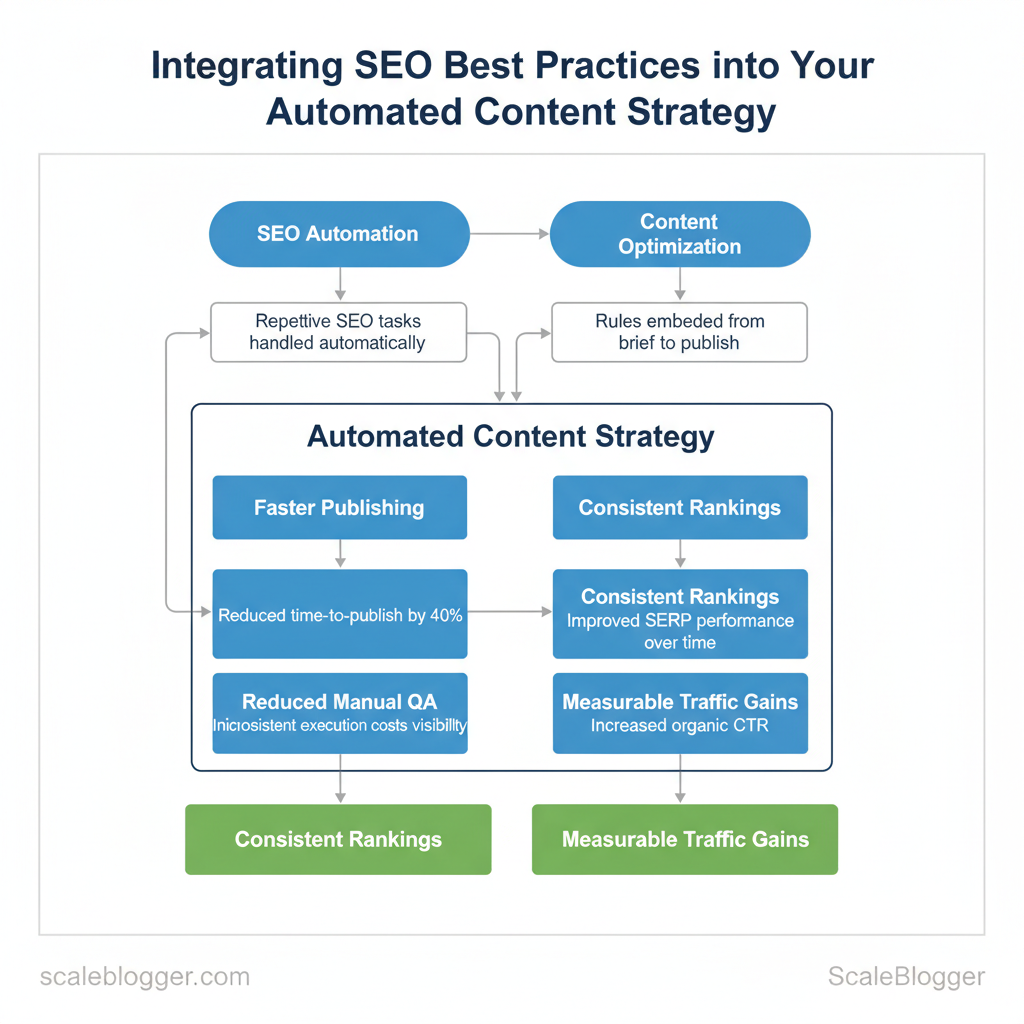
Marketing teams waste weeks reinventing optimization steps. Automation could manage repetitive SEO tasks instead. Integrating SEO best practices into an automated content strategy leads to consistent rankings. It also allows for faster publishing and measurable traffic gains by embedding optimization rules throughout your workflow.
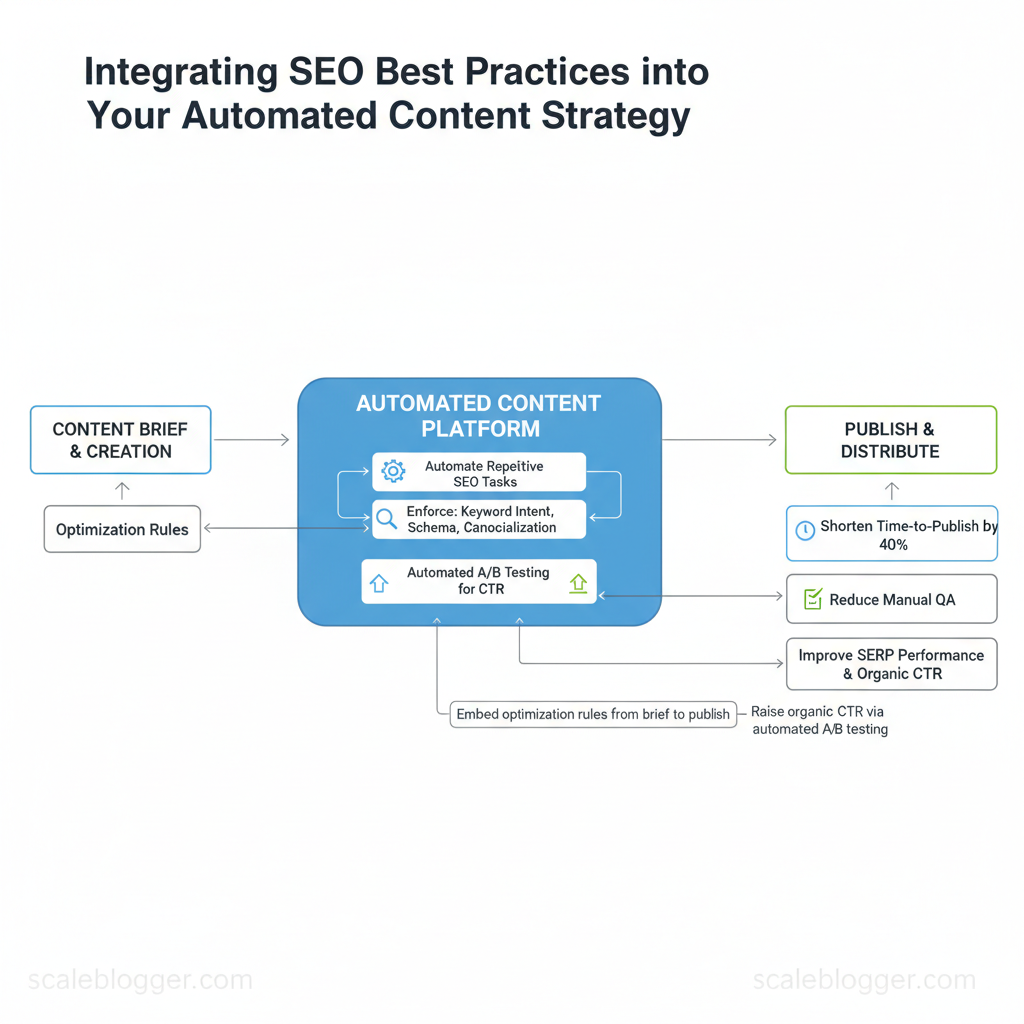
Implementing SEO automation and content optimization rules at the pipeline level guarantees every headline, meta tag, and internal link meets agreed SEO standards without manual checks.
This is important because inconsistent execution reduces visibility and slows down scaling. A content program that uses automated checks for keyword intent, schema, and canonicalization reduces manual quality assurance. This also improves search engine results page (SERP) performance over time. According to Scaleblogger, a team can shorten time-to-publish by 40% while raising organic CTR through automated title A/Bs and schema injection.
Industry practitioners recommend combining rule-based automation with periodic human review to catch nuance. Scaleblogger’s automation capabilities can slot into existing CMS workflows to operationalize these rules and track optimization impact across campaigns. You’ll learn how to map SEO rules to automation triggers, maintain editorial quality, and measure downstream impact.
- How to translate SEO best practices into
automationrules - Where to place checks in the content lifecycle for consistent
content optimization - Practical governance for balancing automated enforcement and editorial judgment
- Measurement approaches that link automation to organic performance
Next, we’ll map the checklist and workflows you can implement immediately. Explore Scaleblogger’s automation platform: https://scaleblogger.com
Table of Contents
- Build an SEO-first Content Automation Strategy
- Section Content
- Keyword & Intent at Scale: Automated Research Best Practices
- Creating SEO-Optimized Content Through Automation
- Quality Control: Testing, Audits, and Human-In-The-Loop
- Scaling Internal Linking, Content Hubs, and Authority Signals
- Measure, Iterate, and the Automated SEO Funnel
- Conclusion
> Key Takeaway:
Build an SEO-first Content Automation Strategy
Begin by translating business objectives into measurable SEO outcomes. Pick clear goals and choose KPIs that show real user and…
Build an SEO-first Content Automation Strategy
Begin by translating business objectives into measurable SEO outcomes. Pick clear goals and choose KPIs that show real user and revenue impact. Then, automate the repetitive work while keeping humans involved for important decisions. Focus on 3–5 topical clusters that align with buyer intent and where search volume plus conversion potential overlap; automate outlines, metadata, and canonical/internal linking patterns for those clusters, and set a reporting cadence that ties content performance back to conversions in your CRM.
Define goals, KPIs, and topical clusters
- Map goals to SEO metrics: For each business goal, choose 1–2 primary SEO KPIs (organic sessions, assisted conversions, ranking velocity) and a conversion KPI from GA4/CRM.
- Prioritize clusters: Select 3–5 clusters where you can win (commercial intent + attainable difficulty). Examples: Product how-tos, comparison pages, and industry trend explainers.
- Set baselines and cadence: Use a 30/90/180 day cadence: weekly for content output, 30-day for engagement, 90-day for ranking shifts, 180-day for conversion lift.
Design templates and workflows for SEO-compliant content
- Template fields to include:
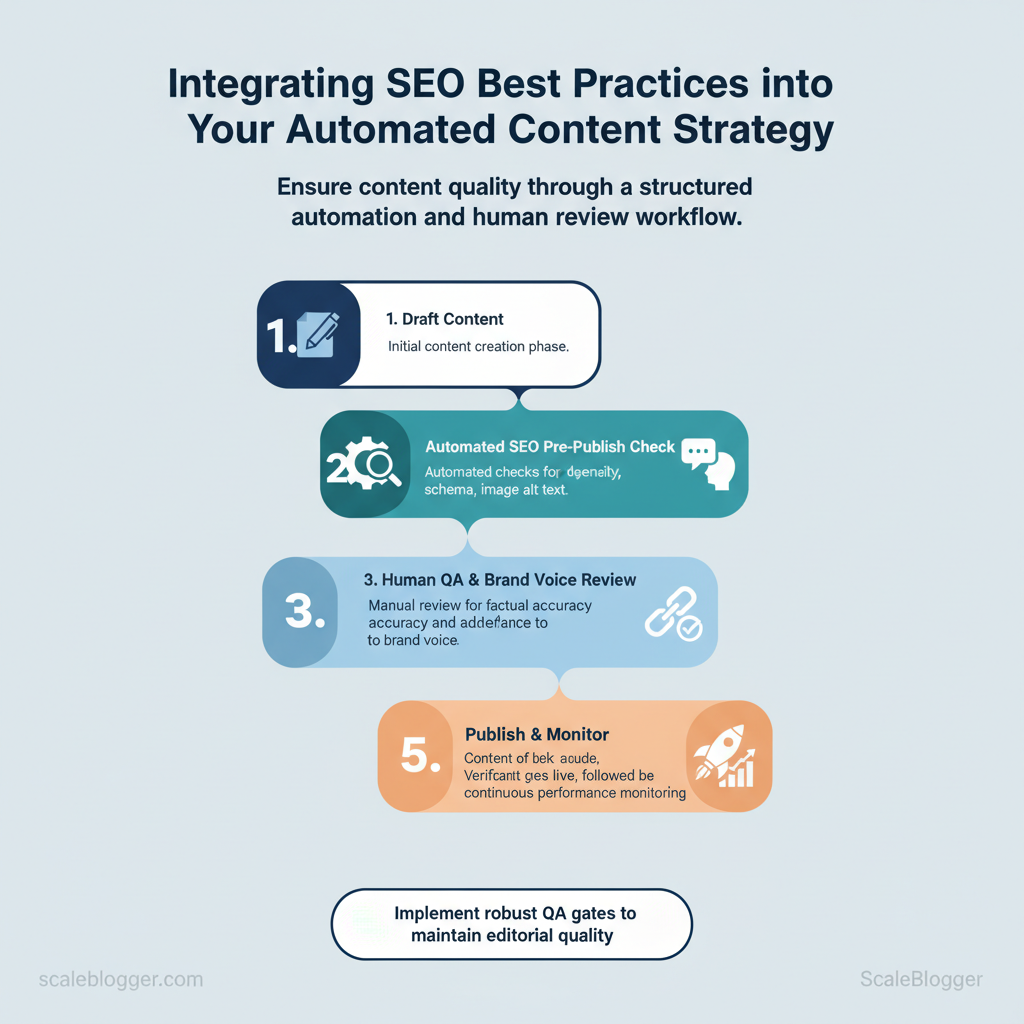
Title (primary & secondary keywords),Meta description (120–155 chars),H1/H2 map,Target keywords (primary + 5 semantically related),Schema type,Suggested internal links,Canonical URL. - Checkpoint placements: Draft → SEO pre-publish check (automated): keyword density, schema, image alt text → Human QA: factual accuracy & brand voice → Pre-publish link audit → Publish and monitor.
- QA gates: Require a human approval for the first 10 automated posts in a cluster, then sample-review 20% thereafter.
Tool integration points
- CMS: Automate metadata injection and scheduled publishing.
- SEO tool: Automate keyword tracking, SERP feature detection, and content gaps.
- Automation platform: Orchestrate tasks (draft creation → SEO check → CMS publish).
- Analytics/CRM: Auto-tag content by cluster and feed conversions back to the content performance dashboard.
Help readers map business goals to specific SEO KPIs and measurement cadence
| Business Goal | SEO KPI | Measurement Frequency | Automation Action |
|---|---|---|---|
| Increase leads | Organic assisted conversions | Weekly (dashboard) | Auto-add CTAs + CRM UTM tagging |
| Grow brand awareness | Organic sessions & impressions | Weekly | Schedule high-volume topic cluster publishing |
| Drive product signups | Organic-to-trial conversion rate | 30 days | Auto-target high-intent keywords + landing templates |
| Reduce content production cost | Cost-per-published-asset | Monthly | Auto-generate outlines & metadata |
| Improve target keyword rankings | Top-10 keyword count | 90 days | Automated rank tracking + refresh alerts |
If you want a ready-built pipeline for these templates and workflows, consider leveraging an AI content automation partner like AI content automation to accelerate setup and link content performance directly to CRM outcomes. Understanding these principles helps teams move faster without sacrificing quality.
> Key Takeaway:
Keyword & Intent at Scale: Automated Research Best Practices
Automated keyword discovery and intent clustering help scale research. They do this by combining multiple…
Keyword & Intent at Scale: Automated Research Best Practices
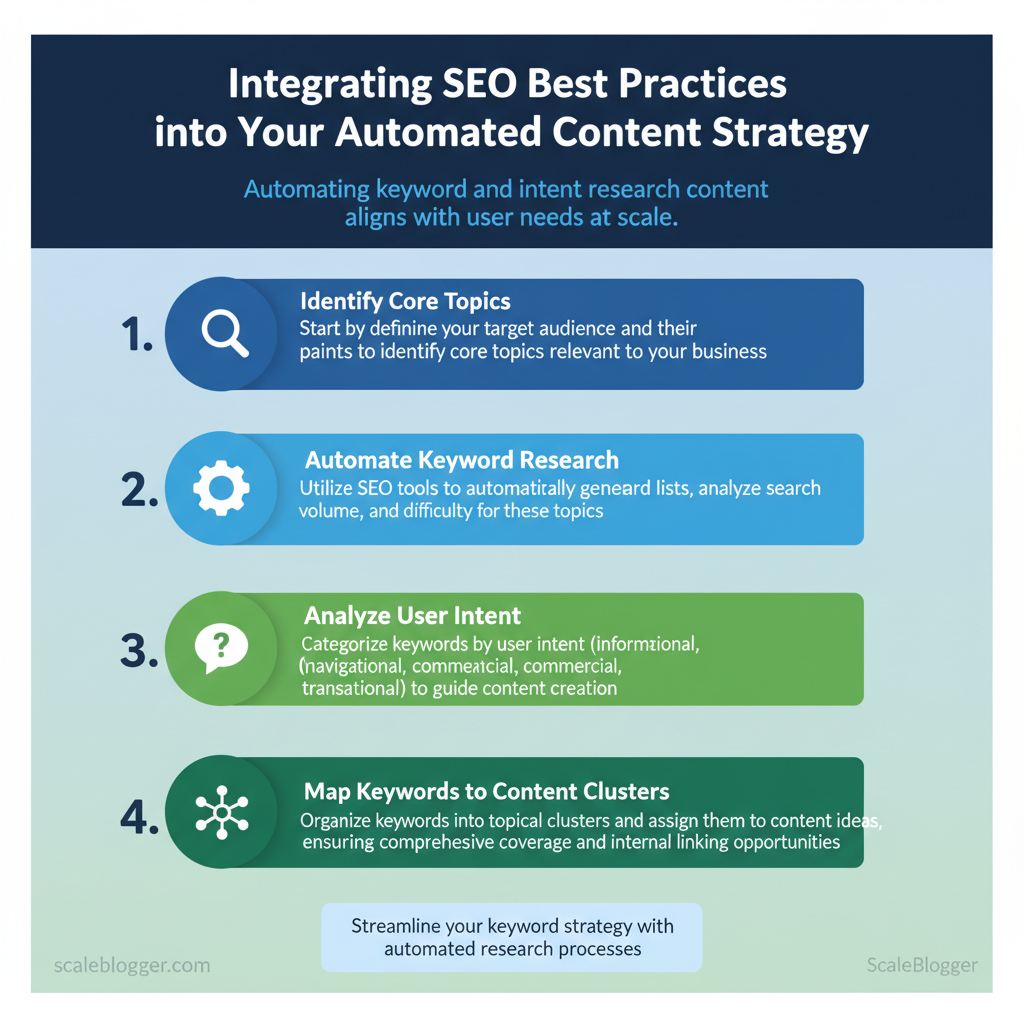
Automated keyword discovery and intent clustering help scale research. They do this by combining multiple signals, applying clear rules, and using numeric prioritization. This way, the system knows what to write automatically and what needs a human brief. Start by pulling keywords from diverse sources to avoid tool bias, normalize metrics to comparable scales, then run rule-based classification (intent by modifiers, SERP features, and click-through proxies).
From there apply a weighted scoring model that flags topics for automated drafts, manual briefs, or archive.
This keeps velocity high while preserving editorial control.
How to build the pipeline
- Multi-source extraction: ingest
Search Console, third-party keyword tools, autocomplete/PAA, competitor SERPs, and internal search logs. Normalization: convert impressions, volume, and CTR into comparable percentiles. , queries withbuy,price→ transactional).
- Clustering: group by semantic similarity using embeddings or shared SERP features. Prioritization: compute a composite score and apply thresholds for automation.
Example cluster (illustrative)
- Cluster label: Best running shoes for plantar fasciitis
- Keywords: “best running shoes for plantar fasciitis”, “sneakers for heel pain”, “supportive shoes for plantar fasciitis”
- Intent: commercial investigation
- Recommended action: automated draft with product comparison table + manual QA for affiliate disclosures
Prioritization rules and numeric scoring
- Scoring components (weights suggested):
- Search Opportunity (volume percentile): 30%
Conversion Intent (intent score): 25%
- SERP Difficulty (backlink/DR proxy): 20%
- Internal Relevance (historic CTR/engagement): 15%
**Recency/Urgency (news/seasonality): 10%
- 1*Recency
- Thresholds for action:
- ≥75: auto-generate full draft and A/B headline variants;
- 50–74: create automated brief for writer with templates;
- <50: store for re-evaluation or long-tail content pool.
Handling low-volume, high-intent keywords
- Flag as strategic: give higher weight to IntentScore;
- Bundle into topic hubs: combine multiple low-volume queries into one comprehensive page;
- Automate outlines: generate structured briefs so writers can produce high-quality pages quickly.
For pipelines that need implementation support or to scale content generation safely, consider platforms that specialize in AI content automation like the services at Scaleblogger.com. Understanding these principles helps teams move faster without sacrificing quality. This is why modern content strategies prioritize automation—it frees creators to focus on higher-value work.
Creating SEO-Optimized Content Through Automation
Automation can reliably produce SEO-optimized content when you combine machine-generated briefs, rule-driven on-page edits, and human validation. Begin by auto-generating a structured brief. This brief should capture intent, target keyword clusters, gaps from competitors, and a prioritized outline. Then apply automated on-page optimization—title tags, meta descriptions, header structure, internal link suggestions, and JSON-LD insertion—using templates and context-aware rules.
The result: faster content production with consistent SEO hygiene, while humans focus on voice, nuance, and topical authority.
Crafting machine-generated briefs and outlines
A high-quality automated brief should include fields that guide both writing and optimization.- Target keyword & intent: primary keyword, search intent label (informational/commercial).
- Traffic & opportunity estimate: relative volume and CTR opportunity (qualitative).
- Competitor gap bullets: phrases and subtopics competitors miss.
- Priority outline: ordered H1/H2s + recommended word ranges.
- SEO actions: target URL slug, canonical, primary schema type.
- Run a competitor scrape to find headings and common subtopics.
- Use NLP topic extraction to surface gaps (questions competitors ignore).
- Auto-rank gaps by estimated opportunity and add to the brief.
Sample auto-generated brief for keyword “remote team onboarding”:
Keyword: remote team onboarding Intent: informational Top gaps: onboarding checklist for async teams; measuring onboarding success; first-week microtasks Priority outline: H1: Remote team onboarding: a practical checklist H2: Day 1 setup (500 words) H2: First-week goals (400 words) SEO actions: slug=/remote-team-onboarding, schema=HowTo, suggested CTAs: download checklistAutomated on-page optimization and schema insertion
Which elements you can safely automate, how to validate JSON-LD, and checkpoints to prevent errors.Which on-page elements to automate vs. review
Which on-page SEO elements should be automated vs manually handled
| Element | Recommended Automation Level | Human Review Needed? | Notes |
|---|---|---|---|
| Title tags | Template + dynamic keywords | ✓ | Auto-generate, but human tune for brand tone |
| Meta descriptions | Auto-write with intent-aware templates | ✓ | Keep 120–155 chars; human edit for persuasion |
| H1/H2 structure | Auto-outline from brief | ✓ | Ensure topical flow and readability |
| JSON-LD schema | Auto-insert per content type | ✓ | Use templates (Article, HowTo, FAQ) and validate |
| Internal links | Auto-suggest relevant anchors | ✓ | Prefer high-authority pages; avoid link spam |
Example JSON-LD snippets to insert by content type:
json { "@context": "https://schema.org", "@type": "Article", "headline": "Remote team onboarding: a practical checklist", "author": {"@type":"Person","name":"Author Name"}, "datePublished": "2025-01-15" }json
{ "@context":"https://schema.org", "@type":"HowTo", "name":"Remote onboarding checklist", "step":[{"@type":"HowToStep","name":"Day 1 setup","url":"#day-1"}] }Validation checkpoints to prevent schema errors:
- Run JSON-LD through a linter and check for missing required fields.
- Confirm URL consistency between canonical tag and schema
mainEntityOfPage. - Test content snippets in staging for rendering and indexability.
Scaleblogger’s AI content automation approach can plug into this workflow to generate briefs, manage templates, and monitor performance—helpful when scaling topic clusters or automating publishing. When teams combine template-driven automation with focused human review, production speeds up and content quality stays high. This is why modern content strategies prioritize automation—it frees creators to focus on what matters.
Quality Control: Testing, Audits, and Human-In-The-Loop
Begin with automated checks and continuous monitoring, so teams can quickly catch obvious failures. Then, add targeted human reviews for nuance, tone, and strategic alignment. Automated checks remove low-hanging issues — broken schema, missing meta tags, glaring duplication, or a sudden CTR drop — while human-in-the-loop editors validate voice, factual accuracy, and commercial suitability. Together they keep velocity high without sacrificing trust or search performance.
Automated testing and monitoring
- Pre-publish checks catch structural and SEO issues before pages go live.
- Post-publish monitoring watches engagement and search signals to detect regressions.
- Alert routing sends different severity notifications to the right people so fixes happen fast.
- Who owns alerts: engineering handles breakages (site errors, schema), SEO/product owners handle CTR and traffic anomalies, and editors get content-quality alerts.
- How to route: critical site errors → PagerDuty/SRE; SEO drops → Slack #seo-alerts + email; editorial flags → editorial queue in CMS or task in project tracker.
Human-in-the-loop and editorial audits
- Who should be on the review team: one senior editor (content quality), one subject-matter expert (technical accuracy), one SEO specialist (search intent), and one product/marketing stakeholder (business alignment).
- When they intervene: on failing automated checks, after significant updates, or when content underperforms beyond thresholds.
- Audit cadence: lightweight audits weekly for new content; full editorial audits quarterly for top pages and topic clusters.
Audit checklist (examples)
- Accuracy: claims checked and sources cited. Voice & readability: meets brand tone and
Flesch/readability targets. SEO basics: meta tags, headings, internal links, canonical.
- Experience: images, schema, load time within targets. Performance: baseline CTR, impressions, and dwell time compared to expectations.
Escalation rules for underperforming automated content
- If CTR drops >30% within 14 days → SEO specialist triages. 2.
If organic traffic drops >25% month-over-month → content rollback or rewrite plan. 3. If factual errors reported → immediate take-down or correction within 24 hours.
Automated checks, the tool/algorithm recommended, and alert thresholds for each check
| Check | Tool/Method | Threshold/Rule | Action on Fail |
|---|---|---|---|
| Readability score | Readable.com / Flesch metric |
Flesch < 50 (hard) or grade level >12 | Send editorial task; require rewrite before publish |
| Duplicate content | Copyscape / Sitewide similarity scan | ≥ 30% overlap with existing pages | Block publish; route to content owner for consolidation |
| Missing meta tags | Screaming Frog crawl | Missing title or meta description | Auto-create draft tags; notify SEO queue |
| Schema validation errors | Google Rich Results Test | Any schema error or warning | Fail deployment; notify dev + content owner |
| CTR drop after publish | Google Search Console + internal analytics | CTR drop ≥30% vs. expected within 14 days | Alert SEO + editor; A/B test alternate titles |
If you want, I can convert the audit checklist into a downloadable checklist or build a sample Slack alert template that integrates with your monitoring system (useful when you Scale your content workflow with AI-powered automation like Scaleblogger.com). Understanding these principles helps teams move faster without sacrificing quality.
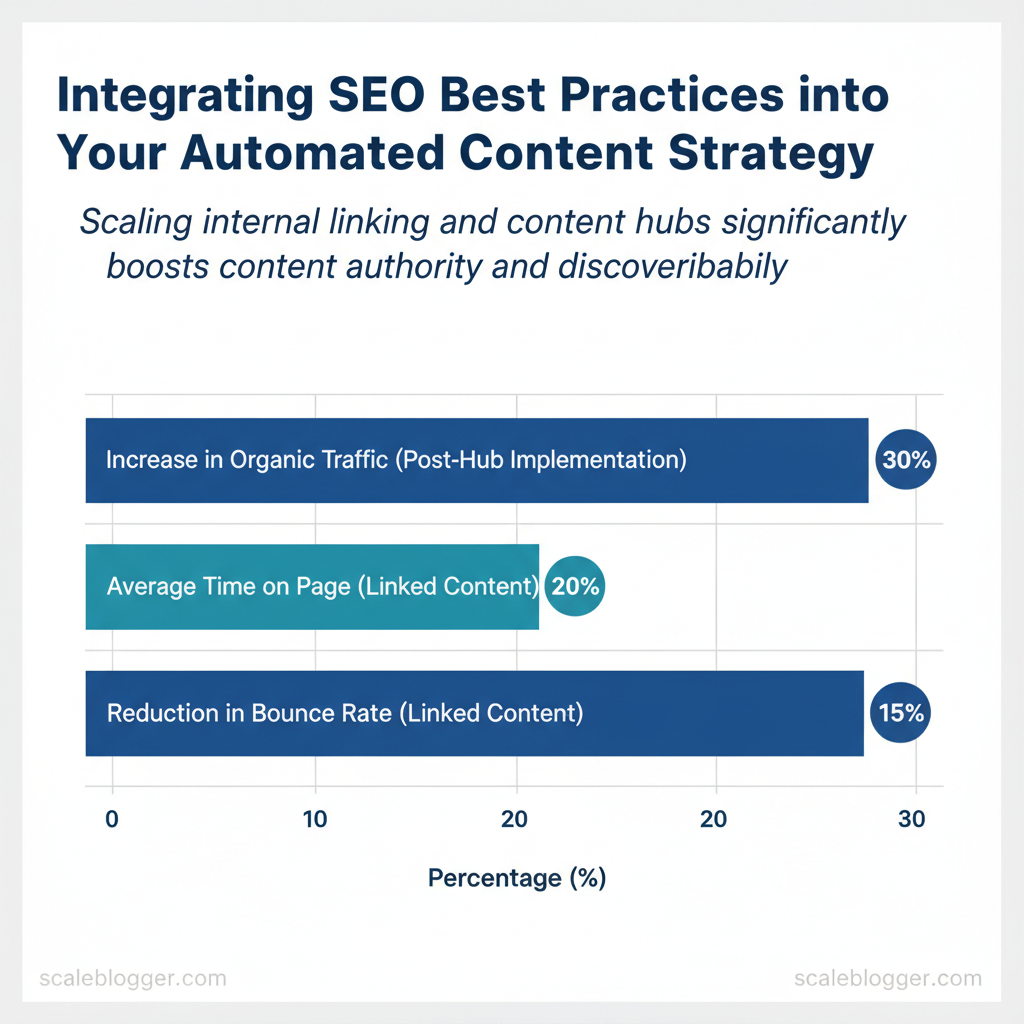
Scaling Internal Linking, Content Hubs, and Authority Signals
Start by designing predictable, rule-driven linking so systems and writers produce the same linking patterns at scale. A hub-and-spoke layout anchored by hub pages (topic overviews) and tightly focused spokes (supporting posts) lets you automate link placement, prioritize crawl paths, and concentrate topical authority where it matters. Automate the rules that decide which spokes link back to hubs, which hubs cross-link, and which secondary pages receive contextual in-body links — then monitor crawl behavior and ranking signals to iterate.
Rule-based internal linking and hub construction
- Define hub pages: Hubs target primary keywords and link to 8–15 spokes that answer subquestions.
- Automated linking rules: Use templates that add a hub link from any new spoke when relevance score ≥
0.6. - Contextual priority: Prefer in-body links in first 150–300 words for higher anchor-weighting.
- Crawl-awareness: Mark hub pages with higher
sitemappriority and ensure internal link depth ≤3 clicks. - Content templates: Force at least one contextual hub link and one “further reading” block on each spoke.
- Create a canonical hub page per topic cluster.
- Configure CMS to insert hub links when editorial metadata matches cluster tags.
- Run weekly crawls to verify link depth, orphan pages, and broken connections.
Example linking template (CMS rule):
liquid {% if page.cluster_score > 0.6 %}<a href="{{ hub.url }}">Learn more about {{ hub.topic }}</a>{% endif %}Automating authority building and external signals
Automated outreach and link-attracting assets scale authority without causing spammy patterns, if you keep quality controls. Build repeatable outreach sequences that surface only to prospects passing relevance filters, and automate follow-ups while routing high-value prospects to humans.- Automated outreach patterns: Targeted sequences — 3 personalized touches over 3 weeks; Relevance filter — domain topicality ≥ threshold; Human escalation — flagged replies route to AE.
- Assets that attract links: Original data reports, interactive tools or calculators, long-form research guides, templates and checklists, visualizations and downloadable assets.
- Risk controls: Domain-quality filters (DR/traffic thresholds), link velocity caps, manual QA on top-tier placements, and diversify anchor text to avoid over-optimization.
Practical example: publish a monthly industry benchmark (dataset + visual dashboard) and seed it through filtered outreach; the data asset earns links from press and niche blogs while the dashboard captures embed links.
Internal linking strategies and their automation suitability
| Strategy | Automation Difficulty | SEO Benefit | Risks |
|---|---|---|---|
| Contextual in-body links | Medium — needs NLP matching | High — strong relevance signal | Over-linking, anchor stuffing |
| Footer/category links | Low — template-driven | Low–Medium — sitewide relevance | Diluted value, possible UX issues |
| Hub introduction pages | Medium — editorial curation | High — concentrates authority | Poor hubs dilute many spokes |
| Automated ‘related posts’ widgets | Low — algorithmic recommendations | Medium — improves engagement | Irrelevant suggestions, crawl traps |
| Sitemap priority tagging | Low — CMS metadata | Medium — guides crawlers | Mis-prioritization, sitemap bloat |
Understanding these principles helps teams scale linking and authority without losing editorial quality. When implemented with safeguards, automation frees creators to focus on higher-value assets that attract external signals.
📥 Download: SEO Automation Strategy Checklist (PDF)
Measure, Iterate, and the Automated SEO Funnel
Start measuring immediately and design experiments so changes can be traced back to specific automation rules. Run controlled content experiments, gather ranking and engagement signals over a realistic window, then update the automation rules based on clear decision criteria. That keeps the funnel moving from hypothesis to validated change without letting noisy short-term fluctuations dictate permanent updates.
Running experiments and A/B testing content variants
- Scope experiments narrowly: test a single variable (title, intro paragraph, schema) to isolate effects. Sample sizes matter: target at least several thousand pageviews or 1–3 months of steady traffic for medium-tail pages; low-traffic pages require pooled tests by topic cluster. Test durations: plan for 6–12 weeks monitoring after launch; allow extra time for pages with long crawl intervals.
- Use multiple signals: combine Google Search Console impressions/CTR, ranking position, and engagement metrics (dwell time, bounce rate from analytics). 05) or consistent directional change across signals before changing automation rules.
> Search performance often needs 6–12 weeks to stabilize after content changes.
- Prepare: collect baseline metrics, create variant, set tracking (Utm tags, experiment IDs).
- Launch: deploy variant to defined sample (canonical A/B, URL split, or dynamic rendering).
- Monitor: daily health checks first week, weekly trend checks thereafter.
- Analyze: compare pre/post windows, look for consistent uplift across CTR, position, and engagement.
- Decide: roll out, iterate, or rollback based on decision criteria.
Table: Section Content — Phase, Duration, Activities & more
| Phase | Duration | Activities | Decision Criteria |
|---|---|---|---|
| Preparation | 1–2 weeks | Baseline metrics, hypothesis, tracking setup (GSC, GA4, A/B tool) | Clear KPI target (CTR +10% or position +3) |
| Launch | 1 day | Deploy variant, tag traffic, enable experiment flags | No site errors, crawlability verified |
| Monitoring | 6–12 weeks | Weekly rank checks, CTR, session quality, logs for indexing | Sustained directional change across signals |
| Analysis | 1 week | Statistical test, funnel impact, SERP feature changes | Statistically significant or business-relevant lift |
| Rollout/Rollback | 1–2 weeks | Full rollout automation update or revert variant | Rollout if criteria met; rollback on negative impact |
Interpreting signals and iterating automation rules
- Diagnostic first: if rankings drop, check crawl errors, index coverage, internal linking, and recent rule changes. , sitewide canonical bug) → immediate hotfix; low severity/high reach (minor meta changes across many pages) → scheduled fixes; high severity/low reach → targeted rollback. * Version control: keep automation rules in a repo with semantic versioning, changelogs, and tag releases.
Use feature flags to toggle rules per site section. 2 enabled: false conditions:
- traffic > 500
- intent = informational
- Rollback plan: automate snapshots of generated content and a single-click revert to previous rule set; run smoke tests post-rollback.
Practical habits: log every rule change, link each change to the supporting experiment, and schedule periodic audits of automation logic. For managed implementations, teams often use an AI content automation partner—learn how to integrate automation safely by testing in small batches or using advisory services like the AI content automation at Scaleblogger.com. When implemented responsibly, this process speeds iteration while keeping search performance predictable.
Conclusion
You can stop rebuilding the same SEO playbook every quarter and instead build a repeatable system that keeps improving. Across the article we saw how automating keyword research, topic clustering, LLM optimization, and on-page checks reduces manual drift, how a content calendar fed by search intent keeps production focused, and how measurement loops spot what to scale. Practical examples—teams that shifted to topic clusters and saw steadier ranking growth, and squads that used automated briefs to cut draft time in half—show the pattern: automation makes the work consistent and scalable without sacrificing quality.
- Automate repetitive SEO tasks to free time for creative strategy.
- Use topic clustering and LLM optimization to increase topical authority and speed.
- Measure continuously so automation learns what actually drives traffic.
If you’re wondering whether to start with keyword automations, a content brief system, or technical audits first, pick the bottleneck consuming the most hours and automate that. For teams looking to automate this workflow, platforms like Scaleblogger can briefs, clustering, and performance tracking so you move from experiments to a growth system faster. Try a focused pilot this quarter and measure visits, rankings, and content cycle time to prove ROI.
com) and see how a purpose-built setup could fit your roadmap.
