

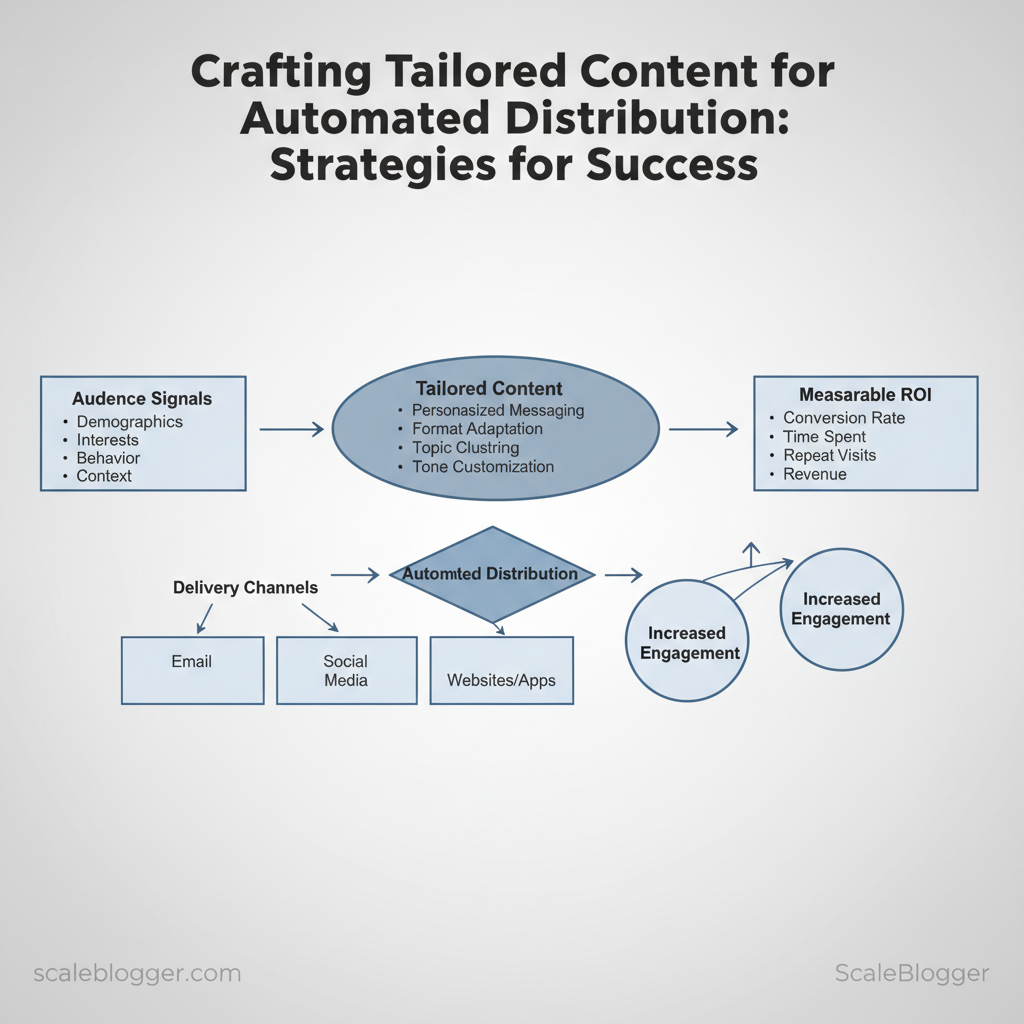
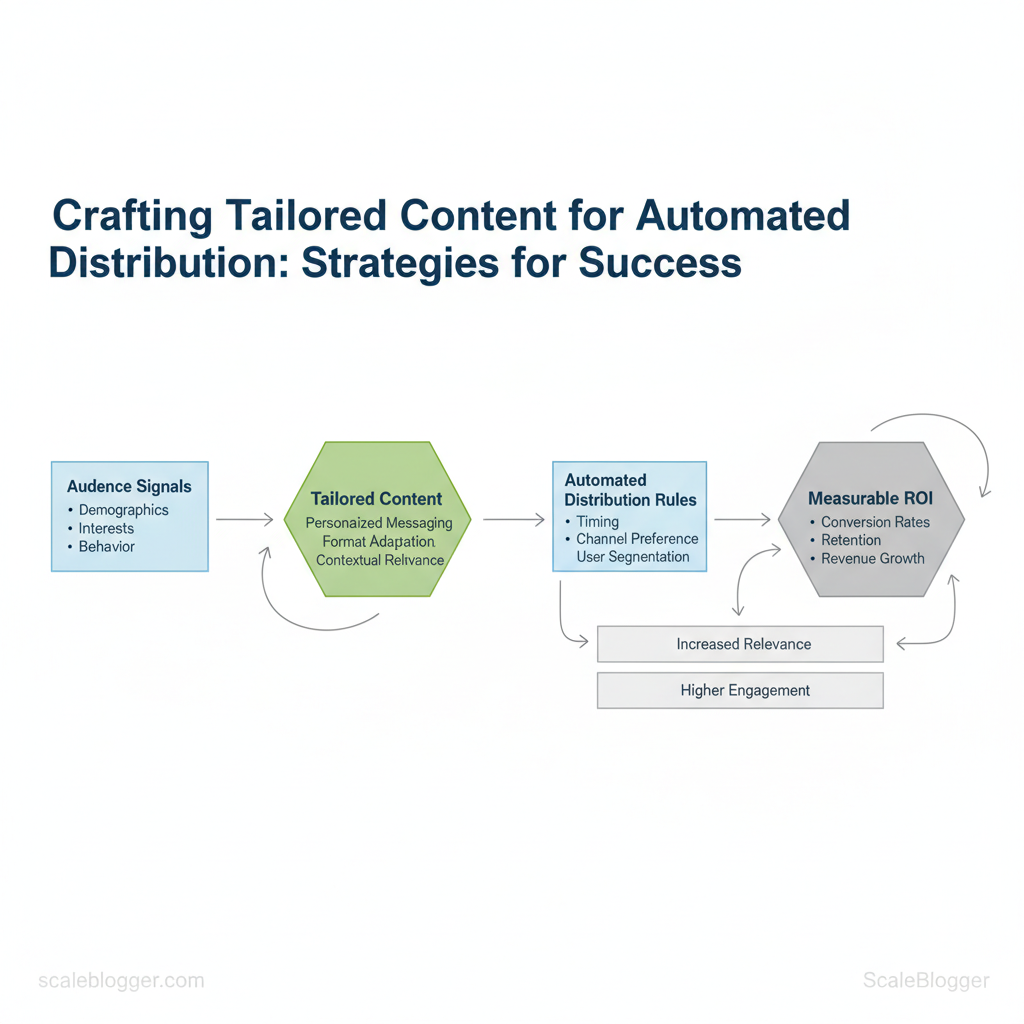
Automating distribution doesn’t mean generic mass blasts — you must design tailored content that maps to audience signals and delivery channels. Start by deciding which segments get which narrative, then automate distribution rules so each piece reaches the right persona at the right moment. Automatically delivering tailored content can boost relevance, engagement, and measurable ROI.
Many teams waste time on manual sequencing and miss chances for personalization across channels. Picture a growth team that pairs behavior-based triggers with short-form variants, lifting click-through rates by noticeable margins while potentially freeing up time for teams. Industry practices show that consistent content personalization across channels improves conversion and retention.
What you’ll learn next
- How to align content variants with audience segments for automated delivery
- Practical rules for sequencing and channel-specific formatting
- Metrics to track automation impact and avoid personalization traps
- Steps to orchestrate content pipelines with minimal manual overhead
Scaleblogger can help map segment strategies and automate distribution workflows so tailored content scales without adding headcount. Get started with Scaleblogger to automate tailored content: https://scaleblogger.com
Table of Contents
- H2: Understand the Foundations of Tailored Content
- Section Content
- H2: Map Audiences and Signals for Automated Distribution
- H2: Design Content Templates and Modular Assets
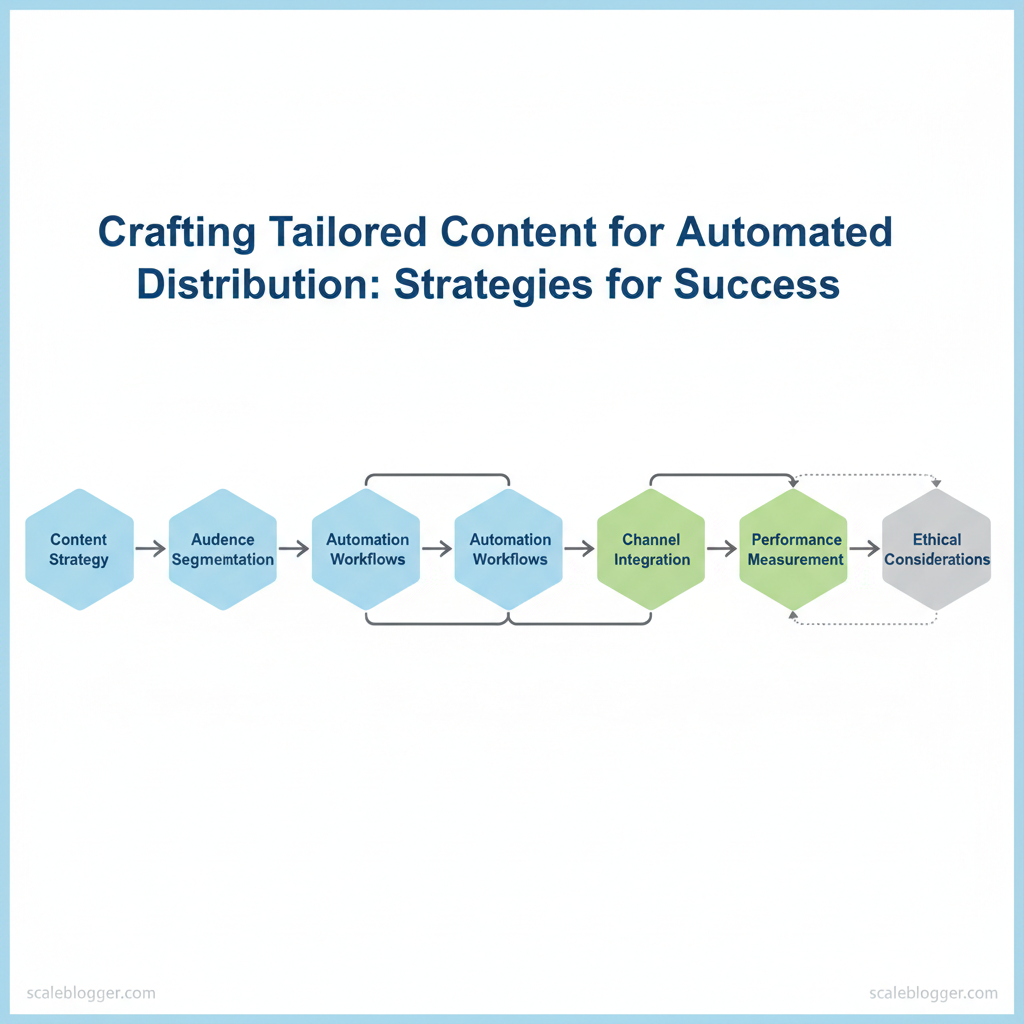
- Build Automation Workflows and Orchestration
- H2: Test, Measure, and Iterate for Continuous Improvement
- H2: Ethical, Privacy, and Operational Considerations
> Key Takeaway:
H2: Understand the Foundations of Tailored Content
Tailored content means designing messages that match an individual’s context, needs, and behavior so the experience feels…
H2: Understand the Foundations of Tailored Content
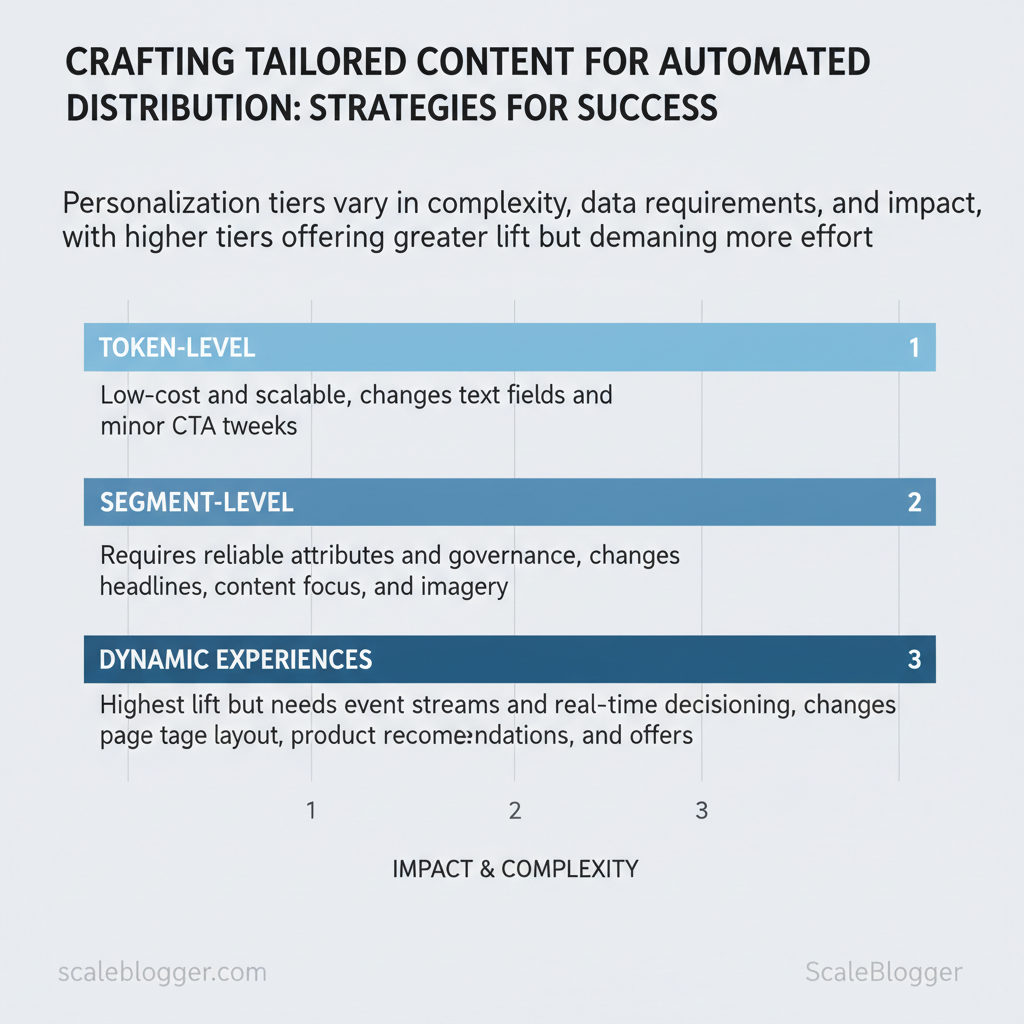
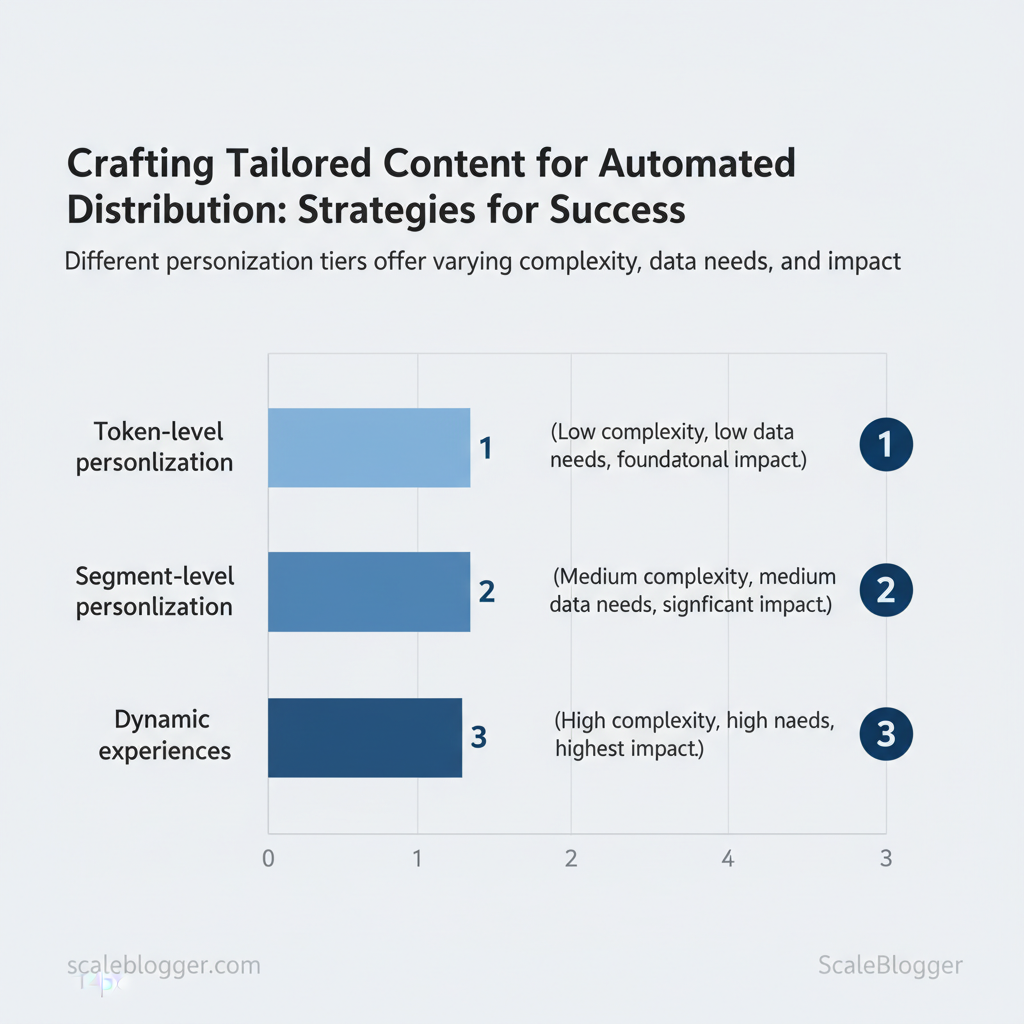
Tailored content means designing messages that match an individual’s context, needs, and behavior so the experience feels relevant and useful. This means matching content elements like format, tone, and call-to-action to data that you can collect and use reliably. View personalization as a spectrum—from basic token changes to fully dynamic experiences—to focus your efforts on impact and complexity. This helps them avoid chasing “perfect” personalization that never gets completed.
H3: Key Concepts and Definitions
Personalization rests on a few clear concepts you should use in planning and scoping work:- Personalization (definition): Customizing content to align with user-specific attributes, behavior, or context.
- Segment: A group of users sharing meaningful attributes for targeting (e.g., SMB marketing directors).
- Dynamic experience: Content that adapts in real-time based on interaction or environment.
Personalization tiers side-by-side to show complexity, data needs, and expected impact
| Personalization Tier | What it changes | Data required | Typical use cases |
|---|---|---|---|
| Token-level (name, location) | Text fields, minor CTA tweaks | first_name, country, timezone |
Welcome emails, geo-specific greetings |
| Segment-level (industry, persona) | Headlines, content focus, imagery | Firmographics, role, subscription type | Email journeys, gated content paths |
| Dynamic experiences (real-time behavior) | Page layout, product recommendations, offers | Clickstream, recent search, session signals | Homepage modules, product detail personalization |
Why precise terminology matters: calling something “personalized” without specifying tier, data source, and trigger creates scope creep. Agree on definitions up front so analytics, engineering, and content share the same success metrics and SLAs.
H3: Why Integration Between Content and Distribution Matters
Personalization fails when content and delivery aren’t synchronized: a perfectly tailored article sent to the wrong audience or at the wrong time is wasted impressions. Integration ensures the right creative, metadata, and delivery signals travel together.Common failure modes:
- Wrong segment: Content meant for enterprise buyers lands in SMB drip lists → low engagement. 2.
Timing mismatch: High-intent content sent before user completes onboarding → confusion. 3. Disconnected metadata: CMS updates not reflected in ad feed → stale headlines.
Three practical cross-team checkpoints:
- Pre-publish sync: Content, metadata, and audience definition validated together.
- Delivery rehearsal: Test send to representative segments and devices.
- Post-send audit: Measure open/engagement and confirm rules executed.
If you want to move faster with fewer coordination headaches, consider building a repeatable checklist and mapping each personalization tier to required data and tests—this is where automation and an AI-powered content pipeline can reduce manual handoffs and errors. Understanding these foundations helps teams move faster without sacrificing content quality.
> Key Takeaway:
H2: Map Audiences and Signals for Automated Distribution
Start by mapping who you want to reach and which measurable behaviors reliably indicate readiness to engage.…
H2: Map Audiences and Signals for Automated Distribution
Start by mapping who you want to reach and which measurable behaviors reliably indicate readiness to engage. Automation can only scale clear and repeatable decisions. So, focus on segments with enough volume to trigger rules and signals that are both predictable and accessible from your systems. Build segments that are actionable (can drive a message or workflow), measurable (tracked in analytics/CRM), and connected to channels (email, paid, organic, push).
H3: Building Practical Audience Segments
Balance granularity with volume by grouping audiences around intent and lifecycle rather than superficial demographics. If a segment is too narrow it won’t generate enough signal; too broad and the messages become irrelevant.- Define by behavior: Use recent pageviews, downloads, or product events as primary criteria.
- Use tiered granularity: Start with 3–5 master segments, then add sub-segments for high-value tactics.
- Prioritize by ROI potential: Automate segments that map to clear business outcomes (trial conversion, repeat purchase).
- Inventory data sources:
GA4, CRM, email platform, CDP. - Estimate volume: Ensure a segment hits minimum threshold (e.g., 1k users/month for nurture flows).
- Test & iterate: Run a 4-week pilot, measure conversion lift, refine criteria.
Sample segment definitions and data sources are in the matrix below for quick implementation and automation prioritization.
H3: Selecting Signals: What Matters and Why
Choose signals that predict the next action and can be pulled reliably. Favor recency and intent over vanity metrics.- High-value signals: Recent product view, add-to-cart, email click, trial start, support ticket opened.
- Moderate signals: site time, pages per session, social engagement.
- Low-value/noisy signals: single pageview without context, bounce (unless combined with other signals).
Use a simple 2×2: Impact (predictive power) vs Availability (how easy to retrieve). Prioritize signals in the high-impact/high-availability quadrant for automation.
Verification checklist to avoid noise:
- Confirm schema and event names across systems. 2.
Validate event frequency against user counts. 3. Filter bots and internal traffic.
- Run A/B checks to correlate signal with conversion before automating.
Quick reference matrix showing sample segments, defining criteria, data sources, and ideal channels for distribution
| Segment | Definition / Criteria | Primary Data Source | Ideal Channels |
|---|---|---|---|
| New Visitor | First session in 30 days; pages visited ≥1 | Google Analytics (GA4) | Organic social, retargeting ads |
| Returning Visitor | 2+ sessions in 30 days | GA4, cookie IDs | Email list, personalized onsite CTA |
| Recent Purchaser | Purchase within last 30 days | CRM, e-commerce platform | Post-purchase email, cross-sell ads |
| Churn-risk | No activity 60+ days after purchase | CRM, CDP | Win-back email, SMS |
| High-value Prospect | High average order value or lead score ≥80 | CRM, lead scoring engine | Sales outreach, targeted ads |
When teams align on these segments and signals, automation becomes a way to deliver consistently relevant experiences without constant manual rules. Understanding these boundaries helps you scale distribution while keeping content timely and useful. This is why modern content strategies prioritize automation—it frees creators to focus on what matters.
> Key Takeaway:
H2: Design Content Templates and Modular Assets
Design reusable templates and modular blocks so teams can assemble consistent, on-brand content quickly. Start by defining a…
H2: Design Content Templates and Modular Assets
Design reusable templates and modular blocks so teams can assemble consistent, on-brand content quickly. Start by defining a small library of atomic modules (headline, intro, value block, social proof, CTA) with explicit variable fields, default fallback text, and clear distribution use cases. That lets writers, designers, and automation tools swap pieces without reworking style or intent — speeding production while keeping messaging tight.
Below you’ll find concrete module definitions, template examples with {{variables}}, naming conventions, and rules for personalization and tone so templates behave predictably at scale.
Modular Content Patterns and Templates
Use a finite set of modules that map to common content needs and channels. Define each module with the fields it accepts, short fallback copy, and where it should appear.
Catalog of modular blocks with recommended variable fields, fallback copy, and distribution use cases
| Module Name | Variables / Fields | Fallback Text | Best Use Case |
|---|---|---|---|
| Headline | {{headline}}, {{benefit}}, {{audience}} |
“Explore what works for your business” | Blog H1, email subject |
| Intro Hook | {{hook}}, {{stat}}, {{problem}} |
“Many teams struggle to…” | Social posts, lead paragraphs |
| Value Proposition Block | {{feature}}, {{outcome}}, {{metric}} |
“Delivers measurable results fast.” | Landing pages, case studies |
| Social Proof / Testimonial | {{quote}}, {{name}}, {{role}}, {{company}} |
“Trusted by customers like you.” | Product pages, emails |
| Primary CTA | {{cta_text}}, {{cta_url}}, {{urgency}} |
“Get started” | Footer CTAs, hero sections |
Example template (use directly in CMS or automation pipelines):
html <h1>{{headline}}</h1> <p class="intro">{{hook | fallback:"Start solving X today."}}</p> <section class="value"> <h3>{{feature}}</h3> <p>{{outcome}}</p> </section> <blockquote>{{quote | fallback:"Our customers see results."}}</blockquote> <a href="{{cta_url}}" class="btn">{{cta_text | fallback:"Get started"}}</a>- Define variables with
snake_caseand prefix contextual groups (e.g.,user_name,company_size). - Set fallbacks for every field to avoid awkward blanks.
- Version templates (
template_v1) and track changes in your CMS releases.
Rules for Personalization, Tone, and Consistency
Personalization should feel helpful, not creepy. Use tone rules and QA checks to keep messaging natural.
- Tone: friendly-authoritative — use plain language, limit jargon.
- Personalization threshold: only apply
{{first_name}}if confidence > 90% or user has explicit opt-in. - Avoid overfitting: don’t surface hyper-specific references (e.g., recent purchase details) unless confirmation exists.
}}` resolved and fallbacks triggered when empty. Tone audit: sample 10% of outputs for passive vs. active voice balance.
- Personalization audit: verify opt-ins and data freshness. Accessibility check: headings, alt text, and CTA contrast comply with standards.
This structured approach makes it straightforward to scale content production reliably. When templates and personalization rules are well-defined, teams can automate the boring parts and focus on creative, high-impact storytelling. If you want, I can convert these modules into a ready-to-import JSON schema for your CMS or show how Scaleblogger can automate the pipeline.
Build Automation Workflows and Orchestration
Automation workflows link triggers, data processing, templates, and delivery. This helps teams provide consistent content experiences without manual delays. Start by modeling each workflow as a timeline—what kicks it off, which systems transform the data, what template drives the output, how it’s delivered, and how you verify success. Research from market experts indicates that good orchestration can reduce handoffs: orchestration layers (CDPs, workflow engines, or serverless functions) handle retries, branching, and fallbacks so creators can focus on content quality rather than plumbing.
Example Workflows for Key Channels
Below are practical blueprints you can implement today; each follows: trigger -> data -> template -> delivery -> measurement. Testing and rollback are built into the verification step.
Step-by-step workflow timeline showing trigger, processing step, and delivery action for each example workflow
| Workflow | Trigger | Processing / Orchestration | Delivery Action | Verification Step |
|---|---|---|---|---|
| Welcome email series | New user signs up (ESP webhook) | CDP (Segment) enriches profile, orchestration engine schedules series | ESP (SendGrid/Mailchimp) sends templated emails with personalization tags | Delivery webhook + open/click metrics; abort if bounce rate >5% |
| On-site hero personalization | Returning visitor with intent signal | Real-time API call to CDP -> recommendation microservice selects variant | Client-side render injects personalized hero via JS | A/B test metrics (CTR on hero), server logs confirm personalization served |
| Segment-triggered social post | User reaches product milestone | Orchestration builds message using content template + UTM params | Social scheduler posts to LinkedIn/X/Facebook via API | API success 200, post engagement tracked for 24–72h |
| Blog post syndication | Content published in CMS | Webhook -> transformation service generates social+email blurbs | Scheduler publishes social, newsletter via ESP | Crawl check of canonical tag, social publish webhook success |
| Retention SMS nudges | 7-day inactivity event | Business rules engine selects offer, rate-limits applied | SMS provider (Twilio) sends message | Delivery receipt + opt-out check; pause on complaints |
| Paid-ad creative refresh | New high-performing post identified | Asset builder auto-generates 3 ad variations | Ads API uploads to platform (Google Ads) | Ad status = Enabled, CTR tracked vs baseline |
| Drip for trial-to-paid | Trial end = 3 days left | Sequence composer personalizes offer, adds coupon | Multichannel send (email + in-app) | Conversion event tracked; rollback offer if misuse detected |
| Content update reminder | Evergreen article >9 months old | Analytics job flags low-performing pages, creates task | Notification to content owner in workflow tool | Task completion + performance recheck after 30 days |
Integration and Data Hygiene Best Practices
Start with required endpoints and a tight hygiene cadence to keep automation reliable.
- Required endpoints: CDP profile API, ESP send API, CMS webhook, analytics event stream, social/ad platform APIs.
- Daily hygiene: Profile deduplication—run matching jobs; Consent sync—align consent flags across ESP/CDP; Event replay—buffer and replay failed events.
- Weekly hygiene: Data freshness checks—verify key attributes (email, locale) completeness; Model recalibration—retrain simple scoring thresholds every week.
- Fallback strategies: Graceful defaults—serve non-personalized template when data missing; Queue-and-retry—exponential backoff for transient API failures; Manual escalation—alert human reviewer after N failures.
Practical tip: document each endpoint and its SLA in your workflow spec and add health checks to the orchestration layer. If you want a turnkey way to orchestrate these patterns while keeping SEO and editorial rules intact, consider exploring AI content automation options like the AI-powered content pipeline at Scaleblogger.com to integrate templates, scheduling, and performance benchmarking. Understanding these principles helps teams move faster without sacrificing quality. When orchestration is done well, creators spend less time babysitting processes and more on impact.
H2: Test, Measure, and Iterate for Continuous Improvement
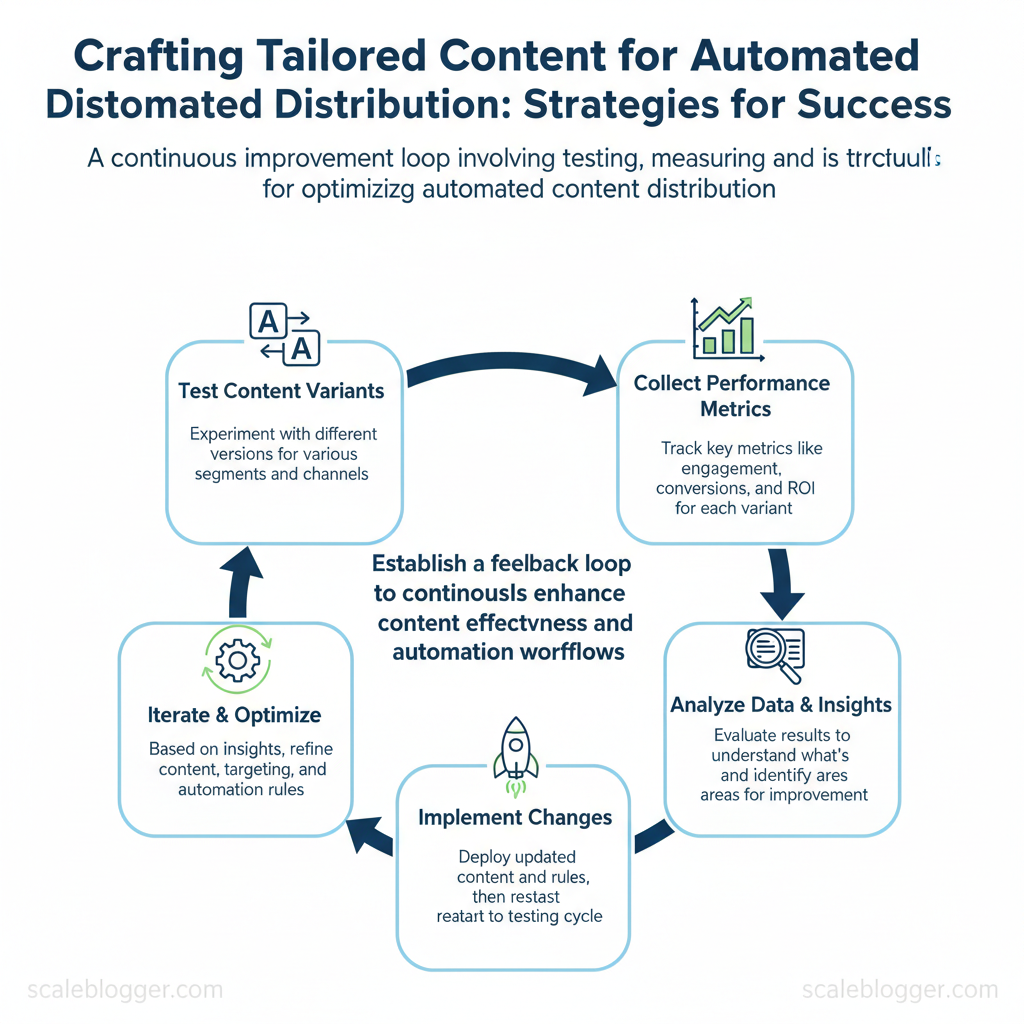
Begin by viewing content changes as experiments. Run focused tests, measure important business outcomes, and then make quick adjustments. That means defining channel-specific KPIs, picking the right experiment type, and ensuring tests are powered to detect real differences. By incorporating this discipline into your workflow, small wins can lead to consistent growth without needing to guess.
Metrics, KPIs, and Experiment Design
Choose KPIs that map directly to business value and are realistic to move with the tactic you’re testing.
- Channel mapping: Align each channel to a small set of primary metrics and a realistic lift to watch for.
- Experiment types: Use A/B tests for single-variable changes, multivariate tests for interaction effects, and holdout cohorts for large-feature rollouts.
- Significance basics: Aim for 80% statistical power and
p < 0.05for decisions; use sample-size calculators before launching. - Sample-size rule of thumb: For conversion-limited channels, Recent research indicates targeting at least 200–500 conversions per variant; for high-traffic impressions, 5,000+ sessions per variant is safer.
- Duration guardrails: Run tests long enough to capture weekly cycles (minimum 7–14 days) and avoid stopping early on volatile signals.
KPI reference table mapping channel to primary metrics, acceptable lift benchmarks, and suggested sample-size considerations
personalization metrics automated distribution
| Channel | Primary KPIs | Benchmark Lift to Watch For | Sample Size Note |
|---|---|---|---|
| Open rate, CTR, Conversion rate | 10–25% relative lift in CTR for personalization (According to a 2023 Mailchimp report, average open rates are around 21% and CTR is approximately 2.6%.) | Industry data suggests aiming for 1,000–5,000 recipients per variant depending on baseline CTR. | |
| On-site Personalization | Conversion rate, Avg. order value, Engagement depth | 10–30% relative lift in conversions (industry reports suggest that there are often double-digit improvements.) | Target 2,000–10,000 sessions per variant to account for traffic variance |
| Paid Social | CTR, CPA, ROAS | 15–25% relative lift in CTR or 10–20% improvement in CPA (WordStream benchmarks: FB CTR ~1.58% to 1.71%) | Require 5,000+ impressions and 200+ clicks per variant for stable results |
| Organic Social | Engagement rate, Reach, Referral traffic | 10–40% relative lift in engagement (varies by platform and content quality) | Use several weeks of publish cycles or aggregate posts to reach statistical relevance |
Scale Safely: Rollout Strategies and Governance
- Pilot: Test on a narrow but representative segment (one country, one list, or 5% traffic).
- Regional rollout: Expand to larger but still bounded cohorts, monitor for regressions.
- Global rollout: Full deployment after meeting success criteria and stability checks.
Governance essentials:
- Decision triggers: Predefine
go/no-gothresholds for KPIs and error rates. , >5% drop in conversions or spike in error rate). * Audit trail: Keep experiment configs, variants, and traffic splits logged for traceability.
- Owner & cadence: Assign an experiment owner and schedule weekly review meetings until stable.
Use a decision checklist before scaling:
- Has the test met statistical significance?
- Are secondary metrics stable (revenue, retention)?
- Is the change technically across environments?
- Have stakeholders signed off on trade-offs and rollback plan?
When you apply these steps consistently—and combine them with automation where it reduces toil—you enable faster, safer scaling. This approach helps teams move quickly while keeping real business risk tightly contained.
📥 Download: Checklist for Crafting Tailored Content and Automated Distribution (PDF)
H2: Ethical, Privacy, and Operational Considerations
Building personalized content systems requires balancing usefulness with user rights and operational safety. Start with a consent-first mindset: collect only the signals you need, make uses transparent, and design retention and access controls so data serves personalization without creating unnecessary risk. Operationally, treat models and pipelines as products — instrument them, monitor for drift, and enforce guardrails that prevent harmful outputs or discriminatory treatment.
Below are concrete practices, a comparative table of consent models, and an operational checklist you can apply immediately.
H3: Privacy and Consent Best Practices
Adopt a consent-first personalization model that defaults to minimal data collection and progressive profiling — ask for explicit permission before using sensitive signals for targeting. Document and publish uses so users can understand choices and revoke consent. Retention should follow purpose-limitation: keep personalized signals only as long as they provide value and ensure easy export/deletion.
- Consent-first model: Start with minimal signals, request escalation for richer personalization.
- Transparent documentation: Publish a plain-language Data Use page detailing each signal and downstream use.
- Retention rules: Define
max_ageper signal (e.g.,30 daysfor session affinity,2 yearsfor subscription billing). - Access controls: Role-based access for PII,
least_privilegefor ML features. - Audit logs: Immutable records for consent changes and data deletions.
Sample consent record template:
json { "user_id":"12345", "consent_given":true, "scopes":["recommendations","email_personalization"], "timestamp":"2025-05-01T12:00:00Z" }Consent models (implicit, explicit, granular consent) with pros/cons and regulatory fit
| Consent Model | Description | Pros | Cons |
|---|---|---|---|
| Implicit consent | Consent assumed from use (e.g., continued browsing) | Low friction, easy UX | Poor regulatory fit for GDPR; unclear audit trail |
| Explicit consent | Active opt-in (checkbox, modal) before processing | Clear legal posture, strong auditability | Higher friction; may reduce adoption |
| Granular consent | Per-signal or per-purpose choices (toggles) | Fine control, better user trust |
Key insight: Explicit or granular consent aligns best with modern regulations and trust-building; implicit consent can work for non-sensitive uses but demands clear notice and limited retention.
H3: Bias, Fairness, and Operational Safeguards
Models mirror the data and signals they consume; bias often appears when training or signal selection reflects historical disparities. Mitigation requires both upstream controls and downstream monitoring.
- Data hygiene: remove or mask protected attributes when not necessary.
- Balanced sampling: ensure training sets reflect target audience segments.
- Feature audits: log feature importance and test counterfactuals.
- Regular fairness tests: run disparity metrics (e.g., outcome rates) monthly.
- Human-in-the-loop: route uncertain or high-impact decisions to reviewers.
Practical audit checklist:
- Define sensitive attributes and justify any use. Run synthetic counterfactuals to detect disparate outputs. Maintain a bias dashboard tracking key metrics.
- Version control datasets and model snapshots. * Incident playbook for harmful outputs or user complaints.
Operational policies should specify review cadences, thresholds for human escalation, and a rollback mechanism for personalization features. Tools and processes that automate logging and scoring — for example, an AI-powered content pipeline — make continuous compliance realistic; teams using solutions like those at Scaleblogger can integrate consent recording and performance benchmarking into the publishing flow.
Understanding these principles helps teams move faster without sacrificing quality. When privacy, fairness, and operational safeguards are baked into the pipeline, personalization becomes scalable and defensible.
You’ve walked through why automating distribution should start with audience signals, how to map narratives to channels, and which checkpoints prevent bland mass blasts. When teams align content templates with behavioral triggers, engagement improves; when they test channel-specific variants, conversion uplifts appear faster. Practical patterns from real projects show that segmenting by intent and baking in a review gate for voice and persona preserved quality while scaling.
Keep focusing on segmentation, channel-fit, iterative testing, and a lightweight approval loop — those four moves will keep automation productive instead of noisy.
If you want a next step, pick one audience segment, design a tailored narrative for its top channel, and run a two-week A/B test to validate assumptions. For teams looking to automate this workflow at scale, platforms like Scaleblogger can help operationalize templates, triggers, and reporting without sacrificing voice — it’s one option to implementation. When you’re ready, Get started with Scaleblogger to automate tailored content and try automating a single campaign end-to-end; that focused run will teach you more than broad theory and show where to expand next.
