UGC isn’t just content—it’s credibility.
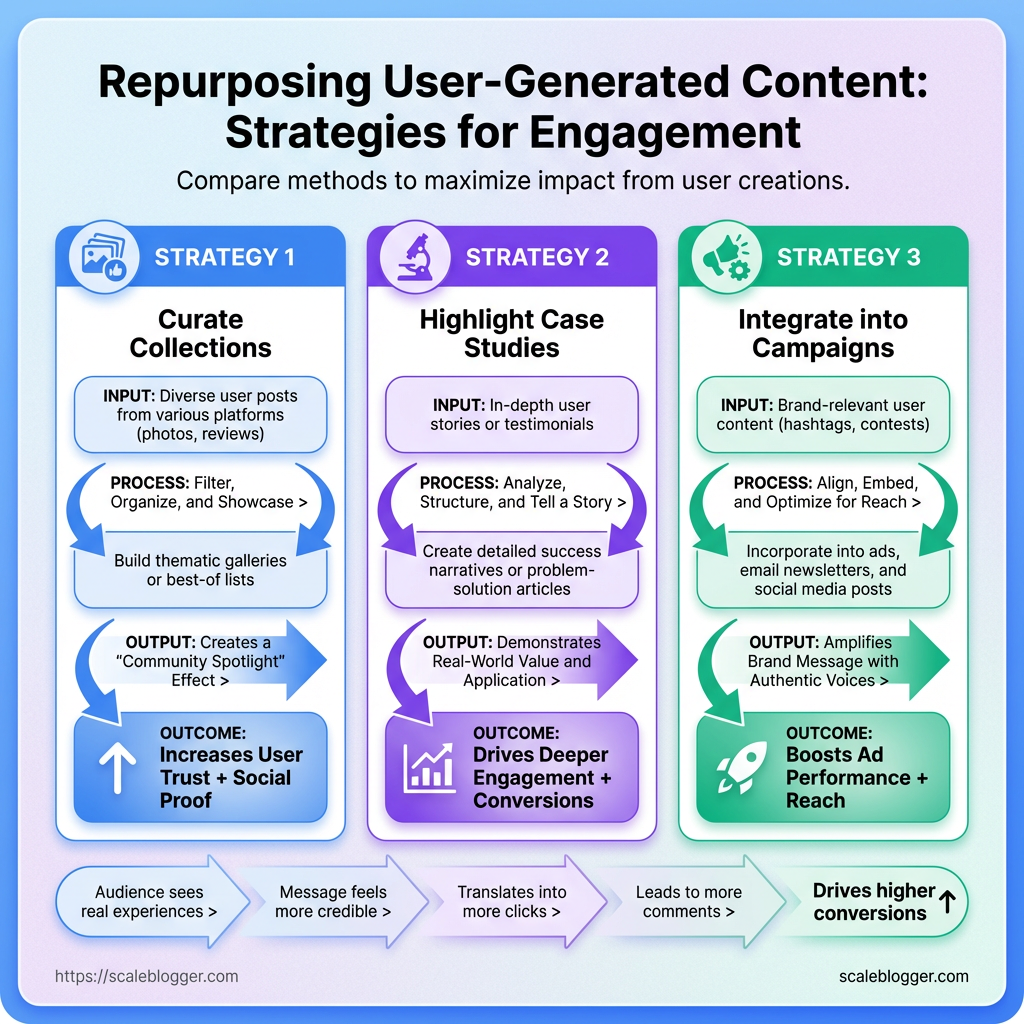
People connect more with real experiences than with marketing claims. When you repurpose customer moments, you aren’t just adding to your content calendar. You’re gaining authenticity that makes your message feel trustworthy and engaging.
To achieve this effect consistently, you need to find the strongest “proof moments.” These are clear problems that lead to real experiences and tangible results. Then, convert those moments into assets that your team can produce and publish repeatedly.
Next, prioritize which proof moments to repurpose first with a simple Impact × Effort framework.
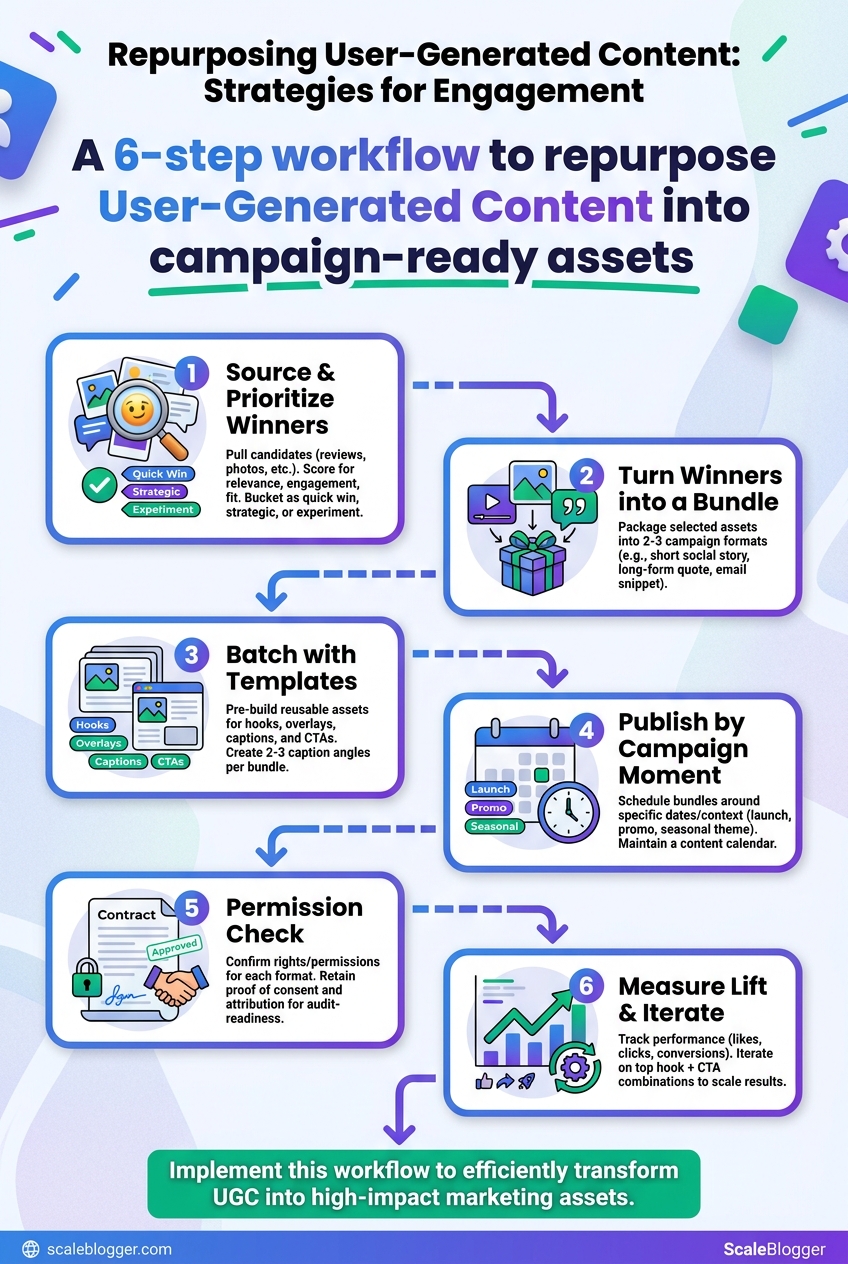
Apply the Impact × Effort method to determine which moments to transform into assets. – Quick wins (high impact, low effort): Repurpose UGC that has already garnered attention and aligns with your audience’s interests. *Example:* a customer question that triggered lots of comments—turn it into a short story/reel answering it. – **Strategic investments (high impact, high effort):** Choose “best of” UGC that can support multiple formats and carry your campaign story. *Example:* a customer transformation video—turn it into an email snippet plus a longer case-study section. – **Experiments (low impact, high learning value):** Test novel formats or perspectives with UGC that may perform modestly today but will teach you what resonates. *Example:* a new creator POV—try it as a poll or reaction post and keep what generates meaningful engagement. After you’ve selected your winners, the next step is to turn them into a workflow that is ready for execution.Quick Answer: Repurpose your selected “proof moment” into a repeatable 6-step workflow: 1) Start with your selected winner. Take the UGC you prioritized and keep the first bundle small so you can learn quickly. 2) Translate the core moment across 2–3 channels. Repackage the same customer claim into different placements. For example, use it in a short social post, an email, and one element on a landing page.
Keep the main message the same while adjusting the format. 3) Build with templates, then test Use a repeatable structure (Hook → Experience → CTA). Create at least two variants that change the framing but stay true to the same customer moment. A/B test different captions and messages, and when relevant, try out creative overlays. 4) Publish for “felt relevance” Schedule releases to align with launches, promotions, seasonal contexts, and recurring customer questions to ensure your repurposed asset feels timely. 5) Run the permissions + attribution gate Confirm rights/permissions, apply attribution language that matches your agreement, and log approvals so scaling doesn’t slow production. 6) Measure lift and scale what works Track engagement and downstream impact (e.g., link clicks via UTMs/event tracking). Compare results to a baseline, then scale winners and pause low performers.
Start with one focused bundle in a short test window—then increase volume once the workflow proves itself.