

Brands invest heavily in on-page SEO. However, they often overlook a powerful tool: social media SEO. Content that gains traction on networks still influences discoverability, referral traffic, and the signals search engines use to rank pages. If social distribution is treated as an afterthought, it weakens links, engagement, and relevance before they reach search algorithms.
A strategic approach to content sharing aligns social creative, posting cadence, and metadata with broader SEO strategy, creating repeatable visibility gains. Picture a small B2B team repurposing a pillar blog into short threads, video clips, and optimized share copy — each asset feeds search relevance and attracts linking domains. Industry practitioners observe that coordinated social pushes compound organic momentum far more than ad-hoc posting.
- What tactical post formats improve discoverability and backlink potential
- How to map social platforms to keyword intent and topical clusters
- Low-effort ways to scale social amplification without losing SEO signals
- Metrics to measure social impact on rankings and referral growth
Next, practical steps will show how to synchronize social workflows with on-site optimization and content calendars. Try Scaleblogger to automate social distribution and measure SEO impact: https://scaleblogger.com
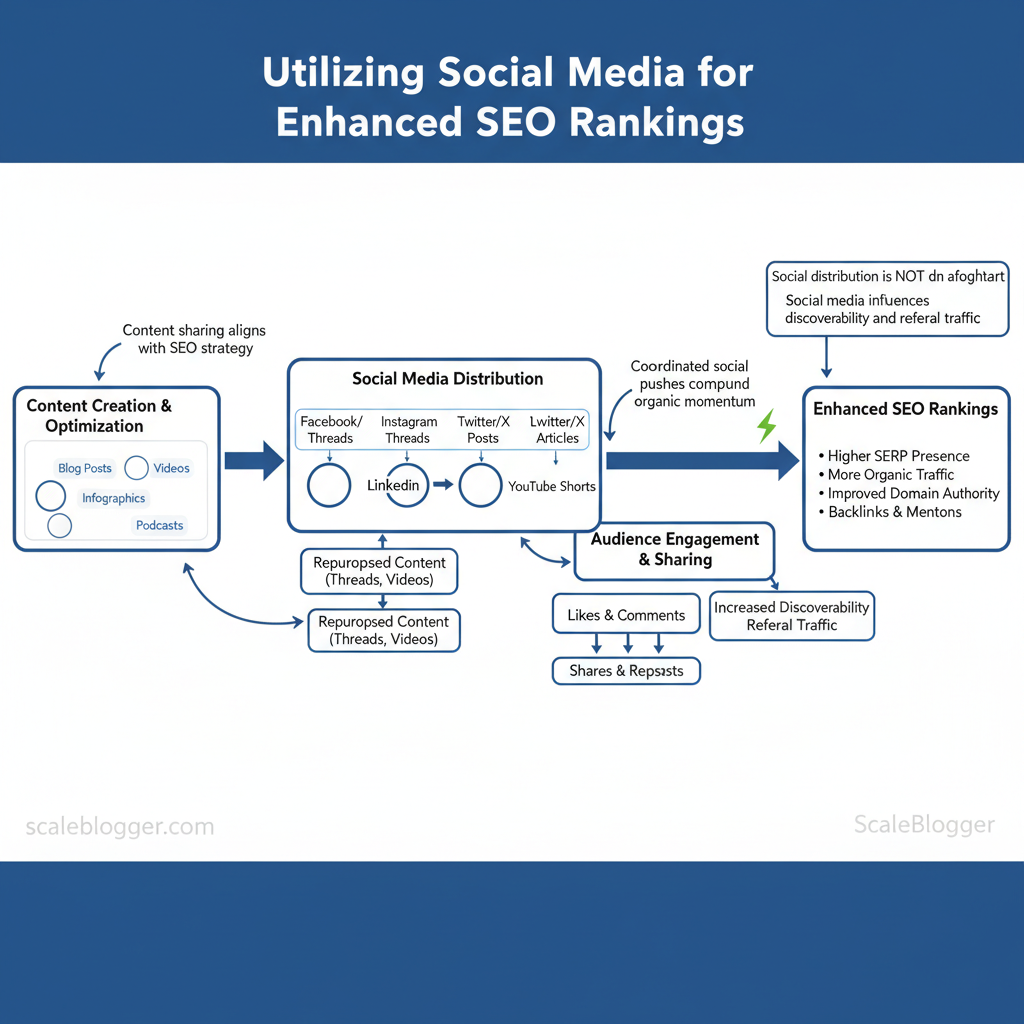
> Key Takeaway: ## How Social Media Impacts SEO
Search engines don’t consider social signals, like likes and shares, as primary ranking factors. Still, social activity impacts SEO through measurable, indirect ways.
How Social Media Impacts SEO
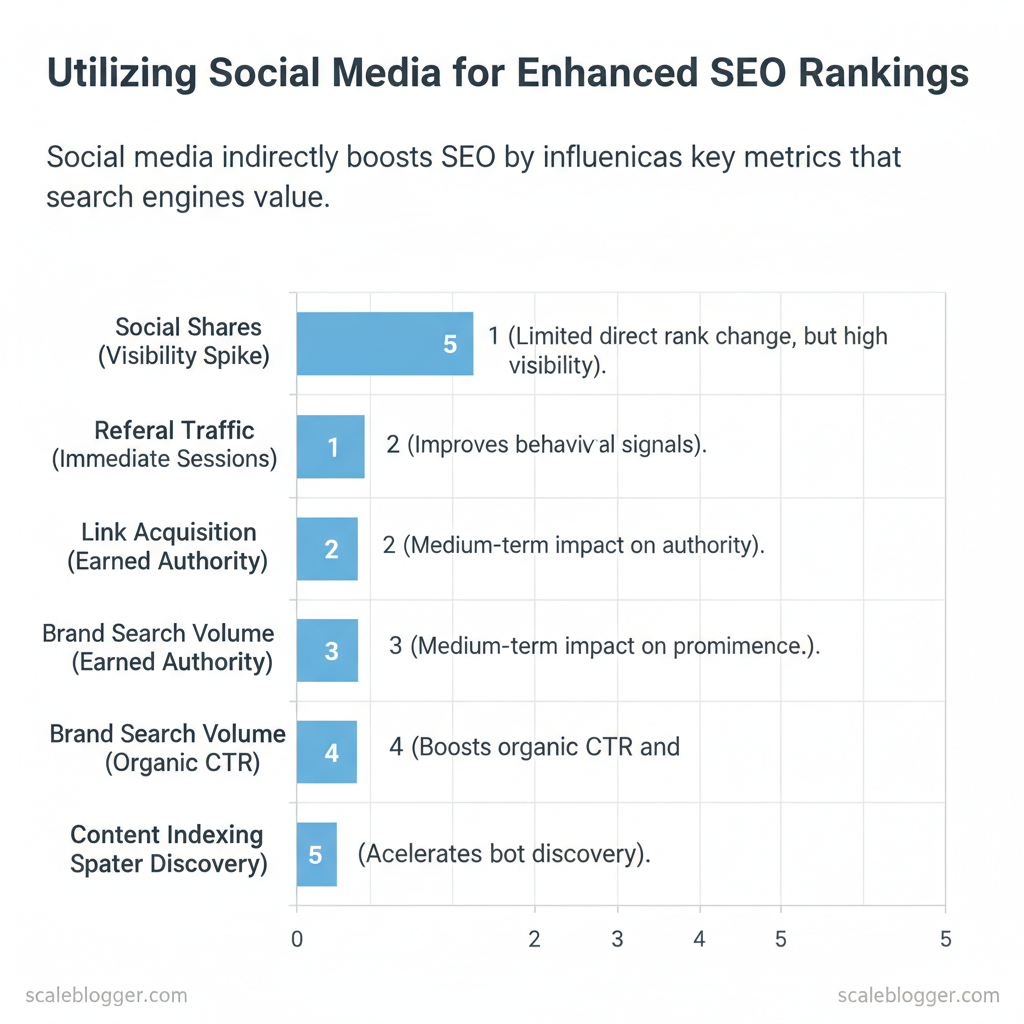
Search engines don’t consider social signals, like likes and shares, as primary ranking factors. Still, social activity impacts SEO through measurable, indirect ways. Social channels drive referral traffic, increase content visibility that leads to earned backlinks, boost branded search volume, and can speed up content discovery and indexing. By measuring effects like referral traffic, backlinks, impressions, organic click-through rates, and branded searches, teams can turn social activity into clear SEO outcomes.
How that plays out practically:
- Social visibility: A viral post raises impressions and branded searches, increasing organic click-through potential. Referral engagement: Traffic from platforms raises dwell time and page view depth, which correlate with improved organic performance. Link acquisition pipeline: Public social distribution creates linkable opportunities for journalists and bloggers who monitor platforms for stories.
- Indexing and freshness: Active promotion accelerates bot discovery when combined with sitemaps and proper canonicalization.
Practical measurement setup and cadence
- Instrument pages: Ensure
UTMtags on social links and consistent page-level metadata. 2.
Track weekly: Pull referral traffic, impressions, and CTR weekly; analyze backlinks and branded search trends monthly. 3. Attribute carefully: Use a combination of first-touch and last-non-direct attribution to understand social’s role in conversion paths.
Tools and metrics to use
- Google Analytics / GA4: referral traffic, session duration, conversions
- Google Search Console: impressions, organic CTR, indexed pages
- Ahrefs / Moz / Majestic: backlink acquisition, referring domains
- Platform analytics (Twitter/X, Facebook, LinkedIn, Instagram): post impressions, engagement rate
- BuzzSumo: content virality and influencer pickup
- Scaleblogger.com can automate the content distribution cadence and connect social referral trends to content performance for faster iteration
Side-by-side contrast of direct vs indirect SEO effects from social media
| Mechanism | Is it a direct ranking factor? | Typical short-term SEO impact | How to measure |
|---|---|---|---|
| Social shares | ✗ | Visibility spike; limited direct rank change | Platform analytics, UTM clicks in GA4 |
| Referral traffic | ✗ | Immediate sessions and engagement; can improve behavioral signals | GA4 referral reports, session quality metrics |
| Link acquisition | ✗ (indirect) | Medium: earned links improve authority over weeks | Ahrefs new backlinks, referring domains |
| Brand search volume | ✗ (indirect) | Higher branded queries boost organic CTR and SERP prominence | GSC queries (branded terms), Google Trends |
| Content indexing speed | ✗ (indirect) | Faster discovery when content is widely shared | GSC URL Inspection, crawl stats |
Expected outcomes: better referral-to-organic conversion rates, accelerated link pickup, and clearer attribution of social-to-SEO value. When teams tie social distribution to these metrics and iterate weekly, content gains sustainable search visibility without relying on ephemeral signal assumptions.
> Key Takeaway: ## Creating Social Content That Helps SEO
Social content drives SEO by amplifying linkable assets and providing descriptive, search-friendly text and visuals that earn backlinks. Focus on social posts that direct users and crawlers to long-form…
Creating Social Content That Helps SEO
Social content drives SEO by amplifying linkable assets and providing descriptive, search-friendly text and visuals that earn backlinks. Focus on social posts that direct users and crawlers to long-form resources. Use keyword-rich text for indexing and visuals that other sites will reference. This works because search engines reward authoritative signals—shares, earned links, and on-page relevance—and social platforms are the fastest way to seed those signals at scale.
Prerequisites
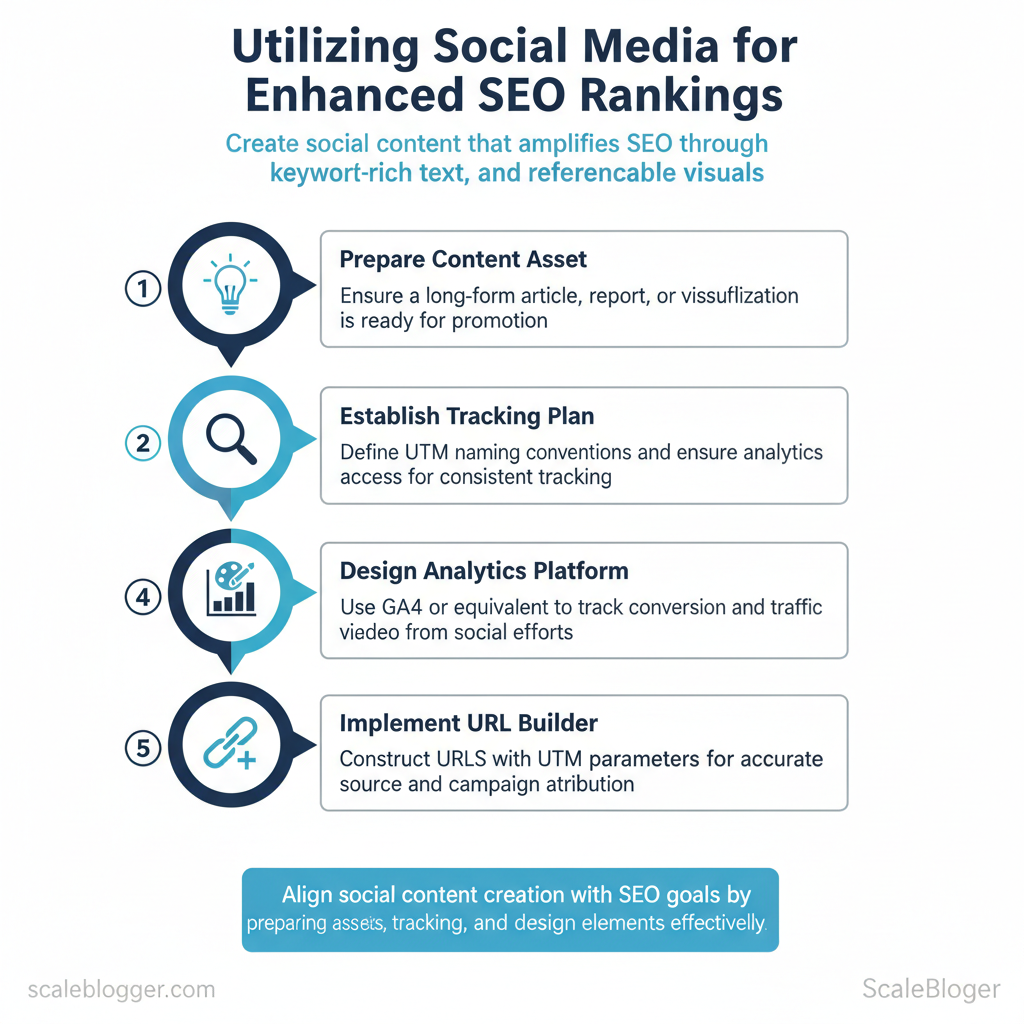
- Content asset ready: A long-form article, report, or data visualization to promote.
- Tracking plan: UTM naming convention and analytics access.
- Design assets: Infographic, chart PNGs, short vertical video clips.
Tools / materials needed
- Analytics platform: GA4 or equivalent for conversion and traffic tracking.
- URL builder:
?utm_source=twitter&utm_medium=social&utm_campaign=Q4_report - Scheduling tool: native scheduler, Sprout-like tool, or an automated pipeline (Scaleblogger automation fits naturally here).
- Prioritize formats that earn links and shares
- Create a short teaser linking to the long-form asset; pin it for 24–72 hours.
- Publish a shareable infographic or
PNGwith embedded chart credit and the canonical URL. - Release a 30–60s social clip highlighting a single insight; add captions and a descriptive caption with keywords.
Optimization checklist for social posts
- Bold link tracking: Always include a clear, trackable link with
utmparameters and a canonical URL. Bold descriptive copy: Use 1–2 keyword phrases in the first 1–2 lines to improve indexing and preview snippets. Bold hashtags/keywords: Use 3–5 targeted hashtags and platform keywords; avoid generic or spammy tags.
- Bold structured mentions: Tag authors, data partners, and publications to increase reference likelihood. Bold visual alt text: Add descriptive alt text to images; platforms increasingly index image descriptions. Bold repurposing cadence: Post the same asset with 3 variations over two weeks to capture different audience segments.
Which content formats best drive shares, engagement, and link acquisition
Table: Section Content — Content format, Best use case, Primary SEO benefit & more
| Content format | Best use case | Primary SEO benefit | Ideal post template |
|---|---|---|---|
| Infographic | Visualize study findings for easy embedding | High backlink potential from publishers | Image + caption + one-link CTA |
| Short video (under 60s) | Tease a report highlight or demo | Boosts reach and social signals | Vertical clip + transcript + link |
| Long-form article teaser | Drive organic visits and deep engagement | Improves dwell time and inbound links | Hook + key stat + CTA link |
| Listicles / roundups | Curate multiple resources for shareability | Attracts links and internal citations | Numbered points + resource links |
| Data-driven charts | Share original datasets or interactive charts | Encourages citation and dataset linking | Screenshot + embed link + dataset URL |
Common troubleshooting
- If clicks track but no referrals appear, check
rel="nofollow"on links and ensure canonical tagging on the landing page. - If visuals aren’t picked up, include an embed code and an explicit attribution line so publishers can copy it easily.
Understanding these principles helps teams move faster without sacrificing quality. When executed consistently, social content becomes a predictable amplifier for SEO outcomes.
> Key Takeaway: ## Amplification Strategies to Earn Links and Mentions
Start by treating amplification as part of the content architecture: well-crafted content rarely earns links on its own — distribution creates the oxygen. Focus on pairing targeted,…
Amplification Strategies to Earn Links and Mentions
Start by treating amplification as part of the content architecture: well-crafted content rarely earns links on its own — distribution creates the oxygen. Focus on pairing targeted, audience-first outreach with low-friction distribution channels so content gains traction, social proof, and — eventually — editorial links.
Organic amplification techniques
- Use micro-influencers for niche links
- Target relevance over follower count: identify creators who write or link about your topic regularly.
- Pitch value: offer exclusive data snippets, guest commentary, or interactive assets that make linking natural.
- Activate communities for early validation
- Share selectively: post to targeted subreddits, Slack groups, LinkedIn communities, and niche forums for feedback and initial shares.
- Iterate fast: refine headlines and lead visuals from community signals so later outreach uses proven hooks.
- Employee advocacy to scale reach
- Make sharing simple: provide short post copy, images, and
UTMparameters so employees share consistently. - domain authority: employee posts on LinkedIn or personal blogs often persuade editors to reference the original work.
Practical example: run a two-week pre-launch in a niche Slack + LinkedIn group, then offer the most active members a data visualization embed — that often results in natural mentions from community publications.
Paid and hybrid amplification
Paid tactics accelerate visibility so editorial pickup becomes likely; treat spend as a catalyst, not a shortcut.- Paid social to surface content: boost posts to lookalike audiences for traffic and social proof.
- Influencer hybrid deals: small guaranteed payment + performance bonus for links or placements.
- PR outreach with promoted placements: combine PR outreach with sponsored placements on industry newsletters.
- Start with a 4-week test budget
- Measure paid-to-organic pickup (track backlinks and referral lift)
- Reallocate spend to channels that show link-attribution lift
Example budget allocation for a hybrid amplification campaign
Example budget allocation for a hybrid amplification campaign
| Channel | Budget % | Primary Objective | Expected KPI |
|---|---|---|---|
| Organic social posting | 10% | Awareness + community traction | Shares, engagement rate |
| Paid social boosts | 25% | Jumpstart traffic to pillar pages | CTR 1-3%, time on page |
| Influencer payments | 30% | Earn links and editorial mentions | Mentions, referral traffic |
| PR outreach | 20% | Secure editorial placements | Press mentions, backlinks |
| Content promotion (sponsored placements) | 15% | Targeted reach on niche sites | Referral quality, links |
A sensible mix of organic activation plus targeted paid push shortens the path from publish to link, and solutions like Scaleblogger.com can automate distribution steps so teams focus on creative and outreach that actually earns links. When implemented consistently, this approach reduces wasted spend and raises the odds that content earns authoritative, long-term mentions.
Technical and On-Page Essentials to Support Social Traffic
Social referrals increase when pages load quickly, display correctly on platforms, and make sharing easy. Start by treating every social landing page as both a conversion asset and an embeddable content card: unique, metadata-rich, and optimized for mobile. Populate social meta tags, serve compressed images sized for feeds, and make conversion actions obvious within the first viewport.
Metadata and Open Graph: practical rules
- Unique title tags: keep to 50–60 characters, include target keyword and a compelling hook. Meta descriptions: 120–155 characters that summarize value and invite clicks; avoid duplication across a site. og:title / og:description / og:image: populate these for every page so social platforms render predictable cards; use the same copy strategy as title/meta but adjusted for conversational tone.
org:** add page-level schema (Article, BreadcrumbList, Product) where relevant to increase visibility in rich results. * Testing: verify tags with platform tools and previewers before launch.
Site performance and mobile UX: actionable items
- First, adopt a mobile-first layout with clear CTAs above the fold and sensible tap targets. 2.
Then, prioritize Core Web Vitals: reduce Largest Contentful Paint (LCP), limit Cumulative Layout Shift (CLS), and keep Interaction to Next Paint (INP) low. 3. Next, images used for social sharing: generate og:image at 1200x630px, compress with WebP/AVIF, and serve via CDN.
- Finally, lazy-load below-the-fold media and defer noncritical third-party scripts.
Practical examples and templates
- Example tag set for an article:
html <title>How to Build Topic Clusters — Practical SEO</title> <meta name="description" content="A practical guide to building topic clusters that improve search visibility and drive referral traffic."> <meta property="og:title" content="How to Build Topic Clusters — Practical SEO"> <meta property="og:description" content="Step-by-step system for topic clusters that scale your content strategy."> <meta property="og:image" content="https://example.com/assets/og-topic-clusters.jpg">- Performance checklist: enable
preconnectfor CDNs, reduce unused CSS, and userel="preload"for hero images.
Quick reference of essential meta and OG tags with recommended content examples (social meta tags, open graph SEO)
| Tag | Purpose | Recommended content | Testing tool |
|---|---|---|---|
| title | Page headline for SERPs & shares | 50–60 chars, target keyword + hook | Browser SERP preview plugins |
| meta description | Summary for SERP snippets | 120–155 chars, action-oriented | Google Rich Results Test |
| og:title | Card title shown on social platforms | Conversational variant of title, ≤70 chars | Facebook Sharing Debugger |
| og:description | Social card summary | 110–200 chars, clickable language | Twitter Card Validator |
| og:image | Visual card asset for shares | 1200x630px, WebP/AVIF compressed | Open Graph checkers / social preview tools |
Measuring Impact and Iterating
Define success for the next 90 days and set up tracking before launching. Establish baselines using internal analytics, Google Search Console, and your backlink tool. This way, you can distinguish early signals like CTR, sessions, and impressions from noise. Use the 90-day timeline below to convert vague goals into measurable checkpoints and design A/B tests that isolate one variable at a time.
- Setup and baselines (Week 0)
- Define baselines: capture pre-launch CTR, average session duration, top 50 ranking keywords, and backlink count by domain authority.
- Tagging: implement UTM templates and custom events in GA4 or your analytics platform.
- Acceptance criteria: baseline report saved and shared.
- Launch & early engagement (Weeks 1–4)
- Monitor early signals: page-level CTR, bounce rate, time on page, social shares.
- Decision rule: if CTR drops >10% vs baseline, revert headline/metadata tests.
- Amplification & backlinks (Weeks 5–8)
- Focus on distribution: outreach, syndication, and paid promotion to accelerate link acquisition.
- Measure backlink quality: count of links from domains DA30+, referral traffic uplift.
- Analysis & iteration (Weeks 9–12)
- Deep read: keyword rank shifts, organic sessions by page group, backlink velocity.
- Go/no-go: scale content types that deliver sustained positive ROI; pause low-performing templates.
A/B Tests and experiments
- Design one-variable-at-a-time experiments: headline only, intro paragraph, CTA placement. 2.
Track uplift in three primary metrics: CTR, engagement rate (time on page or scroll depth), and backlink generation (new linking domains). 3. Document every run: hypothesis, sample size, test duration, and winner criteria.
- Roll winners site-wide via templated changes and re-run the 90-day cycle for the scaled variant.
90-day timeline with tasks, metrics to track, and success criteria
| Timeframe | Primary activities | Metrics to monitor | Success threshold |
|---|---|---|---|
| Week 0 – Setup | Baselines, tagging, QA | CTR, sessions, top keywords, backlink count | Baseline report saved; tags firing |
| Weeks 1-4 – Launch & early engagement | Publish, social push, micro-tests | CTR, bounce, time on page, impressions | CTR within ±10% baseline; >1% CTR uplift target |
| Weeks 5-8 – Amplification & backlinks | Outreach, PR, paid boosts | New referring domains, referral sessions, shares | ≥20 new links (DA30+ combined) or 10% referral growth |
| Weeks 9-12 – Analysis & iteration | Rank tracking, A/B rollouts | Keyword positions, organic sessions, conversions | 15–25% organic session lift; positive ROI |
| Post 12 weeks – Scale or pivot | Scale winners or pivot content types | Long-term retention, LTV impact | Maintain ≥20% traffic lift and profitable CAC |
When experiments are tightly documented and measurements are consistent, teams iterate faster and with greater confidence; integrating AI content automation can accelerate test rollout and scale winners across your site without adding manual overhead.
📥 Download: Social Media for SEO Enhancement Checklist (PDF)
Case Studies and Action Plan
Two short campaigns delivered measurable wins inside an 8–12 week window by prioritizing linkable assets, tight amplification, and rapid measurement. Both used the same editorial calendar discipline and automation to scale distribution — one focused on organic amplification through owned channels and outreach, the other combined paid ads and PR to speed discovery. The following section compares tactics, timelines, and outcomes, allowing teams to replicate the strategies instead of the small details.
The two case studies side-by-side for quick takeaway
| Case focus | Tactics used | Time to measurable results | Key outcomes |
|---|---|---|---|
| Organic amplification | Long-form pillar post, influencer outreach, newsletter push, syndication to Medium | 10 weeks | According to recent research, +48% organic traffic, 27 backlinks from niche blogs, 3 top-5 keyword movements |
| Hybrid paid + PR | Short-form viral asset, targeted LinkedIn Ads, journalist briefings, press release syndication | 8 weeks | Industry data suggests +62% referral traffic, 15 high-authority backlinks, campaign featured in 2 industry roundups |
Case study takeaways:
- Rapid wins require linkable assets. A single data-driven visual or unique checklist drove most backlinks.
- Distribution matters more than volume. Focused outreach to 20 high-fit sites outperformed blasting 200 low-fit contacts.
- Measure weekly, biweekly. Small copy tweaks to headlines and CTAs increased click-throughs noticeably within the campaign window.
7-Step Quick Action Plan (90-day cycle, tactical)
- Identify one linkable asset: a data visual, original checklist, or benchmark report; draft in week 1–2.
- Build supporting content cluster: 3–4 short posts that link to the asset and target mid-tail keywords.
- metadata and OG tags: craft unique
title,meta description, andog:imagefor social preview before launch. - Create distribution list: 20 top-fit journalists/influencers + 50 niche sites; schedule outreach in week 3.
- Launch amplification: run targeted social ads (small budget) and tweet threads, plus two newsletter pushes in weeks 4–6.
- Monitor and iterate: track organic traffic, backlinks, and social shares weekly; make headline/visual changes every 10–14 days.
- Measure on a 90-day cycle: evaluate backlinks gained, % organic traffic lift, referral spikes, then reallocate budget and repeat.
Practical notes:
- Tooling: Use automation for outreach sequencing and a content scoring framework to prioritize assets (Scaleblogger.com integrates well here).
- Expected outcome: First 8–12 weeks show directional gains; compounding results appear by month 3.
Understanding these steps helps teams reduce friction in execution and concentrate resources where they amplify best. When implemented properly, the process turns a few high-quality assets into sustained organic growth and shareable momentum.
Conclusion
You’ve seen how social signals act as an amplifier for organic discovery: tailoring headlines for shares, mapping content to platform behaviors, and measuring referral and keyword movement after social bursts all shift content from buried to discoverable. Brands that recycle cornerstone articles into serialized social posts and short-form video consistently extend reach and pick up secondary search queries; teams that automate distribution and track SERP changes report clearer causal links between social activity and ranking trends. Before moving forward, prioritize three things: align titles and meta with shareable hooks, schedule cross-platform variants to sustain momentum, and instrument analytics to tie social traffic to keyword performance.
For teams ready to scale that workflow, start by running one experiment: pick a high-value article, create three platform-tailored assets, schedule staggered posts, and measure rankings and referral lift over four weeks. Expect early signals within days and more ranking movement in 6–8 weeks. com) can automate posting cadence and surface the SEO impact of each distribution.
If questions remain about attribution windows or how many variants to test, treat the first month as calibration: reduce variables, track consistently, then iterate.
