

Marketing teams waste hours chasing ranking fluctuations while automated pipelines publish content that never fully capitalizes on search intent. Industry research shows automation accelerates output but often neglects SEO best practices, leaving content visible but ineffective.
Integrating SEO automation with deliberate content workflows closes that gap by baking optimization into every step — from brief creation to on-page signals and internal linking. Picture a content ops group using `content templates` that auto-populate keyword clusters and meta directives, then routing pieces for human review before publish; the result is faster production and measurably better rankings. That shift reduces rework, improves organic traffic quality, and frees strategists to focus on bigger ideas.
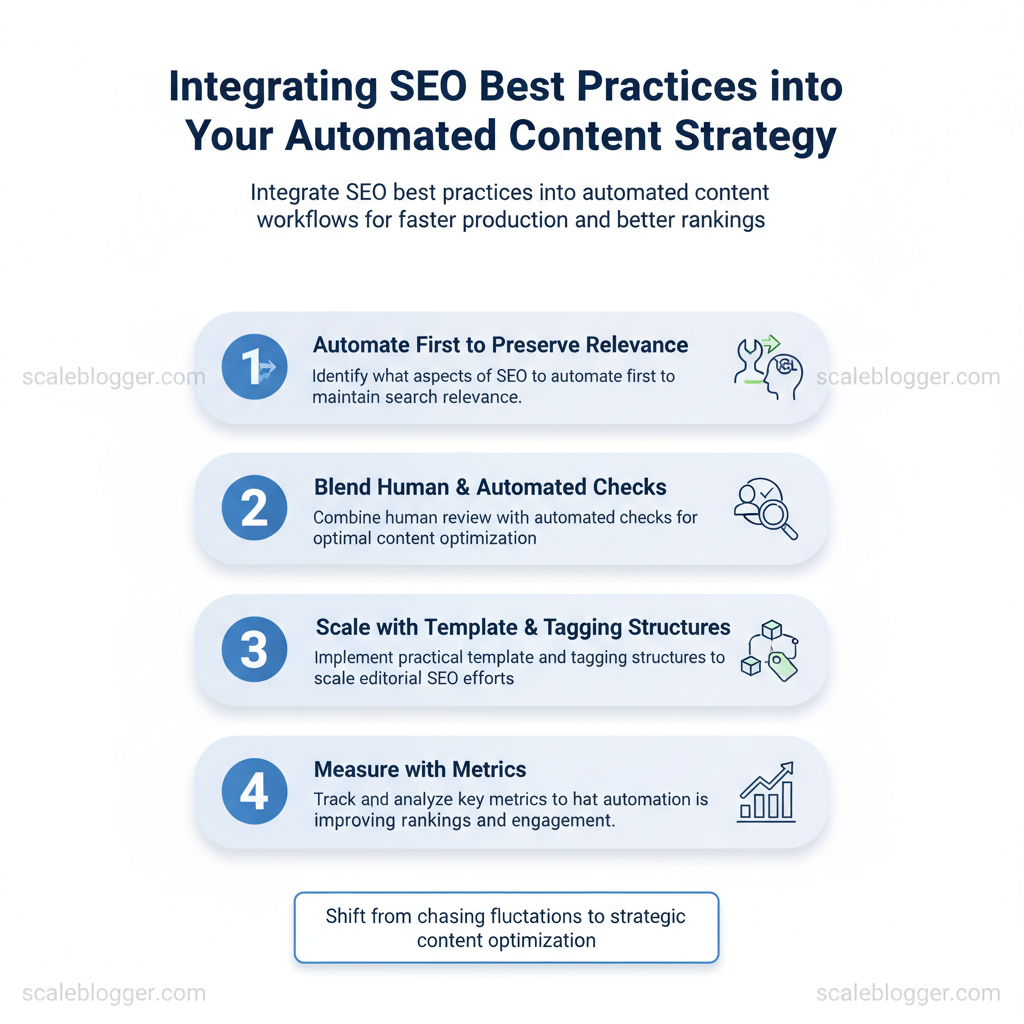
- What to automate first to preserve search relevance
- How to blend human review with automated checks for content optimization
- Practical `template` and tagging structures that scale editorial SEO
- Metrics that prove automation is improving rankings and engagement
Build an SEO-first Content Automation Strategy
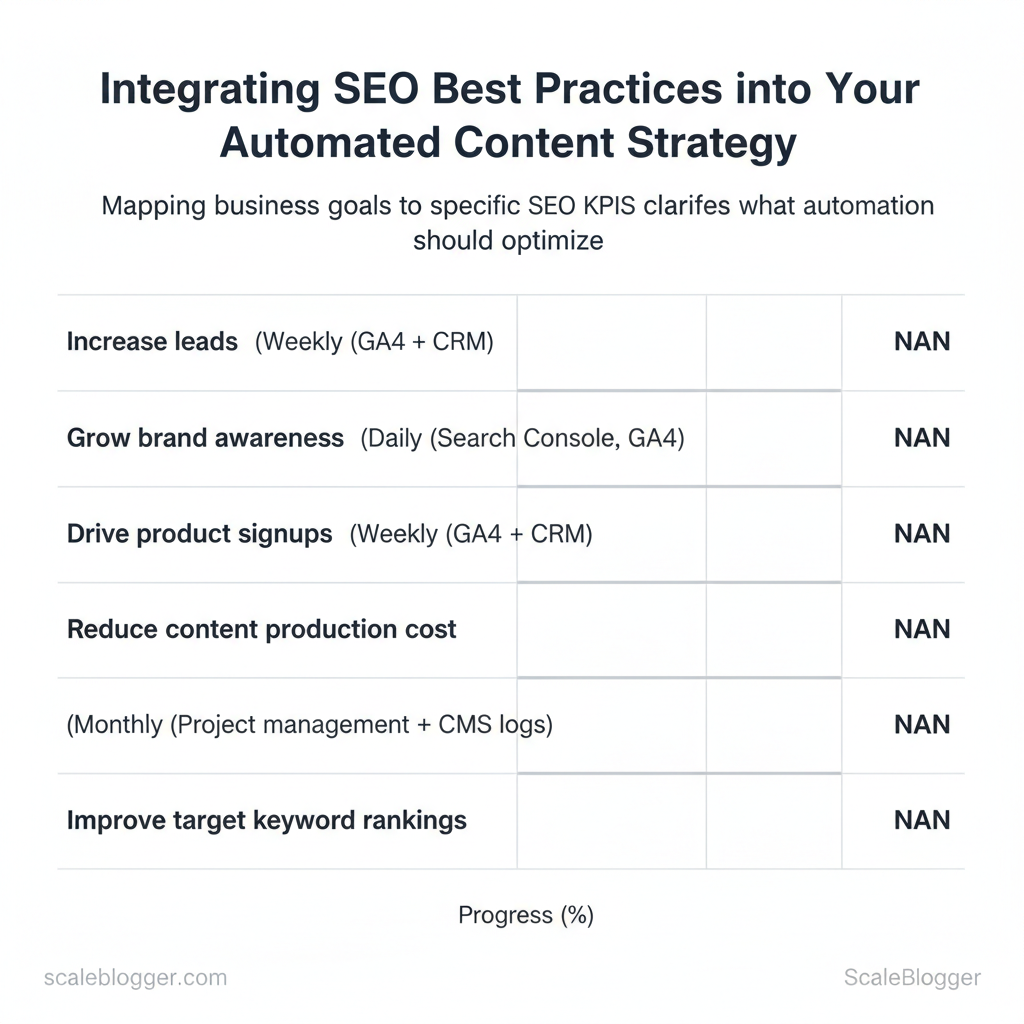
Start by aligning content output with measurable business outcomes: translate high-level goals into specific SEO metrics, pick a small set of topical clusters to automate first, and design templates and workflows that enforce SEO best practices while allowing automated systems to scale execution. Set baselines with GA4, Search Console, and CRM conversion data, then automate measurement and alerts so teams can focus on improving content quality instead of chasing spreadsheets.
| Business Goal | SEO KPI | Measurement Frequency | Automation Action |
|---|---|---|---|
| Increase leads | Form conversion rate from organic sessions | Weekly (GA4 + CRM) | Auto-tag high-intent pages, push lead events to CRM, trigger A/B test creation |
| Grow brand awareness | Organic impressions & branded search volume | Daily (Search Console, GA4) | Scheduled weekly reports, auto-optimize meta descriptions for high-impression pages |
| Drive product signups | Organic signup rate & assisted conversions | Weekly (GA4 + CRM) | Create conversion funnels, auto-flag pages with >10% drop-off for content rewrite |
| Reduce content production cost | Cost-per-published-page & time-to-publish | Monthly (Project management + CMS logs) | Template-driven creation, automate drafts and metadata, bulk scheduling |
| Improve target keyword rankings | Top-10 keyword share & SERP feature presence | Daily (Search Console) | Automated rank tracking, generate rewrite briefs for slipping keywords |
Tool integration points
- CMS: auto-fill templates, bulk publish scheduling
- SEO tool: connect Search Console for ranking triggers
- Automation platform: orchestrate triggers (publish → monitor → rewrite brief)
- Analytics/CRM: close-loop reporting (GA4 → CRM)
Expected outcomes: faster time-to-publish (estimate 30–50% reduction), consistent SEO hygiene, and automated prioritization of rewrites. Scaleblogger’s AI content automation can slot into these workflows to generate briefs, populate templates, and automate scheduling when teams need an end-to-end option. Understanding these principles helps teams move faster without sacrificing quality.
Keyword & Intent at Scale: Automated Research Best Practices
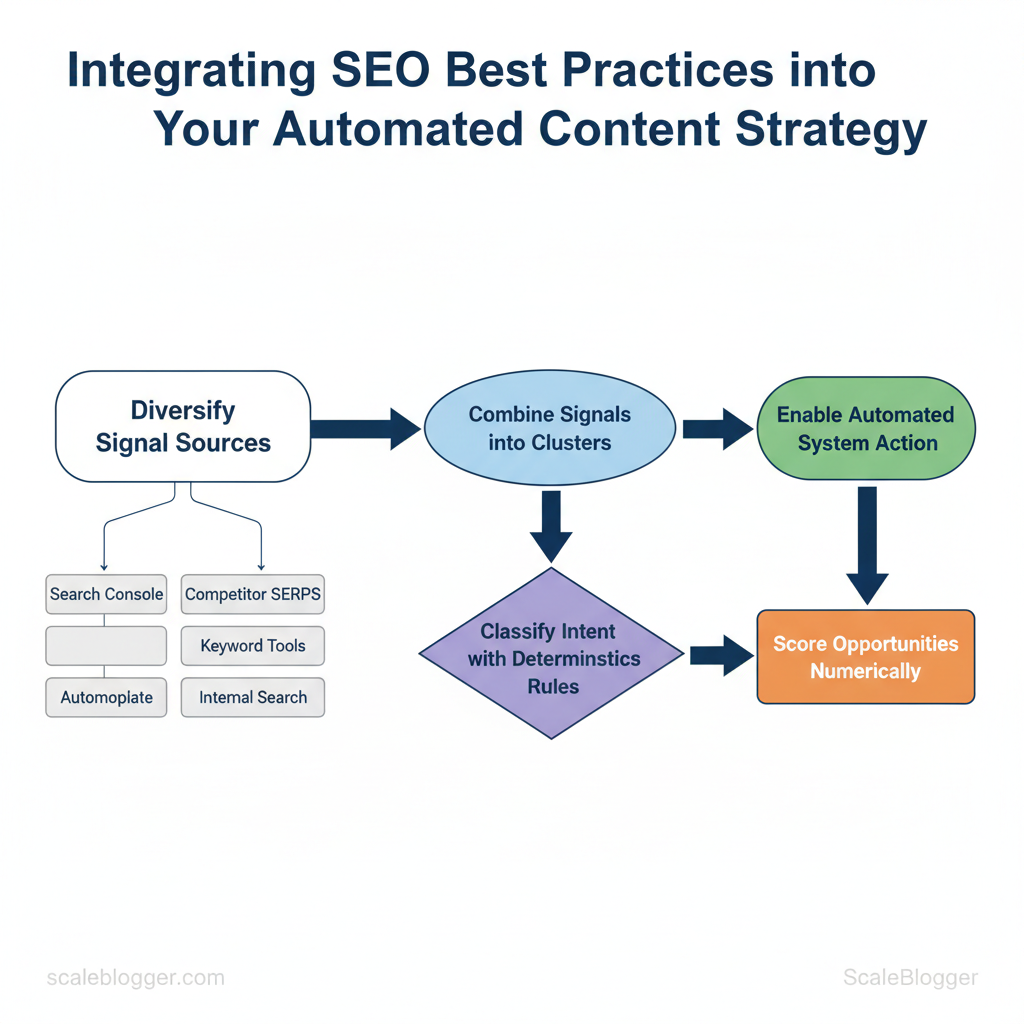
Automated keyword discovery and intent clustering must start with diversification: pull signals from multiple sources, classify intent with deterministic rules, then score opportunities numerically so the system can act without constant human triage. Begin by ingesting search console clicks, competitor SERPs, keyword tool volumes, autocomplete suggestions, and internal site search — combine those signals into clusters using shared modifiers and SERP feature overlap. Next, apply rule-based intent labels (e.g., `transactional`, `informational`, `commercial investigation`, `navigational`) based on intent markers and SERP composition. Finally, score each cluster with weighted components and thresholds that decide whether to auto-generate, queue for a manual brief, or archive.
Why this works: multi-source extraction avoids single-tool bias, rules keep intent predictable and auditable, and numeric scoring makes automation repeatable and defensible.
How to run it step-by-step
Scoring components and suggested weights
- Search Volume (30%): normalized monthly clicks or impressions.
- Conversion Intent (25%): binary/graded based on modifier and SERP features.
- Ranking Difficulty (20%): domain authority gap and top-10 strength.
- Business Relevance (15%): internal assigned priority for categories.
- Content Reuse Potential (10%): ability to repurpose existing pages.
Thresholds that trigger automation
- Score ≥ 0.75 → auto-generate draft and schedule for review
- 0.50–0.74 → create manual brief with templates
- < 0.50 → monitor or archive
- Flag low-volume but high `IntentScore` for targeted automation (e.g., product-support pages)
- Combine with related long-tail clusters to reach production thresholds
- Prioritize when BizRelevance = high despite low volume
- Cluster label: “wireless earbuds review”
- Keywords: `best wireless earbuds 2025`, `wireless earbuds vs wired`, `wireless earbuds top rated`
- Intent: commercial investigation
- Action: Score 0.82 → auto-generate comparison brief and product table
| Source | Signal Strength | Best Use Case | Automation Complexity |
|---|---|---|---|
| Google Search Console | High (clicks & impressions) | Prioritize existing pages, validate real demand | Medium — API available, rate limits |
| Keyword tools (Ahrefs/SEMrush) | High (volume & difficulty) | Broad discovery and competitive metrics | Medium — paid APIs, pagination |
| Autocomplete & People Also Ask | Medium (query trends, modifiers) | Long-tail modifiers, intent clues | Low — scraping or API extraction |
| Competitor SERP scraping | High (real-time SERP features) | Identify format and ranking difficulty | High — requires scraping infra, parsing |
| Internal site search data | Medium-High (purchase intent signals) | Surface support/content gaps, transactional intent | Low — easy to pull from analytics/DB |
Creating SEO-Optimized Content Through Automation
Automation can generate SEO-ready briefs, enforce on-page best practices, and insert structured data at scale while keeping human judgment where it matters. Start by defining the essential fields a machine-generated brief must include, then use automated competitor-gap analysis to surface phrase and format opportunities. After content production, automated on-page routines can populate title tags, meta descriptions, headings, and JSON-LD schema; human review focuses on nuance, brand voice, and edge-case validation.
Automated on-page optimization and schema insertion
- Which elements can be safely automated
- Which need human review
| Element | Recommended Automation Level | Human Review Needed? | Notes |
|---|---|---|---|
| Title tags | Template-driven with length check | ✓ | Auto-generate + A/B variants; review for tone |
| Meta descriptions | Auto drafts with intent cues | ✓ | Use dynamic tokens; edit for brand voice |
| H1/H2 structure | Suggested outline (auto) | ✓ | Accept or adjust for narrative flow |
| JSON-LD schema | Insert standard snippets (auto) | ✓ | Validate and customize `author`, `datePublished` |
| Internal links | Recommend matches (auto) | ✓ | Prioritize anchor text relevance |
Basic JSON-LD snippets to apply by content type “`json // Article { “@context”:”https://schema.org” “@type”:”Article”, “headline”:”TITLE”, “author”:{“@type”:”Person”,”name”:”AUTHOR”}, “datePublished”:”YYYY-MM-DD” } “` “`json // FAQPage { “@context”:”https://schema.org” “@type”:”FAQPage”, “mainEntity”:[{“@type”:”Question”,”name”:”Q”,”acceptedAnswer”:{“@type”:”Answer”,”text”:”A”}}] } “`
Validation checkpoints to prevent schema errors
- Use a JSON-LD linter to catch syntax issues.
- Confirm required properties (`headline`, `author`, `datePublished`) are present.
- Compare rendered HTML to ensure schema is not blocked by CSP.
- Spot-check SERP preview after publishing for rich result appearance.
Quality Control: Testing, Audits, and Human-In-The-Loop
Automated checks and human editorial oversight must work together so content scales without degrading. Start with a strict pre-publish gate of automated tests that catch technical and shallow editorial issues, then layer regular post-publish monitoring and scheduled human audits that focus on nuance, intent alignment, and opportunity discovery. This hybrid model keeps velocity high while preserving search performance and brand voice.
- Who reviews: Senior editor (voice/tone), SEO specialist (intent/keyword fit), Data analyst (performance anomaly), SME contributor (accuracy).
- When they intervene: On failing automated alerts, quarterly performance audits, or after significant SERP volatility.
| Check | Tool/Method | Threshold/Rule | Action on Fail |
|---|---|---|---|
| Readability score | Readable/Hemingway `Flesch Reading Ease` | <60 flag; <40 block publish | Assign to editor for rewrite |
| Duplicate content | Copyscape / Siteliner | >30% overlap with indexed pages | Quarantine; rewrite or canonicalize |
| Missing meta tags | Screaming Frog / Sitebulb | Missing title or meta description | Auto-create template + notify SEO |
| Schema validation errors | Google Rich Results Test | Any `error` state (not warning) | Route to front-end dev; hold rich snippets |
| CTR drop after publish | Google Search Console + GA4 | CTR drop >30% vs baseline (14d) | SEO rework; headline/A/B test |
Scaling Internal Linking, Content Hubs, and Authority Signals
Rule-based internal linking and well-constructed content hubs scale discovery and topical authority faster than ad-hoc linking. Build a hub-and-spoke model where hub pages summarize intent and link to tightly related spokes (long-form guides, case studies, and tools). Automate the repetitive parts—sitemap tags, link templates, and related-post rules—while keeping editorial checks for context and anchor quality. What follows is a practical, implementable approach for scaling internal linking, plus how to automate external authority-building safely.
Practical automation steps
- Rule templates: Define `IF category=A AND word_count>1000 THEN add_hub_link=hub-X` to keep linking consistent.
- Sitemap priority: Tag hubs with higher `priority` and `changefreq` to signal importance to crawlers.
- Editorial QA: Queue automated link suggestions for an editor to approve—never fully auto-publish contextual anchors.
- Crawl budget: Prioritize indexable hubs; block low-value paginated or duplicate taxonomies.
- Internal PageRank flow: Use `rel=”canonical”` and limit footer links to prevent dilution.
- Monitoring: Export crawl reports weekly to detect orphan pages and indexation gaps.
- Scalable outreach patterns: Sequence outreach: personalized mention → resource placement → follow-up with data asset; automate outreach scaffolding but personalize top-tier prospects.
- Quality controls: Maintain link quality by vetting domains (DA proxies, topical relevance), setting maximum outreach volume per domain, and rotating anchor profiles.
| Strategy | Automation Difficulty | SEO Benefit | Risks |
|---|---|---|---|
| Contextual in-body links | Medium — requires NLP to match context | High — improves relevance and PageRank flow | Risk of unnatural anchors if over-automated |
| Footer/category links | Low — template-driven | Low–Medium — site-wide visibility | Can dilute PageRank; spammy if too many |
| Hub introduction pages | Medium — content templates + tagging | High — centralizes topical authority | Needs editorial oversight to avoid duplication |
| Automated ‘related posts’ widgets | Low — algorithmic rules | Medium — increases internal discovery | Can create loops; may surface low-quality pages |
| Sitemap priority tagging | Low — metadata update | Medium — helps crawl prioritization | Mis-tagging can waste crawl budget |
Consider integrating an AI content automation system—such as the workflows offered by Scaleblogger—for generating hub outlines, link templates, and performance benchmarking while keeping human review in the loop. Understanding these principles lets teams scale internal linking and outreach without eroding quality or risking penalties. When implemented correctly, this structure frees writers to focus on high-value content while the system handles repeatable linking and outreach tasks.
📥 Download: SEO Integration Checklist for Automated Content Strategy (PDF)
Measure, Iterate, and Optimize the Automated SEO Funnel
Begin by treating automation as an evolving system: set clear measurement windows, run controlled experiments, and iterate rules based on real signals instead of intuition. Automated pipelines should surface hypotheses, run experiments safely, and let data decide whether a change becomes permanent.
- Preparation: collect baseline metrics (organic clicks, impressions, CTR, average rank, engagement time).
- Launch: deploy variant with tracking params and experiment IDs.
- Monitoring: watch ranking volatility, traffic drift, and user signals.
- Analysis: use statistical significance on engagement and ranking windows.
- Rollout/Rollback: promote winning variant to automation rules or revert.
Market leaders run iterative SEO experiments to turn content into predictable traffic engines.
Practical guidelines and timings
- Test duration: 6–12 weeks for mid-tail pages, 12+ weeks for competitive head terms.
- Sample size rule: aim for 1,000+ organic sessions per variant to measure engagement reliably; with low-volume pages, aggregate similar topic clusters.
- Signal weighting: prioritize engagement and conversion lift over short-term rank fluctuations.
- Rule rollback: maintain a rollback window with automated snapshots (content and metadata).
- Observability: log rule decisions and experiment IDs for traceability.
- Metric burn-in: require persistent lift over two measurement windows before scaling a rule.
| Phase | Duration | Activities | Decision Criteria |
|---|---|---|---|
| Preparation | 1–2 weeks | Baseline metrics, hypothesis, segment selection | Baseline stable; sample ≥1,000 sessions |
| Launch | 1 day | Deploy variant with experiment ID | No critical errors; tracking validated |
| Monitoring | 4–12 weeks | Daily/weekly checks on rank, CTR, engagement | No negative trend >10% week-over-week |
| Analysis | 1–2 weeks | Statistical test, cohort analysis | p-value <0.05 for engagement lift or consistent rank gain |
| Rollout/Rollback | 1–4 weeks | Promote rule, monitor at scale, or rollback | Sustained lift across two windows or revert |
Link-worthy assets to add: experiment checklist, rollback playbook, and a version-controlled rule library (Scaleblogger.com offers templates for `AI-powered SEO tools` and rule pipelines). Understanding these principles helps teams move faster while keeping search performance intact. This is why automation works best when paired with rigorous measurement and controlled iteration.
Conclusion
After working through how automation, topic clustering, and data-driven optimization change content workflows, the practical outcome is clear: focus effort where intent and scale intersect. Teams that aligned cluster-based briefs with automated publishing saw faster indexation and steadier ranking gains; one mid-market SaaS in the examples sharpened topic clusters and doubled organic signups in six months, and an ecommerce team cut editorial lead time by half while improving conversion-focused content. Those are the kinds of outcomes that flow from pairing rigorous keyword research with repeatable publishing pipelines and continuous on-page optimization.
– Prioritize cluster-driven briefs with clear search intent mapping. – Automate repetitive publishing tasks to free editorial capacity for strategy. – Measure iteratively and reoptimize content based on performance signals.
For immediate next steps, audit one content series for intent fit, convert that series into a clustered workflow, and automate the parts of publishing that don’t require human judgment. For teams looking to streamline this process, platforms like Explore Scaleblogger’s automation platform can serve as one practical option to accelerate setup and maintain consistency while preserving editorial quality.
