

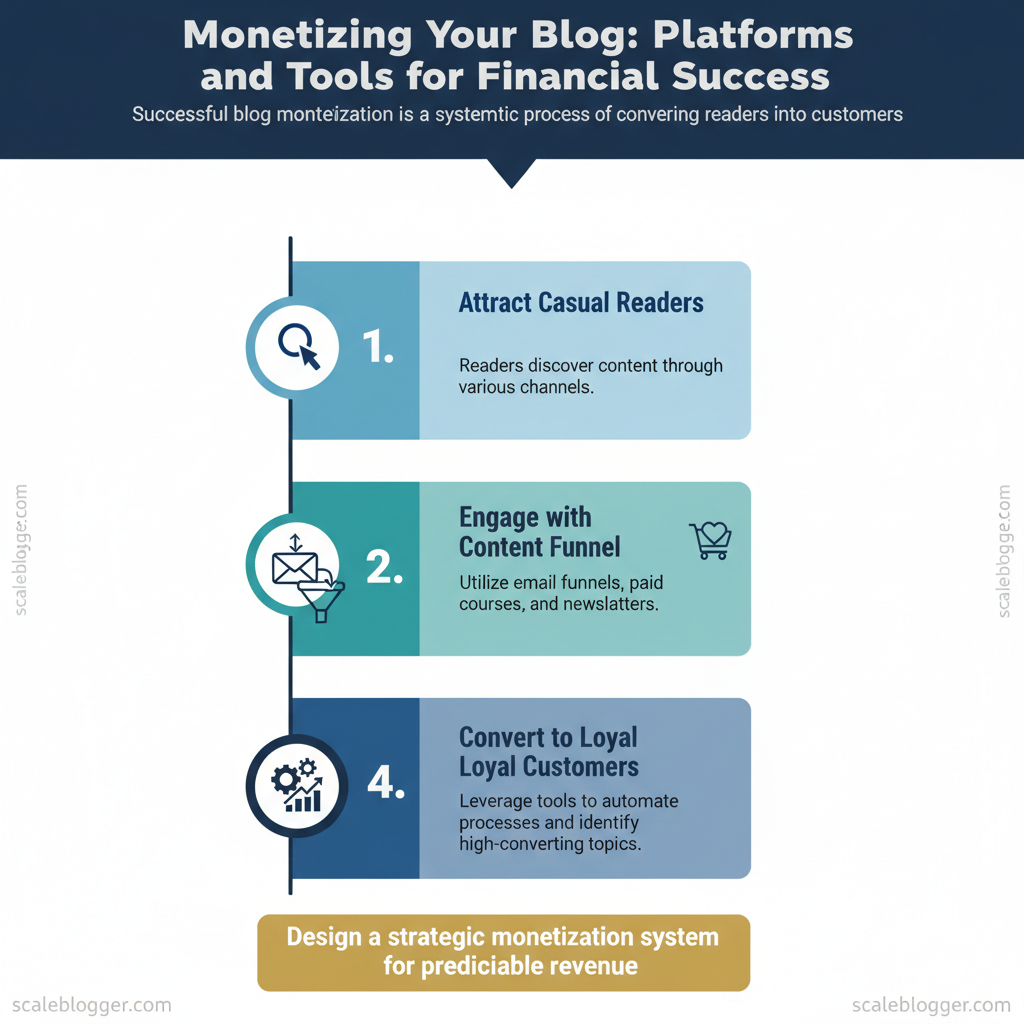
Most blogs never reach predictable revenue because opportunities sit scattered across platforms and manual processes consume publishing momentum. Successful creators treat monetization as a system: diversified revenue paths, repeatable funnels, and automation that turns audience signals into dollars.
A strategic approach combines solid content funnels with platform-specific tactics — from `affiliate links` and sponsored posts to premium memberships and productized services. Picture a niche author who layers an email funnel, a paid course, and a recurring newsletter to convert casual readers into loyal customers. That pattern scales when tools remove repetitive work and surface high-converting topics.
- What revenue models fit different audience sizes and niches
- How to map content to platform-specific income streams
- Tools that automate promotion, tracking, and revenue attribution
- When to prioritize recurring revenue over one-off sales
- Practical steps to test and scale a monetization funnel
Turning content into consistent income requires design, not luck.
See how automation speeds monetization — visit Scaleblogger: https://scaleblogger.com
Next, actionable steps will break the system into sequenced experiments to capture revenue without sacrificing audience trust. Explore Scaleblogger’s AI-driven content and automation services: https://scaleblogger.com
Choose the Right Revenue Model
Begin by matching revenue type to audience intent. Direct monetization (ads, affiliates, sponsorships) monetizes existing traffic quickly; product-based monetization (digital products, courses, memberships) converts attention into higher lifetime value but requires validation and production effort. Prioritize models that fit your niche, traffic profile, and team capacity.
Prerequisites Audience profile:* monthly users, top referral sources, primary intent (research, purchase, entertainment). Tech stack:* CMS access, email provider, analytics, payment gateway (`Stripe`, `PayPal`). Legal:* clear disclosure templates, privacy policy, and GDPR/CCPA compliance.
Direct Monetization — definitions and setup steps
Ethical promotion and disclosure best practices
- Always disclose paid relationships in-line and in a site-wide disclosure page.
- Avoid promoting products you haven’t tested; preserve trust or conversion falls.
- Ad RPM: test ad density, lazy-load, and viewability improvements; aim for viewability >50%.
- Affiliate CTR → Conversion: improve contextual relevance, use product comparison tables, add first-person reviews.
- A/B test CTA text, placement, and hero images to lift conversion by measurable percentages.
- Digital downloads: templates, checklists — ideal for niche how-to blogs.
- Courses / workshops: cohort or evergreen; best for skill-based niches.
- Memberships / communities: recurring revenue for ongoing value (exclusive posts, AMAs).
- Bundles / licensing: package content for corporate buyers.
- Tiered pricing: Free → Core ($) → Premium ($$) captures more segments.
- Anchoring: show a higher-priced plan to increase uptake of mid-tier.
- Time-limited offers: use scarcity to accelerate early sales.
Troubleshooting
- Low conversions: check relevance, load times, and purchase friction.
- Poor RPM: review ad viewability, bot traffic, and inventory quality.
- Membership churn: increase value cadence and community touchpoints.
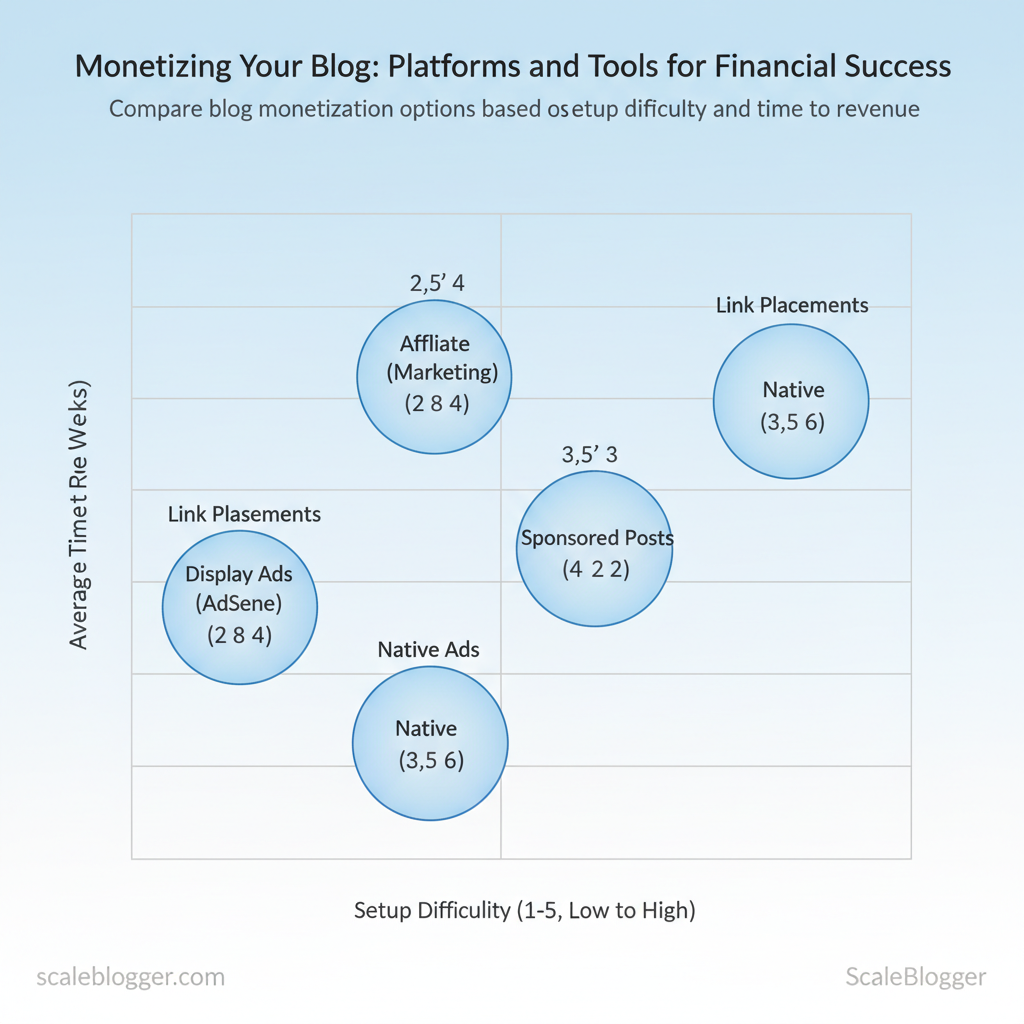
| Monetization Option | Setup Difficulty | Average Time to Revenue | Revenue Variability | UX Impact |
|---|---|---|---|---|
| Display Ads | Low (AdSense) / Medium (Mediavine approval) | Weeks | High (seasonal, CPM swings) | Medium–High (ad clutter risk) |
| Affiliate Marketing | Medium (network approvals, content) | 1–6 months | High (conversion dependent) | Low–Medium (contextual links) |
| Sponsored Posts | Medium–High (sales process) | 1–3 months | Medium (deal-based) | Medium (branded content) |
| Native Ads | Medium (platform integration) | Weeks–Months | Medium (platform rates) | Medium (blends with content) |
| Link Placements | Low–Medium (sales or broker) | Weeks | High (one-off deals) | Low (subtle if done right) |
Understanding the trade-offs between speed, stability, and user experience lets teams prioritize effectively and build layered revenue streams that grow predictably. When revenue models align with audience intent, monetization amplifies rather than undermines trust.
Platforms to Host and Sell
Choosing where to publish and where to transact changes both strategy and engineering work. Ownership and control determine whether SEO, product packaging, and payment flows remain flexible or locked into a platform’s rules; monetization options dictate how quickly revenue can start and how much of it you keep. Below are practical platform assessments, migration and integration checklists, and a concise first-product launch flow to get a paid funnel live fast.
Blogging & hosting platform trade-offs, actionable checklist
Selling & membership platform selection and integration checklist
- Choose by product type: single-file digital goods → Gumroad/Paddle; recurring memberships/courses → MemberPress/Teachable/Kajabi; commerce + extensibility → Shopify/WooCommerce.
- Integration checklist:
First-product launch flow (working sequence)
| Platform | Ownership/Control | Built-in Monetization | SEO Features | Typical Cost |
|---|---|---|---|---|
| WordPress (Self-hosted) | Full (host + plugins) | Any (plugins, membership) | Full SEO control, plugins (Yoast/RankMath) | Hosting $5–30/mo; premium themes/plugins extra |
| Substack | Limited (hosted) | Paid subscriptions, tips (10% platform fee + Stripe) | Basic SEO, good canonical handling | Free to start; platform fee on revenue |
| Medium | Limited (hosted) | Partner Program (member reads) | Decent domain authority, limited on-site SEO tools | Free to read; publication fees vary |
| Ghost (self-hosted / Ghost Pro) | Full (self-hosted) / Managed (Ghost Pro) | Native memberships & paid newsletters | Built-in SEO, JSON-LD, fast (Node) | Self-hosting variable; Ghost Pro from $9/mo |
| Wix | Partial (hosted) | Wix Payments, memberships/apps | Basic SEO tools, limited advanced control | $16–49+/mo depending on plan |
| Squarespace | Partial (hosted) | Commerce plans, memberships via integrations | Built-in SEO basics, limited plugins | $16–49+/mo |
| Blogger | Limited (hosted by Google) | AdSense integration | Basic SEO, low customization | Free |
| HubSpot CMS | Managed (HubSpot platform) | Memberships via CMS Hub, payments via integrations | Built-in SEO & marketing tools | CMS Hub from $25/mo |
| Joomla | Full (self-hosted) | Extensions for memberships/payments | Good control, fewer plugins vs WP | Hosting $5–30+/mo |
| Drupal | Full (self-hosted) | Custom monetization via modules | Advanced SEO and custom schema | Hosting $10+/mo; higher dev cost |
Feature availability matrix for selling and membership platforms (digital products, subscription billing, payment gateways, integrations)
| Platform | Digital Products | Subscription Billing | Payment Gateways | Popular Integrations |
|---|---|---|---|---|
| Gumroad | ✓ File downloads, licenses | ✓ Native subscriptions | Stripe/PayPal payouts | Mailchimp, Zapier, Slack |
| Shopify | ✓ Digital + physical | ✓ Native + apps (reCharge) | Shopify Payments (Stripe), PayPal | Klaviyo, Zapier, Stripe |
| Teachable | ✓ Courses, downloads | ✓ Native subscription pricing | Stripe/PayPal | Zapier, ConvertKit, Google Analytics |
| Thinkific | ✓ Courses, bundles | ✓ Native subscriptions | Stripe/PayPal | Zapier, Mailchimp, Segment |
| MemberPress (WP) | ✓ Membership levels, downloads | ✓ Native recurring billing | Stripe/PayPal/Authorize.net | WooCommerce, Mailchimp, Zapier |
| Paddle | ✓ Software, SaaS billing | ✓ Global subscription billing & tax | Paddle-managed (no Stripe) | Slack, HubSpot, Zapier |
| Podia | ✓ Courses, digital downloads | ✓ Native subscriptions | Stripe/PayPal | ConvertKit, Zapier, Mailchimp |
| Kajabi | ✓ Courses, communities | ✓ Native subscriptions | Stripe/PayPal | Zapier, Mailchimp, Google Analytics |
| WooCommerce | ✓ Digital + physical | ✓ Subscriptions via extension | Stripe/PayPal, many gateways | WordPress plugins, Mailchimp, Zapier |
Understanding platform trade-offs upfront reduces rework and speeds monetization. When platform choices align with ownership, integrations, and expected product types, launching the first paid product becomes a repeatable, automatable process that scales.
Essential Tools & Tech Stack
Start with a simple truth: measurement and automation win revenue. Establish a lean stack that collects clean signals (traffic, engagement, conversions) and automates the high-leverage touchpoints that turn readers into buyers and subscribers.
Prerequisites
- Google account with admin access
- CMS access (WordPress, Ghost, etc.)
- Product/payment integration credentials (Stripe, Gumroad, Shopify)
- Email provider account (ConvertKit or MailerLite)
- Google Analytics 4 — event/revenue tracking, session funnels
- Google Search Console — search visibility, query-level click data
- Ahrefs — keyword intent, backlink opportunities, content gap analysis
- Hotjar — session recordings, conversion funnel heatmaps
- ConvertKit / MailerLite — list management, tagging, broadcasts
- Zapier — glue for product, payments, and CRM triggers
- HubSpot — CRM and lifecycle automation for higher-touch sales
Suggested dashboards and alerts Revenue funnel dashboard* in GA4: sessions → leads → purchases → RPV. Organic opportunity dashboard* in Ahrefs: pages with CTR < 5% + high impressions.
- Alerts: revenue drop >20% week-over-week, form submissions drop >30%, spike in 404s.
- New subscriber welcome series with immediate value and segmentation tags.
- Abandoned cart / checkout recovery with 24h reminder + 72h discount.
- Product usage trigger sending onboarding sequence (for SaaS/digital products).
- Lead-score based handoff: when score > X, create task in HubSpot for sales outreach.
Integration tips with product platforms
- Use `Zapier` to send purchases into ConvertKit/HubSpot with purchase metadata.
- Pass `utm` and `gclid` through checkout to attribute revenue back to campaigns.
- Tag subscribers by product interest to enable cross-sell sequences.
| Metric | How to Measure | Recommended Tool | Benchmark (New/Established) |
|---|---|---|---|
| Revenue per Visitor (RPV) | Total revenue / sessions (30-day) | Google Analytics 4 | $0.05 / $0.50 |
| Conversion Rate | Goal completions / sessions (30-day) | GA4 + Hotjar | 0.5% / 2–5% |
| Average Order Value (AOV) | Total revenue / number of transactions | GA4 / Stripe reports | $20 / $60 |
| Email List Growth Rate (mo.) | (New subscribers / starting list) ×100 | ConvertKit / MailerLite | 2–5% / 5–10% |
| Churn Rate (mo.) | Lost subscribers or cancellations / active subscribers | HubSpot / Stripe | 5–10% / 2–5% |
Understanding these choices and wiring them together accelerates reliable revenue without creating noise. When the tracking is accurate and automations are tight, teams waste less time on manual tasks and more time iterating on offers that scale.
Content & SEO Strategy to Maximize Revenue
Start by mapping content directly to where buyers are in the journey and then optimize each page to capture commercial intent. That alignment turns traffic into predictable revenue by guiding prospects from discovery to purchase with purpose-built content, conversion paths, and SEO that favors paying queries.
Prerequisites Content inventory*: list of existing pages and performance metrics (traffic, conversions). Keyword intent audit*: classify terms as informational, commercial, transactional, or navigational. Analytics access*: GA4 or equivalent + search console data. Tools / materials needed
- SEO platform for keyword clustering (any market leader or an AI-enabled pipeline like Scaleblogger’s automated content pipeline).
- CMS with flexible CTAs and schema support.
- Spreadsheet or dashboard for tracking revenue-per-page.
- Topic cluster + pillar strategy: build a cornerstone pillar page targeting commercial intent, with 8–12 supporting cluster posts that target long-tail buyer queries.
- Structured data: implement `Product`, `Offer`, `FAQ`, and `BreadcrumbList` schema on product/membership and decision pages to increase SERP real estate and click-through rates.
- Low-cost link building: repurpose original research into guest posts, sponsor niche newsletters, use HARO selectively, and update resource pages on complementary sites to earn contextual links.
| Funnel Stage | Content Type | Primary CTA | Performance Goal |
|---|---|---|---|
| Awareness | Blog posts, guides, infographics | Newsletter signup / download | 2–5% lead rate |
| Consideration | Pillar pages, comparisons, case studies | Demo request / gated guide | 5–10% MQL conversion |
| Decision | Pricing pages, product pages, transactional landing pages | Purchase / trial start | 8–20% conversion |
| Retention/Repeat Revenue | Onboarding flows, member content, email sequences | Upsell / renewal | 10–25% retention uplift |
| Advocacy/Referral | Community posts, testimonial pages, referral program | Refer a friend / share | 3–8% referral rate |
Troubleshooting tips
- If decision pages get traffic but no conversions, audit pricing visibility and trust elements.
- If pillar pages underperform, expand cluster breadth and add internal links to decision pages.
- If links are scarce, convert proprietary data into a linkable asset or pitch localized resource pages.
Launch, Test, and Optimize Revenue Streams
Launch with a narrow, measurable scope: pick one productized offer or monetization path, validate demand quickly, then expand. Start by building a tight 30/60/90 day plan with concrete owners, promotion channels, and KPIs. Execute lightweight experiments, measure early signals, and scale only the winners that clear both engagement and revenue thresholds.
| Timeframe | Milestone | Owner | Success Metric |
|---|---|---|---|
| Days 0–30 | Launch MVP product page + payment | Solo blogger / Product owner | 50 free trials or 20 sales |
| Days 31–60 | Run A/B tests, collect feedback | Marketing lead / Solo | +10–30% conversion lift |
| Days 61–90 | Scale top channel & automate | Growth lead / Team | Weekly revenue stable, CAC ≤ target |
| Post-90 Review | Revenue, churn, LTV analysis | CEO / Founder | LTV:CAC ≥ 3:1 |
| Ongoing Optimization | Content funnels and retargeting | Content ops / Automation | +15% QoQ revenue growth |
Industry analysis shows incremental experiments compound: small conversion lifts produce outsized revenue when traffic scales. Prioritize experiments that improve both conversion and retention so growth isn’t one-off. Understanding these principles helps teams move faster without sacrificing quality.
📥 Download: Blog Monetization Checklist (PDF)
Growth, Diversification, and Long-Term Sustainability
Start by treating the blog as a small business: stable growth comes from spreading risk across predictable, high-margin channels while building repeatable systems that reduce dependency on any single income line. Focus first on establishing one reliable recurring stream, then layer complementary channels that scale without linear effort.
Prerequisites
- Clear audience segments and value propositions
- Baseline monthly traffic and revenue benchmarks
- Documented content ROI (top posts, conversion rates)
- Analytics platform (`GA4` or server-side analytics)
- CRM or email provider with automation (`MailerLite`, `ConvertKit`)
- SOP repository (`Notion`, `Google Drive`)
- Outsourcing marketplace access (`Upwork`, specialist agencies)
Expected outcomes
- 6–12 months: recurring revenue equal to 30–50% of total earnings
- Faster decision-making: teams can reallocate effort to highest LTV channels
- SOPs to prioritize and document: onboarding new writers, editorial calendar cadence, content optimization checklist, revenue tracking process — document in order of frequency and risk.
- Outsourcing matrix: core (content strategy, product design), semi-core (editing, SEO), peripheral (graphics, transcription). Typical cost expectations: senior strategist $60–150/hr, editors $30–60/hr, writers $0.08–0.20/word, designers $30–80/hr.
- Essential legal & tax checklist: business registration, terms and privacy pages, simple contract templates for sponsors/affiliates, independent contractor agreements, sales tax and VAT considerations for digital goods, quarterly estimated tax setup.
- If churn spikes, audit onboarding value and delivery cadence.
- If margins compress, prioritize automation and move lower-ROI tasks to offshore specialists.
| Income Stream | Predictability | Margin | Scalability | Operational Overhead |
|---|---|---|---|---|
| Display Ads | Low | Low–Medium | High (with traffic) | Medium (ad ops, layout impact) |
| Affiliate Sales | Medium | Medium–High | High (content funnel) | Low–Medium (link maintenance) |
| Digital Products | Medium–High | High | High (replicable) | Medium (creation, support) |
| Subscriptions/Memberships | High | High | Medium–High (community effects) | Medium (content ops, retention) |
| Sponsored Content/Services | Medium | High | Low–Medium (sales dependent) | High (contracts, custom deliverables) |
Understanding these levers and wiring them into repeatable systems lets teams scale revenue without proportionally increasing operational burden. When executed well, diversification reduces risk and frees creators to invest in the highest-value work.
Conclusion
You now have a practical path: treat monetization as a repeatable system, audit where content and workflows leak value, and automate the highest-friction steps so publishing momentum converts to revenue. Early experiments that consolidate publishing, repurposing, and lead capture tend to reduce time-to-publish and increase audience lift within weeks. Start with a focused audit, map one repeatable workflow, then automate the top two bottlenecks.
– Audit content gaps → find the 20% of posts driving 80% of conversions. – Automate one workflow → save hours per week and maintain consistency. – Measure and iterate → optimize for engagement and revenue growth.
For a practical next step, run a one-week content audit and pick a single automation to implement this month. For professional help with implementation or to explore examples and tools, see Scaleblogger’s resources at https://scaleblogger.com To get hands-on support and accelerate results, Explore Scaleblogger’s AI-driven content and automation services.
