

Marketing teams lose momentum — and audience attention — when the same post lands on every platform unchanged. Poorly adapted content looks generic, performs worse, and wastes time that should drive growth. Smart teams treat cross-posting as a precision tactic, not a shortcuts-and-hopium routine.
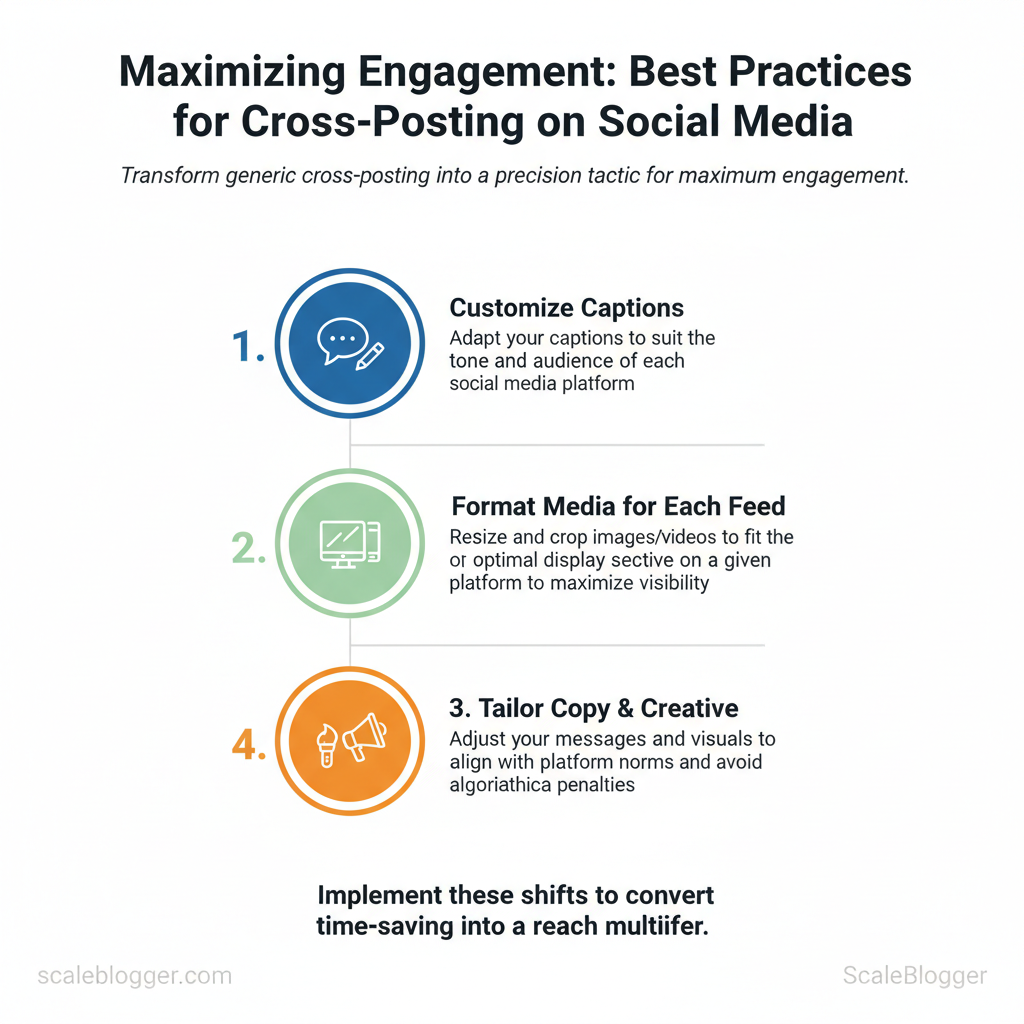
Customize captions, format media for each feed, and schedule with platform-specific timing to preserve reach and engagement. Industry guides emphasize tailoring copy and creative to platform norms to avoid algorithmic penalties and audience fatigue (Iconosquare provides practical guidance on these points). Getting this right converts a time-saver into a reach multiplier.
Picture a small brand doubling its click-throughs by shifting from identical captions to platform-native hooks and image crops. The steps that follow will show how to implement that shift with predictable outcomes and less manual effort.
- What to change per platform to boost engagement
- How to format media without extra design hours
- Timing strategies that respect each algorithm
- Tools and workflows to reduce repetitive work
Plan Your Cross-Posting Strategy
Prerequisites Audience personas* mapped to each platform. One long-form asset* (pillar post, podcast episode, webinar) ready as the source of truth.
- Editorial calendar framework (spreadsheet or tool) and access to scheduling tools.
- Content calendar (Google Sheets or Airtable)
- Scheduling platform (native schedulers, Buffer, or your CMS)
- Lightweight automation for repurposing (Scaleblogger’s AI pipeline or similar)
- Asset repo with copy, image sizes, and video cuts
Practical templates Use this simple mapping as a starting point: “`text Pillar: Industry Trends – Pillar asset: 2,500-word blog + 10-min video – LinkedIn: Long post + link (1) – Instagram: Carousel (3 slides) + Reel (1) – X: Thread (1) – Facebook: Short post + link (1) – TikTok: 15–30s tip clip (2) “`
Warnings and tips
- Avoid one-size-fits-all captions; tailor tone and CTAs per platform.
- Stagger posting times to prevent audience overlap and platform penalization.
- Use analytics to drop low-performing formats and double down on winners.
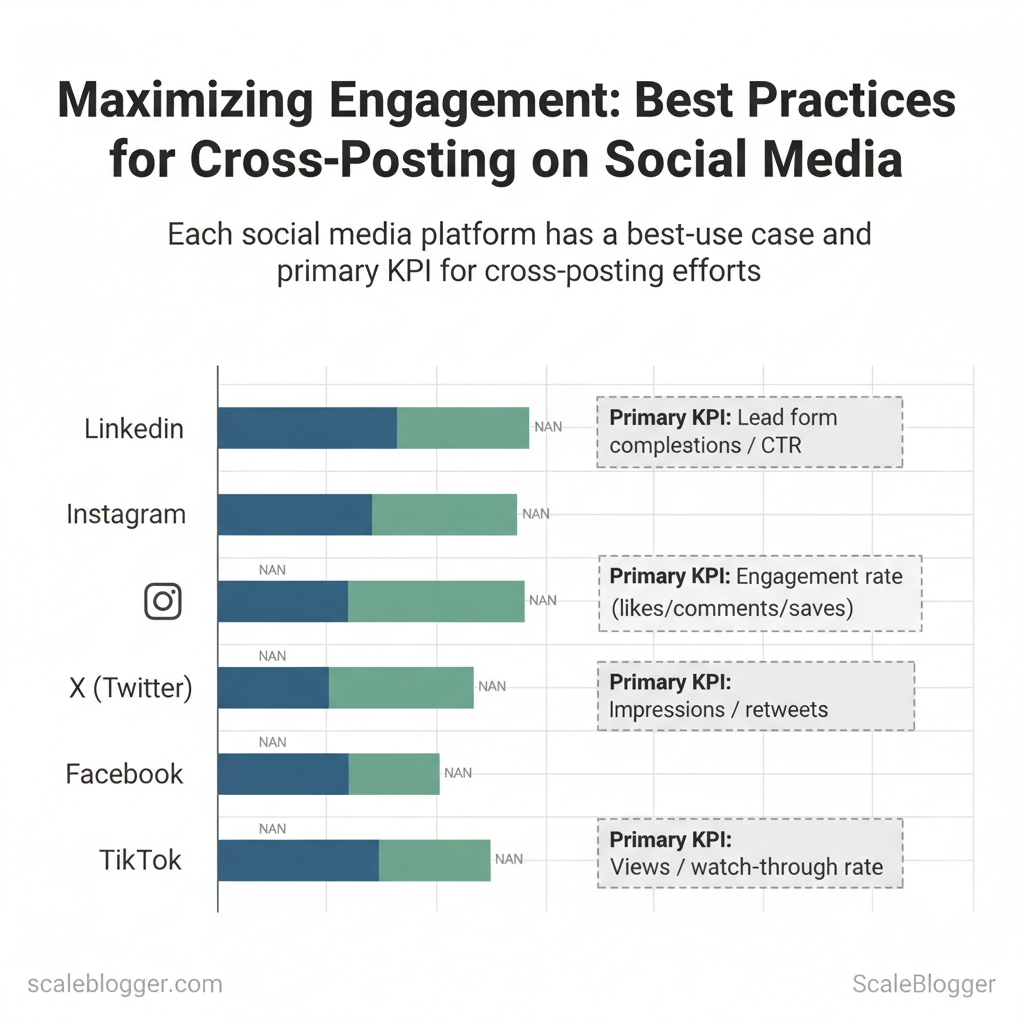
| Platform | Best Use Case | Ideal Content Type | Primary KPI |
|---|---|---|---|
| B2B thought leadership, lead gen | Long posts, articles, native video | Lead form completions / CTR | |
| Visual brand storytelling, community | Reels, carousels, Stories | Engagement rate (likes/comments/saves) | |
| X (Twitter) | Real-time updates, thread-based education | Threads, short text, GIFs | Impressions / retweets |
| Community and sharing long-form links | Native video, link posts, groups | Reach / link clicks | |
| TikTok | Rapid awareness and short tutorials | Short vertical videos (15–60s) | Views / watch-through rate |
Understanding these principles helps teams move faster without sacrificing quality. When implemented correctly, the approach reduces overhead and keeps creative focus on the highest-impact formats.
Craft Platform-Specific Copy and Creative
Start by treating each platform as a different language of the same brand. Short tweaks—tone, length, visual crop—change performance dramatically. Apply these rules to make repurposing fast, consistent, and high-impact.
Prerequisites
- Brand voice guidelines (tone, banned words, CTA hierarchy)
- Master asset (long-form caption, full-size video, raw image)
- Export presets for common aspect ratios and resolutions
Copywriting Formulas & Tone Adjustments — step-by-step
Visuals: Resize, Reformat, and Reframe — practical actions
- Always export using platform-optimized aspect ratios: `1.91:1` or `16:9` for Facebook, `1:1` and `4:5` for Instagram feed, `9:16` for Reels/TikTok, and `1200×675` for X.
- Produce three thumbnails per video: wide crop, portrait crop, and a still with bold on-image text.
- Add burned-in captions for TikTok/Instagram and SRT files for long-form LinkedIn posts.
- Write concise alt text (100–125 characters) describing the image and include primary keyword where appropriate.
- Automate resizing with batch presets in your pipeline to reduce QA time.
| Platform | Recommended Tone | Typical Length | Hashtag Strategy |
|---|---|---|---|
| Professional, insight-driven | 100–300 words (long-form OK) | 3–5 industry hashtags; no emoji or minimal | |
| Conversational, visual-first | 1–3 short paragraphs; 125–300 characters | 5–10 relevant hashtags; include branded tag | |
| X (Twitter) | Punchy, newsy, concise | 20–70 characters (thread when needed) | 1–2 hashtags; topical trending tag optional |
| TikTok | Authentic, energetic | 15–60 seconds (caption 50–150 chars) | 3–6 hashtags; trend/creator tags important |
| Balanced, community-focused | 40–150 words | 2–4 hashtags; mix brand + topical tags |
Expected outcomes
- Faster cross-post production with consistent brand voice
- Higher engagement from appropriate hooks and visuals
- Fewer revision cycles when teams use templates and export presets
- If reach drops after cross-posting, customize captions rather than reusing verbatim. Industry guides from Iconosquare and Buffer show cross-posting loses traction when captions aren’t tailored (Iconosquare cross-posting best practices, Buffer cross-posting guide).
- If captions feel robotic, map 5-7 brand phrases to platform-specific variants and use them as replacements.
Scheduling, Automation, and Tools
Select scheduling tools that publish natively, fit your team size, and give you the metrics necessary to decide what to repeat. Start by prioritizing native posting for each platform (X/Instagram/Facebook/LinkedIn/TikTok), because cross-posting via APIs or workarounds often reduces reach. Next, balance price against capabilities: a cheaper tool that lacks approval workflows or post-level analytics creates hidden costs in rework and risk.
Prerequisites
Tools and materials needed
- Spreadsheet of platform requirements and post types.
- Test accounts or free trials for shortlisted tools.
- `CSV` of content calendar exports for migrations.
- Staggered cadence: Avoid identical copy across platforms in quick succession.
- Smart queues: Use time-zone aware queues to maximize local engagement.
- Analytics baseline: Compare scheduler analytics to native platform insights monthly.
| Tool | Native Posting | Analytics | Team Collaboration | Price Tier |
|---|---|---|---|---|
| Hootsuite | ✓ Native FB/X/IG/LinkedIn | Advanced reports, custom | ✓ Approvals, roles | $99+/mo |
| Sprout Social | ✓ Native broad coverage | Strong analytics + listening | ✓ Workflow + approvals | $249+/mo |
| Buffer | ✓ Native core platforms | Basic & custom reports | ✓ Simple team seats | Free; $6+/seat |
| Later | ✓ IG-first (Reels scheduling) | Visual analytics, linkin.bio | ✓ Planner + approvals | Free–$18+/mo |
| Loomly | ✓ Native posting | Post ideas + analytics | ✓ Approval workflows | $26+/mo |
| Agorapulse | ✓ Native posting | Social inbox & reports | ✓ Collaboration + approvals | $79+/mo |
| MeetEdgar | ✓ Native reposting focus | Basic engagement metrics | ✓ Library + scheduling | $19+/mo |
| SocialBee | ✓ Native posting | Category analytics | ✓ Team roles | $29+/mo |
| Sendible | ✓ Native posting | White-label reports | ✓ Approvals & queues | $29+/mo |
| Zoho Social | ✓ Native posting | Affordable analytics | ✓ Team workflows | $10+/mo |
Understanding these principles helps teams move faster without sacrificing quality. When implemented correctly, this approach reduces overhead by making decisions at the team level.
Optimize for Engagement and Algorithm Signals
Prerequisites: access to platform analytics (native or GA4), a content calendar, short-form video capability, and conversational CTAs.
Tools / materials needed: native analytics dashboards, a simple A/B testing sheet, `CSV` export of post-level engagement, short-video editor (mobile or desktop), and an automated scheduler (Scaleblogger’s automated pipeline is a practical option for test-and-scale workflows).
Timing, frequency, and interaction prompts — step-by-step
Leverage native features and rich media — practical guidelines
- Prioritize native formats: upload video natively rather than link-sharing; platforms reward native `video` with extended distribution.
- Repurpose long-form into short-form: turn a blog into a 30–60s reel, plus a carousel highlighting five data points.
- Use interactive elements: polls, questions, countdown stickers and live Q&A sessions encourage session time and repeated visits.
- Mix media types across the funnel: Reels for reach, carousels for saves, stories for quick engagement nudges, lives for deep conversations.
| Feature | Best For | Typical Engagement Lift | Usage Tip |
|---|---|---|---|
| Reels / Shorts | Reach & shares | ~2x reach vs feed posts | Post natively, use captions & hooks first 3s |
| Stories | Quick interactions & repeat views | +10–30% story view-through | Use polls, stickers, and swipe-ups for CTAs |
| Carousels | Saves & dwell time | +20–40% saves vs single images | Lead with strong image, end with CTA slide |
| Live Streams | Real-time comments & loyalty | High comment rate, long session time |
Understanding these principles helps teams move faster without sacrificing quality. When implemented correctly, this approach reduces overhead and makes each post work harder.
Measure, Test, and Iterate
Prerequisites
- Access to platform analytics and GA4 with `UTM` tagging enabled
- Content calendar with versioned posts for A/B testing
- A link shortener that preserves `UTM` parameters (e.g., Bitly)
- Platform analytics (Facebook Insights, Instagram Insights, X/Twitter Analytics)
- Google Analytics (GA4) for cross-channel attribution
- Bitly or Rebrandly for shortened links
- Social dashboards: Sprout Social, Iconosquare, Buffer
- Spreadsheet or BI tool for the KPI dashboard
- Faster tactical fixes from weekly signals
- Monthly strategic pivots informed by aggregated trends
- Ongoing improvement via repeatable A/B learning loops
Troubleshooting tips
- Low sample size: extend test duration or broaden audience segment.
- Conflicting signals across platforms: prioritize GA4 for multi-channel attribution.
- Attribution noise from shortened links: confirm the shortener preserves `UTM` parameters.
| Metric | Goal (Example) | Reporting Frequency | Recommended Tool |
|---|---|---|---|
| Impressions | 100k/mo | Weekly (trend) / Monthly (strategy) | Platform analytics, Iconosquare, Buffer |
| Engagement Rate | 4% per post | Weekly | Instagram Insights, Facebook Insights, Sprout Social |
| Clicks / CTR | 2.5% CTR | Weekly (tactical) / Monthly (campaign) | Google Analytics (GA4), Bitly click data |
| Conversions | 3% conversion | Weekly (leads) / Monthly (revenue) | GA4, CRM integration, UTM performance |
| Saves / Shares | 500/mo | Weekly (signals) / Monthly (strategy) | Platform analytics, Dripify, Iconosquare |
Follow this cadence and the learning loops will compress decision time and produce consistent lift. When measurement is embedded in the workflow, teams move faster and make higher-confidence bets.
📥 Download: Cross-Posting Engagement Checklist (PDF)
Governance, Compliance, and Scaling Teams
Start by treating governance as an operational playbook rather than a static policy document. Standardized playbooks and short, enforced approval loops keep content timely while preventing legal and brand mishaps.
- Metadata standardization — single-field values for audience and pillar to enable reporting.
- Short approval cycles — enforce SLAs in the tool, not email.
- Role clarity — avoid dual ownership of “approve” permission.
- Automation — use scheduling rules that prevent publishing without required approvals.
- Sponsored content must be labeled with clear disclosure (`#ad`, “Paid partnership”) per platform rules and FTC guidance.
- Accessibility requires `alt` text for images, captioned video, and concise descriptive copy for assistive tech.
- Crisis protocol: implement a `pause-and-review` workflow—any post flagged by monitoring tools triggers an immediate hold, 4-hour audit window, and escalation to legal/PR.
Market leaders recommend customizing captions per platform to preserve engagement, not blind cross-posting (see Buffer’s cross-posting guidance for best practices: https://buffer.com/resources/how-to-crosspost/).
Role matrix that maps responsibilities (create, review, approve, publish) to team members and tool capabilities to prevent overlap
| Role | Responsibility | Approval Window | Tool/Permission |
|---|---|---|---|
| Content Creator | Draft copy, assets, metadata; add `alt` text | 24–48 hours | Hootsuite Drafts (create/edit) |
| Editor | Fact-check, SEO, tone, accessibility | 24 hours | Contentful/Google Docs (review comments) |
| Approver/Legal | Compliance, brand, sponsorship disclosure | 48 hours (expedited 4 hrs) | Brandfolder + Adobe Sign (approve) |
| Publisher | Schedule/publish, platform QA, analytics tagging | 4–12 hours for time-sensitive | Sprout Social/Buffer (publish with role perms) |
Operationalize these practices with monthly audits, a versioned playbook, and automated checks in your CMS and social tools. Understanding these principles helps teams move faster without sacrificing quality. When implemented correctly, this approach reduces overhead by making decisions at the team level.
Conclusion
Walking away, keep three practical moves front of mind: adapt creative for each platform, use templates to cut production time, and measure performance by post variant, not just by channel. Brands that adjusted captions and image crops while preserving core messaging consistently saw higher engagement and less audience fatigue; small edits often outperform wholesale reposting. If wondering how much extra time this adds, start with one campaign and a reusable template—you’ll typically reach positive lift within a handful of posts. For more tactical examples and templates, see the Scaleblogger blog.
Make implementation concrete: set a weekly cadence, A/B a caption or CTA per platform, and automate distribution once variants are proven. When ready to scale that process, Try Scaleblogger to automate and optimize your cross-posting workflow to reduce manual work, enforce platform-specific rules, and keep consistent measurement across channels.
