

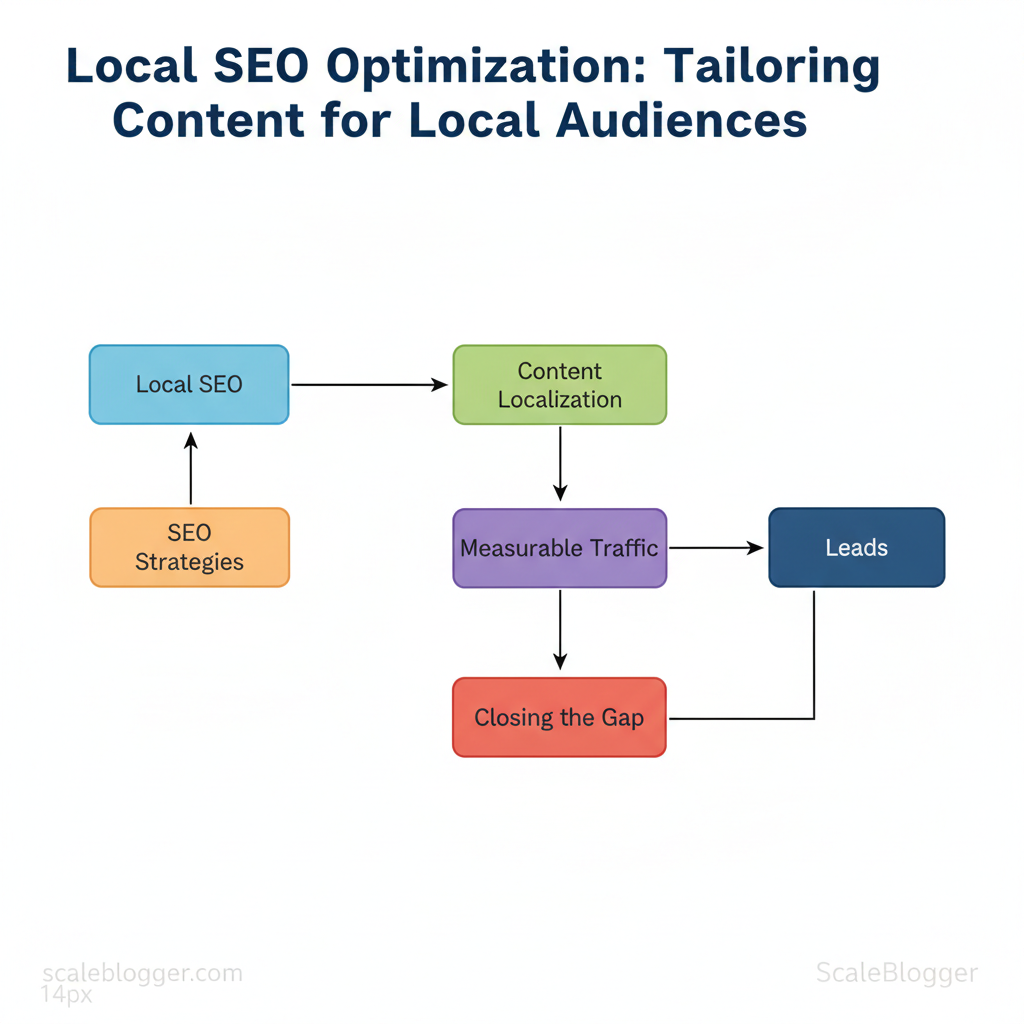
Local competitors often outrank broader brands simply because their content speaks the local language of intent. Too many teams treat location tags and citations as afterthoughts, then wonder why conversion rates lag. Focusing on local SEO through deliberate content localization and smarter SEO strategies closes that gap and turns local relevance into measurable traffic and leads.
Targeting city-level queries, tailoring landing pages to neighborhood needs, and aligning schema with local services reduce friction for searchers and for ranking signals. Picture a service page that answers the exact questions a nearby buyer types at 9 p.m.; that page will outperform a generic regional overview. Industry trends show audiences reward specificity, and marketers who operationalize localization win visibility and revenue.
- Tactics for tying `local-business` schema to service pages
- Ways to scale personalized local pages using automation
- Metrics to track local performance beyond rankings
- Common localization mistakes that waste editorial effort
Understanding Local Search and Audience Intent
Local search ranks results differently than generic web search: Google favors proximity, direct relevance to the query, and local prominence signals such as reviews, citations, and consistent business data. Content that aligns with those signals — clear local keywords, structured `schema` markup, location-specific landing pages and useful local resources — moves listings into the map pack and improves organic visibility. For teams building local content, the practical job is translating user intent into the right content format while reinforcing business signals that Google uses to trust and rank a location.
How Local Search Works (Signals & Ranking Factors)
- Proximity — how close a searcher is to the business location; you can’t outrank distance, but you can capture queries for nearby neighborhoods with local pages.
- Relevance — how well a page or profile matches the query intent; use explicit local phrases and service modifiers.
- Prominence — overall reputation signals (reviews, backlinks, mentions); content that generates local citations and links raises prominence.
- Behavioral signals — clicks, calls, direction requests and dwell time from local searches; useful content increases engagement.
- Structured data & citations — correct NAP (name, address, phone) across directories and `LocalBusiness` schema reduce friction and improve eligibility for map features.
Mapping Local User Intent to Content Types
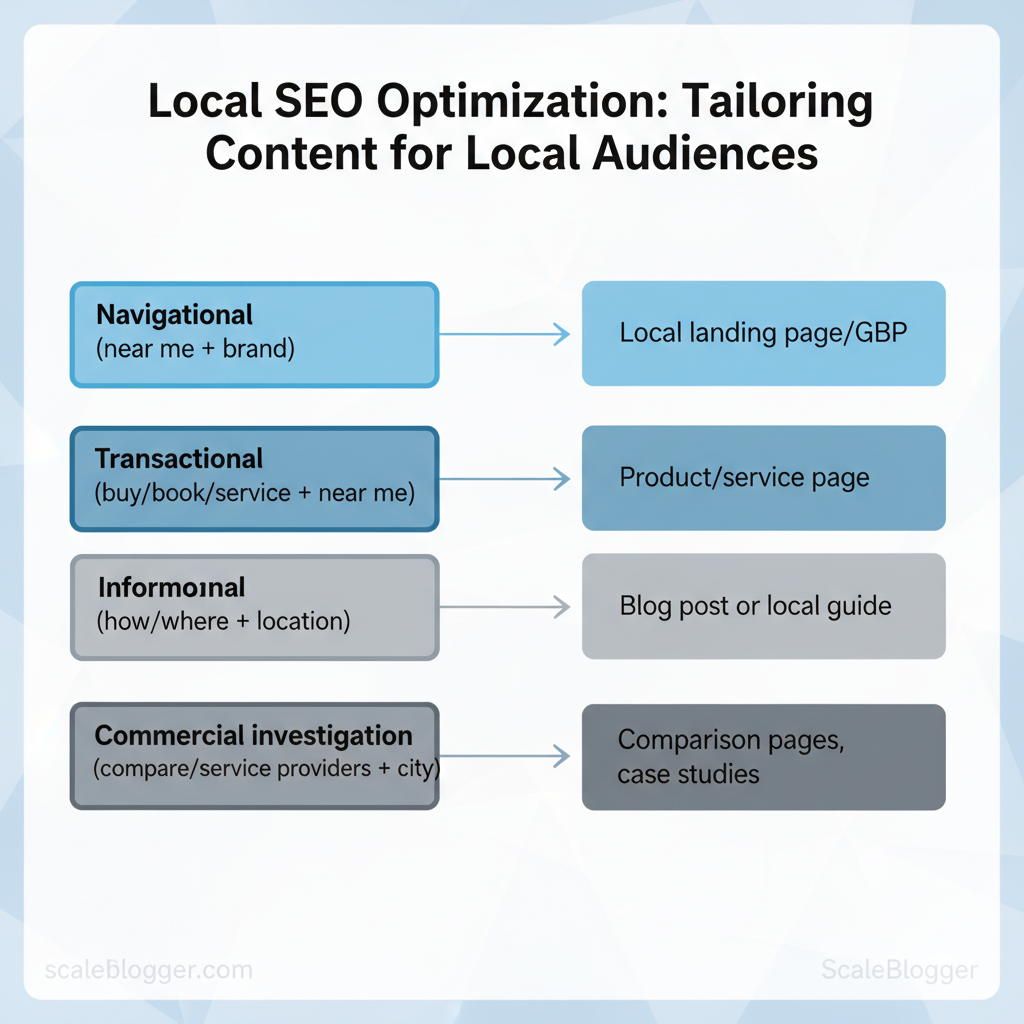
- Navigational (near me + brand) — Local landing page or GBP optimization.
- Transactional (buy/book/service + near me) — Product/service page with local availability and `book/call` CTAs.
- Informational (how/where + location) — Blog post or local guide with neighborhood context and internal links.
- Commercial investigation (compare/service providers + city) — Comparison pages, case studies, testimonials targeting local competitors.
- Service + City: “Emergency Plumber in `City` — 24/7 Service & Same-Day Repairs”
- Near-me transactional: “Best Italian Restaurant Near `Neighborhood`, `City` — Reserve Online”
- Local guide informational: “A Local’s Guide to `Service` in `City`: Prices, Reviews & Neighborhood Tips”
- Comparison/commercial: “`Service A` vs `Service B` in `City`: Which Is Right for You?”
| Ranking Signal | How it Works | Content Actions | Priority (High/Med/Low) |
|---|---|---|---|
| Proximity | Distance from searcher to business | Create neighborhood pages; use local modifiers | High |
| Relevance | Query-page relevance via keywords and intent | Include explicit local keywords, service modifiers | High |
| Prominence | Reviews, backlinks, local mentions, media | Publish review-focused pages; PR for local backlinks | High |
| Behavioral Signals | Clicks, calls, directions, dwell time | Optimize CTAs, speed, and local FAQs to increase engagement | Med |
| Structured Data & Citations | `LocalBusiness` schema and consistent NAP across directories | Add schema, audit citations, maintain GBP accuracy | High |
Researching Local Keywords and Topics
Start with the neighborhoods and user intent you actually want to capture: local keyword research succeeds when it maps geographic granularity (city, neighborhood, zip code) to clear user intent (find, compare, buy, learn). Begin by compiling addressable locations, then expand with modifiers people actually use — `near me`, `best`, `cheap`, and hyperlocal references like stadiums or transit stops. Validate each candidate by checking search behavior and intent signals before deciding whether to target it with a page, a section, or a brief FAQ.
Tools & techniques for practical work
Organizing keywords into local topic clusters
- Cluster by intent: Group discovery queries (informational) separately from purchase queries (transactional).
- Cluster by location granularity: City-level, neighborhood-level, and venue-level clusters should live on different templates.
- Cluster by funnel stage: Use the funnel stage as a page creation rule — one page for high-intent transactional clusters, cluster landing pages for multiple neighborhoods, and blog posts for informational clusters.
- Column A: Keyword — exact phrase
- Column B: Location tag — city/neighborhood/ZIP
- Column C: Intent — Informational / Commercial / Transactional
- Column D: Volume (monthly) — validated estimate
- Column E: SERP features — local pack / maps / reviews
- Column F: Priority score — formula combining volume, intent, and difficulty
- Column G: Page decision — create / add FAQ / no page
Suggest building automated exports from Google Search Console + a keyword API into this schema to keep cluster data fresh; for teams ready to scale, use AI content automation to generate drafts and templates. Understanding these principles helps teams move faster without sacrificing quality.
| Tool | Local Keyword Features | Cost | Best For |
|---|---|---|---|
| Google Keyword Planner | Search volume, location filters, keyword forecasts | Free (requires Ads account) | Basic volume estimates |
| Google Search Console | Actual query data, performance by country/city (limited) | Free | Validating real queries |
| Ahrefs | Local SERP tracking, keyword explorer, traffic estimates | From $99/month | Competitive research |
| Semrush | Local keyword magic tool, position tracking, map pack insights | From $129.95/month | Enterprise local SEO |
| BrightLocal | Local rank tracking, citation audit, Google My Business tools | From $29/month | Local performance monitoring |
| Moz Local | Local listing management, citation sync, local listings score | From $129/year (platform varies) | Listing consistency |
| Mangools (KWFinder) | Long-tail local suggestions, SERP analysis | From $29.90/month | Budget-friendly keyword discovery |
| Ubersuggest | Local keyword suggestions, traffic estimates, SEO difficulty | From $12/month | Small budgets, quick ideas |
| LocalFalcon | Visual local rank heatmaps by ZIP/neighborhood | From $29/month | Hyperlocal rank visualization |
| AnswerThePublic | Question and preposition-based local content ideas | Free/paid | Ideation for FAQs and blogs |
Creating and Localizing Content at Scale
Start with a clear, repeatable template and a lightweight automation layer so local pages stay relevant without manual rewriting for every location. Templates preserve SEO structure (H1, meta, schema, CTA) while micro-briefs and QA rules keep copy accurate, unique, and on-brand. Automate the repetitive plumbing — URL patterns, schema blocks, NAP insertion — and reserve human attention for local references, nuance, and tone.
Prerequisites
- Data sources: verified location list, Google My Business/Places data, local contact details
- Tools: CMS with templating, translation/localization platform, content automation (example: AI content automation from Scaleblogger.com), QA tracking sheet
- Time estimate: 1–3 hours to set up templates; 10–30 minutes per localized draft after automation
- H1 and title patterns: `Service + Location (e.g., Window Cleaning — Austin, TX)`
- Meta description formula: local benefit + CTA + unique stat (≤155 chars)
- Schema block: `LocalBusiness`, `PostalAddress`, `GeoCoordinates`, `OpeningHoursSpecification`
- Primary CTA: phone or booking link; secondary CTA: map/directions
- Local hook section: one short paragraph for neighborhood specifics or testimonials
Automation vs. human tasks
- Automate: URL generation, schema injection, canonical tags, internal linking, basic sentence scaffolding
- Human: local anecdotes, quoting staff, verifying NAP, legal phrasing, competitive positioning
| Template | Primary Use Case | Key Sections | Schema Recommendations |
|---|---|---|---|
| Local Landing Page | Service-area conversion pages | H1, service bullets, CTA, reviews, map | `LocalBusiness`, `GeoCoordinates`, `AggregateRating` |
| Neighborhood Guide | SEO + local discovery | Intro, attractions, services nearby, local tips | `Article`, `Place`, `PostalAddress` |
| Local Informational Blog Post | Topical search + links | Problem→solution, local examples, CTA | `Article`, `BreadcrumbList` |
| Store/Service Listing Page | Single-location detail | Hours, staff, product list, booking | `LocalBusiness`, `OpeningHoursSpecification` |
| Event/Seasonal Local Page | Time-bound promotions | Event details, RSVP, directions | `Event`, `Place`, `Offer` |
7-point QA checklist for localized content
SOP outline for review workflow
Understanding these principles helps teams move faster without sacrificing quality. When implemented correctly, this approach reduces overhead and lets creators focus on the local details that actually drive engagement.
On-Page & Technical Local SEO Best Practices
Start by prioritizing pages that map directly to customer intent — service landing pages, store pages, and high-conversion local content. Put the city or neighborhood modifier where it naturally supports user intent: title tags and H1s for discovery, meta descriptions for click motivation, and visible NAP (Name, Address, Phone) for trust signals. Technical schema and crawlability make those signals machine-readable so search engines can confidently show local rich results.
On-Page Optimization for Local Relevance
Technical SEO & Schema for Local Entities
- Key schema properties: Use `LocalBusiness` or the most specific subtype (`Plumber`, `Dentist`) with `name`, `address` (`postalAddress` fields: `streetAddress`, `addressLocality`, `addressRegion`, `postalCode`, `addressCountry`), `telephone`, `openingHours`, `geo` (`latitude`, `longitude`), `url`, and `sameAs` for social profiles.
- Testing: Validate with structured data testing tools and preview results using the Rich Results Test. Monitor Search Console for enhancement reports.
- Priority checklist (impact-first):
Example JSON-LD snippet for a local store: “`json { “@context”: “https://schema.org” “@type”: “Plumber”, “name”: “Northside Plumbing Co.”, “telephone”: “+1-303-555-0123”, “address”: { “@type”: “PostalAddress”, “streetAddress”: “123 Oak St”, “addressLocality”: “Denver”, “addressRegion”: “CO”, “postalCode”: “80203”, “addressCountry”: “US” }, “geo”: {“@type”: “GeoCoordinates”,”latitude”: 39.7392,”longitude”: -104.9903}, “url”: “https://example.com/denver-plumber” } “`
| Element | Poor Example | Improved Example | Why Improved |
|---|---|---|---|
| Title Tag | “Plumber — Services” | “Plumber Denver — Emergency & Same-Day Service” | Local modifier + service improves relevance and CTR |
| Meta Description | “We do plumbing.” | “Same-day Denver plumbing. Licensed, insured — Call 24/7 for quick quotes.” | Local + trust signals + CTA increases clicks |
| H1 | “Our Services” | “Emergency Plumbing in Denver” | Matches search intent and reinforces title relevance |
| URL Structure | `/services/plumbing` | `/locations/denver/emergency-plumbing` | Hierarchy shows locality, helps internal linking |
| Image Alt Text | “plumber” | “Denver plumber repairing kitchen sink near Capitol Hill” | Adds locality and context for image search relevance |
Understanding these principles helps teams move faster without sacrificing quality. When implemented consistently, localized on-page signals and solid technical schema together drive more reliable visibility in local search.
Local Outreach, Reviews, and Citation Strategy
Start by treating reviews, citations, and local partnerships as coordinated channels — they amplify each other when managed as a single local authority program. Actively soliciting and responding to reviews improves rankings and click-throughs, while a clean citation profile and strategic community partnerships create reliable signals for local search. The recommended approach combines ethical review solicitation, a tight monitoring cadence, and a repeatable outreach sequence for citations and partners.
Managing Reviews & Reputation for Local SEO
- Review solicitation (ethical): Ask customers shortly after purchase or service, via SMS or email, with clear value: “Share one sentence about what stood out — it helps other local customers.” Avoid incentivizing reviews; focus on convenience and clarity.
- Response templates:
- Monitoring cadence & tools: Weekly scan for new reviews, monthly sentiment trend review, quarterly deep dive into response quality. Use review aggregators or local SEO platforms; supplement with `Google Alerts` and an automated workflow from an AI content automation partner like Scaleblogger.com for templated responses and scheduling.
- Citation audit & cleanup:
- Events and sponsorships for SEO: Sponsor a local meetup and require partner pages to include structured `schema` and a link to your site; co-create recap posts and photo galleries to produce shareable local content.
“Most consumers (roughly nine in ten) rely on online reviews when choosing local businesses.”
| Step | Action | Timeframe | Expected Outcome |
|---|---|---|---|
| Audit Citations | Export listings, identify NAP mismatches | 1 week | Cleaned baseline citations |
| Prioritize Targets | Score directories & partners by authority | 1 week | Ranked outreach list |
| Initial Outreach | Intro email + value proposition | 1–2 weeks | Meetings scheduled with 3–5 partners |
| Co-create Content | Produce guest posts/events/pages | 2–4 weeks | Local content + inbound links |
| Publish & Promote | Share across channels, press release | 1 week | Increased visibility, referral traffic |
| Monitor & Iterate | Track rankings, update listings | Ongoing (monthly) | Stable NAP and improved local signals |
Understanding these principles helps teams execute local SEO with repeatable workflows and minimal friction. When coordinated properly, outreach, reviews, and citations become an engine for consistent local discovery.
📥 Download: Local SEO Optimization Checklist (PDF)
Measuring Success and Iterating Local Content
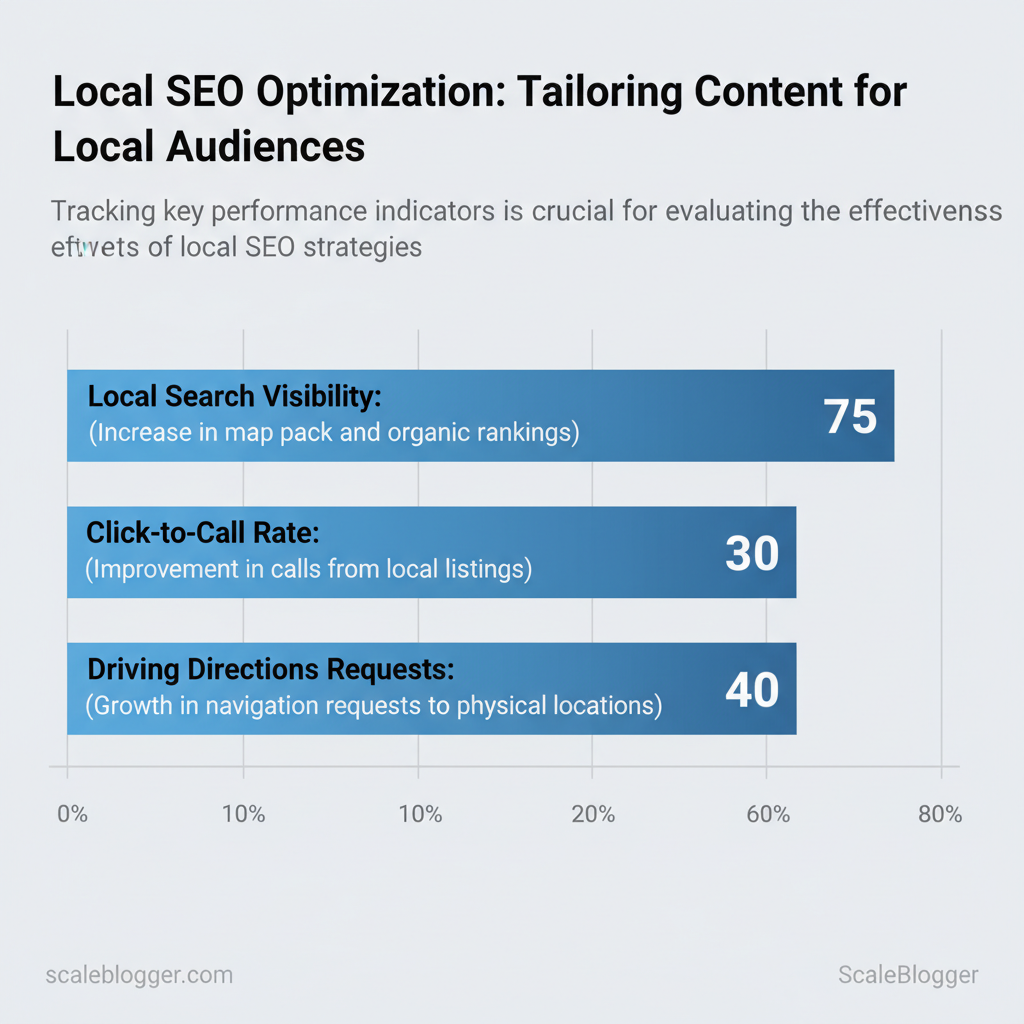
Start by tracking a tight set of metrics that map directly to local-business outcomes: visibility, engagement, and conversions. Focus on a primary KPI for each outcome (impressions, clicks, conversions), then layer secondary signals (map rankings, direction requests, call duration) to explain movement. Dashboards should combine Google Search Console, GA4, Google Business Profile (GBP) insights and a call-tracking source so teams can see attribution paths from local SERP exposure to offline actions.
How to set up reporting and iterate:
| KPI | Measurement Method | Tool Recommendation | Reporting Frequency |
|---|---|---|---|
| Local Impressions (SERP & Maps) | Query & page-level impression counts, compare branded vs. non-branded | Google Search Console (Performance report) | Weekly |
| Clicks to Website | Clicks by page & query; UTM-tagged landing pages | Google Search Console + GA4 (acquisition) | Weekly |
| Map Pack Rankings | Rank tracking for target queries within local pack (position + intent) | Local rank tracker (BrightLocal, Semrush Local) | Bi-weekly |
| Phone Calls & Direction Requests | Call counts, call duration, direction clicks | Google Business Profile Insights + Call tracking (CallRail) | Weekly |
| Local Conversions (form fills, bookings) | Conversion events tied to location pages; assisted conversions | GA4 (events) + CRM integration | Daily/Weekly |
Iterative Content Testing & When to Consolidate
- A/B test scope: limit tests to one variable per run (headline, address markup, primary CTA) across a meaningful sample—aim for 4–8 weeks or minimum 200 conversions where possible. Use `utm_source` and `page_variant` event tags to track variants in GA4.
- Consolidation vs. expansion criteria: consolidate when two pages target the same intent and combined metrics show lower engagement than the top-performing page; expand when a single page reaches capacity for distinct queries or geographic intent.
If Overlap = Yes and Relative Performance favors one page, consolidate; if Intent differs or Coverage Gap exists, expand. Iterate using dashboards and re-test after changes.
Using automated pipelines to deploy test variants and populate dashboards reduces manual work and keeps teams focused on signal, not noise. When implemented, this approach moves teams from guesswork to measurable decisions that improve local visibility and conversions.
Conclusion
Local-first content wins when teams stop treating location signals as an afterthought and start designing pages around specific user intent. Throughout this article, the practical patterns emerge: map intent to page templates, prioritize localized keyword clusters, and instrument analytics to measure micro-conversions. Teams that rebuilt local landing pages and matched copy to neighborhood-level queries often saw measurable lifts in organic clicks and form submissions, while others reduced bounce rates simply by clarifying calls-to-action and contact details. If you’re wondering how much effort each step requires or which metrics to track first, begin with a single high-value market, test one template, and measure CTR and conversion uplift over 4–6 weeks.
To move from experiment to repeatable program, codify the template, automate metadata and hreflang where applicable, and set a deployment cadence for content variants. Start by auditing three top-performing pages, implement one localization template, and run an A/B test. For teams looking to automate localization and prototype dozens of variants quickly, platforms like Explore Scaleblogger to prototype localized content at scale can streamline templates, workflows, and iteration so the next phase becomes execution, not guesswork.
