

Why does a team look sharp on one channel and scattered on the next? The problem often comes down to weak content governance in multi-modal strategies, especially when the workload expands beyond a single blog post or landing page.
When content spans articles, videos, social posts, images, and email, every small decision matters. A caption can drift from the brand voice, a thumbnail can miss the message, and an update can quietly create inconsistencies.
According to Contentful’s explanation of content governance, it involves the processes and strategies that keep content aligned across an organization.
Strong content management becomes even more important when multiple formats, teams, and publishing standards are involved.
Quick Answer:
Content governance is the set of processes and guiding strategies that keeps multi-channel content aligned across an organization, preventing brand voice, messaging, and version updates from drifting as you mix articles, video, social, images, and email.
To make multi-modal execution consistent and AI-ready, define channel-specific rules within a shared governance framework (voice, metadata, and update/change controls) so every format follows the same decision logic.
Table of Contents
Why Multi-Modal Content Breaks Down Without Governance
Why does a content program look tidy in planning, then fall apart once the assets start shipping? The answer is usually not talent.
It is control.
A blog post, a podcast clip, a YouTube cut, and a LinkedIn graphic may all come from the same idea, but they do not behave the same way.
Content governance is the system of policies, roles, and review steps that keeps those pieces aligned, which is why definitions from Contentful’s guide to content governance and Aprimo’s content governance framework both stress process, ownership, and approval flow.
In a multi-modal setup, each format needs different guardrails.
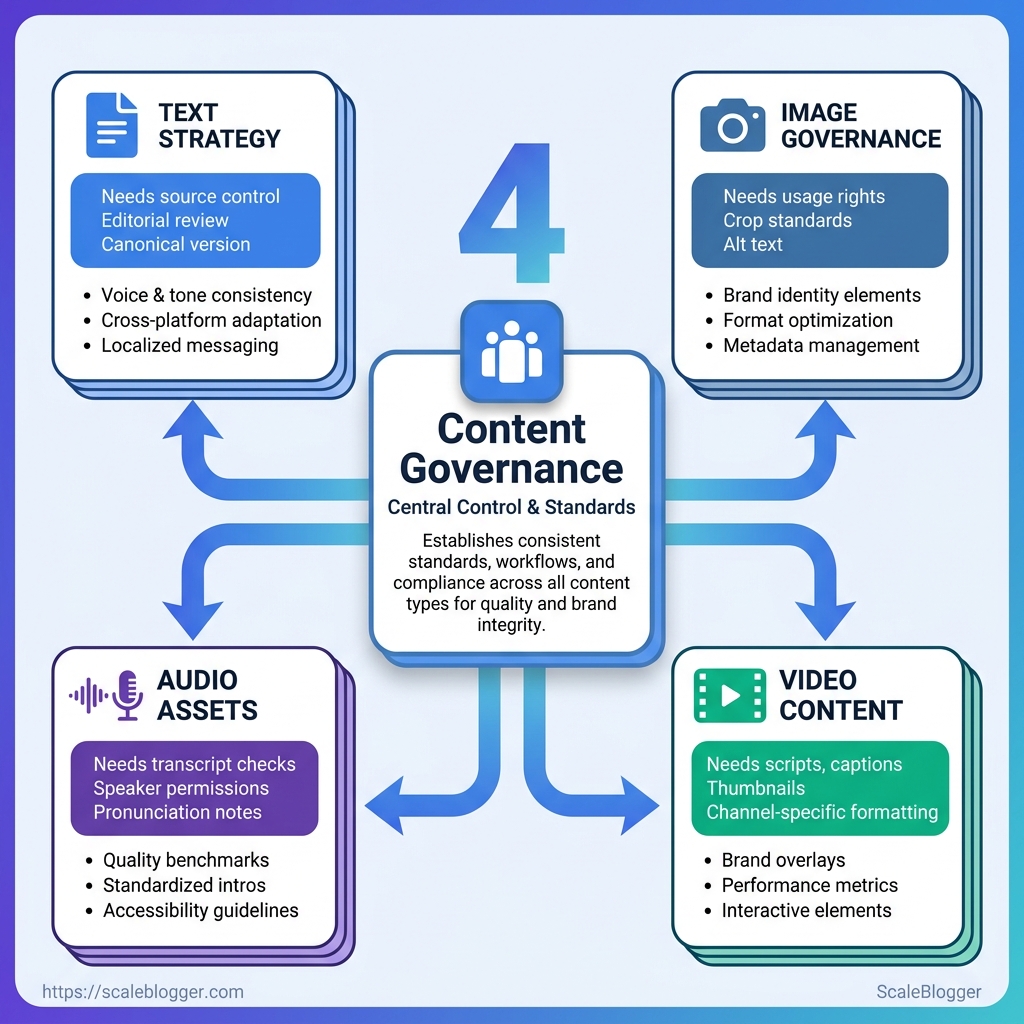
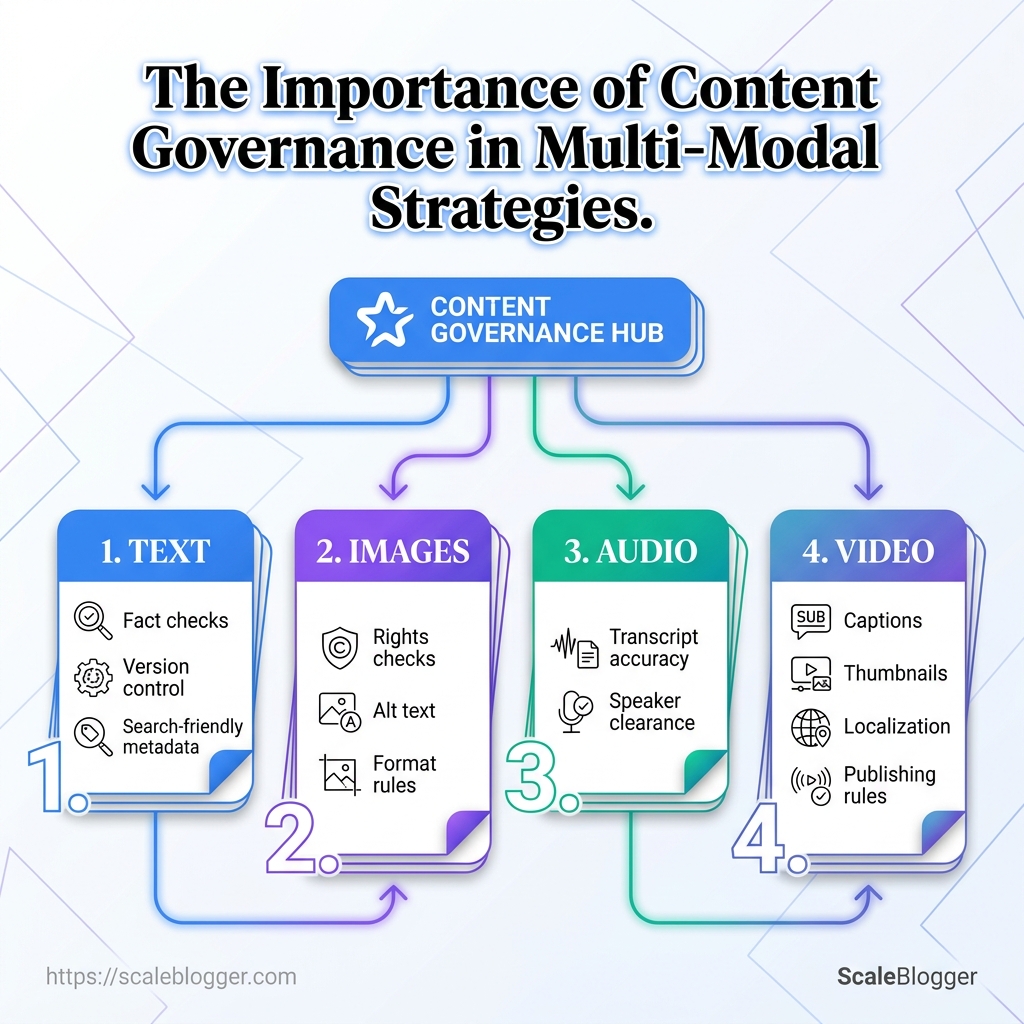
Text needs fact checks, version control, and search-friendly metadata.
Images need rights checks, alt text, and format rules.
Audio needs transcript accuracy and speaker clearance.
Video adds captions, thumbnails, localization, and publishing rules, which is why Highspot’s overview of content governance and consistency ties governance directly to brand alignment and business goals.
Text: Needs source control, editorial review, and a clear canonical version
Image: Needs usage rights, crop standards, and alt text.
Audio: Needs transcript checks, speaker permissions, and pronunciation notes.
Video: Needs scripts, captions, thumbnails, and channel-specific formatting.
When operations stay inconsistent, visibility drops first.
Search systems see duplicate topics, mismatched metadata, and conflicting canonical signals, while people see a mess of near-identical assets that no one wants to trust.
Then trust goes next.
StrattonCraig’s 2026 piece on content governance and scale points to clear review stages and approval roles for a reason: without them, one rushed update can ripple across every format and channel.
A clean multi-modal strategy needs one shared source of truth, not five disconnected production habits.
That is where good content management stops being administrative and starts protecting the whole system.
The Core Elements of an Effective Governance Framework
Why do some content programs feel calm the moment assets start moving, while others turn into a game of digital whack-a-mole? The difference usually lives in governance, not creativity.
Contentful describes content governance as the big-picture management of content across an organization, built from processes, policies, and guiding strategies.
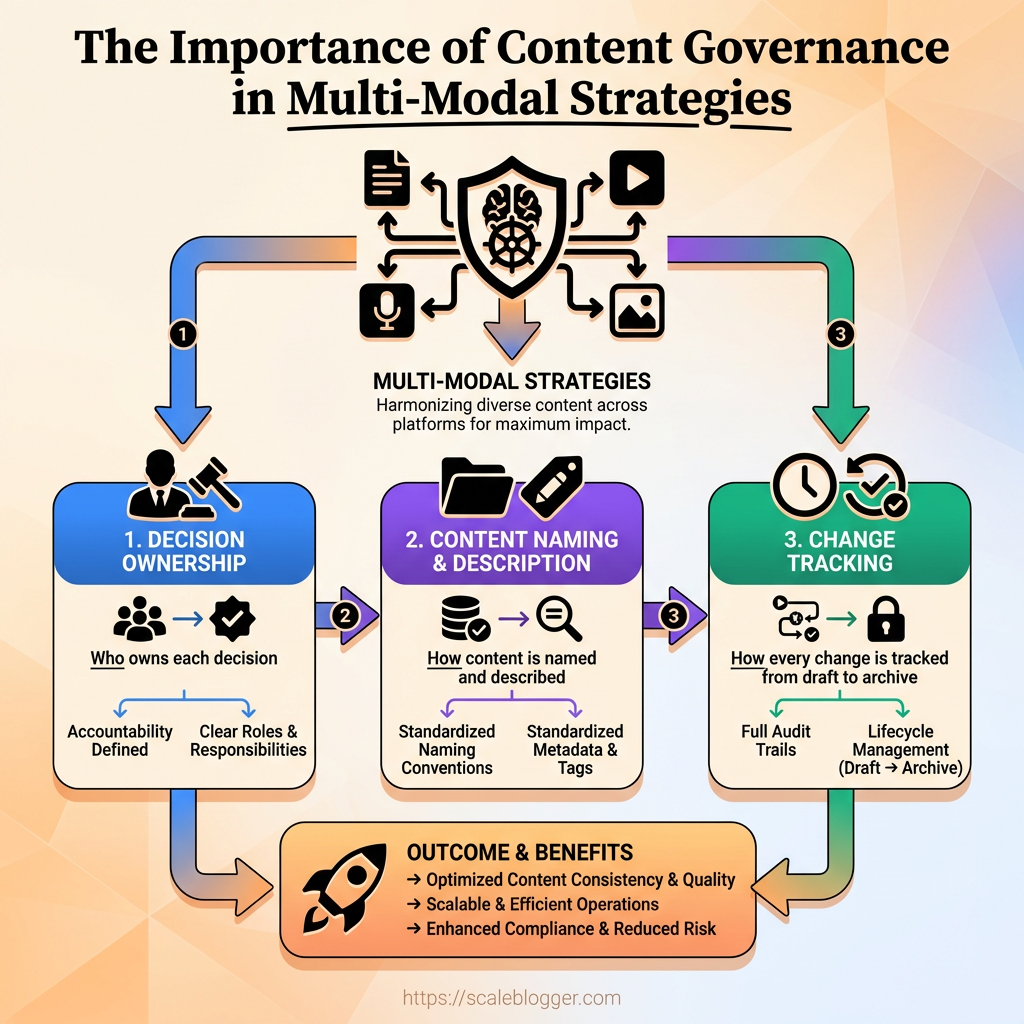
In practice, that means three things have to be locked down: who owns each decision, how content is named and described, and how every change is tracked from draft to archive.
Stratton Craig’s 2026 guidance also points to clear review stages, approval roles, and quality standards as the backbone of content scale content governance is the key to achieving content scale in 2026.
The easiest way to think about it is this: governance turns content management from a loose habit into a repeatable system.
That matters even more for multi-modal strategies, where one article may spawn a video, a LinkedIn post, a newsletter snippet, and a set of images.
Governance checklist
Governance Element | Purpose | Who Owns It | Risk If Missing |
|---|---|---|---|
Roles and permissions | Defines who can create, edit, approve, and publish content | Content operations lead and CMS administrator | Conflicting edits, accidental publishing, unclear accountability |
Metadata standards | Makes assets searchable, sortable, and reusable across channels | Content strategist or information architect | Weak search, duplicate work, hard-to-find assets |
Approval workflow | Sets the review order for editorial, brand, legal, and technical checks | Editorial manager with assigned reviewers | Bottlenecks, skipped reviews, inconsistent quality |
Version control | Tracks changes and keeps the current source of truth clear | CMS administrator and content owner | Wrong file published, no rollback path |
Asset lifecycle rules | Defines when content is created, refreshed, retired, or archived | Content operations team | Stale pages, cluttered libraries, compliance gaps |
Channel-specific guidelines | Adjusts format, length, tone, and specs for each platform | Channel owner or platform lead | Rework, broken formatting, poor performance |
When the metadata model is clean, teams waste less time hunting for assets and more time shipping them.
Aprimo’s governance guide calls out metadata management, approval workflows, version control, access permissions, usage rights, and AI content oversight as core parts of a healthy system Ultimate Guide to Content Governance Strategy.
Version control deserves special care because it protects both speed and trust.
If a headline changes after legal review, or a social cutdown gets updated for a new campaign, the audit trail should show exactly what changed and why.
A good framework does not just stop mistakes.
It makes content easier to reuse, easier to audit, and far easier to scale without losing control.
How Governance Supports AI and Automation in Content Operations
What happens when AI is fast, but the process is messy? You get more content, not better content.
Governance is what lets AI speed up ideation, first drafts, and repurposing without handing over the keys.
It keeps the machine busy while people stay in charge of claims, tone, approvals, and where each asset is allowed to go.
That matters because content governance is not just a policy folder gathering dust. Contentful defines content governance as the mix of processes, policies, and guiding strategies that shape content across an organization, while Aprimo’s guide to content governance points to the practical mechanics: metadata, approval workflows, version control, access permissions, usage rights, and AI oversight.
In other words, AI works best when it is placed inside a controlled system, not left to improvise.
This is where governed automation starts to pay off.
A tool like Scaleblogger fits neatly into that model when teams define topic rules, source boundaries, and review steps before anything is drafted.
That setup is especially useful for multi-modal strategies, where one article becomes a social post, a caption set, or a short-form script, and every version still needs to sound like it came from the same brain.
Separate ideation from approval. Let AI generate topic angles, then require human approval before drafting begins.
Lock the source set. Feed models only approved docs, URLs, and brand notes so they do not wander into guesswork.
Treat drafts as raw material. Every AI draft should pass a factual check, a voice check, and a rights check before publishing.
Repurpose from a master version. Build social posts, summaries, and video scripts from one approved article, not from separate AI prompts.
Keep permissions tight. Not every teammate needs the ability to publish, edit, or overwrite final copy.
That approach is also consistent with the way Stratton Craig frames content governance as the key to achieving content scale in 2026.
Scale only gets ugly when speed outruns control.
Governance gives AI a lane, and the lane makes the speed useful.
In content management, that is the difference between noisy output and a system that keeps improving with every publish.
Governance by Content Format: What Changes Across Channels
Why does a blog post need one kind of control, while a 20-second clip needs another? Because each format fails in a different way.
A text article can usually be corrected after publish.
A social post can spread before anyone spots the mistake.
Video, podcasts, and short-form clips add another layer: rights, captions, source files, and derivative versions all need their own rules.
That is why content governance is not just a policy document; it is the working system around content management, approvals, and reuse.
Contentful describes content governance as the processes and guiding strategies that shape content across the organization, while Aprimo points to metadata, version control, access permissions, usage rights, and AI oversight as part of the same discipline.
See Contentful’s overview of content governance and Aprimo’s guide to content governance strategy.
Text channels need different guardrails, too.
A blog article often gets deeper review because it carries search value, thought leadership, and compliance risk for a longer time.
Social posts usually need faster approval, but they demand stricter brand-voice checks and tighter reuse rules, since one weak line can travel far.
Email sits in a separate bucket because consent, list hygiene, and archival discipline matter just as much as the copy itself, which is why governance has to fit the channel rather than force every asset through the same gate.
Highspot’s guidance on consistency and business alignment makes that point clearly in its content governance overview, and Stratton Craig’s 2026 piece stresses clear review stages and approval roles in content governance for scale.
Video and audio need even sharper rules.
A webinar might become a blog recap, three short clips, and a newsletter embed, but each version needs source metadata, rights notes, and a clear original owner.
That is where multi-modal strategies get real: the asset is no longer one file, but a family of versions that must stay connected.
Format-specific policies for reuse, localization, and compliance
Content Format | Primary Governance Risks | Approval Needs | Metadata Requirements | Reuse Rules |
|---|---|---|---|---|
Blog article | Outdated claims, SEO drift, broken compliance language | Editorial, legal, and subject-matter review before publish | Topic cluster, publish date, author, jurisdiction, version | Can be repurposed into snippets, newsletters, and social captions with source tracking |
Social post | Brand voice errors, misinformation, rapid spread of mistakes | Fast brand and compliance review, especially for regulated claims | Campaign name, platform, date, asset owner, claim status | Reuse needs platform-specific edits; never copy long-form language verbatim |
Email campaign | Consent issues, subject-line risk, stale segments | Marketing, compliance, and list-owner approval | Audience segment, consent basis, send date, archive copy | Reuse allowed for sequences and promos, but subject lines and offers need rechecking |
Video | Rights gaps, missing captions, uncontrolled edits | Script, legal, and rights approval before production and before cutdowns | Talent releases, music rights, transcript, caption files, language versions | Reuse depends on rights scope; clips need separate approval if framing changes |
Podcast | Guest permissions, unverified statements, missing transcripts | Host, editor, and legal review for sensitive topics | Episode title, guest release, transcript, keywords, publish date | Reuse for quotes and clips is common, but audio excerpts need permission and context |
Infographic | Data distortion, citation gaps, localization errors | Data and brand review before design lock | Source data, locale, date, design version, citation notes | Reuse is safest when source data and labels stay intact across languages |
The pattern is simple: the easier a format is to copy, the tighter the rules need to be.
Text channels live or die on review speed and voice control, while audio and video depend on rights, captions, and version history.
Good content governance makes those differences visible before anything ships, which is exactly where the mess gets cheaper to fix.
Metrics That Show Whether Governance Is Working
How do you tell the difference between content governance that looks good on paper and governance that actually helps the team? The answer sits in the numbers.
Good governance should reduce chaos, clarify ownership, and keep content moving without turning every publish into a courtroom drama.
The strongest frameworks treat governance as a system of policies, roles, and review stages, not a vague quality exercise, as outlined in Contentful’s explanation of content governance and Stratton Craig’s 2026 guidance on content governance at scale.
That matters because the same rules that keep a blog clean should also support multi-modal strategies across video, social, and email.
A useful dashboard keeps the story simple.
It should show whether work is moving fast enough, whether it keeps getting rewritten, and whether published content is actually earning attention.
Operational metrics worth watching
Production speed: Measure the time from brief to publish.
If that number keeps climbing, the process is probably getting stuck in review or handoff.
Revision rate: Track how many rounds of edits each asset needs before approval.
A rising revision rate usually means the guidelines are unclear or the brief is weak.
Approval turnaround: Watch how long each approver takes to respond.
Slow approvals often hide in the middle of the chain, not at the start.
Rework volume: Count how often published pieces need corrections after launch.
This is one of the cleanest signs that content management rules are not being followed well.
Performance metrics that prove value
Engagement: Look at clicks, time on page, shares, comments, and saves.
High engagement suggests the content meets audience intent, not just internal standards.
Visibility: Track impressions, search reach, and channel lift by format.
Governance should help content show up more consistently, not just look polished in the editor.
Content reuse: Measure how often one asset becomes several outputs.
Strong governance makes reuse easier because structure, metadata, and usage rules are already in place, which fits the approach described in Aprimo’s content governance guide and Highspot’s article on governance and consistency.
When these metrics move together, governance is doing real work.
Speed improves, edits drop, and published pieces keep paying off across channels.
That is the kind of signal worth trusting.
Common Governance Failures and How to Prevent Them
Why do content teams keep shipping the same story in three different ways? Usually because the system around the work is loose, not because the writers missed the brief.
In multi-modal strategies, failures show up fast: duplicates pile up, approvals stall, and metadata gaps quietly break reuse and reporting.
The goal of this audit is to pinpoint the failure mode—so you can fix the missing gate or rule, not just add more process.
Practical governance audit checklist (symptom-led)
Failure to check | Pass/Fail indicator | What to verify | Priority |
|---|---|---|---|
Duplicate assets / mixed messaging | Pass if every channel references a canonical master (or has an explicit “latest approved” version); fail if multiple versions circulate without a clear source of truth | Look for canonical/version fields, cross-links between repurposed outputs, and whether teams can answer “which is current?” in one step | High |
Approval bottlenecks | Pass if workflow stages are written and measured (turnaround times + SLA); fail if approvals are ad hoc or “whoever is available” controls the flow | Check the handoff points where time accumulates (editorial → brand → legal → tech) and whether the queue is visible to the team | High |
Metadata drift (can’t find, can’t reuse) | Pass if required metadata fields are mandatory and consistent across formats; fail if tags/owners/rights differ by team or channel | Validate mandatory fields (topic/cluster, owner, rights scope, language/jurisdiction, publish intent) and whether they drive reuse and reporting | High |
Rights + compliance gaps | Pass if rights, releases, and localization requirements are checked before production and before cutdowns; fail if rules are handled informally or late | Confirm that usage scope travels with the asset family (video → clips → email embeds, etc.) and that edits trigger re-approval when needed | High |
AI outputs bypass human gates | Pass if AI drafting is separated from approval and every publishable output has human checks (accuracy, voice, rights); fail if anything can ship without review | Verify review gates, permissions, and audit logs (who approved what, when, and against which source set) | High |
Weak audit trail / no rollback clarity | Pass if changes are traceable from draft → approved → published and rollback points exist; fail if the team can’t explain what changed or why | Check version history fidelity and whether “legal/brand changes” are reflected consistently across all repurposed outputs | Medium |
A quick audit like this exposes where governance is real and where it’s mostly decoration.
The pattern is usually obvious once the checklist is honest: when you can’t explain the current canonical asset, you don’t have governance—you have hopes.
Tighten the weak spots first.
That is where content governance stops being a policy document and starts saving time, protecting brand consistency, and preventing expensive rework.
How Content Governance Fits Into the Broader Content Strategy Stack
A content strategy only looks simple from a distance.
Once planning starts, production gets busy, and distribution fans out across channels, small gaps turn into inconsistent messaging fast. Content governance is the layer that keeps the whole stack aligned. It sits between strategy and execution, translating big goals into clear rules for planning, production, review, publishing, and reuse.
That matters because governance is not just about approvals; it is the set of processes and policies that shape how content moves through an organization, as described by Contentful’s definition of content governance and Simpplr’s overview of governance in digital content management.
Planning decides what should exist.
Production decides how it gets made.
Distribution decides where it lands.
Governance keeps those decisions from drifting apart.
That is especially important in content clusters, where one weak page can pull the whole topic off course.
A solid governance model keeps the same naming conventions, angle, claims, and internal logic across related assets, which is exactly the kind of discipline Stratton Craig says is needed for scale in 2026 in its content governance and scale analysis.
It also helps teams avoid the classic “same topic, three different voices” problem that hurts trust.
Planning: Defines the topic map, audience, and business goal before anyone starts writing.
Production: Applies standards for structure, metadata, review, and version control.
Distribution: Uses those same rules so repurposed assets still feel like one system, not random leftovers.
That stack becomes even more useful in multi-modal strategies, where one topic may become a blog post, a short video, a social thread, and a newsletter snippet.
Aprimo’s content governance guide is useful here because it frames governance as the place where metadata, access, approval workflows, and usage rights all come together.
This section fits in the bigger governance cluster as the “systems” chapter.
It connects the why, the how, and the operational payoff without rehashing framework details.
At Scaleblogger, we think of governance as the layer that keeps planning, writing, and publishing from becoming separate universes.
When that layer is clear, content management feels calmer and the cluster holds together for much longer.
📥 Download: Download Template (PDF)
