

Platforms change faster than most editorial calendars can keep up with. This creates a real business risk: content that looks modern but underperforms. Industry changes like AI-assisted workflows, niche publication networks, and platform-specific formats are affecting how content is shared, engaged with, and measured by editors. Imagine teams turning long articles into interactive threads, or changing their SEO strategies because search engines now prioritize multimedia content.
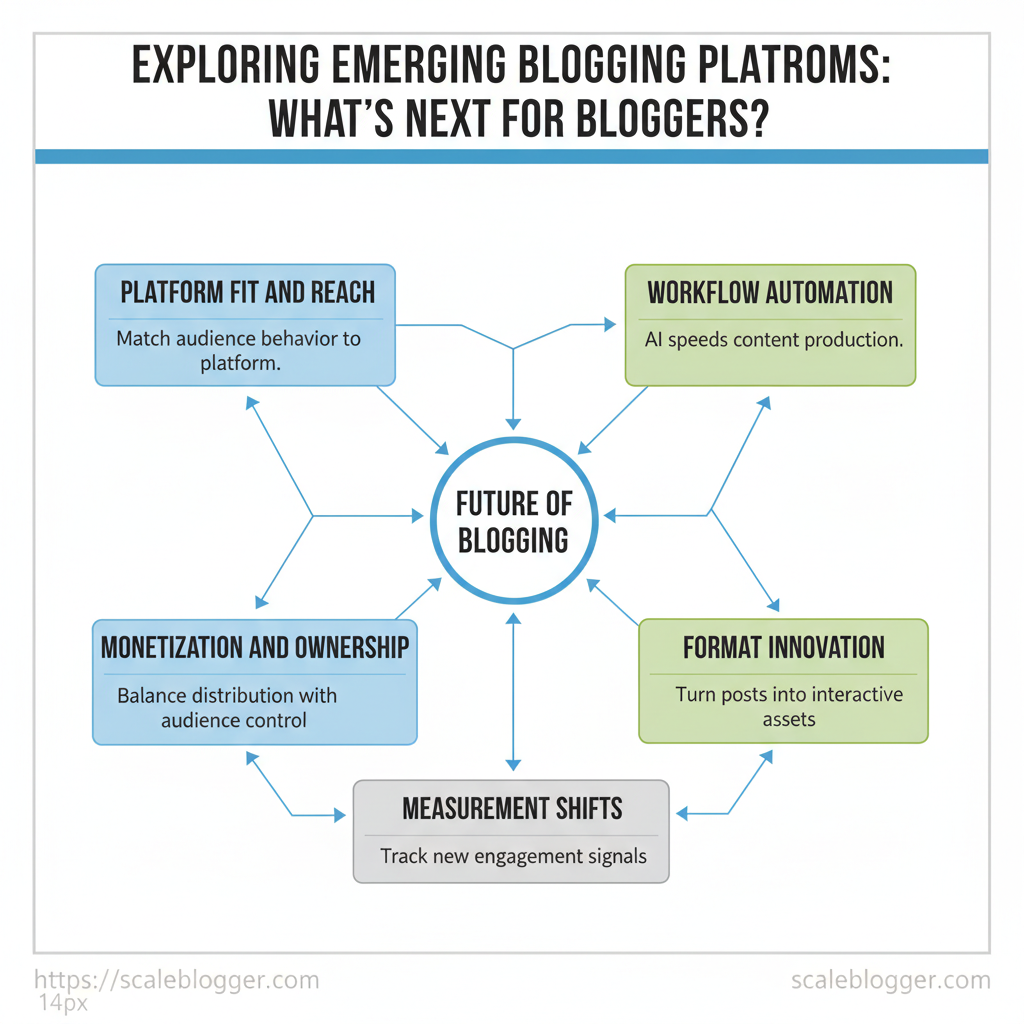
- Platform fit and reach — How to match audience behavior to the platform that amplifies your content and conversions.
- Workflow automation — Practical ways AI and tooling speed content production without sacrificing quality.
- Monetization and ownership — Strategies for balancing platform distribution with long-term audience control.
- Format innovation — Tactics to turn posts into interactive, modular assets that drive repeat visits.
- Measurement shifts — What new engagement signals matter and how to track them effectively.
This guide maps emerging options to real editorial trade-offs, helping you pick platforms and processes that scale. Try Scaleblogger to automate publishing and scale your content: https://scaleblogger.com
Table of Contents
- H2 — The current landscape: Which new blogging platforms are emerging and why they matter
- Section Content
- H2 — Choosing the right platform: Frameworks and decision criteria
- H2 — SEO and discoverability on emerging platforms
- H2 — Content strategy: Formats, audience building, and repurposing
- H2 — Monetization and business models on emerging platforms
- H2 — Migration, interoperability, and future-proofing your content
> Key Takeaway:
Emerging Blogging Platforms: Why They Matter
New platforms are transforming how writers publish, make money, and control their work. They focus more on subscription-based…
Emerging Blogging Platforms: Why They Matter
New platforms are transforming how writers publish, make money, and control their work. They focus more on subscription-based formats, decentralized ownership, and AI-driven creation processes. Below, I describe the platforms that are driving this change and explain why they are important for content strategy.
Table: Section Content — Platform, Best for, Monetization options & more
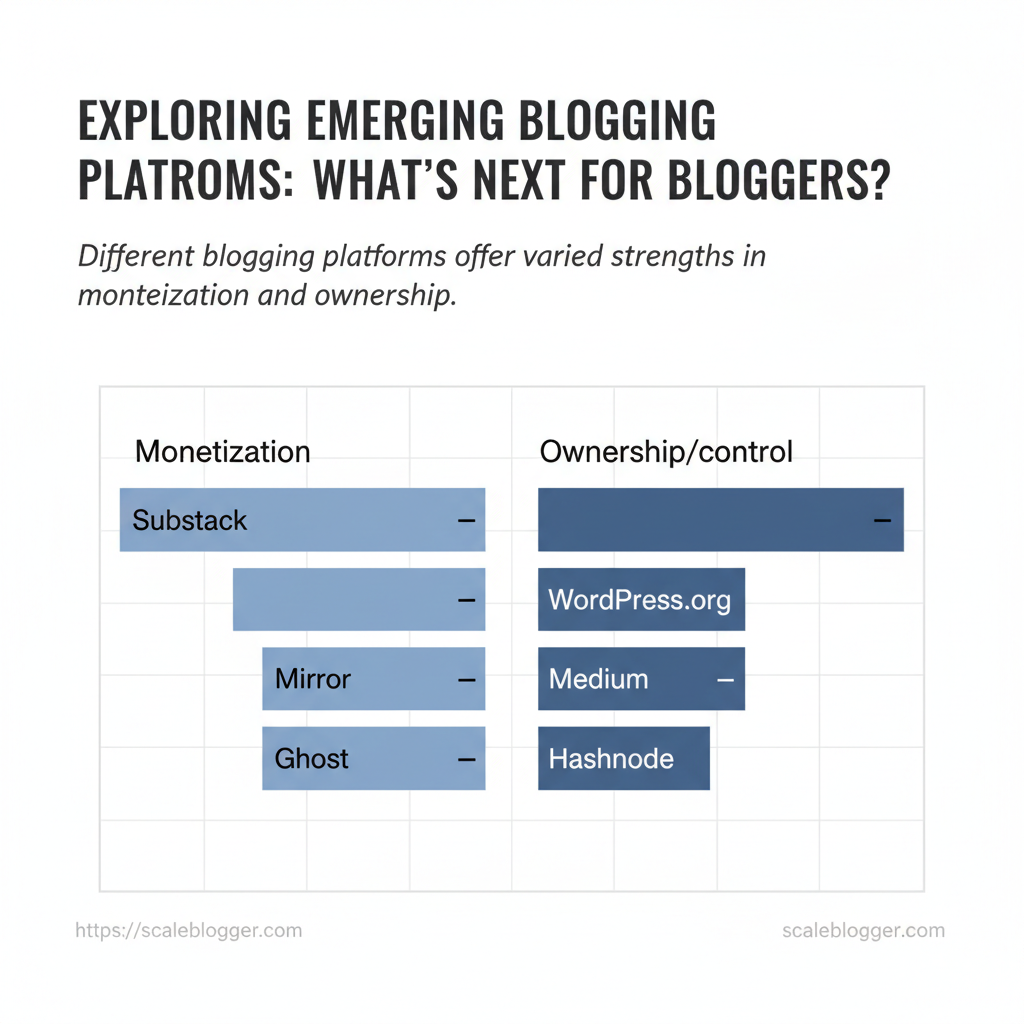
| Platform | Best for | Monetization options | Ownership/control | Unique feature |
|---|---|---|---|---|
| Substack | Newsletter-hybrid writers | Paid subscriptions, tipping | Hosted by Substack; limited export | Simple subscription-first publishing |
| Mirror | Web3 creators, NFT-based publishing | Token sales, NFT drops | Decentralized ownership via blockchain | On-chain publishing & auctions |
| Ghost | Membership-driven blogs | Subscriptions, one-off payments | Self-hostable (full control) or Ghost Pro | Integrated membership + Stripe billing |
| WordPress.org | Full custom sites | Any (ads, ecom, memberships) | Full ownership (self-hosted) | Unmatched extensibility / plugins |
| WordPress.com | Easier WordPress hosting | Paid plans, ads, subscriptions | Hosted; export available | Managed WordPress with simpler UX |
| Medium | Long-form discoverability | Partner Program (read-time payouts) | Hosted; limited control | Built-in audience discovery |
| Hashnode | Dev-focused blogs | Sponsorships, paid newsletters | Hosted; custom domain allowed | Developer community + free custom domain |
| LinkedIn Articles | B2B thought leadership | Indirect (leads, consulting) | Hosted by LinkedIn | Professional distribution to networks |
| Cohost | Social long-form + community | No native payments (tips via links) | Hosted; creator-first policies | Minimal algorithm; chronological feed |
| Wix (Editor X) | Designers + rapid sites | Subscriptions, ads, ecom | Hosted; export limited | Drag-and-drop + built-in SEO tools |
Macro trends shaping platform growth
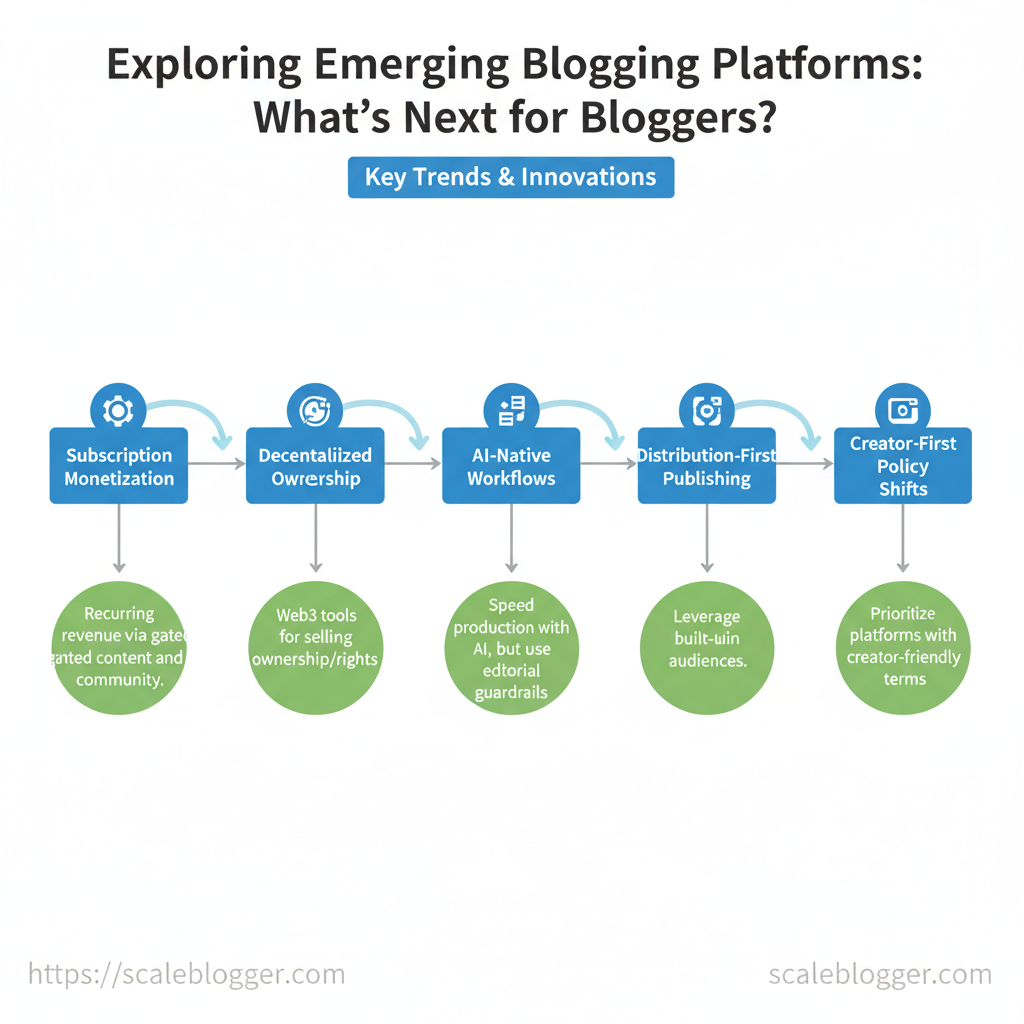
- Subscription monetization: Platforms prioritize recurring revenue — expect strategies that bundle exclusive content and community. Takeaway: build a gated content tier that complements free discovery. Decentralized ownership: Web3 tools let creators sell ownership or rights.
Takeaway: pilot tokenized drops only after legal and audience testing. AI-native workflows: Drafting, SEO, and personalization are embedded; this speeds production but requires editorial guardrails. Takeaway: use AI to outline and iterate, not to publish unchecked.
- Distribution-first publishing: Platforms with built-in audiences reduce acquisition cost. Takeaway: test platform-native formats before moving to owned channels. Creator-first policy shifts:* New entrants emphasize creator revenue share and exportability.
Takeaway: prioritize platforms with easy data export and payment options.
Understanding these developments helps you pick platforms that match your ownership preferences, monetization goals, and audience-growth tactics. When implemented correctly, platform choices let teams focus on quality while the tech handles distribution and payments.
> Key Takeaway:
H2 — Choosing the right platform: Frameworks and decision criteria
Begin by selecting platforms based on measurable goals instead of instincts. Use the `G.
H2 — Choosing the right platform: Frameworks and decision criteria
Begin by selecting platforms based on measurable goals instead of instincts. Use the G.O.A.L.S. framework to turn vague preferences into scoreable criteria you can compare across platforms quickly and consistently.
S. explained
- G — Growth (visibility & SEO): How well the platform supports organic discovery — built‑in SEO controls, canonical URLs, schema, fast hosting. Score 0–3 where 3 = first‑class SEO tools and integrations.
- O — Ownership (data & portability): Do you control content, export formats, and user data? Self‑hosted options score higher. 3 = full export + DB access.
- A — Audience Fit (engagement & distribution): Is the platform where your audience already lives (B2B readers on LinkedIn, niche subscribers on Substack)? 3 = native audience + strong syndication. L — Longevity/Stability (vendor risk): Company health, update cadence, ecosystem maturity.
3 = established platform with large developer community. S — Scale/Workflow (team & automation): Does it integrate with CMS workflows, editorial tools, automation, and analytics? 3 = built‑in APIs, automation, and multi‑user roles.
How to score quickly
- S. matrix and add platforms you’re considering.
- Spend 10–15 minutes per platform: review documentation, pricing page, and two community threads. 3.
Assign 0–3 per criterion and sum for a comparable Total Score. 4. Validate by trialing the top two platforms with a 2-week pilot.
Tradeoffs and recommended priorities
- Creators prioritizing brand control: weight Ownership higher — choose self‑hosted WordPress or Ghost. Small teams focused on speed: weight Scale/Workflow and Growth — Squarespace or Wix often win. Newsletter-first creators: weight Audience Fit — Substack or Medium.
- Agencies & enterprises: weight Longevity and Scale — HubSpot CMS or WordPress VIP.
com** → quick setup, lower maintenance; immediate next step: sign up and import last 6 months of posts. Small business/solopreneur: Recommended match — Squarespace or Wix → templates + commerce; immediate next step: connect domain and enable SEO settings. Newsletter-first writer: Recommended match — Substack or Medium → built-in subscriber flow; immediate next step: import email list and publish a welcome series.
- B2B thought leader: Recommended match — LinkedIn Articles + self-hosted blog → distribution + ownership; immediate next step: cross-post with canonical tags. org or HubSpot CMS** → workflow, integrations; immediate next step: set up staging, roles, and editorial pipeline. Ecommerce content lead: Recommended match — Shopify blog or Duda → commerce-first integrations; immediate next step: map product content templates.
Scoring matrix template to evaluate platforms using the G.O.A.L.S. criteria
| Platform | Growth (0-3) | Ownership (0-3) | Audience Fit (0-3) | Longevity/Stability (0-3) | Scale/Workflow (0-3) | Total Score |
|---|---|---|---|---|---|---|
| WordPress.org (self-hosted) | 3 | 3 | 2 | 3 | 3 | 14 |
| WordPress.com | 2 | 1 | 2 | 3 | 2 | 10 |
| Ghost | 2 | 2 | 2 | 2 | 2 | 10 |
| Squarespace | 2 | 1 | 2 | 2 | 2 | 9 |
| Wix | 2 | 1 | 2 | 2 | 2 | 9 |
| Substack | 1 | 1 | 3 | 2 | 1 | 8 |
| Medium | 1 | 0 | 3 | 2 | 1 | 7 |
| LinkedIn Articles | 1 | 0 | 3 | 3 | 1 | 8 |
| HubSpot CMS | 3 | 2 | 2 | 3 | 3 | 13 |
| Duda | 2 | 1 | 2 | 2 | 2 | 9 |
| GoDaddy Website Builder | 1 | 0 | 1 | 2 | 1 | 5 |
| Strikingly | 1 | 0 | 1 | 1 | 1 | 4 |
Understanding these principles helps teams move faster without sacrificing quality. When you align your priorities with a repeatable scoring process, platform decisions become operational, not emotional.
> Key Takeaway:
H2 — SEO and discoverability on emerging platforms
Search behavior is spreading to places that don’t resemble traditional websites. Discoverability now depends on platform…
H2 — SEO and discoverability on emerging platforms
Search behavior is spreading to places that don’t resemble traditional websites. Discoverability now depends on platform design as much as on keywords. Platform internals — indexability, canonicalization, URL permanence, and content APIs — determine whether your content surfaces to search engines, in-platform search, or recommendation feeds. Start by testing what the platform exposes to crawlers and what it keeps behind JavaScript or proprietary formats.
How platform architecture affects discoverability
- Indexability: Platforms that render content server-side and expose stable HTML and
sitemapsare far easier for external search engines to index. Test by fetching the raw HTML and checking formetatags andcanonicallinks. APIs & feeds: Platforms with open APIs or RSS make syndication and analytics simpler; closed platforms force reliance on in-platform metrics and manual scraping.
- URL permanence: Short-lived or query-string-heavy URLs kill link equity. Prefer platforms that provide stable, human-readable slugs. org` markup boost rich results and recommendations.
- Recommendation algorithms: On long-form social platforms, engagement signals (time on page, comments) trump traditional backlinks.
Quick diagnostic checks (run in five minutes)
- Fetch page source: look for server-rendered content, visible
metatags, andcanonical. 2.
xml accessibility. 3. org presence with a structured data tester.
- Confirm URL stability: create, publish, then revisit the slug. 5.
Measure rendering time and whether content requires JavaScript to display.
Platform-specific SEO playbook, templates, and what to track
- For each platform type below, use title patterns like
Primary Keyword — Angle | Brandfor discoverability, and internal linking rules like linking to 3 topical pieces per new post. - Track: organic pageviews, impressions (in-platform if available), average time on content, referral links, and URL crawl status.
Checklist-style table of SEO tactics mapped to platform types and measurement KPIs
| Platform Type | Top 3 SEO Tactics | Quick Implementation (yes/no) | Key KPI to Track |
|---|---|---|---|
| Newsletter-hybrid platforms | subject/title, canonical to hosted post, include RSS | ✓ | Open rate → hosted page visits |
| Decentralized / blockchain hosts | Perma-URL management, include off-chain mirrors, metadata standards (IPFS) | ✗ | Link permanence & referral volume |
| AI-native blog hosts | Schema + prompt transparency, canonicalize auto-generated pieces, monitor hallucination flags | ✓ | Engagement quality (time, shares) |
| Self-hosted CMS | Full robots.txt control, sitemap, advanced schema, server-side rendering |
✓ | Organic impressions & crawl errors |
| Long-form social platforms | Hook in first 2 lines, internal thread linking, cross-post canonicalization | ✓ | In-platform impressions & saves |
Understanding these principles helps teams prioritize where to apply engineering effort versus editorial craft. When you align title templates, internal linking rules, and diagnostics to each platform’s architecture, discoverability becomes predictable rather than accidental. This is why modern content strategies pair automation with platform-aware SEO checklists.
H2 — Content strategy: Formats, audience building, and repurposing
Next-generation platforms reward specificity. You should match the content format to the platform’s strengths and reuse the content across different channels. Start by choosing a clear engagement goal (discoverability, retention, or direct response) and pick a format that amplifies that goal. Below are practical formats, one-line briefs for creating them, and what to expect when you publish.
Match content formats to platform strengths and engagement goals
Table: Section Content — Content Format, Best Platform Type, Production Effort & more
| Content Format | Best Platform Type | Production Effort | Primary Engagement Metric | Repurposing Opportunities |
|---|---|---|---|---|
| Long-form essay | Editorial platforms, personal blogs (SEO-led) | High — research + 1,500–3,000 words | Organic search traffic / time on page | Series into newsletter, excerpts as micro-posts, audio chapter |
| Serialized newsletter | Email-first platforms, Substack, LinkedIn newsletters | Medium — weekly cadence, 500–1,000 words | Open rate / subscriber retention | Compile into long-form, create gated PDF, social promos |
| Micro-thread / social post | X (formerly Twitter), Threads, LinkedIn posts | Low — 5–10 posts per thread | Replies / re-shares / saves | Expand into a newsletter, turn into short video script |
| Short explainer video | TikTok, Instagram Reels, YouTube Shorts | Medium — 30–90s, editing + captions | Views / watch-through rate | Transcript → blog post, clips for stories, captions for LinkedIn |
| Interactive post / poll | LinkedIn, Instagram Stories, Mastodon communities | Low — quick setup, realtime responses | Participation rate / comment depth | Poll insights → article, quotes for newsletter, data visual |
Key practical steps for repurposing and a 4-week distribution calendar:
- Audit: Tag new content with core idea, CTA, format block.
- Chunk: Break long-form into 6–8 shareable pieces (quotes, stats, visuals).
- Map: Assign each chunk to platform archetype and publishing cadence.
- Automate: Use scheduling tools to queue posts and track
UTMparameters. - Measure & iterate: Monitor
GA4sessions, social saves, and newsletter opens; update top-performing pieces.
Sample 4-week calendar (high-level):
- Week 1: Publish long-form essay → email newsletter summary → 3 social posts
- Week 2: Short explainer video + micro-thread → Stories + poll
Week 3: Serialized newsletter deep-dive → republish excerpt on LinkedIn 4.
Measurement plan: track GA4 sessions, conversion rate on gated repurposed asset, social engagement per format. Iterate weekly: double down on channels with highest conversion and prune low-performing repurposes.
Understanding these principles helps teams move faster without sacrificing quality. When implemented consistently, this approach turns one strong idea into a predictable, multi-channel growth engine.
H2 — Monetization and business models on emerging platforms
Monetizing on new platforms requires thinking beyond ad banners: successful creators combine direct, indirect, and hybrid approaches to balance cash flow, audience experience, and growth. Direct models capture revenue from the audience; indirect models monetize audience attention through third parties or funnels; hybrid models stitch both together so short-term cash doesn’t cannibalize long-term loyalty.
Monetization options — definitions and trade-offs
- Direct: Subscriptions / memberships — Paid recurring access to premium content, communities, or tools. Pros: predictable MRR; cons: high churn risk and content expectations. Direct: Paywalls / paid posts — One-off purchases for individual pieces.
Pros: low friction for casual buyers; cons: less predictable revenue and discovery limits. Indirect: Sponsorships / brand deals — Brands pay for exposure. Pros: high upfront payouts; cons: dependency on brand fit and negotiation skill.
- Indirect: Affiliate marketing — Commission for referrals. Pros: low implementation cost; cons: variable payouts tied to conversion rates. Hybrid: Direct commerce / products — Digital products, courses, or merchandise sold directly plus sponsorships or subscriptions.
Pros: diversified income; cons: requires fulfillment and product development.
Testing checklist and early KPIs
- MVP offer: Launch one
subscription tierorpaid postto test willingness-to-pay. A/B pricing: Test at least two price points and a free trial or sample. Early KPIs: conversion rate, churn rate, LTV:CAC, ARPU, engagement frequency.
- Measurement window: Evaluate conversion and churn at 30/90/180 days. Feedback loop: Collect qualitative feedback from first 100 buyers.
Building a diversified revenue roadmap
- Phase 1 — Validation (0–3 months): Goal: validate willingness-to-pay. KPI: 1–3% conversion on warm audience, $1k MRR.
- Phase 2 — Optimization (3–9 months): Goal: improve funnel and reduce churn. KPI: improve conversion by 50%, churn <8% monthly.
- Phase 3 — Scale (9–18 months): Goal: expand channels (ads, affiliates, sponsorships). KPI: diversify so no channel >40% revenue.
- Phase 4 — Stabilize & Automate (18+ months): Goal: automate fulfillment, grow LTV. KPI: LTV:CAC >3, automated ops handling 70% tasks.
Risk mitigation and scaling tips: stagger launches so you don’t overload ops, use payment holds and pre-orders for product timing, and test sponsorships on small content first to preserve trust.
Monetization models by revenue predictability, implementation complexity, and scalability
| Monetization Model | Revenue Predictability | Implementation Complexity | Scalability | Best For |
|---|---|---|---|---|
| Subscriptions / memberships | Medium–High (recurring) | Medium (content + retention) | High (tiered upsells) | Niche communities, SaaS-adjacent creators |
| Paywalls / paid posts | Low–Medium (one-offs) | Low (payment integration) | Medium (needs steady funnel) | Premium analysis, exclusive pieces |
| Sponsorships / brand deals | Low–Medium (deal-based) | Medium–High (negotiation, deliverables) | Medium (depends on audience) | High-reach creators, B2B niches |
| Affiliate marketing | Low (variable commissions) | Low (links, disclosure) | High (scale via SEO/traffic) | Product reviewers, how-to creators |
| Direct commerce / products | Medium (product sales) | High (product dev + fulfillment) | High (digital products scale best) | Experts, educators, trusted creators |
Understanding how these pieces fit lets teams prioritize experiments with measurable KPIs and avoid overcommitting to a single revenue stream. When implemented thoughtfully, a diversified roadmap turns audience attention into durable, scalable revenue.
📥 Download: Emerging Blogging Platforms Checklist (PDF)
H2 — Migration, interoperability, and future-proofing your content
Migrating content without losing search visibility or audience trust is mostly about planning and making the right artifacts portable. Start by treating content as data: URLs, metadata, semantic structure, and editorial context must move together, not as one-off pages.
- Prepare the inventory and mapping
- Crawl and export your site (XML sitemap, CSV of URLs, and
robots.txt). - Create a URL mapping spreadsheet: old URL → new URL → redirect type → status.
- Extract on-page SEO:
title,meta description,canonical, H-tags, structured data (JSON-LD). - Identify high-value pages (top traffic, backlinks, conversions) and prioritize them.
Migration checklist: Preserve SEO and audience continuity
- Crawl-first export: Use tools that export full content and metadata (HTML/Markdown + JSON-LD) so nothing is left behind. 301 redirects: Map high-value and indexed pages with permanent redirects; test with
curl -Iand Google Search Console. Preserve slugs and semantics: Keep human-readable slugs where possible to retain relevance and backlinks.
- Canonical hygiene: Ensure new pages include the correct
pointing to the canonical content. Structured data continuity: Migrate JSON-LD schemas intact — search engines use them to rebuild context. Backward-compatible formats: Export images and media in original high-res plus a web-optimized variant (WebP/AVIF and original).
- Staged rollout and monitoring: Deploy a subset, monitor organic traffic and index coverage, then continue.
Interoperability best practices and automation
- Use open file formats: Prefer
MarkdownorJSONas canonical source formats; they’re portable and parseable. Standardize metadata: Create a content model with fields liketitle,summary,category,tags,author_id,publish_date. Maintain a single source of truth: Store canonical content in a CMS or Git repo; downstream systems pull or sync from it.
- APIs and webhooks: Automate publishing and updates via REST/GraphQL APIs and webhooks to keep channels synchronized. Version control: Track content changes with commits or content-version fields to enable rollbacks. Integration patterns: Use ETL-style syncs for bulk moves and event-driven updates for near-real-time consistency.
- Metadata-first automation: Automate image optimization, alt-text generation, and schema injection from metadata to reduce manual work.
Practical example — migrating a 500-page blog
- Export Markdown + JSON metadata, generate a redirect sheet, deploy 50 pages as a pilot, monitor top-10 queries and backlinks for 7 days, then continue.
Including an AI-powered content pipeline (for example, automating exports, metadata normalization, and scheduled publishing) reduces manual steps and helps enforce the canonical source model. When you design migrations and integrations this way, teams move faster and content stays discoverable and consistent across platforms.
We covered how editorial agility, audience-first briefs, modular templates, automated distribution, and measurement loops work together to keep content both modern and effective. Teams that moved to AI-assisted outlines and reusable blocks reported faster publish cycles and steadier engagement; similarly, publishers who automated tagging and syndication avoided wasted SEO lift. For clarity, three practical reminders:
- Prioritize audience signals: use behavioral data to shape topics and formats so each piece earns attention.
- Automate repetitive steps: set up templates and publishing workflows to cut time-to-live without losing quality. – Measure the loop: track outcomes and iterate on headlines, formats, and distribution within weeks.
If you want a concrete next step, pick one bottleneck (ideation, drafting, or publishing) and fix it this quarter: create a template, automate one workflow, and set a 30-day test. For professional help implementing those changes, consider Try Scaleblogger to automate publishing and scale your content as a way to accelerate publishing and free your team to focus on higher-value work.
